Ageing Property of Product Extracted From
Hydropyrolytic Depolymerization of LDPE, LLDPE,
MDPE and HDPE Type of Polyethylene
Gautam Kumar Roy
Assistant Chemist, Quality Control Laboratory,
Barauni Refinery, Indian Oil Corporation Limited, Begusarai, INDIA. email:[email protected].
(Received on: April 30, 2019)
ABSTRACT
The ageing property is a process of gradual deterioration of polymeric materials which may be caused due to the long lasting detrimental interactions of physical, chemical and the biological effects on the depolymerized polyethylene materials. The longevity of the hydropyrolytic depolymerized polyethylene materials depends on the change or deterioration in the structural parameters. Thus the ageing property helps in providing the knowledge about the stability of the depolymerized polymers at different conditions. The process of aging has significant practical importance as it determines the time after which polymers can no longer meet material or technical criteria for their proper application. The stability of the fuel depends on the life expectancy of the component at different thermo chemical and physical conditions. Oxidative degradation of the product causes change in the property of the fuel which further reduces the efficiency of the fuel. The differential ageing property of the extracted product from LDPE, LLDPE, MDPE and HDPE mix type of the polyethylene via hydropyrolysis process has been investigated. Formation of the hydroperoxide in the presence of oxygen is also investigated.
Keywords: Ageing, polyethylene, hydropyrolysis, DSC, FTIR, glass transition temperature.
1. INTRODUCTION
generally have very strong chemical bond that make it durable and resistant to natural activity. Several thermo chemical techniques have been employed to convert waste PP (Polypropylene) and LDPE (Low density polyethylene) into value added products. The thermal degradation of the polyethylene materials splits the long chain hydrocarbon into gaseous product, which finally produces low molecular weight, gaseous and liquid products.1,2 Polyethylene to
hydrocarbon fuel is a de-polymerization process of converting waste polyethylene into useful hydrocarbon products. The process of converting the polyethylene into useful hydrocarbon product is followed by hydropyrolytic process.3Degradation depends on the nature, such as
polar groups and structure, for example head-to-head or tail-to tail weak linkages, double bonds or branching points of the polymeric chain, on the ingredients in the polymer resin and on the type of the external stress4. Product from the hydropyrolytic depolymerization of the
LDPE, LLDPE, MDPE and HDPE mix type of the polyethylene is recovered and its physical and chemical properties were analyzed. The ageing property of the extracted product is observed to determine the change in the property of the fuel with certain interval of time.
Long-term durability prediction tests are a useful assessment that provides an estimate of longevity and the intrinsic qualities of a given material to withstand the negative effects of outdoor exposure. This provides a key to develop both novel, high quality materials and more efficient stabilizers. To achieve this goal, long term durability and recyclability are tested during natural and artificial weathering extremes.
2. METHODOLOGY AND EXPERIMENTATION
The depolymerized mother liquid is aged by putting in an oven at different temperature. Oven aging experiments proceed by enhancing the stress level of one of the degradation factors present in the service environment, at specific temperatures. Long term heat aging is a widely used procedure providing information on the performance and durability of polymer stabilizers as well as the thermo-oxidative stability of a given polymer over a reasonable period of time. Here the response of polymeric materials to elevated temperatures, in terms of mechanical and chemical changes, is the subject of monitoring and analysis. Thus as a matter of fact, the life expectancy of the depolymerized polyethylene materials is a part of the eventual enhancement of the chain structure. In the particular case of long term heat oven aging, the polymer items are exposed to increased temperatures in a circulating heated air ambient oven, simulating the outdoor environment.
The long term stability of organic materials involves thermally or photochemically induced oxidation5. For the determination of the rate of oxidation, and the oxygen induction
2.1The thermal ageing procedure for the determination of the difference residence time and the oxidation stability of the product.
One of the most common situations that a polymer is likely to experience in service is that of prolonged exposure to elevated temperatures. The Arrhenius equation is one of the best known models for assessing the lifetime of polymers and is commonly used to predict the combined effects of temperature and time6. It is particularly useful for the accelerated testing
of polymers as it allows short term tests conducted at elevated temperatures to be used to assess long term exposures at lower temperatures.
The Arrhenius relationship is
K(T) = A exp(-E/RT) (1) Thus
lnK(T) = -E/RT + C (2) Where
K(T) is the reaction rate for the process E is the reaction energy
R is the gas constant T is absolute temperature C is a constant
A plot of ln K(T) against 1/T should yield a straight line with slope E/R, which can be extrapolated.
An alternative way of using the Arrhenius equation is to consider
E/RT +C (3) A shift factor, when a master curves is built up from the material's response at different
temperatures. This technique has the advantage that, no particular measure of the reaction rate has to be chosen nor any form assumed for the change of parameter with time. However, considerable care has to be taken with extrapolation. The Arrhenius relation is generally the first choice to apply to the effects of temperature but no general rule can be given for the measure of reaction rate (change of parameter with time) to be used with it. Very frequently the time taken to a given % of the initial value is chosen.
The very well known Arrhenius equation represents a useful tool quoted in a number of works for the determination of the equivalence between residence time in accelerated conditions, and under natural ageing. That correlation is determined by solving a time transformation function of the Arrhenius equation of temperature dependence by some constant.
Clearly other forms of reaction rate may be more appropriate. There are occasions when the Arrhenius equation does not give a straight line and hence there is clear indication that predictions from it will not be valid. An alternative expression which has improved the line in certain cases is
DSC measurements were performed in nitrogen at a heating rate 10°C/min. Melting temperature Tm and heat of fusion Hf were evaluated from the first and second heating runs for each sample. The crystallinity content was calculated according with the relation
Crystallinity (%) = (ΔHs /Δ H0). 100 (5)
Where, Δ H0 is the melting enthalpy of the 100% crystalline polymer, and Δ Hs, is the measured melting enthalpy of the sample.
Oxidation exotherms were obtained in air at a heating rate 5°/min. in a temperature range 130°C to 400°C, on about 5 mg of the sample. The onset temperature was determined from this thermogram, which is the temperature at which oxidation reaction in polymers start. In aged samples, with products containing accumulated oxygen, the exothermic oxidative reactions begin at lower temperatures. Under isothermal conditions, the period of time before the onset temperature is called oxidation induction time (OIT).
2.2 Stability of the depolymerized product
The Arrhenius expression provides the standard procedure for the determination of the stability of the hydropyrolytic depolymerized product from polyethylene mix. This enables the user to define the highest temperature to which a product can be subjected for a chosen length of time before a particular property will have degraded unacceptably. The melting point of a polymer depends not only on the composition and the molecular weight but also on the branching and hence the short chain branching is interrupted in a semi quantitative way. By using the DSC method for the quantitative determination of the sample is difficult because the intensity developed from the combination of the amount of material under analysis and the enthalpy of fusion at a particular temperature. The Thomson-Gibbs equation is used to calculate the relation between the crystal thickness and the melting point. The Thomson-Gibbs plot is a plot of the melting temperature. This is acquired by DSC versus the inverse of crystalline lamellar thickness which is acquired by small angle X-ray Scattering.
The Thompson –Gibbs approach is useful in detection of large number of polymer bound oxygenated products such as alcohols, esters, carbolic acids phenyl conjugated carbonyls and γ-lactones.
The distribution of these groups is not homogeneous in the product and hence displays concentration differentiation due to heterogeneous characteristic of polymer products oxidation. The variation of oxidation is supposed to be due to oxygen diffusion in product, migration of lower molecular weight free radicals, degradation from heavily oxidized locations and distribution through impurities in the product.
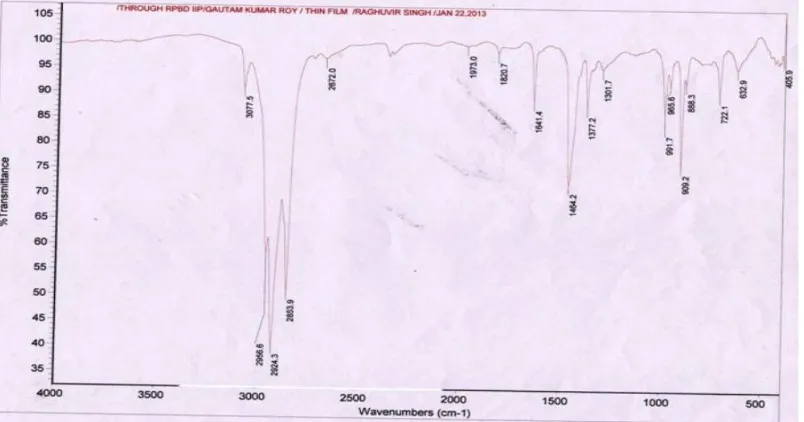
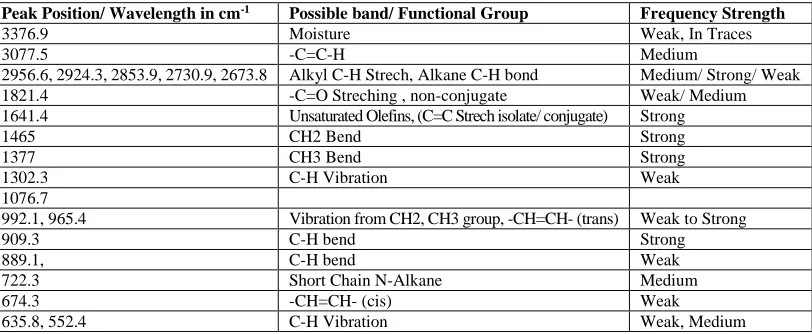
Thick film and thin film study of the FTIR analysis were carried out and the different functional group observed with respect to different wavelength were studied. The FTIR study in figure 1, figure 2 and table 1 produces the evidence of the different possible bands having different functional groups present. The presence of the C=O stretching due to the induction of oxygen in the product is also verified.
Figure 1: Thin film FTIR study of the extracted mother liquid by hydropyrolytic depolymeriation of the polyethylene mix
Table1. Peak position, possible functional group/ band and the frequency strength as observed in FTIR study (Figure 1 and Figure 2) of the Mother liquid from the polyethylene mix
Peak Position/ Wavelength in cm-1 Possible band/ Functional Group Frequency Strength
3376.9 Moisture Weak, In Traces
3077.5 -C=C-H Medium
2956.6, 2924.3, 2853.9, 2730.9, 2673.8 Alkyl C-H Strech, Alkane C-H bond Medium/ Strong/ Weak 1821.4 -C=O Streching , non-conjugate Weak/ Medium 1641.4 Unsaturated Olefins, (C=C Strech isolate/ conjugate) Strong
1465 CH2 Bend Strong
1377 CH3 Bend Strong
1302.3 C-H Vibration Weak
1076.7
992.1, 965.4 Vibration from CH2, CH3 group, -CH=CH- (trans) Weak to Strong
909.3 C-H bend Strong
889.1, C-H bend Weak
722.3 Short Chain N-Alkane Medium
674.3 -CH=CH- (cis) Weak
635.8, 552.4 C-H Vibration Weak, Medium
The study of the ageing property promotes the exposure of mix polymers products to the effects of thermo and photo-oxidative accelerated aging to reproduce processing.
Hydroperoxide concentration was used as an indicator of the extent of polymer degradation in relation to exposure time in oven aging experiments performed at 100 ºC. Exposure time is the time period within which most structural changes of the studied product were detected. Structural factors, such as morphology, are helpful for the interpretation of such degradation profiles. This is shown in table 2. It was observed that most of the oxidation of the polyolefins is restricted to the amorphous phase because oxygen diffusion across the compact crystalline domains is very difficult. Highly amorphous polyethylene mix suffers from oxidation reactions to a greater extent. Colorimetric measurements of hydroperoxide, showed that after two weeks of polyethylene exposure, the hydroperoxide concentration curve displayed a plateau. Figure 3 describes the hydroperoxide concentrations within which the rate of formation and decomposition are in equilibrium.
Table 2. Formation of the hydropyroxides due to the oxidative ageing of the polyethylene mix at 1000C
Exposure time (days) Polyethylene mix hydropyroxide formation mmol/l
2 0.3
5 2.0
10 2.5
15 2.7
20 2.7
30 2.8
56 3.1
90 3.3
135 3.4
150 3.4
Figure 3. Graph showing the hydroperoxide formation due to the ageing of the polyethylene at 1000C
Crystallinity increase observed in oven aged polyethylene mix indicate that scission prevails over cross linking. It also contributed to a drop in original impact strength observed in different types of polyethylene mix and there concentration such as LDPE, LLDPE, MDPE and HDPE plates prepared from oven aged granules. The crystallinity of the oven aged HDPE plate is lower than LDPE and other polyethylene in the respective granules, probably because of the difference in thermo mechanical history. The polyethylene mix was subjected to thermal ageing at 100°C for few days and were observed in intervals.
2.3Effect of glass transition temperature on oxidative deformations
Change in the physical properties may cause due to the mechanical stress in polymers. Because of these stress, chain breakage occurs and the radical introduces initiating the degradative process such as cracking or the oxidation.
In polymers the glassy state, where mobility of the macromolecules is limited, chain end radicals formed by mechanical stress may only abstract hydrogen atoms from adjacent molecules.7The neighboring molecules degrade in a very fast reaction and produces local sites
in the stressed polymer. These are generally considered as micro cracks and are formed due to the weak link in the polymeric materials. Thus micro cracks are generally the main cause of polymer embitterment.
1) Propagation
R· + O2 → R–OO· (6) R–OO· + RH → ROOH + R· (7) ROOH → RO· + HO· (8)
2) Chain Branching
RO· + RH → ROH + R (9) HO· + RH → HOH + R· (10)
3) Termination
R· + R· → Inert product (11) RO2· + R· → Inert product (12) RO2· + RO2· → Inert product (13)
The oxidation process is very fast and the polymer gets modified by either cross linking or chain scission reaction creating alteration in molecular weight and loss in mechanical performance. During the process both cross linking and the chain scission occur. At higher temperature the chain scission reaction is observed during the degradation of the polyethylene materials causing the decrease in the molecular weight. During the degradation process, when the temperature is lowered, mechanical and the thermal stress is applied which results in the increase in the molecular weight and chain branching is dominant. Branching increases the susceptibility of the polymer chain to thermal oxidation because of the reactivity of the tertiary carbon atom at the branch.
Therefore, the order of reactivity of the polyolefin series is, polypropylene > low density polyethylene (branched) > high density polyethylene8.
A simple example of what occurs during multiple reprocessing steps for a polyethylene sample showed that the viscosity of the sample decreased owing to a reduction in the polymer molecular weight and a narrowing of the molecular weight distribution.9,10,11
3. CONCLUSION
4. ACKNOWLEDGEMENT
The author is thankful to Dr. S Jha, Ex. Dean off Science and head of the University department off chemistry, LNM University, Darbhanga, Dr. Bipin Kumar, Associate professor of chemistry, G. D. College Begusarai., Dr. S. H. Ansari, professor of chemistry, University department of chemistry LNM University, Darbhanga, Mr. A. S. Sarkar, Ex-Deputy Manager, Barauni Refinery, Indian Oil Corporation Limited for extending there helping hands in completing this paper. The author also acknowledges the contribution of Mr. Ashok Kumar Roy, Assistant General Manager, M-Junction services limited for completing this paper.
5. REFERENCES
1. Gautam Kumar Roy, Dr. Bipin Kumar, Dr. Swatantreshwar Jha, Estimation of Hydrocarbon Components by the Chromatographic Study of the Naphtha like Component Extracted from Polyethylene Mix, International Journal of Sciences: Basic and Applied
Research (IJSBAR), Volume 31, No 1, pp 165-178 (2017).
2. Moinuddin Sarker, Mohammad Mamunor Rashid, Md. Sadikur Rahman and Mohammed Molla, Conversion of Low Density Polyethylene (LDPE) and Polypropylene (PP) Waste Plastics into Liquid Fuel Using Thermal Cracking Process, British Journal of Environment
& Climate Change 2(1): 1-11, pp 1, (2) (2012).
3. Gautam Kumar Roy, Bipin Kumar, Swatantreshwar Jha, Chromatographic study of the recovered gases from hydropyrolytic de-polymerization of LDPE, MDPE and HDPE mix type of waste polyethylene, Applied Petrochemical Research, Springer.
DOI 10.1007/s13203-015-0138-6
4. Gautam Kumar Roy, Dr. Bipin Kumar, Dr. Swatantreshwar Jha, Blend Study and Characterization of the Diesel Like Fuel Extracted From Hydropyrolytic Depolymerization of Polyethylene Mix, International Journal of Chemical Sciences and Technology, Volume 2, Issue 1, January-March, 2017, DIP 18.02.001/20170201, pp 1-32
5. Feller. Robert L., Accelerated Aging Photochemical and Thermal Aspects, pp 153 (1994). 6. Biron. Michel, Material Selection for Thermoplastic Parts: Practical and Advanced
Information, William Andrew, Elsevier, pp 6 (2016).
7. Rabek. Jan F., Polymer Photodegradation: Mechanisms and experimental methods,
Springer Science, First edition, pp 18 (1995).
8. Baum B. The Weathering Degradation of Plastics, Predicting Plastics Performance, Downington, PA, pp 180 (1973).
9. Vasile C., in Handbook of Polyolefins: Synthesis and Properties (Ed. Seymour R.B), Marcel Dekker, New York, (1993).
10. Tidjani A., Arnaud R., & Dasilva A. Natural and Accelerated Photoaging of Linear Low-Density Polyethylene: Changes of the Elongation at Break J. Appl. Polym. Sci., 47, 211-216 (1993).
11. Pospíšil J., Nešpurek S., Pfaendner R., Zweifel H., Material Recycling of Plastics Waste for Demanding Applications: Upgrading by Restabilization and Compatibilization Trends