Research Paper:
Developing the Persian Version of Sensory
Gating Inventory and Assessing Its Validity and Reliability
Mehrnaz Mohebbi1 , Saeid Mahmoudian1,2* , Seyed Abbas Motevalian3 , Leila Janani3 , Mohammad Farhadi1 , Ahmad Daneshi1
1. Head & Neck Research Center, Department of Ear, Nose, and Throat Diseases,Iran University of Medical Sciences, Tehran, Iran. 2. Department of Otorhinolaryngology, Hannover Medical University (MHH), Hannover, Germany.
3. Department of Epidemiology, School of Public Health, Iran University of Medical Sciences, Tehran, Iran.
* Corresponding Author: Saeid Mahmoudian, PhD.
Address: Head & Neck Research Center, Department of Ear, Nose, and Throat Diseases,Iran University of Medical Sciences, Tehran, Iran.
Tel: +98 (21) 66552827
E-mail: [email protected]
Introduction: Sensory Gating Inventory (SGI) measures behavioral aspects of Sensory Gating
(SG), which filters irrelevant sensory inputs into the higher cortex. It modifies sensitivity to sensory stimuli. Abnormal SG leads to overloading of information in the brain and its subsequent dysfunction. Electrophysiological techniques cannot assess the behavioral aspects of SG. We aimed to design the Persian version of SGI with high validity and reliability. Methods: After a forward and then backward translation of the original SGI, we assessed the content validity and construct validity of the Persian version. A total of 405 participants filled the Persian version of SGI. To assess test-retest reliability, 100 participants filled the inventory again 7-10 days later. The content validity ratio and index, as well as confirmatory factor analysis, were computed, too. Finally, the Cronbach’s alpha, Cohen’s kappa, and intraclass correlation coefficients were calculated.
Results: The content validity ratios of all items of the inventory were more than 60%, which means that they were necessary according to the experts’ opinions. Confirmatory factor analysis confirmed the fitness of the 4-factor structure of the original Inventory. The test-retest reliability using the intraclass correlation coefficient and Cronbach’s alpha coefficients were also high for the four subscales. The Cohen’s kappa coefficients revealed moderate to substantial level of agreement between the first and second scores for all items.
Conclusion: The Persian version of SGI has good and acceptable psychometric properties. It can be used as a valid and reliable tool for studying behavioral aspects of SG in Persian speaking population.
Article info: Received: 17 Jan 2018 First Revision: 15 Feb 2018 Accepted: 24 July 2018 Available Online: 01 Sep 2019
Keywords:
Sensory Gating (SG),
Questionnaire, Translation, Perceptual abnormalities
Citation:Mohebbi, M., Mahmoudian, S., Motevalian, SA., Janani, L., Farhadi, N., & Daneshi, A. Developing the Persian Version of Sensory Gating Inventory and Assessing Its Validity and Reliability. Basic and Clinical Neuroscience, 10(5), 597-608. https://doi.org/10.32598/BCN.9.10.360
:
https://doi.org/10.32598/BCN.9.10.360
Use your device to scan and read the article online
1. Introduction
ensory Gating (SG) is a filtering mechanism of the central nervous system that prevents infor-mation processing of unrelated sensory inputs at the higher cortex (Braff & Geyer, 1990). Nor-mal SG is essential for healthy brain function. SG is necessary for the study of both pathological and nor-mative psychological conditions. It helps the brain to mod-ify its sensitivity to incoming stimuli (Adler et al., 1998). The abnormal function of SG may overload information in the higher cortex and its subsequent dysfunction, which is accompanied by psychiatric symptoms and behavioral dis-orders (Mcghie & Chapman, 1961).
SG can be measured electrophysiologically by the P50 paradigm (Cromwell et al., 2008) or behaviorally by Sen-sory Gating Inventory (SGI) (Hetrick et al., 2012). The P50 mid-latency auditory evoked response is the standard electrophysiological index of SG, where a paired-tone para-digm auditory stimulus is used. Also, N100 and P200 have been currently employed with the same paradigm of stim-uli to show late phase SG in electrophysiology (Rentzsch et al., 2008) N100 and P200 components in a dual-click procedure. Since P50 sensory gating deficits have been ob-served in schizophrenic patients and first degree relatives, this parameter was suggested as an intermediate phenotype of the disease. However, most studies only show a low reli-ability for P50 sensory gating and neither N100 nor P200
sensory gating have been sufficiently tested. METHODS Reliability of P50, N100 and P200 sensory gating was mea-sured in 41 healthy subjects in two sessions, four weeks apart, using intra-class correlation.
Sensory gating was calculated as ratio-gating (second re-sponse magnitude/first rere-sponse magnitude x100. SGI can represent the clinical features of SG (Micoulaud-Franchi et al., 2015). This questionnaire was developed to objec-tify the perceptual abnormalities, as well as functional, and psychosocial consequences of SG function. Besides the conventional psychometric and electrophysiological as-sessments, SGI provides the daily experiences of sensory gating. It also helps to conduct studies on brain-behavior relationships and to assess behavioral aspects of SG ˗ some-thing that P50 cannot. In other words, it clarifies the asso-ciation between SG underlying mechanisms and the subse-quent subjective experiences.
SGI is a self-report questionnaire developed initially by Hetrick et al., (2012) for studying SG in schizophrenic English speakers. With its behavioral questions, it assesses the neurological aspects of SG in the behaviors of healthy or neurologically/psychologically abnormal people. The SGI is composed of 36 items that address a broad range of perceptual abnormalities related to SG deficit. Each item is scored based on a 6-point Likert scale (from 0= never true to 5= always true). The items were grouped based on four influential factors: perceptual modulation, distractibility,
Highlights
• The SGI is a self-report questionnaire
• The SGI measures behavioral aspects of sensory gating
• The Persian version of SGI was designed and validated
• The Persian version of SGI has acceptable psychometric properties.
Plain Language Summary
Sensory Gating (SG) is a filtering mechanism of the central nervous system that prevents information processing of unrelated sensory inputs at the higher cortex. SG is necessary for the study of both pathological and normative psy-chological conditions. It helps the brain to modify its sensitivity to incoming stimuli. SG can be measured behaviorally by Sensory Gating Inventory (SGI). SGI is a self-report questionnaire developed initially by Hetrick et al. (2012). It assesses the neurological aspects of SG in the behaviors of healthy or neurologically/psychologically abnormal people. The SGI has 36 items that address a broad range of perceptual abnormalities related to SG deficit. This study aimed to design the Persian version of SGI (P-SGI) and evaluated its psychometric properties. The content validity ratios of all items of the inventory were more than 60%. The internal consistency and intraclass correlation coefficient for all subscales were high, and kappa values showed moderate agreement. These tests confirmed the reliability of P-SGI.
over-inclusion, and fatigue-stress modulation. It has strong reliability and validity.
The inventory has already been translated and validated in French (Micoulaud-Franchi et al., 2014) and Japanese (Nobuyoshi et al., 2016). SGI can confirm anomalies of sensory gate and perceptual inundation in schizophrenia (Franchi and Vion-Dury, 2013; Micoulaud-Franchi et al., 2014; El-Kaim et al., 2015), Attention Def-icit Hyperactivity Disorder (ADHD) (Sable et al., 2012; Micoulaud-Franchi et al., 2015, 2016), and Tourette syn-drome (Sutherland Owens et al., 2011).
The advantages of the inventory include its low cost, avail-ability, ease of use, the impartiality of scoring/interpretation, and similar questions for all subjects, which facilitate clinical comparison and inference. Thus, it is useful to provide a Per-sian version of SGI consistent with Iranian culture.
This study was performed based on the International Qual-ity Of Life Assessment (IQOLA) protocol, aiming to create the Persian version of SGI (P-SGI). The inventory should have high validity and reliability to be used in Persian-speak-ing countries accordPersian-speak-ing to their formal language and culture.
2. Methods
2.1. Study participants
A total of 405 native Persian speakers voluntarily partici-pated in the study. They were 18-59 years old, with no brain injury, current or past substance abuse or dependency, hear-ing impairment, and neurological diseases. They responded to the final validated P-SGI in Google Forms.
2.2. Study procedure
The final validated P-SGI was created in Google Forms, and its URL link e-mailed or sent through social media to the participants. Also, a letter was sent containing the URL link to each participant with the following information: Par-ticipating in this study is voluntary; they are free to reveal their names; they will not be compensated for their partici-pation and data, and if they reveal their names, the informa-tion will be kept confidential and will not be published in any report. The participants had to register their age, gen-der, education, and history of any physical and or mental diseases. In case they miss any items of the inventory, the participants had to answer all items of P-SGI.
The subjects rated the items of P-SGI on a 6-point Likert scale (from 0= never true to 5= always true). The algebraic
sum of items scores was calculated to obtain the overall score of P-SGI and the scores for each subscale.
2.3. Persian translation of SGI
First, the permission of original SGI authors was obtained for translating SGI into Persian. A forward-backward transla-tion was done according to the IQOLA protocol. Two Persian native speakers performed forward translation from English to Persian. They were highly qualified in both English and Persian. The translators also prepared some alternative trans-lations for some words, and finally, they agreed upon Persian version of the inventory. Then, it was checked by a Persian linguist in terms of clarity, quality, conceptual equivalence (similarity of content), and the use of everyday language.
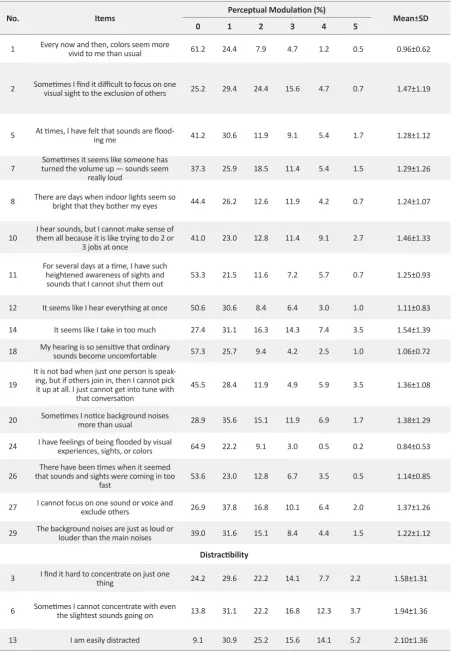
An English native speaker with high proficiency in Per-sian performed back-translation into English. Then, the differences between the back-translation and the original English version were recognized. We discussed these differ-ences and some words with the authors of the original SGI to select the best alternative words for some items. Table 1 presents the final version of the Persian SGI.
2.4. Content and construct validity
To assess the content validity of the Persian SGI, ten ex-perts, including neuroscientists, audiologists, and psycholo-gists familiar with the SG concept, rated the necessity of each item through a 3-point descriptive scale. Relatedness, clarity, and simplicity of each item were assessed through a 4-point descriptive scale. Then the Content Validity Ratio (CVR) and Content Validity Index (CVI) of the inventory were computed. To analyze the construct validity, we per-formed the Confirmatory Factor Analysis (CFA) to test the 4-factor structure of the original SGI. To confirm the fitness of the factor structure, we require a Comparative Fit Index (CFI) greater than 0.9, a Root Mean Square Error of Ap-proximation (RMSEA) less than 0.08, and a Standardized Root Mean Square Residual (SRMR) less than 0.08.
2.5. Reliability
Coefficient (ICC). The interrater reliability was calculated by weighted Cohen’s kappa coefficient to determine the possible agreement between the test-retest scores for each item of Persian SGI. Kappa values <0 indicate no agree-ment, 0–0.20 slight, 0.21–0.40 fair, 0.41–0.60 moderate, 0.61-0.80 substantial, and 0.81-1 almost perfect agreement (Landis & Koch, 1977). Finally, the effect of independent variables, such as gender, was calculated.
2.6. Statistical analyses
Frequencies, means, and standard deviations for SGI total scores, and each subscale were calculated. Also, the
con-struct and content validity was analyzed for the validation process. Test-retest reliability was assessed. The obtained data were analyzed in SPSS V. 21, PASW Statistics and R Statistical software. Stata 11 was used to calculate weighted Kappa’s coefficients.
3. Results
3.1. Participants’ characteristics
A total of 405 participants, 134 males (33.1%), and 271 females (66.9%), aged 18-58 years (Mean±SD: 27.57±7 y), filled the Persian version of SGI. Considering gender
Table 1. Frequency and mean scores for each P-SGI item
No. Items Perceptual Modulation (%) Mean±SD
0 1 2 3 4 5
1 Every now and then, colors seem more vivid to me than usual 61.2 24.4 7.9 4.7 1.2 0.5 0.96±0.62
2 Sometimes I find it difficult to focus on one visual sight to the exclusion of others 25.2 29.4 24.4 15.6 4.7 0.7 1.47±1.19
5 At times, I have felt that sounds are flooding me - 41.2 30.6 11.9 9.1 5.4 1.7 1.28±1.12
7 turned the volume up — sounds seem Sometimes it seems like someone has
really loud 37.3 25.9 18.5 11.4 5.4 1.5 1.29±1.26
8 There are days when indoor lights seem so bright that they bother my eyes 44.4 26.2 12.6 11.9 4.2 0.7 1.24±1.07
10 I hear sounds, but I cannot make sense of them all because it is like trying to do 2 or
3 jobs at once 41.0 23.0 12.8 11.4 9.1 2.7 1.46±1.33
11 For several days at a time, I have such heightened awareness of sights and
sounds that I cannot shut them out 53.3 21.5 11.6 7.2 5.7 0.7 1.25±0.93
12 It seems like I hear everything at once 50.6 30.6 8.4 6.4 3.0 1.0 1.11±0.83
14 It seems like I take in too much 27.4 31.1 16.3 14.3 7.4 3.5 1.54±1.39
18 My hearing is so sensitive that ordinary sounds become uncomfortable 57.3 25.7 9.4 4.2 2.5 1.0 1.06±0.72
19
It is not bad when just one person is speak
-ing, but if others join in, then I cannot pick it up at all. I just cannot get into tune with
that conversation
45.5 28.4 11.9 4.9 5.9 3.5 1.36±1.08
20 Sometimes I notice background noises more than usual 28.9 35.6 15.1 11.9 6.9 1.7 1.38±1.29
24 I have feelings of being flooded by visual experiences, sights, or colors 64.9 22.2 9.1 3.0 0.5 0.2 0.84±0.53
26 that sounds and sights were coming in too There have been times when it seemed
fast 53.6 23.0 12.8 6.7 3.5 0.5 1.14±0.85
27 I cannot focus on one sound or voice and exclude others 26.9 37.8 16.8 10.1 6.4 2.0 1.37±1.26
29 The background noises are just as loud or louder than the main noises 39.0 31.6 15.1 8.4 4.4 1.5 1.22±1.12
Distractibility
3 I find it hard to concentrate on just one thing 24.2 29.6 22.2 14.1 7.7 2.2 1.58±1.31
6 Sometimes I cannot concentrate with even the slightest sounds going on 13.8 31.1 22.2 16.8 12.3 3.7 1.94±1.36
No. Items Perceptual Modulation (%) Mean±SD
0 1 2 3 4 5
16 It is hard to keep my mind on one thing when there is so much else going on. 8.1 23.2 24.0 19.0 19.8 5.9 2.37±1.39
17 When I am in a group of people, I have trouble listening to one person. 28.6 34.3 17.5 9.6 7.4 2.5 1.40±1.32
22 noise, and that makes it difficult for me to I find it difficult to shut out background
concentrate. 17.0 29.1 23.2 13.8 12.6 4.2 1.88±1.40
28 At times, I have trouble focusing because I am easily distracted. 12.6 28.6 24.0 15.8 13.3 5.7 2.06±1.41
31 I have more trouble concentrating than others seem to have. 39.0 24.2 14.6 9.4 8.9 4.0 1.37±1.48
Over-Inclusion
4 The silliest little things that are going on interest me. 9.6 30.1 25.7 16.3 12.1 6.2 2.10±1.37
9 I notice background noises more than other people do. 28.4 30.4 16.5 9.9 10.4 4.4 1.57±1.47
21 but all sorts of little things, like markings on Not only the color of things fascinates me,
the surface, attract my attention, too. 15.6 28.6 20.0 18.8 11.4 5.7 1.99±1.43
23 appliances turn on and off (like the refrigI seem always to notice when automatic
-erator or the heating & cooling system). 12.3 33.6 16.3 15.8 13.8 8.1 2.10±1.50
32 Maybe it’s because I notice so much more about things that I find myself looking at
them for a longer time. 31.1 30.6 19.8 7.7 8.9 2.0 1.39±1.33
33 though I am not particularly interested in Everything draws my attention even
any of it. 32.1 34.3 13.3 10.4 10.4 8.1 1.33±1.33
34 I seem to hear the smallest details of the sounds. 32.1 31.1 16.8 9.1 8.1 2.7 1.38±1.37
Fatigue-Stress Vulnerability
15 When I am driving at night, I am bothered by the bright lights of oncoming traffic. 9.9 23.5 16.5 19.5 18.0 12.6 2.50±1.56
25 When I am tired, the brightness of lights bothers me. 19.8 24.7 18.0 18.0 10.4 9.1 2.02±1.56
as an independent variable, an independent t-test revealed no significant differences between the two genders regard-ing the mean score of each subscale and also total scores of P-SGI (P>0.05). The Mean±SD obtained score of P-SGI was 53.93:28.13 (53.25:28.56 in females and 55.14:27.38 in males). Table 2 compares the total score between the two gender groups.
3.2. Content validity
For checking the content validity, ten experts familiar with the concept of SG rated the necessity of the items by using a 3-point scale (necessary, useful, and not necessary). The minimum reasonable CVR was set as 60% for items. All 36 items showed CVR scores higher than 60%, i.e., the experts
confirmed the necessity of all items. CVI of the total score of the questionnaire was 0.93. Besides, the simplicity and fluency, relevance, or specificity and clarity or transparency for each item were measured with a 4-point scale. The re-sults of the CVI scores (>0.8) showed that all phrases in the Persian SGI were simple, fluent, and clearly expressed according to the expert panel.
3.3. Construct validity
Confirmatory factor analysis indicated an acceptable fit of the 4-factor structure of the original SGI (RMSEA=0.042, CFI=0.982, SRMR=0.066).
No. Items Perceptual Modulation (%) Mean±SD
0 1 2 3 4 5
35 When I am tired, sounds seem amplified. 25.2 29.6 15.3 12.3 12.8 4.7 1.72±1.51
36 It seems that sounds are more intense when I am stressed. 23.5 25.9 18.5 16.3 12.3 3.5 1.79±1.45
Table 2. Independent t-test comparing the Mean±SD of total scores and the score of each subscale for P-SGI between the two genders
SGI Score Mean±SD t P
Female Male
Total 53.29±28.49 55.13±27.28 0.62 .53
Perceptual modulation 16.96±12.57 17.77±12.26 0.61 .53
Distractibility 14.43±8.08 15.25±8.37 0.95 .34
Over-inclusion 11.60±6.85 12.36±7.17 1.03 .30
Fatigue-stress vulnerability 10.28±5.74 9.74±4.98 -0.93 .35
Table 3. Values of Cronbach’s alpha coefficient and intraclass correlation coefficient
SGI Score Mean±SD Alpha ICC SEM
Total 53.87±28.14 --- 0.93 1.39
Perceptual modulation 17.21±12.48 0.90 0.91 0.62
Distractibility 14.69±8.18 0.88 0.91 0.40
Over-inclusion 11.84±6.97 0.83 0.91 0.34
Fatigue-stress vulnerability 10.11±5.50 0.79 0.91 0.27
3.4. Reliability
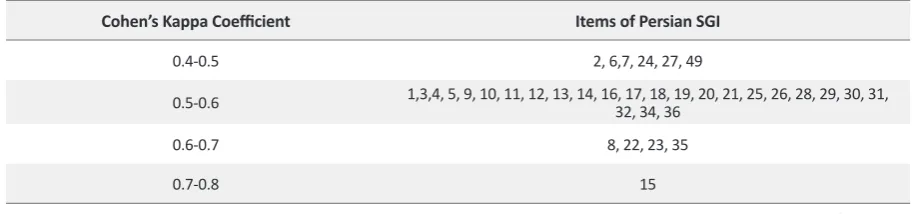
The internal consistencies of the Persian SGI using the Cronbach’s alpha coefficients were 0.90, 0.88, 0.83, and 0.79, respectively for the four subscales of the inventory. The test-retest reliability was high, showing ICC of 0.91 for all four subscales. The ICC for the total score of P-SGI was 0.93. The scatter plots in Figure 1 show the relation-ship between P-SGI scores in test-retest reliability. Table 3 presents the values for the ICC and Cronbach’s alpha coef-ficients. There was moderate to substantial level of agree-ment between the first and second scores for all items in weighted Cohen’s kappa coefficients (Table 4).
4. Discussion
The present study provided the Persian version of SGI and assessed its validity and reliability to measure sensory gat-ing in the Iranian population. To the best of our knowledge, this is the first reliability and validation study on P-SGI. The results showed that the items were all necessary, and the CFA analysis confirmed the four subscales of the origi-nal SGI (Hetrick et al., 2012) in Persian population. The internal consistency and ICC for all subscales were high, and kappa values showed moderate agreement. These tests confirmed the reliability of SGI.
4.1. Gender effect
Comparing the overall and subscales P-SGI scores be-tween the two genders, we found no difference bebe-tween males and females. Some electrophysiological studies showed less gating for P50 in females compared to males (Hetrick et al., 1996; Patterson et al., 2008) while oth-ers found no difference between the two gendoth-ers in P50, N100, and P200 gating (Lijffijt et al., 2010; White et al., 2005; Freedman et al., 1987; Waldo et al., 1987). Hetrick et al., (1996) suggested that differences in auditory gating between males and females were not because of biological differences in the generators of P50 and N100, instead due
to the distinct impact of inhibitory mechanisms affecting the generator of these evoked potentials.
The results of the present study agree with the findings of those electrophysiological studies, which found no dif-ference between the genders. Similar to previous studies, the overall score of P-SGI indicated no effects on gender (Hetrick et al., 2012; Micoulaud-Franchi et al., 2014). In contrast to our findings, Hetrick et al., (2012) found sig-nificantly higher scores on “distractibility”, “fatigue”, and “stress vulnerability”, subscales in females than males. They concluded these higher scores are due to greater “distractibility” and “mind wandering” (Giambra, 1980) and more susceptibility to effects of stress and fatigue in women than men. White et al., (2005) demonstrated sig-nificantly impaired P50 suppression during the stressor condition in females than males but no significant differ-ences between the genders for N100 suppression under the stressor condition.
Since the participants’ level of stress was not controlled or checked before filling the inventory, we hypothesize that women in the study of Hetrick et al., (2012) may be under more stress during the study, but the female participants in our study were under less stress. Also, the intelligibility of items may affect their scoring. Items such as “distractibil-ity”, “fatigue”, and “stresses” are more susceptible to be af-fected by stress, tiredness, and concentration. So selecting some types of sentences and their intelligibility can affect their scoring. Persian sentences may be more explicit.
4.2. Content validity
The CVI of P-SGI was found to be acceptable. However, the CVR was a bit lower in items 24, 35, and 36 compared to the others. These differences are probably due to the type of selected words and the opinion of experts. Unlike our study, content validity has not been assessed in previ-ous studies (Micoulaud-Franchi et al., 2014; Nobuyoshi et al., 2016). In an investigation of content validity, Polit & Beck (2006) confirmed that the CVI is a simple validity
Table 4. Values of Cohen’s kappa coefficient for all items of P-SGI
Cohen’s Kappa Coefficient Items of Persian SGI
0.4-0.5 2, 6,7, 24, 27, 49
0.5-0.6 1,3,4, 5, 9, 10, 11, 12, 13, 14, 16, 17, 18, 19, 20, 21, 25, 26, 28, 29, 30, 31, 32, 34, 36
0.6-0.7 8, 22, 23, 35
0.7-0.8 15
method. It shows the amount to which a sample of items establishes an adequate operational definition of a concept (Polit & Beck (2006).
4.3. Construct validity
The results of CFA were compatible with the original scale (Hetrick et al., 2012) and the French SGI (Micou -laud-Franchi et al., 2014). These results show that the 4-factor structures presented by Hetrick et al., (2012) are also appropriate to investigate sensory gating in the Persian population. CFA indicators for P-SGI showed better results compared to French SGI; however, both confirm the factor structures of the original SGI.
4.4. Test-retest reliability
Our results suggest that the test-retest reliability of the P-SGI using ICC is relatively high. Congruent with our study, Hetrick et al., (2012) indicated good test-retest reliability for SGI using ICC. They assessed the test-retest reliability of SGI at one of three inter-trial intervals across the retest intervals of 4.5, 6.5, and 9 weeks after the first session, but we performed it only once and 10-15 days after the first session. They suggested that the temporal stability of the SGI and its factors is significant within 4-9 weeks in healthy subjects. However, Micoulaud-Franchi et al., (2014) did not conduct-test-retest reliability analyses for French SGI. Of the essential characteristics of a valuable tool are repeat-ability and consistency of obtained scores (Polit and Beck, 2006). In other words, if someone repeats the same test sev-eral times, he or she should get the same results.
4.5. Internal consistency reliability
The internal consistency of the P-SGI by Cronbach’s al-pha value was very high (0.93), and for all subscales ranged between 0.79 and 0.90. Hetrick et al., (2012) reported moderate-to-large internal consistency reliability of SGI for each of the four subscales ranging from 0.75 (“fatigue” and “stress vulnerability”) to 0.92 (Perceptual modulation). Micoulaud-Franchi et al., (2014) indicated satisfactory in-ternal consistency for all subscales of French SGI, ranging from 0.79 to 0.92. Lower internal consistency on the sub-scale of “fatigue” and “stress vulnerability” was reported in all studies compared with other subscales.
It may be due to the different fatigue and stress conditions of the participants in different sessions of completing the inventory. Fatigue and stress conditions of individuals can affect selecting the scales for each item. So, it may be neces-sary to revise the items such that the stress has less effect on individuals. However, P-SGI had the highest internal
consis-tency score among SGI of other languages. Our results of internal consistency agree with the previous studies. This result indicates that the response to every item matches the response of the total items in the P-SGI. These findings sug-gest that P-SGI is a reliable tool for assessing SG.
4.6. Interrater reliability
Weighted Cohen’s kappa coefficient showed a moderate to substantial level of agreement between the first and sec-ond P-SGI scores for all items. Since all items of P-SGI had moderate to substantially weighted kappa coefficient, changing the content of items was not necessary. Previous studies did not assess the reliability of SGI by kappa co-efficient; therefore, we did not have any similar study to compare our results with them.
SG problems may disturb attention and perception (Mc -ghie & Chapman, 1961). Shortages in SG have been re-ported in psychological disorders such as schizophrenia (Patterson et al., 2008), bipolar disorder (Sánchez-Morla et al., 2008), ADHD (Holstein et al., 2013), Alzheimer disease (Jessen et al., 2001), obsessive-compulsive dis-order (Ahmari et al., 2012) and tinnitus (Rauschecker et al., 2010). SGI has been used in studying some of these diseases and can detect the SG dysfunction in schizophre-nia (Micoulaud-Franchi et al., 2014), Tourette syndrome (Sutherland Owens et al., 2011), and ADHD (Sable et al., 2012); thus it is a valuable tool in detecting abnormalities in sensory input perception in psychiatric disorders.
Micoulaud-Franchi et al., (2017) proposed a short version of the SGI. Although the SGI-36 presents high acceptability, it may be too lengthy for patients with inattention symptoms. It is usually recommended that questionnaires for clinical populations should be as brief as possible because they have difficulties in perception and concentration (Ware, 2008). We suggest working on designing short Persian SGI, which seems to be more useful in clinical practices.
5. Conclusion
In conclusion, this study demonstrated that P-SGI has good and acceptable psychometric properties. It can be used as a validated and reliable tool for studying sensory gating in Persian speakers.
The gender ratio was in favor of women. We suggest that future studies be conducted on larger sample sizes and par-ticipants with low educational levels living in rural areas. We also recommend that other validity methods, such as external validity and criterion-related validation, be per-formed. Convergent and discriminant validity can provide valuable information about the external validity of the SGI. However, this study provided preliminary information for further research in validity and reliability of P-SGI and fu-ture studies on SG in Persian population. Although Google Forms had a question about the history of any physical or mental diseases, some participants might not reveal all or part of their illnesses. Thus, we cannot be sure about the healthy condition of all study participants.
Ethical Considerations
Compliance with ethical guidelines
The study procedure was in accordance with the Declara-tion of Helsinki. The Ethical Review Board of Iran Uni-versity of Medical Sciences (IUMS) approved the study procedure (Code: IR.IUMS.REC 1396.29494).
Funding
The study was supported by Iran Ministry of Health re-search program award, No. 271/7.11.2016.
Authors' contributions
All authors contributed equally in preparing all parts of the research.
Conflict of interest
The authors declare no conflicts of interest.
Acknowledgments
The P-SGI will be used as a supplementary tool with elec-trophysiological studies on habituation in patients with tin-nitus. We want to thank Dr. Behrouz Mahmoudi Bakhtiari for his valuable comments on the linguistics of Persian SGI.
References
Adler, L. E., Olincy, A., Waldo, M., Harris, J. G., Griffith, J., Stevens, K., et al., (1998). Schizophrenia, sensory gating, and nicotinic
receptors. Schizophrenia Bulletin, 24(2), 189-202. [DOI:10.1093/
oxfordjournals.schbul.a033320] [PMID]
Ahmari, S. E., Risbrough, V. B., Geyer, M. A., Simpson, H. B., (2012).
Impaired sensorimotor gating in unmedicated adults with
obses-sive-compulsive disorder. Neuropsychopharmacology, 37(5),
1216-23. [DOI:10.1038/npp.2011.308] [PMID] [PMCID]
Braff, D. L., Geyer, M. A., (1990). Sensorimotor gating and schizo
-phrenia. Human and animal model studies. Archives of General Psy-chiatry, 47(2), 181-8. [DOI:10.1001/archpsyc.1990.01810140081011] [PMID]
Cromwell, H. C., Mears, R. P., Wan, L., Boutros, N. N., (2008). Sen -sory gating: A translational effort from basic to clinical science.
Clinical EEG and Neuroscience, 39(2), 69-72. [DOI:10.1177/1550059
40803900209] [PMID] [PMCID]
El-Kaim, A., Aramaki, M., Ystad, S., Kronland-Martinet, R., Cermo
-lacce, M., Naudin, J., et al., (2015). On the correlation between perceptual inundation caused by realistic immersive environ
-mental auditory scenes and the sensory gating inventory in schizophrenia. European Psychiatry, 30(5), 606-14. [DOI:10.1016/j.
eurpsy.2015.01.005] [PMID]
Freedman, Adler, L. E., Waldo, M., (1987). Gating of auditory evoked potential in children and adult. Psychophysiology, 24(2), 223-7. [DOI:10.1111/j.1469-8986.1987.tb00282.x] [PMID]
Giambra, L. M., (1980). A factor analysis of the items of the imaginal processes inventory. Journal of Clinical Psychology, 36(2), 383-409.
[DOI:10.1002/jclp.6120360203]
Hetrick, W. P., Erickson, M. A., Smith, D. A., (2012). Phenomeno
-logical dimensions of sensory gating. Schizophrenia Bulletin, 38(1),
178-91. [DOI:10.1093/schbul/sbq054] [PMID] [PMCID]
Hetrick, W. P., Sandman, C. A., Bunney, W. E., Jin, Y., Potkin, S. G., White, M. H., (1996). Gender differences in gating of the auditory evoked potential in normal subjects. Biological Psychiatry, 39(1), 51-8. [DOI:10.1016/0006-3223(95)00067-4]
Holstein, D. H., Vollenweider, F. X., Geyer, M. A., Csomor, P. A., Belser, N., Eich, D., (2013). Sensory and sensorimotor gating in Adult Attention-Deficit/Hyperactivity Disorder (ADHD).
Psychiatry Research, 205(1-2), 117-26. [DOI:10.1016/j.psyy
-chres.2012.08.013] [PMID]
Jessen, F., Kucharski, C., Fries, T., Papassotiropoulos, A., Hoenig, K., Maier, W., et al., (2001). Sensory gating deficit expressed by a disturbed suppression of the P50 event-related potential in pa
-tients with Alzheimer’s disease. The American Journal of Psychia-try, 158(8), 1319-21. [DOI:10.1176/appi.ajp.158.8.1319] [PMID]
Landis, J. R., Koch, G. G., (1977). The measurement of observ
-er agreement for categorical data. Biometrics, 33(1), 159-74.
[DOI:10.2307/2529310] [PMID]
Lijffijt, M., Moeller, F. G., Boutros, N. N., Burroughs, S., Lane, S. D., Steinberg, J. L., et al., (2010). The role of age, gender, education, and intelligence in P50, N100, and P200 auditory sensory gat
-ing. Journal of Psychophysiology, 23(2), 52-62. [
DOI:10.1027/0269-8803.23.2.52] [PMID] [PMCID]
Mcghie, A., Chapman, J., (1961). Disorders of attention and per
-ception in early schizophrenia. The British Journal of Medical Psy-chology, 34(2), 103-16. [DOI:10.1111/j.2044-8341.1961.tb00936.x] [PMID]
Micoulaud-Franchi, J. A., Hetrick, W. P., Aramaki, M., Bolbecker, A., Boyer, L., Ystad, S., et al., (2014). Do schizophrenia patients
with low P50-suppression report more perceptual anomalies
with the sensory gating inventory? Schizophrenia Research, 157(1-3), 157-62. [DOI:10.1016/j.schres.2014.05.013] [PMID]
Micoulaud-Franchi, J. A., Hetrick, W. P., Boyer, L., Bolbecker, A., Aramaki, M., Ystad, S., et al., (2014). Validation of the French sensory gating inventory: A confirmatory factor analysis.
Psychiatry Research, 220(3), 1106-12. [DOI:10.1016/j.psys
-chres.2014.08.025] [PMID]
Micoulaud-Franchi, J. A., Lopez, R., Cermolacce, M., Vail
-lant, F., Péri, P., Boyer, L., et al., (2019). Sensory gating capacity and attentional function in adults with ADHD:
A preliminary neurophysiological and
neuropsychologi-cal study. Journal of Attention Disorders, 23(10), 1199-09.
[DOI:10.1177/1087054716629716] [PMID]
Micoulaud-Franchi, J. A., Lopez, R., Michel, P., Brandejsky, L., Bioulac, S., Philip, P., et al., (2017). The development of the SGI-16: A shortened sensory gating deficit and distractibility questionnaire for adults with ADHD. ADHD Attention Deficit
and Hyperactivity Disorders, 9(3), 179-87. [
DOI:10.1007/s12402-016-0215-4] [PMID]
Micoulaud-Franchi, J. A., Lopez, R., Vaillant, F., Richieri, R., El-Kaim, A., Bioulac, S., et al., (2015). Perceptual abnor
-malities related to sensory gating deficit are core symptoms in adults with ADHD. Psychiatry Research, 230(2), 357-63.
[DOI:10.1016/j.psychres.2015.09.016] [PMID]
Micoulaud-Franchi, J. A., Vaillant, F., Lopez, R., Peri, P., Bail
-lif, A., Brandejsky, L., et al., (2015). Sensory gating in adult with attention-deficit/hyperactivity disorder: Event-evoked
potential and perceptual experience reports
compari-sons with schizophrenia. Biological Psychology, 107, 16-23.
[DOI:10.1016/j.biopsycho.2015.03.002] [PMID]
Nobuyoshi, M., Kano, Y., Matsuda, N., Fujio, M., Shimoyama, H., (2016). Reliability and validity of Japanese version of the Sensory Gating Inventory (SGI). International Journal of Psy-chology, 51, 1171.
Patterson, J. V., Hetrick, W. P., Boutros, N. N., Jin, Y., Sandman, C., Stern, H., et al., (2008). P50 sensory gating ratios in schizo
-phrenics and controls: A review and data analysis. Psychiatry
Research, 158(2), 226-47. [DOI:10.1016/j.psychres.2007.02.009]
[PMID]
Polit, D. F., Beck, C. T., (2006). The content validity index: Are you sure you know what’s being reported? critique and rec
-ommendations. Research in Nursing & Health, 29(5), 489-97.
[DOI:10.1002/nur.20147] [PMID]
Rauschecker, J. P., Leaver, A. M., Mühlau, M., (2010). Tuning
out the noise: Limbic-auditory interactions in tinnitus.
Neu-ron, 66(6), 819-26. [DOI:10.1016/j.neuron.2010.04.032] [PMID]
[PMCID]
Rentzsch, J., Jockers-Scherübl, M. C., Boutros, N. N., Gallinat, J., (2008). Test-retest reliability of P50, N100 and P200 audi
-tory sensory gating in healthy subjects. International
Jour-nal of Psychophysiology, 67(2), 81-90. [DOI:10.1016/j.ijpsys
-cho.2007.10.006] [PMID]
Sable, J. J., Kyle, M. R., Knopf, K. L., Schully, L. T., Brooks, M. M., Parry, K. H., et al., (2012). The sensory gating inventory as a potential diagnostic tool for attention-deficit hyperactivity
disorder. ADHD Attention Deficit and Hyperactivity Disorders,
4(3), 141-4. [DOI:10.1007/s12402-012-0079-1] [PMID]
Sánchez-Morla, E. M., García-Jiménez, M. A., Barabash, A., Martínez-Vizcaíno, V., Mena, J., Cabranes-Díaz, J. A., et al., (2008). P50 sensory gating deficit is a common marker of vulnerability to bipolar disorder and schizophrenia. Acta
Psychiatrica Scandinavica, 117(4), 313-8. [
DOI:10.1111/j.1600-0447.2007.01141.x] [PMID]
Sutherland Owens, A. N., Miguel, E. C., Swerdlow, N. R., (2011).
Sensory gating scales and premonitory urges in tourette
syn-drome. The Scientific World Journal, 11, 736-41. [DOI:10.1100/
tsw.2011.57] [PMID] [PMCID]
Waldo, M. C., Graze, K., Bender, S. de G., Adler, L. E., Freedman, R., (1987). Premenstrual mood changes and gating of the au
-ditory evoked potential. Psychoneuroendocrinology, 12(1),
35-40. [DOI:10.1016/0306-4530(87)90020-5]
Ware JE Jr (2008). Improvements in short-form measures of
health status: introduction to a series. Journal of Clinical
Epide-miology, 61(1):1-5. [DOI:10.1016/j.jclinepi.2007.08.008] [PMID]
White, P. M., Kanazawa, A., Yee, C. M., (2005). Gender and suppression of mid-latency ERP components during
stress. Psychophysiology, 42(6), 720-5. [