Uniform Circular Motion
Uniform Circular
Motion
Motion of a particle
moving at constant
speed along a circular
arc or path.
Velocity is constant in magnitude but changes in direction.
Centripetal Acceleration
has constant magnitude.
Since the car’s direction
of motion changes, the
car has an acceleration
when an object moves
in a circular path,
CENTRIPETAL ACCELERATION
Objects in uniform
circular motion
experiences centripetal acceleration
Centripetal Acceleration
has
constant magnitude.
It is always directed towards
Vectors
v
pand
v
qhave same magnitude v but because they
point in different directions - they are different vectors.
Velocity
v
and
acceleration
a
in uniform
circular motion at
angular rate ω;
The
speed
is constant
, but
the
velocity is always
tangent to the orbit
;
The
acceleration
has
constant magnitude
, but
always
points toward the
center of rotation
.
LINEAR MOTION LINEAR MOTION
• linear distance
moved per unit of time: m/s
• linear distance
moved per unit of time: m/s
ROTATIONAL MOTION ROTATIONAL
MOTION
• number of rotations
per unit of time
• rpm
• number of rotations
per unit of time
• rpm
Tangential speed is directly proportional to rotational speed and the distance from the axis (radial distance)
Tangential speed is directly proportional to rotational speed and the distance from the axis (radial distance)
v= ωr
The speed of an object moving along a circular path can be called tangential speed because the direction of motion is always tangent to the circle.
Equations to Remember
Frequency ( f )
– number of revolutions per unit time
SI unit: Hertz (Hz) – 1/s Type: derived
Relation of Period and Frequency
Period ( T )
– time for one revolution
SI unit: Seconds (s) Type: fundamental
T = 1
f
=
2 r
v
r : radius of
the circular
arc
Angular Frequency/Angular Velocity (ω)
The speed of the object in the circular path
Tangential speed (v)
The speed of the object as if its moving in a straight line
Centripetal Acceleration (a
c)
The acceleration the object experiences as it moves along the circular
EXAMPLE 1
In a carnival ride, the passengers travel at constant
speed in a circle of radius 5.0m. They make one
complete circle in 4.0s. What is their velocity and
acceleration?
Given:
radius= 5.0 m
Period(T)= 4.0 s
SOLUTION :
T= 2πr
v
T
r
v
2
s
m
v
0
.
4
0
.
5
2
s
m
v
7
.
9
/
r
v
a
rad
2
m
s
m
a
rad0
.
5
/
9
.
7
2
2
/
12
m
s
EXAMPLE 2
What is the centripetal acceleration of an
automobile driving at 40km/h on a circular track
of radius 20m?
a. Given: v = 40km/h, r = 20m
b. Required: centripetal acceleration a
cc. Equation to use: a
c= v
2/r
A
c=
(40000m/3600s)
2
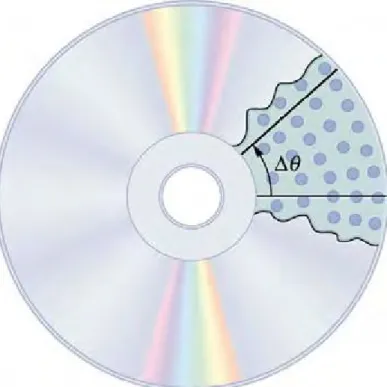
When objects rotate about some axis—for example, when
the CD (compact disc) in Fig 1 rotates about its center—
each point in the object follows a circular arc.
Consider a line from the center of the CD to its edge. Each
pit
used to record sound along this line moves through the
same angle in the same amount of time.
The rotation angle is the amount of rotation and is
analogous to linear distance. We define the
rotation angle
Δ
to be the ratio of the arc length to the radius of
curvature:
Δ
= Δ
s/r
Rotating CD
Figure 1 All points on a CD travel in circular arcs. The pits along a line from the center to the edge all move through the same angle Δθ in a time Δt
The arc length Δs is the distance traveled along a circular
path as shown in Figure 2 Note that r is the radius of curvature of the circular path.
We know that for one complete revolution, the arc length
is the circumference of a circle of radius r . The circumference of a circle is 2πr . Thus for
one complete revolution, the rotation angle is Δ = 2πr/r = 2π.
This result is the basis for defining the units used to
measure rotation angles, Δ to be radians (rad), defined so that
Comparison of Angular Units
Degree Radian
30º
π/
6
Figure 3
A car moving at a velocity
v
to the right has a tire
rotating with an angular velocity
ω
.The speed of the tread of
the tire relative to the axle is
v
, the same as if the car were
jacked up. Thus the car moves forward at linear velocity
v
=
Angular Velocity
How fast is an object rotating? We define angular velocity ω as the rate of change of an angle over a given time. In symbols, this is
ω = Δ / Δt ,
where an angular rotation Δ takes place in a time Δt . The greater the rotation angle, the greater the angular velocity. The units for angular velocity are radians per second (rad/s).
Angular velocity ω is analogous to linear velocity v .
To get the precise relationship between angular and linear velocity,
we again consider a pit on the rotating CD (Fig. 1)
This pit moves an arc length Δs in a time Δt , and so it has a linear
velocity v = Δs /Δt .
From Δ = Δs/r we see that Δs = rΔ . Substituting this into the
expression for v gives v = rΔ/Δt = rω.
v
=
rω
or
ω
=
v/r
Example 3: How Fast Does a Car Tire Spin?
Calculate the angular velocity of a 0.300 m radius car tire when
the car travels at 15.0 m/s (about 54 km/h ). See Figure 3.
Because the linear speed of the tire rim is the same as the speed
of the car, we have v = 15.0 m/s. The radius of the tire is given to be r = 0.300 m.
Knowing v and r , we can use the second relationship in v = rω,
ω =v/r, to calculate the angular velocity.
Solution
Angular velocity: ω =v/r Knowing v and r
EXAMPLE 4
The period of a stone swung in a horizontal circle on a
2.00-m radius is 1.00s.
(a) What is its angular velocity in rad/s?
Given: r = 2.00 m, T = 1.00s
Required: ω
Equations to use:
A.
ω = 2πf
B.
T = 1/f
ω
=
2π/T
The period of a stone swung in a horizontal circle on a 2.00-m
radius is 1.00s.
(b) What is its linear speed in m/s?
Given: ω (from the previous problem)
Required: v
Equation to use:
ω = v/r
therefore
v = ωr
The period of a stone swung in a horizontal circle on a
2.00-m radius is 1.00s.
(c) What is its radial acceleration in m/s
2?
Given: v (from the previous problem), r
Required:
a
ror
a
cEquation to use: a
c= v
2/r
a
c= v
2/r=(4π m/s)
2/2.00m
Centripetal acceleration
“center seeking”
a
r=
v
2
r
UNIFORM CIRCULAR MOTION
When a particle moves at constant
speed
v
in a circle or a circular arc of radius r,
the acceleration of the particle is
directed
toward the center
of the circle and has a
constant magnitude
v
2/r.
NOTE: The notation ar is used to indicate that the centripetal
acceleration is along the radial direction
a
c=
v
2Centripetal acceleration:
v = 2
π
r
a
r= 4
π
2r
T
T
2UNIFORM CIRCULAR MOTION
a
r=
v
2r
WOULD BECOME:
Angular Frequency/ Angular
velocity :
ω
ω = 2πf
ω = v/r
Unit: rad/s (Radians/second)
UNIFORM CIRCULAR MOTION
1 rev/s = 2
π radians/second
Note: 1 rad=360
o/2
π
Example 5 : Going Around in Circles
What is the centripetal acceleration of
an automobile moving at 60km/h on a
circular track of radius 27m? What is its
angular velocity?
a. Given: v = 60km/h, r = 27m
b. Required: centripetal acceleration a
c
and
ωSolutio
n
Given: v = 60 kph; r = 27 m
Find: Centripetal acceleration in m/s² and angular
velocity in rad/s
Solution:
Equation to use: a
c= v
2/r and
ω = v/r
Convert 60 kph to m/s for unit consistency
(60 kph) * (1000 m/k) * 1 h/3600 s = 16.67 m/s
Example 6. How Does the Centripetal Acceleration of a Car
Around a Curve Compare with That Due to Gravity?
What is the magnitude of the centripetal acceleration of a car
going on a curve of radius 500 m at a speed of 25.0 m/s (about 90 km/h)? Compare the acceleration with that due to gravity for this fairly gentle curve taken at highway speed. See Figure below.
Solution
Given v and r, we can use Ac = v²/r ; Ac = rω²
With v = 25.0 m/s and r = 500 m, Ac = 25² /(500) = 1.25 m/s²
Discussion
To compare this with the acceleration due to gravity (g = 9.80
m/s2) , take the ratio of Ac / g = (1.25 m/s2)/(9.80 m/s2) = 0.128
Thus,
ANNOUNCEMENT
Your first exam will be on Oct 3 (Friday) 7-9PM
Room assignments will be announced this week
Coverage:
Physical Quantities Vectors
Kinematics (1D and 2D, up to Relative motion)
We have 4 meetings left till the exam.
Will finish 2D up to Relative motion
Solutions to Quiz 1 to 4 and handout on UCM will be
available at Star shop on Wednesday afternoon.
Note: Those who have conflicts on the time of Exam will be
RECALL:
UNIFORM CIRCULAR
MOTION:
Motion in a
circle
or
an
arc
Acceleration is
“center seeking”
Velocity is
tangent
to
Equations to Remember
Frequency ( f )
– number of revolutions per unit time
SI unit: Hertz (Hz) – 1/s Type: derived
Relation of Period and Frequency
Period ( T )
– time for one revolution
SI unit: Seconds (s) Type: fundamental
T = 1
f
=
2
r v
r : radius of
the circular
arc
Angular Frequency/Angular Velocity (ω)
The speed of the object in the circular path
Tangential speed (v)
The speed of the object as if its moving in a straight line
Centripetal Acceleration (a
c)
The acceleration the object experiences as it moves along the circular