Promoting positive change: Advancing the food well-being paradigm
☆
Melissa G. Bublitz
a,⁎
, Laura A. Peracchio
b, Alan R. Andreasen
c, Jeremy Kees
d, Blair Kidwell
e,
Elizabeth Gelfand Miller
f, Carol M. Motley
g, Paula C. Peter
h, Priyali Rajagopal
i,
Maura L. Scott
j, Beth Vallen
ka
University of Wisconsin Oshkosh, United States
bUniversity of Wisconsin Milwaukee, United States c
Georgetown University, United States
d
Villanova University, United States
e
The Ohio State University, United States
f
University of Massachusetts Amherst, United States
g
University of Alabama at Birmingham, United States
h
San Diego State University, United States
iSouthern Methodist University, United States j
University of Kentucky, United States
k
Fordham University, United States
a b s t r a c t
a r t i c l e i n f o
Article history: Received 1 January 2012
Received in revised form 1 May 2012 Accepted 1 June 2012
Available online xxxx
Keywords: Food Food well-being Food decision making Consumption
Food well-being (FWB) is defined as“a positive psychological, physical, emotional, and social relationship with food at both the individual and societal levels”(Block et al., 2011, p. 6). This article seeks to advance our understanding of FWB along two dimensions. First, we discuss how awareness of consumer goals, as well as motivation and readiness to change, may help us to understand consumer preparedness to advance FWB. Second, we deconstruct the automatic and deliberative influences on food decision making into cogni-tive and emotional information that guide food choices and can be used by consumers to advance their own FWB. We close with a discussion of how measurement and strategies to influence FWB may allow researchers, policymakers, and industry to help consumers advance FWB.
© 2012 Elsevier Inc. All rights reserved.
1. Introduction
In 2005, a small but growing movement within the field of consumer research formed to deliberate key issues related to con-sumer welfare (Mick, 2006). This movement, transformative consumer research (TCR), encourages researchers to tackle chronic social problems plaguing consumers worldwide. One central TCR research stream examines how food decision making influences health and well-being. Researchers from the 2009 TCR Conference advocated for research and consumer programs that foster a positive relationship with food, crafting a vision for the food well-being para-digm (Block et al., 2011). These researchers defined food well-being (FWB) as“a positive psychological, physical, emotional, and social
relationship with food at both the individual and societal levels” (Block et al., 2011, p. 6). This paradigm shift set an exciting path for researchers to focus on how a positive relationship with food may help consumers achieve a higher level of well-being.
Participants at the 2011 TCR Conference advanced the paradigm by envisioning FWB as a continuum and suggesting measurement of five core areas: social influences, economic factors, food literacy, emotional knowledge, and physical and psychological traits to assess an individual's starting point on the FWB continuum (Bublitz et al., 2012). We continue the dialogue by focusing on how to empower consumers to take steps to advance FWB. Specifically, we merge research on goals and motivation with research investigating the automatic and deliberative influences on food choices to further our understanding of how consumers can make changes that help them progress along the FWB continuum. We begin with a discussion of how consumer goals and motivations may influence movement along the FWB continuum. Then, we integrate research on food decision making to identify opportunities for consumers to advance their FWB. We conclude with a discussion of the implications for policymakers, researchers, and industry leaders who seek to advance our understanding of FWB.
Journal of Business Research xxx (2012) xxx–xxx
☆ The authors thank Aradhna Krishna, University of Michigan, and Chrissy Mitakakis, Baruch College, CUNY, along with the four anonymous reviewers whose comments and suggestions helped improve the contribution of this paper. The authors also thank Baylor University for sponsoring and hosting the 3rd Biennial Transforma-tive Consumer Research conference.
⁎ Corresponding author.
E-mail address:[email protected](M.G. Bublitz).
0148-2963/$–see front matter © 2012 Elsevier Inc. All rights reserved. http://dx.doi.org/10.1016/j.jbusres.2012.08.014
Contents lists available atSciVerse ScienceDirect
2. Food well-being goals
Consumer goals impact perceptions of FWB as well as the strategies consumers adopt to advance FWB. Further, a consumer's ability to deter-mine their own FWB level (i.e., their subjective assessment of their own relationship with food) may not align with more objective measures of health and well-being. This section discusses the role of consumer goals and subjective versus objective measures of FWB in an effort to link research on food decision making to opportunities to advance FWB.
2.1. Consumer goals
Consumers hold a wide variety of food-related goals, including functional, symbolic, or hedonic. This section explores how these different types of goals influence FWB.
2.1.1. Functional goals
Consumers often examine their food consumption as they strive to improve health or reduce health risks (Vallis et al., 2003). Their goals can be prevention (e.g., healthy eating to avoid future health problems) or promotion oriented (e.g., increasingfiber intake to promote digestive health). Some consumers take a mechanical approach to managing their consumption by counting calories, sodium, or fat using online tracking tools and mobile applications to monitor their nutrient intake. For some consumers, closely monitoring their food consumption may help them advance their health goals (e.g., diabetics who manage carbohydrate intake to regulate their blood sugar). However, for others, obsessive focus on dieting and tracking may actually be counterpro-ductive, resulting in periods of deprivation followed by periods of overindulgence (Heatherton, Polivy, & Herman, 1991). The FWB para-digm encourages consumers to adopt a positive approach designed to encourage a healthy relationship with food (Block et al., 2011).
2.1.2. Symbolic goals
Consumers also nurture social relationships through eating. Family relationships in many cultures are strengthened through mealtime rituals such as eating Sunday dinner together (Motley & Perry, 2009). Other affiliation-related goals manifest when consumers use dieting behaviors to align with social norms of physical attractiveness (Hayes & Ross, 1987). Consumers also strive to express their identity through eating by demonstrating self-control (Roth, Herman, Polivy, & Pliner, 2001). For example, consumers eat different amounts when dining with members of the opposite sex as a way to project their masculinity or femininity (Allen-O'Donnell, Cottingham, Nowak, & Snyder, 2011). Using food to achieve and display aspects of identity may influence movement along the FWB continuum.
2.1.3. Hedonic goals
Some consumer goals focus on enjoying the sensory experience of eating. Firms developflavor innovations to reach this segment and increase demand for their products (Gottfried, 2010). The hedonic pleasure consumers derive from eating may increase caloric intake, as greater food variety leads consumers to focus on the enjoyment of the consumption experience (Mela, 2006). However, the interplay between pleasurable food experiences, overall health, and well-being is critical to the FWB paradigm (Block et al., 2011). In fact the pleasure associated with food can also be positive and is likely intertwined with associations and memories that connect some foods with social occasions, family, and other positive experiences. In addition, there is evidence to suggest that consumers who diet frequently may develop an unhealthy relationship with food that can negatively influence health (Bublitz, Peracchio, & Block, 2010).
2.1.4. Goals to advance FWB
Understanding functional, symbolic, or hedonic goals may point toward different paths to advance FWB. Consumers with functional
goals may perceive higher levels of FWB as desirable and be motivated to pursue a better relationship with food. However, those with hedonic goals should identify which consumption experiences advance and which undermine their own FWB. Those with symbolic goals may have distinct affiliation or identity motivations, which can be leveraged in the pursuit of FWB. Consumer goals are not always stable: research suggests that consumers often vacillate between restriction or dieting goals and hedonic consumption goals (Stroebe, Papies, & Aarts, 2008). In addition, consumers may simultaneously experience goals that con-flict such as the hedonic desire for something that tastes good along with a desire to pursue healthy eating goals. The FWB concept suggests that balancing and satisfying both healthy and hedonic desires are part of having a positive relationship with food.
2.2. Subjective vs. objective measures
Motivating consumers to advance FWB may depend in part on the gap between an individual's subjective assessment of his/her own FWB and more objective measures of health. The potential discrepancy between subjective and objective measures of well-being makes setting uniform goals for FWB difficult. For example, some studies show that African-American women are less dissatisfied with their weight than white women (e.g.,Rucker & Cash, 1992). Differences in the normative pressure to achieve a certain body size may make some cultures less critical of deviance from the ideal or norm. This may explain why African American girls tend to believe that their size is considered satis-factory by important others (Kemper, Sargent, Drane, Valois, & Hussey, 1994). These young women may have a higher level of body esteem. Having low body esteem has been linked to unhealthy dieting and eating disorders as well as depression and anxiety (Baumeister, Campbell, Krueger, & Vohs, 2003). Measures of health and well-being often incorporate more objective standards such as body mass index (BMI). However, BMI has been criticized because the proportion of lean to fat body tissue can vary depending on factors such as age and ethnicity (Prentice & Jebb, 2001). For women with higher than the recommended BMI but high body esteem, messages to lower their BMI may negatively influence how they feel about their body. Balancing the relationship between objective (e.g., BMI) and subjective measures (e.g., body esteem) is critical to efforts to advance FWB.
Other objective measures of health status have similar limitations. Measures such as weight status or cholesterol levels used to assess healthfulness do not examine psychological influences on food con-sumption. For example, the consumer emotional intelligence scale (CEIS)–a measure that captures a consumer's ability to reason about and use emotional information–has been shown to be a better predic-tor of high quality food choices than one's nutrition knowledge (Kidwell, Hardesty, & Childers, 2008a, 2008b). Another relevant factor is health literacy, which focuses on an individual's ability to understand and communicate health information (Baker, 2006). Some scales attempt to identify consumers with lower health literacy levels (Wallace, Rogers, Roskos, Holiday, & Weiss, 2006) and other measures focus on consumer understanding of nutrition information (e.g., Moorman, 1996). An assessment of FWB should encompass a broad range of mea-sures including social influences, economic factors, food literacy, emo-tional knowledge, and physical and psychological traits (Bublitz et al., 2012). Within these dimensions, a combination of subjective and objec-tive measures will provide a more complete understanding of FWB. Future research should examine in more detail the differences between subjective and objective measures with particular emphasis on under-standing how a gap between these two perspectives may influence a consumer's motivation and ability to advance on the FWB continuum.
3. Motivation and readiness to change
opportunities to influence food consumption (Brug, 2008). The Infor-mation Processing Model (MacInnis, Moorman, & Jaworski, 1991) and the Stages of Change Model (Prochaska & DiClemente, 1982) provide conceptually rich frameworks that can help identify individual and environmental influences that provide the opportunity to advance FWB.
3.1. Individual analysis of motivation and ability to change
Drawing upon MacInnis et al.'s (1991) model of information processing (motivation, ability, and opportunity),Rothschild (1999) indicates that consumers act out of self-interest in the context of health decision making. In particular, if a consumer is not constrained by opportunity, and the ability to act does not require significant capability or resources, then change is a function ofmotivationtoward a desired behavior (Rothschild, 1999). However, motivation may have particular internal and external drivers that help consumers advance along the FWB continuum.
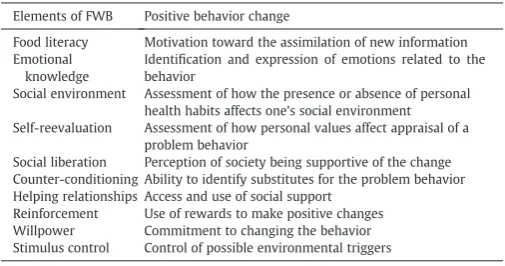
According to the Stages of Change Model (Prochaska & DiClemente, 1982), health behavior change progresses through stages: precontemplation, contemplation, preparation, action, and maintenance. Internal and external motivational variables influence consumers as they progress through the goals of adoption and maintenance of positive health behavior change.Table 1describes how FWB may be influenced by ten variables within the Stages of Change Model to promote a positive health behavior change (Prochaska, 1984 in Armitage, 2010). Research offers empirical evidence for the role these variables play in the context of adoption and maintenance of healthy eating habits. Commitment to health (Kelly, 2008) and self-reevaluation (Armitage, 2010) are key vari-ables that can move one to adopt and maintain positive dietary changes. Consumers can learn to recognize and regulate their emotions (emotional knowledge) in a way that promotes healthful food decision making (Peter & Brinberg, 2012). In addition,Brug (2008)applies the motivation–ability–opportunity model (Rothschild, 1999) to healthy eating and suggests the importance of considering attitudes and personal norms as variables influencingmotivation, and self-efficacy, skills, knowledge, and awareness as variables influencingability. Future research should explore in more detail how the Stages of Change Model may be used to advance FWB.
3.2. Environmental analysis of opportunity to change
Beyond the importance of considering individual variables that influence motivation and ability to advance FWB, environmental variables also shape a consumer's relationship with food. Specifically, physical (point-of-purchase), political (regulations), economic (cost), and socio-cultural (family and peer influences) variables represent key external variables affecting theopportunityto adopt and maintain healthy eating (Brug, 2008). For example, schools struggle to balance
the demands of parents and health advocates seeking affordable healthy choices that kids will actually eat. In schools, the oppor-tunities to adopt changes that advance FWB, even when ability and motivation are present, are often constrained by access tofinancial resources. Creating healthier food options often requires system-level efforts such as modifying educational environments or neigh-borhood commercial structures to encourage the provision of healthy offerings. Understanding the factors affecting consumer motivation, ability, and opportunity to change will help practitioners and policymakers make more effective use of research to motivate con-sumer choices that advance FWB.
4. Deliberative and automatic influences
Once consumers assess their starting point on the FWB continuum and possess the requisite motivation, opportunity, and ability to advance, they may tap into a plethora of research on food decision making to advance on the FWB continuum. Prior research has identi-fied a wide array of factors that influence food choices. Next, we discuss cognitive and emotional influences that can impact food deci-sions. Specifically, consumers may harness these influences to help them take deliberative steps to advance FWB by forming healthy habits. In addition, consumers may increase their awareness of auto-matic influences, particularly those that negatively impact FWB, and become more mindful about the choices they make.
4.1. Deliberative influences
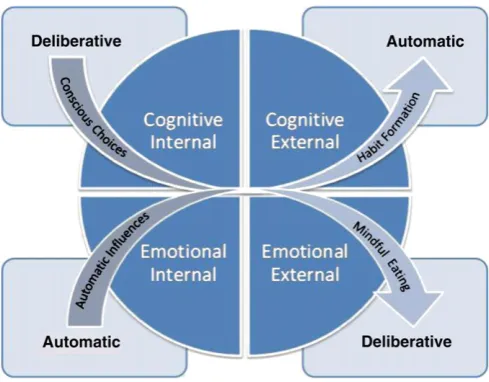
Food-rich environments provide consumers with a multitude of food choices, including choices that will help them accomplish, and others that will undermine FWB goals. The assumption is that consumers have the knowledge required to interpret the complexity of information presented and the motivation to use that information to facilitate healthy choices. Deliberative influences based on cogni-tive (e.g., consumer motivation) or emotional (e.g., consumer emo-tional intelligence) underpinnings interact with variables internal to the consumer (e.g., consumer knowledge) or externally present in the decision making environment (e.g., social others).Fig. 1shows how consumers may be empowered to use the cognitive and emo-tional influences described in this section strategically to advance FWB by taking steps to internalize positive influences and form healthy habits.
4.1.1. Cognitive influences
The cognitive aspects of deliberative processing explain how one mightthink it throughwhen making decisions by considering readily available information. Mindfully evaluating food options can reduce biased inference-making with respect to foods and lead to more healthful choices (Chandon & Wansink, 2007a; Irmak, Vallen, & Robinson, 2011). However, obsessive thinking about food may also lead to rebound effects that trigger some consumers to select indul-gent foods (Bublitz et al., 2010). Both internal and external cognitive information influence the decisions consumers make.
Internal states impact the manner in which consumers process food-related information. Research identifies consumer knowledge and motivation to process nutrition information as key drivers in how consumers use this information (Moorman, 1990). In general, knowledge leads to more informed choices. Greater objective food knowledge (e.g., fat content of a food) results in better interpretation of nutrition-related content claims (Andrews, Netemeyer, & Burton, 1998). Greater subjective food knowledge (i.e., consumer confidence in their knowledge and ability to use that information when making food decisions) leads consumers to selectively search for information consistent with their knowledge and facilitates healthful food choices (Moorman, Diehl, Brinberg, & Kidwell, 2004). However, deciphering nutritional information is a challenging and complicated task at Table 1
Using the Stages of Change Model to advance FWB.
Elements of FWB Positive behavior change
Food literacy Motivation toward the assimilation of new information Emotional
knowledge
Identification and expression of emotions related to the behavior
Social environment Assessment of how the presence or absence of personal health habits affects one's social environment Self-reevaluation Assessment of how personal values affect appraisal of a
problem behavior
Social liberation Perception of society being supportive of the change Counter-conditioning Ability to identify substitutes for the problem behavior Helping relationships Access and use of social support
which even knowledgeable and motivated consumers such as doctors and nutritionists sometimes fail (Block & Peracchio, 2006). Addition-ally, nutrition motivation, such as interest in and consideration of information related to food consumption, enhances nutrition knowl-edge effects (Moorman & Matulich, 1993). The positive effects of knowledge and motivation may be particularly strong for those who are highly knowledgeable and highly motivated (i.e., the“nutrition elite”), relative to individuals who possess either low or moderate levels of knowledge or motivation (Andrews, Netemeyer, & Burton, 2009). These findings demonstrate the need to both educate and boost consumer confidence in using nutrition information to em-power consumers to make choices that advance FWB.
Cognitive cues stem from the external environment in which indi-viduals choose and consume foods. Product information including labels (Howlett, Burton, & Kozup, 2008; Moorman, 1996) and nutrition disclosures (Andrews et al., 1998) can aid consumers in forming accurate perceptions about the nutritional value of foods. However, such information can also bias inference-making when health cues lead consumers to believe that foods are healthier than they actually are. For instance,“low fat”claims often generate mis-perceptions of serving sizes and license consumers to eat more (Geyskens, Pandelaere, Dewitte, & Warlop, 2007; Wansink & Chandon, 2006). In addition, portion size information impacts per-ceptions of caloric content, such that consumers tend to underesti-mate calories for larger compared to smaller servings (Chandon & Wansink, 2007b). For some, consumption increases when foods are served in larger quantities (Wansink, 2004, 2006), when package cues suggest that a food is diet-appropriate (Scott, Nowlis, Mandel, & Morales, 2008), or when brand or product names imply healthful-ness (Chandon & Wansink, 2007a; Irmak et al., 2011). These external cues prompt judgments of healthfulness that influence consumption. By understanding external influences and cognitive biases, con-sumers may proactively make choices that advance, rather than undermine, FWB. For example,Chernev and Chandon (2011)report how using counterfactual thinking or strategies such as estimating the caloric content of individual parts of a meal rather than the meal as a whole can reduce estimation biases.
4.1.2. Emotional influences
To understand and promote a healthy relationship with food one must go beyond the consideration of cognitive information to evaluate how consumers use or fail to use emotional information in food consumption situations. Instead ofthinking it throughin a cognitive sense, consumers try to make decisions based onwhat feels right, or by making decisions based on emotional information. As with the
cognitive component, there are both internal and external influences on how emotions influence our decision making.
Recent research suggests that a consumer's ability to skillfully acquire, appraise, understand, and manage emotions in a purchase or consumption situation is highly beneficial (i.e., consumer emo-tional intelligence;Kidwell et al., 2008a). For example, the decision to order dessert after a meal may rely heavily on the internal emo-tions a person experiences as they contemplate the choice (Luce, 1998). An individual striving to eat better may anticipate feelings of guilt should they give in to the temptation to indulge. This guilt can lead to deeper feelings of regret, frustration, and even depression that can significantly impact that consumer's confidence in using emotional information to make good decisions (Kidwell et al., 2008b). Such at-risk individuals must be able to effectively assess how they might feel during and after consumption (Luce, Payne, & Bettman, 1999) and thereby balance their pleasure-seeking impulses via strategies such as developing self-reward goals (Ramanathan & Menon, 2006). Consumers who succeed in shifting their focus from the anticipated emotions of guilt and regret arising from feelings of satisfaction and goal achievement should they decide to resist the temptation may feel empowered to make a healthy choice.
Emotional components of deliberative processing external to the consumer suggest how social influence (Andreasen, 1995) and feelings of social support (Bagozzi, 2000; Brown & Reingen, 1987) influence choices. For example, consumers who are susceptible to the influence of others are more likely to consume foods they perceive will lead others to evaluate them positively, and avoid consuming foods they believe will lead others to evaluate them negatively (Burnkrant & Cousineau, 1975). In addition, the mere presence of others including both the physical size of those with whom we dine (McFerran, Dahl, Fitzsimons, & Morales, 2010) as well as the gender of our dining partners (Allen-O'Donnell et al., 2011) influences the quantity of food consumed. Consideration of how others evaluate our food choices and the subsequent emotions of feeling accepted as opposed to rejected or judged, demonstrate how external factors prompt emotional influences on food choices. Understanding how external emotional factors and social relationships impact food decisions may facilitate a healthy relationship with food.
4.2. Automatic influences
Many of our daily food choices are relatively low involvement decisions that occur automatically with little thought or consider-ation. Food decisions that occur outside of conscious awareness often rely on consumption norms and cues (Wansink & Cheney, 2005). In fact, some research suggests that the average consumer makes over 200 food decisions each day, most of them outside of conscious awareness (Furst, Conners, Bisogni, Sobal, & Falk, 1996; Wansink & Sobal, 2007). These automatic influences affect decision making through both cognitive (e.g., food labels) and emotional (e.g., food traditions) routes and may be internal (e.g., routines) or external (e.g., plate size) to the consumer.Fig. 1also depicts how recognizing the automatic influences that undermine healthy choices may help consumers identify situations where mindful eating may support their efforts to advance FWB.
4.2.1. Cognitive influences
the ability to tune into and interpret nutrition information also plays an important role in automatic choices by enabling the consumer to use available nutrition information, even though it operates automat-ically (Newman, 2000). Consumers automatically categorize products along both taste and health dimensions and form judgments using simple heuristics that guide their food choices. For example the “unhealthy = tasty intuition”(Raghunathan, Naylor, & Hoyer, 2006) prompts internal beliefs about food. However, consumers with high levels of nutrition consciousness are less susceptible to these heuristic biases when deciding how much to consume (Aydinoğlu & Krishna, 2011). Consumers may be trained to recognize persuasion attempts designed to prompt automatic perceptions of healthfulness for less healthy products so they can become more mindful of their food choices.
Many external factors automatically influence food evaluations and choices. The size, visibility, and fullness of food containers influence the amount of food consumed. For instance, the“bottomless-bowl” experi-ment demonstrates that participants who ate soup from a bowl that was secretly refilled during the study consumed 73% more soup than those eating from normal bowls (Wansink & Cheney, 2005). Similarly, consumers drink larger quantities of liquids from tall, thin glasses than short, wide glasses (Wansink & van Ittersum, 2003), and consume more food when using smaller rather than larger forks when they have a well-defined hunger goal (Mishra, Mishra, & Masters, 2012, study 1). Even the package shape (Raghubir & Krishna, 1999), picture placement (left vs. right) on a package (Deng & Kahn, 2009), the number of units displayed on a package (Madzharov & Block, 2010), the color of the food (Madzharov, Block, & Ramanathan, 2011), and size of the product label (Aydinoğlu & Krishna, 2011) can influence consumer judgments and consumption quantities. Understanding these automatic influences may encourage consumers to make small changes to their environment (e.g., using smaller plates) that reduce consumption.
4.2.2. Emotional influences
Research demonstrates that emotions can exert powerful effects on food choices. Emotions often occur spontaneously, without inten-tion, and may take precedence over cognitive information consumers consider when making food decisions (Shiv & Nowlis, 2004). For example, consumers often view food as a way to regulate mood and the notion of“comfort foods” is a testament to this effect (Wood, 2010). Studies show that comfort foods are consumed both in posi-tive (e.g., happy, jubilant) and negaposi-tive (e.g., sad, bored) emotional states (Wansink & Sangerman, 2000). Unfortunately, many comfort foods are not healthy choices, with potato chips, ice cream, cookies, and candy topping the list of comfort foods (Wansink & Sangerman, 2000). Similarly, food traditions (e.g., overeating at Thanksgiving) are often emotional triggers that contribute to the deleterious effects of“mindless eating” (Wallendorf & Arnould, 1991). Helping con-sumers recognize how positive and negative emotions influence their relationship with food may assist consumers in making positive dietary changes.
External influences such as attractive labels and emotion-laden words in advertisements for food elicit emotional responses that infl u-ence consumption. For example, using labels such as“Grandma's”or “homestyle”increase sales by as much as 27% due to the emotions (e.g., nostalgia) the label evokes (Wansink, Painter, & van Ittersum, 2001). Music prompts an emotional response that increases both the en-joyment of a dining experience and food consumption (Milliman, 1986). Similarly, when we see others enjoying food, a desire to share in that pleasure may influence food consumption (Raghunathan & Corfman, 2006). A healthy relationship with food involves allowances for foods that bring pleasure. However, automaticity in food decision making may trigger overconsumption if consumers are not aware of how emo-tions influence consumption. Research shows that nonconscious factors cue overeating and sedentary lifestyles (e.g., a habit of eating while watching television) (Rothman, Sheeran, & Wood, 2009). The problem
is exacerbated by the fact that consumers are often unwilling to acknowledge and recognize their own susceptibility even after these automatic influences are explained (Wansink & van Ittersum, 2005). Developing a healthy relationship with food involves adopting healthy habits that balance our desires for the foods and consumption scenarios we enjoy with the possible negative effects of overconsumption and indulgence.
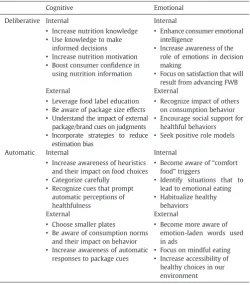
An intriguing opportunity for future investigations stems from research on the power of habits as consumers may be able to use these automatic processes to advance FWB. Habits are mechanisms consumers use to forgo deliberative, contemplative decisions to engage in healthy eating and use automaticity as a positive response. Research suggests that a wide range of health behaviors can be pre-dicted by the degree to which the behavior is habitual (Ouellette & Wood, 1998). Just as automatic influences sometimes result in poor food choices, automatic influences may also facilitate healthier eating decisions (e.g., making it a habit to drink a full glass of water before each meal; choosing a smaller plate). As consumers begin to under-stand how automatic processes impact their food choices, they can strategically use this information to advance FWB. For instance, if parents understand that children consume easily accessible foods more frequently and in greater quantities than inaccessible food (Engell, Kramer, Malafi, Salomon, & Lesher, 1996) they might keep a fruit bowl on the counter and chips in a cabinet out of sight.Table 2 summarizes the strategies outlined in this section and illuminates how research on deliberative and automatic influences may be used to advance FWB.
4.3. Interaction of deliberative and automatic influences
Ultimately, the hundreds of food-related decisions consumers make each day do not occur in isolation. Deliberative efforts to utilize cogni-tive resources to make better food choices may be interrupted by an emotion automatically prompted during a consumption situation. For example, consumers monitoring their food consumption using a food diary may suddenly abandon this healthy habit when they are invited out to a celebratory dinner. To complicate matters, consumers often alternate between healthy and hedonic goals they hold simultaneously. Research demonstrates that achieving progress toward one goal such as making a healthy choice (Fishbach & Dhar, 2005), remembering a prior healthy decision (Mukhopadhyay, Sengupta, & Ramanathan, 2008), or simply having the opportunity to make a healthy choice (Wilcox, Vallen, Block, & Fitzsimons, 2009) may trigger rebound effects as consumers reward themselves and move in the opposite direction. In addition, consumers often forego decisions that positively affect their long-term health and well-being for a choice that immediately satisfies a hedonic desire as they are disproportionally attracted to more imme-diate goals (Fishbach, 2009). Training consumers to place more em-phasis on the future consequences and risks of immediate choices may encourage healthy behaviors (e.g.,Kees, Burton, & Heintz, 2010). Future research should consider how deliberative and automatic factors compete to influence consumption as well as how situational, temporal, and contextual factors interact to influence consumption. FWB may serve as an anchor to measure the behavioral implications of the interactive effects of deliberative and automatic influences on food consumption.
nutrition labels that show the nutrition profile for a single serving together with the nutrition profile for consuming the entire package has been shown to prompt non-dieting consumers to reduce their consumption (Antonuk & Block, 2006). A shift from operating on autopilot to actively deliberating the amount to consume may explain consumption differences. However, dieters in this study (Antonuk & Block, 2006) did not respond in a similar fashion perhaps because they already pay attention to portion size. In this way, indi-vidual difference variables together with situational consumption influences may prompt different results as consumers attempt to strategically manage automatic and deliberative influences to make healthy food choices.
Thoughts about food stem from multiple sources and often con-flict as consumers pursue both healthy and hedonic goals. Research efforts often attempt to isolate and examine separate influences on consumption. However, food decision making involves a complex web of influences. Future research should seek to better understand the joint effects of the multiple and sometimes conflicting influences on food decisions. Development of a comprehensive tool to measure FWB may provide a way to link specific influences on consumption, as well as the interaction of these deliberative and automatic infl u-ences, to overall FWB for various segments of consumers (Bublitz et al., 2012). Armed with options to make small changes designed to advance FWB, consumers can explore and utilize strategies that motivate their individual progress and promote a positive change.
5. Conclusions
During the 2011 TCR Conference, we worked to advance FWB at the individual level. We propose a framework that researchers, policymakers, and industry leaders can use to develop strategies to help consumers advance FWB. However, a significant amount of work is required. First, we need to develop and validate an overall measure to help consumers assess their starting point on the FWB continuum (Bublitz et al., 2012). Understanding consumer goals as
well as motivation and readiness to change will improve our under-standing of how to motivate progress along the FWB continuum. Measuring FWB at a specific point should also include an individual's subjective assessment of his/her own relationship with food as well as objective measures of his/her health and well-being. Much of this article is devoted to summarizing how deliberative and automatic influences on food decision making may be used strategically by consumers to advance along the FWB continuum. We conclude with an examination of how researchers, policymakers, and industry managers might use this information to help consumers in their efforts to advance FWB.
5.1. Implications for research, policymakers, and industry
A FWB measurement tool that is convenient to use (e.g., kiosks, web-based, mobile applications) will expand the opportunities for consumers to undertake a personal FWB assessment and track their progress to advance FWB. However, it is important that any tool developed take caution to measure a consumer's relationship with food in a way that promotes the holistic, integrative, and positive vision for the construct of FWB (Block et al., 2011) and does not focus on paternalistic and restriction measures that currently plague many health assessment tools. Developing and using a FWB measure-ment tool would allow consumers to assess the impact of small changes in lifestyle and habits that either deliberatively or automati-cally influence their path toward FWB. The same tool designed to assess individual levels of FWB may be used in aggregate to examine group level trends important to researchers, policymakers, health professionals, and industry managers. For example, researchers may work to better understand how different groups of consumers respond to influences on food decision making. Policymakers may be particularly interested in how to advance the FWB of vulnerable populations such as children and those in poverty. Health profes-sionals may use this type of tool to help guide patients at risk for a growing number of diseases related to obesity to promote a positive change. Industry may benefit from the development of products and services specifically designed to help consumers advance along the FWB continuum. Creating a dialogue between consumers, re-searchers, policymakers, and practitioners that explores which strat-egies work for different groups of consumers will enhance our collective FWB.
Policymakers may also benefit from looking at aggregate FWB data. A comparison of an individual's subjective assessment of his/her own FWB with more objective health indicators for subsets of the population may suggest important educational opportunities. Understanding the determinants of FWB may provide insight into how regulations can affect FWB. For example, research demonstrates that restrictions on advertising to children in Quebec, Canada decreased fast-food con-sumption by as much as 13% (Dhar & Baylis, 2011). Denmark implemented an added tax on foods with high levels of saturated fat while France and Greece are considering additional taxes on sugary beverages (Bittman, 2011). As these policies proliferate, research should explore how such interventions affect FWB, as well as how they impact healthcare costs. Using a common measure of FWB to judge the impact of regulations, education, and other systemic changes designed to enhance FWB provides a valuable benchmark to compare efforts to advance FWB.
Developing and perfecting the measurement and usage of FWB must involve experts from the health sector ranging from physicians to school nurses, from community health advocates to the private health promotion industry. Research and development should take pains to make the FWB tool useful for these audiences. Field trials in the medical community can provide feedback on which interventions work best for different groups of consumers depending on their indi-vidual starting point on the FWB continuum as well as their motiva-tion to change. Tools that measure global self-rated health may Table 2
A taxonomy of strategies for advancing FWB.
Cognitive Emotional
Deliberative Internal
• Increase nutrition knowledge • Use knowledge to make
informed decisions • Increase nutrition motivation • Boost consumer confidence in using nutrition information
Internal
• Enhance consumer emotional intelligence
• Increase awareness of the role of emotions in decision making
• Focus on satisfaction that will result from advancing FWB External
• Leverage food label education • Be aware of package size effects • Understand the impact of external
package/brand cues on judgments • Incorporate strategies to reduce
estimation bias
External
• Recognize impact of others on consumption behavior • Encourage social support for
healthful behaviors • Seek positive role models
Automatic Internal
• Increase awareness of heuristics and their impact on food choices • Categorize carefully
• Recognize cues that prompt automatic perceptions of healthfulness
Internal
• Become aware of“comfort food”triggers
• Identify situations that to lead to emotional eating • Habitualize healthy
behaviors External
• Choose smaller plates • Be aware of consumption norms
and their impact on behavior • Increase awareness of automatic
responses to package cues
External
• Become more aware of emotion-laden words used in ads
• Focus on mindful eating • Increase accessibility of
provide a working model on how to create measures with practical use for industry and consumers (Fayers & Sprangers, 2002). The more that researchers and practitioners work together in developing a comprehensive measurement tool, the higher the likelihood that the result will be a credible tool that consumers, policymakers, and practitionersfind useful for assessing and advancing FWB.
References
Allen-O'Donnell, M., Cottingham, M. D., Nowak, T. C., & Snyder, K. A. (2011). Impact of group settings and gender on meals purchased by college students.Journal of Applied Psychology,41(9), 2,268–2,283.
Andreasen, A. R. (1995).Marketing social change: Changing behavior to promote health, social development, and the environment.San Francisco, CA: Jossey-Bass. Andrews, J. C., Burton, S., & Kees, J. (2011). Is simpler always better? Consumer evaluations
of front-of-package nutrition symbols.Journal of Public Policy & Marketing,30(2), 175–190.
Andrews, J. C., Netemeyer, R. G., & Burton, S. (1998). Consumer generalization of nutrient content claims in advertising.Journal of Marketing,62(4), 62–75.
Andrews, J. C., Netemeyer, R. G., & Burton, S. (2009). The nutrition elite: Do only the highest levels of caloric knowledge, obesity knowledge, and motivation matter in processing nutrition ad claims and disclosures?Journal of Public Policy & Marketing, 28(1), 41–55.
Antonuk, B., & Block, L. G. (2006). The effect of single serving versus entire package nutritional information on consumption norms and actual consumption of a snack food.Journal of Nutrition Education and Behavior,38(6), 365–370. Armitage, C. J. (2010). Can variables from the transtheoretical model predict dietary
change?Journal of Behavioral Medicine,33(4), 264–273.
Aydinoğlu, N. Z., & Krishna, A. (2011). Guiltless gluttony: The asymmetric effect of size labels on size perceptions and consumption.Journal of Consumer Research,37(6), 1095–1112.
Bagozzi, R. P. (2000). On the concept of intentional social action in consumer behavior. Journal of Consumer Research,27(3), 388–396.
Baker, D. W. (2006). The meaning and measure of health literacy.Journal of General Internal Medicine,21(8), 878–883.
Baumeister, R. F., Campbell, J. D., Krueger, J. I., & Vohs, K. D. (2003). Does high self-esteem cause better performance, interpersonal success, happiness or healthier lifestyles. Psychological Science in the Public Interest,4(1), 1–44.
Bittman, M. Bad food? Tax it, and subsidize vegetables. http://www.nytimes.com/ 2011/07/24/opinion/Sunday/24bittman.html?pagewanted=all The New York Times 2011, July 23 accessed Nov 1, 2011.
Block, L. G., Grier, S. A., Childers, T. L., Davis, B., Ebert, J. E. J., Kumanyika, S., et al. (2011). From nutrients to nurturance: A conceptual introduction to food well-being.Journal of Public Policy & Marketing,30(1), 5–13.
Block, L. G., & Peracchio, L. A. (2006). The calcium quandary: How consumers use nutrition labels.Journal of Public Policy & Marketing,25(2), 188–196.
Brown, J. J., & Reingen, P. H. (1987). Social ties and word-of-mouth referral behavior. Journal of Consumer Research,14(3), 350–362.
Brug, J. (2008). Determinants of healthy eating: Motivation, abilities and environmental opportunities.Family Practice,25(Suppl. 1), i50–i55.
Bublitz, M. G., Peracchio, L. A., Andreasen, A. A., Kees, J., Kidwell, B., Miller, E. G., et al. (2012). The quest for eating right: Advancing food well-being.Journal of Consumer Research,19, 1–7.
Bublitz, M. G., Peracchio, L. A., & Block, L. G. (2010). Why did I eat that? Perspectives on food decision making and dietary restraint.Journal of Consumer Psychology,20(3), 239–258.
Burnkrant, R. E., & Cousineau, A. (1975). Informational and normative social influence in buyer behavior.Journal of Consumer Research,2(3), 206–215.
Burton, S., Creyer, E., Kees, J., & Huggins, K. (2006). Attacking the obesity epidemic: The potential health benefits of providing nutrition information in restaurants.American Journal of Public Health,96(9), 1669–1675.
Chandon, P., & Wansink, B. (2007a). The biasing health halos of fast-food restaurant health claims: Lower calorie estimates and higher side-dish consumption intentions. Journal of Consumer Research,34(3), 301–314.
Chandon, P., & Wansink, B. (2007b). Is obesity caused by calorie underestimation? A psychophysical model of meal size estimation.Journal of Marketing Research,44(1), 84–99.
Chernev, A., & Chandon, P. (2011). Calorie estimation biases in consumer choice. In R. Batra, P. A. Keller, & V. J. Strecher (Eds.),Leveraging consumer psychology for effective health communications(pp. 104–121). Armonk, NY: M.E. Sharpe.
Deng, X., & Kahn, B. E. (2009). Is your product on the right side? The“location effect”on perceived product heaviness and package evaluation.Journal of Marketing Research, 46(6), 725–738.
Dhar, T., & Baylis, K. (2011). Fast-food consumption and the ban on advertising targeting children: The Quebec experience.Journal of Marketing Research,48(5), 799–813.
Engell, D., Kramer, M., Malafi, T., Salomon, M., & Lesher, L. (1996). Effects of effort and social modeling on drinking in humans.Appetite,26(2), 129–138.
Fayers, P. M., & Sprangers, M. A. G. (2002). Understanding self-rated health.Lancet, 359(9302), 187.
Fishbach, A. (2009). The function of value in self-regulation.Journal of Consumer Psychology,19(2), 129–133.
Fishbach, A., & Dhar, R. (2005). Goals as excuses or guides: The liberating effect of perceived goal progress on choice.Journal of Consumer Research,32(3), 370–377. Furst, T., Conners, M., Bisogni, C. A., Sobal, J., & Falk, L. W. (1996). Food choice: A
conceptual model of the process.Appetite,26(3), 247–266.
Geyskens, K., Pandelaere, M., Dewitte, S., & Warlop, L. (2007). The backdoor to overconsumption: The effect of associating‘low-fat’food with health references. Journal of Public Policy & Marketing,26(1), 118–125.
Gottfried, M. (2010). A taste for hotter, mintier, fruitier: The increased craving for intenseflavors suggests that the American palate is changing.Wall Street Journal, 255(122), D1,D6.
Hayes, D., & Ross, C. E. (1987). Concern with appearance, health beliefs, and eating habits.Journal of Health and Social Behavior,28(2), 120–130.
Heatherton, T. E., Polivy, J., & Herman, C. P. (1991). Restraint, weight loss, and variability in body weight.Journal of Abnormal Psychology,100(1), 78–83.
Howlett, E., Burton, S., & Kozup, J. (2008). How modification of the nutrition facts panel influences consumers at risk for heart disease: The case of trans fat.Journal of Public Policy & Marketing,27(1), 83–97.
Irmak, C., Vallen, B., & Robinson, S. R. (2011). The impact of product name on dieters' and nondieters' food evaluations and consumption.Journal of Consumer Research, 38(2), 390–405.
Kees, J., Burton, S., & Heintz, A. T. (2010). The impact of regulatory focus, temporal orientation, andfit on consumer responses toward health-related advertising. Journal of Advertising,39(1), 19–34.
Kelly, C. (2008). Commitment to health theory.Research and Theory for Nursing Practice,22(2), 148–160.
Kemper, K. A., Sargent, R. G., Drane, J. W., Valois, R. F., & Hussey, J. (1994). Black and white females' perceptions of ideal body size and social norms.Obesity Research,2, 117–126. Kidwell, B., Hardesty, D. M., & Childers, T. L. (2008a). Consumer emotional intelligence: Conceptualization, measurement, and the prediction of consumer decision making. Journal of Consumer Research,35(1), 154–166.
Kidwell, B., Hardesty, D. M., & Childers, T. L. (2008b). Emotional calibration effects on consumer choice.Journal of Consumer Research,35(4), 611–621.
Luce, M. F. (1998). Choosing to avoid: Coping with negatively emotion-laden consumer decisions.Journal of Consumer Research,24(4), 409–433.
Luce, M. F., Payne, J. W., & Bettman, J. R. (1999). Emotional trade-off difficulty and choice.Journal of Marketing Research,36(2), 143–159.
MacInnis, D. J., Moorman, C., & Jaworski, B. J. (1991). Enhancing and measuring consumers' motivation, opportunity, and ability to process brand information from ads.Journal of Marketing,55(4), 32–53.
Madzharov, A., & Block, L. (2010). Effects of product unit image on consumption of snack foods.Journal of Consumer Psychology,20(4), 398–409.
Madzharov, A., Block, L., & Ramanathan, S. (2011).Effects of product color brightness on food consumption.Washington D.C.: Marking and Public Policy Conference. McFerran, B., Dahl, D. W., Fitzsimons, G. J., & Morales, A. C. (2010). I'll have what she's
having: Effects of social influence and body type on the food choices of others. Journal of Consumer Research,36(6), 915–929.
Mela, D. J. (2006). Eating for pleasure or just wanting to eat? Reconsidering sensory hedonic responses as a driver of obesity.Appetite,47(1), 10–17.
Mick, D. G. (2006). Presidential address: Meaning and mattering through transformative consumer research.Advances in Consumer Research,33, 1–4.
Milliman, R. E. (1986). The influence of background music on the behavior of restaurant patrons.Journal of Consumer Research,13(2), 286–289.
Mishra, A., Mishra, H., & Masters, T. (2012). The influence of bite-size on quantity of food consumed: Afield study.Journal of Consumer Research,38(5), 791–795. Moorman, C. (1990). The effects of stimulus and consumer characteristics on the utilization
of nutrition information.Journal of Consumer Research,17(3), 362–374.
Moorman, C. (1996). A quasi-experiment to assess the consumer and informational determinants of nutrition information processing activities: The case of the nutri-tion labeling and educanutri-tion act.Journal of Public Policy & Marketing,15(1), 28–44. Moorman, C., Diehl, K., Brinberg, D., & Kidwell, B. (2004). Subjective knowledge, search
locations and consumer choice.Journal of Consumer Research,31(3), 673–680. Moorman, C., & Matulich, E. (1993). A model of consumers' preventive health behaviors:
The role of health motivation and health ability.Journal of Consumer Research,20(2), 208–228.
Motley, C. M., & Perry, V. G. (2009). Home for dinner: Exploring family food traditions. In C. David Shepherd (Ed.),Enriching theoretical and practical understanding of marketing. Proceedings of the 2009 Annual Association for Mark Theory and Practice Conference, Georgia Southern University: Statesburo, GA,18. (pp. 125).
Mukhopadhyay, A., Sengupta, J., & Ramanathan, S. (2008). Recalling past temptations: An information-processing perspective on the dynamics of self-control.Journal of Consumer Research,35(4), 586–599.
Newman, M. A. (2000).Health as expanding consciousness.Sudbury, MA: Jones and Bartlett Publishers.
Ouellette, J. A., & Wood, W. (1998). Habit and intention in everyday life: The multiple processes by which past behavior predicts future behavior.Psychological Bulletin, 124(1), 54–74.
Peter, P. C., & Brinberg, D. (2012). Learning emotional intelligence: An exploratory study in the domain of health.Journal of Applied Social Psychology,42(6), 1394–1414. Prentice, A. M., & Jebb, S. A. (2001). Beyond body mass index.Obesity Reviews,2, 141–147. Prochaska, J. O., & DiClemente, C. C. (1982). Transtheoretical therapy: Toward a more integrative model of change.Psychotherapy Theory Res Practice,19(3), 276–288. Raghubir, P., & Krishna, A. (1999). Vital dimensions in volume perception: Can the eye
fool the stomach?Journal of Marketing Research,36(3), 313–326.
Raghunathan, R., Naylor, R. W., & Hoyer, W. D. (2006). The unhealthy = tasty intuition and its effects on taste inferences, enjoyment, and choice of food products.Journal of Marketing,70(4), 1–6.
Ramanathan, S., & Menon, G. (2006). Time-varying effects of chronic hedonic goals on impulsive behavior.Journal of Marketing Research,43(4), 628–641.
Roth, D. A., Herman, C. P., Polivy, J., & Pliner, P. (2001). Self-presentational conflict in social eating situations: A normative perspective.Appetite,36(2), 165–171. Rothman, A. J., Sheeran, P., & Wood, W. (2009). Reflective and automatic processes in
the initiation and maintenance of dietary change.Annals of Behavioral Medicine, 38, S4–S17.
Rothschild, M. L. (1999). Carrots, sticks, and promises: A conceptual framework for the management of public health and social issue behaviors.Journal of Marketing, 63(4), 24–37.
Rucker, C. E., III, & Cash, T. F. (1992). Body images, body-size perceptions, and eating behaviors among African-American and while college women.International Journal of Eating Disorders,12(3), 291–299.
Scott, M. L., Nowlis, S. M., Mandel, N., & Morales, A. C. (2008). The effects of reduced food size and package size on the consumption behavior of restrained and unrestrained eaters.Journal of Consumer Research,35(3), 391–405.
Shiv, B., & Nowlis, S. M. (2004). The effect of distractions while tasting a food sample: The interplay of informational and affective components in subsequent choice. Journal of Consumer Research,31(3), 599–608.
Stroebe, W., Papies, E. K., & Aarts, H. (2008). From homeostatic to hedonic theories of eating: Self-regulatory failure in food-rich environments.Applied Psychology: An International Review,57, 172–193.
Vallis, M., Ruggiero, L., Greene, G., Jones, H., Zinman, B., Rossi, S., et al. (2003). Stages of change for healthy eating in diabetes relation to demographic, eating-related, health care utilization, and psychosocial factors.Diabetes Care,25(5), 1468–1474. Wallace, L. S., Rogers, E. S., Roskos, S. E., Holiday, D. B., & Weiss, B. D. (2006). Screening
items to identify patients with limited health literacy skills.Journal of General Internal Medicine,21(8), 874–877.
Wallendorf, M., & Arnould, E. J. (1991). We gather together: Consumption rituals of Thanksgiving day.Journal of Consumer Research,18(1), 13–31.
Wansink, B. (2004). Environmental factors that increase the food intake and consump-tion volume of unknowing consumers.Annual Review of Nutrition,24, 455–479. Wansink, B. (2006).Mindless eating: Why we eat more than we think.New York:
Bantam-Dell.
Wansink, B., & Chandon, P. (2006). Can‘low-fat’nutrition labels lead to obesity?Journal of Marketing Research,43(4), 605–617.
Wansink, B., & Cheney, M. M. (2005). Super bowls: Serving bowl size and food consumption.Journal of the American Medical Association,293(14), 1727–1728. Wansink, B., Painter, J. M., & van Ittersum, K. (2001). Descriptive menu labels' effect on
sales.The Cornell Hotel and Restaurant Administration Quarterly,42(6), 68–72. Wansink, B., & Sangerman, C. (2000). The taste of comfort.American Demographics,
22(7), 66–67.
Wansink, B., & Sobal, J. (2007). Mindless eating: The 200 daily food decisions we overlook. Environment and Behavior,39(1), 106–123.
Wansink, B., & van Ittersum, K. (2003). Bottoms up! The influence of elongation on pouring and consumption volume.Journal of Consumer Research,30(3), 455–463. Wansink, B., & van Ittersum, K. (2005). Shape of glass and amount of alcohol poured: Comparative study of the effects of practice and concentration.British Medical Journal,331(7531), 1512–1514.
Wilcox, K., Vallen, B., Block, L., & Fitzsimons, G. J. (2009). Vicarious goal fulfillment: When the mere presence of a healthy option leads to an ironically indulgent deci-sion.Journal of Consumer Research,36(3), 380–393.