ANGEL INVESTMENT AND KOSOVO’S EARLY-STAGE MARKET:
A PROMISING OPPORTUNITY?
Medina Braha
,
(PhD Candidate)University of Prishtina, Kosovo Republic
Abstract
The purpose of this paper is to analyze whether Angel Investment (AI) may serve as a suitable tool for the early-stage market of Kosovo. The activity of the Business Angel (BA) has experienced significant development lately, and moreover, supplementary attention by policymakers all over Europe and beyond. As a result, the BA community in Europe has published the Start-up Investor Manifesto in May 2014 aiming to adopt policies and actions towards the rise of entrepreneurship and innovation through the creation of 1.5 million new jobs in Europe by 2017. In addition, the Manifesto foresees enlargement of cross-border activity of BAs, including the emerging markets lying outside EU borders. Based on its increasing capacity and attention paid to, and on the fact that over 98% of registered Kosovar businesses are micro enterprises, AI may appear an appropriate instrument in advancing country’s early-stage market. Therefore, this paper intends to answer this interrogation by simultaneously studying the scientific arguments as well as best practices regarding AI both in developed and emerging markets. Accordingly it aims to provide a model on how the AI market could be developed in Kosovo.
Key Words:
Business Angel Investment, Early-Stage Market, Entrepreneurship, Funding
1.
Introduction
This paper investigates how Angel Investing (AI) could potentially benefit the early-stage market of Kosovo. The analysis is made based on four sources of knowledge with regard to the activity of the Business Angel (BA), namely based on review of scientific works, study of up-to-date BA best practices (primarily from BAs operating in USA and EU), other review of other researches made from organizations such as EBAN, OECD and the World Bank, and the author’s own knowledge built from personal research as well as direct observation of and communication with BAs during the two-year period that she has been part of EBAN. As a result, this study considers the opportunity to identify and propose a model for enhancing BA activity in Kosovo.
The first part of this work provides a brief introduction on what AI is and shortly describes how BAs function and get organized. Section two talks about the AI market and explains difficulties associated with the visibility of this market in its entirety. The role of AI investing, the early-stage market of Kosovo, and the importance of the former for the latter are discussed in the third section of this paper. Finally, the last part consists of conclusive remarks and recommendations on how Kosovo could develop and potentially benefit from its AI market.
2. Angel Investing
BAs take high-risk investment and require fast-growing enterprises and, as other investors, their investments too are organized in portfolios. Nevertheless, their main characteristic is that they invest much more than their funds. Once having selected a deal, a BA provides mentorship to the entrepreneur based on the former’s business experiences and successes. Thus, know-how is provided as well. In addition, the entrepreneur gets introduced with BA’s network which is, generally, both of high volume and quality. Therefore, for a new entrepreneur this social capital often appears to be more valuable than cash itself (OECD, 2011). BAs are also known to intensively share knowledge among each-other in order to enhance their decision-making quality, and hence, select more promising entrepreneurs to invest in their ideas as well as mentor more effectively the selected enterprises (Smith et al., 2010). In other words, BAs seem rather having a sharing approach.
Besides investing individually, group investing among BAs has gained increased popularity lately. However, according to Mason and Harrison (2013) scholars seem to ignore this alteration trend of how BAs get organized. The structure of such groups can start from an informal cluster (containing just a few privately assembled BAs), up to a formally structured network, known as Business Angels Network (BAN). BANs are an excellent form of synergy in the AI market, since they assemble funds, knowledge, skills, experiences and networks as well as reduce their members’ investment risk. Moreover, BANs are more easily accessible for entrepreneurs and their power increases compared to individual BA with regard to both greater investment efficiency and economical and political influence
Although such integration into BA groups has resulted in drop of investments up to £50,000 (crowdfunding is expected to fill this gap anyway), they keep on assembling additional capital (Mason and Harrison, 2013). An increasing in popularity joint-investing method used more intensively by BAs recently is the co-investment fund. As an investment mechanism a co-investment fund is mainly a product of a public-private partnership between BAs and public money managers, i.e. State/Government, with the intention of jointly funding early stage ventures (EBAN, 2014a; 2015a). Especially governments of developed economies are paying more and more attention to this form of investment and are deciding to co-invest with BAs since such investment aims to increase the funds available to high-potential entrepreneurial ideas.
3. Angel Investment Market
Lack of data is one of the main challenges experienced when conducting research in the field of AI for two main reasons. Firstly, BAs have traditionally kept confidential their investment activity. They are individual investors who usually deal personally with their angel activity, from finding potential deals and through the whole process until the exit stage. A second reason of the data absence is the non-standardization of definitions. Angel investment, business angel, investor, informal investor all are often used interchangeably, complicating data analyzing between different studies (OECD, 2011).
Estimations indicate there are around 75000 BAs in Europe (for comparison it is estimated that there are around 250000 BAs in U.S.) who invest about €4 billion in total a year (OECD, 2011). Regarding the number of BANs, EBAN (2014d) reported an average increase of 17% over the past 10 years to 431 BANs in Europe in 2013, with estimated investments – by the approximately 28000 BAN members – of €5554 million. Most of the BA activity within the EU is concentrated in UK, France, Germany, and The Netherlands (EBAN, 2014a: 2015a). Overall, the BA activity is continuing to experience expansion in the traditional markets as well as evolving trends in emerging ones.
Figure 1. Visibility of the Angel Market
Source: Harrison and Mason (2010)
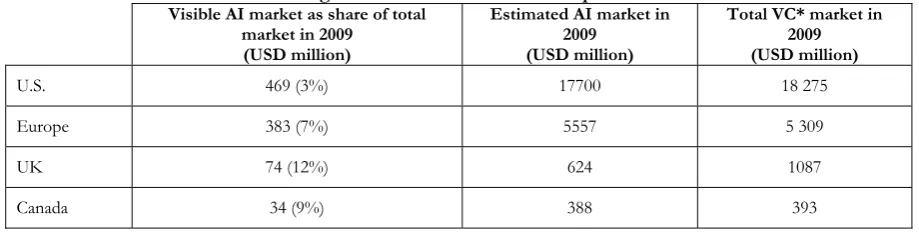
Table 1 illustrates the visible and estimated market of BAs for USA, Europe, UK, and Canada as well as their respective VC market. In line with Harrison and Mason’s (2010) arguments, data presented in this table illustrates the enormousness of estimated AI invisible market. According to this data, the largest visible AI market, that of UK, is merely 12% whereas all other markets score less than 10% in this estimation. Such magnitude of discrepancy may have numerous implications with respect to unused potential of AI market both in terms of research possibilities as well as share of practical knowledge and successes. In addition, there is always a risk of overseeing many important issues when carrying out such estimations. The present techniques of estimating the whole market size fluctuate immensely and are “more art than science” (OECD, 2011).
Table 1. Angel Investment and Venture Capital Markets
Visible AI market as share of total market in 2009
(USD million)
Estimated AI market in 2009
(USD million)
Total VC* market in 2009 (USD million)
U.S. 469 (3%) 17700 18 275
Europe 383 (7%) 5557 5 309
UK 74 (12%) 624 1087
Canada 34 (9%) 388 393
*Includes all stages (seed, start-up, early, expansion, and later) of VC investments.
Source: OECD (2011). Financing High Growth Firms: The Role of Angel Investors
4. Angel Investing’s Potential for Kosovo’s Early-stage Market
Role of Angel Investing
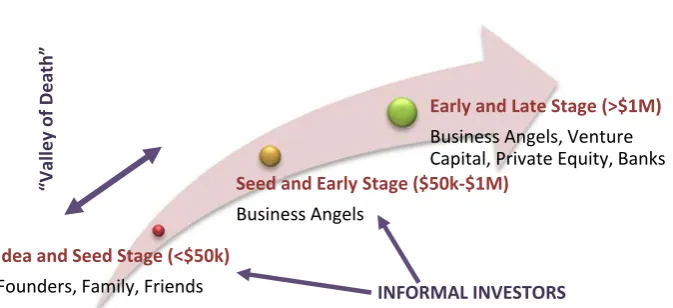
The crucial importance of BAs for an ecosystem lies in that they narrow the capital gap between formal investment (bank, VC etc.) and informal investment (savings, family and friends etc.), especially when taking into account that this gap was widened during the latest financial crisis. The World Bank (2013) defines this gap in funding between what family and friends are able to provide and what VCs and private equity firms are willing to invest, to be between $50000 and $1 million. This gap is also known as the Valley of Death in the sense that many businesses cease to exists exactly due to lack of funds falling in this range. Similarly, OECD (2011) classifies BAs in the group of informal investors together with founders, family and friends, whereas Venture Capital Funds are regarded as formal investors.
Figure 2. Financing Gap
Source: Adapted from OECD (2011) Financing High Growth Firms: The Role of Angel Investors and The World Bank (2013). Creating Your Own Angel Investor Group: A Guide for Emerging and Frontier Markets.
In addition to softening the Valley of Death, BAs invest in higher-risk projects and wider range of innovations compared to VCs (OECD, 2011; The World Bank, 2013). Furthermore, BAs appear to be less vulnerable to business cycles and the total AI market in USA and Europe is estimated to be larger than that of VCs (OECD, 2011). AI results in also contributing to employment. Research in U.S. indicates that start-ups funded by BAs generated around 4.1 jobs per deal or about 274800 new jobs in 2012 (Sohl, 2012). It is important to highlight that, especially in emerging markets, Diaspora community plays a significant role. “Diaspora communities are a source of pride and financial resources for many emerging economies and an important population for angel groups to consider when seeking members” (The World Bank, 2013, p.33).
It should, however, be noted that BAs also require relatively high standards in return for their funds from entrepreneurs who pitch them. In broad lines, in compensation to their investment, BAs expect practically executed business models, skilled entrepreneurs able to build an effective team, satisfying return on their investment through high-growth ventures, and – a very important aspect often neglected by entrepreneurs – successful exits. Exists usually include management buyout (MBO) or selling their shares to other BAs or VC companies. Only occasionally exits end up in Initial Public Offering (IPO). According to Mason and Stark (2004), BAs pay more attention to the investor-entrepreneur fit than VC fund managers do. Correspondingly, Sudek (2006) identifies BAs’ top criteria in taking an investment decision as being the lead entrepreneur’s enthusiasm, quality of management team, trustworthiness of entrepreneur, and exit possibilities.
Social capital is a distinctive feature of BAs and one of the main benefits entrepreneurs receive from this type of funding. Besides being valued by entrepreneurs as being sometimes even more important than the funding itself (OECD, 2011), research on French enterprises suggests that entrepreneurs may be affected by BAs even when they have no contractual agreement yet due to the trust they have in BAs’ accumulated explicit and tacit knowledge and experience (Certhoux and Perrin, 2013). Further, Festel and Kratzer (2012), by focusing their investigation on the high-tech industry, based on BAs’ very active being in such industry, argue that BA investment model appears to have growing start-up activity potential, above all at research establishments and universities. Overall, Kerr et al. (2010), based on their research of 87 high-tech and low-tech American companies, conclude that BA’s package of input to the start-up appears vital for the survival and overall success of that enterprises. Furthermore, BAs themselves claim they enormously enjoy this way of investing – offering more to the entrepreneurs in addition to their funds – and like contributing to their ecosystem (Rose, 2014). Additionally, AI is also considered to be more sustainable. Kerr et al. (2010), find that U.S. angel-funded start-ups experience greater probability in surviving and having a faster growth; their performance improvement reaches an average increase of 30-50%. On the whole, the results suggest that the bundle of inputs angel investors provide has large and significant impact on the success and
Idea and Seed Stage (<$50k)
Founders, Family, Friends
Seed and Early Stage ($50k-$1M)
Business Angels
Early and Late Stage (>$1M)
Business Angels, Venture Capital, Private Equity, Banks
“Valley of
Dea
th”
survival of start-ups. Accordingly, the overall influence of BAs has seen increasing trends, from an expansion of AI activity to more attention received by media which was almost inexistent a decade ago. Moreover, the total amount of capital provided by BAs has constantly exceeded the total amount invested by VCs, namely it is estimated they invest about $190 billion annually in early-stage ventures in 29 countries (Megginson, 2004).
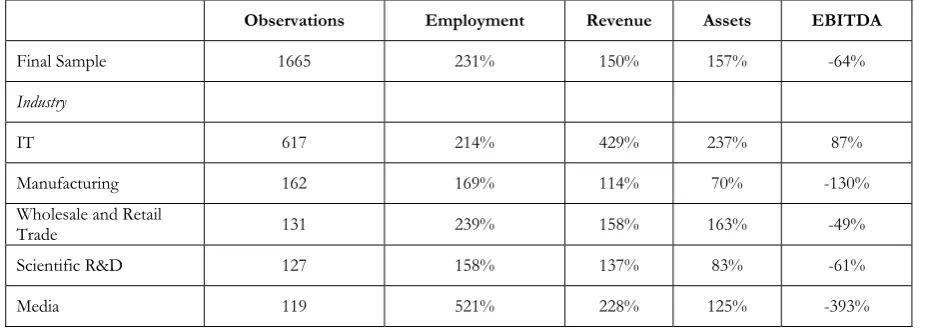
A recent empirical research of AI impact on ecosystem is done by Moreno (2014) in cooperation with EBAN. The study analyzes AI effects on four variables – assets, employment, EBITDA, and revenues. The impact of AI on ecosystem resulted beyond expectations. On average assets grew 156.5%, employment more than tripled, and revenues had a consistent increase of 150%. Regarding EBITDA, the sample start-ups did not achieve break-even within the analyzed time period. These results might to some extend be associated with the necessary period of at least 5 years following which BAs are generally able to exit investments. Therefore, observation of an extensive period is needed in order to be able to state when EBITDA will reach positive figures. Moreno (2014) suggests that EU public policies should incentivize enterprises funded by AI and advocates that the benefits emerging by angel-funded enterprises pay off efforts to encourage AI.
Table 2. Impact of Angel Investing (Cumulative Growth) 3 Years after Initial Investment
Observations Employment Revenue Assets EBITDA
Final Sample 1665 231% 150% 157% -64%
Industry
IT 617 214% 429% 237% 87%
Manufacturing 162 169% 114% 70% -130%
Wholesale and Retail
Trade 131 239% 158% 163% -49%
Scientific R&D 127 158% 137% 83% -61%
Media 119 521% 228% 125% -393%
Source: Moreno (2014) The Economic Impact of Angel Investment Unveiled.
In fact, the interaction between BAs and the ecosystem is reciprocal in the sense that both benefit from each other’s pluses. For instance, from the perspective of support to the American rural entrepreneurial community, Henderson (2002) suggests that rural support networks use various assistances within their ecosystem such as BANs, incubators and any other kind of technical-aid-delivering organization. Furthermore, Berger and Udell (1998) argue that VCs tend to invest more in enterprises which have already received BA funding previously to applying for a VC funding.
AI has not received attention only in its traditional, primarily developed, markets; it has currently rather become quite popular in many emerging markets both in number and amount of investment as well as in creation of BANs. Estonia is such an example where its single functioning BAN (EstBAN) exceeded significantly all other European BANs in performance and was the driving force of reaching an annual average investment of roughly €1.9M per BAN (EBAN, 2014d). BAs in emerging economies believe that both policymakers and investors are able to significantly advance the investment climate and are interested to organize in BA groups so as to benefit from knowledge and experience sharing (Scheela et al., 2012). Patricof and Sunderland (2005) claim that start-ups are usually the rapidly growing potential ventures of emerging markets and, taking into account the high risk they bear, they are most likely left over to BAs since VCs and other investment organizations (even in advanced U.S. market) prefer some successful background before providing funding to a particular company. With regard to assistance BAs think governments could provide Scheela et al. (2012) identify four directions – entrepreneur education, promotion, and financing; more reliable public information; more advanced financial and legal institutions; and improved public governance chiefly by low corruption and political stability. On the other hand, Patricof and Sunderland (2005) identify capitalization, commitment from companies, investment activities, linking with diaspora, linking with pure commercial markets, investment skills, and technical assistance as necessary actions to be taken in order to develop an equity or equity-like capital pool available to high-growth enterprises of emerging markets.
Kosovo’s Market
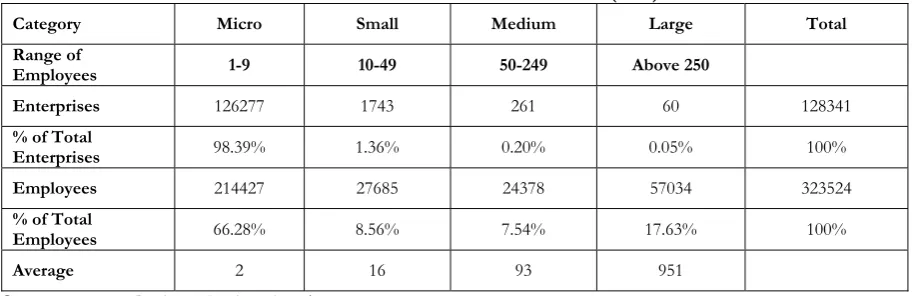
The market of Kosovo is characterized with a business structure vastly dominated by SMEs. Based on the number of registered businesses in Kosova Business Registration Agency in 2013, the percentage of micro, small and medium business is 98.39%, 1.36% and 0.2%, respectively. Table 3 shows in more detail the structure of Kosovar businesses.
Table 3. Number of Businesses in Kosovo (2013)
Category Micro Small Medium Large Total
Range of
Employees 1-9 10-49 50-249 Above 250
Enterprises 126277 1743 261 60 128341
% of Total
Enterprises 98.39% 1.36% 0.20% 0.05% 100%
Employees 214427 27685 24378 57034 323524
% of Total
Employees 66.28% 8.56% 7.54% 17.63% 100%
Average 2 16 93 951
Source: Kosova Business Registration Agency
Figure 4. Regional Lending Interest Rates (%)
Source: Data Obtained from World Bank Online Database “Indicator: Lending Interest Rate” (2016) and Figure is Processed in ExcelSheet
In addition, the impression exists that banks operating in Kosovo are moving towards high-paid individuals and larger firms as part of their continuous efforts to reduce risk. As a consequence, these strategies of banks are deepening even further the funding shortage for SMEs aiming to develop their activity in Kosovo. It is important to highlight here that Kosovo is still underdeveloped what implies it is challenged by numerous issues associated with its situation such as corruption, ineffective governance, poor law enforcement, inadequately educated entrepreneurs and so on. Finally, the number of financial institutions is relatively limited. Table 4 presents the types and number of financial institutions operating in Kosovo. Even in a small economy such as Kosovo’s more variety in finance sources might be expected to contribute towards enriching the market and fueling the entrepreneurship activity and, as such, the current structure of the financial industry could be considered to have an array of areas in need for advancement.
Table 4. Financial Institutions in Kosovo (2013)
Type of Financial Institutions Number of Financial Institutions
Commercial Banks 9
Insurance Companies 13
Pensional Funds 2
Financial Accelerators 39
Microfinance Institutions 17
Source: Central Bank of Kosovo Annual Report (2014)
Based on the abovementioned, this paper argues there is space for creating and developing alternative financial instruments accompanied by the need of advancing further the entrepreneurship culture in the country. An effective operating AI market is advocated to have potentials of contributing in that respect. The following section suggests some strategies on how Kosovo could develop a functioning model for its early-stage market with regard to angel funding.
5. Recommendations and Conclusive Remarks
three-dimensional model on how the AI market could be developed in Kosovo which, to the author’s knowledge, is the first of its kind for the Kosovo early-stage market.
Firstly, governmental support is considered of significant importance (Lerner, 1998; Mason, 2009; OECD, 2011; CSES, 2012; Scheela et al., 2012; The World Bank 2013; EBAN, 2014b; EBAN, 2015b). In addition to recognizing the immense need for overall governance improvement and for recovery of earlier mentioned defects such as corruption and poor law enforcement, a two-way assistance through fiscal incentives on AI and co-investment funds with BAs is suggested. The fiscal incentives are expected to attract foreign BAs, especially now that they have started to expand their activity cross-borderly (EBAN, 2014c). Based on the important role Diaspora community can play in the AI market (Patricof and Sunderland, 2005; The World Bank, 2013), fiscal incentives are expected to also attract investments from Kosovo Diaspora which is considerable in size and may get motivated to start acting as BA in its motherland. On the other hand, co-investment funds aim to increase the funds available to high-potential entrepreneurial ideas (EBAN, 2014a; EBAN, 2015a). Further, such funds is expected to contribute towards a better management of public money – an issue of a particular concern in the case of Kosovo – since the co-investment fund is driven by a business approach rather than serving as a subsidy. The investment decisions are made by BAs or a fund manager appointed and supervised by BAs, limiting the possibilities of fund allocation based on corruption and nepotism.
The second dimension of the model advocates use of the entrepreneurial ecosystem by BAs. The bilateral collaboration between BAs and ecosystems is illustrated earlier in this study (for example. Berger and Udell, 1998; Henderson, 2002; Mason, 2009; Festel and Kratzer, 2012; Moreno, 2014, Ross, 2014). Based on that logic, numerous BA-ecosystem interrelations could potentially appear beneficial for Kosovo’s market too. Economic development agencies, business plan competitions, incubators and accelerators, other formal and informal investors, all represent potential co-workers within the AI activity. Even governmental grants can indirectly be used by BAs. On one hand, BAs can encourage their portfolio companies to apply for grants. On the other, they can facilitate the deal selection process through targeting companies which have previously won grants since winning a grant may be considered an indicator of successful operation of a certain enterprise.
Thirdly, this work claims there is a need for promoting the angel activity to successful local business people and investors in order to encourage them to enter into AI. Pretty much consistent with Patricof and Sunderland’s (2005) proposed program for assisting entrepreneurship in developing countries, here too actions such as technical assistance, Diaspora input, and business community professional development are considered a necessary step towards a better-functioning Kosovo ecosystem. The AI concept is very new in Kosovo’s market, and hence, awareness campaigns are considered to be necessary in this stage. Awareness campaigns may include seminars, conferences and workshops delivered to the business community. Compliant with earlier works (Smith et al., 2010) presented here highlighting the sharing approach BAs possess, the European BA community is fairly cooperative, from EBAN as an institution to individual BAs. Generally, this community’s mission, among others, is to support emerging markets by sharing best practices. This support is provided by means of attending organized events as panel members, key speakers, jury members (in investor-pitching events) and so on. Actually, the European and the American BA communities are paying increased attention to those markets nowadays (Scheela et al., 2012). Particularly EBAN sustains through technical facilities such as statutes for BANs, establishment of professional standards, and research and network opportunities.
Finally, this paper is considered a starting point in the scientific analysis of AI in Kosovo. There is space for additional models and theories in this topic. Therefore, future research work is expected to contribute further towards building a functional AI market in the country.
References
Central Bank of Kosovo (2014). Annual Report 2013. Retrieved from http://www.bqk-kos.org/repository/docs/2014/CBK%20AR%202013-english.pdf
Certhoux, G., & Perrin, A. (2013). Business Angels' practices in the screening stage: A study of knowledge transfer to the entrepreneur. 13rd EURAM Conference.
CSES (Centre for Strategy & Evaluation Services) (2012). Evaluation of EU Member States’ Business Angel Markets and Policies. Final Report. Framework Service Contract for the Procurement of Studies and other Supporting Services on Commission Impact Assessments and Evaluations. Interim, final and ex-post evaluations of policies, programmes and other activities
EBAN (2013). Activity Report. Retrieved from http://www.eban.org/wp-content/uploads/2014/05/Activity-Report-2013.pdf
EBAN (2014a). Compendium of Co-investment Funds with Business Angels. Retrieved from
http://www.eban.org/compendium-of-co-investment-funds-with-business-angels-2014/#.VuNpxtJ97IU EBAN (2014b). Compendium of Tax Outlook in Europe: A Business Angels Perspective. Retrieved from
http://www.eban.org/wp-content/uploads/2015/05/Compendium-fiscal-2014-v1.pdf EBAN (2014c). Startup Investors Manifesto. Retrieved from
http://www.eban.org/wp-content/uploads/2014/09/15.-Startup-Investors-Manifesto.pdf
EBAN (2014d). Statistics Compendium. Retrieved from http://www.eban.org/wp-content/uploads/2014/09/13.-Statistics-Compendium-2014.pdf
EBAN (2015a), Compendium of Co-investment Funds with Business Angels. Retrieved from
http://www.eban.org/2015-compendium-of-co-investment-funds-with-business-angels/#.VnPs8rZ97IU EBAN (2015b). Compendium of Tax Outlook in Europe: A Business Angels Perspective. Retrieved from
http://www.eban.org/2015-compendium-of-fiscal-incentives/#.VnP5kLZ97IU
EBAN (2015c). Guidebook on “Fostering Business Angel Activities in Support of SME Growth”. Retrieved from http://www.eban.org/fostering-business-angel-activities-in-support-of-sme-growth/#.VnPs97Z97IU EBAN (2016). “Online Glossary”. Retrieved March, 10, 2016 from http://www.eban.org/glossary-page/ European Investment Fund (2014). European Small Business Finance Outlook. Working Paper 2014/24. Festel, G., & Kratzer, J. (2012). The founding Angels Investment Model-case Studies from the Field of
Nanotechnology. Journal of Business Chemistry, 9(1), 19-29.
Harrison, R.T. and Mason, C.M. (2010). Annual Report on the Business Angel Market in the United Kingdom: 2008/09. Department of Business, Innovation and Skills, HM Revenue & Customs et al.
Henderson, J. (2002). Building the rural economy with high-growth entrepreneurs. Economic Review-Federal Reserve Bank of Kansas City,87(3), 45.
Kerr W.R., Lerner J., Schoar A. (2010). The Consequences of Entrepreneurial Finance: A Regression Discontinuity Analysis. Harvard Business School, Working Paper 10-086.
Lerner, J. (1998). “Angel” financing and public policy: An overview. Journal of Banking & Finance, 22(6), 773-783. Mason, C. M. (2009). Public policy support for the informal venture capital market in Europe a critical
review. International small business Journal,27(5), 536-556.
Mason, C. M., & Harrison, R. T. (1997). Business angel networks and the development of the informal venture capital market in the UK: is there still a role for the public sector. Small Business Economics, 9(2), 111-123. Mason, C. M., & Harrison, R. T. (2008). Measuring business angel investment activity in the United Kingdom: a
review of potential data sources. Venture Capital, 10(4), 309-330.
Mason, C. M., Botelho, T., & Harrison, R. (2013). The transformation of the business angel market: evidence from Scotland. Available at SSRN 2306653.
Mason, C., & Stark, M. (2004). What do investors look for in a business plan? A comparison of the investment criteria of bankers, venture capitalists and business angels. International Small Business Journal, 22(3), 227-248. Maxwell, A. L., Jeffrey, S. A., & Lévesque, M. (2011). Business angel early stage decision making. Journal of Business
Venturing, 26(2), 212-225.
McKaskill T. (2009). An Introduction to Angel Investing: A Guide to Investing in Early Stage Entrepreneurial Ventures. Breakthrough Publications, Australia.
Moreno, L. (2014). The economic impact of angel investment unveiled. Presented at EBAN Annual Congress on the 19th May 2014 in Dublin. Retrieved February, 05, 2016, from http://www.eban.org/research-the-economic-impact-of-angel-investment/
OECD (2011). Financing High Growth Firms: The Role of Angel Investors. OECD Publishing.
Patricof, A. J., & Sunderland, J. E. (2005). Venture capital for development. Transforming the Development Landscape: The Role of the Private Sector, 74-84.
Rose, D. S. (2014). Angel investing: The gust guide to making money and having fun investing in startups. John Wiley & Sons.
San José, A., Roure, J., & Aernoudt, R. (2005). Business angel academies: unleashing the potential for business angel investment. Venture capital, 7(2), 149-165.
Scheela W., Isidro E., Jittrapanun T., Trang N.T.T., Gunawan J., (2012), Business Angel Investing in Emerging Economies: Policy Implications for Southeast Asia. Submitted to: Kauffman Foundation’s International Research and Policy Roundtable, Liverpool UK.
Smith, D. J., Mason, C. M., & Harrison, R. T. (2010). Angel investment decision making as a learning process. Research Paper.
Sohl, J. (2012). The Angel Investment Market in 2012: A Moderating Recovery Continues. Center for Venture Research, 25.
Sudek, R. (2006). Angel investment criteria. Journal of Small Business Strategy, 17(2), 89.
Swedish Agency for Growth Policy Analysis (2013). Business Angel, Co-investment Funds and Policy Portfolios. Report 209/055
The World Bank (2013). Creating Your Own Angel Investor Group: A Guide for Emerging and Frontier Markets. World Bank. License: Creative Commons Attribution CC BY 3.0