The Impact of A Teacher’s Implementation of the Read works
Digital Reading Program on Second Graders’ Reading Fluency
and Comprehension Test Scores
Cynthia Molina
B.A. Legal Studies, December 1997, University of California at Berkeley M.A. Elementary Education, May 2004, Liberty University
A Dissertation Prospectus Submitted to the Faculty of Old Dominion University in Partial Fulfillment of the Requirements for the Degree of Doctor of Philosophy
Curriculum and Instruction Old Dominion University
Introduction
Many students lack fluency and comprehension skills to read proficiently. According to the National Assessment of Educational Progress (NAEP), only 42% of fourth-grade students were proficient readers, with only 19% of African-American students, 21% of Hispanics, and only 3% of English learners being proficient readers (NAEP, 2011). Being a poor reader can badly affect a student’s success in other academic subjects, resulting in the student most likely dropping out of school (Lesnick, George, Smithgall, & Gwynne, 2010). Struggling readers in elementary schools can become proficient in literacy by benefitting fromtechnology that incorporates effective strategies to read fluently and with comprehension (Curriculum Associates, 2015a; Drummond, et al., 2011; Gibson, Cartledge, & Keyes, 2011).Reading computer-based programs can introduce new vocabulary words within the context of reading, simultaneously narrate and highlight text, and give the reader immediate feedback on how to return to the text to discover answers to comprehension questions(Curriculum Associates, 2015a).
Research suggests that computer-assisted reading instruction can accelerate the rate of students’ reading fluency growth as an intervention for struggling readers(Gibson, Cartledge, & Keyes, 2011; Keyes, Cartledge, Gibson,& Robinson-Ervin, 2016; Lyytinen, Ronimus, Alanko, Poikkeus, & Taanila, 2007). Computer-assisted instruction has also improved students’ reading comprehension skills, as shown for at-risk firstgraders who improved their reading when learning from the Alphie’s Alley computer program(Chambers et al.,2008). The Istation (Mathes, Torgesen, & Herron, 2015) reading computer program’s reading test performance data had a high correlation with passing State of Texas Assessments of Academic Readiness (STAAR) Reading test scores of first to eighth grade Texas students. In Florida, fourth and fifthgrade struggling readers read more fluently and
Abstract:
Since elementary school student performance on the end-of-year summative Virginia Department of Education (VDOE) Standards of Learning (SOL) Reading test is vital in impacting school accreditation, computer-assisted instruction has become popular. Online reading programs have existed in many elementary schools in Norfolk Public School district since 1996, such as Breakthrough to Literacy (McGraw-Hill Companies, 2002a), Istationin 2014 (Mathes, Torgesen, & Herron, 2015), and the i-Ready program from 2015 to 2017 (Curriculum Associates, 2014). The problem is that there is insufficient empirical research supporting the use of the ReadWorks program at several Norfolk, Virginia’s elementary schools.The purpose of this sequential, explanatory mixed methods study is to investigate the effects of teachers’ implementation of the ReadWorks online reading program on second-graders’ reading fluency and comprehension test scores in one Norfolk elementary school. The teachers’ choices of ReadWorks tests and the teachers’ design of reading lessons can impact students’ reading test scores on the STAR reading test (Renaissance Learning, Inc., 2018).
with improved comprehension because of dramatic Istation Diagnostic assessment growth in one school year (Robinson, Campbell, Lambie, Hahs-Vaughn, & Bai, 2015). In research conducted on another program, Achieve3000 (Achieve3000, Inc., 2015) over 1,000 students in grades three, six, and nine who used the program showed statistically significant growth on the Gates-MacGinitie Vocabulary, Reading Comprehension, and Total Reading Tests (Achieve3000, Inc., 2015).
I will investigate the effects of secondgraders using the Readworks program (ReadWorksInc., 2017) to improve their STAR (Renaissance Learning, Inc., 2018)reading test scores and estimated oral reading fluency scores. As ateacher-researcher,I will designmy smalland wholegroup reading lessons based on these data reports to improve students’ reading fluency and comprehension skills. Only one research studyanalyzed the effects of students using the ReadWorks program, and the focus was on its use as a source of non-fiction reading material. I believe that it is valuable to understand Readworks' impact on effecting real fluency and comprehension reading skill growth as shown in the DRA2 and STARreading tests.
Computer Assisted Instruction
In 1996, three elementary schools in Norfolk Public Schools (NPS) in Virginia engaged in a longitudinal research study to test the effectiveness of the Breakthrough to Literacy (BTL; McGraw-Hill Companies, 2002a) computer-assisted reading software program on increasing SOL Reading test scores. Thirdgraders who participated in the BTL program in kindergarten during the 1996-1997 school year had higher average scores in the SOL Reading test in 2000 compared to thirdgraders who had never used the BTL program in kindergarten (McGraw-Hill Companies, 2002a). The BTL program was instrumental in teaching NPS students in kindergarten through second grade the concepts of alphabet knowledge, phonemic awareness, vocabulary, oral and written comprehension, and word recognition skills using features such as colorful animation, talking characters, immediate feedback, and rewards. The Take-Me-Home storybooks allowed students to read the text that the computer read to them on the BTL program.
The benefits of the BTL program on improving thirdgraders’ SOL Reading test scores meant that this computer-assisted reading instruction became a Tier 2 and Tier 3 supplemental reading intervention for students in all NPSelementary schools in 2000 (McGraw-Hill Companies, 2002b). These students needed more one-on-one instruction than their teachers’ Tier 1, wholegroup reading lessons could provide. A determining factor of which students needed such intervention were students’ failing below-benchmark scores on the Phonological Awareness Literacy Screening (PALS). PALS assesses the student’s ability to spell, read aloud letters, sounds, words and passages, and answer comprehension questions (Invernizzi, Meier, Swank, & Juel, 2001).Using formative reading tests such as the DRA2 (Beaver & Carter, 2006), the STAR (Renaissance Learning, Inc., 2018), and PALS (Invernizzi, Meier, Swank, & Juel, 2001), teachers could determine which students needed more intensive Tier 2 and Tier 3 interventions such as small,guided reading group sessions, tutoring, and the BTL program.
New computer-assisted programs would serve many elementary students in some NPS elementary schools. In 2014, a new computer-assisted program, iStation,taught online math and reading lessonsusing colorful, animated talking characters (Mathes, Torgesen, & Herron, 2015).From 2015 to 2017, various NPS elementary schools utilized the i-Ready online reading and math program. Curriculum Associates, i-Ready’s creators, contracted the Educational Research Institute of America (ERIA) to conduct a study about the high correlation of i-Ready Diagnostic results with the New York State Assessment scores. In a 2014-2015 study, ERIA showed that there was a close correlation of 11,000 third through eighthgrade students’ predicted and observed proficiency rates of the i-Ready Diagnostic assessment and the 2015 New York State assessment scores (EIRA, 2016). The students’ overall i-Ready Diagnostic performance had a significant 0.85 correlation in predicting student achievement on the New York State Assessment. The Diagnostic content aligned well with the Common Core State Standards, which is the same content as the New York State Assessment National Governors Association Center for Best Practices and the Council of Chief State School Officers (2010).
Background
printed words and share their ideas with others. By twelfth grade, they can collaborate with others to do research and present their ideas coherently.
In second grade, the Reading Strand requires that students be able to read phonemes, use phonics to read and spell, use semantic clues and syntax when reading, enlarge their vocabulary and word meaning knowledge, use simple reference materials, and read and comprehend fiction and nonfiction texts (Virginia Department of Education, 2017e).
A strong relationship exists between the secondgrade student’s passing or failing STAR scaled score to the student’s probable future success in passing the third grade Reading Standards of Learning high-stakes test. (Renaissance Learning, Inc., 2018). The SOL reading test scores of fail, proficient, and advanced indicate the student’s level of proficiency in knowing his or her English standards of learning. A total of 83 schools with students in grades 3 to 8 participated in the assessment correlation study comparing the students’ STAR test scaled scores to their future SOL reading test scores. A group of 2,748 thirdgraders took the STAR reading test and 2,604 of these thirdgraders who took the SOL reading test. Of this student participant sample, 22% had failing scores, 60% had proficient scores, and 18% had advanced scores in both the STAR reading test and the SOL reading test (Renaissance Learning, Inc., 2018).
Based on current data of the low percentage of thirdgraders passing the Virginia SOL Reading test in third grade, I hypothesize that the intervention of computer-assisted instruction will improve their SOL Reading test scores to be at a minimum of a 75% student pass rate. In 2015, 63% of thirdgraders passed the SOL Reading test(VDOE, 2011b). In 2016, the pass rate was 64% (VDOE, 2011b). Due to the limits of the one-day period for the students to take the SOL Reading test, thirdgraders should be fluent readers to comprehend the digital text and related questions found in the SOL Reading test (Virginia Department of Education, 2017e). When a student spends more time and energy attempting to decode words within a text that are too difficult to read, then the student has less time and energy to comprehend the text. Consequently, the student cannot successfully answer similar SOL Reading test comprehension questions.
Using a computer-based instructionalprogram such as the ReadWorks program is part of NPS’s instructional improvement goal to ―ensure that digital literacy is woven throughout curriculum and instruction for all programs of study‖ (Virginia Department of Education, 2011a, p. 14). The use of the students’ scores from the formative DRA2 (Beaver & Carter, 2006) and the STAR (Renaissance Learning, Inc., 2018) reading tests and the summative end-of-year SOL reading test will show the possible effects of the ReadWorksprogram on students’ reading growth. The DRA 2 is a paper-based assessment, which a teacher administers to determine a student’s independent reading fluency and comprehension as either Advanced, Independent, Instructional, Instructional, or Intervention (Pearson Education Inc., 2011). The computer-based STAR reading test compiles a student’s estimated oral reading fluency, grade level reading SOL proficiency, and independent reading comprehension scores (Renaissance Learning, Inc., 2018). The SOL Reading test assesses student knowledge of Virginia's English SOLs to determine a student's reading comprehension achievement as Pass/Advanced, Pass/Proficient, Fail/Basic, and Fail/Below Basic (Virginia Department of Education, 2015b).
Education reform movement
The demands of testing to gauge students’ reading performance grew out of a 2001 National Education Summit led by Achieve, a legal corporation that included six governors and six business leaders (Owens, 2015). Their chief goal was to raise states’ academic standards and graduation requirements. These educational reformers created national curriculum standards and challenging assessments. The primary concern of the business leaders was that high school graduates were ill prepared to work in the corporate sector. Twenty-one companies offered educational computer-based program prototypes at the summit to showcase their solutions to the education crisis. Computer-assisted instruction’s relevance in the educational reform movement would become more prominent over time.
Partially as a result of the more rigorous English SOLs, Virginia’s fourth-graders’ averageNAEP Reading test scaled score increased from 221 points in 1992 to 229 points in 2015 (National Center for Education Statistics [NCES], 2016). This increase of 8 points was a testament to the growth in the rigor of Virginia’s English SOLs. The NAEP assesses the academic progress of representative samples of American fourth, eighth, and twelfthgraders in the subjects of mathematics, reading, writing, science, civics, economics, geography, U.S. history, and the arts (NCES, 2015). Passing the Virginia SOL Reading test could mean that the student had a high likelihood of passing the NAEP Reading test.
By 1998, the Commission and the Virginia Board of Education established that the annual end-of-year SOL assessments would measure student knowledge of the Virginia SOLs as well as evaluate public school accreditation (VDOE, 2013). Based on 1997 Board Regulations Establishing Standards for Accredited Public Schools in Virginia, public schools must meet accreditation standards requiring at least 70% of their students to pass the SOL tests in all four content areas by the year 2006 (VDOE, 2013). In 2001, the Board of Education’s Office of School Improvement’s academic review teams visited low-performing schools to monitor their creation and implementation of reading and mathematics instructional program improvement plans (VDOE, 2013).
As the English SOLsbecame more rigorous to create a stronger pool of future college students and employees, between 1998 and 2005, the third-grade SOL Reading test pass rates increased 22%, from 55% to 77% (VDOE, 2005).Furthermore, the passing test rates showed a 5% increase from 80.24% in 2006 to 85.49% in 2011 (VDOE, 2011b).The VDOE, the College Board, ACT, Achieve, college professors, and business people revamped the English and Science SOLs to ensure that students were college- and career-ready (VDOE, 2013). In 2012,The VDOE raised the accreditation requirement from 70% to 75% for only the SOL Reading testpass rates (VDOE, 2013) so that schools and their teachers would be more accountable to teach the VDOE SOLs to students. Thirdgraders’ test pass rates dropped down to 72% in 2012, which meant that some elementary schools were accredited with a warning (VDOE, 2014). In the years 2013 to 2016, the thirdgrade SOL Reading test pass rates increased from 69% to 76% (VDOE, 2017b).
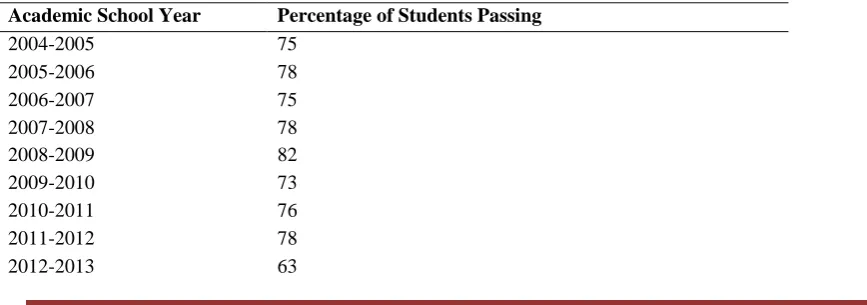
Third grade SOL Reading test pass rates in NPS have declined from 75% in 2005 to 64% in 2016 during which time the VDOE altered the SOL reading test content due to the 2010 English standards revision (Virginia Department of Education, 2011b; see Table 1). The 71% average pass rate shows that, overall, thirdgraders are struggling to meet the 75% VDOE SOL Reading testingpass rate requirementto comprehend passages.
For low-performing schools not meeting NCLB test requirements, the threat loomed of charter schools replacing them. An economic recession prompted the VDOE to receive $4.35 billion from the American Recovery and Reinvestment Act (ARRA) in 2009. Joanne Weissused these funds to implement the Race to the Top (RTTT) program (Owens, 2015). Weiss permitted private industry to create charter schools and sell educational technology programs for schools that were not meeting the NCLB annual testing requirements. President Obama offered more RTTT funding to states that welcomed as many charter schools as possible. Obama proclaimed that, ―Businesses can follow the examples of Intel and Microsoft by developing the software tools and cutting-edge technologies that prepare today’s students to be tomorrow’s teachers‖ (Owens, 2015, p. 174).
Table 1.
ThirdGrader Standards of Learning Reading Test Pass Rate for 2005-2016
Academic School Year Percentage of Students Passing
2004-2005 75
2005-2006 78
2006-2007 75
2007-2008 78
2008-2009 82
2009-2010 73
2010-2011 76
2011-2012 78
2013-2014 55
2014-2015 63
2015-2016 64
Note.The data is for thirdgrader Standards of Learning Reading Test pass rate (Virginia Department of Education, 2011b).
The impetus for students in grades three, four, and five to be proficient readers is that their passing Virginia SOL Reading test scores are integral for a school to maintain its accredited status. Since 2012, the VDOE established elementary public school accreditation benchmarks: a 75% pass rate in SOL tests for English Reading; 75% for English Writing; 70% for Mathematics; 70% for Science; and 70% for History (VDOE, 2015b). Without full accreditation by the VDOE, a school would have constant oversight from the Norfolk School Board and the VDOE to ensure that the school followed through corrective action proposals to improve its SOL test scores (VDOE, 2015b). After four consecutive years of a school not being fully accredited, the VDOE can deny the school's accreditation. In addition, that school may join with a high-performing school or that school’s staff, students, administration, or program may be restructured (VDOE, 2015b). There are several theories that guide this study.
Theories
Automatic Information Processing Theory Supporting Fluency
The Repeated Readings Method (Samuels, 1979) effectively helps to create fluent readers because of rereading the text to improve their word decoding and comprehension abilities, according to the Automatic Information Processing Theory (LaBerge & Samuels, 1974). The premise is that a reader who can decode text effortlessly now has more reserved attention to comprehend the text. The weak decoder thus cannot comprehend the text when all of his or her energy is spent attempting to read the words (LaBerge & Samuels, 1974). Upon reading a text several times, the reading speed increases and the word recognition errors decrease (Samuels, 1979). Some errors are acceptable as the reader reads quickly because reading accuracy should not impede speed. Reading comprehension and fluency grow for the reader who reads the text several times (Samuels, 1979).
The ReadWorks program offers the reader the opportunity to reread the text as often as is necessary with the ReadWorks narration to improve his or her fluency and ultimately his or her reading comprehension (ReadWorks Inc., 2017). The student can choose to have the ReadWorks narrator read aloud the text by simply pressing the play button. The reader can also choose not to use the ReadWorks narration feature if he or she feels confident in being able to read the text independently and accurately.
Schema Theory Supporting Reading Comprehension
According to the schema theory support of reading comprehension (Kant, 1963),the reader should be able to use his or her background knowledge to understand the meaning of the words, and relay understanding in different verbal or written responses (Clarke, Truelove, Hulme, & Snowling, 2013). It can mean that the reader answers questions about the text. These questions could be knowledge level questions concerning information found directly within the text. These questions could also be at a higher cognitive level that expects the reader to infer, compare, sequence, and process the information. Comprehension can also relate to knowing where information belongs in a graphic organizer. Ultimately, there are a variety of ways to show reading comprehension in the reader’s response.
Schema theory, For reading comprehension to occur, the reader connects the text’s meaning to the reader’s own experiences and knowledge, otherwise known as schema (Kant, 1963). Schema Theory describes schema as theabstract knowledge that is personal and distinct to the individual reader (Anderson & Pearson, 1988). The schemas are the reader’s experiences and knowledge that aid the reader to understand the text more readily (de Beaugrande & Dressler, 1981). Enough background knowledge should exist in the reader’s mind to allow him or her to grasp textual concepts.
the limits of their working memory. It’s important to link new knowledge in seven bits of information to the learner’s schema (Reed, 1982).
The ReadWorks program has passages that relate to the learning content that students learn at school or in their home environments. It pertains to subjects that the student has some connection to so that the student can comprehend the vocabulary and contextual meanings of the passage with greater ease. The content relates to subjects in social studies, science, and technology.
Assimilation learning theory. Ausubel’s Assimilation Learning Theory (1977) is akin to Schema
Theory (Kant, 1963), deeming established ideas as schemas that are related to new textual information for the reader to comprehend the new information. When the reader comprehends the text, the reader has melded new information, ―a,‖ with ―A,‖ the schema, to create the comprehension product of ―A‖ and ―a‖ (Ausubel, 1977). When readers can link their current knowledge of the text’s topic with the new information the readers read about that topic, they more fully comprehend the textual information and can consequently more accurately answer comprehension questions.
Reader Response Theory. Rosenblatt’s (2005) Reader Response Theory posits that when a reader
reads, the reader should attach a personal meaning to the text to have full comprehension and actual enjoyment too. The reader recalls the information found in the text when it reminds the reader of his or her own past personal experiences (Rosenblatt, 2005). The reader can be a critical thinker when he or she can personally respond to the text as well as to. The reader’s aesthetic response means that the reader draws on his or her emotions to relate or connect to the text content, while the reader’s efferent response requires concluding a new idea after reading the whole text.
Piaget’s cognitive constructivist theory. The requisite engagement that a reader should have when reading the text relates to Piaget’s (1964) Cognitive Constructivist Theory of using past experiences to gain knowledge. The active learner interacts with the text to understand its meaning. Thus the reader makes new meaning through processing the text information by filtering that information using personal background knowledge and experiences, also known as schemata (Gunning, 2012). The learner learns to organize information into schemes. Then the learner can assimilate new information into schemes. Finally, the learner can accommodate that information when the learner changes those schemes or creates new schemes of new information (Piaget, 1964). Reading thetext that contains new information requires the process of forming schemes, assimilating, and accommodating.
Vygotsky’s Social Constructivist Theory. According to Vygotsky (1978), reading comprehension is a sociocultural activity. The child learns by interacting with the text by relating what he or she knows already and applying that knowledge to the information found in the text. Children are empty vessels who absorb knowledge from their experiences with objects in their world. Thus, the construct of the zone of proximal development (ZPD) is important in teaching a learner to learn from a teacher, or more knowledgeable person, who will guide the learner to solve a problem. This guidance lends itself to teaching a learner reading comprehension strategies using various tools in research as well as in engaging in computer-based learning programs.
Learners construct knowledge by engaging with their world (Vygotsky, 1978). The hands-on experiences are valuable in creating schemas upon which further learning can occur. The text’s contents are more understandable to the learner when the learner has prior knowledge of the text’s contents. Reading other text or having personal experience with the text content can provide students with learning experiences about the reading content. Teachers can provide those experiences along with other people in the student’s life.
Theory of Contingent Scaffolding. Teachers must engage the learner in a series of learning activities to allow them to flourish from dependent to independent learners (Wood, 1998). The teacher must first model how to do an activity, such as reading, by reading the text aloud and thinking aloud the thoughts that a good reader should be asking and answering to oneself before, during, and after reading a text. Then the teacher engages the learner by allowing the learner to practice these modeled behaviors through guided practice with the teacher assisting the learner in each step of the activity. After the teacher has given the learner a sufficient number of prompts on how to do the activity independently, then the learner can independently do a similar activity.
They may review the passage and the vocabulary lessons prior to answering each question by simply clicking on the particular tab on the computer screen.
Theoretical Support for Computer-Assisted Instruction
An understanding of Piaget’s Cognitive Constructivist Theory is essential to understand the benefits of children actively learning independently when they learn the computer program’s content (Simatwa, 2010). The student discovers newtext meaning by answering comprehension questions.
Cognitive learning theory. Cognitive Learning Theory (Piaget, 1964) suggests that learners learn more information quickly in their lessons when they are actively involved in the learning process. When students receive immediate suggestions on strategies to use to answer a question, they are learning from their errors at an optimal rate by trying again to answer a comprehension question. The learner is in control of the learning pace, answering practice questions and test questions from the computer program to further their best understanding of the information taught (Mayer, 2009). The computer program will adjust its lessons to learners’ individual learning needs based on their learning performances.
Paivio’s dual coding theory. Lessons full of verbal and visual information will likely be best remembered (Baddeley, 2003). Paivio’s Dual Coding Theory (Clark & Paivio, 1991) is a central determining factor behind the design of computer-assisted instruction. A multimedia presentation, consisting of verbal and visual information, should teach the learner the most important information in logical chunks for the learner to retain the information adequately (Mayer, 2001). Engaging different memory systems to entertain and teach the learner information so that the learner’s working memory is full but not overloaded can improve learning (Mayer & Moreno, 2003). The ReadWorkstests are very succinct with black and white text and a plain white background with a little color for the borders (ReadWorks Inc., 2017). There is often a photograph included to accompany each passage to relate their knowledge gained from viewing the photograph to learning the new information found within the passage. There is little distraction from the focal lesson content, and if the student would like the text read to him or her, then the student will click the sound button.
Overall, a computer-assisted instructional program operates on the premise that the reader is learning to read within his or her particular ZPD (Vygotsky, 1978). The reader can read a text that is slightly above his or her current reading ability level with the teacher or a computer program’s feedback.
Statement of the Problem
The problem is multi-layered. First, the problem is that no empirical study has examined the effectiveness of the ReadWorks reading program (ReadWorks Inc., 2017) to improve students’ reading fluency and comprehension skills as reflected in their DRA 2 (Beaver & Carter, 2006) and STAR (Renaissance Learning, Inc., 2018) reading test scores. Secondly, the problem is to understand how a teacher can make the best instructional decisions to select appropriate tests based on the student’s academic school year grade or reading grade level, based on teachers' interpretation of the STAR and ReadWorks data reports. Although the ReadWorks program has student tests ranging from kindergarten through the twelfth grade, the teacher ultimately can choose the grade level text that each of their students read (ReadWorks Inc., 2017). Teachers can also tailor their reading instruction based on student performance on the ReadWorks reading tests. No research has explored the impact of teachers’ implementation of data reports such as the ReadWorks data reports on teachers’ designs of lesson plans.
Purpose of the Study
The purpose of this mixed methods research study is to investigate the effects of this teacher-researcher’s interpretation of the STAR(Renaissance Learning, Inc., 2018)and Read Works data reports and how this affects her lesson plans to teach second graders reading fluency and comprehension skills in one Norfolk elementary school (ReadWorks Inc., 2017). I would like to investigate the relationship of using the ReadWorks program to students' scores on the DRA 2 (Beaver & Carter, 2006) and the STAR reading tests.
Research Questions
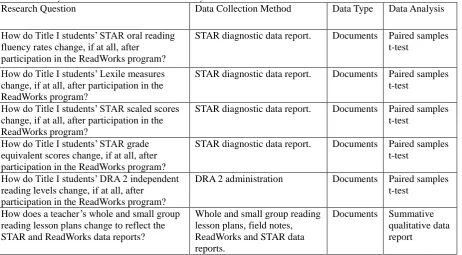
1) How do Title I students’ STAR oral reading fluency rates change, if at all, after participation in the ReadWorks program?
2) How do Title I students’ Lexile measures change, if at all, after participation in the ReadWorks program?
3) How do Title I students’ STAR scaled scores change, if at all, after participation in the ReadWorks program?
4) How do Title I students’ STAR grade equivalent scores change, if at all, after participation in the ReadWorks program?
5) How do Title I students’ DRA 2 independent reading levels change, if at all, after participation in the ReadWorks program?
6) How does a teacher’s whole and small group reading lesson plans change to reflect the STAR and
ReadWorks data reports?
Significance of the Study
In 2005, presenters at the National Education Summit on High Schools were intent on encouraging all schools to adopt technology-based education programs to improve their standardized test scores (Owens, 2015). The National Governor’s Association (NGA), Achieve, the James B. Hunt Institute, the Business Roundtable (BRT), and the Education Commission of the States (ECS) sponsored a summit focusing on improving underperforming school systems. Bill Gates, a founder of Microsoft, the world’s large personal computer software company, was the opening speaker who argued that wealthier school districts had the technological resources to educate their students as compared to the poor school districts whose students underperformed in tests (Owens, 2015).
I have chosen to engage in practitioner research to understand the dynamics of how theSTAR (Renaissance Learning, Inc., 2018)and ReadWorks (ReadWorks Inc., 2017) data reports will impact the design of reading lessonsforsecondgraders at anelementary Title 1 school where I operate as a full-time secondgrade teacher. I possess professional teaching knowledge, having obtained a Master’s in Elementary Education and a Virginia Department of Education Postgraduate Professional Teaching License to teach in the Prekindergarten through the sixth grade. After thirteen years of teaching and experiencing the arrival and departure of several computer-assisted reading programs in NPS, I havechosen to determine the efficacy of the latest intervention, the ReadWorksreading program, on a teacher’s design of lesson plans and the influence on various aspects of student reading growth.
I seek to improve educational practice by fully understanding how a teacher’s interpretation of the STAR (Renaissance Learning, Inc., 2018) and ReadWorks (ReadWorks Inc., 2017) data reports can enhance my secondgrade students’ reading test scores. To date, no research studies have evaluated how teachers have improved their students’ oral reading fluency and reading comprehension skills as reflected in the STARreading test scores by interpreting the STAR and ReadWorks data reports. This study could fill a gap in the literature. While the ReadWorks program does not measure fluency, the program does read aloud the text to the student participant so that the student can read along with the text. This study could enhance teachers’ educational judgment to understand the true impact that the teachers’ interpretation of data reports has on their creation of reading lessons.
Only one empirical study has investigated the effects of the ReadWorks program on reading. Ezaki (2016) conducted a case study and found that the five second grade participants improved their vocabulary and reading comprehension skills when they read in small guided reading groups to learn about the vocabulary words and non-fiction text from www.readinga-z.com and www.readworks.org. They did not perform well when they were required to learn to read the vocabulary words and text independently without any guidance.Ezaki collected data in the form of interviews, field notes, and student work analysis. Further investigation into the ReadWorks program could yield more conclusive evidence of its true efficacy.
According to Alexander (1992), a professional teacher exercises good practice in teaching by following certain tenets that pertain to adopting new interventions such as the ReadWorks program (ReadWorks Inc., 2017) First, the good practice should coincide with the teacher’s aims and values of improving reading fluently with comprehension. Second, the teacher should feel comfortable with the practice of allowing students to learn to read using the ReadWorks program. Third, the teacher should have the authority to implement the practice as the teacher feels it will benefit the students most. Fourth, the practice has evidence to support it being effective to achieve purported aims. If those four tenets exist, then teachers will likely have fidelity when implementing the ReadWorks program intervention.
Doyle and Ponder (1977) believe that instrumentality, congruence, and cost affect teacher buy-in of a program such as the ReadWorksprogram in the classroom. The instrumentality pertains to how the ReadWorks program trainer explains to teachers how to use the program in the classroom to improve students’ reading fluency and comprehension skills. The teachers will likely implement the program when the program reading tests are congruent with the teachers’ teaching philosophy and practices.Lastly, a huge factor is the cost or the further work and time that teachers must devote to ensuring that their students are performing well on their ReadWorkstests and that the teachers are teaching information that the STAR (Renaissance Learning, Inc., 2018) and ReadWorks data reports indicate that the students need further remediation.
ReadWorks Program
In 2017, the ReadWorks program will be one intervention program used in this NPS elementary school to improve students’ SOL Reading test scores. The value of this program is to foster students’ motivation with both independent reading practice and immediate feedback to improve their independent learning in reading. Schools that had received low SOL Reading test scores (i.e., below the 75% VDOE mandate) between 2013 and 2015 were encouraged to use computer-assisted instruction to increase test scores.
When students use the ReadWorks program, they have a variety of choices of articles to read (ReadWorks Inc., 2017). Each article has a different genre, ranging from fiction to nonfiction in different subject matters including technology news. Once the student opens the article, he or she reads with or without the aid of the narration feature, that reads the text aloud. Then the student may review key vocabulary words along with their definitions and sample sentences by clicking on a tab at the top of the screen. Next, the student will answer comprehension questions about the text, being able to review the text as needed by clicking on the appropriate tab.
The ReadWorksprogram (ReadWorks Inc., 2017) incorporates the Common Core State Standards content to create reading articles that are about topics such as science, social studies, and technology (National Governors Association Center for Best Practices and the Council of Chief State School Officers, 2010). Teachers can track individual student progress, which informs the reading lessons teachers design. Teachers can view individual student and class results by product type, question sets, vocabulary activities, and Article-A-Day. Teachers can add audio to permit readers to listen and follow the words in the text.
Teachers can learn by reading articles and watching videos about assigning articles to their students based on grade level, Lexile levels, topics, and subtopics. StepReads passages are less complex versions of the original articles. A StepRead1 passage is more complex than StepRead2 passage. The StepReads article has the same content knowledge, academic vocabulary words, text structures, and the author’s craft as the original article. Students may read the StepRead version before or after reading the original article.
Students can choose to read from a variety of tests that the teacher has permitted the student to read based on the student’s grade level or current reading grade level, which the STAR (Renaissance Learning, Inc., 2018) reading test can determine. The testscontain Nonfiction and Literary Articles, Paired Texts, ReadWorks Article-A-Day, ELL & Extra Support Features for Article-A-Day, and StepReads (ReadWorksInc., 2017). The ReadWorks program teaches the users new vocabulary with a definition, advanced definition, images, and examples.
Paired Texts are two articles that have a common topic, theme, or literary element (ReadWords, Inc., 2017). The question set encourages students to draw connections between the two texts. The questions are explicit and inferential. The six questions have three sections. Questions 1 and 2 relate to the first article. Questions 3 and 4 pertain to the second article. The last questions are about both articles’ content. Students can spend 10-15 minutes a day reading the nonfiction ReadWorks Article-A-Day.
score and percentage of correctly answered multiple-choice answers. The teacher must grade the written response short answers with a 0%, 25%, 50%, 75%, or 100% score using the suggested answer guides. The teacher may give the student corrective feedback by typing a detailed response to the student’s answers. The goal is for the student to master a test with at least an 80% score to show comprehension proficiency. Figure 1 shows a ReadWorks screenshot of a second grade level text passage’s multiple-choice questions.
Definition of Terms
Accountability—Under the No Child Left Behind (NCLB) law, students’ performance on Virginia’s SOL tests must show adequate yearly progress (AYP), and Virginia Department of Education can impose sanctions on those schools that fail to meet AYP goals (Virginia Department of Education, 2015b).
Annual Measurable Objectives—The No Child Left Behind Act (United States Department of Education, 2002). established annual measurable objectives (AMOs) to reduce the proficiency gaps between low- and high-performing schools. They represent the percentage of students within a subgroup that must pass the reading and mathematics tests to show satisfactory progress (Virginia Department of Education, 2013a).
Assessment—Testing is used to measure student academic performance.
Comprehension—An active process requiring the reader to make meaning of the written text by formulating questions while reading, drawing conclusions, making personal connections and inferring (Frey & Fisher, 2006).
Computer-assisted instruction—A computer-based program that offers lessons and assignments using visuals, animation, characters, rewards, and feedback; the goal is for the programs to engage the participant to read (Edmunds & Tancock, 2003).
Diagnostic Reading Assessment 2 (DRA 2)—A reading assessment for grades kindergarten through third. It assesses student reading ability in the areas of sustained reading, previewing and predicting oral reading fluency, and reading comprehension (Beaver & Carter, 2006).
Every Student Succeeds Act (ESSA)—This law replaced No Child Left Behind law on December 10, 2015.ESSA requires schools to assess student learning on multiple measures rather than on only one single end-of-year benchmark summative test such as the Virginia SOL Reading test (United States Department of Education, 2015).
Fluency—Fluency pertains to the reader’s accuracy in reading a text, or the number of words correct per minute (WCPM; Kuhn, Rasinski, & Zimmerman, 2014). Fluent reading also means that the reader reads the text smoothly and expressively (Kuhn & Stahl, 2003).
Guided reading—Differentiated reading instruction given by teachers who teach students effective reading strategies in small groups of up to six students according to their instructional reading level proficiency (Fountas & Pinnell, 1999). Students receive teacher-guided support in applying those strategies while reading theincreasingly challenging text and doing an extension activity after reading the text (Fountas & Pinnell, 1999). NCLB—No Child Left Behind Act of 2001; it was made a law in 2001 by President George W. Bush to ensure that students were meeting annual academic expectations in public schools(United States Department of Education, 2015).
Reading proficiency—The reader’s ability to read the text independently with a fluency rate of 95% or higher and with comprehension or understanding (Rasinski, 1999).
ReadWorks program- This computer-based, online, multiple genrereading program has multiple genre reading articles for users to read with or without audio assistance, vocabulary review, and multiple choice and short written response reading comprehension questions. It provides data reports to teachers to monitor their student reading progress (ReadWorks Inc., 2017).
Research-based instruction—Successfully proven research-based methods provide the rationale for the instructional lesson plans that teachers design to teach subject matter.
Standards of Learning Reading test—The VDOE’s statewide, annual, end-of-year summative assessment of student knowledge of the English SOLs (VDOE, 2017a).
Organization of the Study
Chapter Two provides a review of educational policies, reading proficiency, reader interest, reading motivation, possible causes of low reading proficiency, reading fluency and comprehension instruction, guided reading group instruction, and computer program feedback. Chapter Three describes the mixed-methods research approach and procedures to collect data.
Summary
The effectiveness of a computer-assisted reading program reflects how students use it. Such a program is a supplemental instructional intervention to aid students who need more individualized learning support. The goal is for the program’s tests to encourage students to practice their reading comprehension strategies that they have learned in whole and small group lessons to answer short written response and multiple choice comprehension questions. The teacher likewise tailorsshared whole and small group guided reading lessons to meet students’ literacy needs. The ultimate goal is for the ReadWorks program’s teststo provide the teacher data todesign reading lessons to improve students’ reading fluency and comprehension abilities based on second grade Virginia SOLs (ReadWorks Inc., 2017).
Based on the policy changes to Virginia’s schools, 75% of third, fourth, and fifthgrade elementary students must pass the Virginia SOL reading test in 2018 to maintain school accreditation. The use of the computer-assisted programs is an intervention to help students pass the test at this rate. Based on student reading test performance on the DRA 2 (Beaver & Carter, 2006), STAR (Renaissance Learning, Inc., 2018), ReadWorks (ReadWorks Inc., 2017)tests, and other reading formative and summative assessments, teachers design their reading lessons to raise their students’ scores. The teacher’s in-class activities and online activities, including the ReadWorks program(ReadWorks Inc., 2017), are supposed to combine to be effective in promoting student reading growth.
Review of the Literature
Introduction
In this chapter, I will describe various elements of the basis of my study. My main purpose for this study is to understand the degree to which the ReadWorks program will promote second-graders’ reading fluency and comprehension as evinced on the STAR reading test scaled score and estimated oral reading fluency results. I will explain educational policy changes, as well as the state requirements for reading proficiency improvement as shown on annual end-of-year assessments. Next, I will define reading proficiency and possible causes of low reading performance. Then I will describe low reading proficiency and several possible causes of low reading test performance, and learners’ reading development stages. I will explain research-based small group guided reading instruction, along with the effects of fluency on students’ reading comprehension. I will also delve into the pragmatics surrounding digital literacy tools, digital text reading comprehension strategies, digital text-based assessments, computer-assisted instruction programs to aid fluency and comprehension, and computer program feedback.
A basic understanding of the meaning of reading proficiency will facilitate the ability to distinguish different components of reading proficiency as reflected on the STAR reading test (Renaissance Learning, Inc., 2018) and a formative test,the Developmental Reading Assessment 2 (DRA 2; Beaver & Carter, 2006). It is possible to be proficient according to one assessment and to be non-proficient according to another assessment. The use of these assessments along with other classroom reading tests to determine reading proficiency is important since more data points provide a fuller picture of student reading proficiency as it relates to fulfilling the requirements of the No Child Left Behind Act of 2001.
Educational Policies
No Child Left Behind Act of 2001
Under the No Child Left Behind (NCLB) Act, the 2002 reauthorization of the Elementary and Secondary Education Act (ESEA), elementary schools were expected to ensure that their students meet or surpass the Annual Measurable Objectives (AMOs) for testing and attendance (US Department of Education, 2015). The students also must make adequate yearly progress (AYP) in various academic subjects (US Department of Education, 2002). The primary foci in making AYP in Virginia are that 95% of the school’s students take the Standards of Learning (SOL) tests and that at least 70% pass the SOL Mathematics test and 75% pass the English SOL Reading and SOL Writing tests (Virginia Department of Education [VDOE], 2015b). If a Title I school receiving ESEA federal funding does not meet AYP two years in a row, then they are in a Title I School Improvement status. This priority school must work to meet state and federal mandates. Likewise, it can become a focus school governed by a VDOE-approved coach to aid in creating and implementing sound intervention strategies to increase testing passing rate performance (VDOE, 2015b). Tiered instruction is a solution to help at-risk students.
Teachers must now teach at-risk readers specific reading fluency and comprehension strategies in their design ofTier 2 and Tier 3 reading lessons using students’ reading test performance (Stormont, Reinke, Herman, & Lembke, 2012). The ultimate goal is that they pass the summative SOL Reading test. Data from the DRA 2, the STAR, and Phonological Awareness Literacy Screening (PALS; Invernizzi, Meier, Swank, & Juel, 2001) test reports show student literacy skills, which is information that teachers use to guide their reading instruction in the small group setting of up to eight students maximum. In guided reading small groups, teachers teach SOL-based lessons on word recognition, word study, fluency, vocabulary, comprehension, and strategies at the students’ instructional 94% reading accuracy rate (Norfolk Public Schools [NPS] English Office, 2011). Students receiving Tier 2 and Tier 3 interventions must spend more time learning to read effectively by meeting in daily small guided reading group sessions with the teacher and a well-trained reading interventionist teacher (Fuchs, Fuchs, & Vaughn, 2014). They also spend extensive time learning to read on computer-assisted reading programs such as i-Ready or Achieve3000 (Achieve3000, Inc., 2015).
School focus on remediating students in need of Tier 2 and Tier 3 reading intervention has its roots in the Response to Intervention (RTI) model and the NCLB Act of 2002. The RTI model arose due to the advent of the reauthorization of the Individuals with Disabilities Education Improvement Act (IDEA) in 2004. The model relies on testing to identify and properly educate students with learning disabilities (LD) and those who are struggling learners so that they, along with all students, can successfully pass the annual state standards assessments that NCLB required of schools (VDOE, 2007). If students’ reading progress has still not improved after Tier 2 and Tier 3 instructional interventions, then the student may have a learning disability (Fuchs, Fuchs, & Vaughn, 2008). Under NCLB, all students should pass the Virginia SOL Reading test.
Every Student Succeeds Act
On December 10, 2015, the Every Student Succeeds Act (ESSA) replaced the NCLB law of 2002. ESSA mandates that schools assess student learning on multiple measures rather than on only one single end-of-year benchmark summative test such as the Virginia SOL Reading test (United States Department of Education, 2015). States must comply with the ESSA requirements for the 2017-2018 school year. School-wide reform strategies must strengthen the academic program using activities, programs, and other strategies to improve student test performance (VDOE, 2015a). The ReadWorks computer-assisted program is considered a Tier 2 and Tier 3 intervention for students who did not comprehend Tier 1 shared,whole group,teacher-led instruction.
Schools assess students using multiple valid formative measures including State-driven ones for various reasons. One reason is to identify and teach Tier 2 and Tier 3 instruction to ensure that students pass the NCLB-required summative tests. A majority of students must pass the Standards of Learning (SOL) tests in various subjects such as math, science, reading, and social studies to meet Annual Measurable Objectives (Virginia Department of Education, 2017c).DRA 2 (Beaver & Carter, 2006), STAR (Renaissance Learning, Inc., 2018), ReadWorks(ReadWorks Inc., 2017) student performance data reports, formative assessmentsand summative test data are some measures that teachers use to determine the instruction that students need to pass their SOL tests.
The Accountability Plan for Virginia
Benchmark-Pass Rate,‖ ―Improving School-Pass Rate,‖ ―Warned School-Pass Rate,‖ or being ―Reconstituted‖ (VDOE, 2015a). The requirements for a school to be fully accredited continue to be 70% minimum passing rates on SOL tests for mathematics, science, and history, while it is a 75% minimum passing rate for English (VDOE, 2015a). A school can have its accreditation denied if scores are not meeting Virginia Department of Education accreditation standards forfour consecutive years (VDOE, 2015a). The impetus is on elementary schools to ensure that a minimum of 75% of their third, fourth, and fifthgrade students are reading proficiently to pass the SOL Reading testwith 2017 English content standards (VDOE, 2017a).
Reading Proficiency
The proficient reader actively engages with the text to understand its meaning. Part of being a proficient reader entails being able to use one’s schematic knowledge, or experiences, to understand the text meaning (Latham, 2014). Proficient readers set a reading purpose, ask questions, predict, visualize, and connect the text’s ideas to oneself and the world around them (Latham, 2014).
Part of being a proficient reader also includes being able to summarize the most important events in a text, and that is called being sensitive to structural centrality (Van den Broek, Helder, & van Leijenhorst, 2013). The reader’s background experience in the content of the text’s events cements the events more powerfully to enable the reader to retell key events with sufficient details that can describe the characters’ motivations too.
A proficient reader uses strategies to decode, accurately read, and understand the text (Afflerbach, Pearson, & Paris, 2008). A proficient reader utilizesmetacognition, conscious of knowing when to apply a reading strategy to understand difficult or unknown words and conceptual meaning in a passage or story. Some strategies used by proficient readers include applying context clues, summarizing, and asking questions to infer and to determine the text’s meaning (Bryant, Ugel, Thompson, & Hamff, 1999). Normally that reader has the skill set to understand the meaning of at least 95% of the text meaning for passages and stories that are on that student’s grade level (Rasinski, 1999). Being able to answer text-based questions by answering multiple choice questions, filling out graphic organizers, and responding in written form are excellent ways for the reader to show reading comprehension.
Reading Development Stages
The level of reading growth that a student can experience depends on the student’s progression in stage development. According to Jeanne S. Chall’s stages of reading development (1983), a firstgrade student’s reading ability in Stage 1 grows more slowly than the student’s oral language comprehension. The Stage 1 reader is learning phonics or relationship of letters to sounds. Stages 1 and 2indicate when the students are learning to read. By Grades 2 and 3, students begin to become fluent readers building their comprehension abilities. By the third grade or the end of Stage 2, students can read one-third of what they have orally comprehended. In Grades 4-8, students are in the stage that requires them to read to learn. Students’ reading growth varies due to various factors, but the stages are a general overview of their reading comprehension growth.
Students learn to read at various growth rates, especially in the younger elementary grades. It can be counterproductive to expect second and thirdgrade students to meet current NPS reading proficiency benchmarksbecause many of them are only beginning to become fluent readers who can comprehend text(Chall, 1983).
Reader Interest and Motivation
Students will want to read when they are adequately motivated to read independently for reasons of interest or enjoyment or both (Guthrie, 2011). Some factors that influence students’ attitudes towards reading are their reading goals, interests, and ability to choose text genres, as well as reading with their friends. The readers need to read text that relates to their interests. They should receive enough feedback to be able to read thechallenging text (Kuhn, et al., 2006; Rasinksi, 1989). Thus, teachers should have students complete a reading inventory to know how the students’ knowledge, goals, and interests can match possible reading activities to encourage students to collaborate (Guthrie & Humenick, 2004).
independent or instructional level, with the explicit guidance of a more proficient reader (Keene & Zimmerman, 2007).
A ―just right‖ book means that the reader can read the text at an Independent reading level by oneself or that the reader can read the text at an Instructional level with the aid of another more proficient reader (Rasinski, 1999). The reader’s Independent reading level denotes that the reader can read the text without any aid with a fluency rate of 95% or better (Rasinski, 1999). The reader’s Instructional level means the reader can read 90-95% of the text accurately. The reader should never read a text at a frustrationlevel, but rather read on his or her instructional level with some guidance from a proficient reader (Fountas & Pinnell, 1999). Frustration level arises when the reader finds the text too challenging to read although the reader receives greater reading assistance, and consequently reads with a fluency below 90% and with a poor understanding of its meaning (Rasinski, 1999).
Beyond engaging in classroom reading activities, students should be encouraged to read outside of the classroom to increase their sense of self-efficacy and motivation to continue to read (Auckermam, 2007). A reader who reads often will read with more fluency and with a greater understanding and appreciation of the text.
Low Reading Proficiency
While most students tend to benefit from reading instruction within and outside the classroom, many students still struggle to read proficiently. Virginia's data for the 2015National Assessment of Educational Progress (NAEP) in reading showed that 28% of fourthgraders scored below basic proficiency, while 72% scored at or above basic proficiency (National Center for Educational Statistics, 2015). A study of fourthgraders who scored below basic reading proficiency in the NAEP showed that they faced a 23% chance of not graduating on time (NAEP, 2015). Black and Hispanic students who did not read proficiently in third grade were twice as likely not to graduate from high school compared to white students (Hernandez, 2011). Over 70% of U.S. high school students dropped out of school because of reading problems (Joshi et al., 2009).
Not only do students’ low reading abilities adversely affect their likelihood of graduating high school, but it also increases their chances of receiving special education services. School officials often misdiagnose low readers as having a learning disability, which permits them to have extra learning accommodations, which permit them to read below grade level (National Center for Education Statistics, 2012). They read below their grade level and still move onto successive grade levels because of the reading disability designation. It is vital that trained teachers educate students to read using all research-based strategies and tools such as computer-assisted instruction to enable students to become effective readers.
Possible causes of low reading performance. The problem of low student reading test performance in high-poverty schools can be challenging to solve. Although students living in homes with low income are eligible for specially funded food, health, and housing programs, they face difficulties in survival at home that affect their success in school (Parrett & Budge, 2012). When such students feel hopeless at home regarding being able to eat a healthy meal and wear clean, suitable clothes to school, they may feel inadequate compared to other students at school. These sobering realities may distract students enough so that they cannot focus on doing well academically. Teachers have a responsibility to be respectful in responding to these students’ social, physical, cultural, and academic needs.
Title I schools are home to many students whose families are eligible for free or reduced-price lunch meals. Data from the 2010 Census stated that 28.4% of Norfolk’s population living below the poverty level consisted of families withchildren under 18 years old. In addition, 55.5% of Norfolk’s population living below the poverty level were female-headed households with related children under 18 years old (Department of Development, 2014). Teachers have the power to give tests that students can do without the use of technology and Internet-based resources, provide enough school supplies, extra clothes, and snacks, as well as reach out to parents concerning their student’s academic progress (Gorski, 2007).
However, paraprofessionals are only required to complete two years of college study and possibly complete an associate’s degree that may or may not relate to the education field. They must pass a Virginia Board of Education Parapro assessment, and obtain a certificate showing that they are highly qualified (Virginia Department of Education, 2017d). The net result is that when paraprofessionals teach students how to read, these students do not often make any significant reading proficiency gains as compared to students taught by certified teachers (Croninger & Valli, 2009; Slavin, Lake, Davis, & Madden, 2011).
Reading specialists’ qualifications can affect the kind of expertise they have to teach students to read in small guided reading group lessons and to train teachers to teach reading as effectively as possible(Marvel et al., 2007).According to survey data obtained from the National Center for Educational Statistics in 2004, only one-third of reading specialists possessed a graduate degree in reading (Marvel et al., 2007). The best quality reading instruction comes from those who are highly qualified.When unqualified reading specialists instruct teachers on how to instruct students to read, then the teachers are ill equipped to produce good readers. Teachers must know how to teach reading, administer reading tests, evaluate test results, and teach appropriate lessons to meet students’ learning needs.
Knowing and applying effective reading strategies can lessen the reader’s difficulties in reading fluency and comprehension (Seignuric, Ehrlich, Oakhill, & Yuill, 2000). Lack of metacognition means that the weak reader does not comprehend the text by consistently asking himself or herself questions, does not actively apply phonetic strategies, and has poor vocabulary development (Seignuric, Ehrlich, Oakhill, & Yuill, 2000; Warren & Fitzgerald, 1997). Another deficiency is the low working memory to decode and store information and to complete cognitive tasks like reading for understanding (Baddeley, 2003). If the reader uses too much effort to decode unknown words, then the reader cannot comprehend the text well. According to Greer (2004), poor readers overly preoccupy themselves with simply being able to pronounce the words, and thus are not able to attend to word meaning, since they have not yet developed word automaticity and fluency.
Little to no family support in guiding a child to read is also a contributing factor that affects the child's ability to read effectively on grade level(Zill, Moore, Smith, Stief, & Coiro, 1995). A lack of family support may be due to such factors as the parents' educational background, the parents’ lack of English-speaking abilities, the little amount of time available to teach reading, and low socioeconomic status (Zill, Moore, Smith, Stief, & Coiro, 1995). The student’s home environment may not be literacy-rich, meaning that there are not enough books available to read at home. The less education that a parent has, the fewer vocabulary words that the child actively hears and understands, which hampers the child’s vocabulary development. The child’s reading comprehension will be at a standstill considering that the child's schema will be inadequate when trying to understand story words and the concepts. The quality of vocabulary, fluency, and comprehension reading instruction that he or she receives at school has a large impact on reading skills growth.
Reading Fluency
Fluency implies that the reader accurately pronounces words at a proficient speed with adequate expression(Walker, Mokhtari, & Sargent, 2006). The rate of words correct per minute (WCPM) is the reader’s oral reading fluency. When a reader reads text expressively, then the reader knows the proper volume and rhythm. The reader understands the text’s morphology, syntax, and semantics (Walker, Mokhtari, & Sargent, 2006). The more practice that the reader experiences in rereading the same text, then the reader becomes more fluent and increases the oral reading fluency or words per minute read correctly.
For reading fluency to occur, word-reading fluency must first occur (Ehri, 2002;Hudson, Torgesen, Lane, & Turner, 2012). Automatic word recognition requires the reader to immediately recognize the letter-sound relationship and thus to pronounce the word almost instantly. Automatic word recognition has the four features of speed, autonomy, effortlessness, and lack of conscious awareness (Moors & De Houwer, 2006). The reader’s effortless ability to read with prosody or appropriate expression, tone, and phrasing tends to coincide with higher reading comprehension abilities (Miller & Schwanenflugel, 2006, 2008). It is essential to build vocabulary knowledge to improve one’s fluency skills.
reader to decode words using slow, algorithmic processes now becomes unnecessary, as the reader’s memory has retained these words for quick retrieval to read them automatically (Rawson & Middleton, 2009).
Reading a wide variety of texts will promote the reader’s retention of words to read fluently. Wide reading will ensure that the reader becomes well versed in quickly decoding the words seen in various instances (Schwanenflugel & Ruston, 2008). Wider reading means that the reader has greater memory to read a greater quantity of words more quickly, accurately, and expressively. Thus as the reader’s memory is less focused on decoding words, the reader can use working memory to focus on understanding the text’s meaning. Wider reading experiences enable the reader to develop an extensive vocabulary and a greater understanding of basic concepts.
Effects of fluency on reading comprehension. When a reader reads fluently, the reader can concentrate on understanding the text’s meaning, rather than on decoding individual words (LaBerge & Samuels, 1974; Tan & Nicholson, 1997). Fluent readers can easily detect if they have misread any words since they have a basic cognition of the general meaning of the sentence or paragraph. More of the reader’s working memory is devoted to comprehending the main ideas of the text when the reader reads the text fluently (Breznitz, 1997). The less fluent reader devotes an insufficient amount of memory to be able to focus on comprehending the text (Snow, Burns, & Griffin, 1998). The importance of being able to recognize words readily and to understand their meaning in the context of the text is crucial to comprehending the text as a whole.
Limited processing capacity affects the reader’s ability to decode and comprehend text with equally great amounts of cognitive capacity(LaBerge & Samuels, 1974). If the reader must devote a lot of cognitive capacity to decoding words, then the reader will not have sufficient cognitive capacity to comprehend the textual meaning. A cognitive overload in trying to decipher how to read each difficult word within the text can cause the reader to comprehend the text. The reader struggling to decode words must use the bottom-up process to read, which is taxing on the reader’s cognitive capacity. Fluent readers who comprehend the text more easily use the top-down process, meaning that readers use more cognitive capacity to apply their background knowledge or schema toward understanding the text (LaBerge & Samuels, 1974).
Efficient automatic word and text reading skill development leads to improving fluency and comprehension. In a study conducted on second and third graders, reading prosody, or expressive fluency, predicted reading comprehension score outcomes (Schwanenflugel, Hamilton, Kuhn, Wisenbaker, & Stahl 2004). Changes in ratings of syntactic prosody reciprocally can affect reading comprehension abilities (Klauda & Guthrie, 2008). In another study, below-average fourthgrade readers had difficulty in fluently reading aloud and silently, due to not being able to accurately mark phrase boundaries in sentences (Kleiman, Winograd, & Humphrey, 1979). When there is sufficient modeling on how to have appropriateexpression when reading the text, as well as student practice in being expressive while reading the text aloud, then students will more likely understand the text that they read.
Reading Instruction
Reading instruction includes lesson plans. Teachers design these lesson plans based on data received from student performance on a variety of periodic reading assessments. These assessments are in paper format or online. NPS teachers use the DRA 2 (Beaver & Carter, 2006), STAR (Renaissance Learning, Inc., 2018), and district-wide, mandated assessments as part of the reading instruction guidelines. In NPS, teachers are expected
to teach reading using a guide called Guide to Reading and Writing Instruction and Assessment in Grade 3-5,
which details the school district’s reading instruction tenets along with assessments and benchmarks of student reading proficiency throughout the school year (NPS English Office, 2011). This guide directly instructs teachers how they should instruct students to read as well as how they should assess their reading skills.
Fluency Instruction