IJHS 2015; 3(2): 38
Using Eggshell in Acid Orange 2 Dye Removal from Aqueous Solution
Ahmad Reza Yari1 Gharib Majidi2 Mehdi Tanhaye Reshvanloo2 Mohsen Ansari2, Shahram Nazari3
*Meysam Emami Kale Sar2 Mohammad Khazaei1 Maryam Sadat Tabatabai-Majd4
1- Department of Environmental Health Engineering, Research Center for Environmental Pollutants, Qom University of Medical Sciences, Qom, Iran
2- Department of Environmental Health Engineering, School of Public Health, Qom University of Medical Sciences, Qom, Iran 3- Department of Environmental Health Engineering, School of Khalkhal Medical, Ardabil University of Medical Sciences, Ardabil, Iran
4- General Practitioner, School of Medicine, Islamic Azad University, Tehran Medical Branch, Tehran, Iran
(Received: 16 Nov 2014; Revised: 6 Apr 2015; Accepted: 19 May 2015)
Abstract
Background and purpose: Generated dye wastewater by the textile industry is usually toxic,
non-biodegradable and resistant in the environment. Eggshell is one of the inexpensive material and for the reason the vesicular structures can be used as a proper adsorbent for pollutants removal. The aim of this study is to investigate the efficiency of eggshell for removal of acid orange 2 dye from aqueous solution.
Materials and Methods: In the experimental study was determined the efficacy of variant
variables such as contact time (15, 30, 60, 90 and 120 min), pH (3, 7 and 11), adsorbent dose (10, 25, 50 and 75 g/L), and initial dye concentration (25, 50 and 100 mg/L). The concentration
of dye by spectrophotometer ultraviolet/visible in the wavelength 483 nm was examined.
Results: The results showed that with increasing contact time and adsorbent dose, the dye
removal efficiency was increased, but with increasing pH and initial dye concentration the removal efficiency was decreased. The maximum of removal efficiency of acid orange 2 dye got in the optimum pH: 3, contact time: 90 min, adsorbent dose: 50 g/L and initial dye concentration:
25 mg/L. Adsorption of acid orange 2 dye (R2 = 0.87) follow the Freundlich isotherm.
Conclusion: Eggshells can be used as an inexpensive and effective adsorbent for the removal of acid orange 2 dye.
[Yari AR, Majidi Gh, Tanhaye Reshvanloo M, Ansari M, Nazari Sh, *Emami Kale Sar M, et al. Using Eggshell in Acid Orange 2 Dye Removal from Aqueous Solution. IJHS 2015; 3(2): 38-45] http://jhs.mazums.ac.ir
Key words: Dye, Orange 2, Eggshells, Aqueous Solution
Original Article
Original Article
Original Article
Original Article
1. Introduction
Considering to the limited water resources and increasing on industrial units, social and economic problems can be appeared from the industrial wastewater and water resources pollution (1). An industrial such as textiles and dyeing, paper, leather, pharmaceutical, cosmetic and food industries discharge dye pollutants into the environment (2). Dyes according to their application divide to types of vat, reactive, direct, acidic, disperse and cationic (3). Acid orange 2 is located in the group of azo dyes (4). Azo dyes are one of the artificial dyes important groups that are used for low cost, solubility, and high stability in many of textile industries (5). The azo dyes have the one or several azo bond N-N (6). The dyes in very low concentrations will cause the dye in water (7). The produced dye wastewaters in textile industries are usually toxic, non-biodegradable and resistant in the
environment (8). Discharge of dye
wastewaters in the receiving waters led to eutrophication phenomenon (9). Dyes have the property of carcinogenic and mutagenic and cause to allergy and skin problems too (9). Direct discharge of textile industry wastewater, into the sewage or in the environment causes the sludge formation layers with containing fiber (10). Because of the very low biodegradation ability, existence of dye-making materials, detergents and glues in textile wastewater, disrupt in the biological treatment process (6,10). Resistance of dyes against to detergent materials, sunlight, and oxidation is the cause of its low removal in the conventional treatment systems (10). There are various methods for dye removal from
wastewater. These methods consist of
coagulation and flocculation, biological
treatment, chemical oxidation,
electrochemical treatment, ion exchange and adsorption (11,12). The adsorption process has been noticed nowadays for low cost, facility in operation and insensibility into toxic material as a suitable technique in the
removal of dye, but the usage of expensive adsorbents can be reckoned a limiting factor (1,12).
Different adsorbents such as activated carbon, date fibers, sawdust, grain chaff, rice husk, and cytosine have been used for dye removal (13). The activated carbon as most common and most efficient adsorbent material has been known, but because of the high costs production and reduction, its
commercials’ form in the developing
countries cannot use as a proper option (1). Eggshell is one of the inexpensive material and for the reason the vesicular structures can use as a proper adsorbent for pollutant removal. Eggshell has 7000 up to 17,000 pores (4,13). The structures of this material by 4% organic compounds, 94% carbonated calcium and 2% calcium phosphate and carbonated magnesium have been consisted (13). The most important factors in the dye removal are including the adsorbent dose, initial dye concentration, contact time, and pH of the solution (8,11,14,15). According to that a study has not been conducted on the efficacy of eggshell orange 2 dye removal in acid, so far, this study was conducted to evaluating the performance of eggshell in acid orange 2 dye removal from aqueous solutions. In this evaluating, the efficacy of various variables such as contact time, pH, adsorbent dose, and initial dye concentration were investigated.
2. Materials and Methods
This fundamental and practical study was applied to laboratory scale and batch. Overall, the research process is as follows:
Eggshell in order to removal of impurities and contaminants washed thoroughly with distilled water. Then for 24 h at 100°C dried in oven. Samples were prepared, grinded and to 80 meshes was used as an adsorbent. The properties of the synthetic adsorbent is shown in table 1.
IJHS 2015; 3(2): 40
Table 1. Properties of the synthetic adsorbent
Properties Value
Special sourface area (m2/g) 152
pka 13
pHpzc 5.6
Apparent density (g/ml) 1.1
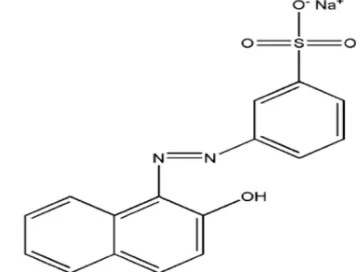
All used chemicals were obtained from Merck Company, Germany. The chemical structure of the acid orange 2 dye has been shown in figure 1. The chemical formula of acid orange 2 dye is, C16H11N2NaO4S. To adjust the pH of a solution, NaOH or 1 N H2SO4 was used.
Figure 1. Chemical structure of the acid orange 2 dye
The maximum of absorbance wavelength of the acid orange 2 dye 483 nm was determined according to previous studies. After determining the maximum absorbance wavelength, the calibration curve was drawn. For this, various concentrations of dye solution were prepared, and their absorption at a wavelength of 483 nm was recorded by
using a spectrophotometer. Then the
calibration curve was prepared by using Excel software (Figure 2). The effect of different variables such as adsorbent dose (10, 25, 50, and 75 g/L), dye concentration (25, 50, and 100 mg), contact time (15, 30, 60, 90, and 120 min), and the pH (3,7,11) were investigated. The experiments were performed in a glass beakers volume (500 ml). By keeping constant, the three parameters and one changing parameter were investigated the dye removal efficiency. For example, for survey
the effect of pH, a dye solution with concentration of 25 mg/L and adsorbent dose 50 g/L was added and in the various pHs and after contact time 90 min, the dye
concentration was determined by
spectrophotometer. This method was used to examine the influence of other factors. Stirrer speed was set at 800 rpm. By controlling the
experimental environment with digital
thermometer, The reaction temperature was same the laboratory temperature (25°C). The sample volume, according to surveyed variables, was estimated at 120. The dye removal percentage (R%) was calculated as follows (Equation 1):
0
0
C C
R(%) 100
C
−
= ×
(Equation 1)
Where, C0 is the initial concentration
(mg/L) and C is the final dye concentration (mg/L).
Figure 2. Standard curve of the acid orange 2 dye at a wavelength of 483 nm
Langmuir and Freundlich isotherms were used for the description to adsorption acid orange 2 dye from aqueous solution by eggshell. Langmuir adsorption isotherm is the most application of adsorption isotherm that
0.0730.163 0.348
0.89
1.738
2.54
0 0.5 1 1.5 2 2.5 3
0 20 40 60 80
A
b
so
rp
ti
o
n
R
a
te
(
m
g
/l
)
Dye Concentration ( mg/l )
has been used for adsorption to solution material of aqueous solution. This isotherm based on a hypothesis of single layer adsorption on an adsorbent with equal structure.
The linear equation of Langmuir isotherms is as follows (Equation 2):
e e
e L m m
C 1 C
q =k q +q (Equation 2)
Where:
Ce: Equilibrium concentration of dye in
solution (mg/L)
qe: Amount of the adsorbed dye per gram
of adsorbent (mg/g)
qm: Theoretical saturated the capacity of
monolayer adsorption (mg/g)
kL: Langmuir constant (L/mg) that get by
drawing the Ce against e
e
C q
Freundlich isotherm is an empirical equation and relating the surfaces of adsorbent heterogeneous (5).
The linear equation of Freundlich isotherm is as follows (Equation 3):
e f e
1
log q log k log C
n
= +
(Equation 3)
Where:
Kf and n: Freundlich constants that get by
drawing the plot of logqe with logCe.
3. Results
Effect of initial pH
As shown in figure 3, with increasing the
solution pH, dye removal efficiency
decreased. Optimum pH 3 was considered. Therefore, the next stage of testing in pH 3 was adjusted.
Effect of adsorbent dose
The results of the adsorbent dose effect on the adsorption in figure 4 and show that increasing the dose of 10 g/L of eggshell to 50
g/L, acid orange 2 dye removal efficiency of
35-74% was increased. The optimum
adsorbent was considered about 50 g/L.
Figure 3. Effect of pH on the acid orange 2 dye removal
efficiency (adsorbent dose: 50 g/L, initial dye concentration: 25 mg/L, and contact time: 90 min)
Figure 4. The effect of adsorbent dose on the removal of acid orange 2 dye (initial dye concentration: 25
mg/L, contact time: 90 min and pH: 3)
Effect of contact time
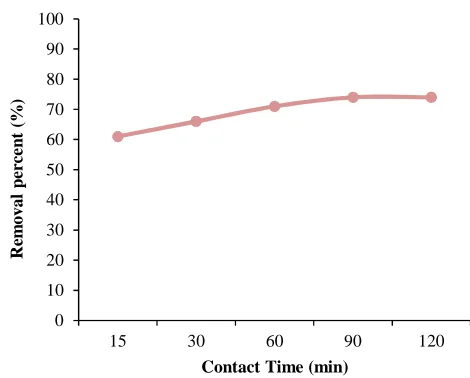
The effect of contact time on the adsorption of acid orange 2 dye by the eggshell is showed in figure 5. Based on the results, by increasing the contact time, dye removal efficiency, increased up to 90 min to reach equilibrium. The removal efficiency of dye by eggshell was during the balance 74%.
0 10 20 30 40 50 60 70 80 90 100
3 7 11
R
em
o
v
a
l
P
e
rc
en
t
(%
)
pH
0 10 20 30 40 50 60 70 80 90 100
15 30 60 90 120
R
em
o
v
a
l
p
er
ce
n
t
(%
)
Contact Time (min)
IJHS 2015; 3(2): 42
Figure 5. The effect of contact time on the removal of acid orange 2 dye (Adsorbent dose: 50 g/L, initial dye
concentration: 25 mg/L and pH: 3)
Effect of initial dye concentration
The results of the effect of initial dye concentration on the removal of acid orange 2 dye are showed in figure 6. With increasing the initial dye concentration of 25 mg/L of eggshell to 100 mg/L, acid orange 2 dye removal efficiency was increased.
Figure 6. The effect of initial dye concentration on the removal of acid orange 2 dye (adsorbent dose: 50 g/L,
contact time: 90 min and pH: 3)
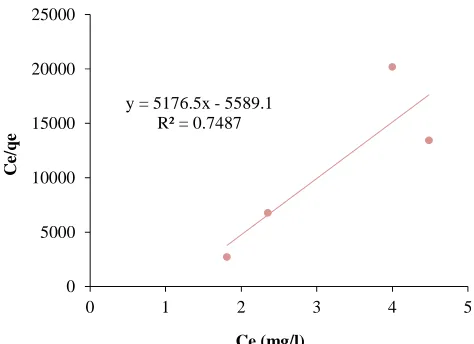
Figures 7 and 8 show the Langmuir and Freundlich isotherms for acid orange 2 dye. The correlation coefficients of each two isotherm are given in table 2.
Figure 7. Curve of Langmuir adsorption isotherm
Figure 8. Curve of Freundlich adsorption isotherm
Table 2. Parameters of Langmuir and Freundlich isotherm
Model of isotherm Parameter Amount
Langmuir R2 0.74
Freundlich R2 0.87
4. Discussion
Effect of initial pH
The results of this study showed that by
increasing the pH from 3 to 11, (pKa = 13) the
removal efficiency of acid orange 2 dye decreased from 74% to 40%. With increasing pH value, the number of positively charged sites on the adsorbent surface decreases and the number of negatively charged sites increases that lead to decreasing in the dye
0 10 20 30 40 50 60 70 80 90 100
10 25 50 75
R
em
o
v
a
l
p
er
ce
n
t
(%
)
) mg/l ( Adsorbent Dose
0 10 20 30 40 50 60 70 80
0 25 50 75 100
R
em
o
v
a
l
P
er
ce
n
t
(%
)
Dye Concentration (mg/l)
y = 5176.5x - 5589.1 R² = 0.7487
0 5000 10000 15000 20000 25000
0 1 2 3 4 5
C
e/
q
e
Ce (mg/l)
y = 0.4608x + 1.3376 R² = 0.8781
-0.7 -0.6 -0.5 -0.4 -0.3 -0.2 -0.1 0
-5 -4.5 -4 -3.5 -3 -2.5 -2 -1.5 -1 -0.5 0
lo
g
qe
(m
g
/g
)
log Ce(mg/l)
removal (16). In a study by Shirmardi et al was done on dye removal of acid red 18 from aqueous solution, the optimum pH value was equal to 3 (5). Yousefi et al. reported the maximum of dye removal of reactive red 198 is at pH 2 (16). The results of Samarghandi et al. study revealed that by decreasing the pH from 11 to 3 dye removal efficiency increases from 67% to 94% (2).
Effect of adsorbent dose
In this study by increasing in amount of adsorbent, dye removal efficiency got about 35-74%. With the increasing amount of adsorbent, the active surface or available surface for adsorption increases that this increasing of adsorbent surface area, lead to the increasing of dye removal efficiency (17). Zheng et al. investigate the adsorption of Cu (II) and cadmium on hydroxyapatite extracted from the eggshell. With an increasing adsorbent mass ratio as the liquid volume ratio of 1:1 to 5:1, the removal efficiency of copper and cadmium was increased from 75% to 97% (18). In a study conducted by Ghaneian et al., the eggshell efficiency in reactive red 123 dye
removal from textile wastewater was
investigated. With increasing adsorbent mass of 1-5 g/100 ml, dye adsorption efficiency of 48-80.7% was increased (17).
Effect of contact time
Based on results of this study, by increasing the contact time from 15 min to 90 min, the removal efficiency of acid orange 2 dye from 61% to 74 % was increased. Fast and high absorption rate at the times of initial contact is probably the reason that most of the sites into absorbent are empty and changes in the level pollutant concentrations in the liquid phase are greater. With time, dye molecules occupy these sites gradually and the rate of change of pollutant concentration in the liquid phase is decreased, and lead to decreased rate of dye adsorption (13,17). Beside over time, the repulsive forces between the dye molecules
adsorbed on the adsorbent surface is increased which led to decreased the rate of dye removal in the blank sites on the adsorbent surface and absorption is prolonged (5,17). In a study by Shokoohi et al. in 2010 about removal of acid red 18 dye by using activated carbon made from poplar wood was done, the removal of acid red 18 dye as 120 min got equivalence (19). In a study conducted by Ghaneian et al. eggshell efficiency in reactive red 123 dye
removal from textile wastewater was
investigated. The maximum adsorption was occurred in the first 60 min (17). In a study was conducted by Mahvi and Heybati efficiency of activated carbon made from walnut wood in the removal of acid red 18 dye was investigated. The maximum removal efficiency for acid red 18 dye was achieved in a time of 90 min (6).
Effect of initial dye concentration
In this study, by increasing of initial dye concentration of 25-100 mg/L, the removal efficiency was decreased. The decreasing removal efficiency due to saturation the vacant sites on the adsorbent surface in higher dye concentrations (5). As respects for a specified amount of an adsorbent, adsorption sites is constant, thus by increasing the initial dye concentration, removal efficiency is reduced. Furthermore, by increasing the initial dye concentration, was created repulsive between dye molecules and was prevented from dye adsorption on the adsorbent (6). In 2009, Bensmaili and Yeddou adsorption of phosphorus on eggshells impregnated with iron were investigated. The results of this study revealed that by increasing the initial concentration of the pollutant, the rate of adsorption is reduced (20). Mahvi and Heybati study showed that by increasing the concentration of acid red 18 dye of 25-100 mg/L, the removal efficiency of 56.56-28.02% was decreased (6). The efficiency of oxidized multiwall carbon nanotubes for the removal of the acid red 18 dye from aqueous solution by
IJHS 2015; 3(2): 44
a Shirmardi et al. was investigated. With increasing initial dye concentration of 25-100 mg, the removal efficiency was decreased from 99% to 70% (5).
Adsorption isotherms
Based on the findings of this study, the adsorption of acid orange 2 dye follow the Freundlich adsorption isotherm (R2 = 0.87). Bazrafshan et al. reported that the adsorption of reactive red 198 dye by pistachio waste ash follow the Freundlich isotherm (21). In another study, Bazrafshan and Mostafapour investigated the efficiency of persica plant’s ash in the removal of methylene blue dye. The results showed that the removal of methylene blue dye follow the Freundlich isotherm (12). Mahvi and Heybati study showed that acid red 18 dye removal by activated carbon made from walnut wood follow the Freundlich isotherm (6).
Acknowledgement
This study was carried out under the key subject of Qom Industries town company as well as been supported by Qom University of Medical Sciences. We thank Eng. Mohsen Ansari for her effective assistance and consulting in this study.
References
1. Samarghandi MR, Azizian S, Samadi MT,
Shokoohi R, Rahmani A. Using Thomas model to evaluate dye removal from aqueous solutions in fixed-bed columns of activated carbon. Journal of Water and Wastewater 2011; 22(77): 23-34. [In Persian]
2. Samarghandi MR, Noori Sepehr M, Zarrabi
M, Norouzi M, Amraie F. Mechanism and removal efficiency of C.I. acid blake 1 by pumice stone adsorbent. Iranian Journal of Health and Environment 2011; 3(4): 399-410. [In Persian]
3. Xu XR, Li HB, Wang WH, Gu JD.
Degradation of dyes in aqueous solutions by
the Fenton process. Chemosphere 2004; 57(7): 595-600.
4. Abramian L, El-Rassy H. Adsorption kinetics
and thermodynamics of azo-dye Orange II onto highly porous titania aerogel. Chemical Engineering Journal 2009; 150(2-3): 403-10.
5. Shirmardi M, Khodarahmi F, Heidari Farsani
M, Naeimabadi A, Vosughi Niri M, Jafari J. Application of oxidized multiwall carbon nanotubes as a novel adsorbent for removal of Acid Red 18 dye from aqueous solution. J North Khorasan Univ Med Sci 2012; 4(3): 335-47. [In Persian]
6. Mahvi AH, Heibati B. Removal efficiency of
azo dyes from textile effluent using activated
carbon made from walnut wood and
determination of isotherms of acid red18. Journal of Health 2010; 1(3): 7-15. [In Persian]
7. Asilian H, Moussavi GR, Mahmoudi M.
dsorption of reactive red 198 azo dye from aqueous solution onto the waste coagulation sludge of the water treatment plants. Iranian Journal of Health and Environment 2010; 3(1): 93-102. [In Persian]
8. Ghanizadeh Gh, Asgari Gh. Removal of
methylene blue dye from synthetic wastewater with bone char. Iranian Journal of Health and Environment 2009; 2(2): 104-13. [In Persian]
9. Asgari Gh, Hoseinzadeh E, Taghavi M, Jafari
J, Sidmohammadi A. Removal of reactive black 5 from aqueouse solutionUsing catalytic ozonation process with bone char. Jundi Shapur J Health Sci 2012; 4(2): 21-30. [In Persian]
10.Saghi MH, Allahabadi A, Rahmani Sani A,
Vaziri T, Hekmatshoar R. Removal of reactive orange 3 dye from aqueous solution by biosorption technology. J Sabzevar Univ Med Sci 2012; 19(2): 127-35. [In Persian]
11.Ghaneian MT, Ehrampoush MH, Ghanizadeh
Gh, Dehvary M, Abootoraby M, Jasemizad T. Application of solar irradiation / K2S2O8 photochemical oxidation process for the removal of reactive blue 19 dye from aqueous solutions. Iranian Journal of Health and Environment 2010; 3(2): 165-76.
12.Bazrafshan E, Kord Mostafapour F.
Evaluation of color removal of Methylene blue from aqueous solutions using plant stem
ash of Persica. J North Khorasan Univ Med Sci 2012; 4(4): 523-32. [In Persian]
13.Ghaneian M, Ehrampoush M, Ghanizadeh G,
Momtaz M. Study of eggshell performance as a natural sorbent for the removal of reactive red 198 dye from aqueous solution. J Toloo e Behdasht 2011; 10(1): 70-81. [In Persian]
14.Mansoorian H, Mahvi AH, Kord Mostafapoor
F. Equilibrium and synthetic studies of methylene blue dye removal using ash of walnut shell. Health in the field 2013; 1(3): 48-55. [In Persian]
15.Hamzeh Y, Azadeh E, Izadyar S, Layeghi M,
Abyaz A, Asadollahi Y. Utilization of canola stalks in the decolorization of reactive dye contaminated water. Iran J Nat Res 2011; 4(6): 409-19. [In Persian]
16.Yousefi N, Fatehizadeh A, Ahmadi A,
Rajabizadeh A, Toolabi A, Ahmadian M. The efficiency of modified wheat brad in reactive black 5 dye removal from aqueous solutions. Journal of Health and Development 2013; 2(2): 157-69. [In Persian]
17.Ghaneian MT, Ghanizadeh Gh, Gholami M,
Ghaderinasab F. Application of eggshell as a natural sorbent for the removal of reactive red 123 dye from synthetic textile wastewater. Zahedan J Res Med Sci 2010; 11(4): 25-34.
18.Zheng W, Li XM, Yang Q, Zeng GM, Shen
XX, Zhang Y, et al. Adsorption of Cd(II) and Cu(II) from aqueous solution by carbonate hydroxylapatite derived from eggshell waste. J Hazard Mater 2007; 147(1-2): 534-9.
19.Shokoohi R, Vatanpoor V, Zarrabi M, Vatani
A. Adsorption of acid red 18 (AR18) by activated carbon from poplar wood- A kinetic and equilibrium study. Journal of Chemistry 2010; 7(1): 65-72.
20.Mezenner NY, Bensmaili A. Kinetics and
thermodynamic study of phosphate adsorption on iron hydroxide-eggshell waste. Chemical Engineering Journal 2009; 147(2-3): 87-96.
21.Bazrafshan E, Kord Mostafapour F, Barikbin B.
Decolorization of Reactive Red 198 by means ofpistachio-nut shell ash. J Birjand Univ Med Sci 2012; 19(3): 266-76. [In Persian]