https://doi.org/10.5194/gmd-11-2175-2018 © Author(s) 2018. This work is distributed under the Creative Commons Attribution 4.0 License.
IPA (v1): a framework for agent-based modelling
of soil water movement
Benjamin Mewes and Andreas H. Schumann
Institute of Hydrology, Water Resource Management and Environmental Engineering, Ruhr University, Bochum, 44801, Germany
Correspondence:Benjamin Mewes ([email protected]) Received: 20 December 2017 – Discussion started: 31 January 2018
Revised: 26 April 2018 – Accepted: 23 May 2018 – Published: 13 June 2018
Abstract.In the last decade, agent-based modelling (ABM) became a popular modelling technique in social sciences, medicine, biology, and ecology. ABM was designed to sim-ulate systems that are highly dynamic and sensitive to small variations in their composition and their state. As hydrolog-ical systems, and natural systems in general, often show dy-namic and non-linear behaviour, ABM can be an appropriate way to model these systems. Nevertheless, only a few stud-ies have utilized the ABM method for process-based mod-elling in hydrology. The percolation of water through the un-saturated soil is highly responsive to the current state of the soil system; small variations in composition lead to major changes in the transport system. Hence, we present a new approach for modelling the movement of water through a soil column: autonomous water agents that transport water through the soil while interacting with their environment as well as with other agents under physical laws.
1 Introduction
Agent-based modelling (ABM) is a relatively new modelling approach or dogma that was born in social sciences to sim-ulate the interactions of autonomous, encapssim-ulated software agents in a predefined environment that form an emergent system through their interactions and their coupled decision-making processes (Macal and North, 2010; Jennings, 2000; North, 2014). Over the years, this technique evolved and came to be applied in various other disciplines like bioinfor-matics (Centarowicz et al., 2010), land use modelling (Ham-mam et al., 2004; Crooks et al., 2008), ecological modelling (Kofler et al., 2014), and policymaking (Lempert, 2002). In
ap-proaches fail or are hard to parametrize. The unexpected out-come evolves from the multi-agent set-up in which the model outcome is more than the pure addition of all individual deci-sions but the result of the interplay of decideci-sions. The system behaviour becomes highly complex as soon as agents have to negotiate the solution of a dilemma situation, like in our case an already saturated target area. In contrast to purely data-driven approaches, agent-based models rely on clearly for-mulated rules that create complex behaviour through large numbers of inter-operating autonomous software units. We see physical process-based agent-based models as appropri-ate tools for modelling the behaviour of wappropri-ater in the soil ma-trix in which various processes like chemical alteration and physical processes like the adsorption of water in macrop-ores or the density variation of water through melting-and-freezing processes near permafrost layers are of great hydro-logic interest. The modelling of these heterogeneities within the soil, e.g. macropores, is an ideal application for agent-based models as here the interplay of dynamic model compo-nents, in this case hydrologic agents, plays a significant role due to changes in the interplay of model components and in-ternal states. Decisions by single agents not only change the model outcome of this very agent but also have a massive influence on the further behaviour of neighbouring agents. These aforementioned processes show a high level of bidi-rectionality and connectivity, motivating us to set up a frame-work with a modelling technique that perfectly fits this emer-gent and dynamic system behaviour.
In our study we wanted to show the ability of dynamic agent-based models to simulate the movement of water through the soil. Therefore, we developed an example model within our Integrated Platform for Agent-based modelling framework (IPA) for agent-based hydrological modelling. IPA follows the instructions for an ABM framework set-up (North, 2014). Our model relies on physical assumptions for percolation speed and distribution of water within the soil matrix. System dynamics are purely based on interactions between hydrologic agents and their environment. With a simple synthetic model set-up we showed that an IPA model compares well with other spatially distributed models, in this case with a model created in the hydrological framework cmf (Kraft et al., 2011). We conducted some virtual experiments with cmf to verify the applicability of IPA in order to over-come the need for a real-data test scenario proving the gen-eral applicability of this new modelling approach (Weiler and McDonnell, 2004). Furthermore, we tested the impact of the type of scheduling and the influence of randomness in the choice of the starting position of hydrologic agents after cre-ation. IPA builds upon the agent-based development environ-ment GAMA (Taillandier et al., 2012, 2014) and is published open source on GitHub.
2 Framework development for agent-based modelling of soil water movement and in-soil interactions
Following the requirements of an ABM framework, we in-troduce the class of the dynamic agents, the class of static agents, and the global agent, which controls the modelling experiment as an embracing supervisor (Macal and North, 2010; North, 2014; Fig. 2). In order to set up an agent-based model for soil water modelling, some principal thoughts on the nature of software agents, their interaction with their vironment, and eventually the constitution of the model en-vironment must be taken into account (Crooks et al., 2008). Software agents are encapsulated entities with a defined boundary and attributes, which follow rules to fulfil their goal (Macal and North, 2010; Blaschke et al., 2013). Agents interact with their environment through actors and interpret their environment through sensors, whose rules of interac-tion have to be defined a priori by the modeller (Macal and North, 2010; Hofmann et al., 2015). The environment acts in the form of a defined number of static agents that comprise all hydrologic agents within their spatial and temporal extent. All actions and interactions are coupled and lead to emergent system dynamics: agent A decided to perform action I, which hinders agent B from performing action II but leads agent B to perform action III and eventually force the environmen-tal layer agent to influence agent A’s future decision. The IPA framework handles all agent classes, the general compo-sition of the modelled system, and global model behaviour and is designed to manage agents in a dynamic way to allow the composition of large-scale agent-based models through the underlying GAMA architecture in headless mode to save computational time (Taillandier et al., 2012; Boulaire et al., 2015).
In our framework, the global agent manages all static agents (the layers) and dynamic agents (the hydrologic agents). The static agents obtain information from the hydro-logic agents, e.g. how much water is already stored within the layer. Conversely, the layers share information on physi-cal properties to the hydrologic agents. They require this in-formation to calculate their movement speed based on the environmental parameters. Through the knowledge about the hydrologic agents inside the layer, the boundary conditions for each layer are checked. In contrast to the aforemen-tioned inter-class communication between layer and agents, the intra-class communication of hydrologic agents is crucial for the decision of movement. In dilemma situations, e.g. in case the target pore space is already covered, the intra-class communication is used to solve that dilemma situation by negotiating the different states of the hydrologic agent (see Fig. 1).
high-Figure 1.Conceptual scheme of IPA showing the global agent, the static layer agents, and the dynamic hydrologic agents that are glued to an experiment. The intra-class communication among hydrologic agents is needed for the pathfinding of the agents, as potential targets for movement might already be occupied. The inter-class communication between hydrologic agents and layer agents shows the information exchange from the dynamic agents to the static agents and vice versa. The bidirectional communication among classes is needed to check boundary conditions like the maximum soil moisture per layer and calculate the potential gradient. Moreover it is used to estimate the velocity kof the hydrologic agent according to their surrounding environment.
performance systems (Wang et al., 2013). Analysis of ABM results is different to analysis of equation-based models. Generally, the pattern-oriented analysis is preferred, espe-cially in the case of spatially distributed ABM (Grimm et al., 2005). In our study, we run GAMA in headless mode to save computational time with 2–4 cores for parallel computing of agent states.
2.1 Dynamic agents: hydrologic agents 2.1.1 Class description of hydrologic agent
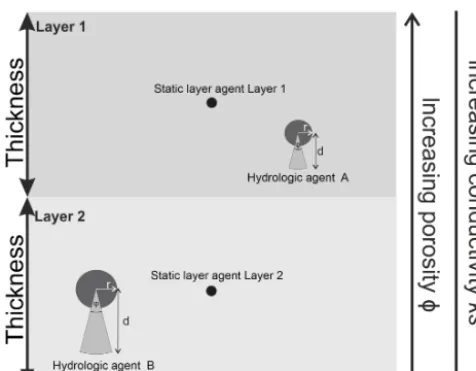
Hydrologic agents are carriers of a constant amount of wa-terwthat defines their mass (represented as grey circles in Fig. 2). All agents carry the same amount of water, but their spatial extent is different because of changing environmen-tal characteristics. Here, the spatial extent of the hydrologic agents is determined by a circle with radius r that is influ-enced by the surrounding porosity8E. Thus the size of the hydrologic agent may change during its way through the soil
column although its mass remains the same due to a change in the porosity. For future applications the densityρ of the carried water is also included (but set to 1).
r= w
8E
ρ (1)
The influenceIhA,L of each hydrologic agent on the static layer agents can be quantified by the area that a hydrologic agent covers of a layer in relation to the complete area of the hydrologic agent (Eq. 2).
IhA,L=
AhA,L
AhA
, (2)
whereAhA,Lis the area of layerLcovered by agent hA, and
Figure 2.IPA scheme with two layers with decreasing porosity per depth and two hydrologic agents.
layers SatL is calculated by the contributed amount of wa-terwhAof the agents located within the layer(hA,0. . . hA,N) weighted by the influenceIhAand the total pore volume of the layerv.
SatL= hA,N
P
hA,0
IhA·whA
V (3)
In order to analyse the possible future location of the agent, a cone-shaped viewshed is constructed (light grey cones in Fig. 2). The viewshed has a larger extent than the area of influence, although its length also depends on the radiusr. Moreover, the saturated percolation speed of the agent in its environmentksand the chosen model time step1tdetermine the viewshed. This can be seen as a tool for numerical inte-gration in the discretized model environment (Servat, 2000), as it shows the maximum distance the agent can travel within the next time step. The cone is constructed with an angle of
ϕ=45◦and the maximum distanced (Eq. 4) and saturated hydraulic conductivity denoted asks. The calculation of the viewshed is influenced by Darcy’s law incorporating the hy-draulic conductivity representing the possible step width and the time step of the model. As the agent has a spatial ex-tent, the radius has to be considered as well. The angleϕis a parameter to include the variability in pathfinding due to dif-ferent grain sizes in the soil structure. As our model set-up is a 1-D soil column and the gradient is limited to one direc-tion, the angle as well is limited to 45◦in the direction of the gravitational gradient. This angle is chosen because in the 1-D case this angle represents the possible range of direction of movement without a substantially changed gradient. The direction and the speed of movement define the pathfinding algorithm of IPA.
d=pr·ks·1t (4)
2.1.2 Rule set for hydrologic agents
The hydrologic agent has to decide whether to move or not to move. Once it has decided whether it will move, the direction of movement has to be considered. In our case, the rules of movement are defined by physical laws of soil water move-ment, which can be seen as a trade-off of vertical forces of gravityψGand matrix potentialψMthat holds water against gravity. These forces are known as the driving potentials. The osmotic potentialψO is neglected, which reduces the deci-sion of each agent for movement to
ψH=ψM−ψG. (5)
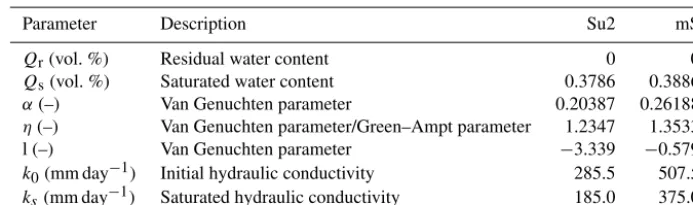
ψH equalling 0 means no movement down with the poten-tial gradient takes place, whereasψH>0 leads to capillary rise.ψH<0 results in further deeper percolation of the agent with the speedkof the agent determined by a soil-dependent retention curve (van Genuchten, 1980; DBG Arbeitsgruppe Kennwerte des Bodengefüges, 2009). The speedkis the ac-tual hydraulic conductivity that is higher than the saturated hydraulic conductivityks. In the case of an infiltration front moving through a wet soil, the matrix potentialψMcan also be in the same sign with the gravitational potentialψG. In the case that the future location of the agent at ti+1t is already occupied, the agent tries to find another route fol-lowing its gradient of potential. Thus the running order, or schedule of hydrologic agents, is of importance, which we discuss later in detail. If no other route is possible, the partic-ular agent’s movement is suspended for this time step, or tick as it is called in ABM. The speed of the movement is given by thekvalue of the surrounding area, which itself depends on the predominant moisture of the environment, which is cal-culated using van Genuchten’s model (van Genuchten 1980). This model links soil moisture and the predominant poten-tialsψH,ψM, andψG with the saturated hydraulic conduc-tivity ks and the hydraulic conductivity k, which is higher under saturated conditions. The physical soil properties used to calculate van Genuchten’s model are given in Table 1. 2.2 Static agents: layer agents
2.2.1 Class description of layer agent
Table 1.Physical soil parameters for the Green–Ampt model and van Genuchten model. Source: DBG Arbeitsgruppe Kennwerte des Bo-dengefüges (2009).
Parameter Description Su2 mS
Qr(vol. %) Residual water content 0 0
Qs(vol. %) Saturated water content 0.3786 0.3886
α(–) Van Genuchten parameter 0.20387 0.26188
η(–) Van Genuchten parameter/Green–Ampt parameter 1.2347 1.3533
l (–) Van Genuchten parameter −3.339 −0.579
k0(mm day−1) Initial hydraulic conductivity 285.5 507.5 ks(mm day−1) Saturated hydraulic conductivity 185.0 375.0
with a fifth degree. This spline was found to fit the char-acteristics of soil water content well, but still needs refine-ment as we show in the detailed analyses. Each layer controls whether the movement of agents is possible, such that prob-lematic situations, e.g. oversaturation of layers, are avoided. With this the layer is like an internal boundary condition for the decision-making process of the hydrologic agents. The interaction between hydrologic agents and the layer agents is bidirectional: thus, not only corresponding amounts of wa-ter carried by hydrologic agents alwa-ter layer processes but also this alteration of soil moisture content is coupled with fu-ture agents’ decision due to the influence of the soil retention curve on speed and direction of movement (Grashey-Jansen and Timpf, 2010).
2.2.2 Rule set for layer agents
Static layer agents have various duties: they create hydro-logic agents, monitor the soil moisture, and oversee that all hydrologic agents act within the boundary conditions. For the creation of the hydrologic agents, an infiltration model has to be used. This can be a potential-based agent model, or as well as in this case a Green–Ampt (GA) approach of infiltration leading to the general assumption of a continuous movement of the infiltration front in the matrix. Therefore, the infiltra-tion in the upmost layer represents the upper boundary condi-tion of the model. In this framework an environmental layer can be assigned with a GA infiltration, which offers a fair ap-proximation of GA to compute (Ali et al., 2016). Ali et al. presented an approximation to GA in whichF (t )represents the cumulative infiltration,Sthe sorption parameter defined by Ali et al. (2016),ksthe saturated percolation velocity de-pending on the soil, andt∗ a dimensionless infiltration time (Eq. 6). The cumulative infiltrationF (t )is transformed into an actual infiltration ratef (t ), which sets the number of hy-drologic agents at a normally distributed random starting po-sition in the upmost layer (Eq. 7). For the calculation of the infiltration into the soil column, the parameters given in Ta-ble 1 are used to calculate the GA infiltration in each time step.
F (t )= S 2
2ks
−1−
t∗+ln
1+t∗+
√ 2t∗
1+ √ 2t∗ 6 1 1+t∗+
√ 2t∗ 1+ √ 2t∗ 6 −1 (6)
f (t )=(F (t )−F (t−1))/1t (7) The mass of the newly generated agents is fixed to a cer-tain amount which limits the maximum number of agents in the system to be simulated. This knowledge is of impor-tance once IPA is able to run on either graphic card acceler-ated systems or on parallel computing platforms like cloud-based services because memory allocation and data stream-ing among processstream-ing units become the bottleneck of perfor-mance and have to be formalized beforehand (Rybacki et al., 2009; Kofler et al., 2014). In contrast to the upper boundary of the model within the IPA framework, the lower boundary is defined by an outflow rate that relies on the ks value of the lowest layer. Once the centroid of the agent, given as the centre of the circular shaped agent, has left the system, it dies and the carried amount of water accounts as outflow.
In IPA all layers or agents of the environment collect infor-mation about processes that take place within their extent and along their boundaries. In order to assign a weight depending on the distance of the hydrologic agents to the centre of the layer, a density kernel approach is applied to assign weights to each agent to smooth results and reduce numerical and graphical artefacts for the integration of all agent movements that are highly variable and are dependent on the simulated situation.
2.3 Scheduling of model actions
the beginning of the simulation) and asks hydrologic agents to register their layer belonging. Moreover, the global agent is able to force the observing agents to recalculate their state in terms of their current storage.
2.4 Model framework for comparison: cmf
For comparison purposes, the cmf framework in which a sin-gle soil column model was created was used (Kraft et al., 2011). The cmf framework was chosen because it offers an open framework for spatially distributed process-based mod-elling (like solving the Richard’s equation for unsaturated flow). Moreover, the general structure of cmf allows a spa-tial discretization and spaspa-tial modelling and can thus be seen as a possible benchmark for a hydrological ABM framework like IPA.
For our model, a single cmf cell, subdivided into 10 layers with a depth of 10 cm each, was used. The uppermost layer was connected by a GA infiltration process and a constant head of water available for infiltration upon surface. Trans-portation of water within the cmf soil column was calculated by the Richards equation for unsaturated flow and Darcy’s law for saturated flow. The soil retention curve was modelled with the help of the van Genuchten–Mualem model. The out-let of the soil column was defined as a free boundary where water can exfiltrate from the system.
2.5 Model set-up and parametrization of environment
For comparison of the general ability of the usage of IPA for the simulation of soil water movements, a simple syn-thetic scenario was created. A soil column with a height of 1 m and a width of also 1 m (leading to a complete volume of 1 m3) was used as model set-up. The soil column was divided into 10 single layers with a constant thickness of 10 cm. This column was filled with a homogenous sand soil (mS) with soil parameters given in Table 1. All parameters applied in the van Genuchten model influence the calculation ofk by the potential gradient and the saturation of the environment, whereas the GA parameters only affect the upper bound-ary condition. The chosen time step was 1 h in order to re-duce computational time, keeping in mind that a time step this long is vulnerable to numerical integration problems. By the reduction of time step length, fewer steps for the hydro-logic agents had to be calculated. All layers were equally pre-filled with soil water, resulting in a layer-specificθ of 20 % of available pore space. Although different in their internal structure, the IPA model and the cmf model (Kraft et al., 2011) shared exactly the same model set-up and parametriza-tion. Infiltration was fed by an initial head of water of 1.0 m at the surface. The number of ticks was set to 90, which means that both models calculated 90 h or 3.75 days of in-filtration and soil water movement. The model time was set long enough (3.75 days) to allow a deeper movement of the infiltration front through a set of layers, without the head of
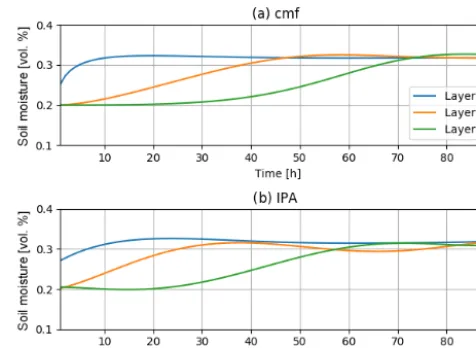
Figure 3.Comparison of soil moisture development of the upmost three layers with a homogenous soil in the column.
water on the surface becoming 0. In both models, the time step is chosen as 1h to increase comparability of results and remains constant in all figures and applications.
2.6 Performance measures
To estimate the quality of IPA representation of the water movement within the soil column, a suitable measure of per-formance had to be found. Both models deliver time series of their current states, the layer-specific soil moistureθ. Here, we chose to measure the performance of IPA with the r2
value.
3 Results
sim-Table 2. Statistical parameters from model comparison between cmf and IPA for homogenous soil.
Model SD (%) Mean (%) r2
Cmf 0.045 0.29
0.80
IPA 0.039 0.29
Figure 4. Comparison of soil moisture development of the up-most three layers with a transition boundary between Layer 1 and Layer 2.
ulation. After 70 h both models show saturation in the first layer, so both models reach the same final stable state. In both models the layers are nearly completely saturated at a soil moisture of about 32.8 %. The transport from Layer 2 to Layer 3 starts in both models 21 h after the beginning of the simulation. Meanwhile, cmf shows a numerically smoother behaviour than IPA, while the general system behaviour is similar as we can see it in the variation in soil moisture in all layers in IPA, although some numerical oscillations in the soil moisture of Layer 2 become visible.
To express the accordance between IPA and cmf for this run, we calculated the corresponding r2 value. Here the meanr2value of the upper three layer scoresr2=0.80. The standard deviation of both models is slightly different with 0.039 % (cmf) compared to 0.045 % (IPA) while the mean values of soil moisture are the same (Table 2).
4 Detailed analyses and discussion 4.1 Soil column with heterogeneous soil
As stated before, the synthetic case was extended to a more complex situation of two heterogeneous soil types. In order to show the general ability of IPA to model complex systems, the 1-D soil column was packed with two different soils lead-ing to the problem of a boundary between two different types
of soils with different physical properties. The geometry and the discretization of the grid for the cmf model remained the same, but the topmost layer consists of Su2 (a weakly silty sand) instead of mS. Su2 was chosen because although it has different physical characteristics, it is still a relative to the original mS soil with a lower share of sand but a higher share of clay. This change of soil type highly affects the process of infiltration and the transition between Layer 1 and Layer 2. None of the other layers were changed, so the ability of IPA to simulate with its pathfinding algorithm (as introduced in Sect. 2.1.1) and its suspension of movement approach was tested in regard to the added layer transition between Su2 and mS.
Again, both models show a similar, yet slightly different behaviour (Fig. 4). Transport from Layer 1 to Layer 2 starts immediately as does the movement of water between Layer 2 and Layer 3 in IPA. Saturation of Layer 1 in IPA is reached slower than in cmf but the result after 40 h of simulation is a stable system with comparable saturation near full satura-tion in all layers, although the general IPA behaviour is less smooth than the cmf behaviour. IPA shows slightly higher saturation of about 27 % in contrast to 26 % for Layers 2 and 3 in cmf. For the saturation of the infiltration, Layer 1 shows exactly the same values for both models. Ther2value scores at 0.71, which means a high correlation between the outcomes of both models, even though the dynamics between Layers 2 and 3 are different from those in cmf. This could be related to the dilemma of spatiality in the agent-based model as all hydrologic agents have a certain shape and it is likely that this shape has a significant influence on the model out-come. The slightly higher saturation might be because of the boundary conditions that the global surveying agents have to check to avoid oversaturation.
4.2 Influence of model scheduling
As mentioned before, scheduling of agent actions is a sen-sible question in ABM. Here, three different methods for scheduling were implemented:
– random calling of agents, which calls agents randomly by chance;
– energy-based scheduling, which allows agents with higher gradients to move first;
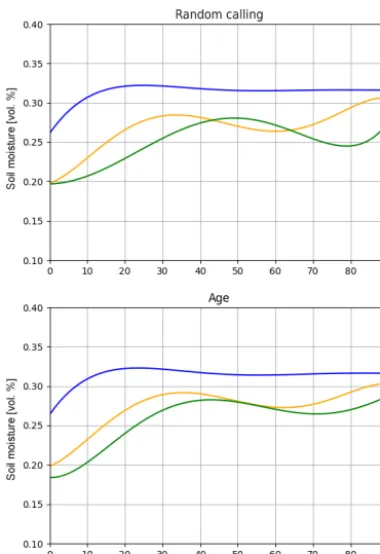
Figure 5.Analysis of different scheduling methods for the soil column with two different soils.
the energy gradient of each agent (the current state of the agent) is not taken into account. Deeper layers show more fluctuations of soil moisture as it can be seen from tick 80 to 90. To overcome this random approach, an energy-based ap-proach was developed: Those agents with the highest energy-gradient are allowed to move first, which results in smoother results with fewer numerical fluctuations. This is the case be-cause the advantage of hydrologic agents with a high poten-tial energy limits conflicts between slow- and fast-moving agents and like for pathfinding issues through a clearly de-fined regulation, which agents have priority in moving first, trying to get their potentials in balance. Last but not least, we implemented a way to organize the running order by the age of the agents. The age is anticipated by the name because the unique names of all agents are not reused as soon as an agent leaves the system but originate from consecutive numbering during creation. In our test, old water is allowed to move first, so the scheduling is in a decreasing order. This approach has some problems with the distribution of old water because the names of those agents that represent old water are rather sim-ilar because they were created during initialization.
The correlation coefficients show that all types of schedul-ing in Layer 1 have less impact than in Layer 2 because all methods do have a high correlation among each other (see Tables 3 and 4). However, correlation coefficients for Layer 2 show that the energy-based approach and the age-based ap-proach have high correlation but struggle less with numerical artefacts like random calling in Layer 2 (Table 5). The soil
Table 3. Statistical parameters from model comparison between cmf and IPA for inhomogeneous soil.
Model SD (%) Mean (%) r2
Cmf 0.033 0.27
0.71
IPA 0.036 0.28
Table 4. Correlation coefficient among scheduling methods for Layer 1.
Random Energy Age calling gradient
Random calling 1 0.73 0.53
Energy gradient 0.73 1 0.66
Age 0.53 0.66 1
Figure 6.Influence of randomly chosen starting point. Calculated with 20 runs and a model set-up with two different soil types.
Figure 7.Mean resulting soil moisture after 20 runs to reduce effects of randomly chosen starting position.
Table 5. Correlation coefficient among scheduling methods for Layer 2.
Random Energy Age calling gradient
Random calling 1 0.90 0.63
Energy gradient 0.90 1 0.86
Age 0.63 0.86 1
4.3 Impact of randomly chosen starting point of hydrologic agents after creation
Another spatial ABM-specific problem is the starting posi-tion for the hydrologic agents within the system. The pro-cess of infiltration describes the spatial transition of water from the surface to the soil matrix. Therefore, we assume that each hydrologic agent is located with its complete shape in the topmost layer somewhere near the upper boundary. The
x coordinates within this layer are chosen randomly around the top of the layer, but always as deep in the soil so that its shape is completely inside the layer. In order to verify our assumptions and to show the impact of different starting po-sitions, we show the influence of the chosen starting position for the same model set up with 20 runs. The starting position
was chosen by a random normal distribution withx=Wand
σ=p·W, wherepis varied from 0.1 to 0.9 in 20 steps andW
is the width of layer, in our case 1m. As one can clearly see, soil moisture in the uppermost layer is only affected by in-filtration because calculated soil moisture is nearly constant without any visible influence of the choice of starting posi-tion, which makes sense as the hydrologic agent is always lo-cated completely within it’s the infiltration layer (see Fig. 6). Thus the relevant layers are the deeper Layers 2 and 3. Both show slight variations that look like numerical oscillations, which makes sense as the smoothing affects the calculation of layer soil moisture because the starting position affects the speed and the pathfinding of the hydrologic agents. The max-imum gap of soil moisture per layer is at 3 % for Layers 2 and 3 and at 0.5 % for Layer 1 for the 20 runs. However, the variance in soil moisture is visible; thus, a multi-run of
nruns should solve the problem and consequently a mean of thesenruns should effectively reduce this numerical artefact that was introduced by the random starting point of the agent (Fig. 7).
4.4 Weight assignation: from univariate, fitted spline towards more comprehensible methods
Figure 8. Decreasing weight with increasing distance of agent’s centroid from layer centroid.
Figure 9.Modelled soil moisture without spline smoothing but log-arithmic kernel weight assignation.
with 5◦in order to smooth the numerical artefacts from the calculation of the layer affiliation of hydrologic agents. As univariate splines fit well, but interpretation and transfer to other applications is difficult, we have chosen a density ker-nel estimator with a simple logarithmic distance function to assign a weight, wherewi denotes the weight of the specific hydrologic agentiat distancedl from layerl with which it has a spatial intersection (Eq. 8). This distance is normalized by the maximum possible distance that a hydrologic agent centroid may have with a corresponding layer agent at dis-tance “ld”, which is defined as the maximum of layer depth or the most far away agent that still corresponds to the layer’s moisture.
wi =
ln(di) max(dl,ld)
(8)
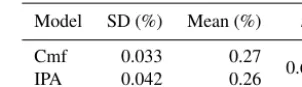
Table 6. Statistical parameters from model comparison between cmf and IPA with kernel-based weight determination.
Model SD (%) Mean (%) r2
Cmf 0.033 0.27
0.62
IPA 0.042 0.26
Hydrologic agents lose their influence on the layer moisture with increasing distance from the static layer agent represent-ing the layer centre (see Fig. 8). Implementrepresent-ing a new weight assignation in IPA removed the demand for smoothing the soil moisture per layer. Results for the two-layered synthetic case show that the approach is promising, yet not fully us-able because numerical artefacts still appear (especially in Layer 2), where fluctuations around the correct mean soil moisture for this layer occur with the relative strong variation of about 5 % of soil moisture (Fig. 9). Layer 1 is modelled better with fewer fluctuations, the soil moisture rises faster, maximum soil moisture is also modelled correctly and shows only little numerical oscillation. In Layer 1 the layer affilia-tion of each agent is only relevant during the transiaffilia-tion from the layer of origin to the target layer. The overallr2 value is lower with 0.62 than for the spline smoothing, but mean moisture is nearly the same (Table 6). The general interpre-tation that the model shows similar dynamics is supported by anr2 value that is higher than 0.5, but yet the standard deviation for both modelling approaches is much higher with 0.042 %, with 0.0332 % for cmf or 0.0363 % for spline-based IPA. The kernel-based weighting approach looks promising, as the chosen function is easier to interpret than a univariate spline. However, for future applications, this weight determi-nation has to be improved and might also be part of a study regarding different distance weighting functions and the con-struction of a method to quickly find the appropriate function.
5 Conclusion and outlook
explana-tory power of the smoothing process that is needed to com-pare the highly discretized hydrologic agents with the rather rugged layers in cmf. Moreover, the scheduling needs more refinement, especially in terms of age-based scheduling that still has a high random component, as it became clear during the analysis of different scheduling techniques. The compu-tational time of the IPA model is slightly higher than for the cmf model. The required computation time could be further lowered by running the framework headlessly, which could be a suitable approach for multi-run optimization approaches like Monte Carlo.
In future research on this topic we will take a closer look at possible age distributions for hydrologic agents that repre-sent old water. In this way, we wish to ameliorate the suspen-sion process that hinders a hydrologic agent from moving in favour of another hydrologic agent that blocks the route along the gradient of forces. Thus, the commonly observed phenomenon of residual old water or pushed out old wa-ter due to freshwawa-ter intrusion can be modelled. In fact, an age-based scheduling also allows finer modelling of hydro-chemical and small-scale pedo-physical processes that occur during the transport of water through the soil matrix than common storage models. Another interesting usage of such a refined age-based scheduling is the residence time of water within a coarse rock glacier in which meltwater is released during rather short melting periods and the water draining from these rock glaciers shows different signatures of age, proving that some water refreezes during the melt and its drain is delayed to later melting periods. Potential applica-tions of spatially distributed hydrological agent-based mod-els are numerous and IPA might be a suitable framework to answer more complex hydrological questions by adding new rule sets. For the modelling of macropore effects on the soil water movement, the principle of agent-based modelling can be interesting: the fastest hydrologic agents wet the surround-ing matrix and allow the followsurround-ing water to use the macro-pore as a shortcut through the matrix until the macro-pore is filled. Through the existence of other hydrologic agents the macro-pore is filled and travel speed is lowered, which results in an alternative pathfinding through the matrix because the poten-tial gradient allows a dispersion from the pore to the matrix. We will investigate this application of preferential flow in a hydrological model of a coarse rock glacier.
All in all, one can say that IPA and generally agent-based hydrological process models are at their beginning. In times of big data and a plethora of highly resolved data, this new modelling approach can be of use for those questions for which system behaviour can be more easily described with dynamic agent-based models than with stiff storage-based models. Within our examples we showed that the new mod-elling approach is as good (or as bad) as traditional, storage-based models but offers the variability of extension by rules and different scheduling routines. Even at this stage, an agent-based process model offers a great variability in model design for future research questions as it is able to depict
the changing dynamics of model components like in nutri-ent transport models or complex rock glacier models with changing internal model constellations. The aforementioned variable inner structure of agent-based models extends the modeler’s capabilities to describe those systems.
Code and data availability. The framework and model are available on GitHub under the following link for gen-eral use: https://github.com/HydroMewes/IPA, or under https://doi.org/10.5281/zenodo.1117558 (Mewes, 2018). Ex-ample data for soil types mS and Su2 are available in the previously mentioned GitHub repository.
Competing interests. The authors declare that they have no conflict of interest.
Acknowledgements. We acknowledge support by the DFG Open Access Publication Funds of the Ruhr-Universität Bochum.
Edited by: Min-Hui Lo
Reviewed by: two anonymous referees
References
Ali, S., Islam, A., Mishra, P. K., and Sikka, A. K.: Green-Ampt approximations: A comprehensive analysis, J. Hydrol., 535, 340– 355, https://doi.org/10.1016/j.jhydrol.2016.01.065, 2016. Bithell, M. and Brasington, J.: Coupling agent-based models of
subsistence farming with individual-based forest models and dy-namic models of water distribution, Environ. Model. Softw., 24, 173–190, https://doi.org/10.1016/j.envsoft.2008.06.016, 2009. Blaschke, T., Hay, G. J., Kelly, M., Lang, S., Hofmann, P., Addink,
E., Queiroz Feito, R., van der Meer, F., van der Werff, H., van Coillie, F., and Tiede, D.: Geographic Object-Based Image Anal-ysis – Towards a new paradigm, ISPRS J. Photogramm., 87, 180– 191, https://doi.org/10.1016/j.isprsjprs.2013.09.014, 2013. Boulaire, F., Utting, M., and Drogemuller, R.: Dynamic agent
com-position for large-scale agent-based models, in: Complex Adap-tive Systems Modeling, 3, 1–23, https://doi.org/10.1186/s40294-015-0007-2, 2015.
Bouziotas, D. and Ertsen, M.: Socio-hydrology from the bottom up: A template for agent-based modeling in irrigation systems, Hydrol. Earth Syst. Sci. Discuss., https://doi.org/10.5194/hess-2017-107, 2017.
Centarowicz, K., Paszy´nski, M., Pardo, D., Bosse, T., and La Poutré, H.: Agent-based computing, adaptive algo-rithms and bio computing, ICCS 2010, 1, 1951–1952, https://doi.org/10.1016/j.procs.2010.04.218, 2010.
Crooks, A., Castle, C., and Batty, M.: Key chal-lenges in agent-based modelling for geo-spatial sim-ulation, Comput. Environ. Urban, 32, 417–430, https://doi.org/10.1016/j.compenvurbsys.2008.09.004, 2008. DBG Arbeitsgruppe Kennwerte des Bodengefüges:
Praxis/Fachgebiete Bodenkunde, Standortkunde und Boden-schutz, Inst. für Ökologie, Bodenökologie und Bodengenese, 40 pp., 2009.
Folino, G., Mendicino, G., Senatore, A., Spezzano, G., and Straface, S.: A model based on cellular automata for the parallel simu-lation of 3D unsaturated flow, Parallel Comput., 32, 357–376, https://doi.org/10.1016/j.parco.2006.06.003, 2006.
Grashey-Jansen, S. and Timpf, S.: Soil Hydrology of Irrigated Orchards and Agent-Based Simulation of a Soil Dependent Precision Irrigation System, Adv. Sci. Lett., 3, 259–272, https://doi.org/10.1166/asl.2010.1124, 2010.
Grimm, V., Revilla, E., Berger, U., Jeltsch, F., Mooij, W. M., Rails-back, S. F., Thulke, H.-H., Weiner, J., Wiegand, T., and DeAn-gelis, D. L.: Pattern-oriented modeling of agent-based com-plex systems: lessons from ecology, Science, 310, 987–991, https://doi.org/10.1126/science.1116681, 2005.
Gunkel, A.: The application of multi-agent systems for water re-sources research–Possibilities and limits, Master Thesis, Institute of Hydrology, Albert-Ludwigs-Universität Freiburg, Freiburg, Germany, 2005.
Hammam, Y., Moore, A., Whigham, P., and Freeman, C.: Irregu-lar vector-agent based simulation for land-use modelling, 16th Annual Colloquium of the Spatial Information Research Centre, Dunedin, New Zealand, 29–30 November 2004.
Hofmann, P., Lettmayer, P., Blaschke, T., Belgiu, M., We-genkittl, S., Graf, R., Lampoltshammer, T. J., and Andrejchenk, V.: Towards a framework for agent-based image analysis of remote-sensing data, Int. J. Imag. Data Fusion, 6, 115–137, https://doi.org/10.1080/19479832.2015.1015459, 2015. Jennings, N. R.: On agent-based software engineering, Artif. Intell.,
117, 277–296, https://doi.org/10.1016/S0004-3702(99)00107-1, 2000.
Kirkby, M. J.: Do Not Only Connect, in: EGU General Assem-bly Conference Abstracts, edited by: Abbasi, A. and Giesen, N., vol. 14 (EGU General Assembly Conference Abstracts), p. 3521, 2012.
Kofler, K., Davis, G., and Gesing, S.: SAMPO: an agent-based mosquito point model in OpenCL, Proceedings of the 2014 Sym-posium on Agent Directed Simulation, Tampa, Florida, Society for Computer Simulation International, 13–16 April 2014, 1–10, 2014.
Kraft, P., Vaché, K. B., Frede, H.-G., and Breuer, L.: CMF: A Hydrological Programming Language Extension For Inte-grated Catchment Models, Environ. Model. Softw., 26, 828–830, https://doi.org/10.1016/j.envsoft.2010.12.009, 2011.
Lempert, R.: Agent-based modeling as organizational and pub-lic popub-licy simulators, P. Natl. Acad. Sci. USA, 99, 7195–7196, https://doi.org/10.1073/pnas.072079399, 2002.
Lindström, G., Johansson, B., Persson, M., Gardelin, M., and Bergström, S.: Development and test of the distributed HBV-96 hydrological model, J. Hydrol., 201, 272–288, https://doi.org/10.1016/S0022-1694(97)00041-3, 1997. Macal, C. M. and North, M. J.: Tutorial on
agent-based modelling and simulation, J. Simul., 4, 151–162, https://doi.org/10.1057/jos.2010.3, 2010.
Mashhadi Ali, A., Shafiee, M. E., and Berglund Zech-man, E.: Agent-based modeling to simulate the dynam-ics of urban water supply: Climate, population growth,
and water shortages, Sustain. Cities Soc., 28, 420–434, https://doi.org/10.1016/j.scs.2016.10.001, 2017.
Mewes, B.: IPA model code and examples of soil water mod-els, https://doi.org/10.5281/zenodo.1117558, last access: 7 June 2018.
North, M. J.: A theoretical formalism for analyzing agent-based models, in: Complex Adaptive Systems Modeling, 2, 1–34, https://doi.org/10.1186/2194-3206-2-3, 2014.
O’Connell, E.: Towards Adaptation of Water Resource Systems to Climatic and Socio-Economic Change, Water Resour. Man-age., 31, 2965–2984, https://doi.org/10.1007/s11269-017-1734-2, 2017.
Parsons, J. A. and Fonstad, M. A.: A cellular automata model of surface water flow, Hydrol. Process., 21, 2189–2195, https://doi.org/10.1002/hyp.6587, 2007.
Rakotoarisoa, M. M., Fleurant, C., Amiot, A., Ballouche, A., Com-munal, P. Y., Jadas-Hécart, A., La Jeunesse, I., Landry, D., and Razakamanana, T.: Agents-based modelling for hydrological sur-face processes on a small watershed (Layon, France), Int. J. Ge-omatics and Spatial Analysis, 24, 307–333, 2014.
Reaney, S. M.: The use of agent based modelling techniques in hy-drology. Determining the spatial and temporal origin of channel flow in semi-arid catchments, Earth Surf. Proc. Land., 33, 317– 327, https://doi.org/10.1002/esp.1540, 2008.
Reaney, S. M., Bracken, L. J., and Kirkby, M. J.: Use of the Connectivity of Runoff Model (CRUM) to investigate the influence of storm characteristics on runoff generation and connectivity in semi-arid areas, Hydrol. Proc., 21, 894–906, https://doi.org/10.1002/hyp.6281, 2007.
Rybacki, S., Himmelspach, J., and Uhrmacher, A. M.: Experiments with Single Core, Multi-core, and GPU Based Computation of Cellular Automata, First International Conference on Advances in System Simulation, 2009 (SIMUL ’09), Porto, Portugal, 20– 25 September 2009, 62–67, 2009.
Servat, D.: Modélisation de dynamiques de flux par agents. Ap-plication aux processus de ruisellement, infiltration et érosion, Dissertation, Université Pierre et Marie Curie, Paris, Institut de Recherche pour le developpement, 2000.
Shao, Q., Weatherley, D., Huang, L., and Baumgartl, T.: RunCA: A cellular automata model for simulating sur-face runoff at different scales, J. Hydrol., 529, 816–829, https://doi.org/10.1016/j.jhydrol.2015.09.003, 2015.
Taillandier, P., Vo, D.-A., Amouroux, E., Drogoul, A.: GAMA: A Simulation Platform That Integrates Geographical Information Data, Agent-Based Modeling and Multi-scale Control, in: Prin-ciples and Practice of Multi-Agent Systems, edited by: Desai, N., Liu, A., and Winikoff, M., 13th International Conference, PRIMA 2010, Kolkata, India, 12–15 November, 2010, Springer Berlin Heidelberg, 242–258, 2012.
Taillandier, P., Grignard, A., Gaudou, B., Drogoul, A.: Des données géographiques à la simulation à base d’agents: application de la plate-forme GAMA, Cybergeo, European Journal of Geography, document 671, https://doi.org/10.4000/cybergeo.26263, 2014. Troy, T. J., Konar, M., Srinivasan, V., and Thompson, S.: Moving
van Genuchten, M. Th.: A closed-form equation for predicting the hydraulic conductivity of unsaturated soils, Soil Sci. Soc. Am. J., 44, 892–898, 1980.
van Parunak, H. D., Savit, R., and Riolo, R. L.: Agent-based model-ing vs equation-based modelmodel-ing, A case study and users’ guide, Lect. Notes Comput. Sc., 1534, 10–25, 1998.
Wang, J., Rubin, N., Wu, H., and Yalamanchili, S.: Accelerating Simulation of Agent-Based Models on Heterogeneous Archi-tectures, Sixth Workshop on General-Purpose Computation on Graphics Processing Units (GPGPU-6), Houston, TX, USA, 16 March 2013.