VOLUME 40, ARTICLE 20, PAGES 533
-
560
PUBLISHED 12 MARCH 2019
https://www.demographic-research.org/Volumes/Vol40/20/ DOI: 10.4054/DemRes.2019.40.20
Research Article
Who leaves, who stays? Gendered routes out of
the family home following union dissolution in
Italy
Francesca Fiori
This publication is part of the Special Collection on “Separation, Divorce, and Residential Mobility in a Comparative Perspective,” organized by Guest Editors Júlia Mikolai, Hill Kulu, and Clara Mulder.
© 2019 Francesca Fiori.
This open-access work is published under the terms of the Creative Commons Attribution 3.0 Germany (CC BY 3.0 DE), which permits use, reproduction, and distribution in any medium, provided the original author(s) and source are given credit.
1 Introduction 534
2 Understanding mobility and housing of both partners upon union dissolution
535
3 Union dissolution, housing arrangements, and legal structures in Italy
537
4 Data and methods 540
5 Results 544
6 Discussion and conclusions 550
Who leaves, who stays? Gendered routes out of the family home
following union dissolution in Italy
Francesca Fiori1
Abstract
OBJECTIVE
This study focuses on couples in Italy who experienced union dissolution between 2005 and 2014 and investigates the existence of gendered routes out of the family home upon separation.
METHODS
The empirical analyses rely on microdata from the EU Statistics on Income and Living Conditions. Using logistic regression, I estimate whether the likelihood that women move out of the family home upon separation is associated with contextual characteristics, the gender balance within couples, and the presence of children.
RESULTS
Women are more likely than men to stay in the family home following separation. They are, however, more likely than men to leave the family home if the male partner owns or rents the accommodation, if he is older than them, and if the couple had no common children. Contextual influences also seem to shape the routes out of the family home, as women separating after 2010 and living in less densely populated areas are more likely than other women to leave the family home. Interestingly, some of these influences have different intensity and significance depending on the presence of children.
CONTRIBUTION
This is the first study of residential mobility following separation in Italy. The consequences of separation are often gendered; knowing whether gender also defines the housing consequences of separation, and which other dimensions of inequality are associated with moving out of the family home, is crucial to inform policies aimed at mitigating the housing disadvantages experienced by individuals who undergo a separation.
1. Introduction
Family formation in Italy has long been characterised by a traditional model of lifelong (religious) marriages. However, in recent decades new family behaviours, typically associated with the Second Demographic Transition (Lesthaeghe and Van De Kaa 1986), have become more common. In particular, separation and divorce rates have increased steadily and rapidly, with important implications for the lives of the individuals and families involved.
When a couple separates, decisions regarding who moves out of the family home constitute one of the first objects of negotiation between ex-partners, the outcome of which will have an impact on their future housing and living arrangements. Unsurprisingly, a large body of literature has thus focused on residential moves and housing after separation. Most studies have concentrated on moves out of homeownership (Sullivan 1986; Dieleman, Clark, and Deurloo 1995; Feijten and Mulder 2005; Helderman 2007; Dewilde 2008; Feijten and Van Ham 2010; Lersch and Vidal 2014), as this downward move represents the most common housing experience following separation for at least one of the two ex-partners. However, more recent work has extended the focus to all separated women and men, looking at moves to different tenure types (Mikolai and Kulu 2018a), as well as to different dwelling types (Mikolai and Kulu 2018b). A specific research thread has directed attention to who leaves and who stays in the joint household upon separation (see, for instance, Mulder and Wagner 2010). This study contributes to this particular line of enquiry by investigating who moves out of the family home following separation in Italy.
In spite of their relevance, residential mobility and housing arrangements following union dissolution have never been investigated within the Italian context–
mostly because of the lack of suitable data recording residential histories. This study aims to fill this research gap by exploiting the informative potential of the EU Statistics on Income and Living Conditions (EU-SILC), an ongoing program of data collection on households in several European countries (Eurostat 2003). Using the Italian data, it focuses on couples who experienced the dissolution of their marital or cohabiting union between 2005 and 2014, a time of important legislative changes, persisting gender inequalities in the labour market, and weak welfare support. In particular, it investigates the existence of gendered routes out of the family home upon separation, by looking at whether the male or the female partner moves out of the family home and what households and contextual characteristics are associated with these outcomes.
produced by the wider cultural and institutional context, the gender balance within the couple, and the presence of children. Therefore, I address the following two research questions:
1. What are the main factors associated with the probability that the woman will leave the joint home upon separation? And in particular, what is the role played by:
a. contextual characteristics;
b. the gender balance within the couple (or the relative resources argument); and
c. the presence of children?
2. Is there a significant interaction between gender and parenthood? In other words, do contextual characteristics and the gendered division of resources within the couple influence the decision of which partner will leave the family home to different degrees depending on whether or not the separating couple has children?
2. Understanding mobility and housing of both partners upon union
dissolution
The relationship between changes in personal and household circumstances and residential mobility has long been acknowledged within academic literature (Rossi 1955); its centrality persists within contemporary theorisations of residential mobility (Geist and McManus 2008; Findlay et al. 2015; Coulter, Van Ham, and Findlay 2016) and housing transitions (Beer and Faulkner 2011), which emphasise the increasing variability of individuals’ life-courses and the consequent diversity and non-linearity of their mobility and housing trajectories.
a single income and therefore will also be likely to adjust housing consumption (Symon 1990; McCarthy and Simpson 1991; Dewilde 2008). As a consequence, separated individuals usually display much higher mobility rates than married, cohabiting, or single individuals, in both the short and longer term (Feijten and Van Ham 2010; Mikolai and Kulu 2018a, 2018b).
A recent thread of inquiry has focused attention on the specific question of which partner moves out of the joint household at the time of separation (Mulder and Wagner 2010; Mulder and Malmberg 2011; Mulder et al. 2012; Mulder and Wagner 2012; Das, De Valk, and Merz 2017; Thomas, Mulder, and Cooke 2017), with the intention of enhancing an understanding of the mechanisms behind this decision, as well as the consequences. Recognising the scarcity and inconsistency of empirical evidence and the lack of a theoretical framework, Mulder and Wagner (2010) developed a theory based on a costs argument: The core rationale is that the ex-partner for whom the costs of moving are lower than the costs of staying will leave the family home upon separation. Costs associated with moving out or staying in the joint household can be either monetary (e.g., mortgage or rent payments or housing maintenance costs) or non-monetary (e.g., emotional costs of moving/staying or loss of local ties). Sometimes the costs of moving might be higher than the costs of staying for both partners, as individuals generally prefer not to move unless it is necessary. In these cases, it is expected that it is the partner for whom the costs of moving would be lower (compared to the other partner) who moves out.
The extent of these costs depends on the opportunities and constraints faced by each partner and, as such, it appears to be shaped by some of the same gendered dynamics that govern the relationships between men and women within, as well as outside the household. In this respect, the relative resources argument (Mulder and Wagner 2010; Mulder and Malmberg 2011; Mulder et al. 2012) postulates that the ex-partner who has more resources is more likely to be able to afford to stay in the common household. The most obvious resource is income, and the partner who contributes more to the household income is, therefore, more likely to stay. Employment status, educational level, and age are generally considered measures of income potential and, therefore, of the ability to afford to stay in the joint house. The impact of relative resources, however, is often not symmetrical, as only women who contribute an exceptionally large share of the household income are more likely to stay in the family home (Mulder et al. 2012).
less likely to leave the family home if the couple has children (Gram-Hanssen and Bech-Danielsen 2008; Mulder and Malmberg 2011; Thomas, Mulder, and Cooke 2017). At the same time, bearing the sole or main responsibility of children might severely have an impact on the labour market participation of separated mothers, thus undermining their economic independence and ability to afford housing costs.
A labour market which offers enough opportunities for female labour force participation is a further precondition for women’s economic independence both before and after separation and has the potential to affect not only their decision of leaving or staying in the family home but also their future housing and living conditions. More generally, comparative research on the consequences of union dissolution suggests that the specific national configuration of family, market, and state institutions can significantly moderate the economic (Uunk 2004; Andress et al. 2006; Aassve et al. 2007) as well as housing (Dewilde 2008) consequences of this life event. Thus, besides individual and household level factors, institutional contexts and gendered structures also shape the opportunities and costs of moving out or staying that women and men face upon separation.
3. Union dissolution, housing arrangements, and legal structures in
Italy
The history of union instability in Italy is relatively short as divorce became legally possible only in 1970. Partly because of their recent legalisation – and also because of the strong normative influence of the Roman Catholic Church, which values lifelong (religious) marriages – separations and divorces have not been as common as in other European countries. Nevertheless, a rapid increase has been observed in more recent decades (Table 1).
Table 1: Divorce rates (per 100 marriages) in selected European countries, 1975–2015
1975 1980 1985 1990 1995 2000 2005 2010 2015
Italy 2.9 3.7 5.2 8.7 9.3 13.2 19.0 24.9 42.4
Spain n.a. n.a. 9.2 10.5 16.5 17.4 35.3 62.0 57.9
Germany 28.1 28.4 36.1 30.0 39.4 46.4 51.9 49.0 40.8
United Kingdom 28.0 35.4 40.8 40.9 52.8 50.5 n.a. 47.2 39.6
Netherlands 20.1 28.6 41.2 29.3 41.9 39.3 44.9 44.7 53.2
Sweden 57.6 52.9 51.6 47.8 67.0 53.9 45.1 47.2 47.6
EU28 17.6 21.7 28.0 26.1 34.0 34.9 n.a. 44.3 43.1
The ‘centrality of marriage’ (Rosina and Fraboni 2004) also long inhibited the diffusion of more modern forms of union, although they have become an increasingly popular choice among younger generations. It is estimated that the number of non-marital unions more than trebled between 1995 and 2012 – to one million non-non-marital unions in total, and 600,000 among partners who never married – and that the proportion of children born to unmarried parents grew from 8% to 25% over the same period (Istat 2015a).
In the event of separation and divorce of a married couple, Italian laws regulate the custody of children, the maintenance of the spouse and children, and the allocation of the marital home when there are minor children. Following the dissolution of a marital union, the economically stronger partner is obliged to pay maintenance to the weaker one, although it is not possible to enforce this and alimony is often not sufficient to grant adequate living standards to the receiving partner (Barbagli and Saraceno 1998). On the other hand, cohabiting unions receive little protection under Italian law unless children are involved. Irrespective of the marital status of their parents, children have the right to remain in the family home – which is thus assigned to the custodial parent regardless of who owns it – until they become economically independent. Until 2005, the prevailing arrangement was to award sole custody to the mother (Istat 2016a). Following the introduction of new regulations in 2006, joint custody has gradually become the norm, with both parents now responsible for the economic maintenance of common children. The new regulations, however, did not make an impact on the share of separations with alimony provided by the husband or of those where the conjugal home was allocated to the woman. In particular, between 2005 and 2015 the proportion of separations where the woman was assigned the conjugal home remained constant at around 60% (Istat 2016a). However, recent court sentences are challenging current interpretations of family law, indicating that divorcees who are economically independent and able to work should not receive maintenance payments aimed to grant them the same tenor of life as before.
participation rates and unequal opportunities to remain in employment for different groups of women. Consequently, women’s participation in the labour market is more constrained by their family roles than men’s. Among 25- to 49-year-olds, for instance, the level of female employment is highest for single women and lowest for mothers. The critical features of the labour market are exacerbated by the conservative and familistic nature of the Italian welfare state (Esping-Andersen 1990; Saraceno 1994; Ferrera 2000). Based on the family as main provider of wealth, support, and care, it contributes to reinforce a gendered model of society where men are seen as the main breadwinners and women bear a disproportionate share of household and family tasks. Institutional measures for the reconciliation of work and family life are insufficient. In particular, the scant provisions of public childcare for children below the age of three years (Brilli, Del Boca, and Pronzato 2014) makes it difficult for Italian women to combine work and family life, restricting their chances to participate in the labour market and undermining their economic independence. This might have important implications for the consequences of separation, as women will have fewer opportunities of maintaining the same living standards they enjoyed when living in a couple.
Further, in a family-based welfare system such as the Italian one, where intergenerational mutual support is key for the provision of many welfare services, the extended family also plays a significant role in providing access to housing. Intergenerational transfers, in the form of financial contributions or inherited properties, are the most common form of help that young adults receive from their parents to secure homeownership (Allen et al. 2004; Poggio 2012). More generally, families play a major role in solving housing issues, replacing institutions in the provision of support to find accommodation. Social rental housing is residual compared to other European countries, currently representing about 5.5% of the national housing stock (Pittini et al. 2015), and is insufficient to meet demand (Caruso 2017). Additionally, the share of owner-occupation is high, while private rental prices are high and largely unregulated (Mulder and Billari 2010).
parents, and the unemployed (Tosi 2007). In particular, events such as an eviction, family separation, or unemployment could cause housing hardship and put further pressure on family solidarity.
A recent study by Stone, Berrington, and Falkingham (2014) examined the effect that some of these events have on the housing careers of young adults in the United Kingdom, paying specific attention to the intersection between gender and parenthood in determining the chances that women and men would boomerang back to their parental home, particularly following a separation. Existing literature suggests that men would be more likely than women to return to the parental home upon the dissolution of their union, as women are often responsible for the children, which increases their likelihood to stay in the previously shared accommodation. The authors, however, emphasise the role of social housing as an important safety net for single parents within the British context and more generally the importance of welfare regimes in differentially affecting pathways to residential independence for men and women. In some contexts, access to means-tested social assistance and social housing determines that lone mothers might be able to maintain an independent household, whereas non-resident fathers would be more likely to experience financial hardship and return to the parental home following a union dissolution. This study explores the issue of gendered routes out of the family home within the context of Italy, where such social housing provisions are non-existent and the family is the main source of welfare.
4. Data and methods
This study is based on Italian microdata from the EU Statistics on Income and Living Conditions (EU-SILC), an annual programme launched by EUROSTAT in 2004 to provide both cross-sectional and longitudinal information on income, poverty, health, social exclusion, and living conditions in the European Union (Eurostat 2003).
In most countries, including Italy, the reference population consists of all private households (and their current members), and data collection takes the form of a rotating panel, where households (and their members) are interviewed for up to four consecutive years. The sample is made up of four rotational groups. Every year a quarter of the sample leaves the panel, while a new set of households are interviewed for the first time. Annual data releases consist of a cross-sectional data set and a longitudinal data set with two, three, or four observations per household depending on the rotational group (see Iacovou and Lynn (2013) for a more detailed account of EU-SILC longitudinal data and cross-country differences).
time before being refreshed, thus resulting in four observations per household. The earliest observations refer to the four-year period between 2004 and 2007, whereas the most recent observations were collected between 2011 and 2014.
All respondents who were living as a couple, either married or cohabiting, in the first wave of each four-year panel, were selected if both partners responded to the individual questionnaire. A total of 29,563 couples, of which 6.1% were in cohabiting unions, were identified in the first wave and then followed up for four years in order to observe whether they experienced the dissolution of their union. Our data is to some extent affected by panel attrition. Of all couples enumerated at wave 1, there are over 9,000 instances where neither partner was enumerated at the following waves. For these couples, we simply do not know whether they experienced a separation or not. Had they all experienced a separation, the ‘true’ separation rate of our sample would be as high as 30% – which is implausible given the separation rates observed on the total Italian population. Further, although we do not know whether these couples have split up, we do know their pre-attrition characteristics: With the only exception of being slightly more likely to be residents in densely populated areas and in the centre-north, they share all other demographic and socio-economic characteristics with couples who are retained in the sample. Thus we do not expect attrition to substantially affect our estimates. On the other hand, the small number of couples for which we observe the dissolution of their union is quite a distinct group: They were more likely to be cohabiting couples, living in rented flats, dual earners, without common children, and the female partner was often more highly educated and owned (or rented) the accommodation. In order to ensure the representativeness of our estimates and to reduce selective attrition bias due to potentially unobserved characteristics, our empirical analyses use longitudinal household sample weights specifically designed to account for these issues (Istat 2007).
In line with previous work on separation based on panel data (see, for instance, Ongaro, Mazzuco, and Meggiolaro 2009, or Brewer and Nandi 2014), we define union dissolution as either i) a change in legal marital status from being married in wave n–1 to being separated in wave n, or ii) a change from the presence of a partner in wave n–1 to the absence of the same partner in wave n,2 based on the comparison of partners’ IDs and excluding when absence was due to death of the partner. This way 587 union dissolutions were initially identified, of which just above a quarter are separations from cohabiting unions. On average, 2 out of 100 couples identified in the first wave
2
experienced the dissolution of their union in the four-year observation window, with separation rates being higher among cohabiting unions than among marriages (8.7% vs. 1.5%, respectively).
Information on which partner left the family home at the time of separation was obtained from the variable ‘membership status’ in the Personal Register file, which reports whether each household member had moved out of the household since the previous wave (or last interview), and the variable ‘household status’ from the Household Register file, which reports whether the household had changed address between waves. This information was further verified by comparing the presence/absence of each partner across waves. In most cases, the separation coincided with the move of (at least) one of the two ex-partners. In a few cases the move occurred one or two waves later (and was included in the count of moves); in another small number of cases (eight couples) the partner came back one year later (and therefore the couple was not considered as experiencing a separation). In 19 cases, neither of the ex-partners moved out of the family home following separation (during the period of observation), and in a further 60 cases both moved out to another home. Although potentially two categories of interest, these couples were dropped from the analysis as their number was too small to draw any meaningful conclusion.
The final analytical sample thus consists of 499 couples (unweighted data), and the dependent variable ‘Who moves out of the family home upon separation?’ is a binary variable assuming the value 1 if the woman moves out and 0 if the man moves out.
A logistic regression model was used to estimate the probability that the woman would move out of the family household following separation. The model has the following formal expression (Agresti 2013):
π = (( )), (1)
whereπ is the probability that the woman moves out for the couple I and X is the vector of couple-level covariates.
The choice of explanatory variables included in the model derives from the literature reviewed earlier and reflects the research questions which guide the analysis. All explanatory variables refer to the wave before separation, i.e., when the two ex-partners were still living together.
their municipality of residence (highly populated, intermediate, or thinly populated). Large urban areas – particularly in the centre-north – might offer better employment opportunities for women, as well as a greater availability of formal childcare services, thus enabling the participation of separated women in the labour market and enhancing their economic independence and ability to afford the joint household. At the same time, social capital tends to be larger in rural than urban communities (Hofferth and Iceland 1998) and in the southern fringes of Italy (Reher 1998) as a reflection of differences in norms and the availability of institutional support. Thus, the closer and more supportive social network in smaller places and in the southern regions may prove particularly helpful for women – who also tend to have closer relationship with family and kin than men (Rossi and Rossi 1990) – in their search for a place to move to or for temporary accommodation (Mulder and Wagner 2012). Housing markets and tenure composition also vary between urban and rural areas, and the north and south parts of the country (Caruso 2017), contributing to a geography of different opportunities and costs of relocating after separation. The variable year of separation (2005 to 2009 and 2010 to 2014) is included to reflect the general deterioration of labour market conditions and the stricter rules to access credit finance following the economic crisis of 2008, as well as the effects of the application of the new family law regulating post-divorce arrangements. Rising unemployment rates, more selective access to credit, a reduction in disposable income, and the introduction of the joint custody might have altered the opportunity costs of moving, possibly with a stronger impact on the weaker partner. At the household level, I then consider a dummy for the couple’s union type (marital or cohabiting). Besides reflecting differences in values and attitudes between married and cohabiting partners, this variable, most importantly, accounts for the legislative framework which regulates the separation of married couples. In particular, women are granted greater protection by law if they were married, although the recent development of the legislative framework might have attenuated this effect.
The second set of variables draws inspiration from earlier work by Mulder and colleagues (Mulder and Wagner 2010; Mulder and Malmberg 2011; Mulder et al. 2012). Replicating their operationalisation, the couple’s relative resources are measured by the age difference between the partners3 (same age, woman is older than man, man is two to four years older than woman, and man is five years or more older than woman); the couple’s educational level (both with up to lower secondary education, both with upper secondary education, both with post-secondary education, man with higher education than woman, and woman with higher education than man); and the couple’s
3
employment status (both partners working, only man working, only woman working, none of the partners working). The data allowed us to include a further measure of the relative bargaining power of each partner vis-à-vis the other: the person responsible for the accommodation, i.e., the person owning or renting the accommodation (both partners, man, woman, and others). We expect this variable to be highly relevant in influencing housing decisions following separation. Perceived housing costs (a heavy burden or not a heavy burden), measured at the household level, is then added as a further control of the gender balance between ex-partners. Where the couple perceived housing costs as a heavy burden, the economically weaker partner (usually the woman) might find it less affordable to remain in the family home.
Lastly, a three-category variable summarises whether the couple had children living in the household before separation and their age: children in the household (no children, at least one child of school age,4 and children of other ages). Information on non-resident children was not available in the data.
5. Results
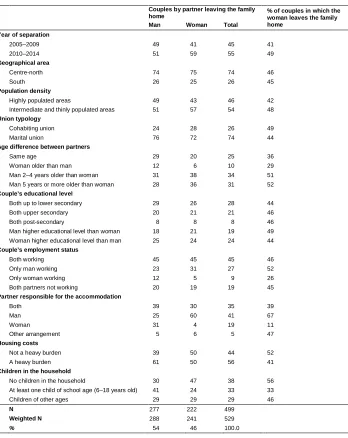
Table 2 reports descriptive statistics on the characteristics of the sample of separated couples (as measured in the wave before separation), distinguishing whether the man or woman moves out of the family home following separation.
On average, men in our sample moved out of the family home more frequently than women (54% vs. 46%). There are, however, some exceptions worth noting. In particular, women moved out more often than men if there were no children living in the joint home before separation (56%). Also, a slightly higher percentage of women than of men leaving the family home after separation is observed among couples where the man was older (51% if the man is two to four years older, and 52% if he is five years older or more), or the only partner in employment (52%), and among couples who did not perceive housing costs as a heavy burden (52%). Most notably, women moved out much more often than men (67%) if the man was the sole person owning or renting the accommodation.
Table 2: Percentage distributions of the explanatory variables included in the analysis
Couples by partner leaving the family home
% of couples in which the woman leaves the family home
Man Woman Total Year of separation
2005–2009 49 41 45 41
2010–2014 51 59 55 49
Geographical area
Centre-north 74 75 74 46
South 26 25 26 45
Population density
Highly populated areas 49 43 46 42
Intermediate and thinly populated areas 51 57 54 48
Union typology
Cohabiting union 24 28 26 49
Marital union 76 72 74 44
Age difference between partners
Same age 29 20 25 36
Woman older than man 12 6 10 29
Man 2–4 years older than woman 31 38 34 51
Man 5 years or more older than woman 28 36 31 52
Couple’s educational level
Both up to lower secondary 29 26 28 44
Both upper secondary 20 21 21 46
Both post-secondary 8 8 8 46
Man higher educational level than woman 18 21 19 49
Woman higher educational level than man 25 24 24 44
Couple’s employment status
Both working 45 45 45 46
Only man working 23 31 27 52
Only woman working 12 5 9 26
Both partners not working 20 19 19 45
Partner responsible for the accommodation
Both 39 30 35 39
Man 25 60 41 67
Woman 31 4 19 11
Other arrangement 5 6 5 47
Housing costs
Not a heavy burden 39 50 44 52
A heavy burden 61 50 56 41
Children in the household
No children in the household 30 47 38 56
At least one child of school age (6–18 years old) 41 24 33 33
Children of other ages 29 29 29 46
N 277 222 499
Weighted N 288 241 529
% 54 46 100.0
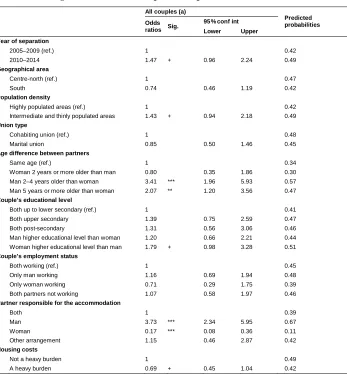
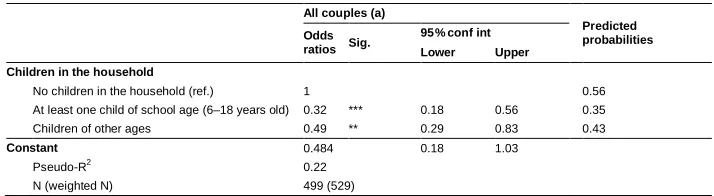
Table 3 reports the results of a logistic regression model (model a) estimating whether the woman moves out after separation.
Table 3: Logistic regression models of the probability that the woman moves out of the family home upon separation. Odds ratios (and their significance levels) and predicted probabilities
All couples (a)
Predicted probabilities Odds
ratios Sig.
95% conf int Lower Upper Year of separation
2005–2009 (ref.) 1 0.42
2010–2014 1.47 + 0.96 2.24 0.49
Geographical area
Centre-north (ref.) 1 0.47
South 0.74 0.46 1.19 0.42
Population density
Highly populated areas (ref.) 1 0.42
Intermediate and thinly populated areas 1.43 + 0.94 2.18 0.49
Union type
Cohabiting union (ref.) 1 0.48
Marital union 0.85 0.50 1.46 0.45
Age difference between partners
Same age (ref.) 1 0.34
Woman 2 years or more older than man 0.80 0.35 1.86 0.30
Man 2–4 years older than woman 3.41 *** 1.96 5.93 0.57
Man 5 years or more older than woman 2.07 ** 1.20 3.56 0.47
Couple’s educational level
Both up to lower secondary (ref.) 1 0.41
Both upper secondary 1.39 0.75 2.59 0.47
Both post-secondary 1.31 0.56 3.06 0.46
Man higher educational level than woman 1.20 0.66 2.21 0.44
Woman higher educational level than man 1.79 + 0.98 3.28 0.51
Couple’s employment status
Both working (ref.) 1 0.45
Only man working 1.16 0.69 1.94 0.48
Only woman working 0.71 0.29 1.75 0.39
Both partners not working 1.07 0.58 1.97 0.46
Partner responsible for the accommodation
Both 1 0.39
Man 3.73 *** 2.34 5.95 0.67
Woman 0.17 *** 0.08 0.36 0.11
Other arrangement 1.15 0.46 2.87 0.42
Housing costs
Not a heavy burden 1 0.49
Table 3: (Continued)
All couples (a)
Predicted probabilities Odds
ratios Sig.
95% conf int Lower Upper Children in the household
No children in the household (ref.) 1 0.56
At least one child of school age (6–18 years old) 0.32 *** 0.18 0.56 0.35
Children of other ages 0.49 ** 0.29 0.83 0.43
Constant 0.484 0.18 1.03
Pseudo-R2 0.22
N (weighted N) 499 (529)
Note: + p<0.10. *p<.05. **p<.01. ***p<.001.
Source: Author’s elaborations on EU-SILC data.
The first set of variables included in the model aims to capture contextual influences on the couple’s housing arrangements following separation. Of the four variables, however, only two are marginally associated (90% significance level) with the probability that the woman moves out of the joint home: The likelihood of the woman moving out is 47% higher if the couple separated after 2010 and 43% higher among couples living in less densely populated areas.
The model then accounts for the gender balance within the couple as measured by the differences in age, educational level, and employment status between the two ex-partners. Our findings are partially in line with previous studies using similar variables (Mulder and Wagner 2010). Results show that the woman moves out more than twice as frequently if the man is at least two years older than she is, compared to couples where partners are of similar age. No strictly significant associations, however, are observed between the two partners’ combined educational levels or employment statuses and the likelihood of the woman moving out of the family home. The only exception are couples where the woman has a higher educational level than her partner, in which case she is more likely to move out (90% significance level), compared to couples where both partners had up to lower secondary education.
sole earner of the couple. Contrary to my expectations, women are less likely to move out (but only at the 90% significance level) if the couple perceived housing costs as a heavy burden before separation.
The last variable relates to the presence of children in the household and their age. As expected, whether the couple has children living in the joint household before separation is a strong predictor of who leaves the family home following separation. Compared to couples with no children, women are least likely to move out if they have children of school age. A negative, and significant, association is also observed for couples with children of other ages.
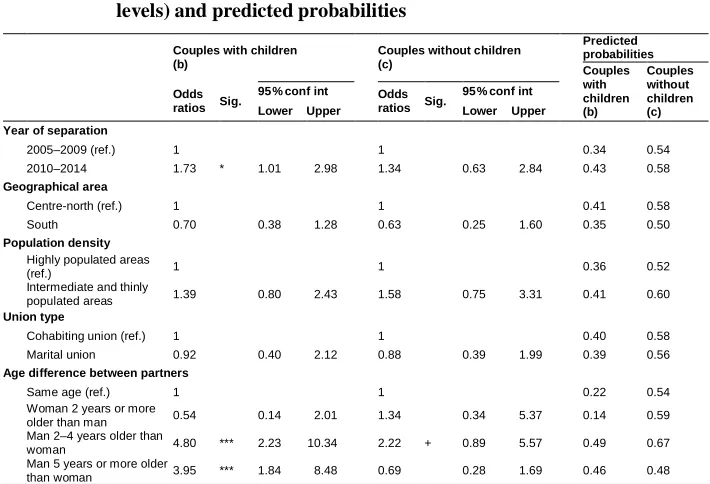
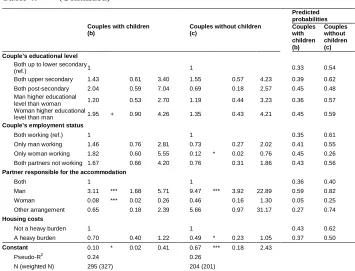
Table 4 presents the results obtained by estimating two separate logistic models, one (model b) on the subsample of couples with children in the household at the time of separation and the other (model c) on the subsample of couples without children.
Table 4: Logistic regression models of the probability that the woman moves out of the family home upon separation, by presence of children in the household before separation. Odds ratios (and their significance levels) and predicted probabilities
Couples with children (b)
Couples without children (c) Predicted probabilities Couples with children (b) Couples without children (c) Odds ratios Sig.
95% conf int Odds ratios Sig.
95% conf int Lower Upper Lower Upper Year of separation
2005–2009 (ref.) 1 1 0.34 0.54
2010–2014 1.73 * 1.01 2.98 1.34 0.63 2.84 0.43 0.58
Geographical area
Centre-north (ref.) 1 1 0.41 0.58
South 0.70 0.38 1.28 0.63 0.25 1.60 0.35 0.50
Population density
Highly populated areas
(ref.) 1 1 0.36 0.52
Intermediate and thinly
populated areas 1.39 0.80 2.43 1.58 0.75 3.31 0.41 0.60
Union type
Cohabiting union (ref.) 1 1 0.40 0.58
Marital union 0.92 0.40 2.12 0.88 0.39 1.99 0.39 0.56
Age difference between partners
Same age (ref.) 1 1 0.22 0.54
Woman 2 years or more
older than man 0.54 0.14 2.01 1.34 0.34 5.37 0.14 0.59
Man 2–4 years older than
woman 4.80 *** 2.23 10.34 2.22 + 0.89 5.57 0.49 0.67
Man 5 years or more older
Table 4: (Continued)
Couples with children (b)
Couples without children (c) Predicted probabilities Couples with children (b) Couples without children (c) Couple’s educational level
Both up to lower secondary
(ref.) 1 1 0.33 0.54
Both upper secondary 1.43 0.61 3.40 1.55 0.57 4.23 0.39 0.62
Both post-secondary 2.04 0.59 7.04 0.69 0.18 2.57 0.45 0.48
Man higher educational
level than woman 1.20 0.53 2.70 1.19 0.44 3.23 0.36 0.57
Woman higher educational
level than man 1.95 + 0.90 4.26 1.35 0.43 4.21 0.45 0.59
Couple’s employment status
Both working (ref.) 1 1 0.35 0.61
Only man working 1.46 0.76 2.81 0.73 0.27 2.02 0.41 0.55
Only woman working 1.82 0.60 5.55 0.12 * 0.02 0.76 0.45 0.26
Both partners not working 1.67 0.66 4.20 0.76 0.31 1.86 0.43 0.56
Partner responsible for the accommodation
Both 1 1 0.36 0.40
Man 3.11 *** 1.68 5.71 9.47 *** 3.92 22.89 0.59 0.82
Woman 0.08 *** 0.02 0.26 0.46 0.16 1.30 0.05 0.25
Other arrangement 0.65 0.18 2.39 5.66 0.97 31.17 0.27 0.74
Housing costs
Not a heavy burden 1 1 0.43 0.62
A heavy burden 0.70 0.40 1.22 0.49 * 0.23 1.05 0.37 0.50
Constant 0.10 * 0.02 0.41 0.67 *** 0.18 2.43
Pseudo-R2 0.24 0.26
N (weighted N) 295 (327) 204 (201)
Note: +p<0.10. *p<.05. **p<.01. ***p<.001.
Source: Author’s elaborations on EU-SILC data.
Although most of the effects are similar across the two subsamples and in line with what was observed on the full sample, there are a few differences worth noting.
If there were children living in the household before separation, then the predicted probability that the woman would leave the home following separation is always lower than that of her male partner, with only one qualification. When the man owns (or rents) the accommodation, then the predicted probability that the woman would leave the household is 59%.
accommodation was jointly owned or rented, when both partners have post-secondary educational qualifications, and when she was the only partner working before separation.
6. Discussion and conclusions
This study contributes to the literature on residential mobility following separation. In particular, it adopts a gender perspective to understand the decision of which partner moves out of the joint home after separation. The focus is on Italy, a country where levels of union instability have historically been low compared to Western European countries but have increased sharply in the last decade. This poses new challenges to the individuals and families involved, particularly within an institutional context which offers little support to families facing economic and housing hardship and which does not adequately protect the weaker position of women within the household and society.
Two research questions are addressed with the empirical analyses. Both relate to the idea of gendered routes out of the family home at the time of separation. Gendered structures of society and of the institutional context, as well as gender relationships between the ex-partners before separation, define different opportunities and costs associated with moving out or staying in the family home. These are likely to impact the decision of which partner will stay in the family home and which will leave following separation. The presence of common children is another important aspect in determining the opportunities and costs of leaving the family home. Most importantly, when children are present, the relevance of bargaining models between ex-partners and the relative distribution of power and resources between them might become less relevant (Thomas, Mulder, and Cooke 2017), as current norms and practices tend to favour children’s permanence in the family home with their mothers. Thus the second research question addresses the issue of the intersection between gender and parenthood more explicitly.
partly related to the unfavourable economic climate post-recession, when the combination of austerity measures and high levels of unemployment and insecure employment severely affected the economic well-being of Italian households (Istat 2015b). Affording mortgage payments or housing costs of a larger common house might thus have become increasingly out of reach for the economically weaker ex-partners. Changes in the legislative framework might also have exerted some influence. The diffusion of shared child custody between parents following the new family law of 2006 might be a reason behind the higher propensity of women (and of mothers in particular) to leave the family home in recent years.
Then, with the intent of assessing the influence of the gender balance within the household, I borrowed from previous studies and tested the relative resources hypothesis (Mulder and Wagner 2010; Mulder and Malmberg 2011; Mulder et al. 2012), according to which partner with greater resources should find it easier to afford the costs of maintaining the joint home and would thus be more likely to stay. Resources mainly derive from individuals’ position in the labour market and from their educational level (Mulder and Wagner 2010). Therefore, the partner with a higher educational level and better employment status should be less likely to leave the family home upon separation. The empirical analyses include a further variable not often available from other data sources, namely the partner responsible for the accommodation. This information clearly defines the resources balance between the ex-partners and is an extremely powerful predictor of which partner will leave the joint home – particularly so if common children are not involved in the separation. As the partner who owns or rent the accommodation is also very often the partner better established in the labour market, the inclusion of this variable in our model conceals the effect of the two ex-partners’ employment statuses. From descriptive statistics and additional analyses, however, we know that women are significantly less likely to move out if they are the only partner in employment. The opposite is also true, i.e., they are more likely to leave if they are not employed. Thus, a greater attachment to the labour market seems to enable women to afford the costs associated with staying and maintaining the family home. On the other hand, no strictly significant relationship is observed between partners’ educational differences and the probability that one or the other would move out. These results are in line with a previous study by Mulder and Wagner (2010) on the Netherlands.
and thus couples where the man is older – and in particular if the differences are large – are regarded as expressions of gender inequality, both in society and within the couples (Presser 1975; Casterline, Williams, and McDonald 1986; Gustafson and Fransson 2015). Modelling results show a significant association with age differences, as the dissolution of unions in which men are older than women results in higher probabilities of the woman leaving the family home upon separation. A similar finding has also been observed for the Netherlands (Mulder and Wagner 2010; Mulder et al. 2012).
Unsurprisingly, the presence of children in the household is one of the strongest predictors of who leaves the family home. Further, the analyses stratified by the presence or absence of children in the household before separation confirm that the relevance of the relative resources argument is greater for childless couples: Variables denoting who is responsible for the accommodation, who is the only working partner, or what the perceived housing costs are have a more pronounced (or statistically significant effect) on this subsample. When children are involved, decisions at the time of separation are usually taken ‘in their best interests.’ This also means minimising disruption to their normal routine and social life, by letting them stay in the family home. The real decision, thus, may be determining which parent will stay with them. Since 2006, Italian law encourages joint parental custody. Jurists argue that its formal application has not been translated in practice (De Blasio and Vuri 2013) and that the most common living arrangement remains that of children living with their mother. However, we do observe that mothers are more likely to move out of the family home in the most recent period compared with the earlier period, which suggests at least a moderate effect of the changing normative framework. However, they are still more likely than men to stay in the family home and possibly to be given custody. This has important implications. For instance, custodial mothers will need to share their income with dependent family members, while their caring responsibilities might prevent them from working full-time. Also, they are less likely to re-partner compared to childless women and mothers with non-resident children (Bumpass, Sweet, and Castro Martín 1990; Beaujouan 2012; Ivanova, Kalmijn, and Uunk 2012), which may result in loneliness and lack of support later in life. Thus, if the routes out of the family home are gendered, so might be the longer-term outcomes in terms of future living arrangements and well-being.
housing and living arrangements can only be observed in the period immediately after separation. Moves at the time of separation are urgent and financially restricted (Feijten and Van Ham 2007), and observed housing arrangements might not be indicative of the long-term consequences for separated people. Re-partnering, the sale of the joint house or a court decision granting the right to the conjugal property to one partner may significantly impact the future housing and living arrangements of separated ex-partners. Lastly, EU-SILC serves the main purpose of providing comparable information on household income and living conditions. Although it allows the study of residential mobility from one wave to the other, and it collects a wealth of data on housing conditions, it is not specifically designed for the study of the life-course and demographic events. Thus, for instance, it does not provide information on aspects such as the reasons for separating, which partner initiated the process or who gets custody of the children, which are all significantly associated with the decision-making around separation (Mulder and Wagner 2010; Das, de Valk, and Merz 2017).
Despite these limitations, EU-SILC data has a number of strengths, which make it a unique data source for the study of residential mobility following separation. First, as the interviews are conducted on a large and representative national sample, it is possible to study the select group of couples undergoing separation, an event which is still relatively rare within the Italian context.
Second, as it is a longitudinal household-based survey, I could derive information on both partners (as well as on other household members). This allowed me to observe the gender relationship within the couple and to test the relative resources hypothesis. Further, as separations were identified through the comparison of the presence or absence of the same partners within the household between two consecutive waves, the study is not restricted to legal separation of marital unions but it also covers the dissolution of cohabiting unions. Extending our knowledge to individuals in non-marital cohabitation is crucial, as these unions are becoming increasingly more popular. They also tend to be unions between more secularised, highly educated, and younger individuals (Gabrielli and Hoem 2010) with higher instability rates but greater gender balance. However, unprotected by the same legislative framework as married individuals (De Rose and Marquette 2011), the weaker partner may face particularly harsh consequences upon separation. Future studies could compare marital and cohabiting unions to assess whether the break-up of the two types of union is associated with different gendered routes out of the family home.
Mulder, and Cooke 2017), it shows that women are more likely than men to stay in the family home following separation, in particular if they have children. The relative resources argument is supported, insofar as women are less likely to stay in the family home when the distribution of resources between partners is unbalanced in favour of men. However, in the presence of children, the relative resources hypothesis loses relevance, and routes out of the family home seem to respond to some extent to contextual and institutional influences, as changes in the economic climate and/or in the normative framework are associated with the likelihood that mothers would move out of the family home.
References
Aassve, A., Betti, G., Mazzuco, S., and Mencarini, L. (2007). Marital disruption and economic well-being: A comparative analysis. Journal of the Royal Statistical Society A: Statistics in Society 170(3): 781–799.doi:10.1111/j.1467-985X.2007. 00483.x.
Agresti, A. (2013).Categorical data analysis. New York: Wiley.
Allen, J., Barlow, J., Leal, J., Maloutas, T., and Padovani, L. (2004). Housing and welfare in southern Europe. Oxford: Blackwell.doi:10.1002/9780470757536.
Andress, H.-J., Borgloh, B., Bröckel, M., Giesselmann, M., and Hummelsheim, D. (2006). The economic consequences of partnership dissolution: A comparative analysis of panel studies from Belgium, Germany, Great Britain, Italy, and Sweden.European Sociological Review 22(5): 533–560.doi:10.1093/esr/jcl012.
Barbagli, M. and Saraceno, C. (1998).Separarsi in Italia. Bologna: Il Mulino.
Beaujouan, E. (2012). Repartnering in France: The role of gender, age and past fertility.
Advances in Life Course Research 17(2): 69–80.doi:10.1016/j.alcr.2012.03.001.
Beer, A. and Faulkner, D. (2011). Housing transitions through the life course: Aspirations, needs and policy. Bristol: The Policy Press. doi:10.2307/j.ctt9 qgq1p.
Brewer, M. and Nandi, A. (2014). Partnership dissolution: How does it affect income, employment and well-being? Essex: Institute for Social and Economic Research (ISER Working Paper Series 2014-30).
Brilli, Y., Del Boca, D., and Pronzato, C. (2014). Does child care availability play a role in maternal employment and children’s development? Evidence from Italy.
Review of Economics of the Household 14(1): 27–51. doi:10.1007/s11150-013-9227-4.
Bumpass, L., Sweet, J., and Castro Martín, T. (1990). Changing patterns of remarriage.
Journal of Marriage and Family 52(3): 747–756.doi:10.2307/352939.
Caruso, N. (2017). Policies and practices in Italian welfare housing. Basel: Springer International.doi:10.1007/978-3-319-41890-2.
Clark, W.A.V. and Onaka, J.L. (1983). Life cycle and housing adjustments as explanations of residential mobility. Urban Studies 20(1): 47–57. doi:10.1080/ 713703176.
Coulter, R., van Ham, M., and Findlay, A.M. (2016). Re-thinking residential mobility: Linking lives through time and space. Progress in Human Geography 40(3): 352–374.doi:10.1177/0309132515575417.
Das, M., de Valk, H., and Merz, E.M. (2017). Mothers’ mobility after separation: Do grandmothers matter? Population, Space and Place 23(2): 1–14. doi:10.1002/ psp.2010.
De Blasio, G. and Vuri, D. (2013). Joint custody in the Italian courts. Bonn: Institute for the Study of Labor (IZA Discussion Paper 7472).
De Rose, A. and Marquette, C. (2011). Same-sex families in Italy compared to Spain.
Journal of Family Research 7: 53–69.
Del Boca, D. and Sauer, R.M. (2009). Life cycle employment and fertility across institutional environments. European Economic Review 53(3): 274–292. doi:10.1016/j.euroecorev.2008.06.001.
Dewilde, C. (2008). Divorce and the housing movements of owner-occupiers: A European comparison. Housing Studies 23(6): 809–832. doi:10.1080/0267303 0802423151.
Dieleman, F.M., Clark, W.A.V., and Deurloo, M.C. (1995). Falling out of the home owner market.Housing Studies 10(1): 3–15.doi:10.1080/02673039508720806.
Esping-Andersen, G. (1990).Three worlds of welfare capitalism. Princeton: Princeton University Press.
Eurostat (2003, July 3). Regulation (EC) no. 1177/2003 of the European parliament and of the Council of 16 June 2003 concerning community statistics on income and living conditions (EU-SILC).Official Journal of the European Union http://eur-lex.europa.eu/LexUriServ/LexUriServ.do?uri=OJ:L:2003:165:0001:0009:EN: PDF (accessed August 22, 2017).
Feijten, P. and Mulder, C.H. (2005). Life-course experience and housing quality.
Housing Studies 20(4): 571–587.doi:10.1080/02673030500114474.
Feijten, P. and van Ham, M. (2010). The impact of splitting up and divorce on housing careers in the UK. Housing Studies 25(4): 483–507. doi:10.1080/0267303100 3711477.
Ferrera, M. (2000). Reconstructing the welfare state in Southern Europe. In: Kuhnle, S. (ed.). Survival of the welfare state. London: Routledge: 166–181. doi:10.4324/ 9780203380314_chapter_10.
Findlay, A.M., McCollum, D., Coulter, R., and Gayle, V. (2015). New mobilities across the life course: A framework for analysing demographically linked drivers of migration.Population, Space and Place21(4): 309–402.doi:10.1002/psp.1956.
Gabrielli, G. and Hoem, J. (2010). Italy’s non-negligible cohabitational unions.
European Journal of Population 26(1): 33–46.doi:10.1007/s10680-009-9193-y.
Geist, C. and McManus, P.A. (2008). Geographical mobility over the life course: Motivations and implications. Population, Space and Place 14(4): 283–303. doi:10.1002/psp.508.
Gram-Hanssen, K. and Bech-Danielsen, C. (2008). Home dissolution: What happens after separation? Housing Studies 23(3): 507–522. doi:10.1080/026730308 02020635.
Gustafson, P. and Fransson, U. (2015). Age differences between spouses: Sociodemographic variation and selection.Marriage and Family Review 51(7): 610–632.doi:10.1080/01494929.2015.1060289.
Helderman, A.C. (2007). Once a home owner, always a home owner? An analysis of moves out of owner-occupation. Journal of Housing and the Built Environment
22(3): 239–261.doi:10.1007/s10901-007-9085-6.
Hofferth, S.L. and Iceland, J. (1998). Social capital in rural and urban communities.
Rural Sociology 63(4): 574–598.doi:10.1111/j.1549-0831.1998.tb00693.x.
Iacovou, M. and Lynn, P. (2013). Implications of the EU-SILC following rules, and their implementation, for longitudinal analysis. Essex: Institute for Social and Economic Research (ISER Working Paper Series 2013-17).
Istat (2007). Nota informativa sull’utilizzo dei file relativi alla componente longitudinale di EU-SILC. Roma: Istat.
Istat (2011). Come cambiano le forme familiari [electronic resource]. Roma: Istat. https://www.istat.it/it/archivio/38613 (accessed August 22, 2017).
Istat (2015b).Come cambia la vita delle donne. Roma: Istat.
Istat (2016a). Matrimoni, separazioni e divorzi: Anno 2015. Roma: Istat (Statistiche report). http://www.istat.it/it/files/2016/11/matrimoni-separazioni-divorzi-2015. pdf (accessed August 23, 2017).
Istat (2016b).Rapporto annual: La situazione del paese: Anno 2015. Roma: Istat.
Ivanova, K., Kalmijn, M., and Uunk, W. (2013). The effect of children on men’s and women’s chances of re-partnering in a European context. European Journal of Population 29(4): 417–444.doi:10.1007/s10680-013-9294-5.
Lersch, P.M. and Vidal, S. (2014). Falling out of love and down the housing ladder: A longitudinal analysis of marital separation and home ownership. European Sociological Review 30(4): 512–524.doi:10.1093/esr/jcu055.
Lesthaeghe, R. and van de Kaa, D.J. (1986). Twee demografische transities? In: Lesthaeghe, R. and van de Kaa, D.J. (eds.). Bevolking: Groei en krimp. Deventer: Van Loghum Slaterus: 9–24.
McCarthy, P. and Simpson, B. (1991).Issues in post-divorce housing: Family policy or housing policy? Avebury: Aldershot.
Mikolai, J. and Kulu, H. (2018a). Short- and long-term effects of divorce and separation on housing tenure in England and Wales. Population Studies 72(1): 17–39. doi:10.1080/00324728.2017.1391955.
Mikolai, J. and Kulu, H. (2018b). Divorce, separation and housing changes: A multiprocess analysis of longitudinal data from England and Wales.
Demography 55(1): 83–106.doi:10.1007/s13524-017-0640-9.
Mitchell, C. (2010). Are divorce studies trustworthy? The effects of survey non-response and non-response errors. Journal of Marriage and the Family 72(4): 893– 905.doi:10.1111/j.1741-3737.2010.00737.x.
Mulder, C.H. and Billari, F.C. (2010). Homeownership regimes and low fertility.
Housing Studies 25(4): 527–541.doi:10.1080/02673031003711469.
Mulder, C.H. and Wagner, M. (2010). Union dissolution and mobility: Who moves from the family home after separation? Journal of Marriage and the Family
72(5): 1263– 1273.doi:10.1111/j.1741-3737.2010.00763.x.
Mulder, C.H., ten Hengel, B., Latten, J., and Das, M. (2012). Relative resources and moving from the joint home around divorce. Journal of Housing and the Built Environment 27(2): 153–168.doi:10.1007/s10901-011-9250-9.
Mulder, C.H. and Wagner, M. (2012). Moving after separation: The role of location-specific capital. Housing Studies 27(6): 839–852. doi:10.1080/02673037.2012. 651109.
Ongaro, F., Mazzuco, S., and Meggiolaro, S. (2009). Economic consequences of union dissolution in Italy: Findings form the European Community Household Panel.
European Journal of Population 25(1): 45–65.doi:10.1007/s10680-008-9157-7.
Pittini, A., Ghekière, L., Dijol, J., and Kiss, I. (2015).The state of housing in the EU 2015: A housing Europe review. Brussels: Housing Europe.
Poggio, T. (2012). The housing pillar of the Mediterranean welfare regime: Relations between home ownership and other dimensions of welfare in Italy. In: Ronald, R. and Elsinga, M. (eds.) Beyond home ownership: Housing, welfare and society.London: Routledge: 51–67.
Presser, H.B. (1975). Age differences between spouses.American Behavioral Scientist
19(2): 190–205.doi:10.1177/000276427501900205.
Reher, D. (1998). Family ties in Western Europe: Persistent contrasts.Population and Development Review24(2): 203–234.doi:10.2307/2807972.
Rosina, A. and Fraboni, R. (2004). Is marriage losing its centrality in Italy?
Demographic Research 11(6): 149–172.doi:10.4054/DemRes.2004.11.6.
Rossi, A.S. and Rossi, P.H. (1990).Of human bonding: Parent–child relations across the life course. New York: Aldine de Gruyter.
Rossi, P. (1955).Why families move. Glencoe: Free Press.
Sabbadini, L.L. (2017, May 11). Divorzio, la cassazione certifica una parità che non c’è. La Stampa.http://www.lastampa.it/2017/05/11/societa/e-sempre-l-8-marzo/ divorzio-la-cassazione-certifica-una-parit-che-non-c-cwEmq91wTeJ2wOS5mra JHN/pagina.html (accessed August 22, 2017).
Saraceno, C. (1994). The ambivalent familism of the Italian welfare states. Social Politics 1(1): 60–82.doi:10.1093/sp/1.1.60.
Stone, J., Berrington, A., and Falkingham, J. (2014). Gender, turning points, and boomerangs: Returning home in young adulthood in Great Britain.Demography
Sullivan, O. (1986). Housing movements of the divorced and separated. Housing Studies 1(1): 35–48.doi:10.1080/02673038608720561.
Symon, P. (1990). Marital breakdown, gender and home ownership: The owner-occupied home in separation and divorce. In: Symon, P. (ed.). Housing and divorce. Glasgow: Centre for Housing Research: 110–138.
Thomas, M.J., Mulder, C.H., and Cooke, T.J. (2017). Linked lives and constrained spatial mobility: The case of moves related to separation among families with children. Transactions of the Institute of British Geographers 42(4): 597–611. doi:10.1111/tran.12191.
Tosi, A. (2007).Case, quartieri, abitanti, politiche. Milano: Libreria Clup.
Uunk, W. (2004). The economic consequences of divorce for women in the European Union: The impact of welfare state arrangements. European Journal of Population 20(3): 251–285.doi:10.1007/s10680-004-1694-0.