Exploring the Economic Impact of Private Equity
in Emerging Industries – An Analysis of the
Dutch Life Sciences Sector
Cristina PORUMBOIU
Bucharest University of Economic Studies 6 Romana Square, 010374 Bucharest, Romania
Abstract. The aim of this paper is to discuss the competitive effects of the private equity industry in emerging industries, with a focus on the Dutch Life Sciences cluster located in West Holland, a Dutch region.As this analysis shows, the circumstances which favored the early success of this industry include factors such as education, infrastructure, governmental support, the existence of key industrial players, as well as the investment strategies of private actors. What this paper underline is the significant influence of private equity investments for the financial support of innovative products, on one side, and the growing opportunities through, on the other side. The paper is structured in two parts. The first reviews the literature regarding the evolution of emerging industries and the impact of geographic locations on their attractiveness to private investors. The second part highlights the way in which an emerging industry (i.e. life sciences industry in West Holland region) has upgraded its competitive advantage under the influence of private capital.
Keywords: agglomeration; clusters; private equity; venture capital; emerging industries; life sciences.
Introduction
The emergence of new, high-growth sectors is, along with disruptive ideas or reconfiguration of value chains, one of the strongest determinants shaping the competitive landscape these days (Russo, 2003). Globalization and the development of technologies led to the transformation of new business models, based on disruptive ideas, with high-growth rates of sectors by being supported by the competition and cooperation between industrial and technological firms. Creativity also conducts the development of these sectors, which often take the social challenges regarding the environment, through eco-innovative solutions and efficient use of resources.
Generally, these industries require significant research and development funds, and due to their innovative products, private investors are attracted to join and to financially support them, despite the lack of information about market conditions. As the companies grow and the investors achieve their financial targets, these mature private equity-backed companies help the whole industry to develop.
This paper attempts to highlight the role of emerging industries for creating competitive advantage under the influence of private equity. This virtuous circle of entrepreneurship helps industries develop at higher than average rates and take advantage not only of the capital inflows but of the accompanying business and industry expertise as well.
In the following, I will subject to scrutiny the hypothesis of a virtuous link between emerging industries’ competitive positioning and private equity inflows with a case study on life sciences in the West Holland region (the Netherlands). The first part of this paper is a review the literature on the evolution, locational advantages, and attractiveness of the emerging industries, while the second one particularizes the way in which an emerging industry (life sciences) has taken advantage of private equity.
Theoretical background
According to one established definition, “emerging industries are either new industrial sectors or existing industrial sectors that are evolving or merging into new industries. They are most often driven by key enabling technologies, new business models such as innovative service concepts, and by societal challenges that industry must address as a matter of survival.” (European Cluster Observatory, 2012).
In the European economy, these sectors account for about 46% of all traded industry employment and are concentrated in approximatively 20% of European locations (European Cluster Observatory, 2016). The same source suggests that these sectors are strongest in those regions in which they have a significant portfolio of traditional sectoral clusters.
In the current literature, a lack of information about the emerging industries exists because of the difficulty to study them until they become mature industries. According to European Cluster Observatory Report (2012), the period of time required for the development of such industry varies between 2 to 50 years in accordance with the business sector, issue confirmed through Forbes and Kirsch’s (2011) research. Because of their dynamism, the challenge of studying the development of these industries is more oriented to their relevance for economic activities of clusters, due to their cross-sectorial characteristics.
The case for emerging industries is representative for what is disruptive and challenging in the contemporary business climate, with characteristics such as:
- They are established based on new products/services as a consequence of technological development and socio-economical changes.
- They evolve based on intensive research and knowledge.
- Since they are the result of traditional industries changed using new technologies in order to meet the new needs of customers, actors of emerging industries are more oriented to new opportunities and initiatives; this entrepreneurial behavior lead firstly, to changes in business models and secondly, to rise of new products and services, and even new suppliers.
- Being based on disruptive ideas which redefine value chains and market demand, these industries are characterized by uncertainty due to the lack of information regarding the market conditions.
- They tend to agglomerate in areas with location-specific conditions, by establishing linkages with other actors.
- Because these industries require significant research and development funds, they try to raise private capital. Investors are attracted by the high growth potential and innovative approach of the industry. Venture capitalists join these companies in the early stages of their development and contribute to their development, and before the late-growth stage was overpassed and they become mature on the market, investors exit, often by selling for mergers. (European Cluster Observatory, 2012).
As this depiction suggests, two key features – location and risk associated with technological development – lie at the core of the business model of emerging industries. Let us turn to each of them to assess the key determinants in a competitive context.
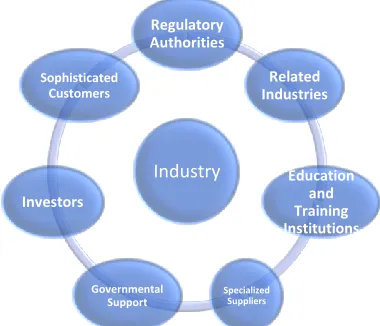
Location mostly relates to clusters – groups of interconnected firms, and related private and public actors, which activate within an industry – as drivers of competitive advantage. A typical organization of clusters (Porter, 1990) includes companies, suppliers, other related companies, customers, educational institutions, public authorities, and regulatory bodies, all of these being related to one specific industry.
The following graph shows a general approach of clusters’ organization.
Figure 1. A generic cluster environment (Porter, 1990)
Industry Regulatory Authorities
Related Industries
Education and Training Institutions
Specialized Suppliers
Governmental Support
Investors
According to Porter (2000), clusters affect business strategies in three directions, as follows:
- Productivity, because of the ease of access to qualitative information and technology, advanced-skilled employees and suppliers, and more support through coordination with institutions or other related companies.
- Innovation, because of direct competitive exposure to other companies’ performances and innovative approaches. The proximity of customers brings more advantages for companies located in clusters, compared to isolated competitors, thanks to rapid ideas-to-market transfers.
- New business formation, because of the linkages created between clusters’ members. Market opportunities are immediately seized upon in such agglomerations and new businesses arise taking advantages of new needs, lower entry barriers, and resources already available.
In light of the accumulated evidence (Marshall, 1890; Porter, 1990; Schumpeter, 1939), clusters' development can be explained through the advantageous use of resources – tangible and intangible – available in particular areas, successful past experiences of entrepreneurs and industry specialization. Cooperation between companies, suppliers, customers, and institutions help clusters evolve. The local rivalry is another important factor which positively influences the development of such agglomerations through innovative improvements for changing needs in the marketplace. Since qualified labor is another pre-requisite for clusters' development, the whole business "community" takes advantage of high skills of employees and their continuous improvements.
Governments have a clear interest in supporting clusters since these agglomerations are conducive to increasing exports and are a constant source of attracting foreign investments (European Cluster Observatory, 2012; InterCluster, 2010; Porter, 2000;). In the case of emerging industries, this support targets technological development, especially through regulations, improvements in infrastructure and education, or innovation grants oriented to specific business needs. Due to the influence of all these determinants, clusters develop and become stronger and stable in the market even during economic downturns. Delgado, Porter, and Stern (2016) conclude that strong clusters become more resilient to negative shocks, while the regional economy and the related industries take advantage of rapid recovery.
More than being supported by governments, clusters quickly grow up because of the market conditions location-specific, therefore the quality of the economic environment is an important pre-requisite for their development. Porter (1990) identified four attributes which lead to economic development, considering the location advantages. His model, “The Diamond of National Advantage”, explains that there are four forces of nations which, individually and correlated as a system, determine the national competitive advantage, as follows:
- Factor conditions; - Demand conditions;
As for the risk associated with technology development and innovation, the existing evidence (European Cluster Observatory, 2012; Invest Europe, 2017) points to a virtuous circle from emerging industries to clusters and to the private equity industry. In a context of optimal determinants of competitiveness, emerging industries are basically innovative traditional industries, which were transformed according to market trends; clusters are geographically agglomerations of highly innovative companies, while the private equity firms are the financial supporters of innovative ideas. As long as innovative approaches are encouraged and financed, new industries develop, while the traditional ones are transformed. Their growth attracts specialized suppliers and supports other related business sectors. The business environment is enriched due to new technological resources and because of increasing high skilled labor. Also, governments observe the power of the innovation and join this cycle through preferential and supporting policies. Investors receive high returns because of their financial and strategic support for the development of these disruptive ideas, and in the end, the whole economy benefits.
Figure 2. Linkages between emerging industries, clusters and private equity investments
Private equity investments help industries, and especially the emerging ones, evolve through capital inflow and business expertise. Joining the companies and offering strategic advice, they support the increased productivity of investees and innovative products or services, at the firm level, and enhance competitiveness at the macroeconomic level (Frontier Economics, 2013). Nonetheless, because each private investor accepts to take part of the growth plans of a company, the exit strategy is important, for shareholders will expect to benefit from the increasing value of their equity through an appropriate selling alternative. Even if companies will be sold to other players or will be listed on the stock exchange markets to increase their capital and to attract other investors, or another private equity firm will continue their development plans though fresh inflow of capital or the management teams/owners will take back their shares, the divestment method should be a win-win situation for both the company and the investing firm.
For emerging industries, to attract private capital can be challenging because of their disruptive business models. Traditional financing instruments such as bank loans, overdrafts, credit lines, leasing or factoring, are limited for these companies because of the lack of collaterals (European Investment Fund, 2017), while public investors are
Economic Growth through INNOVATION
Clusters Emerg
ing Indust
afraid of risks because of the difficulty of measuring the maturity of the industry. Moreover, because these industries are research-intensive industries the need of funding is higher compared with traditional sectors, so the companies which are active in emerging industries try to raise capital from private investors which are attracted by their high growth potential. Some alternative financing instruments available are venture capital (start-ups and early-stage companies financing), development capital (financing for the expansion of mature companies), mezzanine (equity and debt financing through a subordinated loan) or distressed debt (financing for the restructuring of troubled companies) (Seretakis, 2012). A report of the European Investment Fund (2018) suggests that equity as a source of financing for the SMEs of the Eurozone was mostly required for activities concerning companies’ development such as developing and launching of new products or services and hiring and training of employees, compared with traditional instruments.
According to a report prepared by the European Savings and Retail Banking Group (2016), the dominant financing sources for both European and American SMEs are bank loans. The report emphasizes that the banking sector is smaller in the United States compared with the European Union, but with a large access to capital markets. According to British Bankers' Association (2014), in Europe, 70% of total financed amounts come from banks, while in the United States bank lending represents only 30% of total financing, (70% of American financing is supported by capital markets and other institutions), in 2014. Moreover, banks usually provide significant amounts of money as debts for private equity firms, in order to cover companies' acquisition costs, during buyout investments (Gilligan & Wright, 2010).
The Guide on Private Equity and Venture Capital for Entrepreneurs (European Venture Capital Association, 2007) defines the private equity industry is defined by medium to long-term investments in non-listed companies, with the purpose to pursue their development plans and to create value for companies in critical stages of development. Several studies identified the economic impact of private equity investments on innovation, productivity, and competitiveness, as follows:
- Impact on Innovation.By allocating funds to research and development, private equity firms directly help investee companies to create new products and services, compatible with the changing needs of customers. Together with capital, the companies also receive business expertise and support for their corporate governance for innovative plans. In order to highlight the direct effects of these capital inflows over the innovative potential of companies, Popov and Roosenboom (2009) studied the private equity investments and the number of patents developed by private equity-backed companies during 1977-2004. Considering the patents as a proxy for innovation, they concluded that 12% of innovation by private companies is attributable to investments made by private equity firms.
equity. The same study highlights the improved productivity of private equity-backed companies of 6.9 % on average, measured as EBITDA per employee. A study made by Kaplan and Strömberg (2009), over 1979-2007, with data from 17,171 worldwide companies backed by private equity firms, demonstrated the positive relationship which exists between the investments made by these firms and the performances of investee companies.
- Impact on competitiveness. At the local level, competitiveness between companies is enhanced through investments for increasing productivity. By attracting capital flows, companies produce more and improve their offerings, gaining more market share, therefore they become more competitive. Also, at the international level, private equity investments can lead to competitiveness by supporting companies oriented to export activities or by helping companies to expand abroad. New or small businesses have the opportunity to grow by receiving capital for internationalization efforts (Frontier, 2013).
Life Sciences Industry
According to the World Health Organization (2005, p.5), “life sciences comprise all sciences that deal with living organisms, including human beings, animals and plants; a broad field that encompasses biology, biotechnology, genomics, proteomics, bioinformatics, pharmaceutical and biomedical research and techniques”. Even if the European Cluster Observatory (2016) considers the biopharmaceutical and the medical devices as two different (emerging) industries for the purpose of this study, the life sciences industry refers to the combination of three core business sectors such as biotechnology, healthcare and pharmaceuticals, following the aforementioned definition.
The outcomes of these combined industries do not move forward only the medical world through the new solutions, but also the whole world economy, as described by the European Commission (2002) in its strategy, “the next wave of the knowledge-based economy, creating new opportunities for our societies and economies”, following the IT industry.
At the worldwide level, the United States dominates this market in terms of number of companies, number of employee and funding opportunities. Compared with the American market, in Europe the life sciences companies face challenges especially for research and development funding (Ernst & Young, 2012), and the demand is increasing from a development phase to another, according to the European Investment Bank (2018) - for instance, EUR 17 million are on average required in Phase I, compared with EUR 169 million in Phase III.
Other challenges of the industry such as global competition and healthcare reforms (Mihuzo Bank, 2013) force companies to build collaborative partnerships with the scientific and business actors.
may financially affect more the companies than to help them due to industry confidence strongly associated with a higher risk.
a) Grants are, in the most cases, the first capital inflows received by the SMEs, from the public sector or different organizations for the research and discovery activities of the life sciences companies, being a very important financing source, without a repayment obligation, despite the small tickets offered. European Commission strongly supports the research activities through grants as part of the Horizon 2020 Programme (European Investment Bank, 2018).
b) Venture Capital/Private Equity represents a major financing source for the life sciences companies, with an increasing interest from global fund managers oriented to this industry (European Investment Bank, 2018). In return for the capital invested, they receive control in companies by acquiring shares and may decide the entities’ development plans. The investee companies can take advantage in the late phase of development of fund managers’ industry expertise and can be strongly supported to “go public”. Only in Europe, according to Invest Europe’s statistics, venture capital fund managers invested in average more than EUR 1.2 billion per year, between 2007-2017, which represents in average more than 20% of venture capital investments every year. With respect to the backed number of companies, on average, 761 companies received capital, per year in the aforementioned period.
A very interesting part of the venture capital investors is represented by the corporate venture capitals. As defined by Chesbrough (2002), these structures are corporate funds used to make investments, mostly financed from the balance sheet, in external companies, which activates in the same industry as the corporates. Their objectives are, on one side, strategic – to take advantage of the synergies created with the investee company, and, on the other side, financial – to gain attractive returns from companies with high potential in the industry. Such successful examples in the life sciences industry are M Ventures, the capital arm of Merck KGa A, Pfizer Ventures, the capital arm of Pfizer Inc., and Roche Venture Fund, the capital arm of Roche.
Despite the high attractiveness of private equity investors to life sciences industry, according to an analysis made by the European Investment Bank (2018), fund managers still face several challenges due to the mismatch between their investment model and life sciences companies’ development phases, as follows:
- the capital demand of life sciences companies is often higher than the size of capital tickets invested by fund managers;
- the average investment period of funds is smaller than the period of time required for a life sciences company to start the commercialization phase (5-7 years compared with 10-12 years);
- strong industry expertise is required in order to assess the risk/return of such investments (already considered riskier, compared with other industries);
- lack of industry confidence due to a lack of successful companies.
used by fund managers, according to Gilligan and Wright (2010), are sale to corporate buyers, flotation on a stock market and receivership and liquidation, alongside with newer methods such as sale to another private equity firm or another financial institution, repayment of loans and preferred shares, and sale of portfolio of companies to other financial companies. As the analysis conducted by the European Investment Bank (2018) emphasized, for the life sciences companies the most preferred divestment method used is the first one, mostly due to increasing value of the company from the investment moment until the sale. A successful case was the acquisition of Kudos, a cancer company backed by large private equity firms, by Astra Zeneca, for USD 210 million, in 2005. Compared with the United States, where the access to capital markets is significantly higher compared with Europe (European Savings and Retail Banking Group, 2016), initial public offerings of life sciences companies are not so numerous. However, there are several examples in Europe which may show the dynamics of this business sector.
c) Access to public market can be gained through an exit made by the previous investor and it represents for the companies the opportunity to raise capital from a greater number of investors. The greater limitation of this financing opportunity is investors' lack of confidence in this industry (Ernst & Young, 2016; KPMG, 2018).
d) In the case of joint ventures and alliances, through a partnership with large multinational companies, the life sciences companies receive capital for a specific product, offering in exchange a stake in the development of the product and future revenues. It consists of payments made upfront and with a specific development milestone, and royalty fees if the commercialization phase starts. The greatest advantage for the large players is access to results of R&D activities made outside their company, without taking the risk of the drug development (European Investment Bank, 2018)
Table 1. The life cycle of companies – comparison between life sciences companies and general companies (European Investment Bank, 2018; European Investment
Fund, 2018; Mihuzo Bank, 2013)
At the European level, the largest life sciences companies are concentrated in the United Kingdom, Germany, France, the Netherlands, Austria, Denmark, Sweden, and Norway, according to the publication The Leading Life Sciences Clusters in Europe (Science Business, 2016). According to Biotechgate Database (2018), the United Kingdom is the home of 1,948 life sciences companies, followed by Germany with 1,884 companies and France with 1,249 companies, in 2018. Leading the pharma industry in terms of number of companies (121 companies), the UK has the most products in development, with a focus on pre-clinical and clinical research, strongly supported by private investments, according to KPMG’s (2018) report on “Site Selection for Life Sciences companies in Europe” - in 2014, 2 billion USD was raised by public companies, while the private ones received more than 400 million USD. Germany hosts the highest number of med-tech companies in Europe (531 companies), according to the aforementioned database. Local incentives for innovative SME and intensity of private investments are the most important advantages of German companies. The amounts raised by public companies are very low, while the private ones achieved in 2014 the third highest level in Europe, following the United Kingdom and Switzerland (KPMG, 2018).
The West Holland Life Sciences Cluster
Methodological orientation
(The Netherlands) was made. The linkages created between the cluster members demonstrate cluster's success, and, at the same time, industry's growth perspective.
Following Porter’s (1990) general cluster map, investors –as cluster’s members – have a significant impact over economic growth of agglomerations, through their power of financing. Their influence over emergent life sciences companies is the focus of the cluster map analysis. Nonetheless, we are interested in highlighting private equity influence over the cluster evolution through financing support offered to big industry players in their early stages of development.
An overview of the Dutch business environment
The Netherlands ranks fourth as the most competitive global economies. According to the Global Competitiveness Index 2017-2018 (World Economic Forum, 2018), the Dutch economy’s competitiveness is supported by advanced infrastructure, a strong education system, but mostly by an innovative environment, with a high capacity of innovation (6th rank out of 137).
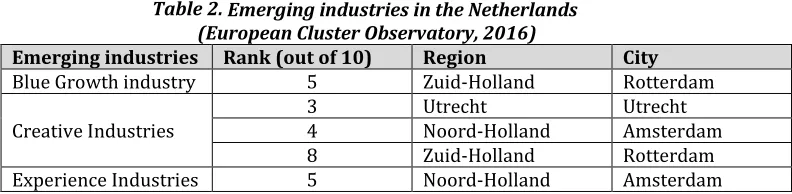
The increasing innovation of the Dutch companies can explain the growth of emerging industries in this country. According to the European Cluster Observatory (2016), the South and the North Dutch regions are significant cross-sectorial hotspots in Europe in emerging industries clusters: out of the top ten emerging industries in the European economy (advanced packaging, biopharmaceuticals, blue growth industries, creative industries, digital industries, environmental industries, experience industries, logistical services, medical devices, and mobility technologies), three of them are Dutch hubs, as follows:
Table 2. Emerging industries in the Netherlands (European Cluster Observatory, 2016)
Emerging industries Rank (out of 10) Region City
Blue Growth industry 5 Zuid‐Holland Rotterdam
Creative Industries
3 Utrecht Utrecht
4 Noord‐Holland Amsterdam
8 Zuid‐Holland Rotterdam
Experience Industries 5 Noord‐Holland Amsterdam
Following Porter’s (1990) diamond, the determinants factors of the Dutch competitive advantage are as follows:
a) Factor conditions
Its strategic location is important for attracting customers and for import-export activities – around 170 million customers within a 500-km radius, according to PWC (2017) Report, from London, Paris, Dusseldorf or Brussels. Also, it can easily take advantages of the technological developments produced by its neighboring countries, due to the close proximity with other strong economies such as Germany, Switzerland, the United Kingdom or France.
Another competitive advantage of the Netherlands, from the factor conditions category, is the strong infrastructure built during the time for technology and innovation. The development of the high-tech industry in the Netherlands significantly supports the growth of the other industries as well, especially for the life sciences sector, which takes advantages of the newest bio-technologies for its products.
b) Demand conditions
The country’s development is facilitated as well by the increasing level of buyers’ sophisticated needs. This demand forces the producers and suppliers to offer innovative solutions, in order to remain in the market (PWC, 2017).
The demand for innovative solutions, especially in the life sciences sector, is continuously increasing at the national and the international level. Because of the technological development, in present, it is possible to discover and to produce medical drugs or appliances for critical diseases, such as cancer. Therefore, the Dutch life sciences companies have a great potential to develop.
c) Related and supporting industries
The Netherlands is the home of more advanced industries which strongly support each other, such as high-tech and logistics, grouped as clusters, according to the Netherlands Foreign Investment Agency (2018). The life sciences sector is highly supported by these industries, but as well by the chemicals clusters existing in the Netherlands. In this way, the development of one industry positively influences the evolution of the others, following the general cluster theory.
d) Firm strategy, structure, and rivalry
The research and developmentgrants allocated by the Dutch government are increasing from year to year, according to OECD (2018) statistics, around 2% of the GDP, facilitating in this way the innovation. Also, these activities are supported by special tax credits and other tax incentives.
The economic stability of the Netherlands attracts more businesses in the country and more foreigners to work. To this aspect, the high competitiveness existing in the business environment explains the quick development of industries and clusters.
Private equity investors’ interest is increasing for the Dutch companies as well, being attracted by innovative ideas. According to the Invest Europe statistics, the number of companies backed by private equity investors increased by 30% compared with 2010 and reached the highest level of invested amounts after the 2008 financial crisis.
Figure 3. Private equity investments in the Dutch companies(Invest Europe, 2018)
According to the same source, most attractive business sectors for venture capitalists in the Dutch market are biotech and healthcare and ICT (communications, computer, and electronics). Based on 2007-2017 data, on average, 52 life sciences companies are financed by venture capital funds.
Figure 4. Venture Capital investments by business sector in the Dutch companies (Invest Europe, 2018)
The Dutch life sciences industry
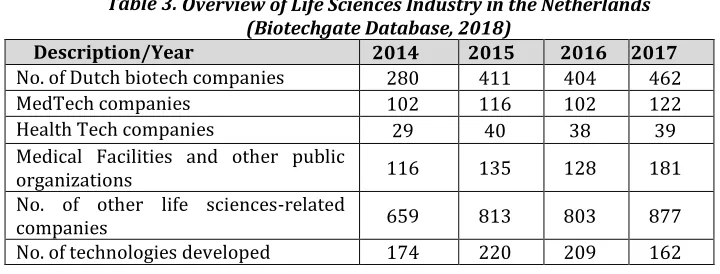
According to the data provided by Biotechgate Database (2018), the industry of life sciences in the Netherlands is developing from year to year, based on the number of companies which are active in this sector (including both the companies which are directly involved and related companies as well) and the number of new technologies created each year. The following table presents a short overview of the Dutch life sciences industry.
0 100 200 300 400 500
0 2 4 6 8
2007 2008 2009 2010 2011 2012 2013 2014 2015 2016 2017 Num
b
er
o
f co
m
p
an
ie
s
Bil
lion
E
U
R
Amount invested
Table 3. Overview of Life Sciences Industry in the Netherlands (Biotechgate Database, 2018)
Description/Year 2014 2015 2016 2017
No. of Dutch biotech companies 280 411 404 462
MedTech companies 102 116 102 122
Health Tech companies 29 40 38 39
Medical Facilities and other public
organizations 116 135 128 181
No. of other life sciences-related
companies 659 813 803 877
No. of technologies developed 174 220 209 162
According to Leading Life Sciences Clusters in Europe Report (Science Business, 2016), the Netherlands is home of approximative 63 life sciences parks, 12 universities, and eight university medical centers, where ca. 98,000 people are employed.
One of the largest European clusters of exact sciences is located in Amsterdam Science Park and offers scientific opportunities for the life sciences industry, together with high technologies, physics, and chemistry. The cluster's development is strongly supported by academic and scientific institutions such as University of Amsterdam, VU University Amsterdam, the Academic Medical Centre Amsterdam, the Neuroscience Campus Amsterdam and the Pan-Amsterdam Technology Transfer Office (Science Business, 2016). The Utrecht Science Parkhosts the highest number of research institutions on a small area of 300-hectares and is focused on life sciences and health activities. More than 80 businesses are located in this cluster, together with the University Medical Centre Utrecht and the Utrecht University. Starting with 2012, a new business park supports the life sciences industry in the Netherlands, the Pivot Park, located in Oss. This cluster developed a mix of initiatives of the government, existing companies, and private equity investors. The pharmaceutical company MSD together with the municipality of the city and of the province, the Ministry of Economic Affairs and Ministry of Health, Welfare and Sports were the principal actors for this clusters' development. The financial support was offered by the Brabant Development Agency (BOM). Another very important life sciences hub in the Netherlands is the Zernike Campus Groningen, founded in the 1960s. In this park, there are around 150 companies, with more than 4,000 employees and researchers and approximative 35,000 students. The University of Groningen and the Hanzehogeschool supports the clusters’ knowledge (PharmInvestHolland, 2018).
The life sciences and health industry’s potential can be assessed also by taking into consideration the Dutch Association Innovative Medicines’ initiative to transform the Netherlands into the “choice in Europe when it comes to research and development of medicines” (PharmInvestHolland, 2018). The life sciences and health industry are one of the nine key sectors of the Dutch economy, with more than 3,000 active companies and research organizations (PWC, 2017). The Dutch life sciences companies exported more than 37 billion EUR in 2017, out of which 25 billion EUR are revenues from pharmaceutical products (PharmInvestHolland, 2018).
Jensen), and continued with other great discoveries, scientific, for example microbiology (Antoni van Leeuwenhoek), human anatomy (Andreas Vesalius) or physiology (Herman Boerhaave), or mainly technical, for example electrocardiogram (Willem Einthoven), or different medical appliances such as heart-lung machine and artificial heart (Willem Kolff), according to PharmInvestHolland (2018) report.
According to Euro Health Consumer Index (2017), the Netherlands is the best country based on the healthcare system, because of the significant number of health providers, who act in competition, compared with other EU countries. The industry is supported by significant investments made in research and development, more than 2 billion EUR per year, according to the PWC (2017) Report.
The Leiden-Rotterdam-Delft-De Hague/West Holland region is home of the leading life sciences cluster in the Netherlands, home of the three largest biosciences parks and more than 400 companies, highly supported by five research and educational institutions and ten R&D facilities (West Holland Life Sciences Hub). The cluster's most important members are as follows:
1. Large industry players.The West Holland cluster hosts a significant number of large healthcare and pharmaceutical companies, which strongly influenced the evolution of the region. Some examples are Crucell, Pfizer, DSM, Janssen (part of Johnson and Johnson), Thermo Fisher Scientific, 3M, Siemens Healthineers and MSD. Two of the most important innovative solutions developed by the companies located in this cluster are for auto-immune diseases and the first vaccine for five childhood diseases.
Big players of the life sciences industry were supported by private equity firms in their early stages of development, such as Crucell (in late 1990), Viroclinics Biosciences (in 2001), and PanGenetics (in 2005).
- Crucell, a Leiden-based company, was backed in late 1990 by the leading life sciences investor, Life Sciences Partners. In 2000, the company was listed on the Euronext Amsterdam stock exchange and later merged with another life sciences company, Introgene. It continued as a public company until 2011 when it was acquired by the global pharmaceutical company, Johnson and Johnson, and today the company is one of the most important actors in the vaccines industry.
- Viroclinics Biosciences, a Rotterdam-based company, was founded in 2001 as a spin-off from the Department of Virology of Erasmus Medical Centre Rotterdam. It became a global clinical trial operation companies after it was backed by Gilde Healthcare, in 2014, and it continues its development with a new capital inflow from Parcom Capital after it changed its main shareholder in 2017.
- PanGenetics is another example of a private equity-backed company located in the West Holland (Utrecht) which rapidly grew up because of private capital inflow. According to Business Weekly (2006), the company received two rounds of funding for its drug development. Soon after its establishment in 2005, a 2 million USD seed round supported the research activities of PanGenetics.
research and development activities. For this purpose, there are ten R&D facilities available and three incubators.
University research laboratories are often the starting point from a new life sciences company when some researchers decide to continue in a different direction. Only in Leiden, there were 35 spin-offs from academia, located now in the middle of the largest Dutch life sciences cluster. Harbour Antibodies BV and Quantib are only 2 successful cases started at Erasmus Medical Center from Rotterdam and further supported by private investors.
3. Government. At the regional level, the local authorities support this cluster through the West Holland investment agency which facilitates the companies' development, together with fiscal incentives for innovation. The West Holland region benefits of the Health Ministry located in this cluster. The Association of Innovative Medicine is another national authority, located in the Hague, which tries to create the best conditions for pharmaceuticals' development and manufacturing. In the same way, HollandBio supports the biotechnology companies. The local authorities support the life sciences companies not only through direct grants but also through support to private equity funds. In 2010, around 35% of the funds raised came from the governmental institutions, according to Invest Europe (2018) statistics.
The public-sector support the industry's development also through collaboration between the European Investment Fund (EIF) (part of the European Investment Bank) and the Dutch Minister of Economic Affairs for financing innovative companies. According to the EIF's website, the first collaboration, namely the Dutch Venture Initiative I, ended up in December 2016 with a total amount committed of EUR 148 million, to 13 different venture and growth capital investment funds, out of which 5 are exclusively dedicated to life sciences sector. In 2016, the second program was launched with a focus on med-tech and life sciences alongside with ICT, clean-tech and renewable energy, fact that indicates the high level of innovation of these industries and how attractive they are for investments. Moreover, in September 2017, the Dutch Growth Co-Investment Programme was launched to support the transition of companies from early-stages to growth lifecycles.
4. Patient organizations.For healthcare policies, the patient organizations (such as The Netherlands Patient and Consumer Federation (NPCF), Dutch Cancer Federation and other disease-specific organizations - Parkinson Association and the Epilepsy Association) have a crucial role, especially for the new regulations. They play the role of sophisticated buyers for the cluster and all the research activities are conducted in order to satisfy their medical needs through innovative drugs or appliances (Van de Bovenkamp & Trappenburg, 2011).
instance, the 3D-printing used for medical appliances. In the same way, the chemical industry provides high-quality inputs for drugs development.
6. Private equity investors. Because the life sciences sector's activities are high research intensive, the demand for funding is substantial. The product development of healthcare companies requires more funding rounds compared with other business sectors. In some cases, after years of research, these companies obtain a prototype after 4 or even 5 investments rounds. In the West Holland region, Innovation Quarter, an economic development agency, supports financially the life sciences companies in this area. Alongside with this regional investor, there are also other private equity firms with a broader focus, such as Life Sciences Partners, Merck Ventures, Gilde Healthcare, and Forbion Capital Partners.
According to Invest Europe (2018) statistics, the investments made in the West Holland regions, in the biotechnology and healthcare sector represents in average 21% of the total investments made in this industry (2007-2016 data). More than 60% of the investments are made in small and medium companies, in the early stages of development. Also, in 2016, 23,29% of the total fundraising in the Netherlands was raised by funds oriented to life sciences companies (Invest Europe, 2018). This inflow of funds, the highest since 2007, explains the increasing potential of the life sciences industry in the Netherlands and how attractive it has become for private investors.
The local authorities support the life sciences companies not only through grants but also through support to private equity funds, therefore the aid is not only financial but also strategic because of the business expertise of these firms. Another significant category of investors for this industry is represented by the corporations, which can activate in the same sector or related, and academic institutions. The following graphs show the type of investors who invest in life sciences funds in the Netherlands.
Figure 5. Type of investors in the Dutch life sciences funds (Invest Europe, 2018)
The number of private equity backed-companies did not change significantly from 2007 until 2017, in average 11 companies received capital each year leading to an increased workforce.
0% 5% 10% 15% 20% 25% 30% 35% 40% 45%
2007 2008 2009 2010 2011 2012 2013 2014 2015 2016
Academic institutions & Endownments & Fundations Corporate investors (including banks)
Government agencies
Figure 6. Number of private equity-backed companies and economically active population in
the West Holland region(Invest Europe, 2018)
Considering the economic growth of this region, mostly endorsed to the life sciences industry, around 13% of the increasing welfare is justified by the private equity investments made in the life sciences companies clustered in the West Holland, based on Invest Europe and Eurostat data.
Alongside with the national incentives for the development of the life sciences companies, the features that characterized the West Holland clusters are as follows: - high competitiveness within the region due to a large number of companies (the 18th most competitive European region according to Regional Competitiveness Index 2016); - very developed infrastructure (Port of Rotterdam and Rotterdam the Hague Airport) which assure the international trade for medical andpharmaceutical products on one side, and great connectedness with other cities, on the other side;
- superior high education assures the training of researchers and advanced-skilled workforce.
Conclusions
Competitiveness at cluster level is enhanced through the high number of private equity-backed companies and follow-on investments which support the research and development activities. In the same way, new funding rounds increased productivity at the company level through expansion. But mostly, the private equity investments support the innovation in the West Holland life sciences cluster, throughout industry players, related-companies and governmental initiatives.
As this paper has emphasized, the success of the West Holland Life Sciences cluster is explained by a local context of strong cooperation between (1) large industry players, (2) knowledge institutions, (3) government and (4) patient organizations, (5) private equity investors and (6) supporting industries, enhanced by the high competitive level within the region due to the large number of companies (the 18th most competitive European region according to European Commission, 2016).
The private capital inflows in this area are expected to increase in the following years due to the relocation of the European Medicine Agency from London to Amsterdam. In the same way, some big industry players may change their operational activities in the European Union to take advantages of the community benefits, therefore the West
0 10 20
2.30 2.32 2.34 2.36 2.38
2007 2008 2009 2010 2011 2012 2013 2014 2015 2016
N
um
be
r o
f c
o
m
ap
an
ie
s
m
ill
ion
p
ers
o
n
s
Active population
Holland can become a better option for private equity investors instead of the United Kingdom, and a more successful life sciences cluster at the international level.
Acknowledgment: An older version of this paper was presented at
STRATEGICA International Conference 6th Edition (Bucharest, October 11-12,2018) and included in conference proceedings - Brătianu, C., Zbuchea, A.,
and Vitelar, A. (Eds.) (2018). Strategica. Challenging the Status Quo in Management and Economics. Bucharest: Tritonic. ISSN 2392-702X, ISBN 978-606-749-365-8.
References
BiotechGate Database (2018). Life science trend analysis. Retrieved from
www.biotechgate.com/web/cms/index.php/life_science_trend_analysis.html. British Bankers' Association (2014). Financing European Growth. Retrieved from
https://www.bba.org.uk/.
Chesbrough, H.W. (2002). Making sense of corporate venture capital. Harvard Business Review, 80(3), 90-99.
Delgado, M., Porter, M.E., and Stern, S. (2016). Clusters and the great recession. Retrieved from
http://mitsloan.mit.edu/shared/ods/documents/?DocumentID=4075. Ernst & Young (2012). Globalizing Venture Capital. Retrieved from
https://www.ey.com/Publication/vwLUAssets/Globalizing_venture_capital_VC_in sights_and_trends_report_CY0227/$FILE/Globalizing%20venture%20capital_VC %20insights%20and%20trends%20report_CY0227.pdf.
Ernst & Young (2016). Beyond borders 2016: Biotech financing. Retrieved from https://www.ey.com/gl/en/industries/life-sciences/ey-vital-signs-beyond-borders-2016-biotech-financing.
European Cluster Observatory (2012). Emerging industries report on the methodology for their classification and on the most active, significant and relevant new emerging industrial sectors. Retrieved from
http://ec.europa.eu/growth/industry/policy/cluster/observatory_en. European Cluster Observatory (2016). European Cluster Panorama 2016. Retrieved
from http://ec.europa.eu/growth/industry/policy/cluster/observatory_en. European Commission (2002). Life sciences and biotechnology - A strategy for Europe.
Communication from the Commission to the European Parliament, the Council, the Economic and Social Committee and the Committee of the Regions. Brussels: European Commission.
European Commission (2016). European Regional Competitiveness Index. Retrieved from
https://ec.europa.eu/regional_policy/en/information/maps/regional_competitiv eness/.
European Investment Bank (2018). Access-to-finance conditions for Life Sciences R&D. Retrieved from http://www.eib.org/en/infocentre/publications/all/access-to-finance-for-life-sciences-rd.htm.
European Investment Fund (2017). Financing Micro Firms in Europe: An Empirical Analysis. Luxembourg: European Investment Fund.
European Savings and Retail Banking Group (2016). Financial systems in Europe and the United States: Structural differences where banks remain the main source of finance for companies. Bruxelles: E.S.B.G
European Venture Capital Association (2007). Guide on Private Equity and Venture Capital for Entrepreneurs. Retrieved from
https://www.investeurope.eu/media/78722/guide-on-private-equity-and-venture-capital-2007.pdf.
Forbes, D.P., and Kirsch, D.A. (2011). The study of emerging industries: Recognizing and responding to some central problems. Journal of Business Venturing, 26(5), 589-602.
Frontier Economics (2013). Exploring the impact of private equity on economic growth in Europe. A report prepared for the EVCA. London: Frontier Economics.
Gilligan, J., and Wright, M. (2010). Private equity demystified: An explanatory guide. London: Corporate Finance Faculty
Health Consumer Powerhouse (2017). Euro Health Consumer Index 2017. Retrieved from https://healthpowerhouse.com/publications/euro-health-consumer-index-2017/.
InterCluster (2010). White paper: the emerging of European world-class clusters. Retrieved from
https://en.calameo.com/read/000247397ad80d9a0b27a?authid=Qpz1lGMJQnjC. Invest Europe (2017). The acceleration point: Why now is the time for European
Venture Capital. Retrieved from
https://www.investeurope.eu/media/664430/InvestEurope_Acceleration-Point_VCReport_05072017.pdf.
Invest Europe (2018). European Data Cooperative. Retrieved from https://www.investeurope.eu/data.
Kaplan, S.N., and Stromberg, P. (2009). Leveraged buyouts and private equity. Journal of Economic Perspectives, 23(1), 121-146.
KPMG (2018). Site Selection for Life Sciences Companies in Europe. Retrieved from https://assets.kpmg.com/content/dam/kpmg/ch/pdf/site-selection-for-life-sciences-companies-europe-2018-en.pdf.
Marshall, A. (1980). The Principles of Economics. Hampshire: McMillan.
Mihuzo Bank (2013). Life Sciences and Biotechnology Industry Clusters in Europe - Building Bridges between Science and Industry. Retrieved from
https://www.mizuhobank.com/fin_info/industry/pdf/mif_122.pdf.
Mihuzo Bank (2014), Life Sciences and Biotechnology Industry Clusters in Europe- Recent Trends and Partnership Strategies for Growth and Expansion. Retrieved from https://www.mizuhobank.com/fin_info/industry/pdf/mif_147.pdf. Netherlands Foreign Investment Agency (2018). Key Industries. Retrieved from
https://investinholland.com/.
OECD (2018). Gross domestic spending on R&D (indicator). Retrieved from https://data.oecd.org/rd/gross-domestic-spending-on-r-d.htm. PharmInvestHolland (2018). The Netherlands –Europe’s most attractive and
innovative biopharmaceutical industry environment. Retrieved from
https://www.health-holland.com/news/2018/03/the-netherlands-europe-s-most-attractive-and-innovative-biopharmaceutical-industry-environment. Popov, A., and Roosenboom, P. (2009). On the real effects of private equity investment:
Porter, M.E. (1990). The competitive advantage of nations. Competitive Intelligence Review, 1(1), 14-14.
Porter, M.E. (1998). Clusters and the new economics of competition. Harvard Business Review, 76(6), 77-90.
Porter, M.E. (2000). Location, competition, and economic development: Local clusters in a global economy. Economic development quarterly, 14(1), 15-34.
Price Waterhouse Coopers (2017). Doing Business in the Netherlands. Retrieved from https://www.pwc.nl/en/publicaties/doing-business-in-the-Netherlands-2017.html.
Russo, M.V. (2003). The emergence of sustainable industries: building on natural capital. Strategic Management Journal, 24(4), 317-331.
Schumpeter, J.A. (1939). Business Cycles. A Theoretical, Historical and Statistical Analysis of the Capitalist Process. London: McGraw-Hill.
Science Business (2016). Leading Life Sciences Clusters in Europe Report. Retrieved from https://sciencebusiness.net/report/leading-life-sciences-clusters-europe. Seretakis, A. (2012). A comparative examination of private equity in the United States and Europe: Accounting for the past and predicting the future of European private equity. Fordham Journal of Corporate & Financial Law, 18, 613-667.
Van de Bovenkamp, H.M., and Trappenburg, M.J. (2011). Government Influence on Patient Organizations. Health Care Analysis, 19(4), 329–351.
World Economic Forum (2018). Global Competitiveness Index 2017-2018. Geneva: World Economic Forum.
World Health Organization (2005). Life science research: opportunities and risks for public health. Mapping the issues. Retrieved from
http://www.who.int/ethics/Life%20Science%20Research.pdf.