JIEM, 2016 – 9(3): 732-785 – Online ISSN: 2013-0953 – Print ISSN: 2013-8423 http://dx.doi.org/10.3926/jiem.1522
Pre-emptive Resource-Constrained Multimode Project Scheduling
Using Genetic Algorithm: A Dynamic Forward Approach
Aidin Delgoshaei , Mohd Khairol Mohd Ariffin , B.T. Hang Tuah Baharudin
University Putra Malaysia (Malaysia)
[email protected], [email protected], [email protected]
Received: May 2015
Accepted: July 2016
Abstract:
Purpose: The issue resource over-allocating is a big concern for project engineers in the process of scheduling project activities. Resource over-allocating drawback is frequently seen after scheduling of a project in practice which causes a schedule to be useless. Modifying an over-allocated schedule is very complicated and needs a lot of efforts and time. In this paper, a new and fast tracking method is proposed to schedule large scale projects which can help project engineers to schedule the project rapidly and with more confidence.
Design/methodology/approach: In this article, a forward approach for maximizing net present value (NPV) in multi-mode resource constrained project scheduling problem while assuming discounted positive cash flows (MRCPSP-DCF) is proposed. The progress payment method is used and all resources are considered as pre-emptible. The proposed approach maximizes NPV using unscheduled resources through resource calendar in forward mode. For this purpose, a Genetic Algorithm is applied to solve.
Originality/value: The method can be used alone or as a macro in Microsoft Office Project® Software to schedule MRCPSP-DCF problems or to modify resource over-allocated activities after scheduling a project. This can help project engineers to schedule project activities rapidly with more accuracy in practice.
Keywords: multimode project scheduling, genetic algorithm, pre-emptive resource-constrained, discounted cash flows
1. Introduction
Classic Resource-constrained project scheduling problem (RCPSP), which is dealt with scheduling the project activities considering time and resource constraints, is generalized for minimizing completion time (or makespan) of the project Kelley (1963). Normally, in RCPSP, activities are scheduled considering two main types of constraints:
• The executive priority relations between activities which are expressed by a relation matrix
• The availability resources level for executing activities
Multi-mode resource constraint project scheduling problems (MRCPSP) are distinctive resource-constraint problems where each activity can be carried out via different modes (regarding to technologies or material). As consequence, the execution period (activity duration), resource requirement level and even the cash flow may be vary form a mode to another. Kolisch and Drexl (1997) proved that the MPRCPSP problem is a NP-hard problem.
Traditionally, classic RCPSP models were developed for minimizing makespan (Talbot, 1982). But, during last 2 decades, scientists have developed more RCPSP problems considering varied objectives. Mainly, authors developed RCPSP while 4 main optimization objectives are taken into consideration:
1.1. Makespan (Cmax) minimization
schemes and multi-project approach provide a base for managers to minimize mean project delay or multi-project duration increasing. Alcaraz and Maroto (2001) developed a GA for solving single mode RSPCP. They showed that GA can efficiently solve RCPSPs in an acceptable computation time. In the
same year, GA was also employed by Hartmann (2001) for minimizing Cmax in MRCPSP and then using a
local search extension motor for the proposed GA, results were more improved. Kim, Yun, Yoon, Gen and Yamazaki (2005) proposed a hybrid of GA with fuzzy logic controller (FLC-HGA) to solve the resource-constrained multiple project scheduling problem (RC-MPSP). The proposed approach worked based on using genetic operators with fuzzy logic controller (FLC) through initializing the revised serial
method with precedence and resources constraints. Using fuzzy concepts in minimizing Cmax was carried
out by Ke and Liu (2010) in a fuzzy-based GA. Delgoshaei, Ariffin, Baharudin and Leman (2015) proposed a backward method for minimizing makespan in the resource constrained project scheduling problem. For this purpose they used a hybrid greedy and genetic algorithm. The novelty of their research is using remained resources through the calendar of the project to minimize the completion time of the project.
1.2. Optimizing Robustness of Solutions
For this purpose normally a trade-off between quality-robustness and solution-robustness in RCPSP will be determined while safety times in project scheduling were taken into consideration (Van de Vonder, Demeulemeester, Herroelen & Leus, 2005). Afterward, Van de Vonder, Demeulemeester, Herroelen and Leus (2006) focused on resource constraint impacts in determining trade-off values between quality-robustness and solution-robustness in RCPSP. Lee and Lei (2001) presented 2 versions of resource-constraint multi project scheduling problem were developed in a way that in first version, the activity durations are considered fixed but in second one, a project duration function is used to decrease
the amount of resource allocating. Afterward, an attempt has been done for minimizing Cmax, as well as
maximizing solution robustness by increasing float time maximization (Abbasi, Shadrokh & Arkat, 2006).
A two-stage algorithm for robust RCPSP was used while minimize Cmax, of the project as an acceptance
threshold for second stage was carried out and then, in next stage, a set of 12 alternative robust predictive indicators was employed to maximize robustness of the project (Chtourou & Haouari, 2008).
Multi-mode resource constraint project scheduling problems (MRCPSP) are distinctive resource-constraint problems where each activity can be carried out via different modes (regarding to technologies or material etc.). As consequence, the execution period (activity duration), resource requirement level and even the cash flow may be vary form a mode to another. The MPRCPSP problem was initially developed for minimizing the project makespan and was proved to be a NP-hard problem (Kolisch & Drexl, 1997). Węglarz, Józefowska, Mika and Waligóra (2011) provided a wide research on literature of the multimode project scheduling. One of the most important issues in MRCPSP studies is financial issues which can be considered in two ways of positive or negative cash flows. Positive cash flows are supposed to earn as scheduled milestones. Despite, negative cash flows are referred to those expenses which must be spent for making positive cash flows (as human resource salary, equipment and machinery purchasing and maintenance costs, raw material providing etc.). In such models, cash flow can be influenced by activity due date, duration, resource requirements and also payment method which will effect on activity execution mode as well. GA was then used for solving a multi-criteria project portfolio selection problem when project interactions (in terms of multiple selection criteria) and preference information (in terms of the criteria importance) were considered (Yu, Wang, Wen & Lai, 2012).
Kolisch and Drexl (1997) found that MRCPSP is NP-hard if more than one resource is considered. To come up with such problem, many heuristics and metaheuristics approaches are applied so far. Yan, Jinsong, Xiaofeng and Ye (2009) applied some heuristics to solve project scheduling problem in order to provide a quick response structure while encountering with maritime disasters. Laslo (2010) presented an integrated method using simulation for resource planning and scheduling to minimize scheduling dependent expenses. Kim et al. (2005) proposed a hybrid GA and fuzzy logic controller (FLC-HGA) to solve the resource-constrained multiple project scheduling problem (RC-MPSP). Their objectives were minimizing total project time and total tardiness penalty. Ke and Liu (2010) used hybrid fuzzy set and GA to minimize total cost with completion time limits (see also Hartmann & Briskorn, 2010). Jarboui, Damak, Siarry and Rebai (2008) used particle swarm optimization (PSO) to show the effectiveness of PSO for solving MRCPSPs.
1.3. Maximizing Profit of the Project
proposed a two stage heuristic to maximize NPV of a RCPSP. They found that while difference between the due date and the minimum duration increases, the NPV gets more improved.
One of the most important issues in maximizing NPV is considering positive or negative cash flows during scheduling process. Positive cash flows are supposed to earn as scheduled milestones. Despite, negative cash flows are referred to those expenses which must be spent for making positive cash flows (as human resource salary, equipment and machinery purchase and maintenance costs and raw material providing). In such models, cash flow can be influenced by activity due date, duration, resource requirements and also payment method which will effect on determining activity execution mode as well.
Etgar, Shtub and LeBlanc (1997) showed that resources beyond time limit can have significant effect on makespan of project Meanwhile, De Reyck (1998) offered an algorithm based on which both positive and negative cash flows had been considered. A lower and upper bound were considered for each activities where coupled with limited resources. Icmeli, Erenguc and Zappe (1993) discussed that adding resources limitations caused turning model into a non-poly nominal model which cannot be solved easily by optimizing algorithms. Then, they considered discounted rate in the proposed a model a way that more cash flows will be earned in case of completing an activity in shorter period (RCPSPDC). Afterward, many researchers tried their utmost effort with the aim of solving the problem of maximizing NPV while discount rate is taken into consideration. Baroum and Patterson (1999) solved a RCPSPDC model with 50 variables where only positive cash flows were considered. Afterward, Icmeli and Erenguc (1994) used Tabu search (TS) algorithm in solving RCPSPDC problem. They set penalty for activities later than the due date. Yang, Talbot and Patterson (1993) developed statistical programming for solving RCPSPDC problems while positive cash flows were taken into consideration. Moreover, Zhu and Padman (1999) used TS for solving RCPSPDC problems. Mika, Waligóra and Węglarz (2005) presented a model with the aim of maximizing NPV of project with taking discounted rate and also both renewable and non-renewable resources. They used hybrid of SA and TS to solve the problems. During last decade, considering preemptive resource in scheduling problems have been more developed due to their impacts on making major delays through project lifecycle as well. Delgoshaei, Al-Mudhafar and Ariffin (2016) developed a new branch and bound based scheduling method for modifying resource over-allocated schedules. Laslo (2010) proposed a method for minimizing total cost of executing project activities. Delgoshaei, Ariffin, Baharudin and Leman (2014) used SA for maximizing NPV of the MRCPSPDC while discounted cash flows is taken into consideration. For this purpose a backward method is used to use remained resources through the resource calendar of a schedule.
in their model. Buddhakulsomsiri and Kim (2006) discussed that considering pre-emption resources is vital while studying makespan of the project. Damay, Quilliot and Sanlaville (2007) applied linear programming algorithms for preemptive RCPSP studies while Ballestín, Valls and Quintanilla (2008) proposed heuristic for solving preemptive RCPSP. Seifi and Tavakkoli-Moghaddam (2008) evaluated four payment methods during maximizing NPV and minimizing holding cost of completed activities in a MRCPSP. Vanhoucke and Debels (2008) focused on impacts of variable activity durations under a fixed work content, possibility of allowing activity pre-emption and use of fast tracking in decreasing project makespan. Van Peteghem and Vanhoucke (2010) used GA to minimize makespan of MRCPSP while they considered preemptive resources which allow activity splitting through their research.
To the best knowledge of authors, the idea maximizing profit of manufacturing projects in MRCPSPs while activity split is allowed and preemptive resources are taken into consideration, is less developed. To overcome such shortcoming, a multi-mode resource constrained scheduling problem with positive cash flows (MRCPSP-PCF) is developed. Then impact of activity split on preventing resource over-allocation is examined. In this regard, a forward method is proposed which works based on positive cash flow and activity id priority rules to overcome the resource over-allocations that usually happen by scheduling resource constraint project. The reminder for rest of the research is summarized as: research methodology including mathematical model is presented in section 2. In continue the proposed solving algorithm is illustrated in section 3. Section 4 presented a number of experiments where the performance of the proposed method is explained in detail and to examine the performance of the proposed method in practice, a case study is solved and results are compared with the results of Microsoft Office Project (MSP) 2010.
2. Materials and Methods
In this section, we present the proposed mathematical scheduling model with the aim of NPV in the condition of resource constraint. The model considers multi-mode of execution for each activity. Our aim is to survey how allocation of pre-emptive resources can change the activity scheduling and what is their impact to the net present value.
2.1. Problem Definitions
In order to classify models easily, in this section we define problems with a unique code as below:
n\m\k\th\it\g\p (1)
In this classification, n presents number of Activities, m is number of activity mode, k is number of
resource types, th is time horizon of the project, it is number of time iterations of the program, g is
number of generations is each time iterations during time horizon, p indicates population size.
2.2. Assumptions
The properties of the developed model are shown as:
1. Model is presented in Activity on Node (AON) structure.
2. PP (Progress Payment) is selected as the payment model. Noted that in progress payment method, the contractor receives the project payments from the client at regular time intervals until the project is completed Ulusoy, Sivrikaya-Şerifoğlu and Şahin (2001).
3. Resources are considered preemptive.
4. Activities are allowed to be split through the planning horizon.
5. The preemptive resources have limited capacities.
6. In this study, positive cash flows are considered as weight factor of each activity.
7. Activities can be executed in different modes. While a mode selected to an activity, the same mode must be used during executing of the activity.
8. Activities are allowed to move only in their free-float time.
9. All improving movements will carry out in forward mode.
2.3. Subscript
Subscripts used in the model are considered as follows:
i = number of activities which is a 1 × n matrix ([1 .. N]1×n)
k = number of resource types which is a 1 × m matrix ([1 .. K]1×k)
2.4. Parameters
The list of parameters and notations is as follows:
Resource_Capacity: illustrates available resource in sub periods:
(2)
As result, number of in-process activities that queued ina waiting list to be served by a preemptive resource can be expressed using below formula:
(3)
Activity_time: shows duration of each activity considering different execution modes.
(4)
Activity_sequence matrix is used in mathematical programming to show precedence relations between activities.
(5)
CF(i,m) = positive cash flow of activity i while it performs in mode m
r(i,k) = usage amount of resource type k for activity I
R(k) = available level of resource type k
D(i,m) = duration of activity i while it performs in mode m
TH = time horizon of the projects
α = discounted rate
2.5. Decision Variables
(6)
2.6. Mathematical Model
As mentioned in the previous parts, studying an MRCPSP problem is the major objective of this paper.
We supposed to have n activities on an AON network. Hence, Mathematical model is now written as
follows:
(7)
S.T:
(8)
(9)
(10)
(11)
(12)
(13)
(14)
(15)
(16)
(17)
activity while α is considered 0.05. As seen while the activity is scheduled earlier, more NPV is achieved than those conditions that it is scheduled later or being split for any reason.
Figure 1. Calculating NPV in 3 execution alternatives of an activity
First constraint in this model is defined for determining early start of activities, which guarantees the solving
algorithm to stay feasible during searching process. Using the term mint=1:TH({t.(y(i,m,t) – (y(i,m,t – 1))| y(i,m,t – 1) = 0
helps identifying the real early start of activities when they are taken apart by the solving algorithm to avoid encountering with resource over-allocation. The reason of using split ability for some activities will be explained in section 3.4. It is important to know that using standard definition of early start of
activities (which is ESi ≥ ESj + dj if j is predecessor of i ) is not appropriate for MRCPSPs while activity
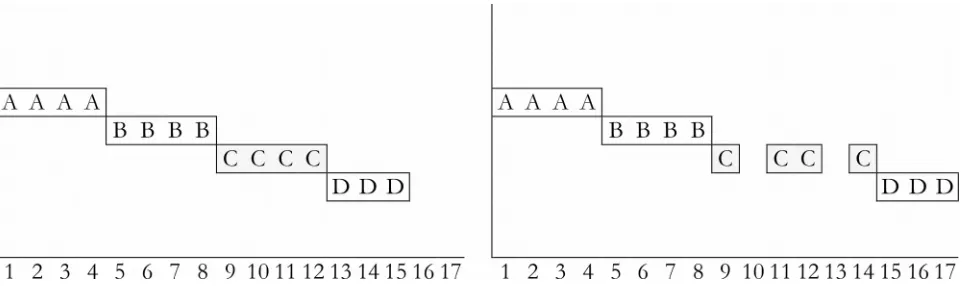
splitting is allowed since it causes wrong calculation. To explain more, suppose it is decided to calculate
ES for activity D with and without activity splitting permission (Figure 2).
Figure 2. Comparing different styles of calculating ES with and without activity splitting (left to right)
In the left Gantt of Figure 2, while splitting is not allowed, ESDcan be calculated correctly by using the
mentioned formula (ESD = ESC + DC). But, as seen, calculating early start of activity D while activity
splitting is allowed (right figure) is not 13 anymore since activity C is split two times in days 10 and 13 and
the day 15. Therefore, to prevent such error, a new formula is developed for calculating ES of each activity:
(18)
Second constraint ensures that activity will not be started before the early finish of its predecessors. Similar to the logic used for calculating early start of activities while activity splitting is allowed, early
standard finish formula (EFi = ESi + di) cannot be used here as there might be some none working days
that happens by the solving algorithm to avoid resource over-allocating. Therefor a formula is developed for calculating the early finish of an activity which is able to consider the idle times among the lifecycle of an activity:
(19)
The third constraint is developed to set a logic starting day for any project. The fourth set of constraints is
used for those activities which are related to each other by finish to start (FS) relation. In this model the
FS precedence is converted to the following mode to be applicable to employ in the model:
(20)
3. An Iterative Genetic Algorithm Procedure
In this section a new forward method is proposed for scheduling activities through planning horizon while maximum amount of available resources are restricted and activity splitting is allowed.
Elmaghraby and Herroelen (1990) have dealt with the demonstration of NP-hard in its RCPSP models. Zhou and Askin (1998) also reported that Resource-constrained project scheduling problems with cash flows (RCPSPCF) are complex and combinatorial optimization problems and should be solved by heuristics. As mentioned in above, if MRCPSP issues enjoy more than one resource, they will be considered strongly as part of NP-hard issues. Since nonlinear with exponential status is considered as target function of our desired model and with due observance to this fact that some of constraints enjoy nonlinear status like constraints of the first group, we can come to this conclusion that the proposed model is NP-hard.
There is also another reason for considering the mentioned model as NP-hard that is due to the number of the basic solutions that increases extremely while we increase the number of the variables. For example consider a simple model with 10 variables and 3 resources with 75 constraints that
includes C = 85! / (10! 75!) = 3,129,162,672,636 solutions as basic feasible and basic infeasible
solutions together. Therefore, if the number of the variables increases extremely, optimal solution algorithms obviously cannot able to find the Optimum Basic solution.
Consequently since MRCPSP are dynamic in their natures, it seems necessary to use self-improve algorithms such as Genetic Algorithms (GA), Simulated Annealing (SA) and Neural Networks as the problem cannot be solved by optimal solution algorithms. As mentioned during last two decades, genetic algorithm has been widely used to solve MRCPSP. Therefore, the research group decided to develop an efficient GA in this article to determine net present value of the project while resources are considered as pre-emptive .
In general, the main steps of our GA procedure are:
Step 1) Create the initial population.
Step 2) Compute the fitness value of each individual in the population.
Step 3) Select a set of individuals to undergo genetic operators.
Step 4) Evaluate the individuals created by the genetic operators.
Step 5) Apply a replacement strategy to form the new generation.
The main concept of the proposed GA method is inspired from Delgoshaei et al. (2015) as their research is similar to this research in terms of scheduling constraint resource activities. The following flowchart shows the mechanism of the proposed method (Figure 3):
Figure 3. Structure of the proposed GA to solve CMS model
The procedure starts by finding an initial feasible solution to the problem from an upper bound for each activity that meet the feasible priorities to each activity but not necessarily the maximum objective function value (or a set of activities that can make full scheduling). In this step we do not pay attention to the time horizon of the project. The upper bound for the cycle can be found from the below equation:
(21)
3.1. Population Size and Number of Generations
Generally metaheuristic algorithms quickly respond to small size or relaxed resource RCPSPs but while large scale problems are taken into account choosing appropriate population size for such algorithms plays essential rule to solve experiments. For this purpose a GA coding operator is developed which suggests the suitable, but not necessarily the best, population size according to the equation below:
(22)
Considering the complexity of experiments, number of generations is considered 20, 50 and 100 generations for small, medium and large scale experiments respectively.
3.2. String Representation
The technique of GA requires a string representation scheme (chromosomes). The encoding of solutions in the proposed procedure is of type ‘one-to-one’ which means that each solution is represented exactly by one chromosome and the decoding of each chromosome results in exactly one solution for the problem. The chromosome is a string of length N where each element represents a Genetic operator of paired data of an activity priority based on activity priority list and machine position to which the corresponding task is assigned.
Figure 4 shows the solution string which is based on product sequencing:
(23)
Figure 4. An example of a chromosome and the corresponding balancing solution
3.3. Selection Operator and Fitness Functions
The selection operator is applied to select parent chromosomes from the population. A Monte Carlo selection technique is applied. Individual's selection procedure operates as follows:
• Possible feasible function operator: The GA procedure works to find a feasible solution, that is, a solution with S operators. The procedure is restarted with an upper cycle time to bind the operator movement over feasible solutions.
The fitness Function operator is considered as the objective function of the proposed mathematical model which is represented in Equation 3.
3.4. Crossover Operator
The genetic algorithm maintains a collection or population of solutions for each activity set throughout the search.
The main genetic operator is the crossover, which has the role to combine pieces of information from different individuals in the population. Two parents (P1 and P2) are chosen from the tournament list and a crossover point (cp), from Priority matrix is selected.
The selection method is based on two rules respectively:
• Weight Rule: the gen will choose according to maximum weighted factor, here is cash flow, among parents' genes.
• Remained path: In this step if resource becomes over allocated, operator will find the much less important scheduled paths to make a split in the activities.
• Resource availability: if resource becomes over allocated, algorithm will find the next good gene (next activity) for allocation.
Figure 5. Sample of Crossover Operator’s Function
This heuristic also checks if the task to be assigned is over allocated to the machine capacity. In this manner the task will wait on the queue of the allocated machine or will allocate to another same type machine.
In this way, the suggested GA can quickly locate high performance regions in each step in extremely large and complex search spaces of product sequences in order to maximize total NPV of the project.
3.5. Mutation Operator
The mutation operator is used to rearrange the structure of a chromosome which helps escaping from local optimum traps. In this Article, the swap mutation is used, which is selecting two chromosomes randomly and swapping their contents. The probability of mutation of a gene is based on statistical function and is a low probability in its nature as below:
(24)
Which P1, P2 are chromosomes of random parent 1 and 2 and P' is new solution. The mutation rate is
3.6. Stopping Criterion
The program is terminated when at least one of these conditions happen:
1. The maximum number of generations is reached.
2. Activities are scheduled in a way that there are no remain resources during time horizon which means there is no improvement in current solutions.
3. Time Horizon of the project finishes.
It is important to consider the steady conditions of designed algorithm as it is dynamic in its nature. For example, if two activities, which scheduled simultaneously and over allocated through their scheduled period, were bonded by a common successor, the program would never meet steady condition since it got stock into a loop:
(25)
*ES=early start; **LF=late finish; ***D=Duration
Figure 6. A graphical sample of unsteady condition of MRCSP
4. Results and Discussion
To examine and verify the impact of pre-emptive resources to net present value of a resource-constraint scheduling problem, 3 problems (in small, medium and large scales) will be illustrated in detail at first. Then a number of large scale experiments will be solved to examine the effectiveness of the proposed
method. The problems will be solved using MATLAB R2011® which is installed on a Core i7 laptop that
is supported by 8 Mb RAM. Each problem is allowed the maximum time based on upper bound introduced in Equation 15. Noted that the proposed model is Np-hard that cannot be solved within reasonable time optimally. Thus, we consider a feasible interval for the optimal objective function value (OFV). At such a point, the user may choose to interrupt the solver and go with the current best solution
in the interest of saving on additional computation time.
4.1. Experiment 1 (Medium Scale)
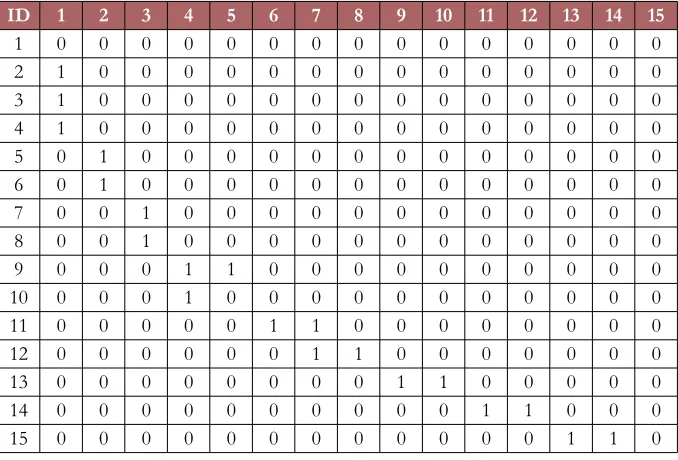
In this experiment, 15 activities are considered. Number of modes are 4 and number of the limited resources are 3. The network diagram of the project is shown by Figure 7. Using Figure 7, a binary matrix is drawn which can be entered to the Matlab program (Table 1). Other projects information including resource usage, priorities between activities and resource availability level are presented in Table 3 (example 7).
ID 1 2 3 4 5 6 7 8 9 10 11 12 13 14 15
1 0 0 0 0 0 0 0 0 0 0 0 0 0 0 0
2 1 0 0 0 0 0 0 0 0 0 0 0 0 0 0
3 1 0 0 0 0 0 0 0 0 0 0 0 0 0 0
4 1 0 0 0 0 0 0 0 0 0 0 0 0 0 0
5 0 1 0 0 0 0 0 0 0 0 0 0 0 0 0
6 0 1 0 0 0 0 0 0 0 0 0 0 0 0 0
7 0 0 1 0 0 0 0 0 0 0 0 0 0 0 0
8 0 0 1 0 0 0 0 0 0 0 0 0 0 0 0
9 0 0 0 1 1 0 0 0 0 0 0 0 0 0 0
10 0 0 0 1 0 0 0 0 0 0 0 0 0 0 0
11 0 0 0 0 0 1 1 0 0 0 0 0 0 0 0
12 0 0 0 0 0 0 1 1 0 0 0 0 0 0 0
13 0 0 0 0 0 0 0 0 1 1 0 0 0 0 0
14 0 0 0 0 0 0 0 0 0 0 1 1 0 0 0
15 0 0 0 0 0 0 0 0 0 0 0 0 1 1 0
Table 1. Priority Matirx for experiment number 1
This experiment is also solved in two modes of relaxed and limited resource constraints. Figure 8 and 9 show the proposed Gantt charts for relaxed and limited resource modes respectively. The calculated upper bound for this experiment is 90 working days. In this experiment also the limited resources cause the makespan of the project to be extended from 36 working days in the first mode to 42 working days in the second mode. The Gantt chart in Figure 8 shows that activities 7 and 10 are taken apart by the algorithm to increase the resource usage.
Figure 9. Gantt chart of the 4th experiment after using the proposed method
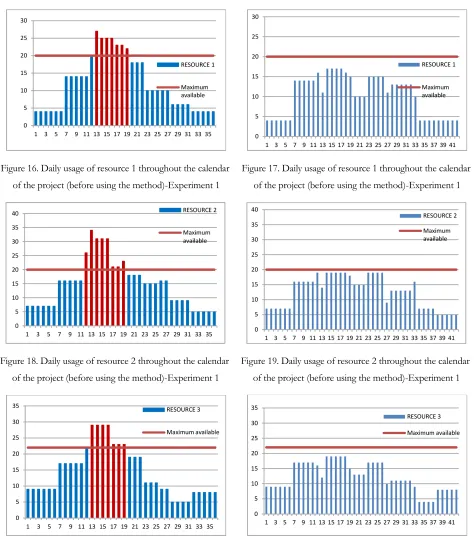
The cumulative resource usages throughout the project calendar for each of the resources are shown in Figures 10 to 15. As seen for each of the resources, the slope of resource usage graphs after using the proposed forward method is smoothed (Figures 11, 13 and 15). The S-curve of the graphs shows that the schedule is safe to be used.
Figure 10. Cumulative resource usage for resource 1 of experiment 1 (relaxed resource constraint)
Figure 12. Cumulative resource usage for resource 2 of experiment 1 (relaxed resource constraint)
Figure 13. Cumulative resource usage for resource 2 of experiment 1 (after using forward method)
Figure 14. Cumulative resource usage for resource 3 of experiment 1 (relaxed resource constraint)
Figure 15. Cumulative resource usage for resource 3 of experiment 1 (after using forward method)
Figure 16. Daily usage of resource 1 throughout the calendar of the project (before using the method)-Experiment 1
Figure 17. Daily usage of resource 1 throughout the calendar of the project (before using the method)-Experiment 1
Figure 18. Daily usage of resource 2 throughout the calendar of the project (before using the method)-Experiment 1
Figure 19. Daily usage of resource 2 throughout the calendar of the project (before using the method)-Experiment 1
Figure 20. Daily usage of resource 3 throughout the calendar of the project (before using the method)-Experiment 1
4.2. Experiment 2 (Large Scale)
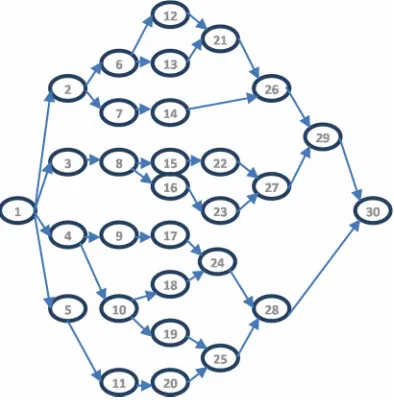
In this experiment, 30 activities are considered. Number of modes is 4 and number of the limited resources is 2. The network of this experiment is shown by Figure 22. Similar to the previous experiment, rest of the required data are presented by Table 3.
Figure 22. Network diagram for experiment number 2
Figure 24. Gantt chart of the 8th experiment after using the proposed method
The cumulative resource usages throughout the project calendar for each of the resources are shown in Figures 25 to 28. As seen for each of the resources, the slope of resource usage graphs after using the proposed forward method is smoothed (Figures 26 and 28). The S-curve of the graphs shows that the schedule is safe to be used.
Figure 25. Cumulative resource usage for resource 1 of experiment 2 (relaxed resource constraint)
Figure 27. Cumulative resource usage for resource 2 of experiment 2 (relaxed resource constraint)
Figure 28. Cumulative resource usage for resource 2 of experiment 2 (after using forward method)
The resource usage through the resource calendar is shown by Figures 29 to 32. The days 17, 18, 19, 20 and 21 are reported as over-allocated working days where the number of available resources is insufficient to complete the activities that are scheduled in these days (Figures 29 and 31). In order to modify the over-allocation in this case, the algorithm decided to take apart activities number 23 and 27 (as shown by Figure 24) for the mentioned days. Consequently, the activity 23 is split in days 19 and 20 and activity 27 is taken apart in days 31 to 36. Similar to other experiments, in this experiment after using the forward method, none of the working days are reported over-allocated (Figures 30 and 32).
Figure 29. Daily usage of resource 1 throughout the calendar of the project (before using the method)-Experiment 2
Figure 31. Daily usage of resource 2 throughout the calendar of the project (before using the method)-Experiment 2
Figure 32. Daily usage of resource 2 throughout the calendar of the project (before using the method)-Experiment 2
4.3. Experiment 3 (Large Scale)
The last experiment is a large scale MRCPSP which contains 50 activities, 4 executing modes and 5 preemptive resources. The network diagram is shown by Figure 33. Rest of the information is shown by Table 4.
Figure 33. Network diagram of experiment number 3
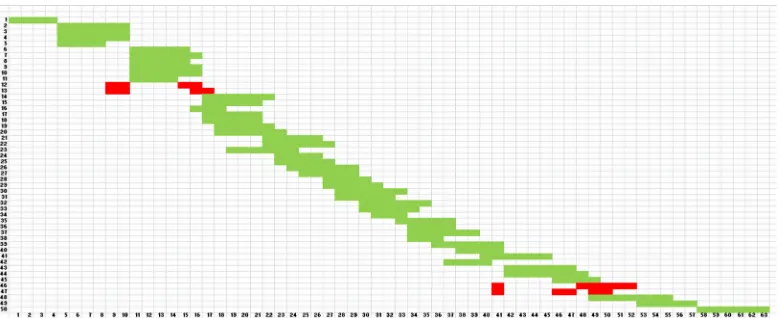
Figure 34. Gantt chart of the 10th experiment relaxed resource constraints
Figure 35. Gantt chart of the 10th experiment after using the proposed method
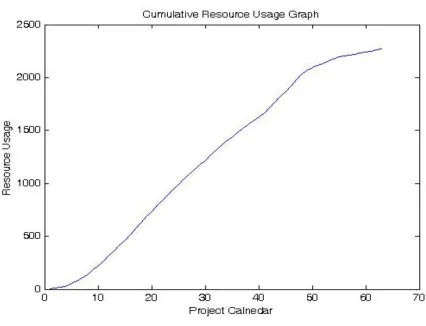
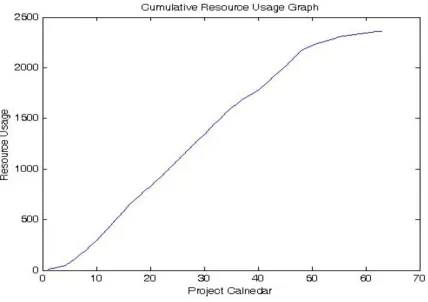
The cumulative resource usages throughout the project calendar for each of the resources are shown in Figures 36 to 45.
Figure 38. Cumulative resource usage for resource 1 of experiment 3 (relaxed resource constraint)
Figure 39. Cumulative resource usage for resource 1 of experiment 3 (after using forward method)
Figure 40. Cumulative resource usage for resource 1 of experiment 3 (relaxed resource constraint)
Figure 41. Cumulative resource usage for resource 1 of experiment 3 (after using forward method)
Figure 42. Cumulative resource usage for resource 1 of experiment 3 (relaxed resource constraint)
Figure 44. Cumulative resource usage for resource 1 of experiment 3 (relaxed resource constraint)
Figure 45. Cumulative resource usage for resource 1 of experiment 3 (after using forward method)
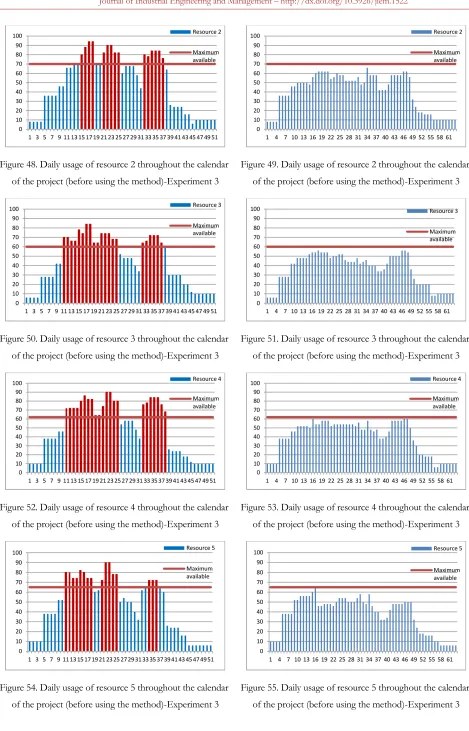
The resource usage through the resource calendar is shown by Figures 46 to 55. The days 10 to 38 are mostly reported as over-allocated working days where the number of available resources is insufficient to complete the activities that are scheduled in these days (Figures 46, 48, 50, 52 and 54). In order to modify the over-allocating in this case, the algorithm decided to take apart activity number 46 and 47 (as shown by Figure 35) for the mentioned days. Consequently, the activity 46 is split in days 42 to 47 and activity 47 is split in days 42 to 45 and again in day 48. Similar to other experiments, in this experiment after using the forward method, none of the working days are reported over-allocated (Figures 47, 49, 51, 53 and 55).
Figure 46. Daily usage of resource 1 throughout the calendar of the project (before using the method)-Experiment 3
Figure 48. Daily usage of resource 2 throughout the calendar of the project (before using the method)-Experiment 3
Figure 49. Daily usage of resource 2 throughout the calendar of the project (before using the method)-Experiment 3
Figure 50. Daily usage of resource 3 throughout the calendar of the project (before using the method)-Experiment 3
Figure 51. Daily usage of resource 3 throughout the calendar of the project (before using the method)-Experiment 3
Figure 52. Daily usage of resource 4 throughout the calendar of the project (before using the method)-Experiment 3
Figure 53. Daily usage of resource 4 throughout the calendar of the project (before using the method)-Experiment 3
Figure 54. Daily usage of resource 5 throughout the calendar of the project (before using the method)-Experiment 3
4.4. Solving Experiments Gathered from the Literature
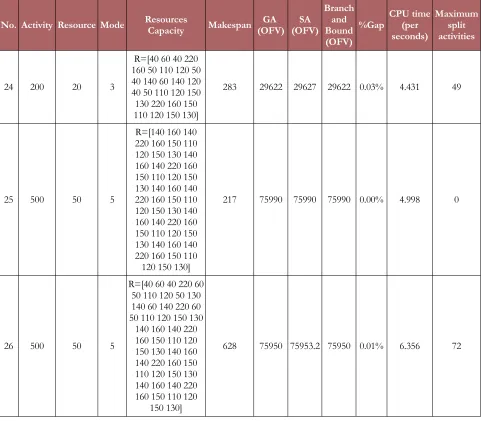
To examine the proposed approach, 10 series of small, medium and large scale examples are designed and solved with 5, 6, 13, 15, 18, 20, 25, 30, 40, 50, 100, 200 and 500 variables. For evaluating the efficiency of proposed model each example is solved under two conditions where all the criteria are considered the same but resource availability. The results, then, checked with results of forward serial programming method (Table 2).
No. Activity Resource Mode ResourcesCapacity Makespan (OFV)GA (OFV)SA
Branch and Bound (OFV)
%Gap CPU time(per seconds)
Maximum split activities
1 5 3 2 [60 100 300] 16 539.4 539.4 539.4 0.00% 0.357 0
2 5 3 2 [6 10 30] 19 538.7 538.7 538.7 0.00% 0.338 1
3 6 2 2 [130 100] 17 753.7 753.7 753.7 0.00% 0.212 0
4 6 2 2 [13 10] 19 751.3 751.3 751.3 0.00% 0.2109 1
5 13 2 2 [220 300] 30 2014.2 2014.2 2014.2 0.00% 0.218 0
6 13 2 2 [22 30] 32 2013.1 2013.1 2013.1 0.00% 0.217 5
7 15 3 4 [200 200 220] 36 2574.0 2574.0 2574.0 0.00% 0.336 0
8 15 3 4 [20 20 22] 41 2572.3 2572.3 2572.3 0.00% 0.34 1
9 18 3 3 [24 24 28] 27 2998.3 2998.3 2998.3 0.00% 0.334 0
10 18 3 3 [24 24 28] 36 2995.8 2995.8 2995.8 0.00% 0.335 1
11 20 3 4 [220 280 300] 35 3226.0 3232.0 3226.0 0.19% 0.33 0
12 20 3 4 [22 28 30] 42 3223.0 3223.0 3223.0 0.00% 0.334 2
13 25 2 3 [320 200] 52 4004.3 4031.0 4004.3 0.66% 0.178 0
14 25 2 3 [32 20] 52 4003.1 4016.0 4003.1 0.32% 0.221 3
15 30 2 4 [450 400] 45 5021.8 5021.8 5021.8 0.00% 0.222 0
16 30 2 4 [45 40] 45 5019.9 5019.9 5019.9 0.05% 0.226 2
17 40 4 3 [450 400 350] 57 6082.6 6086.4 6082.6 0.06% 0.352 0
18 40 4 3 [45 40 35] 68 6078.8 6082.1 6078.8 0.05% 0.354 6
19 50 5 4 [550 700 600 620650] 47 8457.3 8458.7 8457.3 0.02% 0.594 0
20 50 5 4 [55 70 60 62 65] 57 8450.7 8450.7 8450.7 0.04% 0.612 6
21 100 10 4 64 78 124 220 135R=[120 130 45 89
90] 190 1580.7 1584.2 1580.7 0.22% 2.266 0
22 100 10 4 R=[45 40 45 50 6445 64 45 65 45] 204 1692.5 1692.5 1692.5 0.09% 2.866 23
23 200 20 3
R=[140 160 140 220 160 150 110 120 150 130 140 160 140 220 160 150 110 120 150
130]
No. Activity Resource Mode ResourcesCapacity Makespan (OFV)GA (OFV)SA
Branch and Bound (OFV)
%Gap CPU time(per seconds)
Maximum split activities
24 200 20 3
R=[40 60 40 220 160 50 110 120 50 40 140 60 140 120 40 50 110 120 150 130 220 160 150 110 120 150 130]
283 29622 29627 29622 0.03% 4.431 49
25 500 50 5
R=[140 160 140 220 160 150 110 120 150 130 140 160 140 220 160 150 110 120 150 130 140 160 140 220 160 150 110 120 150 130 140 160 140 220 160 150 110 120 150 130 140 160 140 220 160 150 110 120 150 130]
217 75990 75990 75990 0.00% 4.998 0
26 500 50 5
R=[40 60 40 220 60 50 110 120 50 130 140 60 140 220 60 50 110 120 150 130
140 160 140 220 160 150 110 120 150 130 140 160 140 220 160 150 110 120 150 130 140 160 140 220 160 150 110 120
150 130]
628 75950 75953.2 75950 0.01% 6.356 72
Table 2. Results of solving experiments derived from the literature
Results that are shown in Table 2 indicate that for small scale problems the algorithm can avoid activity split by postponing activities that are scheduled in over-allocated days. However by increasing the number of activities and complicating the precedence matrix, it is shown that number of times that activities are split to modify over-allocation is increased (Table 2)
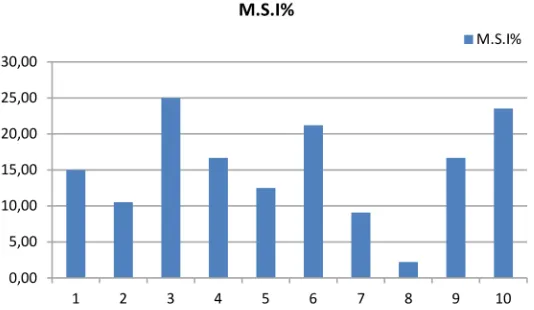
4.5. Measuring the Completion Time with Makespan Index
In this section in order to evaluate how limited resources influence the makespan of the project, a new index is developed:
Figure 56 shows the results of calculating Equation 15 for the experiments.
Figure 56. Makespan index graph for the solved experiments
No. Number ofActivities Number ofResources Number ofexecution
modes Resource level
Method
M.S.I% U.B schedulingNormal programmingFroward
method
1 5 3 2 [6, 10, 30] 23 20 23 15.00
2 6 2 2 [13, 10] 31 19 21 10.53
3 13 2 2 [22, 30] 78 28 35 25.00
4 15 3 4 [20, 20, 22] 90 36 42 16.67
5 18 3 3 [24, 24, 28] 93 32 36 12.50
6 20 3 4 [22, 28, 30] 112 33 40 21.21
7 25 2 3 [32, 20] 136 55 60 9.09
8 30 2 4 [45, 40] 164 45 46 2.22
9 40 3 3 [45, 40, 35] 205 60 70 16.67
10 50 5 4 [55, 70, 60, 62, 65] 275 51 63 23.53
The results in Table 3 shows that although proposed method can avoid over-allocating of activities, but at the same time limited resources can cause delay in makespan in a value between 2.22% and 25%.
Figure 57. Comparing the makespan in normal scheduling and forward serial programming for the solved experiments
Figure 57 shows that in all the studied case the observed makespan are smaller than UB. UB is considered as upper limit for the makespan of a project and any value larger than this can thus be considered as an infeasible solution.
No. 1 2 3 4 5 6 7 8 9 10
Over allocated days
(Normal Scheduling) [3, 3, 0] [4, 0] [5, 0] [7, 8, 7] [6, 5, 2] [12, 7, 6] [4, 11] [5, 5] [7, 13, 24] [22, 15, 21, 22, 17] Over-allocated days
(Forward programming
method) [0, 0, 0] [0, 0] [0, 0] [0, 0, 0] [0, 0, 0] [0, 0, 0] [0, 0] [0, 0] [0, 0, 0] [0, 0, 0, 0, 0]
Table 4. Over-allocated days in normal and modified schedules observed before and after using the method
Figure 58. Comparing number of over allocated days for the solved experiments
Results also indicate that by increasing the discounted rate and the number of activities (dimension of the problem) the angle of slope of the NPV is increased (Figure 59).
5. Verification the Proposed Method
In this section the proposed scheduling method is applied for 2 case studies. The first case study is constructing a hospital. The list of activities is shown by Table 5:
ID Activity Duration ID Activity Duration
1 Shop Preparedness and Mobilization 7 30 Installing Gas Supply System 2
2 Foundation 21 31 Installing Cable Trunk 5
3 Structure 40 32 Install Cable Tray 5
4 Flooring 10 33 Cabling 7
5 Trench 2 34 Installing Lightning Cables 5
6 Wall Erection 12 35 Installing Lightning Lamps 2
7 Roofing 5 36 Installing of Electrical Panels 7
8 Window Frames 3 37 Cable Connecting for Electrical Panel 2
9 Door Frames 3 38 Installing of Plugs & Sockets 2
10 Fire Box Frames 1 39 Connect Cables and Pipes of Chillers 1
11 Installing False Ceiling Structure 10 40 Installing CCTVs 2
12 Roof Insulation 2 41 Installing Nurse Call System 2
13 Installing False Ceiling 10 42 Installing Paging System 2
14 Rain Water Piping 3 43 Windows 3
15 Install Piping Tray 4 44 Wooden Doors 2
16 Water Piping 5 45 Plastering 7
17 Return Piping 5 46 Tilling 2
18 Drainage Piping 5 47 Operating Rooms Tilling 2
19 Floor Drains 1 48 Installing Ceramics 4
20 Installing Supports for Ducts 10 49 Painting 4
21 Installing Ducts 7 50 Installing Wooden Works 2
22 Installing Coverage for Ducts 7 51 Installing Radiology Door 1
23 FCU(Duct) 6 52 Locker Room Preparation 2
24 FCU (Cold, Hot and Return Water Piping) 3 53 Installing Hospital Beds 1
25 FCU (Drainage Piping) 4 54 Sliding Door 2
26 FCU (Machine) 2 55 Installing Surgical Beds 1
27 FCU (Grille) 2 56 Area 30
28 Structure of Chillers 2 57 Building Facades 30
29 Install Chillers 4 58 Testing And Site Delivery 2
The Table 6 shows the precedence network between activities:
1 2 3 4 5 6 7 8 9 10 11 12 13 14 15 16 17 18 19 20 21 22 23 24 25 26 27 28 29 30 31 32 33 34 35 36 37 38 39 40 41 42 43 44 45 46 47 48 49 50 51 52 53 54 55 56 57 58 1
2 FS 3 FS
4 FS
5 +1SS 6 +1FS
7 FS
8 FS
9 FS
10 FS
11 FS
12 FS FS FS
13 FS FS FS FS FS FS FS
14 FS
15 FS FS
16 FS
17 FS FS
18 FS
19 FS
20 FS FS
21 FS
22 +1SS
23 FS 24 FS 25 SS 26 FS 27 FS 28 FS 29 FS 30 FS
31 FS FS
32 FS
33 FS
34 FS FS
35 FS FS
36 FS
37 FS FS
38 FS
39 FS FS
40 FS
41 FS
42 FS
43 FS
44 FS
45 FS FS FS FS FS
46 FS FS
47 FS FS
48 FS FS
49 FS FS
50 FS
51 FS
52 FS
53 FS
54 FS
55 FS FS FS
56 FS
57 FS
58 FS FS FS FS FS FS FS FS
And finally Table 7 shows the resource usage of activities:
Activity ID
1 2 3 4 5 6 7 8 9 10 11 12 13 14 15
Civil
Worker MechanicalWorker ElectricalWorker Pipeman TechnicianElectrical MechanicalTechnicianTechnician Welder Painter Carpenter BlacksmithCivil EngineerCivil MechanicalEngineer ElectricalEngineer Mason
1 1 1 1 1 1 1 1 1 1
2 5 1 1
3 5 1 1
4 4 1 1
5 1 1
6 5 1 1 1
7 4 1 1 1
8 2 1
9 2 1
10 2 1
11 4 1 2 1 1
12 1 1 1
13 4 1 2 1 1
14 2 2 1 1
15 4 2 1 2 1
16 4 2 1 1
17 4 2 1 1
18 2 1 1 1
19 2 1
20 4 1 1
21 4 1 1
22 2 1
23 2 1 1
24 4 1 1
25 1 1 1
26 2 1 1
27 1 1
28 1 1 1 1
29 2 1 1
30 2 1 1
31 4 1 1 1
32 4 1 1 1
33 2 1 1
34 2 1 1
35 2 1 1
36 2 1 1
37 2 1 1
38 2 1 1
39 2 1 1
40 2 1 1
41 2 1 1
42 2 1 1
43 2 1 1
44 2 1 2 1
45 4 1 1 2
46 4 1 1 2
47 2 1 1 1
48 4 1 1 2
49 1 2 1
50 2 1 2 1
51 2 1 1 1
52 2 1 1
53 2 1 1
54 2 1 1
55 2 1 1
56 2 1 1 1
57 4 1 1 1
And finally Table 8 shows the maximum available resource:
Resource WorkerCivil MechanicalWorker ElectricalWorker Pipeman TechnicianElectrical MechanicalTechnicianTechnicianCivil Welder Painter Carpenter Blacksmith EngineerCivil MechanicalEngineer ElectricalEngineer Mason
Maximum
Level 800% 800% 800% 200% 200% 200% 200% 200% 200% 100% 200% 100% 100% 100% 200%
Table 8. Maximum Available Resource
In the first step we schedule the problem using Microsoft Office Project® 2010 (MSP 2010). As expected
the project is unacceptable since most of the resources are over-allocated (Figure 60).
Figure 60. Resource sheet of MSP 2010
Figure 61. Gantt Chart of MSP 2010 for case study (Continued)
Figure 62. Gantt Chart of MSP 2010 for case study
In continue the proposed algorithm is used to modify the over-allocated schedule. The results show that the modified schedule is not suffered by any over allocated resource so it is trustable and can be used for constructing phase.
Table 9 compares the information of the activities before and after using the proposed method.
MSP 2010 Classic Branch and Bound Proposed Algorithm
Number of Activities 58 58 58
Number of Resources 15 15 15
Number of over allocated resources 10 10 0
Number of Split Times 0 0 5
Makespan 146 146 204
NPV – 77564$ 77560$
Table 9. Comparing results of scheduling the hospital unig MSP, Classic Branch and Bound and the proposed algorithm
Figures 64 and 65 show the Gantt chart of the modified scheduled that is achieved by the proposed solving method.
Figure 65. The modified Gantt chart for the Hospital
Results show that the proposed algorithm can successfully modified the over-allocated resources in a reasonable computing time.
6. Conclusion
Scheduling multi-mode resource constraint project scheduling problems while preemptive resources are exists are a big concern in project management. In this research the over-allocated project schedules with preemptive resources are rescheduled using genetic algorithm. By presenting a dynamic forward approach, an appropriate and logical solution is boosted and it is observed that the proposed method can modify over-allocated MRCPSPs schedules by taking apart less important activities and keeping more important activities. It is also found that using the proposed procedure has caused noticeable rise in remaining resources usage during life the project implementation. Further expansion of the research by considering negative cash flows is suggested.
References
Abbasi, B., Shadrokh, S., & Arkat, J. (2006). Bi-objective resource-constrained project scheduling with
robustness and makespan criteria. Applied Mathematics and Computation, 180(1), 146-152.
http://dx.doi.org/10.1016/j.amc.2005.11.160
Achuthan, N., & Hardjawidjaja, A. (2001). Project scheduling under time dependent costs–A branch and
bound algorithm. Annals of Operations Research, 108(1-4), 55-74. http://dx.doi.org/10.1023/A:1016046625583
Alcaraz, J., & Maroto, C. (2001). A robust genetic algorithm for resource allocation in project scheduling.
Annals of Operations Research, 102(1-4), 83-109. http://dx.doi.org/10.1023/A:1010949931021
Ballestín, F., Valls, V., & Quintanilla, S. (2008). Pre-emption in resource-constrained project scheduling.
European Journal of Operational Research, 189(3), 1136-1152. http://dx.doi.org/10.1016/j.ejor.2006.07.052
Baroum, S.M., & Patterson, J.H. (1999). An exact solution procedure for maximizing the net present
value of cash flows in a network. Project Scheduling (pp. 107-134). Springer.
http://dx.doi.org/10.1007/978-1-4615-5533-9_5
Buddhakulsomsiri, J., & Kim, D.S. (2006). Properties of multi-mode resource-constrained project
scheduling problems with resource vacations and activity splitting. European Journal of Operational Research,
175(1), 279-295. http://dx.doi.org/10.1016/j.ejor.2005.04.030
Castejón-Limas, M., Ordieres-Meré, J., González-Marcos, A., & González-Castro, V. (2011). Effort
estimates through project complexity. Annals of Operations Research, 186(1), 395-406.
http://dx.doi.org/10.1007/s10479-010-0776-0
Chtourou, H., & Haouari, M. (2008). A two-stage-priority-rule-based algorithm for robust
resource-constrained project scheduling. Computers & industrial engineering, 55(1), 183-194.
http://dx.doi.org/10.1016/j.cie.2007.11.017
Damay, J., Quilliot, A., & Sanlaville, E. (2007). Linear programming based algorithms for preemptive and
non-preemptive RCPSP. European Journal of Operational Research, 182(3), 1012-1022.
http://dx.doi.org/10.1016/j.ejor.2006.09.052
De Reyck, B. (1998). A branch-and-bound procedure for the resource-constrained project scheduling
problem with generalized precedence relations. European Journal of Operational Research, 111(1), 152-174.
Delgoshaei, A., Al-Mudhafar, A., & Ariffin, M.K.A. (2016). Developing a new method for modifying over-allocated multi-mode resource constraint schedules in the presence of preemptive resources.
Decision Science Letters, 5(4), 499-518. http://dx.doi.org/10.5267/j.dsl.2016.5.002
Delgoshaei, A., Ariffin, M.K., Baharudin, B.H.T.B., & Leman, Z. (2014). A Backward Approach for Maximizing Net Present Value of Multi-mode Pre-emptive Resource-Constrained Project Scheduling
Problem with Discounted Cash Flows Using Simulated Annealing Algorithm. International Journal of
Industrial Engineering and Management, 5(3), 151-158.
Delgoshaei, A., Ariffin, M.K.M., Baharudin, B.H.T.B., & Leman, Z. (2015). Minimizing makespan of a
resource-constrained scheduling problem: A hybrid greedy and genetic algorithms. Resource. International
Journal of Industrial Engineering Computations, 6(4), 503-520. http://dx.doi.org/10.5267/j.ijiec.2015.5.002
Demeulemeester, E.L., & Herroelen, W.S. (1996). An efficient optimal solution procedure for the
preemptive resource-constrained project scheduling problem. European Journal of Operational Research,
90(2), 334-348. http://dx.doi.org/10.1016/0377-2217(95)00358-4
Elmaghraby, S.E., & Herroelen, W.S. (1990). The scheduling of activities to maximize the net present
value of projects. European Journal of Operational Research, 49(1), 35-49.
http://dx.doi.org/10.1016/0377-2217(90)90118-U
Etgar, R., Shtub, A., & LeBlanc, L.J. (1997). Scheduling projects to maximize net present value—the case
of time-dependent, contingent cash flows. European Journal of Operational Research, 96(1), 90-96.
http://dx.doi.org/10.1016/0377-2217(95)00382-7
Hartmann, S. (2001). Project scheduling with multiple modes: a genetic algorithm. Annals of Operations
Research, 102(1-4), 111-135. http://dx.doi.org/10.1023/A:1010902015091
Hartmann, S., & Briskorn, D. (2010). A survey of variants and extensions of the resource-constrained
project scheduling problem. European Journal of Operational Research, 207(1), 1-14.
http://dx.doi.org/10.1016/j.ejor.2009.11.005
Icmeli, O., & Erenguc, S. S. (1994). A tabu search procedure for the resource constrained project
scheduling problem with discounted cash flows. Computers & operations research, 21(8), 841-853.
http://dx.doi.org/10.1016/0305-0548(94)90014-0
Icmeli, O., Erenguc, S.S., & Zappe, C.J. (1993). Project scheduling problems: a survey. International Journal
Jarboui, B., Damak, N., Siarry, P., & Rebai, A. (2008). A combinatorial particle swarm optimization for
solving multi-mode resource-constrained project scheduling problems. Applied Mathematics and
Computation, 195(1), 299-308. http://dx.doi.org/10.1016/j.amc.2007.04.096
Ke, H., & Liu, B. (2010). Fuzzy project scheduling problem and its hybrid intelligent algorithm. Applied
Mathematical Modelling, 34(2), 301-308.
Kelley, J.E. (1963). The critical-path method: Resources planning and scheduling. Industrial scheduling, 13,
347-365.
Kim, K., Yun, Y., Yoon, J., Gen, M., & Yamazaki, G. (2005). Hybrid genetic algorithm with adaptive
abilities for resource-constrained multiple project scheduling. Computers in industry, 56(2), 143-160.
http://dx.doi.org/10.1016/j.compind.2004.06.006
Kolisch, R. (1996). Serial and parallel resource-constrained project scheduling methods revisited: Theory
and computation. European Journal of Operational Research, 90(2), 320-333.
http://dx.doi.org/10.1016/0377-2217(95)00357-6
Kolisch, R., & Drexl, A. (1997). Local search for nonpreemptive multi-mode resource-constrained project
scheduling. IIE transactions, 29(11), 987-999. http://dx.doi.org/10.1080/07408179708966417
Laslo, Z. (2010). Project portfolio management: An integrated method for resource planning and
scheduling to minimize planning/scheduling-dependent expenses. International Journal of Project
Management, 28(6), 609-618. http://dx.doi.org/10.1016/j.ijproman.2009.10.001
Lee, & Lei, L. (2001). Multiple-project scheduling with controllable project duration and hard resource
constraint: some solvable cases. Annals of Operations Research, 102(1-4), 287-307.
http://dx.doi.org/10.1023/A:1010918518726
Lova, A., & Tormos, P. (2001). Analysis of scheduling schemes and heuristic rules performance in
resource-constrained multiproject scheduling. Annals of Operations Research, 102(1-4), 263-286.
http://dx.doi.org/10.1023/A:1010966401888
Mika, M., Waligóra, G., & Węglarz, J. (2005). Simulated annealing and tabu search for multi-mode resource-constrained project scheduling with positive discounted cash flows and different payment
models. European Journal of Operational Research, 164(3), 639-668. http://dx.doi.org/10.1016/j.ejor.2003.10.053
Russell, A. (1970). Cash flows in networks. Management Science, 16(5), 357-373.
Seifi, M., & Tavakkoli-Moghaddam, R. (2008). A new bi-objective model for a multi-mode
resource-constrained project scheduling problem with discounted cash flows and four payment models. Int. J. of
Engineering, Transaction A: Basic, 21(4), 347-360.
Sprecher, A. (2000). Scheduling resource-constrained projects competitively at modest memory
requirements. Management Science, 46(5), 710-723. http://dx.doi.org/10.1287/mnsc.46.5.710.12044
Sung, C., & Lim, S. (1994). A project activity scheduling problem with net present value measure.
International Journal of Production Economics, 37(2), 177-187. http://dx.doi.org/10.1016/0925-5273(94)90169-4
Talbot, F.B. (1982). Resource-constrained project scheduling with time-resource tradeoffs: The
nonpreemptive case. Management Science, 28(10), 1197-1210. http://dx.doi.org/10.1287/mnsc.28.10.1197
Ulusoy, G., Sivrikaya-Şerifoğlu, F., & Şahin, Ş. (2001). Four payment models for the multi-mode resource
constrained project scheduling problem with discounted cash flows. Annals of Operations Research,
102(1-4), 237-261. http://dx.doi.org/10.1023/A:1010914417817
Van de Vonder, S., Demeulemeester, E., Herroelen, W., & Leus, R. (2005). The use of buffers in project
management: The trade-off between stability and makespan. International Journal of Production Economics,
97(2), 227-240. http://dx.doi.org/10.1016/j.ijpe.2004.08.004
Van de Vonder, S., Demeulemeester, E., Herroelen, W., & Leus, R. (2006). The trade-off between
stability and makespan in resource-constrained project scheduling. International Journal of Production
Research, 44(2), 215-236. http://dx.doi.org/10.1080/00207540500140914
Van Peteghem, V., & Vanhoucke, M. (2010). A genetic algorithm for the preemptive and non-preemptive
multi-mode resource-constrained project scheduling problem. European Journal of Operational Research,
201(2), 409-418. http://dx.doi.org/10.1016/j.ejor.2009.03.034
Vanhoucke, M., & Debels, D. (2008). The impact of various activity assumptions on the lead time and
resource utilization of resource-constrained projects. Computers & industrial engineering, 54(1), 140-154.
http://dx.doi.org/10.1016/j.cie.2007.07.001
Węglarz, J., Józefowska, J., Mika, M., & Waligóra, G. (2011). Project scheduling with finite or infinite
number of activity processing modes–A survey. European Journal of Operational Research, 208(3), 177-205.
http://dx.doi.org/10.1016/j.ejor.2010.03.037
Yan, L., Jinsong, B., Xiaofeng, H., & Ye, J. (2009). A heuristic project scheduling approach for quick
response to maritime disaster rescue. International Journal of Project Management, 27(6), 620-628.
Yang, Talbot, F.B., & Patterson, J.H. (1993). Scheduling a project to maximize its net present value: an
integer programming approach. European Journal of Operational Research, 64(2), 188-198.
http://dx.doi.org/10.1016/0377-2217(93)90176-N
Yu, Wang, S., Wen, F., & Lai, K.K. (2012). Genetic algorithm-based multi-criteria project portfolio
selection. Annals of Operations Research, 197(1), 71-86. http://dx.doi.org/10.1007/s10479-010-0819-6
Zhou, M., & Askin, R.G. (1998). Formation of general GT cells: an operation-based approach. Computers
& industrial engineering, 34(1), 147-157. http://dx.doi.org/10.1016/S0360-8352(97)00157-5
Zhu, D., & Padman, R. (1999). A metaheuristic scheduling procedure for resource‐constrained projects
with cash flows. Naval Research Logistics (NRL), 46(8), 912-927.
http://dx.doi.org/10.1002/(SICI)1520-6750(199912)46:8<912::AID-NAV3>3.0.CO;2-C
Appendix
Precedence Matrix for Experiments number 1 and 2 in Table 3
1 2 3 4 5
1 - - - -
-2 FS(1)+2 - - -
-3 SS(1) FS(2) - -
-4 - FS(2) SS(3)+1 -
-5 - - - SF(4)
-Precedence Matrix for Experiments number 3 and 4 in Table 3
1 2 3 4 5 6
1
2 FS(1)
3 FS(1)+2
4 SF(3)
5 FS(3)+1
Precedence Matrix for Experiments number 5 and 6 in Table 3
1 2 3 4 5 6 7 8 9 10 11 12 13
1
2 FS(1)+1
3 FS(1)
4 FS(1)
5 SS(2)+1
6 FS(2)+1
7 FF(3)+1
8 FS(4)+1
9 FS(4)+1
10 FS(5) FS(6)
11 SS(7)+1
12 FS(8)+1 FS(9)+1
13 FS(10) FS(11) FS(12)
Precedence Matrix for Experiments number 7 and 8 in Table 3
1 2 3 4 5 6 7 8 9 10 11 12 13 14 15
1 2 FS(1)
3 FS(1)+1
4 FS(1)
5 FS(2)+1
6 FS(2)+1
7 FS(3)
8 FF(3)+1
9 FS(4)+2 FS(5)
10 SS(4)+1
11 FS(6)+1 FS(7)
12 FS(7)+1 SS(8)+1
13 FF(9)+1 FF(10
)
14 SS(11) FS(12)+1
Precedence Matrix for Experiments number 9 and 10 in Table 3
1 2 3 4 5 6 7 8 9 10 11 12 13 14 15 16 17 18
1 2 FS(1) 3 FS(1)+1 4 FS(2)+2 5 FS(2) 6 SS(3)+1 7 FS(3) 8 FF(4)+1 9 FS(5) 10 FS(6)+1 11 SF(7) 12 FS(8)+1 13 FF(8) 14 SS(9) 15 SS(10) 16 FS(11)+2 17 SF(11)+1
18 FS(12)+2 SS(13)+1 FS(14)+1 FS(15)+1 FS(16)+1 FS(17)+1
Precedence Matrix for Experiments number 11 and 12 in Table 3
1 2 3 4 5 6 7 8 9 10 11 12 13 14 15 16 17 18 19 20
1 2 FS(1) 3 FS(1) 4 FS(1) 5 FS(2) 6 FS(2) 7 SS(3) 8 FF(4) 9 FS(4) 10 FS(5) 11 SS(6) 12 FS(6) 13 FS(7) 14 SS(8)+2 15 SF(9)+3 16 FS(9)+2
17 FS(10)+2 FS(11)+1
18 SS(12)+3 FS(13)+1
19 FS(14)+4 FS(15)+1 FF(16)+3
Precedence Matrix for Experiments number 13 and 14 in Table 3
1 2 3 4 5 6 7 8 9 10 11 12 13 14 15 16 17 18 19 20 21 22 23 24 25
1 2 FS(1) 3 FS(1) 4 FS(2)+1 5 SS(2) 6 FS(3)+1 7 SF(3)+1 8 FS(3)
9 SS(4)+1
10 FF(5)+2
11 FS(6)
12 FS(7)
13 SS(8)+1
14 FS(9) FS(10)
15 FS(11) FS(12) FS(13)+1
16 FS(14) FS(15)+1
17 SS(16)+1
18 FS(16)
19 FF(17)+1
20 FS(18)
21 SF(18)+1
22 FS(19)+1
23 FS(20)
24 FS(21)
Precedence Matrix for Experiments number 15 and 16 in Table 3
1 2 3 4 5 6 7 8 9 10 11 12 13 14 15 16 17 18 19 20 21 22 23 24 25 26 27 28 29 30 1 2 FS (1) 3 FS (1) 4 FS (1) 5 FS (1)+1 6 FS (2) 7 FS (2)+1 8 SS (3) 9 FS (4)+1 10 FF (4) 11 FS (5)+1 12 SF (6)+1 13 FS (6) 14 SS (7)+1 15 FF (8) 16 FS (8)+1 17 FS (9) 18 SS (10)+1 19 FS (10) 20 SS (11)+1 21 FS
(12) (13)+2FS
22 FF
(15)+1
23 SF
(16)+2
24 SS
(17) (18)+3FS
25 FS
(19) (20)FS
26 FS
(14) (21)FS
27 FS
(22) (23)FS
28 SS
(24) FS (25)+1
29 FS
(26) (27)FS
30 FS
Precedence Matrix for Experiments number 17 and 18 in Table 3
1 2 3 4 5 6 7 8 9 10 11 12 13 14 15 16 17 18 19 20 21 22 23 24 25 26 27 28 29 30 31 32 33 34 35 36 37 38 39 40
1 2 FS (1) 3 SS (1) 4 FS (1) 5 FS (2) 6 FF (2)+1 7 FS (3) 8 SS (4) 9 FS (4)+1 10 FS (4) 11 FS (5) FS (6) 12 FS
(6) FS(7)
13 SS (8) 14 FS (9) FS (10) 15 FS
(11)(12)FS
16 FF (8) 17 FS (13) FS (14) 18 FF (14) 19 FS
(15) (16)FS
20 FS (17) FS (18)+1 21 SS (19) 22 FS (19)+1 23 FF (19) 24 SS (17)+ 1 25 FS (20)+1 26 FS
(21)(22)+1FS
27 FS
(22) (23)FS
28 SF
(24)
29 FS
(24)+1(25)FS
30 FF (25) 31 FS (26) 32 SS (26)+1 33 FS (27) 34 FS (28)+1 35 SF (29) 36 FS (30)+1 37 FS (31) FS (32) FS (33) 38 FF (34)+1 39 FS
(35)(36)FS
Precedence Matrix for Experiments number 19 and 20 in Table 3
1 2 3 4 5 6 7 8 9 10 11 12 13 14 15 16 17 18 19 20 21 22 23 24 25 26 27 28 29 30 31 32 33 34 35 36 37 38 39 40 41 42 43 44 45 46 47 48 49 50
1 2 FS (1) 3 FS (1) 4 FS (1) 5 SS (1) 6 FS (2) 7 FS (2) 8 FF (2)+1 9 FS (3) 10 SS (3)+1 11 SF (4) 12 FS (5)+1 13 SS (5) 14 FF (6) 15 FS (6)+1 FS (7) 16 SS (8)+1 17 SS (9) 18 FS (10)+1 19 FS (10) 20 FS (11)+1 21 SS (11) 22 FS (12) 23 FS (13) 24 FS (14) 25 SS (14)+1 26 FS
(15) (16)+1FS
27 SF
(17)
28 FS
(18)+1
29 FS
(19)
30 FS
(20)+1
31 SS
(20)+1
32 FS
(21) FS (22)
33 SS
(23)+1
34 FS
(24) FS (25)
35 FS
(26)+1 FS (27)
36 FF
(27)+1
37 FS
(28) FS (29)+1
38 FS
(30) (31)FS
39 FS
(32) FS (33)
40 FS
(34) FS (35)
41 FS
(36) (37)FS
42 FS
(38)+1
43 SS
(39)
44 FS
(39)
45 FS
(40) FS (41)
46 FF
(42)
47 FS
(42)
48 FS
(43) (44)FS
49 FS
(46) FS (47)