Volume 5, Issue 2, 2018, pp. 241-260 Available online at www.jallr.com ISSN: 2376-760X
* Correspondence: Mojdeh Ebrahimi Dehkordi, Email: mojdeh_ebrahimy yahoo.com © 2018 Journal of Applied Linguistics and Language Research
A CIPP Approach to Evaluation of Grammar Teaching
Program at a High school in Iran
Mojdeh Ebrahimi Dehkordi *
PhD Candidate of TEFL, Islamic Azad University, Shahreza branch, Iran
Mohammad Reza Talebinezhad
Associate Professor, Islamic Azad University, Shahreza branch, Iran
Abstract
This study aimed to evaluate the effectiveness of high school grammar program through the perspectives of instructors and students. To this end, The CIPP (context, input, process, and product) evaluation model developed by Stufflebeam (1971) was utilized. 120 students attending the second grade high school in the 1393-1394 educational year. 10 instructors teaching in the program participated in the study. The data were gathered through a self-reported student questionnaire. An interview which was designed for the instructors. While the data based on the questionnaire were analyzed through descriptive and inferential statistics, content analysis was carried out to analyze qualitative data. Results of the study indicated that the grammar program at a high school served for its purpose. The finding revealed that some improvement in the objectives, teaching methods and grammar curriculum effects on oral productive skill, were required to make the grammar program more effective.
Keywords: curriculum evaluation, grammar teaching, high school
BACKGROUND
with two languages, Persian and English, but this has never materialized due to the above mentioned reasons .Any educational system is composed of five important components (students, a teacher, materials, teaching methods, and evaluation) which are closely interrelated.
In Iran, educational policies are decided primarily by the central government. All of the decisions made by the central government are passed down through provincial organizations for implementation at lower levels which have less authority in decision-making. All major educational policies concerning the school systems, the curriculum standards, the compilation of textbooks, the examination system and so on, are under the jurisdiction of the Ministry of Education (ME). According to Jahangard (2007), students’ aural and oral skills are not emphasized in Iranian prescribed EFL textbooks. They are not tested in the university entrance examination, as well as in the final exams during the three years of senior high school and one year of pre-university education. Teachers put much less emphasis, if any, on oral drills, pronunciation, listening and speaking abilities than on reading, writing, grammar and vocabulary. The main focus is to make students pass tests and exams, and because productive abilities of students are not tested, most teachers then skip the oral drills in the prescribed books.
Similarly, according to Namaghi (2006), there are sociopolitical forces which help determine teachers’ work in Iran. First, since teachers cannot choose a textbook which is in line with their students’ needs, their input is controlled by the prescribed curriculum. Second, the output is controlled by the mandated national testing scheme so that teachers cannot develop tests which have positive washback on teaching and learning. Third, since a higher score is culturally equal to higher achievement, the process of teaching and learning is controlled by grade pressures from students, parents and school principals. Consequently, as Namaghi argues, teachers become mere implementers of prescribed initiatives and schemes without recourse to their own professional knowledge and experience.
Grammar is an essential component that should be learnt in order to master a language. If one uses incorrect grammatical pattern in constructing a sentence, there is a tendency that the sentence will constitute different meaning from what it is intended, or even meaningless. Therefore, grammar is called as “sentence-making machine” by Thornbury. It means that, even though one has sufficient number of vocabularies, without having good grammar mastery, he will find problem in arranging those vocabularies into good sentences. As what is said by Ur, one cannot use words unless he/she knows how those words should be put. Considering the significant role of grammar in mastering a language, grammar is important to be learnt by the learners of the language. Thus, language teachers need to teach grammar to their learners.
learners’ expectation, especially for those who want to have an analytical learning style. On the other hand, inductive approach is good for some reasons: (1) it will help the learners, especially young learners, who cannot understand the abstract concept of grammar to learn grammar unconsciously; (2) it will make the learners become autonomous learners; (3) it will make grammar learning more meaningful; and (4) it will make the learners become more active in teaching and learning process. Moreover, deductive approach will be more appropriate to be applied for adult learners, while inductive approach will be better for teaching young learners. It is obvious since young learners usually do not like a serious circumstance. They love to play and only have a short span of concentration. Conversely, adult learners may take benefit from deductive approach, because they can make use of abstract things to gain knowledge. They can get involved in a serious circumstance and can concentrate longer than young learners. Ellis believes that language teachers should teach forms that differ from the learners’ first language. Hence, this article aims at introducing an innovative strategy to teach the 16 English tenses, which are considered different from Iranian grammar system and difficult to be understood by the learners. Based on the strengths of deductive and inductive approaches, an innovative teaching strategy which combines both deductive and inductive approach is proposed. Combining deductive and inductive approach has been done by Nunan. He argues that combining deductive and inductive approaches for teaching grammar will be good especially in focusing a certain purpose of grammar teaching. In addition, by combining both deductive and inductive approaches because it is expected that the learners are not only able to remember or understand the English tenses, but also able to use it communicatively.
Generally, learners can be divided into three categories based on their their age, namely young learners, adolescence, and adult learners. Young learners are those whose ages are between 2 and 14 years old, adolescents are those who are around 12 to 17 years old, while adults are commonly 16 years old and above. From teaching English as foreign language point of view, young learners are those who learn English as a foreign language for the first six or seven year of the formal school system that is usually in the elementary school level. Seeing from their age, they are about 5 until 12 years old. Age is one of the major factors which should be taken into account in deciding how to teach grammar to learners. It is because learners with different age will have different characteristics. Young learners do not only focus on what is being taught, but they also learn something else at the same time, such as acquiring information from their surroundings.
constrained by the educational system or parental pressure to learn English, so the problem of dealing with conscripts does not exist.
In addition, adult learners can decide about what they their age, namely young learners, adolescence, and adult learners. Young learners are those whose ages are between 2 and 14 years old, adolescents are those who are around 12 to 17 years old, while adults are commonly 16 years old and above. From teaching English as foreign language point of view, young learners are those who learn English as a foreign language for the first six or seven year of the formal school system that is usually in the elementary school level. Seeing from their age, they are about 5 until 12 years old. Age is one of the major factors which should be taken into account in deciding how to teach grammar to learners. It is because learners with different age will have different characteristics. Young learners do not only focus on what is being taught, but they also learn something else at the same time, such as acquiring information from their surroundings.
Moreover, young learners may consider seeing, hearing, and touching are as important as the teacher’s explanation. They usually respond the activities focusing their life and experience well. They can be good speakers of a new language if they have sufficient facilities and enough exposure of the target language. They may learn foreign language better through a game. Young learners love to play and to learn best when they enjoy themselves. Adult learners have mature personality, many years of educational training, a developed intelligence, a determination to get what they want, fairly clear aims, and above all strong motivation to make as rapid progress as possible. An adult is no longer constrained by the educational system or parental pressure to learn English, so the problem of dealing with conscripts does not exist.
In addition, adult learners can decide about what they their age, namely young learners, adolescence, and adult learners. Young learners are those whose ages are between 2 and 14 years old, adolescents are those who are around 12 to 17 years old, while adults are commonly 16 years old and above. From teaching English as foreign language point of view, young learners are those who learn English as a foreign language for the first six or seven year of the formal school system that is usually in the elementary school level. Seeing from their age, they are about 5 until 12 years old. Age is one of the major factors which should be taken into account in deciding how to teach grammar to learners. It is because learners with different age will have different characteristics. Young learners do not only focus on what is being taught, but they also learn something else at the same time, such as acquiring information from their surroundings.
problem of dealing with conscripts does not exist. In addition, adult learners can decide about what they program and the students’ perceptions of their own competencies are aimed to be examined. By means of this study, the researcher’s ultimate aim is to suggest relevant adaptations and contribute to the improvement of the high school curriculum.
Statement of the problem
Since the introduction of foreign language instruction into the Iranian education system, there has been an increasing need for intensive English education at a high school in all aspects and parts of English. One of this important and necessary parts of English is grammar, because it could have positive effect on four basic skills if it taught by new methods. The researcher has observed many occasion when the instructors and students express their discontentment regarding the effectiveness of English grammar program implemented at a high schools. Despite the fact that a substantial amount of time, money and effort is allocated for teaching grammar, neither the students nor the instructors appear to be pleased with the outcome grammar program. Furthermore, since the program was established, no research has been carried out to see how effective the implemented grammar program is.
Thus, the questions such as how much the instructors and students are satisfied with the grammar program , whether the materials are sufficient in achieving the aims and whether the assessment procedure are parallel to the instructions are left unanswered. With all those points in mind, the researcher aims to find out whether the developed and organized experiences are producing the intended outcomes or result and to diagnose the strength and weakness of plans organization (Tyler, 1949).
Objectives of the study
The main purpose of the study is to evaluate the effectiveness of high School grammar program through the perspectives of instructors and students using context, input, process, and product components of the CIPP evaluation model developed by Stufflebeam (1971). More specifically, the environment that the English program takes place, the students’ and instructors’ perceptions in terms of objectives, content, teaching methods, materials and assessment dimensions of the grammar program and the students’ perceptions of their own competencies are aimed to be examined. By means of this study, the researcher’s ultimate aim is to suggest relevant adaptations and contribute to the improvement of the high school curriculum.
Research questions
This study has four major research questions which are listed below:
1- Context: What kind of educational setting does the English grammar program take place in?
3- Process: What are the students’ and instructors’ perceptions on teaching methods and assessment dimensions of the grammar program?
4- Product: What are the students’ perceived competencies in grammar?
Significance of the study
In a direct sense, this study will inform educators and decision makers about the students’ competencies in four skills, characteristics of teaching- learning process through the instructors’ and students’ perspectives. Therefore, this particular study will help the Preparatory School administration to figure out how effective the current English Teaching Program is, along with identifying the strengths and weaknesses of the program. By means of providing a thorough picture of the program, this evaluation study will help administrators make relevant changes, additions and deletions to the program. Furthermore, perceived skills competencies revealed by this study will be helpful for teachers to make wise decisions to improve students’ competencies. It is hoped that the results of the study will provide valuable insights into the effectiveness of the program and be used as a framework for curriculum improvement.
More specifically, four skills development plays an important role in the language learning process. Ensuring that the students possess the previously aimed competencies in four skills is one of the preliminary goals of preparatory school. Therefore, it is vital to see what the students think about the emphasis on four skills and how they perceive their competencies. Furthermore, effects of several demographic variables on students’ perceived English competencies revealed by this study will be helpful for instructors, stake holders and curriculum planners to make wise decisions to improve students’ competencies .
Additionally, the results will provide information regarding the materials, teaching methods, assessment and communication opportunities, all of which will definitely add up to the suggestions to improve the identified deficiencies in preparatory school classes. Another significant aspect of this study is that it will contribute to the scant body of literature on preparatory school program evaluation in Turkey. By these means, the results of the study may be considered as a clue for other universities in understanding the deficiencies in their programs.
METHOD
The purpose of the study was to evaluate the effectiveness of Iran's high school grammar program from the perspectives of instructors and students. The CIPP (context, input, process, and product) evaluation model developed by stufflebeam (1971) was used in the study. In this evaluation study, both qualitative and quantitative data were collected. Qualitative data were gathered through interviews with the instructors currently working at the high school.
Participants
The target population from whom the data were collected through a questionnaire consisted of students from high schools in Mashhad attending high school classes in 1393-1394. The sample composed of nearly 120 students from 7 classes belonging to second level in order to determine the sample, a list of all the classes will be obtained. For the interview, ten instructors participated in the study. The instructors should be graduated in Language teaching with bachelor and master degrees and have at least five year experience in teaching at High school.
Data collection and instruments
Questionnaire and interview were used to collect data in this study:
The researcher used a questionnaire developed by Tunc (2010) consisting of six parts. Along with gathering students demographic information, the questionnaire served for the purpose to find out the high schools students perceived competencies in grammar their perceptions on content, materials, teaching methods, assessment and finally communication with instructors and administrators.
An interview was used in order to get in-depth data about the instructors perceptions on the current program implement at the high school. Note- taking technique was used during the interviews which were conducted individually. The interview schedule consisted of open-ended questions related to the program, as they provide valuable information in gathering more detailed data in the sense that they give the respondents an opportunity to express their points of view freely. During the interviews, the instructors were asked about the objectives of the grammar program and to what extent those objectives were met along with their opinions regarding the teaching methods, materials and assessment dimensions of the program.
In the development process of interview questions, one expert in Curriculum and Instruction field and two practitioner instructors at the institution were consulted. Prior to the administration of the interviews, the questions were tested on 2 instructors so as to see whether the questions were understandable and clear. Before conducting the interviews with the respondents, some adaptations related to the wording of the questions were done in the light of the pilot study. After the planning for the interview, the researcher selected a sample of the population to conduct the interviews by asking volunteer instructors. The main aim was to find out the instructors’ points of view regarding the program and to help complement unclear points from the questionnaire. The interview consisted of seven open-ended questions.
Data collection procedure
requesting sincere answers, promising confidentiality and saying thank you. There appeared no problem during the administration of the study. The students were told that there was no time limit for filling out the questionnaire. However, it took approximately 20 minutes for the students to complete it .
As for the instructors’ perceptions of the program, 10 instructors were interviewed. The schedules were set up in convenience of the interviewees. After giving the respondent background information about the study, the researcher assured the interviewee of confidentiality as no authorized persons would have access to their answers. The researcher was fully aware of the importance of enabling the informant to be at ease so as to obtain a high rate of participation. As a technique to record the answers, the interviewer chose to write down the responses immediately. Each interview approximately took 20 minutes and at the end of the interview, the researcher thanked again to the respondents for their contribution in the study.
RESULTS
Research question one
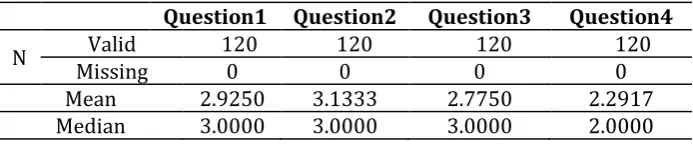
As it was stated earlier, the first research question sought to investigate in what kind of educational setting the English grammar program takes place. To gain enough information for the first research question, the researcher used the questions number One, Two, Three, and Four in the questionnaire for the students’ point of view and the related data to the context of English language teaching are gathered from interviews here. First the answer of the questions 1-4 are brought and their frequencies are calculated through SPSS. The result of frequencies for the so called questions are brought in table 1.
Table 1. Thefrequencies of the first research question
Question1 Question2 Question3 Question4
N Missing Valid 120 0 120 0 120 0 120 0
Mean 2.9250 3.1333 2.7750 2.2917
Median 3.0000 3.0000 3.0000 2.0000
Table 2. The frequency and percentage of the question
Question2
Frequency Percent Percent Valid Cumulative Percent
Valid
0 3 2.5 2.5 2.5
1 11 9.2 9.2 11.7
2 16 13.3 13.3 25.0
3 52 43.3 43.3 68.3
4 38 31.7 31.7 100.0
Total 120 100.0 100.0
This first question was on how much time participants are spending on learning grammar. As the result of the above tables shows the answer “never’ enjoyed a small percentage (2.5%), it indicates that few students are not spending time on grammar. On the other hand, the answers “satisfactory” and “excellent” had more percentage. Accordingly, in the case of time most participants care about grammar and spend time on it.
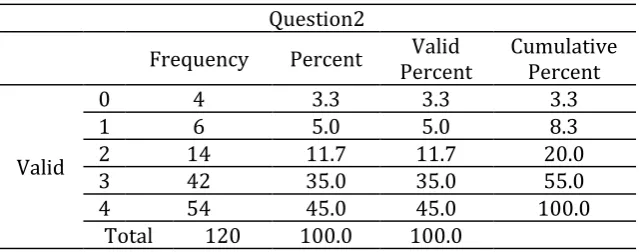
The next question of questionnaire is again the matter of time, but the time which has been allocated to the grammar in the school curriculum, and here the students’’ point of view has been considered. Table 3 shows the frequencies of the answers to this question.
Table 3. The Frequency and Percentage of the Question
Question2
Frequency Percent Percent Valid Cumulative Percent
Valid
0 4 3.3 3.3 3.3
1 6 5.0 5.0 8.3
2 14 11.7 11.7 20.0
3 42 35.0 35.0 55.0
4 54 45.0 45.0 100.0
Total 120 100.0 100.0
As the result shows the smallest percentage is allocated to “never” (3.3%) and the highest percentage to “excellent” (45%). Therefore most of the students are satisfied with the time of grammar teaching in Iranian schools.
The third question is raised to see if the allocated time to grammar is matched to the materials which are used in classes. The following table (4) shows the result of statistical analysis for this question.
Table 4. The Frequency and Percentage of the Question
Question3
Frequency Percent Percent Valid Cumulative Percent
Valid
0 5 4.2 4.2 4.2
1 8 6.7 6.7 10.8
2 27 22.5 22.5 33.3
3 49 40.8 40.8 74.2
4 31 25.8 25.8 100.0
As the table 4 shows, the lowest frequency is for the answer “never” (4.2%), and the highest one is the answer “satisfactory”. It shows that the time of the curriculum and the content of the materials are to some extent matched, but it is not ideal according to the participants’’ answers.
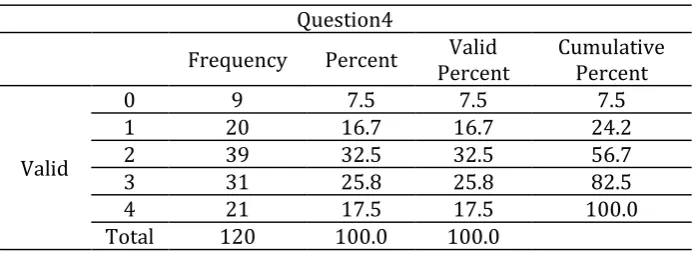
The fourth question of the questionnaire has to do with adding the time of other parts to the grammar. The answers to the fourth question and their frequencies are shown in table 5.
Table 5. The Frequency and Percentage of the Question
Question4
Frequency Percent Percent Valid Cumulative Percent
Valid
0 9 7.5 7.5 7.5
1 20 16.7 16.7 24.2
2 39 32.5 32.5 56.7
3 31 25.8 25.8 82.5
4 21 17.5 17.5 100.0
Total 120 100.0 100.0
As it has been shown in the above table (5), the answer “never” enjoyed the smallest percentage (7.5), and the answer “needs improvement” has the highest percentage. Generally most of the participants do not agree with adding the time of other parts to grammar.
As the result of the frequencies in these four questions shows, from high school students’ point of view, the time of the grammar in curriculum and students’ time for learning it, is well considered, this time also is matched by the material content but it is not fully matched, and finally the is no urgent need to add the time of other parts to grammar.
Also the result of the interview with the teachers showed that, in Iranian high school educational system, students are concerned about their score, so their first aim is to learn each skill for this purpose. And most of the teachers spends one third of their classes on teaching grammar, although, the level of difficulty of the to be taught grammar is also another factor to be considered for the time allocated to the grammar and it can be extended to half of each session. Another problem that has been mentioned during the interviews was that because of grammar’s being difficult, some high school students are memorizing them to learn and it makes it less practical to be used in a task or to use it in their productive skills.
Research question two
Table 6. The Frequencies of the Second Research Question
Question9 Question 10 Question 11 Question 12
N Missing Valid 120 0 120 0 120 0 120 0
Mean 3.1667 3.1750 2.7333 2.7250
Median 3.0000 3.0000 3.0000 3.0000
To analyze the answers to each question, the frequencies for each question will be presented in separated tables. Question Nine was that according to learners’ need how much effective the taught grammatical points are. The detail of answers are shown in table 7.
Table 7. The Frequency and Percentage of the Question
Question9
Frequency Percent Percent Valid Cumulative Percent
Valid
0 3 2.5 2.5 2.5
1 8 6.7 6.7 9.2
2 14 11.7 11.7 20.8
3 36 30.0 30.0 50.8
4 59 49.2 49.2 100.0
Total 120 100.0 100.0
As the results of the frequencies for Question Nine shows, the lowest percentage is for the answer “never” (2.5%) and the highest percentage with near half of the participants answers, is for the answer “excellent” (49%). From these results it can be claimed that the taught grammatical points met learners’ need and they are effective enough for them.
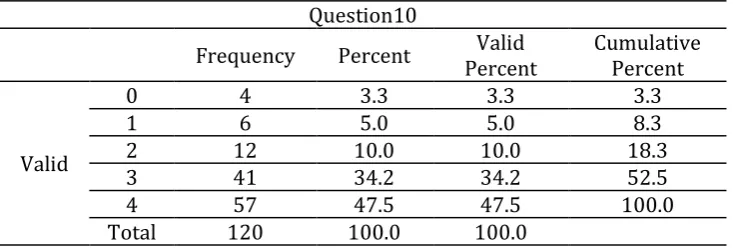
The next question is the tenth one, it is on appropriateness of practices in the learners’ book. The results of statistical analysis of this question brought in table 8.
Table 8. The Frequency and Percentage of the Question
Question10
Frequency Percent Percent Valid Cumulative Percent
Valid
0 4 3.3 3.3 3.3
1 6 5.0 5.0 8.3
2 12 10.0 10.0 18.3
3 41 34.2 34.2 52.5
4 57 47.5 47.5 100.0
Total 120 100.0 100.0
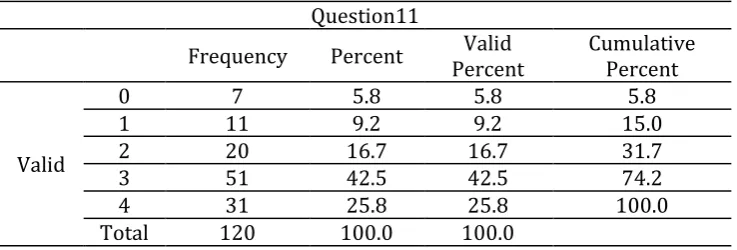
Question Eleven is how much teachers use books to teach grammar, the participants’ answers and the frequency of them are shown in table 9.
Table 9. The Frequency and Percentage of the Question
Question11
Frequency Percent Percent Valid Cumulative Percent
Valid
0 7 5.8 5.8 5.8
1 11 9.2 9.2 15.0
2 20 16.7 16.7 31.7
3 51 42.5 42.5 74.2
4 31 25.8 25.8 100.0
Total 120 100.0 100.0
As it is shown in table 9 the lowest percentage is allocated to the answer “never” (5.8%) and the highest percentage to “satisfactory” (42.5%). Therefore, it can be drawn from the results that teachers usually refer to book to teach grammatical points in the class. And there are a few cases that teachers refer to book to teach grammatical points in the class. And there are a few cases they explain and a point just on their own and their own examples.
The twelfth question is how much helpful are the example of the book to learn grammar; and it is referring again to the book and its usefulness in learning grammatical points. The result of the frequencies for this question’s answers are shown in the following table (10).
Table 10. The Frequency and Percentage of the Question
Question12
Frequency Percent Percent Valid Cumulative Percent
Valid
0 8 6.7 6.7 6.7
1 12 10.0 10.0 16.7
2 18 15.0 15.0 31.7
3 49 40.8 40.8 72.5
4 33 27.5 27.5 100.0
Total 120 100.0 100.0
The results of the above table indicates that the lowest frequency and percentage again is allocated to the answer “never” (6.7%), and the highest one to the answer satisfactory (40.8). The finding of this table give credit to the fact that more than three fifth of Iranian learners at high schools consider the example of their book as useful ones in order to enhance a grammatical point.
than three fifth of participants found the examples of the book helpful to have a better understanding for taught grammars.
Another perspective of the present research was teachers’ ideas; the results and answer of the Iranian teachers’ interview showed that nearly all teachers found example useful to teach grammar and have a better output, half of the interviewees mentioned the fact that the method with which grammar is presented in Iranian high school books is deductive, and the focus of the book is mainly on grammar. Teachers mostly focused on the fact that the method in which book are developed and written should be based on a new method to be more effective on learners’ productive skills.
Research Question Three
The third research question was what the students’ and instructors’ perceptions on teaching methods and assessment dimensions of the grammar program are. The questions Thirteen, Fourteen, Fifteen, Sixteen, Seventeen, and Eighteen of questionnaire are considered to find the learners’ perspectives on grammar and input. These questions frequencies are brought in the following table (11).
Table 11. The frequencies of the third research question
Statistics Question
13 Question 14 Question 15 Question 16 Question 17 Question18
N Missing Valid 120 0 120 0 120 0 120 0 120 0 120 0
Mean 1.5417 3.1417 3.2417 3.2917 3.1667 3.1333
Median 1.0000 3.0000 4.0000 4.0000 3.0000 3.0000
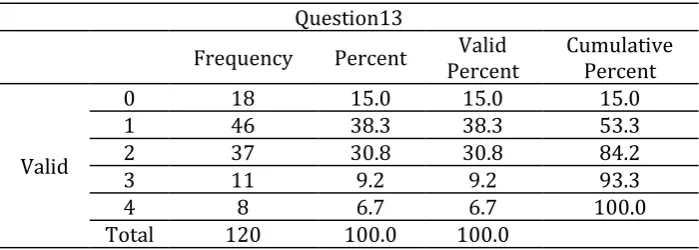
The first step here is the results and frequencies for the thirteenth question it was to what extend your teacher uses new method in teaching grammar. The result of statistical analysis for this question are shown in the following table (12).
Table 12. The frequency and percentage of the question
Question13
Frequency Percent Percent Valid Cumulative Percent
Valid
0 18 15.0 15.0 15.0
1 46 38.3 38.3 53.3
2 37 30.8 30.8 84.2
3 11 9.2 9.2 93.3
4 8 6.7 6.7 100.0
Total 120 100.0 100.0
As it is shown in the results of the answers of the participants to this question. The most frequent answer was “unacceptable” (38.3 percent), and the least is “excellent” (6.7 percent). This can be the indication of the fact that teachers do not use new method enough in teaching grammar.
Table 13. The Frequency and Percentage of the Question
Question14
Frequency Percent Percent Valid Cumulative Percent
Valid
0 3 2.5 2.5 2.5
1 7 5.8 5.8 8.3
2 12 10.0 10.0 18.3
3 46 38.3 38.3 56.7
4 52 43.3 43.3 100.0
Total 120 100.0 100.0
Table 13 has to do with this question that how much new methods of teaching affect their learning grammar. As it is shown here, the highest frequency is for the answer “excellent” (43%), and the lowest percentage belongs to the answer “never” (2.5%). It can be seen that the result of teachers’ new method were sufficient enough for participants to learn grammar better.
The next table shows the statistical analysis for the fifteenth question. Table 14. The Frequency and Percentage of the Question
Question15
Frequency Percent Percent Valid Cumulative Percent
Valid
0 4 3.3 3.3 3.3
1 7 5.8 5.8 9.2
2 13 10.8 10.8 20.0
3 28 23.3 23.3 43.3
4 68 56.7 56.7 100.0
Total 120 100.0 100.0
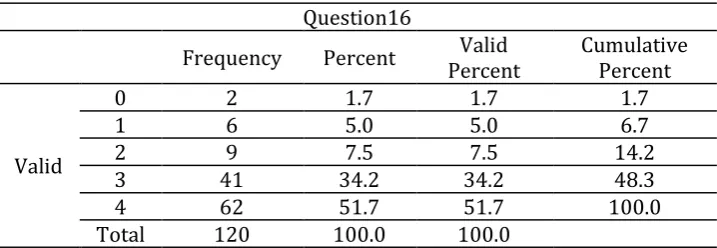
The Question Fifteen was how much old methods affect your learning. The result of the analysis shows that more than half of the participants agree that the old methods were excellent for the (56.7%), and the least are agreed on the negative effect of them on learning grammar (3.3%). Therefore, participants are satisfied by the old methods in learning grammar. The following table shows the frequencies and results for the sixteenth question.
Table 15. The Frequency and Percentage of the Question
Question16
Frequency Percent Percent Valid Cumulative Percent
Valid
0 2 1.7 1.7 1.7
1 6 5.0 5.0 6.7
2 9 7.5 7.5 14.2
3 41 34.2 34.2 48.3
4 62 51.7 51.7 100.0
Total 120 100.0 100.0
show they believe exams are evaluating their grammar the best by having the answer “excellent” (51.7), and the least was the answer “never” (1.7).
The next table shows the results and answers for the Question Seventeen. Table 16. The Frequency and Percentage of the Question
Question17
Frequency Percent Percent Valid Cumulative Percent
Valid
0 5 4.2 4.2 4.2
1 3 2.5 2.5 6.7
2 13 10.8 10.8 17.5
3 45 37.5 37.5 55.0
4 54 45.0 45.0 100.0
Total 120 100.0 100.0
As the table 16 shows, the question Seventeen which was to what extend teachers are evaluating students’ grammar in the class, responded by the choice that most of students were satisfied by it and they had 45 percent answers for “excellent” and 37.5 percent for “satisfactory”. Table 17 shows the next and last question on process and its results (Question18).
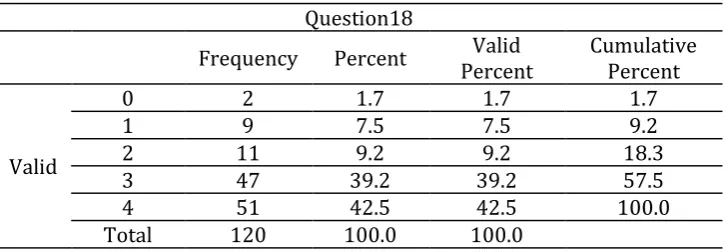
Table 17. The Frequency and Percentage of the Question
Question18
Frequency Percent Percent Valid Cumulative Percent
Valid
0 2 1.7 1.7 1.7
1 9 7.5 7.5 9.2
2 11 9.2 9.2 18.3
3 47 39.2 39.2 57.5
4 51 42.5 42.5 100.0
Total 120 100.0 100.0
The question was how much exams and class evaluations affect their learning. Out of 81.7 percent of participant answered “excellent” (42.5%) and “satisfactory” (39.2%). This can be the result that shows these activities and exams affect students’ grammar enhancement positively.
The result and answer of the teachers to interview questions showed that they all have exams and class evaluations on their list of things to do, their methods basically is based on traditional methods though. And they believe it will be a fact to bring about the external motivation for students to study their grammar.
Research Question Four
Table 18. The Frequencies of the Fourth Research Question
Question
5 Question 6 Question 7 Question 8
N Missing Valid 120 0 120 0 120 0 120 0
Mean 1.5333 1.2583 2.8000 2.7500
Median 2.0000 1.0000 3.0000 3.0000
The following table shows the result of participants’ answers to Question Five. Table 19. The Frequency and Percentage of the Question
Question5
Frequency Percent Percent Valid Cumulative Percent
Valid
0 33 27.5 27.5 27.5
1 22 18.3 18.3 45.8
2 42 35.0 35.0 80.8
3 14 11.7 11.7 92.5
4 9 7.5 7.5 100.0
Total 120 100.0 100.0
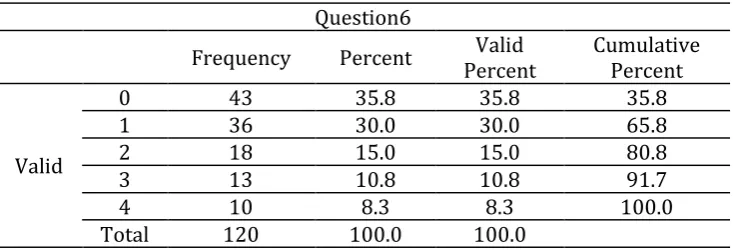
Question Five was how much effective the taught grammatical points are on your listening skill. The result of the answers shows that students listening were not affected by the taught grammar. And this can be seen as the least answers are “excellent” (7.5%) and satisfactory” (11.7%). The next table is the result of the answers for the sixth question of the questionnaire.
Table 20. The Frequency and Percentage of the Question
Question6
Frequency Percent Percent Valid Cumulative Percent
Valid
0 43 35.8 35.8 35.8
1 36 30.0 30.0 65.8
2 18 15.0 15.0 80.8
3 13 10.8 10.8 91.7
4 10 8.3 8.3 100.0
Total 120 100.0 100.0
Table 21. The Frequency and Percentage of the Question
Question7
Frequency Percent Percent Valid Cumulative Percent
Valid
0 6 5.0 5.0 5.0
1 12 10.0 10.0 15.0
2 24 20.0 20.0 35.0
3 36 30.0 30.0 65.0
4 42 35.0 35.0 100.0
Total 120 100.0 100.0
Seventh question was how much effective the taught grammatical points are on your writing skill. The result shows that the most frequent answers are those which shows positive affect teaching method of grammar on writing skill, 35 percent answered “excellent” and 30 percent “satisfactory”. The last table is showing the eighth question answers and results
Table 22. The Frequency and Percentage of the Question
Question8
Frequency Percent Percent Valid Cumulative Percent
Valid
0 5 4.2 4.2 4.2
1 14 11.7 11.7 15.8
2 30 25.0 25.0 40.8
3 28 23.3 23.3 64.2
4 43 35.8 35.8 100.0
Total 120 100.0 100.0
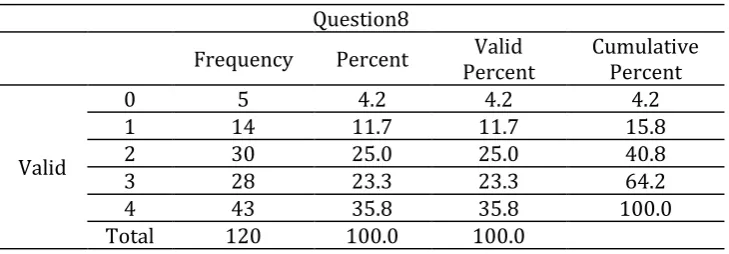
This question was how much effective the taught grammatical points are on students’ reading skill. The results indicate that the taught grammar had a fairly positive effect on reading. The most frequent answer was “excellent” (35.8%), and the least is “never”. The other aspect for the answer of this question is teachers’ perspective. The result of collected data from teachers shows that their idea about taught grammar is a lot close to majority of students; it means they said the taught grammar in the classes were more useful for writing and then reading and had the least effect on listening and speaking.
CONCLUSION
The main purpose of this study was to evaluate the effectiveness of high school grammar program through the perspective of students and instructors. According to the results and above-mentioned analysis of that, it can be concluded that the time allocated to grammar curriculum is not fully matched by the material content. So the educational setting in which grammar program take place is no ideal for both students and instructors. In order to overcome this, more frequent curriculum schedule could be organized and more match to content of text books and difficulty level of lessons is needed.
and high school textbooks is deductive methods. Because of this, students memorize grammatical rules more with no practical usage, in most cases because of Iranian high schools educational system, students concern about scores rather than learning grammar effectively to be used in productive skills. In order to increase the competencies in practical usage, specially in productive skills, it could be more motivated teachers for learning new methods of teaching grammar, so teaching students to learn grammatical points more practical can have positive effect on four basic skills.
REFERENCES
Airasian, P. W., & Walsh, M. E. (1997). Cautions for classroom constructivists Education
Digest, 62 (8), 62-69. Retrieved September 26, 2009, from EBSCOHOST database.
Akar, H. (2009). Foreign language teacher education: The Polish case. The New Educational Review, 17(1), 185-211.
Ankara University. (2009). School of foreign languages, Retrieved September 10, 2009, fromhttp://www.yabdil.ankara.edu.tr.
Atai, M.R., & Mazlum, F. (2013). English language teaching curriculum in Iran: Planning and practice. The Curriculum Journal, 24(3), 389-411
Baker, C. (1988). Key issues in bilingualism and bilingual education. Clevedon: Multilingual Matters.
Best, J.W., & Kahn, J.V. (2003). Research in education (9th ed.). Boston, MA: Pearson Education Company.
Birjandi, P., Soheili, A. Norouzi, M., & Mahmoodi, G. (1994). English Book 1. Tehran: Iran's School Book Publishers
Birkmaier, E. M. (1973). Research on teaching foreign languages. Chicago: Rand- McNally.
Bobbitt, F. (1923). The curriculum. New York: Macmillan.
Bowman, B. (1989). Teaching English as a foreign or second language. Washington DC: Peace Corps.
Brown, H. D. (2001). Teaching by principles: An interactive approach to language
pedagogy (second edition). New York: Longman.
Cabatoff, K. (1996). Getting on and off the policy agenda: A dualistic theory of program evaluation utilization. The Canadian Journal of Program Evaluation, 11(2), 35-60. Carroll, J.B. (1962). The prediction of sources in intensive foreign language training.
Pittsburgh: University of Pittsburgh Press.
Cooper, R.L. (1989). Language planning and social change. New York: Cambridge University Press.
Dahmardeh, M. (2009). Communicative textbooks: English Language textbooks in Iranian secondary school. Linguistik Online, 40(4), 45-61
Dörnyei, Z. (2003). Questionnaires in second language research: Construction,
administration and processing. Manwah, NJ: Lawrence Erlbaum Associates, Inc.
Erdem, H. E. (1999). Evaluating the English language curriculum at a private school in Ankara: A case study. Unpublished doctoral dissertation, Middle East Technical University, Ankara.
Erdoğan, V. (2005). An evaluation of the English curriculum implemented at the 4th and 5th grade primary state schools: The views of the teachers and the students. Unpublished master’s thesis, Mersin University, Mersin.
Field, A. P. (2005). Discovering statistics using SPSS (2nd ed.). London: Sage.
Fitz-Gibbon, C.T., & Morris, L.L. (1987). How to design a program evaluation. LA: Sage Publications, Inc.
Flowerdew, J., & Peacock, M. (2001). (Eds.). Research perspectives on English for academic purposes, Cambridge: CUP.
Fraenkel, R., & Wallen, N. E. (1990). How to design and evaluate research in education. New York: McGraw-Hill.
Frechtling, J. A. (2007). Logic modeling methods in program evaluation. San Francisco: Jossey-Bass.
Gagné, R. (1987). Curriculum research and the promotion of learning: Perspectives of curriculum evaluation. Chicago: Rand McNally.
Gerede, D. (2005). A curriculum evaluation through needs analysis: Perceptions of intensive Englishprogram graduates at Anadolu University. Unpublished master’s thesis, Anadolu University, Eskisehir.
Ghorbani, M.R. (2009). ELT in Iranian high schools in Iran, Malaysia and Japan. Reflections on English Language Teaching, 8(2), 131-139
Gredler, M. E. (1996). Program evaluation. NJ: Prentice Hall
Grittner, F.M. (1969). Teaching foreign languages. New York: Harper and Row, Publishers.
Henson, K. T. (2006). Curriculum planning integrating multiculturalism, constructivism and education reform. Boston: Mcgraw Hill.
Jawarska, E. and Porte, G. (2007). Forty years of language teaching. London: Cambridge University Press.
Khedir Sharabian, Sh., Kheierabadi, R., Alavi Moghaddam, S. Behnam, Anani Sarab, M. R., Forouzandeh Shahraki, E., & Ghorbani, N. (2013). English for Schools: Prospect 1. Tehran: Iran's School Book Publishers.
Kelly, A.V. (1999). The curriculum: Theory and practice. London: Paul Chapman.
Lawes, S. (2000). Why learn a foreign language. In Field, Kit. (Ed.). Issues in foreign language teaching. (pp. 41-55). London: Rutledge/Falmer.
Lynch, B.K. (1996). Language program evaluation: Theory and practice. Cambridge: Cambridge University Press.
Meshkat, M., & Saeb, F. (2013). High school students' beliefs about language learning. ROSHD ELT, 28(1), 50-55.
Ornstein, Allan C., & Hunkins Francis P. (2004).Curriculum: Foundations, principles and issues. Englawood Cliffs, NJ, Prentice Hall.
Payne, A. (1994). Designing educational project and program evaluations. London: Norwell.
Pekiner, G. (2006). Evaluation of the science and technology curriculum at grade level 4 and 5: Pilot study. Unpublished master’s thesis, Middle East Technical University, Ankara.
Pryor, J., & Torrance, H. (1996) Teacher-pupil interaction in formative assessment: assessing the work or protecting the child. The Curriculum Journal, 7.
Rossi, P. H., & Freeman, H. E. (1999). Evaluation. California: Sage.
Saylor, G. J. Alexander, W. M., Lewis, A. J. (1981). Curriculum planning for better teaching and learning, New York: Holt, Rinehart and Winston.
Stufflebeam, D. L. (1983). The CIPP model for program evaluation. Boston: Kluwer- Nijhoff.
Stufflebeam, D. L., & Shinkfield, A. J. (1985). Systematic evaluation. Boston: Kluwe-Nijhoff.
Stufflebeam, D.L. (2000). The CIPP model for evaluation. In T.Kellaghan and D.L Stufflebeam (Eds). International handbook of educational evaluation, Part 1 (pp.31-62). Dordrecht: Kluwer Academic Publishers.
Taba, H. (1962). Curriculum: Theory and practice. New York: Harcourt, Brace. Talmage, H. (1982). Evaluation of programs. New York: Free Press.
Tanner, D., & Tanner, L. N. (1980) Curriculum development: Theory into practice. New York: Macmillan.
Thompson, G. (1996). Some misconceptions about communicative language teaching. ELT Journal,50(1), 9-15.
Tyler, R.W. (1949). Basic principles of curriculum and instruction. Chicago: The University of Chicago Press.
Weir, C., & Roberts, J. (1994), Evaluation in ELT. Oxford: Blackwell Publishers.
Weston, C., McAlpine, L., & Bordonaro, T. (1995). A model for understanding formative evaluation in instructional design. Educational Technology Research and Development, 43(3), 29-46.
Wiles, J., & Bondi, J (1985). Curriculum development: A guide to practice (7th ed.), Upper Saddle River, NJ: Prentice Hall.
Worthen R., & Sanders, R. (1998). Educational evaluation: Alternative approaches and practical guidelines. New York: Longman.