R E S E A R C H A R T I C L E
Open Access
Global collaborative networks on meta-analyses of
randomized trials published in high impact factor
medical journals: a social network analysis
Ferrán Catalá-López
1,2*, Adolfo Alonso-Arroyo
3,4, Brian Hutton
5, Rafael Aleixandre-Benavent
3and David Moher
5Abstract
Background:Research collaboration contributes to the advancement of knowledge by exploiting the results of scientific efforts more efficiently, but the global patterns of collaboration on meta-analysis are unknown. The purpose of this research was to describe and characterize the global collaborative patterns in meta-analyses of randomized trials published in high impact factor medical journals over the past three decades.
Methods:This was a cross-sectional, social network analysis. We searched PubMed for relevant meta-analyses of randomized trials published up to December 2012. We selected meta-analyses (including at least randomized trials as primary evidence source) published in the top seven high impact factor general medical journals (according to Journal Citation Reports 2011):The New England Journal of Medicine,The Lancet, theBMJ,JAMA,Annals of Internal Medicine,
Archives of Internal Medicine(now renamedJAMA Internal Medicine), andPLoS Medicine. Opinion articles, conceptual papers, narrative reviews, reviews without meta-analysis, reviews of reviews, and other study designs were excluded.
Results:Overall, we included 736 meta-analyses, in which 3,178 authors, 891 institutions, and 51 countries participated. TheBMJwas the journal that published the greatest number of articles (39%), followed byThe Lancet(18%),JAMA
(15%) and theArchives of Internal Medicine(15%). The USA, the UK, and Canada headed the absolute global productivity ranking in number of papers. The 64 authors and the 39 institutions with the highest publication rates were identified. We also found 82 clusters of authors (one group with 55 members and one group with 54 members) and 19 clusters of institutions (one major group with 76 members). The most prolific authors were mainly affiliated with the University of Oxford (UK), McMaster University (Canada), and the University of Bern (Switzerland).
Conclusions:Our analysis identified networks of authors, institutions and countries publishing meta-analyses of randomized trials in high impact medical journals. This valuable information may be used to strengthen scientific capacity for collaboration and to help to promote a global agenda for future research of excellence.
Keywords:Authorship, Evidence-based medicine, Meta-analysis, Randomized controlled trial, Scientific collaboration, Social network analysis
Background
The past decades have seen the establishment of evidence synthesis, particularly systematic reviews and meta-analyses, as a key component of evidence based medicine (EBM) [1,2]. Meta-analyses of randomized trials have become more widely accepted by clinicians, researchers and policy makers as a useful tool to critically assess the totality of
evidence in a research question. When performed well and reported completely, incorporating explicit and detailed methods and results, such studies produce information that can have undoubtedly major, immediate effects on medical practice, research agendas and the establishment of healthcare policies.
Important milestones that may have encouraged research in this field, from the point of view of scientific publications and institutional development of EBM [1-4], include the creation of international research groups, centers, and con-sortia (such as the Centre for Evidence Based Medicine and * Correspondence:[email protected]
1Division of Pharmacoepidemiology and Pharmacovigilance, Spanish
Medicines and Healthcare Products Agency (AEMPS), Madrid, Spain 2Fundación Instituto de Investigación en Servicios de Salud, Valencia, Spain
Full list of author information is available at the end of the article
The Cochrane Collaboration in the 1990s) in addition to groups developing reporting guidelines to ensure arti-cles contain all essential information, such as QUOROM (Quality of Reporting of Meta-analyses) [5] and, more re-cently, PRISMA (Preferred Reporting Items for Systematic Reviews and Meta-Analyses) [6].
Global health challenges require research collaboration and multi-lateral programs on a global scale, owing to the nature and magnitude of the public health problems. Noteworthy examples include major environmental, polit-ical, and social determinants of health, as well as complex and changing clinical issues related to the conditions and risk factors that cause the highest burden of disease around the world [7-9]. Despite continuous efforts of individual scientists and institutions to remedy deficiencies in health-care effectiveness and safety, multiple gaps and disparities remain. Research collaboration contributes to the advance-ment of knowledge by exploiting the results of scientific efforts more efficiently, but the global patterns of collabor-ation on analysis are unknown. Given that meta-analyses can provide high-quality clinical evidence regarding the robustness of the effects of healthcare interventions to inform medical practice, there is an urgent need to evaluate and promote scientific activity and growth in the field of EBM [4,10-12].
Social network analysis [13], the study of structure derived from the regularities in the patterning of relation-ships between social entities (which might be people or organizations), is grounded in the assessment of empirical data, and can provide an appropriate approach to identify top scientists and researchers, groups of excellence, and leading institutions. It also offers information to assess the citation patterns among papers within a specialty [14], to identify gaps in the evidence from scientific re-search [15], and to understand the structure and nature of relationships and interactions within a scientific community that collaborate to better achieve common or compatible goals [13,16].
This study aimed to describe and characterize global collaborative patterns with regard to the conduct of meta-analyses of randomized trials published over the past three decades in high impact factor medical journals, by applying techniques from social network analysis.
Methods
Design and sample
In December 2012, we searched for reports of meta-analyses of randomized trials that were indexed in PubMed and published in one of the top seven high impact general medical journals, as identified in 2011, based on an impact factor of at least 10 (subject categories‘Medicine, General & Internal’ of Journal Citation Reports, Thomson Reuters):
The New England Journal of Medicine(NEJM),The Lancet, the British Medical Journal (BMJ), the Journal of the
American Medical Association (JAMA), Annals of Internal Medicine, Archives of Internal Medicine (now renamed
JAMA Internal Medicine) andPLoS Medicine. Specifically, the following terms were used for PubMed: (‘meta-analy-sis’[Publication Type] OR‘meta-analysis as topic’[MeSH Terms] OR‘meta-analysis’[All Fields]) AND (‘randomized controlled trial’[Publication Type] OR ‘randomized con-trolled trials as topic’[MeSH Terms] OR‘randomized con-trolled trial’[All Fields]) AND (‘Lancet’[Journal] OR‘N Engl J Med’[Journal] OR‘JAMA’[Journal] OR‘Br Med J’[Journal] OR‘Br Med J (Clin Res Ed)’[Journal] OR‘BMJ’[Journal] OR ‘PLoS Med’[Journal] OR ‘Ann Intern Med’[Journal] OR ‘Arch Intern Med’[Journal]) AND (hasabstract[text] AND ‘humans’[MeSH Terms]). We also performed complemen-tary hand-searches and reviewed references of identified eligible reports to identify additional meta-analyses.
We included two types of articles from the eligible journals: original research reports and reviews (both in-corporating meta-analyses of randomized trials). Editorials, commentaries, and other opinion articles were excluded. We also excluded conceptual papers, literature (narrative) reviews, reviews of reviews, meta-analysis of observational studies not considering randomized trials, single random-ized trials, and other study designs (such as cost-effective-ness analyses and epidemiological studies).
For the purposes of this study, we selected all articles published in English and indexed in PubMed between January 1985 and December 2012. One researcher with expertise in evidence synthesis (FC-L) screened the titles and abstracts, and identified all potentially eligible articles. The same researcher excluded the articles not meeting the pre-specified criteria.
Data extraction
In the case of institutions, we unified the different variants to match the name recorded in public directories of insti-tutions. Similarly, given that institutional names in many records included two or more institutions (for example, university hospitals, research centers and academic institu-tions), we proceeded to distinguish between these names by recording all variations of any individual macroinstitution as could be identified for each bibliographic record (for ex-ample, for the institutional address‘Reproductive Medicine Unit, Department of Obstetrics & Gynaecology, University of Adelaide, Queen Elizabeth Hospital, Australia’, the standardization approach was to present‘University of Adelaide, Australia’ separately from ‘Queen Elizabeth Hospital, Australia’). With all this information, we con-structed a Microsoft Access database.
Data analysis
In this paper, we use the term‘co-authorship’to refer to joint authorship of a scientific paper by at least two indi-viduals, and the term‘institutional collaboration’to refer to joint authorship by different institutions.‘Intensity of collaboration or threshold’refers to the number used to form clusters of authors and institutions (that is, the fre-quency of co-authorship between pairs of authors or of collaboration between institutions), and reflects a criterion to label identifiable clusters as research groups. Collabor-ation between authors (or institutions) was portrayed by calculating the number of papers, names, signatures and collaborations, the index of signatures per paper or collab-oration index (which is the mean number of signatures per paper), and the index of authors per paper (mean number of authors per paper, considering only the different authors). A summary box with definitions of each of the measurements of collaboration is provided in the supplementary material (see Additional file 1:‘Definitions of collaborative measurements’).
To construct co-authorship networks, we identified all combinations of pairs of authors for each paper. The number of co-authorships for each paper is related to the number of authors as is equal to
m! m−n ð Þ!n!;
where mis the number of individual authors and nthe number of elements in the groups constructed. Once co-authorship was quantified, we further established an
a posteriori threshold of two or more collaborations be-tween pairs of authors, in order to reduce the number of nodes and links that would prevent a clear view of the network, and thus center the analysis on the more intense co-authorship relationships. The same approach was ap-plied to institutional and country authorship to construct the network of collaborations, although in this case, we
applied ana posteriorithreshold of three or more papers signed in co-authorship. The productivity and patterns of collaboration by author, institution and country were analyzed.
We used PAJEK [17], a software package for large network analysis that is free for non-commercial use, to analyze indicators and construct social networks.
Results
Number of meta-analyses
The PubMed search generated 804 records. Following screening of abstracts and full text articles, 724 publications were retained, and 12 additional publications were added from complementary searches of reference lists, thereby yielding a final sample of 736 included meta-analyses. The process of study selection is presented in Figure 1.
General characteristics of the sample
TheBMJpublished the largest number of articles (n = 289; 39%), followed by The Lancet(n = 132; 18%), JAMA(n = 113; 15%) and theArchives of Internal Medicine(n = 112; 15%). Overall, 736 meta-analyses received 130,644 citations, of which 37,930 citations (29%) corresponded toBMJ, 34 911(27%) toThe Lancet and 25,273 (19%) to JAMA. The number of publications increased exponentially over the study period (Table 1). Approximately three-quarters of the meta-analyses were reported during the most recent decade.
The included meta-analyses had a median of 5 authors, although 41 (6%) were single authored (Table 1). More than a quarter (214 [29%]) of the first authors were from the USA, with three countries (the USA, the UK and Canada) accounting for more than two-thirds of the meta-analyses published during the period of analysis (Table 1).
Production and collaboration patterns
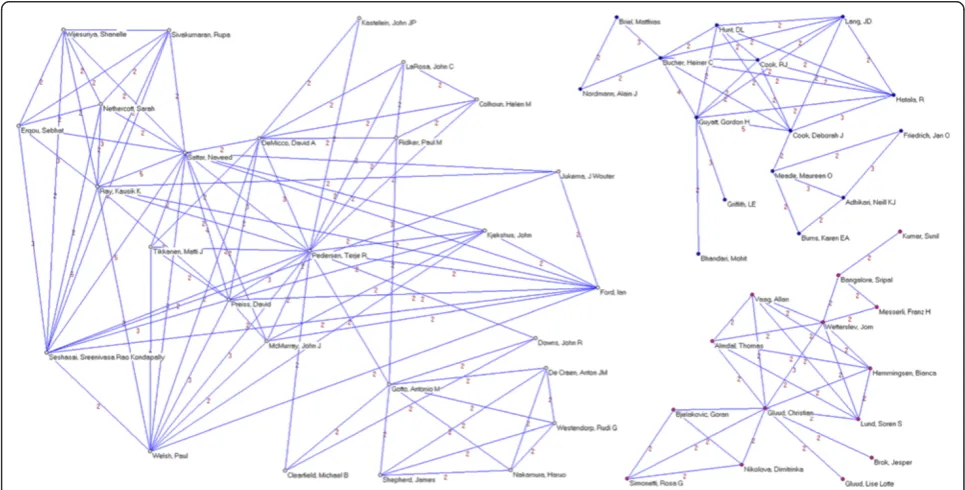
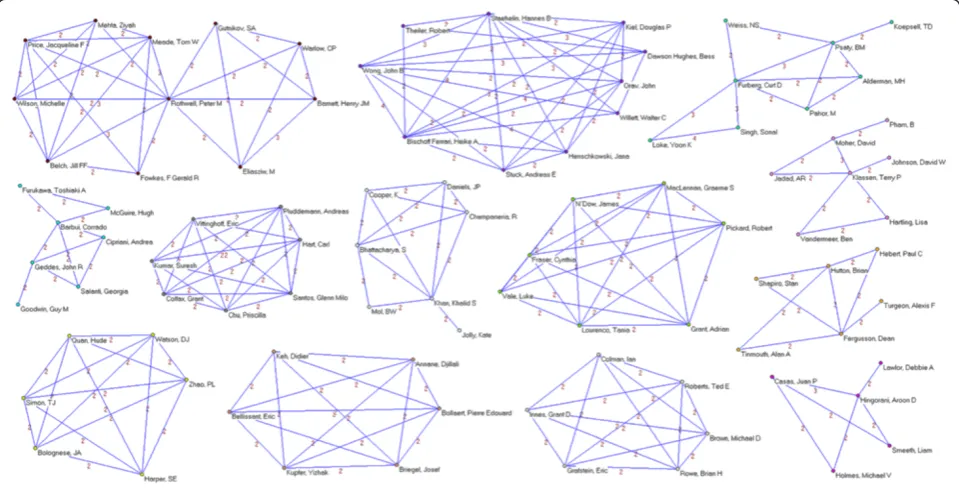
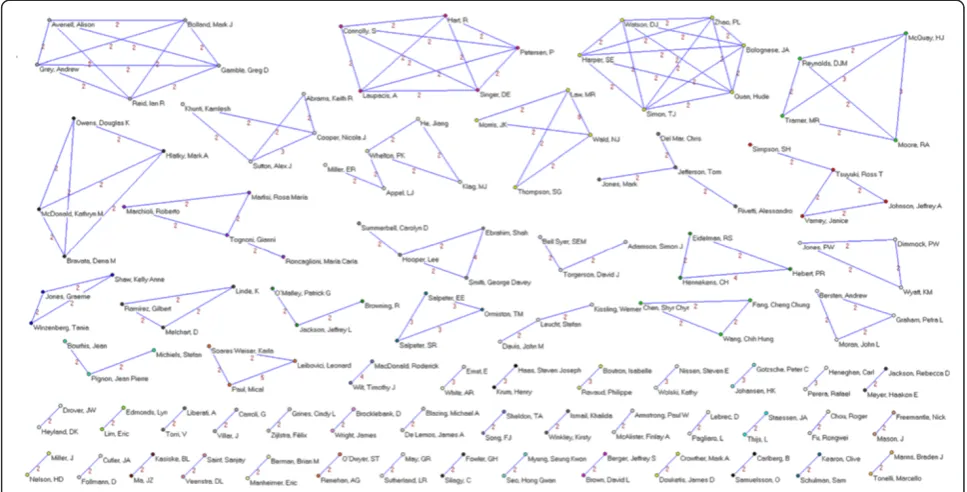
Overall, 3,178 authors, 891 institutions and 51 countries worldwide were involved in the sample of articles. We identified 64 authors who published 5 or more papers (Table 2). The most prolific authors were Lau (15 papers), Guyatt (14), Peto (13), Yusuf (12), Cook (11) and Jüni (11). Many of the most prolific authors are affiliated with only a few academic institutions and/or medical centers; six are affiliated with the University of Oxford (Peto, Collins, Clarke, Baigent, Gray and Rothwell), five are affiliated with McMaster University (Guyatt, Yusuf, Cook, Douketis, and Eikelboom) and five are affiliated with the University of Bern and/or the Inselspital – Bern University Hospital (Jüni, Trelle, Egger, Reichenbach and Nüesch). Apply-ing a threshold of 2 or more papers published as co-authors (Figures 2, 3, 4, 5, 6, 7), we identified 82 clusters of authors. Of these, 12 were identified as major co-authorship groups (1 with 55 members, 1 with 54 mem-bers, 1 with 27 memmem-bers, 1 with 15, 4 with 14 memmem-bers, 3 with 11 members, 1 with 10 members, 1 with 8 mem-bers, 5 with 7 memmem-bers, 5 with 6 members and 3 with 5 members).
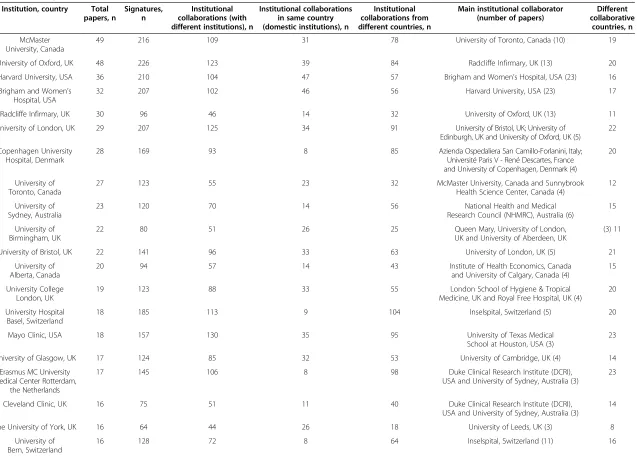
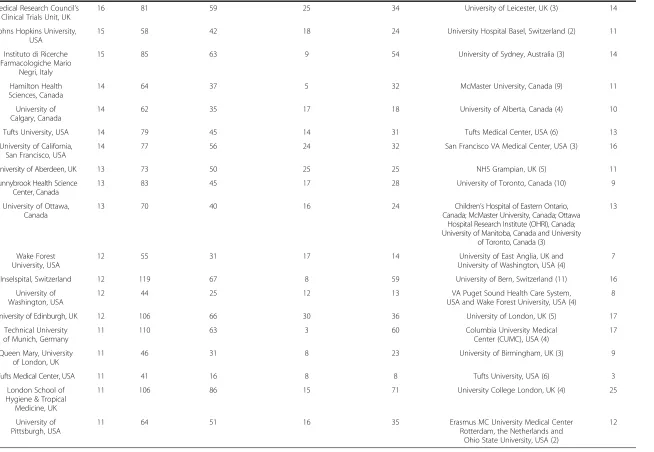
Institutional productivity was headed by McMaster University (49 papers), University of Oxford (48 papers) and Harvard University (36 papers) (Table 3). Next came some of their affiliated hospitals or medical centers (Brigham and Women’s Hospital and the Radcliffe In-firmary, with 32 and 30, respectively). Applying a col-laboration threshold of at least 3 papers signed with inter-institutional collaboration, we identified 19 clusters comprising a total of 120 institutions (Figures 8 and 9). Of these, the most important institutional cluster comprised 76 members.
The productivity ranking for countries with respect to the number of papers (Table 4) was headed by the USA (310 papers), the UK (297 papers) and Canada (143 papers). After these countries came Australia (70 papers), and Italy and the Netherlands (57 papers each). The USA and the UK also headed the list of the number of different countries with which they had collaborated, as well as the total number of collaborations. Figure 10 shows a visual repre-sentation of the collaborative network between countries, in which we can see the relationships of some with respect to others and the position that each occupies in the network as a whole.
The 75 most cited articles by number of citations are listed in the supplementary material (see Additional file 2: ‘List of most cited analyses’). Heavily cited meta-analyses include randomized trials examining the health effects of pharmacological interventions in cardiology and oncology (for example, antithrombotic trials, anti-platelet trials, antihypertensive trials, lipid-lowering trials, chemo-therapy for diverse cancers such as breast cancer, lung cancer, or head and neck cancers).
Table 1 General characteristics of the sample of study
Characteristic Number (%)
Total number of articles 736 (100)
Articles per journala
BMJ 289 (39.3)
The Lancet 132 (17.9)
JAMA 113 (15.3)
Arch Intern Med 112 (15.2)
Ann Intern Med 70 (9.5)
New Engl J Med 13 (1.8)
PLoS Med 7 (0.9)
Citations per journalb
BMJ 37,930 (29.0)
The Lancet 34,911 (26.7)
JAMA 25,273 (19.3)
Ann Intern Med 13,381 (10.2)
Arch Intern Med 11,945 (9.1)
New Engl J Med 6,992 (5.3)
PLoS Med 212 (0.1)
Articles per period of publication
1985 to 1989 3 (0.4)
1990 to 1994 53 (7.2)
1995 to 1999 140 (19.0)
2000 to 2004 166 (22.6)
2005 to 2009 231 (31.4)
2010 to 2012 143 (19.4)
Country of publication (first author)c
USA 214 (29.1)
UK 207 (28.1)
Canada 94 (12.8)
Australia 36 (4.9)
Switzerland 26 (3.5)
France 26 (3.5)
Denmark 20 (2.7)
Italy 20 (2.7)
Number of authors per paper
1 41 (5.6)
2 to 3 166 (22.5)
4 to 6 297 (40.3)
> 7 232 (31.5)
a
PLOS Medicine has been published weekly online since 19 October 2004. b
Information refers to the total citations received by all the papers published in a given journal (for example, 289 papers published in BMJ received a total of 37,930 citations).
c
Table 2 Ranking of most prolific authors (five or more papers) and their collaborative patterns
Author Primary affiliation at the time of publication
Year of first eligible paper
Total papers, n
Signatures, n Collaborations, n Main collaborators (number of papers)
Lau, Joseph Brown University, USAa 1992 15 90 54 Chalmers TC and Ioannidis
JPA (5)
Guyatt, Gordon H McMaster University, Canada
1996 14 104 76 Cook DJ (5)
Peto, Richard University of Oxford, UK 1991 13 124 75 Collins R (8)
Yusuf, Salim McMaster University,
Canada
1989 12 83 54 Collins R, Eikelboom JW, Mehta
SR and Pogue J (3)
Cook, Deborah J McMaster University, Canada
1995 11 71 49 Guyatt GH (5)
Jüni, Peter University of Bern,
Switzerland
1996 11 124 59 Reichenbach S (8)
Collins, Rory University of Oxford, UK 1991 9 78 45 Peto R (8)
Trelle, Sven University of Bern,
Switzerland
2007 9 103 67 Jüni P and Reichenbach S (7)
Bucher, Heiner C University Hospital Basel, Switzerland
1996 8 60 41 Guyatt GH (4)
Egger, Mathias University of Bern, Switzerland
2001 8 65 49 Jüni P, Reichenbach S and
Trelle S (3)
Gluud, Christian Copenhagen University Hospital, Denmark
2001 8 40 21 Wetterslev J (3)
Gøtzsche, Peter C The Nordic Cochrane Centre, Denmark
1995 8 27 17 Johansen HK (3)
Jackson, Jeffrey L Zablocki VA Medical Center, USA
1997 8 33 23 Browning R and O’Malley
Patrick G (2)
Law, Malcolm R Queen Mary University
of London, UK
1991 8 24 7 Wald NJ (8)
Reichenbach, Stephan University of Bern, Switzerland
2004 8 81 44 Jüni P (8)
Sutton, Alex J University of Leicester, UK 2003 8 40 28 Cooper NJ (3)
Suttorp, Maarten J St Antonius Hospital, the Netherlands
2003 8 120 61 Maglione M, Mojica WA, Morton
SC and Shekelle PG (5)
Wald, Nicholas J Queen Mary University of London, UK
1991 8 24 7 Law MR (8)
Clarke, Michael University of Oxford, UK 1994 7 83 67 Peto R (4)
Furberg, Curt D Wake Forest University School of Medicine, USA
1989 7 36 20 Loke YK, Psaty BM and
Singh S (3)
Baigent, Colin University of Oxford, UK 1996 6 50 26 Collins R and Peto R (5)
Boersma, Eric Erasmus Medical Center,
the Netherlands
2001 6 74 63 Califf RM, Serruys P, Simes J,
Simoons ML and Topol EJ (2)
Boissel, Jean-Pierre Université Claude Bernard Lyon 1, France
1992 6 42 26 Fagard RH and Gueyffier F (3)
Chalmers, Thomas C Tufts Medical Center, Tufts University, USA
1990 6 31 16 Lau J (5)
Douketis, James D McMaster University, Canada
2000 6 32 25 Crowther MA (2)
Ebrahim, Shah London School of
Hygiene and Tropical Medicine, UK
1997 6 70 60 Smith GD (4)
Ioannidis, John PA Stanford University, USA 1995 6 32 17 Lau J (5)
Khan, Khalid S Queen Mary University
of London, UK
1996 6 39 27 Bhattacharya S, Champaneria R,
Table 2 Ranking of most prolific authors (five or more papers) and their collaborative patterns(Continued)
Klassen, Terry P University of Manitoba, Canada
1996 6 48 36 Moher D (3)
Loke, Yoon K University of East Anglia, UK
2000 6 18 7 Singh S (4)
McAlister, Finlay A University of Alberta, Canada
2001 6 30 23 Armstrong PW (2)
Moher, David Ottawa Hospital Research
Institute, Canada
1996 6 52 42 Klassen TP (3)
Roberts, Ian London School of
Hygiene and Tropical Medicine, UK
1996 6 18 12 All co-authorship (1)
Sattar, Naveed University of Glasgow, UK
2009 6 91 58 Ray KK and Seshasai SRK (5)
Shekelle, Paul G Rand Corporation, USA 2003 6 57 29 Maglione M, Mojica WA, Morton
SC and Suttorp MJ (5)
Stone, Gregg W Columbia University
Medical Center, USA
2005 6 120 77 Leon MB (4)
Tognoni, Gianni Consorzio Mario Negri Sud, Italy
1993 6 78 69 Marchioli R, Marfisi RM and
Roncaglioni MC (2)
Topol, Eric J Scripps Translational Science Institute, USA
1991 6 44 33 Boersma E, Califf RM, Simoons
ML, Tcheng JE and Van de Werf F (2)
Bischoff Ferrari, Heike A University Hospital Zurich, Switzerland
2004 5 48 26 Dawson Hughes B, Staehelin
HB, Willett WC and Wong JB (4)
Briel, Matthias University Hospital Basel, Switzerland
2006 5 51 43 Bucher HC (3)
Eikelboom, John W McMaster University, Canada
2000 5 19 10 Yusuf S (3)
Ernst, Edzard University of Exeter, UK 1995 5 18 11 White AR (3)
Fagard, Robert H University of Leuven, Belgium
1997 5 51 36 Boissel JP and Gueyffier F (3)
Fergusson, Dean Ottawa Hospital Research Institute, Canada
1998 5 33 22 Hutton B (3)
Glasziou, Paul Bond University, Australia 1993 5 26 21 All co-authorship (1)
Godwin, Jon Glasgow Caledonian
University, UK
1995 5 52 38 Peto R (4)
Gray, Richard University of Oxford, UK 2001 5 48 36 Clarke M and Peto R (3)
Hennekens, Charles H Florida Atlantic University, USA
1995 5 28 19 Hebert, PR (4)
Leibovici, Leonard Rabin Medical Center, Israel
2003 5 22 12 Paul M (5)
Maglione, Margaret Rand Corporation, USA 2003 5 49 22 Mojica WA, Morton SC, Shekelle
PG and Suttorp MJ (5)
Mojica, Walter A Rand Corporation, USA 2003 5 49 22 Maglione M, Morton SC, Shekelle
PG, and Suttorp MJ (5)
Morton, Sally C University of Pittsburgh, USA
2003 5 49 22 Maglione M, Mojica WA, Shekelle
PG and Suttorp MJ (5)
Nüesch, Eveline University of Bern, Switzerland
2009 5 35 16 Jüni P (5)
Paul, Mical Rabin Medical Center,
Beilinson Hospital, Israel
2003 5 22 12 Leibovici L (5)
Pignon, Jean-Pierre Institut Gustave-Roussy, France
Discussion
Generally, the visibility and recognition of scientific re-search activities benefits from increasing collaborative research [18]. Research collaboration plays an important role in science, policy and medicine [19,20]. Research collaboration in the ‘Big Science’ era involves addressing
important and relevant research questions that require a complex construction of multi-disciplinary teams of scien-tists and researchers, large-scale scientific structures, bud-gets of an unprecedented scale, and widespread sharing of scientific knowledge and data. Thus, meta-analysis can be considered a good example of ‘Big Science’ in medicine
Table 2 Ranking of most prolific authors (five or more papers) and their collaborative patterns(Continued)
Pocock, Stuart J London School of Hygiene and Tropical Medicine, UK
1995 5 67 54 Boissel JP, Boutitie F, Fagard RH,
Gueyffier F, Hamm CW, Hueb WA, King SB and Rodríguez A (2)
Ray, Kausik K St George’s University of London, UK
2009 5 73 49 Saltar N and Seshasai SRK (5)
Rothwell, Peter M University of Oxford, UK 2003 5 36 19 Belch JFF and Meade TW (3)
Seshasai, Sreenivasa RK University of Cambridge, UK
2009 5 73 49 Ray KK and SN (5)
Simes, John National Health and
Medical Research Council Clinical Trials Centre, Australia
2002 5 53 36 Baigent C, Blackwell L, Collins R,
Keech A and Peto R (3)
Smith, George Davey University of Bristol, UK 1993 5 63 54 Ebrahim S (4)
Torgerson, David J University of York, UK 1999 5 46 39 Adamson SJ and Bell Syer
SEM (2)
Wetterslev, Jorn Copenhagen University Hospital, Denmark
2007 5 28 15 Gluud C (3)
Wilt, Timothy J Minneapolis VA Center for Chronic Disease Outcomes Research, USA
1998 5 40 32 MacDonald R (4)
a
Joseph Lau was based at Tufts University Medical Center in Boston (USA) until 2012, and the institutional networks represent this fact.
and clinical epidemiology [21], as quantitative evidence synthesis is the application, in practice, of the principle that science is cumulative [22,23]. An obvious manifest-ation of this is the observed trend of 75 new randomized trials and 11 new systematic reviews being published daily, with a plateau in this growth not yet reached [24].
Therefore, promoting research collaboration in evidence synthesis is able to strengthen research activity, productiv-ity and impact.
In general, we found a strong clustering of papers published in two British journals (BMJandThe Lancet
accounted for 57% of meta-analyses), in contrast to other Figure 3Co-authorship networks.Second most productive cluster of authors, applying a threshold of two or more papers signed in co-authorship.
general medical journals (for example, the NEJM repre-sented less than 2%). We hypothesized that these different findings between journals may potentially reflect an edi-torial policy and/or preference, with theBMJ,The Lancet
and JAMA journals specifically being more interested in
and/or promoting the publication of high-quality quantita-tive evidence synthesis.
Perhaps a relevant finding is that collaborative networks are expanding in multiple regions, revealing a discernable and well-established scientific community, with the most Figure 5Co-authorship networks.Main clusters of authors (≤14 members), applying a threshold of two or more papers signed in co-authorship.
prolific authors and institutions having an important number of collaborations. As might be expected, the scientific community captured by the networks is centered on a nucleus of scientists and researchers from academia, medical centers and health research institutes from western high-income countries (North America, Western Europe and Australia/Oceania). Specifically, the most in-tense global collaborations took place between authors and institutions from the USA, the UK and Canada. How-ever, although these three countries lead in the number of published high impact meta-analyses, the efforts during the period of study were global, with publications from authors and institutions in more than 50 different coun-tries. Cultural links may have historically benefited some countries through alliances with nations and regions that speak the same language (as may be the case for the UK through alliances with Commonwealth countries that speak English) and have adopted similar scientific and research structures [25]. However, there is a clear over-representa-tion of scientists based in western high-income countries, and the limited participation of low and middle income-based researchers could warrant further pragmatic action. Given that research resources and funding are often re-stricted, it is the responsibility of the scientific commu-nity to utilize the resources available most efficiently when exploring research priorities to afford the health needs of the population, stimulating north–south and west–east collaborations where possible. In fact, these results are consistent with those reported by Uthmanet al. [26], who assessed the characteristics of the 100 most frequently cited meta-analysis related articles. Although the scope of
our research is definitely different from that paper, those authors also showed that the USA, the UK and Canada have taken leadership in the production of citation papers, but no first author from low or middle income countries led one of the most cited papers.
The maps of scientific partnership show that authors who are‘leaders’and thus who may contribute collab-oration, have more frequent and intense collaboration between other authors and institutions from different countries. The study also identifies highly cohesive cluster networks and provides considerable information on the structure that can be put to various purposes, such as funding agencies designing strategies for future scien-tific collaboration, agencies such as the World Health Organization promoting a global coordinated agenda for perceived high priority clinical topics, and sharing of reli-able and innovative methodologies that can be linked to world-class educational and training opportunities.
different institutions), n (domestic institutions), n different countries, n countries, n
McMaster University, Canada
49 216 109 31 78 University of Toronto, Canada (10) 19
University of Oxford, UK 48 226 123 39 84 Radcliffe Infirmary, UK (13) 20
Harvard University, USA 36 210 104 47 57 Brigham and Women’s Hospital, USA (23) 16
Brigham and Women’s Hospital, USA
32 207 102 46 56 Harvard University, USA (23) 17
Radcliffe Infirmary, UK 30 96 46 14 32 University of Oxford, UK (13) 11
University of London, UK 29 207 125 34 91 University of Bristol, UK; University of
Edinburgh, UK and University of Oxford, UK (5)
22
Copenhagen University Hospital, Denmark
28 169 93 8 85 Azienda Ospedaliera San Camillo-Forlanini, Italy;
Université Paris V - René Descartes, France and University of Copenhagen, Denmark (4)
20
University of Toronto, Canada
27 123 55 23 32 McMaster University, Canada and Sunnybrook
Health Science Center, Canada (4)
12
University of Sydney, Australia
23 120 70 14 56 National Health and Medical
Research Council (NHMRC), Australia (6)
15
University of Birmingham, UK
22 80 51 26 25 Queen Mary, University of London,
UK and University of Aberdeen, UK
(3) 11
University of Bristol, UK 22 141 96 33 63 University of London, UK (5) 21
University of Alberta, Canada
20 94 57 14 43 Institute of Health Economics, Canada
and University of Calgary, Canada (4)
15
University College London, UK
19 123 88 33 55 London School of Hygiene & Tropical
Medicine, UK and Royal Free Hospital, UK (4)
20
University Hospital Basel, Switzerland
18 185 113 9 104 Inselspital, Switzerland (5) 20
Mayo Clinic, USA 18 157 130 35 95 University of Texas Medical
School at Houston, USA (3)
23
University of Glasgow, UK 17 124 85 32 53 University of Cambridge, UK (4) 14
Erasmus MC University Medical Center Rotterdam,
the Netherlands
17 145 106 8 98 Duke Clinical Research Institute (DCRI),
USA and University of Sydney, Australia (3)
23
Cleveland Clinic, UK 16 75 51 11 40 Duke Clinical Research Institute (DCRI),
USA and University of Sydney, Australia (3)
14
The University of York, UK 16 64 44 26 18 University of Leeds, UK (3) 8
University of Bern, Switzerland
16 128 72 8 64 Inselspital, Switzerland (11) 16
et
al.
BMC
Medicine
2014,
12
:15
Page
11
of
17
ntral.com/1
Johns Hopkins University, USA
15 58 42 18 24 University Hospital Basel, Switzerland (2) 11
Instituto di Ricerche Farmacologiche Mario
Negri, Italy
15 85 63 9 54 University of Sydney, Australia (3) 14
Hamilton Health Sciences, Canada
14 64 37 5 32 McMaster University, Canada (9) 11
University of Calgary, Canada
14 62 35 17 18 University of Alberta, Canada (4) 10
Tufts University, USA 14 79 45 14 31 Tufts Medical Center, USA (6) 13
University of California, San Francisco, USA
14 77 56 24 32 San Francisco VA Medical Center, USA (3) 16
University of Aberdeen, UK 13 73 50 25 25 NHS Grampian, UK (5) 11
Sunnybrook Health Science Center, Canada
13 83 45 17 28 University of Toronto, Canada (10) 9
University of Ottawa, Canada
13 70 40 16 24 Children’s Hospital of Eastern Ontario,
Canada; McMaster University, Canada; Ottawa Hospital Research Institute (OHRI), Canada; University of Manitoba, Canada and University
of Toronto, Canada (3)
13
Wake Forest University, USA
12 55 31 17 14 University of East Anglia, UK and
University of Washington, USA (4)
7
Inselspital, Switzerland 12 119 67 8 59 University of Bern, Switzerland (11) 16
University of Washington, USA
12 44 25 12 13 VA Puget Sound Health Care System,
USA and Wake Forest University, USA (4)
8
University of Edinburgh, UK 12 106 66 30 36 University of London, UK (5) 17
Technical University of Munich, Germany
11 110 63 3 60 Columbia University Medical
Center (CUMC), USA (4)
17
Queen Mary, University of London, UK
11 46 31 8 23 University of Birmingham, UK (3) 9
Tufts Medical Center, USA 11 41 16 8 8 Tufts University, USA (6) 3
London School of Hygiene & Tropical
Medicine, UK
11 106 86 15 71 University College London, UK (4) 25
University of Pittsburgh, USA
11 64 51 16 35 Erasmus MC University Medical Center
Rotterdam, the Netherlands and Ohio State University, USA (2)
12
et
al.
BMC
Medicine
2014,
12
:15
Page
12
of
17
ntral.com/1
this was a paper by the Antithrombotic Trialists’ Collab-oration [28] that contributed to determine the protective effects of anti-platelet therapy (such as low dose aspirin) for patients at high risk of occlusive vascular events. Analyses of the Oxford-based Early Breast Cancer Trialists Collaborative Group (EBCTCG) provided breakthrough examples of complete pictures of the evidence on the
long-term effects of various therapies on early breast cancer [29-31].
Collaborative networks, an important form of social network analysis, have been intensively studied in many scientific disciplines, including biology, physics, medicine and economics [13,16,32-36]. To our knowledge, no study has previously described and characterized the global Figure 8Institutional networks.Most productive cluster of institutions applying a threshold of three or more papers signed in co-authorship.
Table 4 Productivity and patterns of collaboration by countries
Country Total
papers, n
Papers per million inhabitants, n
Collaborations, n Distinct countries of collaborations, n
Main collaborator(s) (number of collaborations)
USA 310 0.99 428 43 UK (63)
UK 297 4.73 380 44 USA (69)
Canada 143 4.15 200 29 USA (53)
Australia 70 3.14 165 30 UK (30)
Italy 57 0.94 205 29 USA (34)
The Netherlands 57 3.41 173 27 USA (27)
France 51 0.78 159 27 USA (26)
Germany 50 0.61 164 32 USA (30)
Switzerland 47 5.94 177 35 USA (25)
Denmark 41 7.36 124 28 UK (18)
Belgium 23 2.09 92 23 UK (14)
Sweden 21 2.22 69 14 USA (13)
Spain 19 0.41 76 28 USA (8)
Norway 14 2.83 56 20 UK and USA (11)
Japan 13 0.10 51 21 USA (9)
New Zealand 13 2.95 24 11 UK (8)
Finlad 11 2.04 43 14 Australia and USA (7)
Brazil 9 0.05 40 16 UK and USA (5)
Greece 8 0.71 12 5 UK and USA (4)
Israel 8 1.03 7 5 USA (3)
Ireland 6 1.31 24 14 UK (5)
China 6 0.00 10 7 USA (4)
South Africa 6 0.12 23 16 USA (4)
Argentina 5 0.12 24 13 Brazil, Switzerland, UK and USA (3)
Czech Republic 5 0.48 42 18 UK and USA (5)
Poland 5 0.13 23 13 UK (4)
South Korea 5 0.10 31 13 USA (4)
Austria 4 0.47 9 6 Germany (3)
Thailand 4 0.06 10 10 All countries (1)
Chile 3 0.17 10 8 Canada and USA (2)
India 3 0.00 2 2 Australia and UK (1)
Portugal 3 0.28 1 1 Canada (1)
Taiwan 3 0.13 3 3 Denmark, UK and USA (1)
Costa Rica 2 0.42 8 6 Canada and USA (2)
Hungary 2 0.20 16 14 UK and USA (2)
Pakistan 2 0.01 2 1 UK (2)
Russia 2 0.01 18 14 Belgium, Denmark, Germany, and UK (2)
Saudi Arabia 2 0.07 7 6 UK (2)
Serbia and Montenegro 2 0.28 4 2 Denmark and Italy (2)
Turkey 2 0.03 13 9 Australia, Canada, Switzerland and USA (2)
Colombia 1 0.02 6 6 All countries (1)
Cuba 1 0.09 5 5 All countries (1)
collaborative patterns and networks of published meta-analyses of randomized trials. Very few studies have reviewed evidence synthesis for decision-making using a research collaboration approach [35,36], and although not directly comparable with our analysis, there are aspects worthy of comment. A recent paper by Wagstaff and Culyer [35] examined four decades of health economics research. They compared authors, institutions, countries and journals in terms of the volume of publications in the US, the UK and Canada; Harvard University, the World Bank and the MIT emerged at the top on a variety of mea-sures. Previously, Greenberget al. [36] conducted a review of cost-effectiveness analyses of the English-language articles indexed in PubMed since 2006, and observed that the most prolific authors were affiliated with renowned US institutions in the USA (for example, Harvard University,
Stanford University and Tufts University, and their affili-ated hospitals).
There are several limitations to our study. First, although the scientific production analysed has been drawn from an exhaustive analysis of the literature, it is possible that the search missed some relevant articles. Furthermore, some reports were published in journals without being indexed as meta-analyses, making them difficult to identify. The analyses inevitably represent an initial investigation, and a more detailed exploration is also needed. In addition, we restricted our analysis to meta-analyses that considered randomized trials as the primary source of clinical evidence, and therefore there may be scientists and researchers (or institutions) who do not appear because their papers are not reflected in the collaborative networks (for example, genetic epidemiology). It would be interesting to explore
Table 4 Productivity and patterns of collaboration by countries(Continued)
Ghana 1 0.04 10 10 All countries (1)
Latvia 1 0.49 12 12 All countries (1)
Mexico 1 0.01 1 1 USA (1)
Morocco 1 0.03 10 10 All countries (1)
Mozambique 1 0.04 10 10 All countries (1)
Republic of Malawi 1 0.07 1 1 UK (1)
Singapore 1 0.19 0 0
-Tanzania 1 0.02 10 10 All countries (1)
Note: Country inhabitants (year 2011) were obtained from the World Bank.
whether the use of alternative sources (such as obser-vational research, descriptive epidemiology, molecular genetics, non-clinical studies) resulted in similar results to those reported here. Our analysis was also limited in scope, focusing only on original research and reviews articles. Undoubtedly, there are other important reports (for example, methodological [37-39] and conceptual papers [6,40,41]) that also merit consideration. Second, we ex-cluded the Cochrane Library, specifically, the Cochrane Database of Systematic Reviews, a major source of sys-tematic reviews. However, to date its impact factor is smaller than that of any of the included journals. Given the dynamic nature of the field, other opportunities for further research include examining the evolution of the identified networks over time (for example, by means of longitudinal analysis) also considering papers published in multi-disciplinary journals or those included in journals belonging to other categories.
Additionally, there were no further inquiries or attempts to verify the quality of reporting of the meta-analyses in our sample. Previous research [42] has addressed this issue, pointing out that some of the meta-analyses published in leading medical journals have important methodological limitations. Third, as in many bibliometric analyses, the im-portance of normalizing the names of scientists, researchers and their institutions is fundamental to avoiding potential errors caused in recognizing variations in the name of a sin-gle author. Nevertheless, we conducted a careful manual validation of the bibliographic references to avoid these po-tential errors. In the case of authors, the criterion followed with two or more variants of a name or surname was to check the coincidence of the different variants with the workplace. As discussed elsewhere [34], this procedure does not assure complete certainty. It does not take into account possible changes in the author’s workplace, nor does it avoid the problem where the same bibliographic name refers to the scientific production of two or more authors, although the fact that a single field and a short chrono-logic period were being analyzed helped to minimize this kind of error. For institutional names, the main problem is that the same name frequently applies to two or more institutions, something that is common for authors who work in institutes or hospitals connected to universities. In such cases, we opted to assign as many names to the macroinstitutions as could be identified. Although this resulted in the problem of multiplying the number of institutions in the recount, it was necessary in order to avoid losing information concerning the macroinstitutions occurring in second place or later in the list of names. The same criterion of multiplying the names was used in the case of the institutes and other research organizations, sometimes administratively dependent on one macroinsti-tution, the result being that a‘fictitious’inter-institutional collaboration may have been obtained.
Conclusions
Our study identified the most significant collaborative networks of authors, institutions and countries publishing meta-analyses of randomized trials in high impact medical journals. This information may be used to strengthen scientific capacity for global collaboration and help to build a cooperative scientific agenda for future research of excellence in the field of clinical evidence synthesis in a manner similar to how some international clinical trial collaborations have developed. We hope that this analysis will be useful as policy makers, researchers and institutions look to the future.
Additional files
Additional file 1:Definitions of collaborative measurements.
Additional file 2:List of most cited meta-analyses.
Competing interests
The authors declare that they have no competing interest.
Authors’contributions
FC-L conceived the original idea. AA-A, RA-B and FC-L designed the study. AA-A and FC-L collected the data and performed the statistical analysis. FC-L and AA-A take responsibility for the integrity of the data and the accuracy of the data analysis. DM, BH and FC-L interpreted the data. All authors wrote and/or critically revised the manuscript for important intellectual content. All authors approved the final version of the manuscript. FC-L is the guarantor.
Author’s information
RA-B and DM are joint senior authors.
Funding
This study received no specific funding. DM is funded by a University Research Chair, University of Ottawa; and BH is a Canadian Institutes of Health Research DSEN (Drug Safety and Effectiveness Network) New Investigator.
Author details
1Division of Pharmacoepidemiology and Pharmacovigilance, Spanish
Medicines and Healthcare Products Agency (AEMPS), Madrid, Spain. 2
Fundación Instituto de Investigación en Servicios de Salud, Valencia, Spain. 3López Piñero Institute for the History of Medicine and Science (IHMC),
Spanish National Research Council (CSIC) and University of Valencia, Valencia, Spain.4Department of History of Science and Documentation, University of Valencia, Valencia, Spain.5Clinical Epidemiology Program, Ottawa Hospital Research Institute (OHRI), Ottawa, ON, Canada.
Received: 24 October 2013 Accepted: 2 January 2014 Published: 29 January 2014
References
1. Evidence-Based Medicine Working Group:Evidence-based medicine. A new approach to teaching the practice of medicine.JAMA1992,
268:2420–2425.
2. Sackett DL, Rosenberg WM, Gray JA, Haynes RB, Richardson WS:Evidence based medicine: what it is and what it isn’t.BMJ1996,312:71–72. 3. Cochrane AL:Effectiveness and Efficiency. Random Reflections on Health
Services.London: Nuffield Provincial Hospitals Trust; 1972.
4. Higgins JPT:Green S, editors: Cochrane Handbook for Systematic Reviews of
Interventions.Chichester: Wiley; 2008.
5. Moher D, Cook DJ, Eastwood S, Olkin I, Rennie D, Stroup DF:Improving the quality of reports of meta-analyses of randomised controlled trials: the QUOROM statement. Quality of Reporting of Meta-analyses.Lancet1999,
6. Moher D, Liberati A, Tetzlaff J, Altman DG, PRISMA Group:Preferred reporting items for systematic reviews and meta-analyses: the PRISMA statement.PLoS Med2009,6:e1000097.
7. Boekholt P, Edler J, Cunningham P, Flanagan K, European Commision:
Drivers of International collaboration in research.Luxembourg: Publications
Office of the European Union; 2009.
8. Murray CJ, Vos T, Lozano R, Naghavi M, Flaxman AD, Michaud C, Ezzati M, Shibuya K, Salomon JA, Abdalla S, Aboyans V, Abraham J, Ackerman I, Aggarwal R, Ahn SY, Ali MK, Alvarado M, Anderson HR, Anderson LM, Andrews KG, Atkinson C, Baddour LM, Bahalim AN, Barker-Collo S, Barrero LH, Bartels DH, Basáñez MG, Baxter A, Bell ML, Benjamin EJ,et al:Disability-adjusted life years (DALYs) for 291 diseases and injuries in 21 regions, 1990–2010: a systematic analysis for the Global Burden of Disease Study 2010.Lancet2012,
380:2197–2223.
9. Murray CJ, Lopez AD:Measuring the global burden of disease.N Engl J Med2013,369:448–457.
10. Concato J, Shah N, Horwitz RI:Randomized, controlled trials, observational studies, and the hierarchy of research designs.N Engl J Med2000,342:1887–1892.
11. Davidoff F, Haynes B, Sackett D, Smith R:Evidence based medicine.BMJ 1995,310:1085–1086.
12. Moher D, Tetzlaff J, Tricco AC, Sampson M, Altman DG:Epidemiology and reporting characteristics of systematic reviews.PLoS Med2007,4:e78. 13. Newman ME:Coauthorship networks and patterns of scientific
collaboration.Proc Natl Acad Sci USA2004,101:5200–5205. 14. Greenberg SA:How citation distortions create unfounded authority:
analysis of a citation network.BMJ2009,339:b2680.
15. Kappagoda S, Ioannidis JP:Neglected tropical diseases: survey and geometry of randomised evidence.BMJ2012,345:e6512.
16. Catalá-López F, Alonso-Arroyo A, Aleixandre-Benavent R, Ridao M, Bolaños M, García-Altés A, Sanfélix-Gimeno G, Peiró S:Coauthorship and institutional collaborations on cost-effectiveness analyses: a systematic network analysis.
PLoS One2012,7:e38012.
17. Batagelj V, Mrvar A:Pajek 1.28. Program for large network analysis.Ljubljana: University of Ljubljana; 2010.
18. Glänzel W, Schubert A:Analyzing scientific networks through coauthorship.
In Handbook of Quantitative Science and Technology Research: the Use of Publication and Patent Statistics in Studies of S&T Systems. Edited by Moed HF,
Glanzel W, Schmoch U.Dordrecht: Springer; 2005.
19. Adams J:Collaborations: The fourth age of research.Nature2013,
497:557–560.
20. Katz JS, Hicks D, Narin F, Hamilton K:International collaboration.Nature 1996,38:16.
21. Davey Smith G:Big business, big science?Int J Epidemiol2008,37:1–3. 22. Chalmers I, Hedges LV, Cooper H:A brief history of research synthesis.
Eval Health Prof2002,25:12–37.
23. Tricco AC, Tetzlaff J, Moher D:The art and science of knowledge synthesis.J Clin Epidemiol2011,64:11–20.
24. Bastian H, Glasziou P, Chalmers I:Seventy-five trials and eleven systematic reviews a day: how will we ever keep up?PLoS Med2010,7:e1000326. 25. Adams J:Collaborations: the rise of research networks.Nature2012,
490:335–336.
26. Uthman OA, Okwundu CI, Wiysonge CS, Young T, Clarke A:Citation classics in systematic reviews and meta-analyses: who wrote the top 100 most cited articles?PLoS One2013,8:e78517.
27. Pan RK, Kaski K, Fortunato S:World citation and collaboration networks: uncovering the role of geography in science.Sci Rep2012,2:902. 28. Antithrombotic Trialists’Collaboration:Collaborative meta-analysis of
randomised trials of antiplatelet therapy for prevention of death, myocardial infarction, and stroke in high risk patients.BMJ2002,
324:71–86.
29. Early Breast Cancer Trialists’Collaborative Group (EBCTCG):Effects of chemotherapy and hormonal therapy for early breast cancer on recurrence and 15-year survival: an overview of the randomised trials.
Lancet2005,365:1687–1717.
30. Early Breast Cancer Trialists’Collaborative Group:Polychemotherapy for early breast cancer: an overview of the randomised trials.Lancet1998,
352:930–942.
31. Early Breast Cancer Trialists’Collaborative Group:Effects of radiotherapy and surgery in early breast cancer. An overview of the randomized trials.
N Engl J Med1995,333:1444–1455.
32. Martin T, Ball B, Karrer B, Newman ME:Coauthorship and citation patterns in the Physical Review.Phys Rev E Stat Nonlin Soft Matter Phys2013,
88:012814.
33. Morel CM, Serruya SJ, Penna GO, Guimarães R:Co-authorship network analysis: a powerful tool for strategic planning of research, development and capacity building programs on neglected diseases.PLoS Negl Trop Dis2009,3:e501.
34. González-Alcaide G, Aleixandre-Benavent R, Navarro-Molina C, Valderrama-Zurián JC:Coauthorship networks and institutional collaboration patterns in reproductive biology.Fertil Steril2008,90:941–956. 35. Wagstaff A, Culyer AJ:Four decades of health economics through a
bibliometric lens.J Health Econ2012,31:406–439.
36. Greenberg D, Rosen AB, Wacht O, Palmer J, Neumann PJ:A bibliometric review of cost-effectiveness analyses in the economic and medical literature: 1976–2006.Med Decis Making2010,30:320–327.
37. Higgins JP, Thompson SG, Deeks JJ, Altman DG:Measuring inconsistency in meta-analyses.BMJ2003,327:557–560.
38. Sterne JA, Sutton AJ, Ioannidis JP, Terrin N, Jones DR, Lau J, Carpenter J, Rücker G, Harbord RM, Schmid CH, Terzlaff J, Deeks K, Deeks JJ, Peters J, Macaskill P, Schwarzer G, Duval S, Altman DG, Moher D, Higgins JP:
Recommendations for examining and interpreting funnel plot asymmetry in meta-analyses of randomised controlled trials.BMJ2011,
343:d4002.
39. Riley RD, Higgins JP, Deeks JJ:Interpretation of random effects meta-analyses.BMJ2011,342:d549.
40. Liberati A, Altman DG, Tetzlaff J, Mulrow C, Gøtzsche PC, Ioannidis JP, Clarke M, Devereaux PJ, Kleijnen J, Moher D:The PRISMA statement for reporting systematic reviews and meta-analyses of studies that evaluate health care interventions: explanation and elaboration.PLoS Med2009,
6:e1000100.
41. Mills EJ, Ioannidis JP, Thorlund K, Schünemann HJ, Puhan MA, Guyatt GH:
How to use an article reporting a multiple treatment comparison meta-analysis.JAMA2012,308:1246–1253.
42. Gerber S, Tallon D, Trelle S, Schneider M, Jüni P, Egger M:Bibliographic study showed improving methodology of meta-analyses published in leading journals 1993–2002.J Clin Epidemiol2007,60:773–780.
doi:10.1186/1741-7015-12-15
Cite this article as:Catalá-Lópezet al.:Global collaborative networks on meta-analyses of randomized trials published in high impact factor
medical journals: a social network analysis.BMC Medicine201412:15.
Submit your next manuscript to BioMed Central and take full advantage of:
• Convenient online submission
• Thorough peer review
• No space constraints or color figure charges
• Immediate publication on acceptance
• Inclusion in PubMed, CAS, Scopus and Google Scholar
• Research which is freely available for redistribution