J. Math. Comput. Sci. 6 (2016), No. 6, 1047-1057 ISSN: 1927-5307
EXTRACTION OF THIN NETS IN GREY-LEVEL IMAGES USING COMPUTATIONAL DIFFERENTIAL GEOMETRY
NASSAR H. ABDEL-ALL1, M. A. SOLIMAN2, R. A. HUSSIEN2, AND WADAH M. EL-NINI2,∗
1Department of Mathematics, Faculty of Science and Arts, Qassim University, Oniza, Saudi Arabia 2Department of Mathematics, Faculty of Science, Assiut University, Assiut, Egypt
Copyright c2016 Abdel-All, Soliman, Hussien and El-Nini. This is an open access article distributed under the Creative Commons Attribution License, which permits unrestricted use, distribution, and reproduction in any medium, provided the original work is properly cited.
Abstract. In this paper, we describe a new approach for extracting thin nets in 2−Dgrey-level images. The key point is to model thin nets as the crest lines of the image surface. Crest lines are the lines where one of the two principal curvatures is locally extremal. We define these lines using first, second and third derivatives of the image. We compute the image derivatives using recursive filters approximating the Gaussian filter and its derivatives. This paper presents an algorithm to extract thin nets from 2−Dimages and we apply this method to the extraction of roads in satellite images.
Keywords: thin nets; differential geometry; curvatures.
2010 AMS Subject Classification:53C21.
1. Introduction
In many images, Thin Nets (TN) correspond to important features [12, 13]. For instance, in aerial and medical images, TN are attached respectively to roads and blood vessels. TN are formed by the points where the grey-level is locally extremum in a given direction. This direction is the normal to the curve traced by the TN at this point. Classical edge detection
∗Corresponding author
Received Aug 3, 2016
algorithms [4, 9, 10, 15, 27] are not able to detect TN. In this paper, we propose a new method to detect TN using differential geometry.
The authors in [1, 2, 3, 4, 6] provided a new approach to extract ridges (as local maximum) and ravines (as local minimum) in images by the gradient, Hessian matrix and its derivatives of this images, and they provided a new approach in [24], a new algorithm in [7] to extract height ridges (generalized local maximum) in 2-D images and [25] provide generalized of this algorithm in n-D Riemannian geometry.
An important point of our approach in this paper is the ability to identify TN by crest lines on the surface defined by the image [22]. We use the definition of crest lines proposed in [19] for 3−Dvolumic images, i.e. the points where the maximum curvature is maximum along the maximum principal curvature direction. In the present case, we come up with different expres-sions of the surface differential properties, using partial derivatives of the 2−Dimages. The principal curvatures and principal directions of the surface defined by the image are expressed using first and second order partial derivatives of this image. These are the same as those given in reference [22]. We propose a new criterion which uses, in addition to the first and second order partial derivatives, a third partial derivative for characterizing the crest points. We stress that this criterion is different from the one proposed in [19] for 3−Dvolumic images, although it characterizes the same differential property. To compute the partial derivatives, we use an ex-tension to the third order of the recursive filters approximating the Gaussian and its derivatives [11, 18]. We have tested this method on satellite data in which TN correspond to roads. The quality of the results obtained clearly shows the flexibility and the pertinence of our approach.
2. Computing partial derivatives of a 2-D image using the Gaussian filter
and its derivatives
LetI(x,y)be a 2−Dimage. We look for the partial derivatives ofI(x,y)using the following formula :
Ixmyp= ∂
n(I(x,y))
∂xm∂yp , n=m+p. (2.1)
Here, we use the subscript notationIxmyp to indicate for the derivative orders. If
toI∗g, where∗is the 2−Dconvolution product. Typically, when the properties of the convo-lution product are used, we obtain :
∂nIr
∂xm∂yp =
∂n(I∗g)
∂xm∂yp =I∗( ∂ng
∂xm∂yp) (2.2)
where, the impulse response of the filter which computes Ixmyp can be defined by : ∂ ng
∂xm∂yp .
Using the separability property, we use the Gaussian smoothing filter and its derivatives up to the third order described in [20] to compute the derivatives of a 2−Dimage. We use these filters because all the results of the forthcoming algorithms strongly depend on the way for which the partial derivatives are computed. We come up with the following algorithm for computing
∂nI
∂xm∂yp,m+p≤3 [13] :
f or(m,p)such that(m+p)≤3do
Ixm=I∗gm(x)
Ixmyp=Ixm∗gp(y)
where the convolution products are implemented using the recursive filters. In the next section, we estimate first, second and third-order partial derivatives which estimate using this algorithm.
Lemma 2.1. In digital image processing, convolutional filtering [16, 23] plays an important role in many important algorithms in edge detection and related processes.
3. Using differential properties of the image surface to extract the TN
3.1. TN and crest lines of an image surface
is the directional derivative of the maximum principal curvature (DMC) in the corresponding principal direction defined by em=∇κmax ·tmax, where · means the scalar product. We use this expression (em =0) in order to extract TN, but our explicit equation ofem is completely different because it must be obtained from a 3−Dsurface defined by a 2−Dimage.
We can also extract the TN by the zero-crossings of
DDI=∇I(x,y)·tmax, whereDDIis the directional derivative of the 2-D grey-level image func-tionI(x,y)in directiontmax. The explicit expression ofDDI shows thatDDI can be computed directly from the first and second derivatives of the image which an interesting aspect of this method. But unfortunately, the quality of the results obtained by this algorithm is not accept-able for various reasons including noise. Moreover conceptually speaking, this method does not stem from the differential geometry properties of the surfaces. This is why we have chosen em=0 using the third derivative of the image.
3.2 From partial derivatives to crest lines of an image surface
3.2.1 Computing the directional Derivative of the Maximum principal Curvature (DMC)
Let us consider the surface S(x,y) associated to the grey-level intensity of a 2−D image I(x,y)described by the Mong formS(x,y) = (x,y,I(x,y))t.
We define the tangent planeST(x,y) ={Sx,Sy}of the surfaceS(x,y)at each pointPby :
Sx= (
∂S
∂x) = (1,0,Ix)
t, S y= (
∂S
∂y) = (0,1,Iy)
t (
3.1)
and we have
Sxx= (0,0,Ixx)t, Sxy= (0,0,Ixy)t, Syy= (0,0,Iyy)t (3.2)
The first and second fundamental quantitiesgα β andLα β respectively, can be used to compute the two principal curvatures and two principal directions at each point P of the surfaceS(x,y)
[8] as the following
gxx=1+Ix2, gxy=IxIy, gyy=1+Iy2, g=Det(gα β) =1+I 2 x+Iy2
gxx= gyy
g = 1+Iy2
g , g
xy= −gxy g =
−IxIy g , g
yy= gxx g =
1+Ix2 g
Lxx= √Ixx
g, Lxy= Ixy √
g, Lyy= Iyy √
g, L=Det(Lα β) = 1
g[IxxIyy−I 2
xy] (3.4)
whereN= Sx√∧Sy
g = 1
√
g(−Ix,−Iy,1).
By definition,κg=κ1κ2is the Gaussian curvature andκm= 12(κ1+κ2)is the mean curvature at each point of the surfaceS(x,y). Therefore, the expressions ofκgandκmcan be given by the following forms:
κg= L g =
1
g2(IxxIyy−I 2 xy)
κm= 1 2g
α βL α β =
1 2g32
(Ixx−2IxIxyIy+IxxIy2+Iyy+IyyIx2)
(3.5)
Finally, the principal curvaturesκ1andκ2are the solutions the equation given as follows:
K2−2kmK+km=0
κ1,2=κm±
q
κm2−κg (3.6)
The explicit expression can be written as (using (3.5)):
κ1,2=[Ixx−2IxIxyIy+IxxIy2+Iyy+IyyIx2±(Ixx2 +4Ixy2 −2IxxIyy+4Ix2Ixy2+
Ix4Iyy2 −2IxxIy2Iyy−4IxIxxIxyIy3−2Ix2IxxIyy−4IxIxyIyIyy+2Ixx2Iy2+
4Ixy2Iy2+Ixx2Iy4+Iyy2 +2Ix2Iyy2 −4Ix3IxyIyIyy−4IxIxxIxyIy+2Ix2IxxIy2Iyy+
4Ix2Ixy2Iy2)1/2]/(1+Ix2+Iy2)3/2
(3.7)
The expressions of κ1 or κ2 show that the principal curvatures of a surface can be computed directly from the first and second derivatives of the image. Onceκ1andκ2 are computed, the principal directionst1 andt2, which are the two eigenvectors of the matrix(Lα βg
α β), may be represented in the basis{Sx,Sy}of the tangent space to the image with the two vectors
ti= 1
g3/2
Ixy+Iy2Ixy−IxIyIyy g3/2κi−(Ixx+Iy2Ixx−IxIyIxy)
,i=1,2.
Let κmax =κ1 be the maximum curvature in absolute value (|κ1| ≥ |κ2|) and also tmax =t1. The gradient of κmax in the associated directiontmax , called the directional derivative of the maximum curvature (DMC), is given by :
where
∇κmax=
∂ κmax
∂x ∂ κmax
∂y
,tmax =
ξ
κmax−ζ
,ξ =
Ixy+Iy2Ixy−IxIyIyy g3/2 ,
ζ =
Ixx+Iy2Ixx−IxIyIxy
g3/2 and tr means the matrix transpose.
The expression of DMC can also be written as
DMC= (∂ κmax ∂x )ξ+ (
∂ κmax
∂y )(κmax−ζ) (3.9)
The expression of the DMC shows that the directional derivative of the maximum principal curvature at each point of the surface can be computed directly from the first, second and third derivatives of the image. Once the DMC is computed, we extract the points where the DMC=0 (the zero-crossings of the DMC).
3.2.2. Extraction of the zero-crossings of the DMC
Here, we present how to extract the zero-crossings of the computed DMC, in the previous section. Theoretically, the absolute value of the DMC is invariant but its sign depends on the orientation of the vectorst1andt2. That is one reason why Thirion [26] introduced the Gaussian extremality which is an Euclidean invariant but having a different geometrical meaning than crest lines. However, in our case, assuming that(N,t1,t2)is always a direct orthogonal frame, where N is the surface unit normal, we can ensure the coherence of the orientation of tmax. Therefore, the zero-crossings of the DMC can be characterized, in most cases, as the points where the sign of the DMC changes.
Using the expression 3.9 and separating the flat and umbilical points (the points whichκ1=
κ2=0 andκ1=κ26=0 respectively) [8], we compute the DMC image. The sign image(Sdmc) can be built from the DMC image as follows :
Sdmc=1 if DMC>0 Sdmc=0 if DMC≤0
(3.10)
and remove in image obtained the points whereκmaxis smaller than the other one. This thresh-olding image allows us to remove the valley points having one principal curvature which is negative with a high absolute value and the other having a small value near zero. Moreover, this thresholding stage yields to hold only the points where the maximum curvature is locally maximum (the zero-crossings of the DMC correspond to both the maximum and the minimum of the maximum curvature).
4. Algorithms
The proposed extraction algorithm of TN can be split as follows :
(1) Computation of the partial derivatives of the imageI(x,y)up to 3d order. We estimate these derivatives using a recursive Gaussian filter and its derivatives [11, 20].
(2) Computation of the two principal curvaturesκ1, κ2, as well as the two principal
direc-tionst1,t2.
(3) Separating the flat and umbilic points and for the other points:
i f|κ1|>|κ2| do κmax=κ1, tmax=t1 else do κmax=κ2, tmax=t2 end.
DMC=∇κmax·tmax
(3.10)
(4) Extraction of the zero-crossings of the DMC.
5. Experimental results
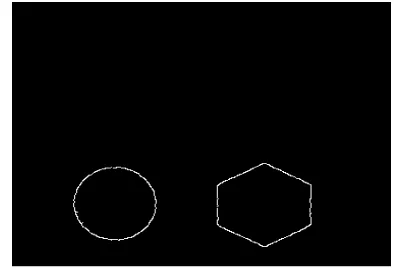
(A) Original image with Gaussian noise. (B) Edge detection by Gaussian filter.
FIGURE 1. Edge detection
Fig. (2) is the results of our extraction algorithm of TN for two values of the threshold, which we illustrate the extraction of these thin nets.
(A) Extraction of TN. Threshold =0.5 (B) Extraction of TN. Threshold =0.8
FIGURE2. Extraction of TN by our algorithm.
Fig.(3) to Fig.(5) present the results of our algorithm on satellite data. For these images, we have extracted the zero-crossings of the DMC image and have thresholded withκmax image.
(A) Satellite Image of the roads. (B) Extraction of TN
FIGURE 3. Extraction of TN for Satellite Image
(A) Satellite Image (B) Extraction of TN
(A) Image of Dubai City (B) Extraction of TN
FIGURE 5. Dubai City.
Conflict of Interests
The authors declare that there is no conflict of interests.
REFERENCES
[1] Nassar. H. Abdel-All and A. A. Al-moneef, Ridges and singularities on hypersurfaces.J. of Inst. of maths.& Comp. Sci.,21 (2008) 109-116.
[2] Nassar. H. Abdel-All and A. A. Al-moneef, Generalized ridges and ravines on an equiform motion.Studies in Mathematical sciences,4 (2012) 76-85.
[3] Nassar. H. Abdel-All and A. A. Al-moneef, Local study of singularities on an equiform motion.Studies in Mathmatical sciences,5 (2012) 26-36.
[4] Nassar H. Abdel-All, M. A. Soliman, R. A. Hussien and Wadah M. El-Nini, Geometric image edge detection techniques.Int. J. Math. Comput. Applics. Res.,3 (2013) 1-14.
[5] Nassar H. Abdel-All, M. A. Soliman, R. A. Hussien and Wadah M. El-Nini, The circle-point mapping be-tween image space and parameter space,Int. J. Math. Comput. Applics. Res.,3 (2013) 53-62.
[6] Nassar H. Abdel-All, M. A. Soliman, R. A.Hussien and Wadah M. El-Nini, Extract Ridges and Ravines Using Hessian Matrix of 3D Image,J. Math. Comput. Sci.,3 (2013) 1252-1270.
[7] Nassar H. Abdel-All, M. A. Soliman, R. A.Hussein and Wadah M. El-Nini, On an Algorithm for Extracting Height Ridges on 2-D Images,J. Math. Comput. Sci.,6 (2016), No. 1, 86-102
[8] M. P. D. Carmo. Differential Geometry of Curves and Surfaces,Prentice Hall,(1976) 153-175.
[10] R. Deriche, Optimal edge detection using recursive filtering, In Proc. First International Conference on Computer Vision, London,June (1987) 8-12.
[11] R. Deriche, Recursively implementing the Gaussian and its derivatives,INRIA Research Report,(1993). [12] D. Geman and B. Jedynak, Tracking Roads in Satellite Images by Playing Twenty Questions,INRIA Research
Report, August,(1994).
[13] D. Geman and B. Jedynak, Detection of roads in SPOT satellite images,Proc. IGRASS 91, Helsinski,(1991). [14] G. Giraudon and R. Deriche, On Corner and Vertex Detection,In Conference on Computer Vision and Pattern
Recognition, Hawaii (USA),June (1991).
[15] R. M. Haralick, Digital step edge from zero-crossing of second directional derivatives,IEEE Transactions on Pattern Analysis and Machine Intel ligence,6 (1984) 58-68.
[16] P. M. Mather, Computer Processing of Remotely-Sensed Images An Introduction Third Edition,West Sussex. John Wiley, Sons Ltd.,(2004).
[17] P. Montesinos, H.V. Blanc, Perceptual Grouping of Continuation : Application to Satellite Images,CARI 94, 2nd African Conference on Reasearch in Conputer Science, Ouagadougou, Burkina Faso,October (1994). [18] O. Monga, R. Lengagne, R. Deriche, Extraction of the zero-crossings of the curvature derivative in volumic
3D medical images : a multi-scale approach,In IEEE Conference on Computer Vision and Pattern Recogni-tion, Seattle, USA,June (1994).
[19] O. Monga, S. Benayoun and D. Faugeras, Using partial derivatives of 3D images to extract typical surface features,In IEEE Conference on Vision and Pattern Recognition, Urbana Champaign, Illinois,July (1992). [20] O. Monga, R. Lengagne, R. Deriche, Crest lines extraction in volumic 3D medical images : a multiscale
approach,In International Conference on Pattern Recognition (ICPR), Jerusalem, Israel,October (1994). [21] J. A. Noble. Finding Corners,In Image and Vision Computing,6 (1988) 121-128.
[22] J. Ponce and M. Brady, Towards a surface primal sketch,In Proceedings, IJCAI,(1985).
[23] S. W. Smith, The Scientist and Engineer’s Guide to Digital Signal Processing,California Technical Publish-ing San Diego, California,(1999).
[24] M. A. Soliman, Nassar H. Abdel-All, R. A. Hussien and Wadah M. El-Nini, Extraction of Ridges on 2-Dimensional Images.Ciencia e Tecnica Vitivinicola Journal,30 (2015) 311-325.
[25] M. A. Soliman, Nassar H. Abdel-All, R. A.Hussein and Wadah M. El-Nini, Generalized Algorithm to the Extraction of Height Ridges in Riemannian Geometry,Int. J. Manage. Infor. Technol. Eng.,4(2) (2016) 23-36.
[26] J. P. Thirion, The Extremal Mesh and Understanding of 3D Surfaces,INRIA Research Report 2149,December (1993).