THE INQUIRY LEARNING MODEL
AS AN APPROACH TO MATHEMATICS INSTRUCTION
by
Michael C. Brune
A thesis
submitted in partial fulfillment of the requirements for the degree of Masters of Science in Mathematics Education
BOISE STATE UNIVERSITY GRADUATE COLLEGE
DEFENSE COMMITTEE AND FINAL READING APPROVALS
of the thesis submitted by
Michael Christopher Brune
Thesis Title: The Inquiry Learning Model as an Approach to Mathematics Instruction Date of Final Oral Examination: 01 October 2010
The following individuals read and discussed the thesis submitted by student Michael Christopher Brune, and they also evaluated his presentation and response to questions during the final oral examination. They found that the student passed the final oral examination, and that the thesis was satisfactory for a master’s degree and ready for any final modifications that they explicitly required.
Margaret T. Kinzel, Ph.D. Chair, Supervisory Committee Mary J. Smith, Ph.D. Member, Supervisory Committee Laurie O. Cavey, Ph.D. Member, Supervisory Committee
iv
ACKNOWLEDGEMENTS
v ABSTRACT
Since current approaches to mathematical instruction fall short of the goals of NCTM (National Council of Teachers of Mathematics) research was conducted in a small rural school district in the northwest United States evaluating inquiry based
instruction. To complete the study two high school geometry classes were taught area formulation using a traditional lecture based approach to instruction. A third geometry class was taught area formulation utilizing inquiry-based instructional methods. Students in both groups took both a pre-test and post-test, filled out a questionnaire, and
participated in a project designed to test their applications of mathematical understanding. Results indicated that inquiry-based instructional methods had a
significant effect on students’ ability to solve decontextualized mathematical problems, students’ retention of the mathematics, and improved students’ attitudes about the
vi
TABLE OF CONTENTS
ACKNOWLEDGEMENTS...iv
ABSTRACT...v
LIST OF TABLES ...viii
LIST OF FIGURES ...ix
CHAPTER 1: INTRODUCTION ...1
CHAPTER 2: LITERATURE REVIEW ...5
Current Educational Practice ...5
Constructivist Learning Approaches ...8
Inquiry Learning ...9
Implementing Inquiry ...11
Inquiry Lessons and Instruction ...11
The Importance of Community ...13
The Role of Challenge and Proof ...14
Conclusion ...15
CHAPTER 3: METHODOLOGY ...16
Participants ...16
Lesson Design ...17
Lesson Progression ...19
vii
CHAPTER 4: RESULTS ...25
Pre-Test ...25
Post-Test ...26
Questionnaire ...32
Project ...37
Retention Quiz ...38
CHAPTER 5: DISCUSSION ...40
Observations ...40
Conclusion ...44
Limitations ...45
WORKS CITED ...47
APPENDIX A ...49
Inquiry-Based Lessons APPENDIX B ...84
Tests and Quizzes APPENDIX C ...91
Questionnaire APPENDIX D ...94
viii
LIST OF TABLES
Table 1: Lesson Progression ...19
Table 2: Pre-Test Results ...25
Table 3: Post-Test Results ...27
Table 4: Questionnaire Results ...33
Table 5: Retention Quiz Results ...38
Table E1: Pre-Test Item Analysis ...99
Table E2: Post-Test Item Analysis ...100
ix
LIST OF FIGURES
Figure 1: Distribution of Scores for Post-Test...28
Figure 2: Post-Test Items p=0.01 ...28
Figure 3: Post-Test Items p=0.05 ...29
Figure 4: Post-Test Items p=0.01...31
CHAPTER 1: INTRODUCTION
Students often question the validity of the mathematics that they are exposed to in the classroom and its relationship to their everyday life. Doubt that the mathematics learned in school is applicable outside of school leads to a logical disconnect between what is learned in school and what may be needed for a real-life problem. Research into approaches used by students when confronted with mathematical situations outside of the classroom indicates that students do not transfer the mathematics used to complete
classroom tasks into applicable knowledge. Instead students frame their attempts to solve a problem around either the environment or the context of the problem. Since classroom problems are often decontextualized, giving no real-world context for the students to consider, and the classroom environment is not replicated by students’ real-world experiences, students fail to see the relationship between their educational experiences and real-world mathematical applications. As a result students do not transfer
mathematical knowledge learned in school (Boaler, 1998).
learning in classrooms throughout their lives. However, since students will be
progressing into the real-world they will need to develop mathematical skills that they can utilize throughout their lives.
Investigations into students’ inability to transfer mathematical knowledge reveal underlying instructional issues. Boaler (1998) has suggested that students in traditional mathematics classrooms are unable to use the mathematics learned because they don’t fully understand the mathematics, but simply have learned to repeat specific processes that underlie certain mathematical actions. Skemp (1976) seems to support this with his research into the role of instrumental (procedural) understanding in the classroom and strongly advocates relational approaches. These relational approaches focus on building conceptual understanding that can be applied in many different environments. Skemp credits the ability to apply learned mathematics to a more dynamic understanding of mathematical relationships.
Boaler (2000) also suggests that the context of the classroom environment bears some of the blame with regard to students’ lack of ability to solve problems framed in a real-world environment. Her research states that students learn classroom cues and then base their mathematical actions on how they interpret these cues. Classrooms in this respect serve as a very specific social environment in which certain behaviors and practices have been learned and are strictly followed. Along with the cue-based
situations, students fail to perceive the relationship between school-learned mathematics and areas where mathematics is useful in their real-life experiences (Boaler, 1998, 2000).
Skemp (1976) goes as far as to suggest that two completely different forms of mathematics are being taught, leading to different types of understanding among
students: instrumental and relational. Skemp emphasizes that the type of understanding a student achieves affects that student’s ability to use their mathematical knowledge in different contexts. Obviously, it is desirable that mathematics instruction promote students’ ability to apply mathematics in a variety of ways and in different contexts. Educators in the United States are currently falling short of that goal and, for the most part, continue to teach for instrumental understanding. This problem must be addressed and non-traditional approaches need to be considered as possible catalysts to relational understanding.
Open-ended, process-based, mathematical tasks have been shown to promote more student enjoyment, retention, understanding, and transferability of mathematics knowledge (Boaler, 1998). Such approaches, however, have not been applied on a large scale. Current textbook selection seems to reflect a more traditional approach to
mathematics instruction. Although reformed curriculums have been shown to increase problem-solving ability and conceptual understanding, only about 15% of the current textbook market is made up of such texts, indicating that they are not widely used
There is unease from teachers when implementing a new methodology into a classroom that the students will not adequately adapt to their new role. Throughout their classroom experiences, students develop a sense of acceptable and expected behaviors. Changing the instructional style will require a shift in their role as a student. This raises concern as to whether students are equipped to adapt to a new classroom climate and become the successful problem solvers that society wishes them to be. If they do adapt, one wonders how long it will take students to properly assume their new role.
Students will also be expected to continue to perform on standardized tests even though less traditional approaches are being used. Educators fear that less procedural approaches will inhibit students’ ability to solve decontextualized problems, thereby
handicapping them when they take standardized tests. In an era where high-stakes testing can mean receiving a diploma as a student, and receiving funding as an institution, these concerns are worth consideration.
I conducted an investigation of the inquiry-learning model to address some of the concerns raised when new instructional approaches are taken. It is important to
understand which educational methods are most effective in light of what we expect students to know, and be able to accomplish in and out of the classroom. In light of these educational priorities, my research goal was to determine what affects an inquiry-based instructional approach would have on:
Students’ problem-solving abilities.
Students’ ability to solve traditional decontextualized classroom problems. Students’ retention of mathematical knowledge.
CHAPTER 2: LITERATURE REVIEW Current Educational Practice
In a recent study, Jerry Stonewater (2005) examined 29 teachers’ perceptions of best educational practices in middle-school mathematics before and after they were taught using inquiry-based methods throughout a mathematics course designed for middle-school mathematics teachers. Data were collected using an open-ended essay in which teachers were asked to address specific elements of what they viewed as the best practices for teaching mathematics. This essay was administered before and after the instructional period. The initial responses revealed that 20 of the 29 teachers involved viewed mathematics education as a process of imparting knowledge to students. What these teachers perceived as good educational practice consisted mostly of teachers modeling a specific way to solve a problem, followed by students solving similar problems using the method presented by the teacher. Best teaching practice was then defined as reducing problems to a set of steps that the students could follow.
The most common approach to teaching mathematics fits this perception and involves a review of previously completed homework, followed by a teacher-directed demonstration the students watch carefully, and concluding with a homework assignment from the textbook. This model emphasizes mathematics through reproduction of
The National Council of Teachers of Mathematics (NCTM) does not support such an approach to mathematics education. In their recent online publication (NCTM, 2009) of guiding principles in mathematics instruction, the NCTM asserts that students need to learn mathematics by solving problems that support conceptual understanding. Ideally a marriage between knowledge, procedure, and conceptual understanding would be the result of mathematics lessons. In fact, they go as far as to say that reasoning,
communication, problem solving, conceptual understanding, and procedural ability must be developed simultaneously for a student to be successful at mathematics (NCTM, 2009).
Skemp (1976) bolsters this argument with his discussion of relational versus instrumental understanding. Instrumental understanding can be considered strictly procedural understanding, rules without reason. Relational understanding, on the other hand, is an interrelated conceptual understanding of the mathematics that students learn, both the how (procedure) and the why for a specific mathematical exercise. It is
reasonable to believe that relational understanding is much more applicable and transferable for students. Traditional educational practices, however, more closely resemble practices meant to encourage only instrumental understanding.
beneficial in building conceptual understanding, only 25% of the classrooms surveyed used such tasks frequently.
Further evidence that current practice does not meet the ideal goals presented by the NCTM and Skemp can be found in evaluations of the texts used to teach
mathematics. A recent study of textbooks used in Australia revealed that most texts presented problems of a low overall procedural complexity. These texts also contained a low overall number of concept connecting questions, completely overlooking the need for relational understanding. This lack of challenge, and also the high percentage (25%-71%) of repetitive questions coincide with teachers’ push for a back-to-basics approach (Vincent & Stacey, 2008). The same push for a back-to-basics approach was present in the United States throughout the relatively recent “math wars” and resulted in students
who lack fundamental mathematical skills, limiting their ability to compete internationally (Cavanagh, 2006).
NCTM pushes for conceptual approaches to instruction to support these
fundamental mathematical skills. The NCTM standards for mathematics have become widely used as a basis for many state curriculums. However, curriculums designed to meet these standards take on many different forms. Schoenfeld (2007) comments that due to the nature of the standards, textbooks can simply contain strict procedure followed by repetitive practice and still meet individual strands of the standards. Such texts cover the listed standards, but fail to emphasize problem-solving ability and relational
The lack of focus on relational understanding evident in current educational approaches and textbook selection in the United States is not ideal if the goal is to prepare students to use the mathematics that they learn in school throughout their lives. New approaches to instruction must be considered to support students in developing a relational understanding of mathematics.
Constructivist Learning Approaches
The constructivist approach to learning takes the position that learners build a construct within their mind to understand their sensory experiences. This construct serves as a catalyst for students to internalize the relationships that exist in the world around them. Constructivist learning theories suggest that students develop their own knowledge through experience and interaction. In a lecture-oriented learning
environment, students will build their own understanding of the material presented during the instruction based on their experiences. This can create disparity between what the educator is attempting to teach and what the student actually learns. Simply stated, constructivist learning theory suggests that knowledge must be developed; it cannot simply be passed on by the instructor (Saunders, 1992). Constructivist approaches to learning are more in line with the goals of the NCTM in the sense that they focus on building students’ conceptual understanding, linking new knowledge to previous experience.
their long-term memory. They argue that skills and knowledge necessary for future application cannot be learned without first being added to students’ long-term memories.
Hmelo-Silver, Duncan, and Chinn (2007) argue that Kirschner, Sweller, and Clark are incorrect in their evaluation of some of these constructivist techniques. They
concluded that inquiry-based instruction and problem-based learning, both considered constructivist guided approaches, can arguably be considered to be guided forms of instruction. They also note that between these two methods there is enough similarity that they are often considered the same approach but were developed through different
educational avenues.
Inquiry Learning
The inquiry learning style establishes itself as different from other constructivist guided approaches in the sense that it is not a minimally guided learning environment and that direct instruction can be used in the context of inquiry learning. Proper inquiry learning requires that teachers carefully scaffold their students as they challenge them with new mathematical material (Hmelo-Silver et al., 2007). Once students are
challenged, they are expected to engage in creating conjectures, analyzing conjectures, communicating, working collaboratively, and engaging in mathematical argument (Stonewater, 2005). This sets inquiry learning squarely within the context supported by the NCTM and other reform documents (Lampert, 1990).
mathematical knowledge to multiple environments and to solve complex problems. Students taught using inquiry-based methods have also been shown to transfer their knowledge better to new tasks, and still maintain the ability to perform well on standardized tests. In fact, students in a middle school that adopted an inquiry-based learning model performed better on their standardized tests when compared with those in the traditional curriculum (Hmelo-Silver et al., 2007). Ismail (2008) noted that when using the Connected Mathematics Program, which is arguably an inquiry directed text, her students showed great gains in their problem-solving abilities with no loss in their procedural abilities. These examples show that inquiry methods offer great opportunities for enhancing students’ problem-solving and mathematical-reasoning abilities without sacrificing their procedural knowledge.
Longitudinal studies have also shown that gains made in inquiry-based
classrooms are more likely to last long periods of time, reduce achievement gaps, and help disadvantaged students find success (Hmelo-Silver et al., 2007). Long term gains may be related to the fact that students involved in inquiry classrooms report that they find these classes more enjoyable than other studies in school because of the discussion and reasoning involved in place of memorization (Goos, 2004). This ability to find solutions to problems rather than memorize them is often cited as a better way to understand mathematics and is linked to better retention, because if your memory fails you, your logic will not. Students with self-reported bad memorization skills tend to enjoy inquiry instruction over traditional methods (Stonewater, 2005).
school mathematics educators needs to be considered. Concluding essays written by the participants revealed that the teachers’ beliefs about educational practice were shifting. Of the 20 instructors who initially favored direct instruction, 14 began to show signs that their perception was changing. After becoming involved in lessons that were taught using the inquiry approach, teachers began to see that different levels of understanding could be attained through inquiry-based instruction (Stonewater, 2005). Such research suggests that though educators lack exposure to the inquiry-learning method, they may see the value in such methods if they could see them implemented.
Implementing Inquiry
Inquiry Lessons and Instruction
Proper inquiry instruction requires facilitation by the instructor and well-designed inquiry tasks. Such tasks can be identified as problematic situations that engage the students in mathematical problems in context (Hodge, 2008). Before tasks are put into action, they should be evaluated to ensure that they meet a standard of objective-oriented instruction. Tasks should promote understanding of important mathematical ideas or ways to solve problems. Tasks should be accessible to all students and support mathematical thinking. Finally, tasks should relate to other mathematical topics being learned so that mathematics is not separated into strands, but understood as a web of connected knowledge that can be applied (Marcus & Fey, 2003).
Lampert (1990) states that “The most important criterion in picking a problem was that it
be the sort of problem that would have the capacity to engage all of the students in the class in making and testing mathematical hypotheses” (p. 39). Such problems allow students access to both inductive and deductive reasoning as they make conjectures and prove or disprove them together. Properly designed inquiry lessons will provide students with the opportunity to investigate, debate, and challenge what they know (Hmelo-Silver et al., 2007).
In such a classroom of constant conjecture, a great burden of understanding is placed on the teacher as they serve as the facilitator of the learning process. It is easy to imagine that students will come up with many mathematical theories that may or may not be correct. The teacher must be able to redirect the students when necessary. Teachers, therefore, must closely monitor students’ processes, adjust quickly to individual student needs, and be ready to face the challenges within the classroom of inquiry (Goos, 2004).
It is also important to note that although direct instruction can be used in a
classroom of inquiry, it is suggested that investigative learning precede direct instruction. Pesek and Kirshner (2000), in their research of investigative approaches to learning and subsequent student understanding indicate that when direct instruction precedes
The Importance of Community
Central to the concept of inquiry learning is the notion of a mathematical community. Students are expected to participate in discussion, promote and defend mathematical ideas, solve unfamiliar problems, and challenge the ideas of their peers (Goos, 2004; Hodge, 2008). Often students are asked to share their way of doing a particular task or their reasoning throughout the process. As a result, students begin to feel as though their processes are as important, if not more so, than the teacher’s thinking about a problem. Student sharing is directed not only at the teacher, but also at fellow students, and fellow students have the right to challenge the reasoning of their peers (Hodge, 2008). Such interaction between peers acts as a scaffold to bring students to higher levels of understanding. Students who may not have been able to reach a new plane of understanding on their own do succeed at gaining new and complex
mathematical understanding when working with others (Goos, 2004). When students do find success in such group-work sessions, they feel a strong sense of accomplishment, which may motivate them to continue future investigations (Stonewater, 2005). It is reasonable to assume that the same feeling of accomplishment would not be present if the teacher had provided the answer or if the solution had been arrived at through strict procedure.
Depending on students’ understanding, the amount of guidance provided by the teacher
fluctuates to meet the needs of the student groups. When groups make mistakes in their reasoning, these mistakes can be brought before the entire class and can lead to a
discussion facilitated by the instructor to bring to light any misconceptions that may have been presented. By structuring investigations in such a manner, students will feel
ownership of the mathematics that they are learning (Goos, 2004). By allowing students to interact with one another, they learn more than they could have if the answer or
process had simply been given to them (Stonewater, 2005).
The Role of Challenge and Proof
Conclusion
Since new direction is needed in mathematics curriculum and instruction, investigations into the inquiry method seem natural. Data suggest that most students learn best when given problems to solve and that such problem-based learning improves retention and ownership of the mathematics (Goos, 2004; Stonewater, 2005; Hmelo-Silver et al., 2007). Through investigations into this approach of teaching it seems feasible that one could create a more optimal learning environment for most students.
CHAPTER 3: METHODOLOGY
To complete this quasi-experimental study of the effects of inquiry-based learning on problem-solving ability, I conducted research at a high school serving grades 10-12 in a low-income rural school district. The high school had an enrollment of 628 students.
Participants
Experimental and control groups were chosen based on pre-established classes. These classes were determined by student enrollment and administrator and teacher placement. The experimental group consisted of 27 students, of which 14 were female and 13 were male. I instructed this class during fifth period, which fell directly before lunch. Two classes represented the control group; I instructed the control group during sixth and seventh periods. The control group consisted of 37 students, of which 20 were female and 17 were male. Student ages ranged from 15-18 years in all three class periods. The experimental group was made up of 2 seniors, 15 juniors, and 10
sophomores. The control group on the other hand was made up of 3 seniors, 20 juniors, and 14 sophomores. The overwhelming majority of students were white, with only two Hispanic students and one African American student involved in the study.
mathematical path had no bearing on where they were placed, so each class was a mixed-ability group.
Lesson Design
One of the goals of this study was to teach the same material two different ways: using traditional, lecture-based instruction with the control group, and inquiry-based instructional methods with the experimental group. These lessons were to be taught over the same timeframe. For this reason, I followed the progression through area formulation dictated by the McDougal Littell Geometry 2007 textbook adopted by the district.
The control group lessons were taught using the traditional approach described by Stonewater (2005) and Goos (2004). This involved reviewing the homework assignment from the previous day, followed by a presentation of new material, and concluded with a homework assignment of 20-30 problems. New material was presented using lecture-based instruction that included examples of problems that they would see in their homework, and the formulas required to solve these problems. Parts necessary for substitution into area formulas were highlighted, and examples included shapes that were orientated in different ways. These lessons also included dissections of specific area formulations to inform students of the origins of the formulas taught during the lesson.
definition of what inquiry learning entails can be found through the National Research Council’s National Science Education Standards (1996) and is as follows:
Inquiry is a multifaceted activity that involves making observations; posing questions; examining books and other sources of information to see what is already known; planning investigations; reviewing what is already known in light of experimental evidence; using tools to gather, analyze, and interpret data; proposing answers, explanations, and predictions; and communicating the results. Inquiry requires identification of assumptions, use of critical and logical thinking, and consideration of alternative explanations. (p. 23)
The inquiry methods for instruction used focused student investigations and encouraged community-based learning through discussion and on-going hands-on tasks. These tasks supported students as they worked to discover specific mathematical
relationships and understanding.
The inquiry lessons were taught through facilitated group work with the
At the end of each lesson, students were provided a problem set to take home and complete using their newly developed method. These problem sets were short
(consisting of three to five problems) and only served to solidify developed understandings.
Lesson Progression
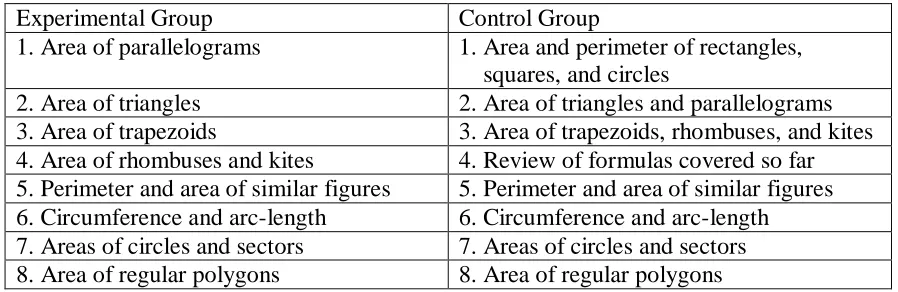
Area topics taught in this unit were taught in the order presented in Table 1. Table 1: Lesson Progression
Procedure
At the beginning of the study, all members of the control group and the
experimental group took a pre-test. The purpose of the pre-test was to measure students’ prior knowledge about shapes and area-based problems. Prior knowledge should have included: an ability to use the Pythagorean theorem to find missing side lengths in right triangles, the ability to use right triangle trigonometry to find unknown measures for sides in right triangles, a basic understanding of perimeter, and a basic understanding of simple area formulas. Known formulas should have included square, rectangle, triangle, and circle area formulas. The pre-test also contained a small number of problems involving
Experimental Group Control Group
1. Area of parallelograms 1. Area and perimeter of rectangles, squares, and circles
area formulas that the students had been minimally exposed to, including trapezoids and parallelograms. Data from the control group was compared with the experimental group using a t-test. Differences were noted and included in the final comparison of the two classes.
Once the pre-test was completed, the differing lessons began. I instructed both the experimental class as well as those classes that represented the control group. I was careful to maintain a different approach between the two groups, using well-developed lessons to ensure fidelity to each instructional approach.
The inquiry-based lessons were taught over a two and a half week period. Students were encouraged to discuss the mathematics and develop methods through this discourse. Students’ desks were arranged in groups of two or three to encourage group discussion. I served as a facilitator of the discussion and guided the direction of the discourse in a way that helped students recognize the meaningful relationships underlying their mathematical tasks. This included small segments of direct instruction as well as extended periods monitoring students’ progress as individual groups developed
approaches. I closely monitored individual groups’ progress, aiding them in recognizing any noticeable misconceptions through question posing. Though direct instruction was sometimes used, it was never the primary method of instruction, and every class period began with student investigations and discussions of the mathematics.
concluded with short take-home assignments to assess the students' developing understanding of the mathematics.
The control group was taught using the McDougal Littell Geometry 2007 edition adopted by the selected school district. Their lessons followed those from the selected text and were supplemented with worksheets that I generally have used in my geometry classes to highlight specific concepts of area formulation. Students were instructed how to find the area of a variety of geometric figures and were expected to use those formulas on a variety of problems, including problems that do not give all necessary information. All instruction was lecture-based and examples were provided to guide the students in using the area formulas. Students were also shown the reasoning behind the area formulations. For example, when students were learning how to find the area of a triangle, I illustrated for control-group students that a triangle is actually half of a parallelogram.
Students were expected to participate in the lecture by answering questions and by taking formal notes, which were assessed for completeness at the end of the unit. To encourage participation and focus on the instructor throughout the class period, students’ desks were placed in rows facing forward. Once instruction was completed, students were given an assignment out of the book consisting of 10-20 problems and a small amount of class time to begin work so that they could ask questions if necessary. Work not completed during this time should have been taken home by the student for
Throughout the course of the study I maintained a journal in which I documented student behaviors within the control and experimental classrooms, as well as my own reflections on what went well during the instructional periods. I recorded examples of student conversations and strategies as they attempted to use the mathematics they were learning. Through careful observation I hoped to discover if the method of instruction impacted the students’ willingness to attack difficult problems on their own. I was also trying to determine if the students in the experimental group adapted and took
responsibility for their learning. When differences developed in their approaches to the mathematics and problem-solving approaches, then I attempted to generalize these differences and included them in my observational data. I also tried to find whether the experimental-group students performed better when confronted with a real-life situation involving area, observing whether they had a better established ability to convey meaning and understanding through mathematical discourse than their control-group peers. All of this information was important in determining the overall success of each educational approach.
on the part of the students and a better understanding of the area relationships that exist among shapes. Students’ post-test scores were compared based on their instructional
approach. A t-test was used to determine differences between group scores on the post-test. Determining the effectiveness of each approach was partially based on these findings.
At the end of the study, all students were asked to complete surveys designed to gain insight into their perspective of the mathematics learned. This included program-oriented questions developed to measure students’ attitudes towards the instructional approach as well as questions regarding their feelings towards the usefulness of the mathematics they had just learned. The survey was designed to gain insight into how students felt about the mathematics they learned with respect to their future learning and to real-world situations. A copy of the survey can be found in Appendix C.
At the very end of the year, all geometry students were given a retention quiz over the area unit. This quiz included area problems similar to those on the post-test. Scores on the retention quiz were collected and analyzed to see if there was any difference in retention between the two groups. An example of the retention quiz can be found in the Appendix B.
CHAPTER 4: RESULTS Pre-Test
The study began with the completion of a pre-test by all students in both the control and the experimental groups. Students who did not return consent forms were excluded from the final analysis. The scores of the control group and experimental group were compared to obtain a baseline measure of students’ knowledge. The mean score was found for each group, including the standard deviation. This was followed by a t-test to evaluate for differences in the scores not attributable to chance. Results can be found in Table 2.
Table 2: Pre-Test Results
N mean standard
deviation
p-value
Control 33 6.70 3.70 0.151
Experimental 19 8.26 3.78
A review of the item analysis of the pre-test revealed that the only item that appeared to have a statistically significant difference in score between the control group and the experimental group was item 3f. This item involved finding the circumference of a circle and appeared to reveal that the experimental group had a better memory of the formula for circumference. Item 3d also revealed a rather large difference in mean scores. This item involved finding the perimeter of a triangle with an altitude given. Further testing on individual items revealed that if the only items included in the t-test were those involving area, items 4a-4g, then the p-value increased to p=0.196. If problem 4a, the area of a rectangle, was removed from this set, then the p-value for comparing means increased to p=0.454. This revealed that the students’ overall understanding of area did not differ in a statistically meaningful way.
Post-Test
After the treatment period the post-test was given. The analysis of the post-test mean scores for the two groups can be found in Table 3. One significant factor for the post-test was student absences on the date of the test. Many students from the
The post-test results revealed a p-value = 0.0061, which is statistically significant at the p=0.01 level. This implies that the difference in the mean scores for the two groups did not happen by chance and can be attributed to the treatment that was given. Since the experimental group achieved a much higher score, we can conclude that the inquiry based instruction was beneficial to the students’ performance on the post-test.
Table 3: Post-Test Results
n mean standard
deviation
p-value
Control 31 16.968 8.631 0.0061**
Experimental 17 24.352 8.306
**Statistically significant at the p=0.01 level
12 5 5 4 5 5 5 13 12
obtained a better understanding of the mathematical relationships, and overall achieved higher scores on the post-test.
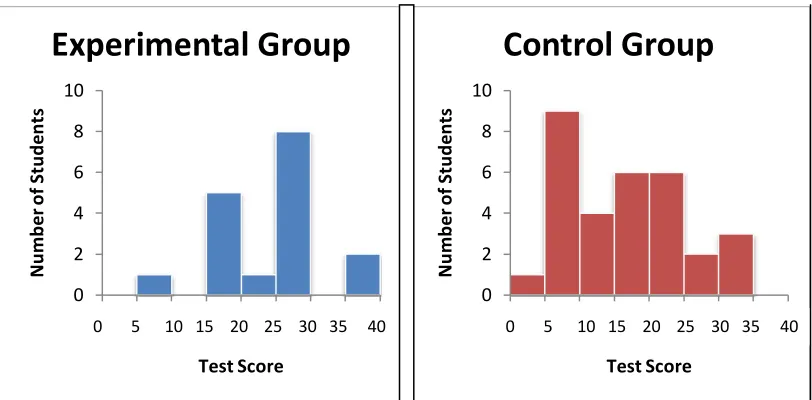
Figure 1: Distribution of Scores for Post-Test
Again, to further analyze the differences in the scores between the groups, a complete item analysis for the post-test was conducted. The results of this item analysis can be found in Appendix E; the post-test can be found in the Appendix B.
The item analysis reveals that the experimental group performed statistically significantly better at the p=0.01 level on item 1c and item 1f. These problems can be viewed in Figure 2.
1c. 1f.
Figure 2: Post-Test Items p=0.01
0 2 4 6 8 10
5 10 15 20 25 30 35 40
N u mb er o f St u d en ts Test Score
Experimental Group
0 2 4 6 8 105 10 15 20 25 30 35 40
N u mb er o f St u d en ts Test Score
Control Group
5
4 8
10 6
Regular Hexagon
14
12.12 3
Item 1c involves finding the area of a kite. Most students in the experimental group attacked this problem by dividing the kite into triangles and finding the area of all involved triangles. Though some of the students in the control group used this method,
most relied heavily on the formula for the area of a kite ( ).
Item 1f involves identifying the parallelogram and finding the parts necessary for area. All important elements are given, but students must demonstrate a strong
understanding of area by reasoning how the area of the parallelogram can be found. Control-group students more so than experimental-group students had a strong tendency to multiply 10x12 or 5x13. Since the experimental students did significantly better on this problem, it leads to the conclusion that inquiry based instruction leads to better visual understanding of area and an ability to break down shapes.
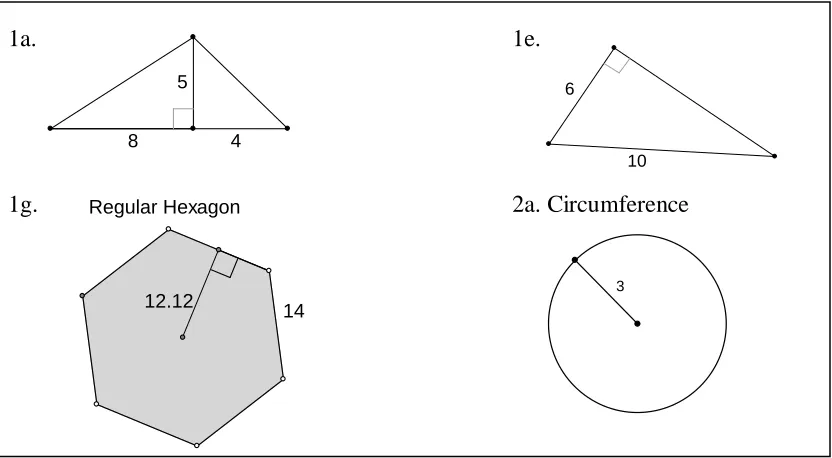
The experimental group did statistically significantly better at the p=0.05 level on items 1a, 1e, 1g, and 2a. These problems can be viewed in Figure 3.
1a. 1e.
1g. 2a. Circumference
Though item 1a is a straightforward triangle area problem, item 1e requires a small amount of analysis followed by the use of the Pythagorean Theorem. This then becomes a multi-step problem. Many students, more in the control group than in the
experimental group, used the triangle formula improperly by multiplying .
Students in the experimental group outperformed their peers, suggesting that even though they were never given the formula directly, they had a better understanding of the parts necessary for finding the area of a triangle.
Item 1g proved fairly straightforward for the experimental students, as most of them broke the hexagon into six triangles and found the area using this strategy. Control
group students were handicapped by their dependence on the formula .
Finally, the difference in score on item 2a is not surprising given that the experimental students outperformed the control group students in a statistically meaningful way on the circumference problem on the pre-test.
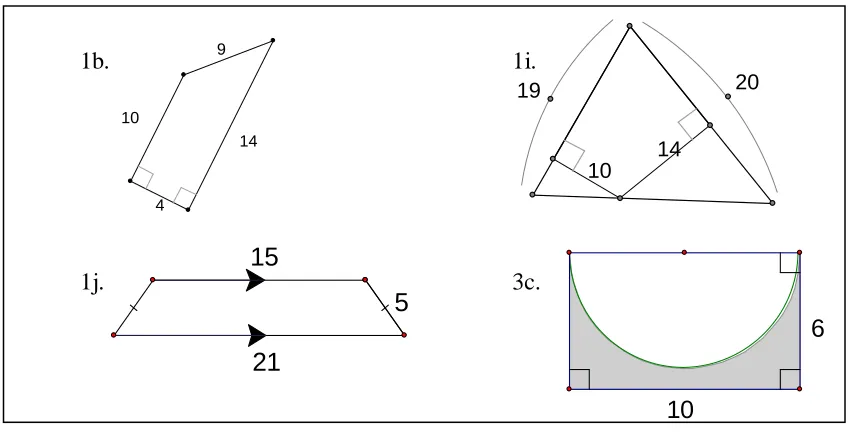
The experimental group outperformed the control group at a nearly statistically significant level (p=0.1) on items 1b, 1i, 1j, and 3c. These problems can be viewed in Figure 4.
4 9
14 10
19 20
14 10
5 15
21
6
10
experimental-group students performed better on this problem further promotes the idea that the experimental-group students had developed better problem solving abilities and a more dynamic understanding of the concept of area.
1b. 1i.
1j. 3c.
Figure 4: Post-Test Items p =0.1
Item 1j is another example that would require analysis of the given shape in order to find the height of the trapezoid. Again experimental-group students demonstrated better problem-solving ability by analyzing what was given, and deciding not only what was needed, but how to find what was needed in order to calculate the area of a difficult problem. Finally, item 3c further supports this claim by again indicating that the
experimental-group students were more capable of solving multi-step problems, which required analysis and understanding of the concept of area.
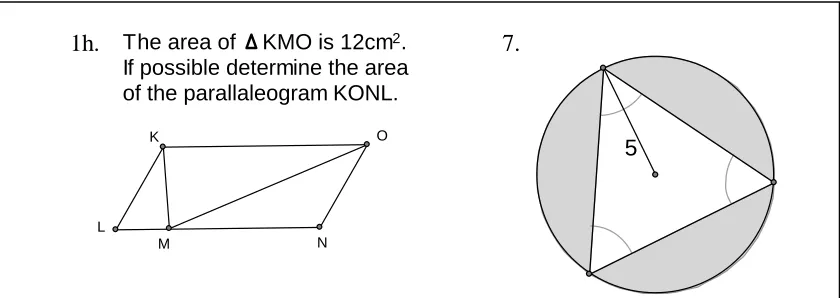
The area of KMO is 12cm2.
If possible determine the area of the parallaleogram KONL.
N K
L
O
M
5
1h. 7.
Figure 5: Items on which Control Group Outperformed Experimental Group
Notably item 1h is a problem that draws reference to the relationship between a parallelogram and a triangle and the understanding that the area of the triangle is half of the parallelogram with the same base and height. The fact that the experimental group did worse on this problem may indicate that they did not grasp the relationship through the tasks that were given to them. Item 7 is a multi-step problem involving a regular triangle cut out of the area of a circle. Item 7 was given as a bonus problem for all students and as a result not all students attempted this problem. Performance on the problem may be an indication that the control group was slightly better attuned to the area of a regular triangle, or it may indicate that the experimental group felt less desire to complete an extra-credit portion of the test.
Questionnaire
of the questionnaire included six open-ended questions. Responses to these questions were synthesized to identify common themes. This questionnaire is included in Appendix C and the results of questions 1 – 8 of the questionnaire are tabulated in Table 4.
Table 4: Questionnaire Results
Control Group n = 31
Experimental Group n = 22
Questions mean standard
deviation
mean standard deviation
p-value
1. How well did you like this chapter compared to other chapters we have covered?
1.968 0.983 3.773 0.922 0.000**
2. How well do you feel you understand how to find area of shapes?
2.742 0.930 3.182 1.053 0.114
3. How confident do you feel that if you had to find area to complete a project you would be able to do it?
2.645 1.050 3.364 1.049 0.018*
4. How much do you feel you learned this chapter?
2.807 0.910 3.409 1.008 0.027* 5. How prepared did you feel before
this chapter started to apply what you knew about area to real world applications?
1.968 0.752 2.333 0.913 0.121
6. How prepared do you think you are now to apply what you know about area to real world
applications?
2.645 0.950 3.500 0.802 0.001**
7. How did your performance in this chapter (homework and tests) compare with your performance on previous chapters?
2.194 1.167 3.000 1.113 0.015*
8. Did you feel that the approach we took to learning area was beneficial to your understanding?
2.807 1.195 3.682 1.129 0.010**
Results of the questionnaire indicate that students in the experimental group felt that they learned more than their control group counterparts and felt more prepared to use what they learned outside of the classroom. The experimental group indicated that they had a slightly higher confidence level for applying area before the study began, but felt even stronger after the study. In fact, the experimental students’ indication that they were more prepared to apply what they learned during the unit on area outside of the classroom can be attributed to the difference in approaches at the p=0.01 level, giving a strong indication that the students felt more prepared to apply their knowledge when instructed using inquiry-based methods.
The experimental students also indicated that they enjoyed the area unit more than other units that they had covered throughout the year and felt that the approach was beneficial to their understanding. The control students, on the other hand, indicated that they liked the area unit less and were mixed on how beneficial they felt the approach was. As would be expected, the t-test reveals that this can be attributed to the differences in approaches at the p =0 .01 level. This should not be surprising considering these are questions directed at how the students felt about the approach itself.
Responses to open-ended questions on the survey further illuminate the responses from the Likert scale questions. Question 9 asked the students, “Why did you feel that the way this chapter was taught was helpful or not helpful?” Multiple control-group
with their own learning style. Multiple students also cited the pace of the class as being too rapid, with inadequate time for examples to grasp the concepts. There was a
comparable amount of positive and negative responses among the control-group students in response to this question with eleven positive responses, fourteen negative responses, and four responses that could not be classified as either positive or negative.
Experimental-group students overall seemed positive about the approach, citing that they learn better in groups and that they enjoyed seeing different ways to solve the problems. One student commented that he “was able to see different ways to solve problems, helped find the way that (he) learned.” Others commented that the method was fun and that the slower pace helped.
Not all experimental group comments were positive however. Some felt that they should be working individually because everyone has their own pace. Others cited that their group was continually lost so they didn’t feel that they learned very much.
Question 10 asked the students, “What was the most interesting thing you learned during this chapter?” An overwhelming number of control-group students made some
reference to the formulas used. Some students did this by stating that a specific formula was the most interesting thing that they learned, such as “The trapezoid formula and the fact that there were two bases,” while other students cited the formulas in general, such as “the formulas for all the shapes to find area.”
just following one approach.” Still others referenced individual connections that they
made throughout the unit, such as the connection between circle area and parallelograms or how they can break complicated figures down to find the area.
Question 11 asked the students, “If you were an educator, how would you change the way that lessons are taught?” and question 12 followed up with “Why?”
Control-group students varied on their responses to this question, but many students did identify that they would vary their instructional methods, give more time, and give more hands-on work. Much of the justification behind this was that students learn in different ways and need more time to master concepts before moving on.
Experimental-group responses also varied, but many students did seem to like having more hands-on activities and would continue using similar methods. Others suggested small changes to the inquiry-based approach, such as changing groups every day to allow students to gain access to more ideas or giving the formulas first before the explorations. A few of the experimental students did feel that better explanations would have helped them; they did not always feel that what they accomplished in their group was adequate for complete understanding.
height of an object, which may convey a misunderstanding of area formulation. A few experimental students referenced the number of squares inside of an object as area. Overall, both groups indicated a basic understanding of the two concepts.
Project
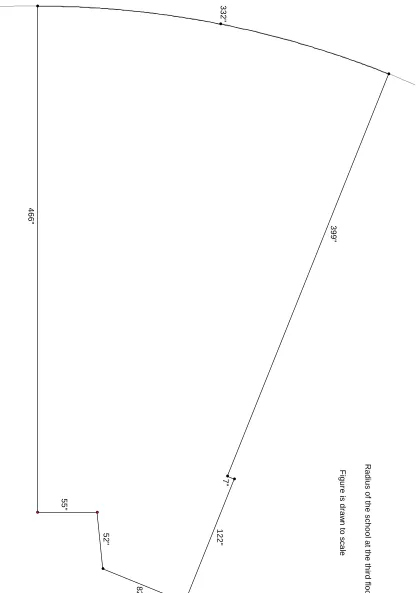
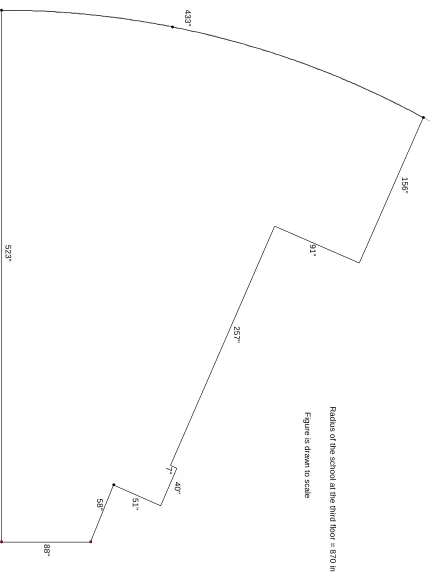
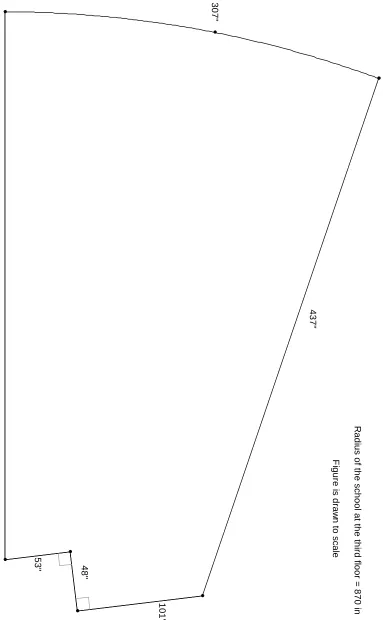
At the very end of the area unit and questionnaire, all students were placed in groups and spent two days working on a culminating area project. Every group was given a scale drawing of the floor space of a room within a dome-shaped high school and asked to find the area. Examples of these problems can be found in Appendix D.
The goal of the project was to discern if the experimental students were better prepared for real-world applications of their learning. Small differences in methods did come to light, including a willingness of the experimental group to jump in and attempt to solve the problem, often asking questions like, “does this make sense?” seeking to
validate their own ideas. The control group was much more likely to ask the question, “How do I do this?” or “Is this right?” These questions indicated that the
the sector portion of the room in an appropriate fashion. These students were members of the control group.
This leads to the conclusion that two weeks of inquiry-based instruction did increase the students’ acceptance of multiple methods for solving problems and their willingness to jump in and attempt working their own ideas. It did not increase their efficiency, or the likelihood that they would correctly navigate the difficulties and misconceptions of a real-world problem involving area.
Retention Quiz
At the end of the semester, four weeks after the culmination of the area project, students were given a retention quiz over the area unit. It is worth noting that between the area unit and the end of the semester two units were covered, one on surface area and one examining volume.
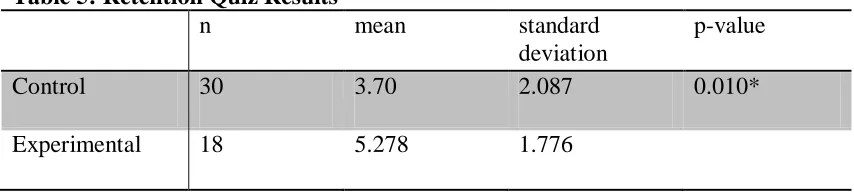
The results of the retention exam can be found in Table 5. It is important to recognize that the experimental group did significantly better at the p=0.05 level on the retention exam. This indicates that the inquiry-based treatment of the experimental group did increase retention among the students involved.
Table 5: Retention Quiz Results
n mean standard
deviation
p-value
Control 30 3.70 2.087 0.010*
Experimental 18 5.278 1.776
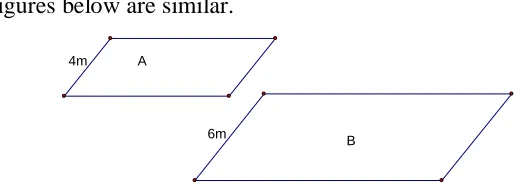
Analysis of the retention exam is continued with a complete item analysis, found in Appendix E with the complete retention quiz in Appendix B. Results indicate that the experimental group performed statistically significantly better at the p=0.01 level on item 7, which required students to find the area of a sector with a 90o central angle. The experimental students performed better at the p=0.05 level on item 1 and item 8. Item 1 required students to use the Pythagorean Theorem to find the length of the missing side of a triangle and use that length to calculate area. Item 8 consisted of two parallelograms that were mirror images of one another. Students could use a variety of approaches to find the combined area of the parallelograms
CHAPTER 5: DISCUSSION Observations
While the research was being conducted, I kept a daily journal to track how the lesson went and if the students experienced any great revelations as a result of the instruction. Throughout the two-week period, many interesting factors came to light.
It is important within a classroom that students remain on task in order to learn. Though the experimental group of students met every day in groups, this did not seem to detract from time on task. One might expect students to be off task when placed in groups and given more freedom within a classroom, but this was not the case. The continual movement from task to task and encouragement to discuss the mathematics at hand kept students interested, and groups continued to work through the problems. The freedom of exploration seemed to spur groups on in their discussions and explorations. This is not to imply that groups did not get off task or that I did not take an active role in reminding students what they should be discussing. However, on-task time for the experimental students surpassed that of the control-group students.
students left the class without becoming involved in the lecture. This leads to concern regarding what they actually understood.
Not all experimental students were involved however. Throughout the unit there was one particular student that refused to take part in the discussion and would become obstinate when approached. The student did not attempt to complete group assignments and disengaged herself from other group members. Working with the student was frustrating and unrewarding. Throughout the unit, I was unable to reach this student and as a result the student’s learning was minimal.
Other students engaged in similar behavior at times, waiting for one member of the group to lead the rest to the discovery. Complete group involvement was hard to come by in this regard. Many groups learned to rely on one strong member for their progress through assigned tasks.
their method. In one such instance, the student became openly irritated by the constant questioning, but when she eventually conveyed her understanding in a meaningful way, she seemed to be proud of the argument that she had constructed. Since students were often required to present their findings and defend the methods of their group, students slowly adapted to asking the questions to discover why a specific approach did or didn’t work.
The idea of proof is central to the goal of inquiry-based learning. Although students did get closer to proof by discussion, they never fully engaged in one another’s ideas. This could be the result of instructional shortcomings, or a reflection of the short amount of time students were given to adapt to the inquiry-learning style. Even when two students had different yet valid ideas, the students’ arguments failed to be proof oriented as students reacted to frustration in their attempts to defend their ideas. Group dynamics played a large role as some students were not interested in others’ ideas, especially if they felt they had the correct answer already. This kept students from engaging in discussion about the validity of a response simply due to the fact that their process was not the same.
clearing up their lack of understanding. As a result, the experimental-group students never seemed to fully grasp the connection. Scaffolding and the ability of the student to draw and defend their own valid conclusions is central to inquiry-based lessons. If the lesson fails to allow students to do this, then it is unlikely that they would be able to progress mathematically.
The second illuminating lesson involved finding the area of regular polygons. Students have always seemed to struggle with this complex area formula. However, the experimental-group students jumped in. By the end of the two-day lesson, every group was able to find the area of a regular polygon given a side length and defend the method they used for finding that area. The connections students had drawn differed from those traditionally drawn during lessons on regular polygons, and as a result the experimental students displayed a much better understanding of how to find areas of those figures than the control-group students did, even though the control-group students had a simple and concise formula for that area. This lesson illustrated the importance of the connections the students had drawn. Since the students made their own conclusions, and had their own arguments, their method was remembered. This is further backed by the results of the retention quiz.
Students also had a tendency to remember what they had come up with on their own. Due to the approach we took to learning area of a circle involving a formula derived from parallelograms built from sectors of the circle, one student always
It is important to admit that misconceptions among the experimental group were common throughout the lessons. Though I attempted to discuss with each group their misconceptions and clarify them, often there was not enough time to clear up all of the misconceptions. As a result, I was concerned throughout the implementation that the students may not have been adequately grasping the material. The results of the study indicate that even though there were many misconceptions along the way, students developed a better understanding of area than their peers who were taught in the
traditional fashion. This leads to the conclusion that the control-group students suffered from at least as many misconceptions as the experimental-group students. The difference then lay in the fact that the experimental-group students were constantly discussing their understanding, thus bringing these misconceptions to light. Mathematics instructors may be more likely to engage in correcting these misconceptions because they see them as being developed by the students. This research reflects that even when students are taught explicitly, their understanding is not without its misconceptions. Educators may often overlook these misconceptions because they know that the students have been instructed in how the mathematics should be done. Students will still develop their own understanding based on their interpretations of the information presented; an
understanding that is imperfect and subject to the students’ misconceptions is often developed.
Conclusion
creates a learning environment that is superior, and better enjoyed by the students, than the traditional classroom. Students involved in the inquiry-based lessons exhibited better retention, a better ability to problem solve, and better performance on decontextualized mathematical problems than their peers who were taught in the traditional fashion. They did not, however, display a better ability at proof or greater aptitude in a real-life area problem situation.
These results validate many of the claims of the inquiry-based instructional style. To maintain quality education for our students and to help them build a relational
understanding of the mathematics teachers should incorporate inquiry-based instructional methods into their classrooms. Fear of change and concern about high stakes testing should not inhibit change within classrooms as these fears are shown to be baseless by the results of this research. Implementation of inquiry-based instructional methods should be encouraged by administrators and embraced by educators in an effort to continually improve public education in the United States.
Limitations
After the conclusion of the study, it became apparent that more research would lead to a better understanding of the impacts of inquiry-based instruction. Changes to elements of this study would bring about better understanding of the impacts of inquiry-based instruction. It is impossible to predict the full impact of such changes without further research.
introducing students to inquiry-based learning at the very beginning and continuing in this format. Such an experiment may lead to greater acceptance of the approach by the students and thus involve a greater number of them in the thinking process. Along the way, students may learn better what mathematical discourse looks like and be better prepared to communicate mathematically. Such an extension of the study would give greater insight into the benefits of inquiry-based instruction in terms of retention, problem-solving ability, development of mathematical discourse, and transferability of learned mathematics.
The retention element of this study was also limited by timeframe. There was only a four-week period between the end of the inquiry-based lessons and the end of the semester. This did not allow for long term testing of retention. A longitudinal test for retention would lead to greater insight into whether the gains due to the inquiry-based methods are lasting and could include extended studies of students’ real-world
application of the mathematics.
As the sole instructor of the inquiry-based lessons and the designer of the lessons used in this study, the results cannot be disconnected from my classroom or my
WORKS CITED
Barell, J. (2007). Problem based learning and inquiry approach. New Delhi: Sage Publications India Pvt. Ltd.
Boaler, J. (1998). Open and closed mathematics: student experiences and understanding.
Journal for Research in Mathematics Education, 29 (1), 41-62.
Boaler, J. (2000). Exploring Situated Insights Into Research and Learning. Journal for Research in Mathematics Education, 31 (1), 113-119.
Cavanagh, S. (2006). Big cities credit conceptual math for higher scores. Education Week, 25 (18), 1-15.
Goos, M. (2004). Learning mathematics in a classroom community of inquiry. Journal for Research in Mathematics Education, 35 (4), 258-291.
Hmelo-Silver, C. E., Duncan, R. G., & Chinn, C. A. (2007). Scaffolding and achievement in problem-based and inquiry learning: a response to Kirschner, Sweller, and Clark(2006). Educational Psychologist, 42 (2), 99-107.
Hodge, L. (2008). Student roles and mathematical competence in two contrasting elementary classes. Mathematics Education Research Journal, 20 (1), 32-50.
Ismail, J. (2008). The effects of a reform curriculum on students' problem solving abilities. (Unpublished master’s thesis). Boise State University, Boise, ID.
Kirschner, P. A., Sweller, J., & Clark, R. E. (2006). Why minimal guidance during instruction does not work: an analysis of the failure of constructavist, discovery, problem based, experiential, and inquiry based teaching. Educational
Psychologist, 41 (2), 75-86.
Levasseur, K., & Cuoco, A. (2003). Mathematical habits of mind. In H. L. Schoen,
Teaching mathematics through problem solving (pp. 27-37). Reston: The National Council of Teachers of Mathematics Inc.
Marcus, R., & Fey, J. T. (2003). Selecting quality tasks for problem-based teaching. In H. L. Schoen, Teaching mathematics through problem solving (pp. 55-67). Reston: The National Council of Teachers of Mathematics, Inc.
McKinney, S., & Frazier, W. (2008). Embracing the principles and standards for school mathematics: an inquiry into the pedagogical and instructional practices of mathematics teachers in high-poverty middle schools. Clearing House, 201-209.
National Research Council. (1996). National science education standards. Washington DC: National Academy Press.
NCTM. (2009, June). Guiding principles for mathematics curriculum and assessment.
Retrieved 10 14, 2009, from National Council for Teachers of Mathematics: http://www.nctm.org/standards/content.aspx?id=23273
Pesek, D. D., & Kirshner, D. (2000). Interference of instrumental instrucion in
subsequent relational learning. Journal for Research in Mathematics Education, 31 (5), 524-540.
Saunders, W. L. (1992). The constructavist perspective: implications and teaching strategies for science. School Science and Mathematics, 92 (3), 136-141.
Schoenfeld, A. H. (2007). Problem solving in the United States, 1970-2008: research and theory, practice and politics. ZDM Mathematics Education (39), 537-551.
Skemp, R. R. (1976). Relational understanding and instrumental understanding.
Mathematics Teaching, 77, 20-26.
Stonewater, J. K. (2005). Inquiry teaching and learning: teh best math class study. School Science and Mathematics, 105 (1), 36-48.
APPENDIX A
The Slant company has hired a local architect to design a
building that is slanted to one side. Above you can see a
sketch of his plan. The builder needs to know the area of
one side of the building to begin putting together a list of
necessary materials. What is the area of this slanted
face of the building?
115ft
65ft
Lesson 1 Parallelograms
Objectives:
1. SWBAT find the area of rectangles, squares, and parallelograms using grid paper drawings.
2. SWBAT develop a method for finding the area of parallelograms. 3. SWBAT use developed formula to find area of parallelograms. Procedures:
1. Present students with building problem which requires finding the area of parallelograms.
2. Distribute grid paper containing rectangles, squares, and parallelograms. Ask students to find the area of all the figures on the paper in their groups.
3. Once students have found the area of all the figures, ask them to formalize how they are finding the area of figures of different types and compare their answers and method with one other group.
4. Groups should then flip over the distributed grid paper drawings, and find parallelograms with lengths provided on the reverse side. Students should begin finding the area of these figures.
5. Give students the opportunity to discuss their methods for finding the area of the parallelograms in front of the class. If time permits allow students to discuss their methods, and demonstrate how they work.
3 4 10
6
3 5 12
7.5
14
9
4
12
5
10 6
20 10 8
12
5
13 2
12
Area of Parallelograms Homework Name_________________________
Find the area of each parallelogram.
1. 2.
3. 4.
Lesson 2 Triangles
Objectives:
1. SWBAT find the area of triangles with and without right angles using grid paper, and matching triangle cut outs.
2. SWBAT Develop a method for finding area of a triangle.
3. SWBAT use their developed method to find the area of triangles not on grid paper, including triangles with missing base or height that can be calculated using Pythagorean Theorem, or right triangle trigonometry.
4. SWBAT break complex shapes into recognizable forms to find their area. Procedures:
1. Distribute grid paper with constructed triangles to every student, also distribute cut out copies of the same triangles to each group. Ask the students to find the area of each triangle in the set.
2. Once students complete gridded triangles, ask them to flip the paper over and continue by finding the area of triangles with base and height given, but no grid to guide them. Some of these triangles will require the use of Pythagorean theorem and right triangle trigonometry.
3. Have groups discuss their method for finding area, and define in their groups why the formula bh
2 1
works for finding the area of a triangle. Each group will be responsible for writing down, and turning in a short justification for why this formula works before leaving the classroom.
4. If time permits have students rotate groups, and verify their justification for why the formula bh
2 1
6 8
10 7
24
26
8
5
16 6
8
4.2 3.5
10
6 5
10 6
4
12
9
15
7.5 4 6
20
25
2 4
10
Area of a Triangle Homework Name_________________________
Find the area of each figure
1. 2.
3. 4.
Lesson 3 Trapezoids
Objectives:
1. SWBAT find the area of trapezoids using grid paper.
2. SWBAT develop a method for finding the area of any trapezoid. 3. SWBAT find the area of any trapezoid using given parts.
4. SWBAT explain their method for finding the area of trapezoids to their peers.
Procedures: Day 1:
1. Present students with the floor plan of a room that has a bay window and ask how many 3ft x 3ft tiles it would take to tile the floor.
2. Hand out, one to each student, grid paper constructions of trapezoids, and instruct them to find the area of these figures in their groups. To help complete this task, also distribute packets of the same trapezoids cut out so that students can put them together in different ways.
3. Once students have discovered the area of each gridded trapezoid, instruct them to turn over the grid paper, and find the area of the non-gridded trapezoids on the reverse side using what they discovered while working with the grid paper.
Day 2:
4. Give each group two identical large trapezoid with measurements written on them. These trapezoids need to be large enough to allow students to see them from across the room if necessary. Many of the handed out trapezoids should require the use of Pythagorean Theorem to find the height.. Instruct the students to find the area of their groups trapezoid, and to be prepared to explain how they found that area.
5. If students complete this task, they should continue working on the gridded, and non-gridded trapezoids from the previous day.
6. Have students present the area they found for the large trapezoid, and justify their method for finding the area of the trapezoid.
F
E
D C
B A
15 12
5
8 18
13 13
5
17
10
2 13 6
13 17
2 17
8 10 18