Ibrahim Barut
1, a, c–f, Selcuk Kaya
2, B, c, fThe Diagnostic Value of C-Reactive Protein in Bacterial
Translocation in Experimental Biliary Obstruction
1 Department of General Surgery, Suleyman Demirel University Medical School, Isparta, Turkey 2 Department of Microbiology, Suleyman Demirel University Medical School, Isparta, Turkey
A – research concept and design; B – collection and/or assembly of data; C – data analysis and interpretation; D – writing the article; E – critical revision of the article; F – final approval of article; G – other
Abstract
Background. Many experimental studies have verified that obstructive jaundice (OJ) causes bacterial translocation (BT).
Objectives. The aim of this study was to assess to whether c-Reactive Protein (cRP) can be used to detect bacterial translocation induced by biliary obstruction.
Material andMethods. Twenty rats were divided into two groups containing 10 rats each: sham-operated con-trols and the obstructive jaundice (OJ) group. all procedures were performed aseptically. after an upper midline incision, the common bile duct (cBD) was identified, mobilized, ligated and divided. The sham-operated animals had a similar incision, followed by mobilization of the cBD, without ligation or division. Ten days after the first operation, a second laparotomy was performed. Blood samples were collected for culture and serum cRP analysis. In addition, liver, spleen, and mesenteric lymph node (MLN) specimens were taken for microbiological culture to determine the presence of BT. BT was considered positive if there was any bacterial growth in the MLN, liver, spleen, or blood cultures; a lack of bacterial growth indicated a negative BT.
Results. The OJ group had significantly higher rates of bacterial translocation than the sham-operated group (p = 0.002). Mean cRP levels (ng/mL) were 8.7 ± 11.8 and 18.6 ± 17.2 in the sham-operated group and the OJ group respectively. There was no significant difference in mean cRP levels between the two groups (p = 0.257). Mean cRP levels were 4.5 ± 4.3 and 24.9 ± 16.4 in the BT (–) and BT (+) groups respectively (p = 0.003). a marked increase in cRP levels paralleled an increase in BT.
Conclusions. This study has demonstrated a direct relationship between BT and cRP levels in an experimental OJ model (Adv Clin Exp Med 2014, 23, 2, 197–203).
Key words: c reactive protein, bacterial translocation, obstructive jaundice, cholestasis, animal experimentation. adv clin Exp Med 2014, 23, 2, 197–203
ISSN 1899–5276
ORIGINaL PaPERS
© copyright by Wroclaw Medical University
Patients with jaundice due to extrahepatic bil-iary obstruction (BO) are still subject to significant morbidity and mortality, despite advances in diag-nosis and treatment [1].
Obstructive jaundice (OJ) can be induced in rats by common bile duct (cBD) ligation. cBD ligation has been documented as causing paren-chymal cell damage that subsequently leads to liv-er cirrhosis and hypliv-ertension [2]. In rats, marked engorgement of Kupffer cells may hinder sinusoi-dal blood flow and contribute to the patchy hepatic necrosis seen in this animal model [3, 4].
The main complications of untreated ob-structive jaundice include cholangitis, coagulation
defects and liver damage progressing to biliary fi-brosis and cirrhosis [2]. Despite advances in pre-operative evaluation and postpre-operative care, surgi-cal treatment of patients with obstructive jaundice still carries a mortality rate of 10–37% and a major complication rate of up to 60%. Many of the post-operative complications are related to sepsis, renal failure and pulmonary dysfunction [5, 6]. cardio-vascular instability and a predisposition to hypo-tension and shock have been reported in patients with OJ [7, 8].
biliary tract is free of indigenous bacteria [12]. It is well known that whenever the biliary tract is ob-structed, cholangitis can develop, which can even-tually result in septicemia [13]. Several studies have identified elevated intrabiliary pressure as a causative factor in the development of septicemia [14, 15]. In addition, the secretion of Iga in the bile is dimin-ished, which means the ability to bind bacteria and maintain mucosal integrity decreases [16].
The harmful effects of prolonged OJ on the re-ticuloendothelial system [RES) have been estab-lished in experimental and clinical studies [3, 17]. The RES is the primary site for the clearance of bacteria, endotoxin, disrupted cells and cellu-lar debris from circulation, and the liver contains 80–90% of the RES activity in the body. Endotox-emia following disturbed RES function is respon-sible for elevated postoperative morbidity and mortality [9, 10]. Many experimental studies have verified that prolonged OJ can disarrange the nat-ural ecological balance in the intestinal flora, com-promise the host immune system and cause bac-terial translocation by deteriorating the intestinal mucosal barrier [18].
The hypothesis that translocation of bacte-ria and endotoxin from the gastrointestinal tract may initiate or aggravate septic states is increas-ingly accepted [19]. In this alleged gut hypothesis of sepsis and multiple organ failure, translocated enteric bacteria and endotoxin induce cytokine se-cretion from tissue macrophages, stimulate neu-trophil responses and promote a pro-inflammato-ry endothelial cell phenotype [20]. Organ damage may be mediated by complement and coagulation system activation, as well as by the products of ac-tivated phagocytes and neutrophils, including re-active oxygen intermediates, cytokines and pro-teases. This theory may clarify why no septic focus is identified in approximately 30% of bacteremic patients dying of sepsis [21]. furthermore, gut-de-rived bacteria or endotoxin may induce this sep-sis syndrome in the absence of microbiological ev-idence of infection [22].
a compromised gut barrier function is proba-bly relevant to sepsis in jaundiced patients. The in-testine could be a source of systemic endotoxemia; many investigators have reported a high incidence of portal and systemic endotoxemia in jaundice. It has been suggested that gut-derived endotoxins play an important role in the pathophysiology of OJ [23–25]. The gastrointestinal tract has recent-ly been defined as an “undrained abscess” because of its reservoir function for bacteria and endotox-in [26]. However, hosts have developed multiple defense mechanisms that function together to pre-vent intestinal bacteria and endotoxin from reach-ing systemic organs and tissues [27]. These include
mechanical and immunobiologic defenses, the sta-bilizing influences of normal intestinal microflora, as well as a fully functional hepatobiliary system [28]. a loss of intestinal barrier function, which manifests as increased intestinal permeability al-lowing gut-derived bacteria and endotoxin to cross the mucosal barrier to the mesenteric lymph nodes (MLN) and other distant organ sites, has been doc-umented both clinically and experimentally in a variety of circumstances [28, 29]. In numerous previous studies, using a model of OJ, authors rec-ognized that extrahepatic biliary obstruction pro-motes the systemic translocation of bacteria from the gastrointestinal tract to visceral tissues [9, 10, 12–14, 18, 22, 24, 25, 27, 28, 30]. It has been report-ed that endotoxemia is present in 25–85% of OJ [31]. The association between OJ and BT has been reported by several authors [31–33]. The rates of bacterial translocation (BT) observed in OJ are be-tween 20% and 71% [28–33]. The rate of BT is di-rectly proportional to the severity of OJ, and it has been shown that biliary decompression gradually decreases the rate of BT [31, 32].
a predictor in patients who have progressed to se-vere pancreatitis [43]. It has been reported cRP can be used in the evaluation of treatment effectiveness [44]. La Greca et al. found cRP levels significantly higher in patients with cancer such as pancreatic cancer, gall bladder cancer and intrahepatic cho-langiocarcinoma, probably due to an intensive in-flammatory response to the tumor [45]. Raised se-rum c-reactive protein concentration at the time of presentation of advanced pancreatic cancer car-ries a poor prognosis independent of biliary tract obstruction [46].
No previous studies have been aimed at evalu-ating the diagnostic value of cRP in bacterial trans-location in experimental obstructive jaundice. The authors of the current study tested the hypothesis that cRP levels may be a useful marker of BT in ex-perimental biliary obstruction.
Material and Methods
Animals
Twenty albino Wistar rats weighting between 200 and 250 g were included in this study. The rats were maintained in standardized conditions in terms of food, water, light, and temperature. all the animals were fed standard rat chow and water ad libitum, and were given only water for 14 hours before the surgery. The Ethics committee of Suleyman Demirel University Medical School approved the experimental procedures used in this study. The animals were obtained from the breeding unit of the Suleyman Demirel University School of Medicine and all of the guiding princi-ples in the care and use of laboratory animals were strictly adhered to throughout the entire study.
Experimental Design
The animals were divided into two groups of ten rats. The first group served as the sham-operat-ed controls, and underwent laparotomies in which the cBD was manipulated but not ligated or di-vided. The second group, which served as the OJ group, underwent laparotomies in which the cBD was ligated and divided.
Surgical Technique
all the procedures were performed aseptically. The rats were anesthetized using intramuscular in-jections of 25 mg/kg ketamine hydrochloride (Ke-talar®, Parke-Davis, Eczacibasi, Istanbul, Turkey)
and 10 mg/kg xylazine (Rompun®, Bayer,
Leverku-sen, Germany). after shaving the abdomen and
preparing the site with 10% povidone-iodine so-lution, the abdomen was opened through a small upper midline incision. The cBD was identified, mobilized, doubly ligated using 4-0 silk and divid-ed. The sham-operated animals had a similar inci-sion followed by mobilization of the cBD without ligation or division. all abdominal incisions were closed in two layers using 3-0 polyglactine (Vic-ryl®; Ethicon, Woluwe, Belgium) and 4-0
polypro-pylene (Prolene®; Ethicon, Woluwe, Belgium).
Ten days after the first operation, a second lap-arotomy was performed. Liver, spleen, MLN and portal blood samples were taken for microbiolog-ical culture. after completing the experimental procedure the animals were sacrificed.
Bacterial Translocation
Portal blood samples of 1–2 mL were cultured aerobically using BacTec Peds blood culture bot-tles (Becton, Dickinson and company, USa) un-der sterile conditions. The blood cultures were continuously monitored for ten days. The grow-ing microorganisms were subcultured on blood agar and eosin methylene blue agar. The rest of the blood samples were centrifuged at 3000 rpm for 10 min, and the resultant sera were separated for cRP assay.
The MLN, spleen and liver samples were ho-mogenized with sterile sand in 2 mL of distilled wa-ter, in separate Petri dishes. after homogenization, the tissue residues were centrifuged at 1000 rpm for 2 min. Dilutions of 101,102, and 103 were then
made using 100 µL of supernatant. a portion (100 µL) of each diluted specimen was then inoc-ulated on blood agar, eosin methylene blue agar and chocolate agar and incubated for 24–48 h at 35°c under aerobic conditions.
following incubation, the bacterial colonies on the blood agar and chocolate agar were count-ed, and mean values for the 100 µL samples were calculated. Each calculation took into account the starting volume of the homogenate and dilution ratios. The values were expressed as colony form-ing units (cfu) of the bacteria per 1 g of tissue (wet weight). The microorganisms were also identified using conventional tests and the Becton Dickinson identification system.
BT was considered positive in case of any bac-terial growth in MLN, liver, spleen or blood cul-tures, whereas a lack of bacterial growth indicated a negative BT.
a standard curve was constructed by plotting the mean absorbance obtained from each reference standard against its concentration in ng/mL on linear graph paper, with absorbance values on the vertical or Y-axis, and concentrations on the hori-zontal or X-axis.
Statistical Analysis
all the statistical analyses were carried out using SPSS for Windows (SPSS Inc., version 13.0, chica-go, IL, USa). The results were evaluated using the Mann Whitney U-test. all values were expressed as mean ± standard deviation. Differences were con-sidered significant when P was less than 0.05.
Results
There had been no death in either group by the 10th day. The number of positive cultures for
all the samples in each group is shown in Table 1. One of the ten subjects in the sham-operated group (10%) had bacterial growth in their MLN and spleen tissue cultures, but no bacterial growth was noted in either liver tissue or blood cultures.
In the obstructive jaundice group, bacterial growth was found in eight of the ten MLN cultures (80%), eight of the ten liver tissue cultures (80%), eight of the ten spleen tissue cultures (80%), and seven of the ten blood cultures (70%).
The frequency of positive cultures was signif-icantly higher in the OJ group than in the control group. P values for the MLN, liver, spleen, and blood cultures were p = 0.002, p < 0.001, p = 0.002 and p = 0.001 respectively. The OJ group had also significantly higher rates of bacterial translocation than the sham-operated group (p = 0.002).
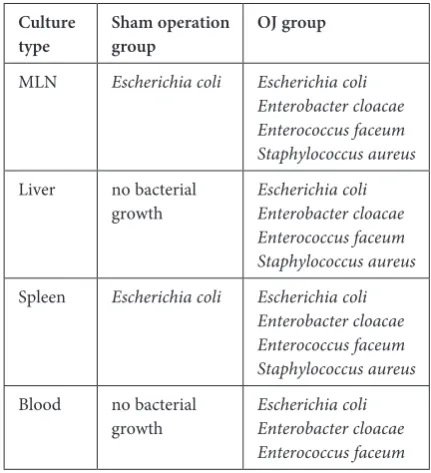
The predominant pathogens obtained from the MLN, liver, spleen and blood were Escheri-chia coli (E. coli), Enterobacter cloacae, Enterococ-cus faceum and Staphylococcus aureus. The most common microorganism found in all cultures was
E.coli (Table 2).
Mean cRP levels (ng/mL) were 8.7 ± 11.8 and 18.6 ± 17.2 in the sham-operated group and the OJ group respectively. There was no significant differ-ence in mean cRP levels between the two groups (p = 0.257).
When the mean cRP levels were evaluated ac-cording to the positiveness of BT, mean cRP lev-els were 4.5 ± 4.3 and 24.9 ± 16.4 in the BT (–) and
Table 1. The number of positive cultures for each group in all samples
Groups MLN Liver Spleen Blood Total BT
Sham-operated control (n = 10)
Obstructive jaundice (n = 10) 18 08 18 07 18
Total 9 8 9 7 9
Table 2. Types of bacteria grown in cultures by subject group Culture
type Sham operation group OJ group
MLN Escherichia coli Escherichia coli
Enterobacter cloacae Enterococcus faceum Staphylococcus aureus
Liver no bacterial
growth Escherichia coliEnterobacter cloacae Enterococcus faceum Staphylococcus aureus
Spleen Escherichia coli Escherichia coli Enterobacter cloacae Enterococcus faceum Staphylococcus aureus
Blood no bacterial
growth Escherichia coliEnterobacter cloacae Enterococcus faceum
BT (+) groups respectively. There was a significant difference in the mean cRP levels between BT (–) and BT (+) groups (p = 0.003). a marked increase in cRP levels paralleled an increase in bacterial growth and BT.
Discussion
The present study clearly showed that obstruc-tive jaundice caused bacterial translocation. The study also demonstrated that OJ can be induced in the rat by common bile duct ligation. This model was reliable, with no procedure-related mortality, suggesting that ligation of the common bile duct for ten days is non-lethal but promotes BT.
In the present study, BT was demonstrated in cultures of blood, MLN, spleen and liver samples obtained from animals with obstructive jaundice.
been demonstrated following both experimental jaundice and jaundiced patients [18, 28]. Deitch has proposed three factors that promote this process: (i) disruption of the indigenous gut microecology; (ii) physical injury of the gut mucosa; and (iii) impair-ment of host immunity [47]. Steffen and Berg dem-onstrated a correlation between the incidence of bac-terial translocation to mesenteric lymph nodes and cecal bacterial overgrowth in mice [48]. Intestinal anaerobic bacteria outnumber aerobic and faculta-tive bacteria by 100 : 1 or 1000 : 1, but rarely seem to be translocated [47]. anaerobes have been thought to control the colonization and concomitant trans-location of facultative bacteria. Thus, a disruption of the balance in the enteric microflora seems to occur in OJ [49]. The current study demonstrated a sig-nificant increase in the incidence of BT in the MLN, liver, spleen and blood in jaundiced rats.
The most commonly encountered pathogens in the MLN, liver, spleen and blood were E. coli, Enter-obacter cloacae, Enterococcus faceum and Staphylo-coccus aureus. These pathogens were also determined to be the most common in various other studies [42, 50]. One limitation of the present study is the exclu-sion of an anaerobic culture, which should also be ex-amined. On the other hand, anaerobes are isolated in only a small percentage of infected bile [34].
although elevation of acute phase reactant lev-els, such as cRP, is a non-specific host response to infection, inflammation and tissue injury, measur-ing alterations in these levels can be clinically useful when an infection or inflammatory response is sus-pected [44–47, 51, 53]. In the present study, cRP lev-els did not significantly differ between the sham-op-erated group and the OJ group. This may reflect the non-specific nature of the response of cRP to inflam-mation and infection, which impairs its selectivity for OJ. The observed increase in cRP levels may have been due to a systemic inflammatory response to sur-gery. a weakness of the experimental design could be the lack of an “anesthesia control group”. But when the mean cRP levels were evaluated according to positiveness of BT, there was a significant difference in mean cRP levels between the BT (–) and BT (+) groups (p = 0.003). a marked increase in cRP levels paralleled an increase in bacterial growth and BT.
Results from several studies suggest that sur-gery also increases the likelihood of bacteri-al translocation [53, 54]. In this study, one of the ten subjects in the sham-operated group (10%) had bacterial growth in their MLN and spleen tis-sue cultures, but no bacterial growth was shown in either liver tissue or blood cultures. although surgery may have contributed to bacterial trans-location in the present study, the rate of bacteri-al translocation in the OJ group was significantly higher than in the sham-operated control group (p = 0.002).
This study demonstrated a direct relationship between the BT and cRP levels in an experimental model of obstructive jaundice. although such a re-lationship has not been previously established in this model, prior results suggest possible mechanisms. as mentioned previously, endotoxin is a potent trigger of the mediator cascade and may have an important role in inducing mediators of the acute phase reaction [55]. Endotoxin also can cause systemic inflammato-ry response syndrome, multiple organ failure, septic shock and even non-septic shock [56, 57]. The lumi-nal flow of bile salts has antibacterial effects and a di-rect detergent affect on endotoxins, and it has been suggested that the increased absorption of endotoxin in OJ may be associated with an absence of bile salts in the small intestine [28, 58]. Therefore, with the ab-sence of bile, translocation of endotoxins along with bacteria in cases of OJ may cause a parallel increase in cRP levels. furthermore, high concentrations of serum cRP are closely related to a high risk of organ failure and death [59].
The authors consider cRP estimation a direct semi-quantitative, simple, sensitive and inexpen-sive measure of acute phase reaction and, due to its kinetics, provides adequate information regard-ing the stage of bacterial infections and BT.
In conclusion, cRP levels do not appear to be of value in distinguishing biliary obstruction. However, serum cRP levels may be useful for pre-dicting and determining the severity of bacterial translocation in cases of obstructive jaundice. The ability to detect changes in cRP levels this early is clinically useful, as it provides an opportunity to use this information in patient management.
Acknowledgements. The authors wish to thank Mustafa Ozturk, MD, who works at the Department of Public Health at Suleyman Demirel University Medical School, for his assistance with the statistical analysis. We also want to thank Hasan Dinelek, MD, for collecting experimental data; Omer Sekerci, PhD, for assisting with the preparation of the manuscript and correcting the language of the article.
References
Pitiakoudis M
[1] , Mimidis K, Tsaroucha AK, Papadopoulos V, Karayiannakis A, Simopoulos C: Predictive value of risk factors in patients with obstructive jaundice. J Int Med Res 2004, 32, 633–638.
Sikuler E
Scott-Conner CE
[3] , Grogan JB: The pathophysiology of biliary obstruction and its effect on phagocytic and immune function. J Surg Res 1994, 57, 316–336.
Lee SS
[4] , Girod C, Braillon A, Hadengue A, Lebrec D: Hemodynamic characterization of chronic bile duct-ligated rats: effect of pentobarbital sodium. am J Physiol 1986, 251, 176–180.
Zimmermann H
[5] , Reichen J, Zimmermann A, Sagesser H, Thenisch B, Hoflin F: Reversibility of secondary bili-ary fibrosis by biliodigestive anastomosis in the rat. Gastroenterology 1992, 103, 579–589.
O’Connor MJ
[6] : Mechanical biliary obstruction. a review of the multisystemic consequences of obstructive jaundice and their impact on perioperative morbidity and mortality. am Surg 1985, 51, 245–251.
Greig JD
[7] , Krukowski ZH, Matheson NA: Surgical morbidity and mortality in one hundred and twenty-nine patients with obstructive jaundice. Br J Surg 1988, 75, 216–219.
Gonullu NN
[8] , Canturk NZ, Utkan NZ, Yidirir C, Dulger M: factors affecting surgical mortality and morbidity in patients with obstructive jaundice. Mater Med Pol 1998, 30, 6-11.
Papakostas C
[9] , Bezirtzoglou E, Pitiakoudis M, Polychronidis A, Simopoulos C: Endotoxinemia in the portal and the systemic circulation in obstructive jaundice. clin Exp Med 2003, 3, 124–128.
Sakrak O
[10] , Akpinar M, Bedirli A, Akyurek N, Aritas Y: Short and long-term effects of bacterial translocation due to obstructive jaundice on liver damage. Hepatogastroenterology 2003, 50, 1542–1546.
[11] Padillo FJ, Muntane J, Montero JL, Briceno J, Mino G, Solorzano G, Sitges-Serra A, Pera-Madrazo C: Effect of internal biliary drainage on plasma levels of endotoxin, cytokines, and c-reactive protein in patients with obstruc-tive jaundice. World J Surg 2002, 26, 1328–1332.
Sung JY
[12] , Shaffer EA, Olson ME, Leung JW, Lam K, Costerton JW: Bacterial invasion of the biliary system by way of the portal-venous system. Hepatology 1991, 14, 313–317.
Karsten TM
[13] , van Gulik TM, Spanjaard L, Bosma A, van der Bergh Weerman MA, Dingemans KP, Dankert J, Gouma DJ: Bacterial translocation from the biliary tract to blood and lymph in rats with obstructive jaundice. J Surg Res 1998, 74, 125–130.
Thompson JN
[14] , Cohen J, Moore RH, Blenkharn JI, McConnell JS, Matkin J, Blumgart LH: Endotoxemia in obstructive jaundice. Observations on cause and clinical significance. am J Surg 1988, 155, 314–321.
Yoshimoto H
[15] , Ikeda S, Tanaka M, Matsumoto S: Relationship of biliary pressure to cholangiovenous reflux dur-ing endoscopic retrograde balloon catheter cholangiography. Dig Dis Sci 1989, 34, 16–20.
Rank J
[16] , Wilson ID: changes in Iga following varying degrees of biliary obstruction in the rat. Hepatology 1983, 3, 241–247.
Kimmings AN
[17] , van Deventer SJ, Obertop H, Rauws EA, Gouma DJ: Inflammatory and immunologic effects of obstructive jaundice: pathogenesis and treatment. J am coll Surg 1995, 181, 567–581.
Deitch EA
[18] , Sittig K, Li M, Berg R, Specian RD: Obstructive jaundice promotes bacterial translocation from the gut. am J Surg 1990, 159, 79–84.
Van Leeuwen PA
[19] , Boermeester MA, Houdijk AP, Ferwerda CC, Cuesta MA, Meyer S, Wesdorp RI: clinical significance of translocation. Gut 1994, 35, S28–34.
Deitch EA
[20] : Multiple organ failure. Pathophysiology and potential future therapy. ann Surg 216, 117–134, 1992. Nuytinck JK
[21] , Goris RJ: Pathophysiology of the adult respiratory distress syndrome (aRDS) and multiple organ failure (MOf) – a hypothesis. Neth J Surg 1985, 37, 131–136.
Reynolds JV
[22] , Murchan P, Leonard N, Clarke P, Keane FB, Tanner WA: Gut barrier failure in experimental obstructive jaundice. J Surg Res 1996, 62, 11–16.
Dawiskiba J
[23] : The role of endotoxaemia in the development of renal disorders in experimental obstructive jaundice in rats. HPB Surg 1996, 10, 7–10.
Inan M
[24] , Sayek I, Tel BC, Sahin-Erdemli I: Role of endotoxin and nitric oxide in the pathogenesis of renal failure in obstructive jaundice. Br J Surg 1997, 84, 943–947.
Turkcapar AG
[25] , Ersoz S, Gur U, Yerdel MA, Karaaslan A, Erden E, Kuterdem E: The effect of octreotid on bacte-rial translocation from the gut. an experimental study. Int Surg 1995, 80, 264–266.
Marshall JC
[26] , Christou NV, Meakins JL: The gastrointestinal tract. The “undrained abscess” of multiple organ failure. ann Surg 1993, 218, 111–119.
Ogata Y
[27] , Nishi M, Nakayama H, Kuwahara T, Ohnishi Y, Tashiro S: Role of bile in intestinal barrier function and its inhibitory effect on bacterial translocation in obstructive jaundice in rats. J Surg Res 2003, 115, 18–23. Slocum MM
[28] , Sittig KM, Specian RD, Deitch EA: absence of intestinal bile promotes bacterial translocation. am Surg 1992, 58, 305–310.
Kuzu MA
[29] , Kale IT, Col C, Tekeli A, Tanik A, Koksoy C: Obstructive jaundice promotes bacterial translocation in humans. Hepatogastroenterology 1999, 46, 2159–64.
Hori Y
[30] , Ohyanagi H: Protective effect of the intravenous administration of ursodeoxycholic acid against endotox-emia in rats with obstructive jaundice. Surg Today 1997, 27, 140–144.
Sileri P
[31] , Morini S, Sica GS, Schena S, Rastellini C, Gaspari AL, Benedetti E, Cicalese L: Bacterial translocation and intestinal morphological findings in jaundiced rats. Dig Dis Sci 2002, 47, 929–934.
Ding JW
[32] , Andersson R, Soltesz V, Willen R, Loft S, Poulsen HE, Parsson H, Olsson K, Bengmark S: The effect of biliary decompression on bacterial translocation in jaundiced rats. HPB Surg 1993, 7, 99–110.
Van Bossuyt H
[33] , Desmaretz C, Gaeta GB, Wisse E: The role of bile acids in the development of endotoxemia dur-ing obstructive jaundice in the rat. J Hepatol 1990, 10, 274–279.
Vaishnavi C
Mackenzie I
[35] , Woodhouse J: c-reactive protein concentrations during bacteraemia: a comparison between patients with and without liver dysfunction. Intensive care Med 2006, 32, 1344–1351.
Dong Q
[36] , Wright JR: Expression of c-reactive protein by alveolar macrophages. J Immunol 1996, 156, 4815–4820. Jabs WJ
[37] , Logering BA, Gerke P, Kreft B, Wolber EM, Klinger MH, Fricke L, Steinhoff J: The kidney as a second site of human c-reactive protein formation in vivo. Eur J Immunol 2003, 33, 152–161.
van der Meer V
[38] , Neven AK, van den Broek PJ, Assendelft WJ: Diagnostic value of c reactive protein in infections of the lower respiratory tract: systematic review. BMJ 2005, 331, 26.
Gabay C
[39] , Kushner I: acute-phase proteins and other systemic responses to inflammation. N Engl J Med 1999, 340, 448–454.
Ranzani OT, Zampieri FG, Forte DN, Azevedo LC, Park M:
[40] c-reactive protein/albumin ratio predicts 90-day
mortality of septic patients. PLoS One. 2013, 8, e59321. Sierra R
[41] , Rello J, Bailen MA, Benitez E, Gordillo A, Leon C, Pedraza S: c-reactive protein used as an early indicator of infection in patients with systemic inflammatory response syndrome. Intensive care Med 2004, 30, 2038–2045.
Cevikel MH
[42] , Ozgun H, Boylu S, Demirkiran AE, Aydin N, Sari C, Erkus M: c-reactive protein may be a marker of bacterial translocation in experimental intestinal obstruction. aNZ J Surg 2004, 74, 900–904.
Alper E, Baydar B, Vatansever S:
[43] Does presence of common bile duct stones in patients with acute biliary pan-creatitis affect the severity of illness or laboratory findings? Turk J Gastroenterol 2011, 22, 517–522.
Ozdil B, Kece C, Cosar A, Akkiz H, Sandikci M:
[44] Potential benefits of combined N-acetylcysteine and
ciprofloxa-cin therapy in partial biliary obstruction. J clin Pharmacol 2010, 5, 1414–1419. La Greca G, Sofia M, Lombardo R, Latteri S, Ricotta A, Puleo S, Russello D:
[45] adjusting ca19-9 values to predict
malignancy in obstructive jaundice: influence of bilirubin and c-reactive protein. World J Gastroenterol 2012, 18, 4150–4155.
Pine JK, Fusai KG, Young R:
[46] Serum c-reactive protein concentration and the prognosis of ductal adenocarci-noma of the head of pancreas. Eur J Surg Oncol 2009, 35, 605–610.
Deitch EA:
[47] Bacterial translocation of the gut flora. J Trauma 1990,30, S184–189.
Steffen EK
[48] , Berg RD: Relationship between cecal population levels of indigenous bacteria and translocation to the mesenteric lymph nodes. Infect Immun 1983, 39, 1252–1259.
Ding JW
[49] , Andersson R, Soltesz V, Willen R, Bengmark S: Obstructive jaundice impairs reticuloendothelial fun-ction and promotes bacterial translocation in the rat. J Surg Res 1994, 57, 238–245.
Aldemir M
[50] , Geyik MF, Kokoglu OF, Buyukbayram H, Hosoglu S, Yagmur Y: Effects of ursodeoxycholic acid, glutamine and polyclonal immunoglobulins on bacterial translocation in common bile duct ligated rats. aNZ J Surg 2003, 73, 722–726.
Westhuyzen J
[51] , Healy H: Review: Biology and relevance of c-reactive protein in cardiovascular and renal disease. ann clin Lab Sci 2000, 30, 133–143.
Peyrin-Biroulet L, Gonzalez F, Dubuquoy L:
[52] Mesenteric fat as a source of c reactive protein and as a target for bacterial translocation in crohn’s disease. Gut 2012, 61, 78–85.
Cicalese L
[53] , Sileri P, Green M, Abu-Elmagd K, Kocoshis S, Reyes J: Bacterial translocation in clinical intestinal transplantation. Transplantation 2001, 71, 1414–1417.
Meddah AT
[54] , Leke L, Romond MB, Grenier E, Cordonnier C, Risbourg B, Canarelli JP: The effects of mesenteric ischemia on ileal colonization, intestinal integrity, and bacterial translocation in newborn piglets. Pediatr Surg Int 2001, 17, 515–520.
Bolke E
[55] , Jehle PM, Graf M, Baier A, Wiedeck H, Steinbach G, Storck M, Orth K: Inflammatory response during abdominal and thyroid surgery: a prospective clinical trial on mediator release. Shock 2001, 16, 334–339.
Glauser MP
[56] , Zanetti G, Baumgartner JD, Cohen J: Septic shock: pathogenesis. Lancet 1991, 338, 732–736. Ito Y
[57] , Machen NW, Urbaschek R, McCuskey RS: Biliary obstruction exacerbates the hepatic microvascular inf-lammatory response to endotoxin. Shock 2000, 14, 599–604.
Ding JW
[58] , Andersson R, Soltesz V, Willen R, Bengmark S: The role of bile and bile acids in bacterial translocation in obstructive jaundice in rats. Eur Surg Res 1993, 25, 11–19.
Qin YS, Li QY, Yang FC, Zheng SS:
[59] Risk factors and incidence of acute pyogenic cholangitis. Hepatobiliary Pancreat Dis Int 2012, 11, 650–654.
Address for correspondence:
Ibrahim Barut
Department of General Surgery Istiklal M. 1107 S. Gunhan ap. No: 6/8 32300-Isparta
Turkey
Tel.: +90 246 211 9246 E-mail: [email protected]
conflict of interest: None declared