Dr. Syed Shahzad Hasan
School of Pharmacy, The University of Queensland, 20 Cornwell Street, Woolloongabba, 4102 Brisbane, Australia
Email: [email protected]
Address for correspondence
Access this article online www.japer.in
An assessment of pharmacy students’ empathy levels in Malaysia
INTRODUCTION
Empathy earns global attention and cited as the
backbone of patient care in recent years.[1] Empathy
is one of the basic “ingredients” of good
physician-patient relationships.[2-3] Empathy is often
considered an important attribute for professionals in
the health field,[4]and is directly linked to positive
clinical outcomes.[5] Like many other English words,
empathy also originates from Greek word
“empatheia”, meaning ‘feeling into’.[6] Empathy was
first introduced in the context of patient care by Hojat
(2007), as predominantly cognitive (rather than
emotional) attribute that involves an understanding
(rather than feeling) of experiences, concerns and
perspectives of the patients, combined with a capacity
to communicate this understanding.[3] Pedersen
(2009) defines empathy succinctly as the “appropriate
understanding of the patient”.[7] Both empathy and
sympathy involve sharing,[8] but the concept of
empathy lies on cognitive understanding,[9] whereas
sympathy involves sharing emotions with the
patients.[10-11]
Numerous studies have reported a decline in empathy
level among undergraduate medical students as they
progress through their professional education,[12-16]
as well as during their post-graduate training.[17]
While this decline is commonly reproduced in studies,
there are still some studies that found senior students
as being significantly more empathetic than junior
students.[18-20] A longitudinal study by Hojat et al
(2009) found no significant change in the first 2 years
of medical school but a significant decline in empathy
by the third year that continued throughout the
students’ medical training.[15] However, a
cross-sectional study in Iran did not find variations in
empathy scores.[21] Some studies linked “erosions” in
empathy level with the learning context, the “hidden
curriculum”, student difficulties in dealing with
stressors in medical education, and poor role
modeling in the academic and clinical workplaces.[15,
22-23]
Empathy is considered to be equally important in
pharmacy education and practice.[24] Despite the fact
that empathy influences adherence to medical
recommendations,[25] reduces medical errors,[26] R
Research esearch ArticleArticleArticle
This study examined the validity and reliability of the student version of Jefferson Scale of Empathy-Health Profession (JSE-HPS) in a sample of pharmacy students and to subsequently use JSE-HPS to assess empathy levels in first to fourth (final) year pharmacy students in public and private universities in Malaysia. The JSE-HPS was administered to 719 first to fourth (final) year pharmacy students; 313 were enrolled at a public university and 406 at a private university in Malaysia. Both descriptive and inferential statistics were performed using SPSS® version 18. The JSE-HPS demonstrated good internal consistency (Cronbach’s α = 0.70). A three-factor solution emerged and included ‘perspective taking’, ‘compassionate care’ and ‘standing in patient’s shoes’ factors, accounting for 16.4%, 16%, and 7.6% of the variance, respectively. The total mean empathy score was 83.02±8.23, the actual score ranged between 46.05 and 113.25. Overall, males and students of Malay origin were more empathic than females and students of other ethnic origins. Junior students (year one and two) were more empathic than senior students (year three and four), and public university students had significantly higher mean empathy score compared to those enrolled at a private university (83.89 versus 82.34, p=0.012). This study confirms the construct validity and internal consistency of the JSE-HPS for measuring empathy in pharmacy students. Empathy scores among students vary depending on type of university and year of study.
Keywords: Empathy, pharmacy students, public, private, university, Malaysia
ABSTRACT ABSTRACT ABSTRACT ABSTRACT
Syed Shahzad Hasan1,2*, Muneer Gohar Babar1*, Kheng Kai Chan1*, Syed Imran Ahmed1*, Shahid Mitha1*
1International Medical University,
Jalan Jalil Perkasa 19, Bukit Jalil, Kuala Lumpur, 57000, Malaysia
2School of Pharmacy, The
University of Queensland, 20 Cornwell Street, Woolloongabba, 4102, Brisbane, Australia
and facilitates patients’ satisfaction,[27] only few
studies have examined empathy level in pharmacy
students.[28-29] A study by Fjortoft et al (2011),
found that empathy level in first year pharmacy
students is comparable to those reported for medical
students,[3, 29] and physicians.[10] Few studies have
explored potential differences in empathy levels
between students from different health disciplines
using the Jefferson Scale of Empathy.[12, 28] In one
study, pharmacy students were found to have the
lowest empathy scores on entering the first year of
training, with little change in their empathy scores on
completion of the first year, as compared to nursing,
dental and medical students.[12] Another study found
nursing students with significantly higher levels of
empathy as compared to pharmacy students.[28] Due
to the significant decline in empathy level, numerous
approaches have been suggested in order to improve
pharmacy students’ empathy such as providing
communication-skills training,[28] participating in
service activity,[30] attending workshop about
aging,[31] and patient empathy modeling.[24]
Several instruments are available to examine empathy
level such as Interpersonal Reactivity Index,[32] The
Empathy Scale,[33] The Emotional Empathy Scale,[34]
and Jefferson Scale of Physician Empathy (JSPE).[3, 10,
14, 19] JSPE is a well-validated, content-specific and
context-relevant instrument, and exists in two
versions, the physician version and the student
version.[3, 10, 19] The generalization of findings
within the pharmacy schools is uncertain, since the
published literature is mainly restricted to medical
schools or few pharmacy schools in developed
countries. Few studies have been reported about the
measurement properties of the Jefferson Scale of
Empathy-Health Profession Students version
(JSE-HPS) among pharmacy students.[29] The primary aim
of this study was to examine the validity and
reliability of the student version of JSE-HPS in a
sample of pharmacy students and to subsequently use
to assess empathy levels in first to fourth (final) year
pharmacy students in a public and private university
in Malaysia.
MATERIALS AND METHODS
Study design and population
This cross-sectional study was carried out among first
to final-year (4th year) undergraduate pharmacy
students using a well-validated, self-administered
Jefferson Scale of Empathy-Health Profession Student
Version (JSE-HPS). In order to gain a general picture of
empathy among pharmacy students, one public
(government-funded) university, University
Kebangsaan Malaysia (UKM) and private university,
International Medical University (IMU). One staff
member from each university coordinated the
distribution and collection of the anonymous
questionnaires. The study was approved by the
International Medical University’s research and ethics
committee (IMU-REC) and permission to collect data
was obtained from the Dean Office of UKM.
The Jefferson Scale of Empathy - (JSPE-HPS)
A widely used, student version of Jefferson Scale of
Empathy was used in this study.[14, 18-20, 29, 35-36]
The scale was developed by the Jefferson Medical
College, and was originally developed for medical
students,[36] and was later modified to be applicable
to practicing physicians and other health
professionals.[10] The psychometric properties of this
scale have been reported as satisfactory and the
construct validity of the scale has been examined
previously.[13, 29, 36] The instrument was found to
be reliable (0.89 and 0.87) among medical students
and residents, respectively.[36] The instrument
consists of 20 items answered on 7-point Likert scale
which are scored from 1 (strongly disagree) to 7
(strongly agree). Among the 20 questions, 10
negatively worded items in the scale were reverse
scored.[20, 29] The total score ranges from 20-140; a
higher score indicates a behavioral tendency favoring
Data collection
During the data collection phase, one of the
researchers approached each cohort of students at
IMU to provide information about the study and
distribute the questionnaires to the students.
Questionnaires were posted via courier service to the
coordinator at UKM, together with a copy of the
ethical approval letter, participant information sheets
and consent forms. Convenience sampling was used to
enroll all the eligible respondents during the study
period. The researchers were instructed not to lead
the students in their answers but to elucidate the
questions when it was necessary to clarify the points.
The participants were briefed by the researchers
before filling up the questionnaire. The participants
were approached after major teaching and learning
sessions to obtain higher response rate. Informed
consent was obtained from all participants. Responses
from first to final year pharmacy students were
collected at the beginning of the semester. The content
and the teaching methods remained stable over the
period in which the information was collected.
Participation was voluntarily and all information
gathered was kept confidential
Statistical analyses
Both descriptive and inferential data analyses were
performed using SPSS® version 18 with 0.05 as the
level of significance. Descriptive statistics was used to
generate summary estimates on the participants by
type of university and study year. Since JSPE-HPS has
not been previously used in Malaysia, we conducted a
Principal Component Analysis (PCA),[37-38] to
examine the underlying components of JSE-HPS in
pharmacy students. In order to achieve a favorable
ratio (>10:1) of respondents over instruments items, a
minimum of 200 participants were required to
conduct factor analysis.[38] Next we performed
Kaiser-Meyer-Olkin test (KMO) to measure sampling
adequacy of > 0.7.[18] An Eigenvalue of > 1 was used
for retaining factors in PCA.[37] However, potential
bias can be introduced by the use of > 1 cut-off
value,[37] and therefore we also inspected the Scree
plot, as a superior factor selection method to
determine the appropriate number of factors to retain
for rotation.[39] Bartlett’s test of sphericity was used
to measure significant correlations between
variables.[18] The corrected item-total score
correlations were also examined. Internal consistency
was analysed using Cronbach’s alpha. Independent
T-test and one way analyses of variance (ANOVA)
including post hoc tests were computed to examine
differences in empathy scores related to gender, age
and ethnic groups, type of university and year of
study.
RESULTS
Out of 1,011 students who were requested to
participate in the study, 719 accepted and successfully
completed the questionnaire, with a response rate of
71.1%. The number of students from each university
who participated in the study is presented in Table 1.
Of the total sample, 596 students were females
(82.9%), 384 aged between 21-23 years (55.4%) and
492 were Chinese (68.4%). There was a good
representation of students from each of the four years
of study; 34.4% from first year, 19.6% from second
year, 22.7% from third year, and 23.4% from final
year. Similarly there was a good representation of
students from public and private universities; 43.6%
from public university, and 56.4% from private
university.
Table 2 summarized the descriptive statistics of the
study. The total mean empathy score for 719 students
was 83.02 with the standard deviation of 8.23. The
actual score ranged between 46.05 and 113.25. The
Cronbach’s alpha value of the scale was 0.70 which
indicates acceptable, satisfactory reliability. An
analysis of the individual JSE-HPS items showed that
respondents tended to answer all items.
Principal Component Analysis (PCA)
The 20 items of JSE-HPS were entered into iterated
The KMO test of sampling adequacy was applied prior
to factor extraction, which resulted in overall index of
0.84, suggesting that the sample was adequate for
factor analysis. The Bartlett’s test for sphericity
showed that the inter-correlation matrix was
factorable (Chi-Square (190) = 2946.4, p < 0.001).
Inspection of the corresponding Scree plot and
identification of an ‘elbow’ point after which the
inclusion of additional factors does not result in
substantial gains in ‘variance explained’ yielded the
existence of at least three factors, with eigenvalues
more than one. Based on the plot of the eigenvalues
that leveled off after the third factor, a 3-factor
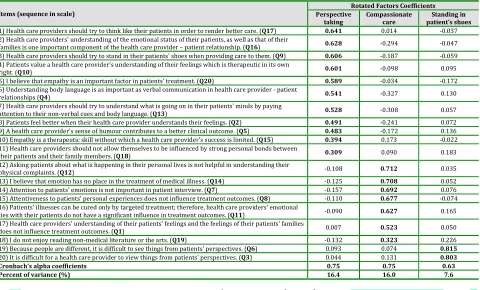
solution was selected. The loadings of individual items
on these three factors are presented in Table 3.
The three underlying factors were labeled as
“perspective taking”, “compassionate care” and
“standing in patient’s shoes”. Eleven items had the
highest factor coefficients (≥0.3) on the first extracted
factor, which accounted for the largest proportion of
the variance before rotation (16.4%). Seven items
under “compassionate care” and 2 items under
“standing in patient’s shoes” had significant factor
loadings (>0.3), accounted for 16%, and 7.6% of the
variance, respectively. The total variance explained by
the three dimensions of empathy was 40%.
Cronbach’s alpha values were acceptable for all three
identified factors, and ranged from 0.63 for factor 3 to
0.75 for factors 1 and 2.
Comparisons of empathy scores
Table 4 demonstrates the overall mean scores of
JSE-HPS measures. The mean empathy score for males
(mean=84.85, SD=9.07) was significantly higher than
the mean empathy score for females (mean=82.64,
SD=8.00), p=0.013. Participants aged between 18 to
20 years had highest empathy mean score
(83.63±8.44). No significant difference in empathy
scores between the age groups; similarly, post hoc
testing did not demonstrate any statistically
significant difference. Overall, Malay students
(mean=84.51, SD=8.90) had higher mean empathy
score compared to Chinese (mean=82.50, SD=7.95)
and Indian (mean=82.02, SD=7.70) students. Students
in public university had significantly higher mean
empathy score compared to students in private
university (83.89 versus 82.34, p=0.012). Students in
the second year had higher mean empathy score
compared to students in other study years,
significantly higher than fourth year students
(p<0.001). Students in the fourth year of study had
lower empathy scores compared to students in other
study years.
After stratification by type of university, we found that
female students enrolled at public university
(84.03±8.23) had the highest mean empathy score
compared to females (82.17±8.22) enrolled at private
university and male students enrolled at both, public
and private universities (Table 5). Participants aged
24 years and older had highest empathy mean score in
public university (84.51±6.97), but had lowest
empathy mean score in private university
(81.99±9.45). Students in the second year of study had
the highest mean empathy score compared to
students in other study years.
DISCUSSION
The main objectives of this study were to describe and
summarize the psychometric properties of JSE-HPS,
including its internal consistency and factor structure
and to assess the empathy level among pharmacy
students of public and private universities in Malaysia.
The mean empathy score of 83 in this study is much
lower than the average empathy scores of 103 – 114
reported by previous studies among medical,[16, 19,
39-41] and pharmacy students.[29] The findings
suggest that empathy level among pharmacy students
in Malaysia is lower compared to medical and
pharmacy students in the US, Korea, Japan, South
Africa, and Iran.[16, 19, 21, 29, 39-41] The total
variance explained by the three dimensions of
empathy instrument (40%) is similar to the ones
students with S-version,[21, 39] and pharmacy
students with HPS version.[29]
In our factor analysis, there were three underlying
principal factors identified in the JSE-HPS instrument,
namely “perspective taking”, “compassionate care”,
and “standing in patient’s shoes”. Perspective taking
describes the understanding of patient’s concerns
while compassionate care was labeled to explain the
association of feeling and emotion with empathy
understanding,[29] and is the core ingredient of
empathy, while compassionate care is considered as
an important aspect for healthcare provider-patient
relationship.[10, 19, 29, 35, 42] “Standing in patient’s
shoes” indicates an ability to comprehend and reflect
patients’ concerns.[3, 6] These factors are similar to
the prominent ones reported in previous studies,
supporting the construct validity of this instrument
for pharmacy students.[10, 21, 39, 42] However a
study conducted in a pharmacy school in the United
States (US) reported only two underlying
components,[29] namely perspective taking and
compassionate care. The reason being the authors did
not follow Kaiser’s suggestion to retain factors with an
eigenvalue greater than one,[43] instead followed
Velicer and Fava method, which suggests a minimum
of 3 items per factor for a stable structure.[44]
Factor analysis does not reveal a value greater than
0.35 for items 18 and 19 (Table 2) in the instrument.
Similarly the study among South African and Japanese
medical students, and a study among pharmacy
students in the US also revealed factor loading of less
than 0.35 for items 18 and 19.[19, 39, 45] From this
finding, it is evident that students had some difficulty
with these two items. The remaining 18 items were
answered consistently by the students, demonstrating
a strong presence of empathy. Boyle et al suggested
that item 18 has the most relevance to sympathy
rather than empathy.[20] Similarly Looi suggested
that item 19 has the most relevance to examine (1) the
ability to render care and not necessarily empathy or,
(2) the perception of empathy by physicians, patients
or the public.[46] Despite these findings, there was a
strong internal consistency for the JSE-HPS in this
study as measured by Cronbach’s alpha coefficient.
However, our Cronbach’s Alpha value of 0.70 is lower
than those reported by the studies conducted
elsewhere.[18, 29, 36]
Consistent with previous study by Grace et al,[47] our
results indicated that male students obtained a higher
total mean empathy score than female students.
However after stratification by type of university, we
found that female students enrolled at public
university were more empathic than men.[10, 12-13,
18-20, 24, 28-29, 35] Previous studies argued that
empathy is a feminine trait and that females are more
receptive to emotional signals.[10, 20] Some explained
this finding with help of evolutionary theory of
parental as women tend to display more care-giving
attitudes compared to men.[10, 19] No significant
difference between students in different age groups
was found and, as such, the results overall show the
extent of empathy to be more similar than different
across the various age groups.
Malaysia is a multi-racial country with three distinct
ethnic groups. Malays are the dominant ethnic group,
followed by Chinese and Indians in Malaysia. Malay
students had higher empathy level compared to
Chinese and Indian students in our study. This
difference in empathy level could be a result of their
different cultural values, religious beliefs or
traditions.[39] It has been reported earlier that
cultural differences, ethnicity, religious beliefs, and
sex stereotyping may lead to empathy score
disparity,[19, 42] and can also influence empathic
engagement during clinical encounters.[39]
Interestingly, public university students were more
empathic than private university students in our
study. There could be several reasons to explain this
finding. For instance public universities in Malaysia
have their own teaching hospitals which allowed their
students to have more frequent visits to hospitals and
patients, resulting in improvement of empathy level.
to identify reasons as available literature is not
adequate particularly in developing countries.
Several studies have investigated potential differences
in empathy between students from different study
year; however, there are still significant gaps in the
literature.[13, 24, 28] Students in the second year of
study had higher mean empathy score compared to
students in other study years, whereas students in the
fourth year had lowest empathy score in our study.
Similar results can be seen in medical and dental
students as well.[13, 24] This decline in student
empathy appears to be a common phenomenon
emerging in the literature.[14, 16, 20, 35] As empathy
is a core “ingredient” of good health care
professional-patient relationship,[2, 3] improving students’
empathy is one of the important tasks of medical
education.[42] However, empathy is generally only
taught in a context where it is not formally evaluated
and is rarely integrated into clinical teaching and
learning.[4] Our findings of junior students being
more empathic than senior students could be partially
explained by the fact that participating universities
covered certain aspects of empathy in year one and
year two. As time progress, they tend to forget and
focus on other subjects,[19] or students become
‘hardened’ or develop an emotional coping
mechanism that distances themselves from the
patients they work with once they gain clinical
experience.[4] Idealism or eagerness to show positive
attributes of healthcare provider embraced by junior
students erode as they progress through their
professional education.[12, 18] Other reasons include
stressful workload, limited bedside interactions with
patients and environmental factors.[13, 42]
LIMITATIONS OF THE STUDY
This study had several limitations that may affect its
generalization. This study was completed early in the
academic year, and students’ responses may be based
on learning experiences of the previous years. This
study did not explore whether clinical experience or
placements for the complete course had an overall
impact on students’ empathy. Those students who did
volunteer to participate may themselves bias the
results. Our assessment of empathy level was based
on self-report measures of a validated instrument, and
not on the actual behaviours. Lastly, our study was
cross-sectional in design which did not allow for a
baseline or tracking changes in empathy level across
the year levels of the program.
CONCLUSION
The scale appears to be reliable based on good
internal consistency, supporting the construct validity
of this instrument for pharmacy students. The
empathy level of students who participated in this
study was much lower to the average empathy level
reported by previous studies among medical and
pharmacy students. Overall males and students of
Malay origin were more empathic than females and
students of other ethnic origins. Junior students (year
one and two) were more empathic than senior
students (year three and four). There was a significant
difference recorded between students enrolled at
public and private university. Findings should be
confirmed in more diverse pharmacy student
populations and to explore changes in empathy level
in students, longitudinal studies are recommended.
ACKNOWLEDGEMENTS
We wish to record our appreciation for the
administrative assistance of the International Medical
University Postgraduate Office and our gratitude to
the management and students of participated
institutions.
CONFLICTS OF INTEREST
The authors declare that they have no competing
Table 1: Socio-demographics of pharmacy students, by type of university (N=719)
Variables Overall
N (%)
Public Uni N (%)
Private Uni
N (%) Association (p-value)
Gender
Male 123 (17.10) 53 (7.40) 70 (9.70) 0.913
Female 596 (82.90) 260 (36.20) 336 (46.70)
Age groups
18-20 318 (44.20) 161 (22.40) 157 (21.80) 0.001
21-23 384 (53.40) 152 (21.10) 232 (32.30)
24-26 17 (2.40) 0 (0.00) 17 (2.40)
Ethnic groups
Malay 176 (24.50) 160 (22.30) 16 (2.20) 0.001
Chinese 492 (68.40) 145 (20.20) 347 (48.30)
Indian 36 (5.00) 5 (0.70) 31 (4.30)
Others 15 (2.10) 3 (0.40) 12 (1.70)
Year of study
Year 1 247 (34.40) 98 (13.60) 149 (20.70) 0.421
Year 2 141 (19.60) 67 (9.30) 74 (10.30)
Year 3 163 (22.70) 75 (10.40) 88 (12.20)
Year 4 168 (23.40) 73 (10.20) 95 (13.20)
Uni = University
Table 2: Descriptive Statistic for the JSE-HPS in pharmacy students (N = 719)
Items
Score, Mean (SD) 83.02 (8.23)
Score, Median 82.35
25th Percentile Score 77.35
50th Percentile (Median) Score 82.35
75th Percentile Score 87.35
Possible Score Range 20-140
Actual Score Range 46.05 – 113.25
Alpha Reliability Coefficient 0.70
Note: JSE-HPS = Jefferson Scale of Empathy-Healthcare provider Student Version
Table 3: Summary of Factor Analysis and corrected item-total score correlations of the JSPE-HPS administered to 719 pharmacy students
Items (sequence in scale)
Rotated Factors Coefficients Perspective
taking
Compassionate care
Standing in patient’s shoes
1) Health care providers should try to think like their patients in order to render better care. (Q17) 0.641 0.014 -0.037 2) Health care providers' understanding of the emotional status of their patients, as well as that of their
families is one important component of the health care provider – patient relationship. (Q16) 0.628 -0.294 -0.047 3) Health care providers should try to stand in their patients' shoes when providing care to them. (Q9) 0.606 -0.187 -0.059 4) Patients value a health care provider's understanding of their feelings which is therapeutic in its own
right. (Q10) 0.601 -0.098 0.095
5) I believe that empathy is an important factor in patients' treatment. (Q20) 0.589 -0.034 -0.172 6) Understanding body language is as important as verbal communication in health care provider - patient
relationships (Q4) 0.541 -0.327 0.130
7) Health care providers should try to understand what is going on in their patients' minds by paying
attention to their non-verbal cues and body language. (Q13) 0.528 -0.308 0.057
8) Patients feel better when their health care provider understands their feelings. (Q2) 0.491 -0.241 0.072 9) A health care provider's sense of humour contributes to a better clinical outcome. (Q5) 0.483 -0.172 0.136 10) Empathy is a therapeutic skill without which a health care provider's success is limited. (Q15) 0.394 0.173 -0.022 11) Health care providers should not allow themselves to be influenced by strong personal bonds between
their patients and their family members. (Q18) 0.309 0.090 0.183
12) Asking patients about what is happening in their personal lives is not helpful in understanding their
physical complaints. (Q12) -0.108 0.712 0.035
13) I believe that emotion has no place in the treatment of medical illness. (Q14) -0.125 0.708 0.052 14) Attention to patients' emotions is not important in patient interview. (Q7) -0.157 0.692 0.076 15) Attentiveness to patients' personal experiences does not influence treatment outcomes. (Q8) -0.110 0.677 -0.074 16) Patients' illnesses can be cured only by targeted treatment; therefore, health care providers' emotional
ties with their patients do not have a significant influence in treatment outcomes. (Q11) -0.090 0.627 0.165 17) Health care providers' understanding of their patients' feelings and the feelings of their patients' families
does not influence treatment outcomes. (Q1) 0.007 0.523 0.050
18) I do not enjoy reading non-medical literature or the arts. (Q19) -0.132 0.323 0.226
19) Because people are different, it is difficult to see things from patients' perspectives. (Q6) 0.093 0.074 0.815
20) It is difficult for a health care provider to view things from patients' perspectives. (Q3) 0.044 0.131 0.803
Cronbach’s alpha coefficients 0.75 0.75 0.63
Table 4: Overall mean scores of JSPE-HPS measures (N = 719)
Variables N Mean SD P-value
Gender
Male 123 84.85 9.07
0.013
Female 596 82.64 8.00
Age groups
18-20 318 83.63 8.44
> 0.05
21-23 384 82.56 7.99
24-26 17 81.99 9.45
Ethnic groups
Malay 176 84.51 8.90
Malay vs Chinese = 0.028
Chinese 492 82.50 7.95
Indian 36 82.02 7.70
Others 15 84.78 8.82
Type of university
Public 313 83.89 8.21
0.012
Private 406 82.34 8.20
Year of study
Year 1 247 82.99 8.15
Year 2 vs Year 4 = 0.001
Year 2 141 85.00 9.18
Year 3 163 82.85 7.52
Year 4 168 81.55 7.92
Table 5: Mean scores of JSPE-HPS measures, by public and private universities (N = 719)
Variables Public Uni
Mean score (SD)
Private Uni Mean score (SD) Gender
Male 83.27 (8.12) 83.20 (8.09)
Female 84.03 (8.23) 82.17 (8.22)
Age groups
18-20 82.44 (7.36) 82.76 (8.32)
21-23 84.34 (8.54) 82.09 (8.04)
24-26 84.51 (6.97) 81.99 (9.45)
Ethnic groups
Malay 87.05 (9.50) 84.74 (9.06)
Chinese 83.56 (8.12) 82.16 (8.15)
Indian 84.20 (6.68) 82.46 (8.03)
Others 88.40 (11.80) 84.07 (9.27)
Year of study
Year 1 82.45 (7.04) 83.15 (8.83)
Year 2 85.89 (8.78) 83.15 (8.40)
Year 3 83.89 (8.44) 81.67 (6.72)
Year 4 83.18 (7.99) 81.07 (8.16)
REFERENCES
1. Spiro H. Commentary: The practice of empathy. Acad
Med 2009; 84(9):1177-1179.
2. Reiss H. Empathy in Medicine: A Neurological
Perspective. J Am Med Assoc. 2010; 304(14):
1604-1605.
3. Hojat M. Empathy in Patient Care: Antecedents,
Development, Measurement, and Outcomes. New
York, NY: Springer; 2007.
4. Boyle MJ, Williams B, Brown T, Molly A, McKenna L,
Molly L, Lewis B. Level of empathy in undergraduate
health science students. Int J Med Educ. 2010; 1(1).
5. Hojat M, Louis DZ, Markham FW, Wender R,
Rabinowitz C, Gonnella JS. Physicians’ empathy and
clinical outcomes for diabetic patients. Acad Med.
2011;86(3):359-364.
6. Kohut H. Analysis of the Self: A Systematic Approach
to the Psychoanalytic Treatment of Narcissistic
Personality Disorders. International Universities
Press; 1971.
7. Pedersen R. Empirical research on empathy in
medicine–A critical review. Patient Educ Couns.
8. Hemmerdinger JM, Stoddart SD, Lilford RJ. A
systemic review of tests of empathy in medicine.
BMC Med Educ. 2007; 7:24.
9. Lillo MD, Cicchetti A, Scalzo AL, Taroni F, Hojat M.
Jefferson Scale of Physician Empathy: Preliminary
psychometrics and group comparisons in Italian
physicians. Acad Med. 2009; 84:1198-1202.
10. Hojat M, Gonnella JS, Nasca TJ, Mangione S, Vergare
M, Magee M. Physician empathy: Definition,
measurement, and relationship to gender and
specialty. Am J Psych. 2002; 159: 1563-1569.
11. Nightingale SD, Yarnold PR, Greenberg MS.
Sympathy, empathy, and physician resource
utilization. J Gen Intern Med. 1991; 6: 420-423.
12. Nunes P, Williams S, Sa B, Stevenson K. A study of
empathy decline in students from five health
disciplines during their first year of training. Int J
Med Educ. 2011; 2: 12-17.
13. Chen D, Lew R, Hershman W, Orlander J. A
Cross-sectional Measurement of Medical Student Empathy.
J Gen Intern Med. 2007; 22(10): 1434-1438.
14. Hojat MR, Mangione S, Nasca TJ, Rattner S, Erbmann
JB, Gonnella JS, Magee M. An empirical study of
decline in empathy in medical school. Med Educ.
2004; 38:934-941.
15. Hojat M, Vergare M, Maxwell K, Brainard G, Herrine
S, Isenberg G, Veloski J, Gonnella J. The devil is in the
third year: a longitudinal study of erosion of
empathy in medical school. Acad Med. 2009,
84(9):1182-1191.
16. Chen D, Lew R, Hershman W, Orlander J. A
Cross-sectional Measurement of Medical Student Empathy.
J Gen Intern Med. 2007, 22(10):1434-8.
17. Hojat M, Gonnella J, Mangione S, Nasca T, Magee M.
Physician empathy in medical education and
practice: experience with The Jefferson Scale of
Physician Empathy. Sem Integr Med. 2003,
1(1):25-41.
18. Magalhaes E, Salgueira AP, Costa P, Costa MJ.
Empathy in senior year and first year medical
students: A cross-sectional study. BMC Med Educ.
2011; 11:52.
19. Kataoka HU, Koide N, Ochi K, Hojat MR, Gonnella JS.
Measurement of Empathy among Japanese Medical
Students: Psychometrics and Score Differences by
Gender and Level of Medical Education. Acad Med.
2009; 84:1192-1197.
20. Boyle MJ, Williams B, Brown T, Molly A, McKenna L,
Molly L, Lewis B. Level of empathy in undergraduate
health science students. Int J Med Educ. 2010; 1(1).
21. Rahimi-madiseh M, Tavakol M, Dennick R, Nasiri J.
Empathy in Iranian medical students: a preliminary
psychometric analysis and differences by gender and
year of medical school. Med Teach 2010, 32:471-478.
22. Spencer J. Decline in empathy in medical education:
how can we stop the rot? Editorials. Med Educ. 2004,
38:916-920.
23. Thomas MR, Dyrbye LN, Huntington JL, Lawson KL,
Novotny PJ, Sloan JA, Shanafelt TD. How do distress
and well-being relate to medical student empathy? A
multicenter study. J Gen Intern Med. 2007,
22(2):177-83.
24. Chen TJ, LaLopa J, Dang D. Impact of Patient
Empathy Modeling on Pharmacy Students Caring for
the Underserved. Am J Pharm Educ. 2008; 72:40.
25. Vermeire E, Hearnshaw H, Van Royen P, Denekens J.
Patient adherence to treatment: three decades of
research. A comprehensive review. J Clin Pharm
Ther. 1998; 26(5) : 31-342.
26. Stepien KA, Baernstein A. Educating for empathy: a
review. J Gen Intern Med. 2006; 21(5):524-539.
27. Kim S, Kaplowitz S, Johnston MV. The effects of
physician empathy on patient satisfaction and
compliance. Eval Health Professions. 2004; 27(3):
237-251.
28. Wilson SE, Prescott J, Becket G. Empathy Levels in
First and Third Year Students in Health and
Non-health Disciplines. Am J Pharm Educ. 2012; 76 (2).
29. Fjortoft N, Van Winkle LJ, Hojat MR. Measuring
Empathy in Pharmacy Students. Am J Pharm Educ.
2011; 75(6).
30. Brazeau CML, Schroeder R, Rovi S, Boyd L.
Relationship between Medical Student Service and
Empathy. Acad Med. 2011; 86(10):42-45.
31. Van Winkle LJ, Fjortoft N, Hojat MR. Impact of a
Workshop About Aging on the Empathy Scores of
Pharmacy and Medical Students. Am J Pharm
Educ.2012; 76(1).
32. Davis MH. Measuring individual differences in
empathy: evidence for a multidimensional approach.
J Pers Sco Psychol. 1983; 44(1):113-126.
33. Hogan R. Development of an empathy scale. J Consult
34. Mehrabian A, Epstein NA. A Measure of Emotional
Empathy. J Pers. 1972; 40(4):525-543.
35. Sherman JJ, Cramer A. Measurement of Changes in
Empathy during Dental School. J Dent Educ. 2005;
69(3): 338-345.
36. Hojat MR, Mangione S, Nasca TJ, Cohen MJM,
Gonnella JS, Erdmann JB, et al. The Jefferson Scale of
Empathy: development of preliminary psychometric
data. Educ Psychol Meas. 2001; 61: 349-365.
37. Costello AB, Osborne J. Best practices in exploratory
factor analysis: four recommendations for getting
most from your analysis. Pract Assess Res Eval.
2005: 10: 7.
38. Bentler PM, Yuan KH. Test of linear trend in
eigenvalues of a covariance matrix with application
to data analysis. Br J Math Stat Psychol. 1996: 49:
299–312.
39. Vallabh K. Psychometrics of the student version of
the Jefferson Scale of Physician Empathy (JSPE-S) in
final-year medical students in Johannesburg in 2008.
S African J Bioethics Law 2001;4(2):1.
40. Roh M, Hahm B, Lee D, Suh D. Evaluation of Empathy
Among Korean Medical Students: A Cross-sectional
Study Using the Korean Version of the Jefferson Scale
of Physician Empathy. Teach Learn Med. 2010,
22(3): 167-171.
41. Mangione S, Kane GC, Caruso JW, et al. Assessment of
empathy in different years of internal medicine
training. Med Teach 2002;24(4):370-373.
42. Gonullu I, Oztuna D. A Turkish Adaptation of the
Student Version of the Jefferson Scale of Physician
Empathy. Marmara Med J. 2012; 25: 87-92.
43. Kaiser H. The application of electronic computer
factor analysis. Educ Psychol Meas.
1960;20(1):141-145.
44. Velicer WF, Fava JL. Effects of variable and subject
sampling on factor pattern recovery. Psychol
Methods. 1998;3(2): 231-251.
45. Kane GC, Gotto JL, Mangione S, West S, Hojat M.
Jefferson Scale of Patient’s Perception of Physician
Empathy: preliminary psychometric data. Croat Med
J. 2007;48:81-86.
46. Looi JCL. Empathy and competence. Med J Aust.
2008;188(7):414-416.
47. Grace Rose, Norman Frankel, Willard Kerr. Empathic
and Socio-metric Status among Young Teenagers. J
Gen Psycho. 1956; 89: 277-278.
How to cite this article: Syed Shahzad Hasan1,2*, Muneer
Gohar Babar1*, Kheng Kai Chan1*, Syed Imran Ahmed1*,
Shahid Mitha1*; An assessment of pharmacy students’
empathy levels in Malaysia; J. Adv. Pharm. Edu. & Res. 2013: 3(4): 531-540.