Copyright © 2015 IJECCE, All right reserved
77
Energy-Aware Routing Minimizing Interference and
Delay in Wireless Sensor Networks
Elmira Shahraki
Dept. of Electrical Engineering, University of Sistan And Baluchestan, Zahedan, Iran.
email: [email protected]
Hengameh Keshavarz
Dept. of Comm. Engineering, University of Sistan And Baluchestan, Iran.
email: [email protected]
Javad Ahmadi shokouh
Dept of Electrical Engineering, University of Sistan and Baluchestan, Zahedan, Iran.
email: [email protected]
Ali Shokouhi Rostami
Dept Electrical Engineering In Universityof Sistan And Baluchestan. email: [email protected]
Abstract: One of the main challenges of wireless communications is interference. Transmitters around a receiving sensor node cause interference for that node as long simultaneous transmissions occur in wireless sensor networks. Reducing interference results in less collision of communicative signals as well as less retransmission of information packets. Hence, appropriate scheduling is required to avoid interference. Suppressing interference reduces indirectly power consumption and delay; meanwhile increases the network lifetime. In this paper, an energy-aware routing algorithm is proposed to reduce both interference and delay simultaneously. The proposed routing algorithm creates a tradeoff between interference, delay and energy consumption in the sensor network. This routing method is based on the network geography; while energy, interference and delay criterions are utilized to select relay nodes transmitting data from the source node to the destination node or the cluster head. Stimulations results show the tradeoff between interference and delay in the proposed routing algorithm, which not only increases the network lifetime but also enhances network performance.
Keywords: Hierarchical Wireless Sensor Network, Geographical Routing Algorithm, Interference, Delay, Life Time.
1. INTRODUCTION
A sensor node is a small electronic device, which has low power and limited computing and communicating capabilities. A wireless sensor network is a set of sensor nodes, which are networked aiming a certain objective. Each sensor can measure certain physical phenomena such as temperature, pressure, light intensity or vibrations around it[1].
The wireless sensor networks have so many of applications such as supervision on the environment, biological detection and so on. Fire detection is an example of supervision application. The task of sensor is rapid and certain detection of fire using noisy data of sensors. Robust communications with very low delay have the highest priority for such applications within alarm status. Simultaneous transmission can be utilized in mentioned applications to reduce delay [2].
The lifetime is greatly appreciated in sensor network due to limited energy. Recent studies show cluster-based hierarchical routing has several different advantages to
increase network performance. In cluster-based routing protocols like LEACH and HEED, there are one or more nodes among those nodes grouping in the clusters, which have satisfactory evaluation criterions such as higher remaining energy levels and selected as cluster head. The cluster heads collect data from cluster members, and collected data are transmitted to the base station, which placed at their one or more hops distance [3].
One of the main challenges of wireless network is interference. Data transmitting nodes are effective on the amount of data receiving capacity of nodes except target ones. As a node in receiving mode receives a signal from another transmitter but main transmitter, then this node is not able to receive information from its neighbors desirably; this mutual jamming in communications called interference. Reducing of interference in network leads to less collision as well less retransmitting of packets, which reduces power consumption and delay indirectly and increases network lifetime [4]. The interference imposes a capable negative effect on the performance of wireless networks. So, reducing interference is an important objective for wireless networks. Interference appears in two forms of inter cluster and intra cluster in hierarchical structure. The interference effects more appear on one cluster due to more intensity of nodes in a cluster. Therefore, reducing interference in a cluster comparing to reducing it between several clusters has more authority. Since nodes are closer to each other in a cluster, and interference effects due to simultaneous transmissions are considerable.
signal-to-interference-plus-Copyright © 2015 IJECCE, All right reserved
78
noise ratio is
=
� .‖ ‖ −�+∑�∈��� .‖ ‖− , mean while Euclide and istance between node u and v is called‖ ‖.� > and Gaussian noise are background, while is a set of active transmitting nodes as node u is being transmitted. � > is path loss power and = ، ∀u ∈ V is uniform transmitting power of each node u [5].Based on Physical Interference Model, interference can be determined as an equal of distance from transmitters except the main transmitter. Meaning as much as simultaneous transmitter are far away from each other, their induced interference is less in target receiver. If simultaneous transmission is required in network to reduce delay, these transmissions will lead to interference. In this study, a routing algorithm based on network geography is proposed, which is an aware-energy one to minimize interference in network, and has a desirable delay. Evaluating observed results indicates the proposed algorithm leads to increasing of lifetime.
2. RELATED WORK
A study was conducted on topology meaning all target possible links are not needed, since they cause to higher power consumption and increase interference [6]-[7]. Regarding to what above mentioned, some user excluded links can be disconnected and a spread structure can be created. One of the main objective of control is topology. A new distributed topology control technic calling Yao Gabriel Graph with intelligent boarders is provided in [8], which has low efficiency regarding energy and interference. First, Gabriel Graph was built based on unit disc graph, and then unit vectors are calculated for neighbours and mean of direction vector is obtained to build the above-mentioned graph. The mean vector became the first axis of the cone area, which caused to obtain Yao Graph. Therefore, the corresponding graph is built and used as an input of routing algorithm for target objectives.Scheduling in data aggression and delay in wireless sensor networks utilizing signal-to-interference-plus-noiseratioare evaluated in [9]-[10]; and two scheduling algorithms are proposed, which can lead to scheduling of the free incidence links to collect data.A pair of simultaneous transmission links are needed to prevent interference in data transmission separating from each other so well, and network-dividing method is expressed in grid. In this method, the space is divided in blocks, which called interference blocks. This dividing is carried in such way that only a sensor in each block transmits data per time.
The multi-path logical pipeline method is proposed in [11]-[12]; that sets up a free interference multi-path geographical protocol using dividing paths from each other. Each pipeline is placed in a certain distance from each other and between source and destination nodes, and divides determined area into three part including the area of source node, the area of between source and destination node and the location of pipeline entry. The pipeline area, which is free of collision placed between enter and exit
locations of each pipeline. The area of destination node placed between exit location of pipeline and distinction node. Their results show the proposed protocol indicates better performance in respect to data delivery and overall delay comparing to introduced references.
In another study, an aware-energy geographical routing algorithm is introduced that interference joins to routing cost function and is used for routing decision. The current algorithm applies all three factors which are being affected by power consumption from routing including distance, interference and computation cost. Based on Physical Interference model (signal-to-interference-plus-noiseratio), a function is obtained from integrating distance to destination and interference power; and the objective of the algorithm is a node with minimum value of current function to found next step [13].
A multi-parts routing algorithm based on location and interference-aware for wireless sensor networks is proposed in reference [14]. The proposed algorithm estimates minimized transmitting power to transmit a packet as long interference effects are not strong, of course regarding interference power levels. The available nodes which placed at strong interference areas are detected, while the neighbors placed in strong interference areas are omitted from routing table of each node to prevent interference of areas. The Physical Interference Model (signal-to-interference-plus-noiseratio) and its threshold value are utilized in Energy Consumption Model. As long the interference effects are not too much, the transmitter transmits to a group of destination nodes, which have the minimum energy consumption. The results indicate improving the ratio of data delivery and energy performance.
A study conducted in [15] expresses the probability theory to expand Interference Model. This model proposes interference analysis based on the combination probability of Physical and logical model (signal-to-interference-plus-noiseratio) and describes setting up of model details using cross-layer method to provides a probable routing algorithm which is interference-aware. Evaluating Interference Model based on simultaneous transmission nodes and transmitter as well Interface Model of receiver based on Physical Model provides an interference-aware probable routing function, and the objective of the proposed algorithm is maximizing this function. The results of stimulation shows the ratio of data delivery, throughput and delay are enhanced comparing to its resources.
Min-hop is the minimum number of hop and the algorithm is carried out aiming minimum amount of interference, meanwhile data packets are transmitted from sensor node to cluster head sensor. Then, the same stages are applied on proposed algorithm calling TINEN, and an appropriate tradeoff between three criterions of interference, delay and energy is conducted.
3. NETWORK MODEL AND ENERGY MODEL
Copyright © 2015 IJECCE, All right reserved
79
Consider a cluster of a wireless sensor hierarchical as a graph G=(V,E) of n nodes, which placed at a two dimensions area, that V={�, � … , �} is a set of n nodes (modeling a set of communication nodes) and for two nodes u and v, ، E={(u,v)|d(u,v)< � , u,v∈V}is an edge set of G graph (modeling a set of communication links). Each sensor node is aware of its location using internal GPS or a separated calibration process as well exchanging beacon message for its neighbors’ location. All sensor nodes are placed at the same frequency, besides supposing all sensor nodes have the maximized transmitting range ( � and interference range ( �) that max =
�(α ) [16].
The covering amount of a one-way edge e=(u,v) is in form of a set of all nodes which covered by transmitting circle of two nodes u and v. , , is a circle with center of u and a radius equal to the amount of Euclidean distance between two nodes u and v.
� = |{ ∈ �| � ( , , ), ≠ } ∪ { ∈ �| � , , ≠ } | (1)
While the graph interference is determined as the following:
� = max ∈� � (2)
B. Energy model
Many of energy models in sensor networks are introduced due to energy considerations. In thisresearch, modeling based on LEACH Energy Model is regarded, supposing . is Euclidean distance between two nodes u and v and is the amount of pass loss depending on transmission environment. value 2 for outdoor propagation model and relative short distance, and value 4 for two-path ground model propagation and farer distance. Therefore, energy model is as the following to transmit a message with L bit in distance of . [17].
, = + � , =
{ + �+ � −� , , <
� −� , , (3)
While, the required energy to activate electronic circuit, , and the activation energy for power amplifiers are � −� and� � −� for outdoor and multi-path environments respectively.
4. ROUTING IN TARGET NETWORKS
First, each source node broadcasts a beacon packet to inform neighbors of its location information. As a neighbor receives this packet, saves transmitter location information in its routing table, then broadcasts a new beacon packet to its neighbors. Therefore, a beacon message only includes location information of transmitter and used to exchange location information between neighbors. This process is being repeated, as long all nodes of network reach to their neighbors’ location information in sensor range of each other. Then, the available nodes in a cluster transmit their information packets to cluster head in three, four, five and six sets based on routing algorithm. As a simultaneous transmission set is transmitting data, the other set will not
be called to transmit. Each sensor node can only take transmitting or receiving mode per time.
A. Routing algorithm based on minimum number of
hop
In routing with the min-hop, the number of hops between pair nodes of source and destination are calculated and then routing is carried out based on the minimum number of hops, which lead to shortest possible time. As long the distance between source and destination is more than one hop, the source choses a node with the minimum number of hops from its neighbors set toward destination, and the data packet is transmitted to destination using candidate packet [18]. The proposed method based on the minimum hop selects node as forwarding one, which has the most distance from source node [19].
This algorithm, which called Min-hop aiming minimize delay in transmission path. A set of neighbors introduce source node as candidate list member for transmitter node in the routing with the minimum hop. All available nodes in transmission range of source node are placed as transmitter list member, while the available routing algorithm selects that node which has the minimum Euclidean distance between itself and toward destination node to transmit packet from source node to destination one. The candidate procedure is being continued as the packet will reach the target node [20].
B. Energy- aware Interference - sensitive geographic
Routing Algorithm
EIGR Algorithm aiming minimize interference in transmission paths. For transmitter node u, two case of the following are consider to create the transmission decision: a. If d(u,v) , then it is clear that data packet
transmits to destination node v directly.
b. If d(u,v)> , then the node u needs selecting of forwarding node to transmit data. First, the node must be found for node u to select forwarding node. This node is placed on a direct line of node u toward destination node v, that d(u, )= and its coordinates are as the following:
{
=
−
d ,−
=
−
d ,−
(4)Copyright © 2015 IJECCE, All right reserved
80
This method was evaluated in conducted stimulation, meanwhile signal-to-noise-plus-delay and lifetimeratio are illustrated.
Advantages and disadvantages of EIGR Method
This method is ideal for a status that a node transmits data separately. However, this method is not desirable as a simultaneous transmission is being done. Since this method aiming reduce overlap area using subscription area between forwarding node and transmitter node. While those nodes are selected incorrectly, which are closer to the transmitter node and no reduction occurs regarding logic due to the amount of overlap in candidate forwarding node, which is the closest node to source node based on EIGER Method,that may lead to more interference in simultaneous transmission neighbor nodes except its source.5. ENERGY-AWARE PROPOSED ALGORITHM
WITH THE MINIMUM INTERFERENCE AND
DELAY
This study aiming provide an efficient energy-aware algorithm, which is able to create a tradeoff between interference and delay regarding over available methods. To achieve this objective, in addition to considering the delay and interference parameters, which are greatly appreciated, the energy amount of sensor nodes must be involved in forwarding node selection process in routing. The remaining energy of sensors must be calculated to consider and involve energy. In proposed method calling TINEN, a condition must be calculated for each of them to conduct a tradeoff between delay and interference.
The main challenge of reducing interference is the minimum overlap in radio area of those sensors, which transmit data simultaneously. While the minimum delay requires this condition that the number of skips from the source to destination have the minimum value. If we want to maximize network lifetime, the state of energy consumption must be regarded too. A tradeoff is required to consider all these three parameters simultaneously. First, a certain area for candidate sensor range for transmission is determined to set a tradeoff over proposed method. Then the two following stages are evaluated to find search area based on the number of hops between source and destination:
First, a covering area and an interference area are illustrated for source and destination nodes, which are equal to a circle with center of target node, and a radius with the maximum amount of transmission range ( � , a circle with the center of target node and a radius with the amount of interferences range ( � respectively [16]. The search area is formed regarding the two following status. Then the target parameters are evaluated for the available nodes.
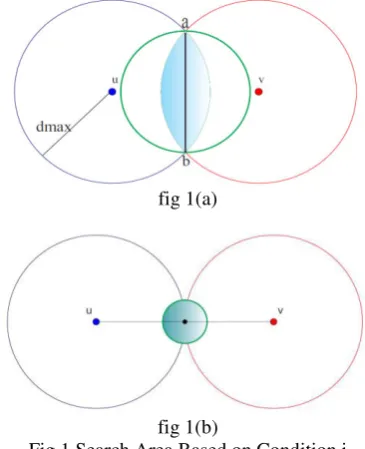
i) If , � , a circle centering of that point which is placed at forwarding line between source and destination nodes and in the middle of subscription area induced of two nodes covering areas, with a diagonal equal to the distance between two points of occurred
intersection are circled by the covering areas of source and destination based on fig.1a. A space with wider range than subscription area as a specific area for selecting candidate sensor range is formed. If two covering areas of source and destination nodes are crossed only in one point in line to source and destination mid line, then an area will be formed to select forwarding node in a circle space centering cross point and the radios showing in fig.1b.
fig 1(a)
fig 1(b)
Fig.1.Search Area Based on Condition i
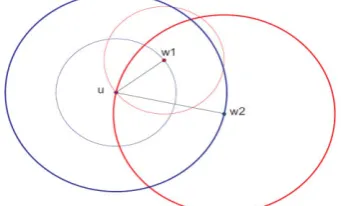
ii) If , > � , then an area is formed to find the forwarding node for both source and destination nodes, of course after illustrating covering and interference areas in a semicircular space facing to each other for two nodes and regarding the areas of points’ interferences. The occurred area in square form with side length, which is equal to radius of interference area around subscription area obtaining intersection of the two areas of interference areas between source and destination nods. Regarding fig.2, two opposite angles in the occurred square are the intersection of interference areas related to source and destination nodes, while two other angels are accorded to source and destination nodes.
Fig.2. Search Area Based on Condition ii
Copyright © 2015 IJECCE, All right reserved
81
allocated to the interference parameter. Based on what is mentioned in fig.3; first the covering area is illustrated for candidate node in the target search area and source node, then the amount of subscription and overlap between two area is evaluated to select forwarding node. The node with the minimum amount of overlap area is selected as the next transmission node. The parameter of delay is weighed considering the function = min , , , , … that , is Euclideandistance between source and forwarding nodes and regarding the number of hop and evaluating the amount of closeness of evaluated node to destination as well the most distance to source. As the amount of remain energy of candidate node is involved, the third parameter is also valued weighting energy of nodes based on function = max , , … that is the amount of remain energy of candidate node. Depending on amount of priority of determined weights are normalized to set up a tradeoff. Base on the determined criterions in this space, that node will be candidate as forwarding, which is placed at an efficient location for source node. In this study, the coefficient of weights importance are supposed equal altogether, and a sensor will be candidate that has desirable values of three mentioned parameters.
Fig.3.The overlap area between two nodes
Each node obtain the maximum transmission range to efficiently utilize energy of those sensor nodes, which are on border of dying, as well preventing early omission of these nodes (sensors) from transmission process if they have data to be transmitted. While ach sensor follows transmission conditions, but the target sensor node supposed as died one if it is not able to transmit data up to no distance or no node exists in transmission radios. It must be mentioned that at the beginning of conducting proposed method in this part, the network bed is grouped and selected for simultaneous transmission within first step. Then sensors are fitted and evaluated.
6. SIMULATION
In this part, the performance of expressed algorithms is evaluated using conducted stimulation of MATLAB Software. First, stimulation environment and evaluation functions of performance are introduced, then, the performance will be evaluated comparing given environment and parameters. The appropriate stimulation environment is considered as a cluster of wireless sensor hierarchical network in a square space regarding
conducted study in [22]. The primary aspects of cluster are given as 300 in 300, which was changed up to 200 in 200. The stimulation parameters are mentioned in table 1.
A. Performance function and recruited definition
The signal-to-interference-plus-noise ratio: SINR is evaluated based on the following formula [23]:
=
� +∑ . −�. −�≠ (5)
is transmission power of transmitter, is power
spectral density of the noise, is Euclideandistance
between transmitter and receiver nodes, is Euclideandistance between simultaneous transmission nodes, main transmitter (i) and receiver.
Delay:
The delay criteria is evaluated based on the number of hops and the amount of hops numbers, which are passed to transmit a packet from source to destination.Lifetime:
The lifetime of a sensor node is considered as its establishment time until considering the node of remain energy to transmit based on conducted discussion in part. The node is called alive during this period but dead after that time. The lifetime of network is a time between start of network to a time while 10 percent of nodes are alive [24].Table 1.Stimulation Parameters 4000 bit Size of each data packet
90 meter Maximum transmission range �
65,79 and 25,56 and 82
meter and and
50 ⁄ � Activation energy of electronic
circuit
� ⁄
⁄ 10
and 0.0013
� ⁄ ⁄
Activation energy of power amplifiers in outdoor space (� −� and
multi-path � � −�
05 Initial energy of each sensor node
= 0.01053 The amount of transmission power of
transmitter
= −6 ℎ ⁄ power spectral density of the noise
B. The results of simulation
The network is stimulated within different status to evaluate the amount of algorithms performance, meanwhile stimulated network is evaluated and compared. Change of the number of nodes in a cluster, cluster size, increasing of transmission range of sensor nodes and transmitting in simultaneous multi-sets are evaluated. The results, which are mentioned on diagrams, are the mean output of 30 times of stimulations. Consider the results of stimulation. The change procedure of delay amount and increasing of network size, change in the number of simultaneous transmission nodes and increasing of transmitting radios are mentioned in fig.4, fig.5 and fig.6 respectively. As long reducing of network size in fig.4, more hops must be passed to transmit data to cluster head node.
Copyright © 2015 IJECCE, All right reserved
82
diagrams are evaluated regarding the number of hop and delay, then the blue diagram, which shows Min-hop algorithm has less value, meaning has the minimum delay comparing to the other algorithms. The proposed algorithm also provides a tradeoff between the three criterions placing at a better location comparing that method, which is based on interference criteria and enjoy a desirable amount of delay.
Fig.4.The Value of Delay to Change of Network Size
Fig.5.The Value of Delay to Change in Number of Sets Nodes
Fig.6.The Amount of Delay to Change of Transmission Range
As shown in fig.7, as long network size is increasing, the relative distance of simultaneous transmission nodes are increasing too, which leads to reducing of interference. The downtrend of interference is upward in respect to the three mentioned methods, and the proposed method also has a desirable amount of reduction. The number of nodes in a cluster leads to a better selection in fig.8 regarding interference criteria, and increasing of signal-to-interference-plus-noiseratio. A comparison regarding the amount of interference considering fig.7 and fig.8 indicates EIGR Algorithm has the most signal-to-interference-plus-noiseratio comparing to the other
algorithms. While the proposed algorithm results in signal-to-interference-plus-noiseratio and an inference near to the interference-based algorithm.
Fig.9 shows increasing of lifetime for change of transmitting radios of sensors, meaning a bigger transmitting radios of transmitter node involving less forwarding node in each stage due to increasing of sensor range of source node. According to fig.1 and based on determining search area, which has a direct relationship with covering areas of node and has a sort of the same transmission range creating a more expanded area to be evaluated and searched. The increasing of network lifetime is obtained from increasing transmission range of sensor node due to mentioned reasons.
Comparing and evaluating references and proposed method, and regarding selections of EIGR Algorithm and the closeness of candidate nodes to transmitting node that increases the mean number of escapes in a cluster, while only candidate paths of closest nodes toward transmitter are selected. If the determination of network lifetime change, the network will have very less lifetime regarding to this structure, meaning EIGR Algorithm only utilized interference criteria in routing. In propose method, TINET tries to create a tradeoff between delay and occurred interference, while network lifetime criteria is utilized. The diagrams 4, 5 and 6, which evaluate the amount of delay in cluster indicate TINEN Method has less hop number comparing to EIGER Method, and indicates a desirable delay and closeness to Min-hop Algorithm. Fig.7 and fig.8 show the downtrend of inference, besides the TINEN Method has a desirable signal-to-interference-plus-noiseratio comparing to EIGER Method. As evaluating network lifetime in fig.9 indicates the above-mentioned conditions is true if the proposed method has the highest amount of lifetime comparing to the other algorithms.
6. CONCLUSION
Copyright © 2015 IJECCE, All right reserved
83
Fig.7.The Values of Signal to Noise for Change of Network Size
Fig.8.The Values of Signal to Noise as the Number of Nodes of Cluster Nodes Change
Fig.9.The Amount of Network Lifetime for Change of Transmission Range
REFERENCES
[1] P.Agrawal and G.K. Das, "Improved Interference in Wireless Sensor Networks," Distributed Computing and Internet Technology, pp. 92-102, 2013.
[2] M.Goldenbaum and S.Stanczak, "On multiantenna sensor networks th interference: Energy consumption vs. robustness," in Smart Antennas (WSA), 2012 International ITG Workshop on, 2012, pp. 125-132.
[3] K.-H. Phung, T. Ngo-Quynh, H. Luong-Duc, and T. Nguyen-Huu, "Improving performance of wireless sensors networks by using multichannel communications," in ECTI-CON, 2013 10th International Conference on, 2013, pp. 1-6.
[4] M. A. Hassan and A. Chickadel, "A review of interference reduction in wireless networks using graph coloring methods," arXiv preprint arXiv:1103.5791, 2011.
[5] X. Xu, X.-Y.Li, P.-J.Wan, and S. Tang, "Efficient scheduling for periodic aggregation queries in multihop sensor networks," IEEE/ACM Transactions on Networking (TON), vol. 20, pp. 690-698, 2012.
[6] P. Von Rickenbach, R. Wattenhofer, and A. Zollinger, "Algorithmic models of interference in wireless ad hoc and sensor networks," IEEE/ACM Transactions on Networking (TON), vol. 17, pp. 172-185, 2009.
[7] V. Černý, "Topology Control with Anisotropic and Sector Turning Antennas in Ad-hoc and Sensor Networks," ActaPolytechnica, vol. 51, 2011.
[8] T. M. Chiwewe and G. P. Hancke, "A distributed topology control technique for low interference and energy efficiency in wireless sensor networks," Industrial Informatics, IEEE Transactions on, vol. 8, pp. 11-19, 2012.
[9] X. Xu, X.-Y.Li, and M. Song, "Efficient aggregation scheduling in multihop wireless sensor networks with sinr constraints," Mobile Computing, IEEE Transactions on, vol. 12, pp. 2518-2528, 2013. [10] S. Chen, Y. Wang, M. Li, and X. Shi, "Data collection capacity of
random-deployed wireless sensor networks," in Global Telecommunications Conference, 2009.GLOBECOM 2009. IEEE, 2009, pp. 1-6.
[11] J. Lee, H. Park, S. Oh, Y. Yim, and S.-H. Kim, "Radio-Disjoint Geographic Multipath Routing for Reliable Data Transfer in Lossy WSNs," in Vehicular Technology Conference (VTC Spring), 2012 IEEE 75th, 2012, pp. 1-5.
[12] J. Lee, H. Park, S. Oh, Y. Yim, and S.-H. Kim, "A radio-disjoint geographic multipath routing in wireless sensor networks," in Advanced Information Networking and Applications (AINA), 2012 IEEE 26th International Conference on, 2012, pp. 803-809. [13] T.-Y. Chen, H.-W.Wei, C.-R.Lee, F.-N.Huang, T.-S.Hsu, and
W.-K. Shih, "EEGRA: Energy Efficient Geographic Routing Algorithms for Wireless Sensor Network," in Proceedings of the 2012 12th International Symposium on Pervasive Systems, Algorithms and Networks, 2012, pp. 104-113.
[14] J. Cha, J. Jeon, J. Kim, and Y. Kwon, "Location-based multicast routing algorithms for wireless sensor networks in presence of interferences," in Communication Systems (ICCS), 2010 IEEE International Conference on, 2010, pp. 41-45.
[15] J. Lu and X. Wang, "Interference-aware probabilisti routing for wireless sensor networks," Tsinghua Science and Technology, vol 17, pp. 575-585, 2012.
[16] O. Bazan and M. Jaseemuddin, "A Conflict Analysis Framework for QoS-Aware Routing in Contention-Based Wireless Mesh Networks with Beam forming Antennas," Wireless Communications, IEEE Transactions on, vol. 10, pp. 3267-3277, 2011.
[17] W.B.Heinzelman, "Application-specific protocol architectures for wireless networks," Massachusetts Institute of Technology, 2000. [18] Z. Ren, Z. Xu, J. Cao, and Q. Chen, "A cross-layer energy-balanced
bidirectional minimum hop routing algorithm for WSNs," in Biomedical Engineering and Informatics (BMEI), 2012 5th International Conference on, 2012, pp. 1384-1388.
[19] K. Dai, Q. Wang, W. Xu, C. Han, M. Xiong, and Y. Cheng, "Link-aware geographic routing in WSN," in Web Society (SWS), 2010 IEEE 2nd Symposium on, 2010, pp. 231-236.
[20] C. Yamuna Devi, B. Shivaraj, S. Iyengar, S. Manjula, K. Venugopal, and L. Patnaik, "Multi-hop optimal position based opportunistic routing for wireless sensor networks," in Region 10 Symposium, 2014 IEEE, 2014, pp. 121-125.
[21] H.Huang, G.Hu, F.Yu, and Z.Zhang, "Energy-aware interference-sensitive geographic routing in wireless sensor networks," Communications, IET, vol. 5, pp. 2692-2702, 2011.
[22] A. Förster, A. Förster, and A. L. Murphy, "Optimal cluster sizes for wireless sensor networks: an experimental analysis," in Ad Hoc Networks, ed: Springer, 2010, pp. 49-63.
[23] M. F. Uddin, H. M. AlAzemi, and C. Assi, "Optimal flexible spectrum access in wireless networks with software defined radios," Wireless Communications, IEEE Transactions on, vol. 10, pp. 314-324, 2011.
Copyright © 2015 IJECCE, All right reserved
84
aik,"EESOR: Energy Efficient SelectiveOpportunistic Routing in Wireless Sensor Networks," in Recent Trends in Computer Networks and Distributed Systems Security, ed: Springer, 2014, pp. 16-31.
AUTHOR
’
S PROFILEElmira Shahraki
Brief Introduction: received the B.Sc. degreein electrical engineering from the University of Sistan and Baluchestan, Zahedan, Iran in 2012. Currently she isgraduate student at University of Sistan and Baluchestan, Zahedan, Iran in 2015.email: [email protected]
Hengameh Keshavarz
Brief Introduction: received the B.Sc. and the M.Sc. degrees, both in electrical engineering, from Ferdowsi University of Mashhad, Mashhad, Iran in 1997 and 2001, and the Ph.D. degree in Electrical and Computer Engineering from the University of Waterloo, Waterloo, Canada in 2008. From 2008 to 2009, she was a post-doctoral fellow in the Department of Electrical Engineering, University of Manitoba, Winnipeg,Canada. She is currently an assistant professor and theChair of Communications Engineering Departmentat the University of Sistan and Baluchestan.email: [email protected]
Javad
Ahmadi
Shokouh
Brief Introduction: received the B.Sc. degree in electrical engineering from Ferdowsi University of Mashad, Mashad, Iran, in 1993, the M.Sc. degree in electrical engineering from the University of Tehran, Tehran, Iran, in 1995, and the Ph.D. degree in electrical engineering from the University of Waterloo, Waterloo, ON, Canada, in 2008. From 1998 to 2003, he was with the Department of Electrical Engineering, University of Sistan and Baluchestan, Zahedan, Iran, as a Lecturer, where he is currently an Assistant Professor. He was also with the Department of Electrical Engineering, University of Manitoba, Winnipeg, MB, Canada (2008 2009) as a Postdoctoral Fellow.email: [email protected]