Journal Homepage: www.jitecs.ub.ac.id
Augmented Reality Application to Efficiency the Process
of Making Batik Motifs Using Vertex Marker
Wahyu Teja Kusuma1, Herman Tolle2, Ahmad Afif Supianto3 1,2,3Faculty of Computer Science, University of Brawijaya, Malang 66145, Indonesia
{ 1[email protected], 2[email protected], 3[email protected]
Received 06 November 2019; accepted 03 Desember 2019
Abstract. From the total time of making traditional Batik Tulis, the pembatikan stage is the most time consuming because there are a lot of mistakes due to lack of carefulness when making Batik motifs on cloth. To overcome the problem of making Batik motifs, this research utilizes the strengths and capabilities of Marker-Based Augmented Reality technology. The development of Marker- Based Augmented Reality applications is done by replacing digital objects with Batik motif images and markers attached to the fabric. Development of Marker- Based Augmented Reality applications using vertex markers to reproduce Batik motif objects in order to overcome the limitations of the reach of hands when making Batik motifs on fabric. Finally, by using a vertex marker on the Marker- Based Augmented Reality application, the Batik Tulis craftsman does not need to draw a Batik motif with a pencil on the fabric because the Batik motif is directly displayed on the fabric surface by the application, so that it is expected to reduce the process time of making Batik motifs compared to making Batik motifs using traditional methods.
Keyword: Batik Tulis, Vertex Marker, Augmented Reality
1.
Introduction
Batik Tulis has a positive impact on the economy of the Indonesian people. But, to make traditional Batik requires a long process and a long time. The method of making traditional Batik Tulis consists of the stages of pemotongan, pembatikan, pewarnaan, pengeringan, lorod, dan pengeringan. The total time spent in the process of making Batik Tulis was 5,749 minutes. The pembatikan stage is the most time-consuming stage. The time needed at the pembatikan stage is 4,400 minutes. That is, 76.53% of the total time spent on making traditional Batik is spent by the pembatikan stage. The
pembatikan stage is the most time consuming because there are many mistakes due to lack of precision when drawing Batik motifs with a pencil on the fabric [1].
Marker-Based Augmented Reality is a technology that is able to display digital objects into the real world. The development of Marker-Based Augmented Reality sapplications has now become a research trend because it has many advantages. Judged in terms of human interaction with computers, the advantage of Marker-Based Augmented Reality is to provide convenience, maintain collaborative learning, do not limit the flexibility of hand movements, interactive, and maintain the natural interaction of users [2][3][4][5]. In terms of the production, the advantage of Marker-Based Augmented Reality is that it can save production time, produce process efficiency, and
268 JITeCS Volume 4, Number 3, Desember2016, pp 267-277
increase productivity [6]. In terms of the marketing, the advantages of Marker-Based Augmented Reality are to increase interest, increase understanding of information, and provide real experience [2][3][7].
Marker-Based Augmented Reality displays digital objects into the real world based on markers. Markers serve as a system reference to determine the position and orientation of digital objects. So, the Augmented Reality camera will first detect the marker to determine the position and orientation of the digital object to be displayed. By applying Marker-Based Augmented Reality technology, users can interact with digital objects and the real world simultaneously through the smartphone screen in realtime.
The capabilities and advantages of the Marker-Based Augmented Reality technology are used to overcome the many errors of batik when drawing Batik motifs on fabric. Digital objects used in the development of Marker-Based Augmented Reality applications will be replaced with images of Batik motifs. While the marker is attached to the fabric to display the object of the Batik motif on the fabric.
However, the process of making Batik motifs can only be done if the hand can reach the fabric. To be able to interact with Batik motif objects that are in the corners, edges, or any part of large fabric, this study applies vertex markers to the development of Marker-Based Augmented Reality applications. Vertex markers are markers that can be relied upon to reproduce and display pieces of digital objects as if they remain intact [8]. This research utilizes vertex markers to cut Batik motifs as wide as fabric into smaller parts to reach the hands and display the pieces as if they were intact when displayed on the application. Finally, by using a vertex marker on the Marker-Based Augmented Reality application, the Batik Tulis craftsman does not need to draw a Batik motif with a pencil on the fabric because the Batik motif is directly displayed on the fabric surface by the application, so that it is expected to make the process of making Batik motifs more efficient compared to making the motif Batik uses traditional methods.
2.
Development Method
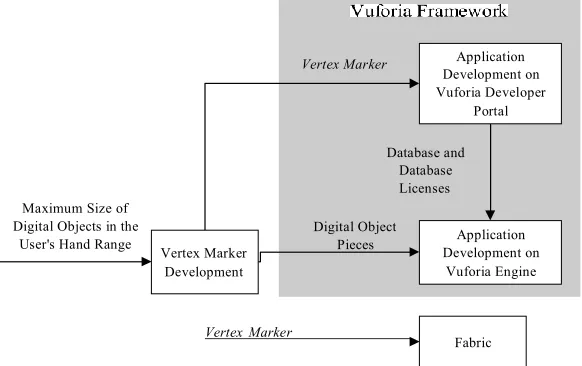
Fig. 1 is the architecture of the Batik Tulis Marker Based Augmented Reality application development method. The stages of the Batik Tulis Marker Based Augmented Reality application development method consist of vertex marker development and Marker-Based Augmented Reality application development using the Vuforia Framework.
Maximum Size of Digital Objects in the
User's Hand Range
Vertex Marker
Fig. 1. The Architecture of Batik Tulis Augmented Reality Application
Vertex Marker
Database and Database Licenses
Digital Object Pieces Vertex Marker
Development
Application Development on Vuforia Developer
Portal
Application Development on
Vuforia Engine
Uploading Vertex Marker Creating
Database
3.1 Vertex Marker Development
Fig. 2. The Flow Of Vertex Marker Development [8]
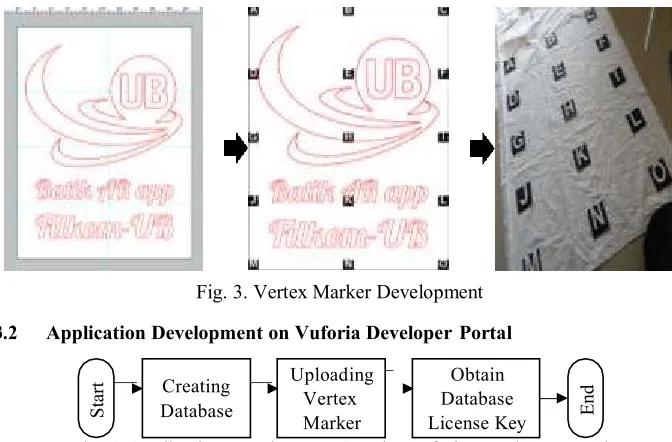
Fig. 2 shows the flow of vertex marker development. Development of vertex markers is based on the maximum size of digital object in the reach of the user's hand. At the maximum range of hands calculated from the age of 10-49 years, the cell size limit that can be used to cutting large digital object is <77x54 cm [8][9]. Cutting digital objects into many parts is done by referring to the Grid dimensions. The next step is to remove the edge from the Grid, but the vertex is still retained for use as a marker installation guide. Markers in this study used alphabet images. Finally, Vertex markers can be installed to fabric by sticking or printing. Documentation of vertex marker development is shown in Fig. 3.
Fig. 3. Vertex Marker Development
3.2 Application Development on Vuforia Developer Portal
Fig. 4. Application Development On The Vuforia Developer Portal
Fig. 4 shows the application development path in the Vuforia Developer Portal consists of creating a database, uploading a vertex marker, and obtaining a Database License Key. The creation of a database aims to store the vertex marker assets used in application development. License Key is used to configure the Vuforia Developer Portal and the Vuforia Framework Engine on Unity.
3.3 Application Development on Vuforia Engines
The application development of Marker-Based Augmented Reality Batik application is done on the Android mobile device environment using Vuforia Software Development Kit [2][5][10]. The minimum specifications of smartphones used to develop Marker-
User Hand
Reach Producing
Markers
Install Vertex Marker
Obtain Database License Key
S
ta
rt
S
ta
rt
E
nd
E
nd
Define Grid Dimensions
Cut Digital Objects
270 JITeCS Volume 4, Number 3, Desember2016, pp 267-277
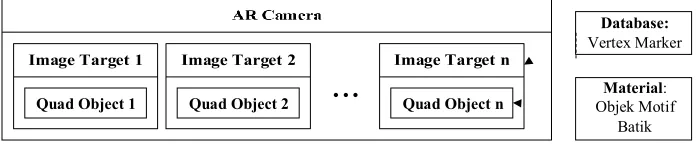
Based Augmented Reality applications in this study are Android 4.4.2 Operating System, Quad core processor 1,3 GHz, 5 MP camera, 4,5 inches touchscreen LCD 16 M colors, and RAM IGB. While the application development stages in Vuforia Framework at Unity consists of adding AR Camera, configuring Vuforia Engine, adding Image Targets for markers, filling Image Targets with vertex markers, adjusting the position and size of Image Targets, adding Quad Objects as children of Image Targets for digital objects, import digital objects, create material from digital objects, insert material into Quad Objects, adjust the position, rotation, and size of Quad Object, Build Settings, and Build APK. The engine structure of the application development is shown in Fig. 5.
Fig. 5. The Engine Structure of the Application Development
3.
Testing
3.1 Selection of Work Environment and Research Subjects
The work environment where the testing is carried out is at Anjani Batik Galeri. Anjani Batik Galeri was chosen because it has won many awards in the field of written batik, is able to produce more than 200 pieces of written batik per month, and has consumers to foreign countries. While the test subjects are Batik artisans at Anjani Batik Gallery who have expertise in making Batik motifs for at least 5 years.
3.2 Design of Test Case for Measurement of Process Time for Making Batik
Motifs
The design of a test case measuring the time process of making Batik motifs aims to establish standardization of process elements and the treatment of making Batik motifs. Determination of the elements of the process and the treatment of making traditional Batik motifs is based on the process of making Batik motifs on a daily basis carried out by research subjects at Anjani Batik Galeri. While the determination of process elements and the treatment of making Batik motifs using applications is based on the working principle of Marker Based Augmented Reality technology.
3.3 Measurement of Process Time for Making Batik Motifs
The method of measuring the time process of making Batik motifs is carried out by the method of direct observation using the stop-clock method. Where Subject 1 and researchers served as observers, while Subject 2 and Subject 3 carried out the treatment. The test case of the time measurement process of making Batik motifs is carried out by Subject 2 and Subject 3 alternately. The process and treatment elements are carried out sequentially. If one process element is completely finished, only then continue the next process element.
4.
Results
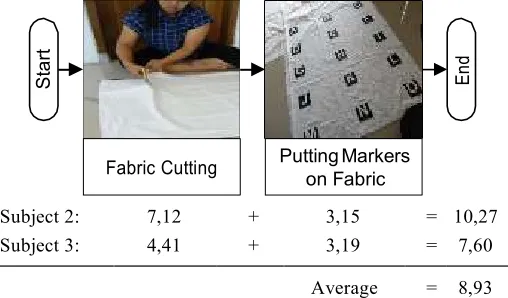
Based on the Fig. 6 and Fig. 7, the process of making Batik motifs using the Marker- Based Augmented Reality Batik application process elements is shorter than using traditional methods. The process of making Batik motifs using traditional methods consists of cutting fabrics, making sketches of Batik motifs, and copying sketches of
...
Material:Objek Motif Batik
Quad Object n Quad Object 2
Quad Object 1
Database:
Fabric Cutting Putting Markers
Based Augmented Reality Batik application, the process elements only consist of cutting cloth and installing markers on the fabric.
Fabric Cutting Making Batik Motif Sketches Copying Batik Motif Sketches to Fabric
Subject 2: 7,12 + 21,11 + 15,02 = 43,25
Subject 3: 4,41 + 27,34 + 15,42 = 47,17
Average = 45,21
Fig. 6. Time Testing Results Process of Making Batik Motifs Using Traditional Methods (Minutes)
on Fabric
Subject 2: 7,12 + 3,15 = 10,27
Subject 3: 4,41 + 3,19 = 7,60
Average = 8,93
Fig. 7. Time Testing Results of the Process of Making Batik Motifs Using Marker Based Augmented Reality Applications
From the results comparing the average process time to make Batik motifs in Fig. 6 and Fig. 7, it was found that the process time to make Batik motifs using the Marker- Based Augmented Reality application is much faster than traditional methods. The average time spent on the process of making Batik motifs using the Marker-Based Augmented Reality application is 8.93 minutes. While the average time spent on the process of making Batik motifs using traditional methods is 45.21 minutes. That is, the process of making Batik motifs using the Marker-Based Augmented Reality application can save time by 36.28 minutes or 80.24%. The efficiency was successfully carried out because by using the Marker-Based Augmented Reality application, craftsmen did not need to copy Batik motifs into fabric as shown in the Fig. 9. The time comparison of the process of making Batik motifs is shown in Fig. 8.
S
ta
rt
St
a
rt
E
nd
E
272 JITeCS Volume 4, Number 3, Desember2016, pp 267-277
45,21
8,93
Fig. 8. Comparison of Process Time for Making Batik Motifs (Minutes) The time process of making Batik motifs using the Marker-Based Augmented Reality application can be much faster because there is no need to make elements of the process of making batik motifs and sketching batik motifs onto fabric. After the fabric is cut, the process of making Batik motifs using the Marker-Based Augmented Reality application only needs to install markers on the fabric. Furthermore Batik motifs are displayed on the fabric surface using the Marker-Based Augmented Reality application shown in Fig. 9. So as to save time and process elements in the process of making Batik motifs.
Fig. 9. Display of Batik Motifs on Fabric Through the Application
5.
Conclusion
Based on the results, it can be concluded that the implementation of vertex marker in the development of Marker-Based Augmented Reality Batik applications has succeeded in making the process of making Batik motifs more efficient. The process of making Batik motifs using the Marker-Based Augmented Reality Batik application can save time by 36.28 minutes or 80.24% of the time of the process of making Batik motifs with traditional methods.
References
1. Rinawati, D. I., Puspitasari, D., & Muljadi, F. (2013). Pengelolaan Produksi Menggunakan Pendekatan Lean And Green Untuk Menuju Industri Batik Yang Berkelanjutan (Studi Kasus Di Ukm Batik Puspa Kencana). J@TI Undip, 8.
2. Adrianto, D., Luwinda, F. A., & Yesmaya, V. (2016). Augmented Reality Implementation in Watch Catalog as e-Marketing Based on Mobile Aplication. International Conference
on Computing and Applied Informatics. https://doi.org/10.1088/1742-6596/801/1/012008.
3. Chun, L. meng, Arshad, H., Nizam, S. S. M., & Shukri, S. A. A. (2017). A Usability Evaluation of an Interactive Application for Halal Products Using Optical Character
Marker-Based Augmented Reality Application
Traditional Methods 50
Recognition and Augmented Reality Technologies. The 2nd International Conference on
Applied Science and Technology. https://doi.org/10.1063/1.5005417
4. Taçgin, Z., Uluçay, N., & Özüağ, E. (2016). Designing and Developing an Augmented Reality Application: A Sample of Chemistry Education. Journal of The Turkish Chemical
Society, Cilt 1(Sayı 1), Sayfa 147-164.
5. Vora, D., Udeshi, D., Bhatti, T., Desai, A., & Lade, N. (2018). Marker Based Augmented Reality Techniques: Review. IOSR Journal of Engineering, 3.
6. Li, W., Nee, A. Y. C., & Ong, S. K. (2017). A State-of-the-Art Review of Augmented Reality in Engineering Analysis and Simulation. Multimodal Technologies and Interaction
MDPI.
7. Waruwu, A. F., Bayupati, I. P. A., & Putra, I. K. G. D. (2015). Augmented Reality Mobile Application of Balinese Hindu Temples: DewataAR. I. J. Computer Network and
Information Security, 2, 59–66.
8. Kusuma, W. T., Supianto, A. A., & Tolle, H. (2019). Vertex markers: Modification of grid methods as markers to reproduce large size augmented reality objects to afford hands.
International of Journal Electrical and Computer Engineering (IJECE), 10.
https://doi.org/10.11591/ijece.v10i1.pp%25p
9. Indonesia, A. (2018). Antropometri Indonesia. Retrieved from http://antropometriindonesia.org/index.php/detail/artikel/4/10/data_antropometri. 10. Lytridis, C., Tsinakos, A., & Kazanidis, I. (2018). ARTutor—An Augmented Reality
Platform for Interactive Distance Learning. Multidisciplinary Digital Publishing Institute