Volume 02, No. 3, March 2016
P
age
45
“An Optimization Studies on Effect of Process Parameters on
Out Put Parameter While Grinding Mild Steel Material in
Numerical Control Surface Grinding Machine”
Sibabrata Mohanty*, Silla subrat kumar**, Manoranjan tripathy***, &
P. Kiran kumar patra****
*Assistant Professor, Department of Mechanical Engineering, Gandhi Institute of Engineering and Technology, Gunupur, Rayagada Odisha,
** B.Tech Final year Mechanical Students, Gandhi Institute of Engineering and Technology, Gunupur, Rayagada Odisha,
*** B.Tech Final year Mechanical Students, Gandhi Institute of Engineering and Technology, Gunupur, Rayagada Odisha,
**** B.Tech Final year Mechanical Students, Gandhi Institute of Engineering and Technology, Gunupur, Rayagada Odisha,
ABSTRACT
Surface grinding is used to produce a smooth finish on flat surfaces. It is a widely used abrasive machining process in which a spinning wheel covered in rough particles (grinding wheel) cuts chips of metallic or non metallic substance from a work piece, making a face of it flat or smooth. Surface grinding is the most common of the grinding operations. It is a finishing process that uses a rotating abrasive wheel to smooth the flat surface of metallic or non metallic materials to give them a more refined look or to attain a desired surface for a functional purpose.In this study, the Taguchi method that is a powerful tool to design optimization for quality is used to find the optimum surface roughness in grinding operations. An orthogonal array, a signal-to-noise (S/N) ratio, and an analysis of variance (ANOVA) are employed to investigate the surface-roughness characteristics of Mild Steel Plates in Numerical control Surface grinding Machine.
Keywords:Surface Grinding, surface roughness L9 orthogonal array, and ANOVA, S/N Ratio.
Mean.
1.0 INTRODUCTION
Volume 02, No. 3, March 2016
P
age
46
conditions. Surface textures can be isotropic or anisotropic. Sometimes, stick-slip friction phenomena can be observed during sliding depending on surface texture. In this study the
wheel speed (V), the rate of feed (F) and the depth of cut (D) were selected as variable
parameters. Other process parameters were fixed. The above parameters of grinding were analyzed and optimized with the Taguchi method using the experimentally obtained surface-roughness (Ra) results. Confirmation experiments were conducted at the optimum level to verify the effectiveness of the Taguchi approach.
2. EXPERIMENTAL STUDIES
Work piece Material and Grinding Machine
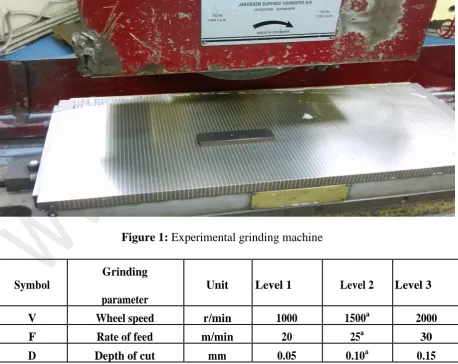
Finishing operation will be performed on Mild Steel of 100X50X6 mm. Experiments were performed using a Numerical Control Surface Grinding machine. The intense heat generated during the grinding due to a relatively high friction impairs the work piece quality by inducing thermal damage. Therefore, the cooling and lubrication play a decisive role in grinding. In this study, a cutting fluid was used as a coolant in order to cool the work piece
and, hence, to prevent the thermal damage of the work piece.The initial grinding parameters
were selected as follows: the wheel speed (V) of 1000 r/min; the feed rate (F) of 25 m/min
and the depth of cut (D) of 0.10 mm.
Figure 1: Experimental grinding machine
Symbol
Grinding
Unit Level 1 Level 2 Level 3
parameter
V Wheel speed r/min 1000 1500a 2000
F Rate of feed m/min 20 25a 30
D Depth of cut mm 0.05 0.10a 0.15
Volume 02, No. 3, March 2016
P
age
47
Each grinding parameter is assigned to a column, having nine grinding-parameter combinations available. There-fore, only nine experiments are required to study the entire
parameter space using the L9 orthogonal array. The experimental layout for the three grinding
parameters using the L9 orthogonal array is shown in Table 2. Since the L9 orthogonal array
has four columns, one column of the array is left empty for the error of the experiments; orthogonality is not lost by keeping one column of the array empty. To increase the
sensitivity of the results each experiment in the L9 orthogonal array was repeated three times.
Experiment Grinding parameter level
V/(r/min) F/(m/min) D/mm
number
Wheel speed Rate of feed Depth of cut
1 1 1 1
2 1 2 2
3 1 3 3
4 2 1 2
5 2 2 3
6 2 3 1
7 3 1 3
8 3 2 1
9 3 3 2
Table 2: Experimental layout of the L9 orthogonal array
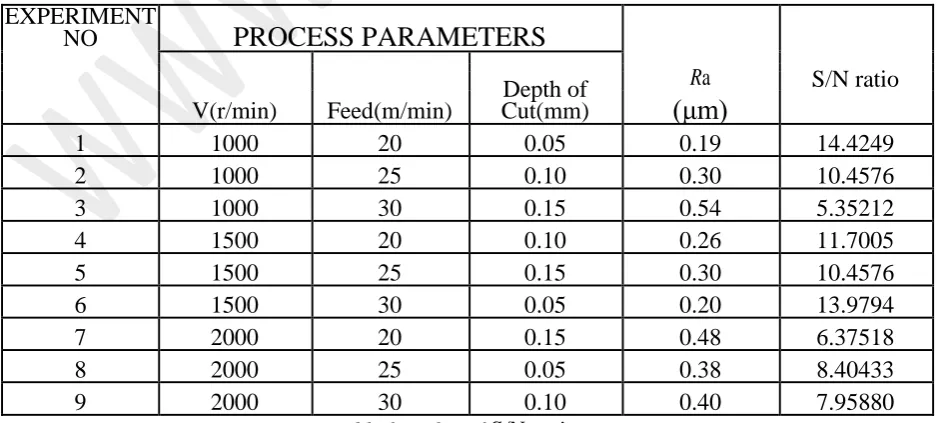
Experimental results were transformed into a signal-to-noise (S/N) ratio. There are three categories of quality characteristics, i.e., lower-better, the higher-better, and the-nominal-the-better. In the present study the-lower-the-better quality characteristic was selected for the surface roughness. S/N ratio was determined by using Minitab Software.
EXPERIMENT
NO
PROCESS PARAMETERS
Ra S/N ratio
V(r/min) Feed(m/min) Cut(mm) Depth of
(μm)
1 1000 20 0.05 0.19 14.4249
2 1000 25 0.10 0.30 10.4576
3 1000 30 0.15 0.54 5.35212
4 1500 20 0.10 0.26 11.7005
5 1500 25 0.15 0.30 10.4576
6 1500 30 0.05 0.20 13.9794
7 2000 20 0.15 0.48 6.37518
8 2000 25 0.05 0.38 8.40433
9 2000 30 0.10 0.40 7.95880
Volume 02, No. 3, March 2016
P
age
48
3.0 RESULT AND ANALYSIS
3.1 Taguchi Analysis:-
Response Table for Signal to Noise Ratios
Smaller is better
Level V(r/min) Feed(m/min) Depth of Cut(mm)
1 10.078 10.834 12.270
2 12.046 9.773 10.039
3 7.579 9.097 7.395
DELTA 4.466 1.737 4.875
RANK 2 3 1
Response Table for Means
Level V(r/min) Feed(m/min) Depth of Cut(mm)
1 0.3433 0.3100 0.2567
2 0.2533 0.3267 0.3200
3 0.4200 0.3800 0.4400
DELTA 0.1667 0.0700 0.1833
Volume 02, No. 3, March 2016
P
age
49
3.2 Results of ANOVA for the grinding parameters
Linear Model Analysis: SN ratios versus A, B, C
Estimated Model Coefficients for SN ratios
Volume 02, No. 3, March 2016
P
age
50
Constant 9.9012 0.7342 13.486 0.005 A 1 0.1770 1.0383 0.171 0.880 A 2 2.1447 1.0383 2.066 0.175 B 1 0.9324 1.0383 0.898 0.464 B 2 -0.1280 1.0383 -0.123 0.913 C 1 2.3684 1.0383 2.281 0.150 C 2 0.1378 1.0383 0.133 0.907
S = 2.203 R-Sq = 87.9% R-Sq(adj) = 51.5%
Analysis of Variance for SN ratios
Source DF Seq SS Adj SS Adj MS F P A 2 30.064 30.064 15.032 3.10 0.244 B 2 4.598 4.598 2.299 0.47 0.678 C 2 35.728 35.728 17.864 3.68 0.214 Residual Error 2 9.703 9.703 4.851
Total 8 80.093
Linear Model Analysis: Means versus A, B, C
Estimated Model Coefficients for Means
Term Coef SE Coef T P Constant 0.338889 0.02857 11.863 0.007 A 1 0.004444 0.04040 0.110 0.922 A 2 -0.085556 0.04040 -2.118 0.168 B 1 -0.028889 0.04040 -0.715 0.549 B 2 -0.012222 0.04040 -0.303 0.791 C 1 -0.082222 0.04040 -2.035 0.179 C 2 -0.018889 0.04040 -0.468 0.686
S = 0.08570 R-Sq = 87.4% R-Sq(adj) = 49.6%
Analysis of Variance for Means
Source DF Seq SS Adj SS Adj MS F P A 2 0.041756 0.041756 0.020878 2.84 0.260 B 2 0.008022 0.008022 0.004011 0.55 0.647 C 2 0.052022 0.052022 0.026011 3.54 0.220 Residual Error 2 0.014689 0.014689 0.007344
Total 8 0.116489
4. CONCLUSION
Volume 02, No. 3, March 2016
P
age
51
experiments and trials. The experimental results obtained in this study showed that the depth of cut and the wheel speed have significant effects on the surface roughness. The rate of feed has a lower effect on the surface roughness. The contribution order of the grinding para-meters including the depth of cut, the wheel speed and the rate of feed is 50 %, 40 % and 10 %, respectively. A change made to all the grinding parameters significantly changes the surface roughness. The optimum grinding-parameter combination for the Mild steel includes
the wheel speed (V) of 1 500 r/min and the depth of cut (D) of 0.05mm.Through ANOVA the
model Conformity has been found to be 87.4% for mean and 87.9% for S/N ratio.
5 REFERENCES
i. P. Krajnik, J. Kopac, A. Sluga, Design of grinding factors based on response surface
methodology, Journal of Materials Processing Technology, 162 (2005), 629–636
ii. L. R. Hecker, Y. L. Steven, Predictive modeling of surface roughness in grinding,
International Journal of Machine Tools & Manufacture, 43 (2003), 755–761
iii. C. P. Bhateja, Grinding: theory, techniques and troubleshooting, Society of
Manufacturing Engineers Society of Manufacturing Engineers (SME), Dearborn, 1982
iv. J. Kwak, Application of Taguchi and response surface methodologies for geometric error
in surface grinding process, International Journal of Machine Tools & Manufacture, 45 (2005), 327–334
v. S. Shaji, V. Radhakrishnan, Analysis of process parameters in surface grinding with
graphite as lubricant based on the Taguchi method, Journal of Materials Processing Technology 141 (2003) 1, 51–59
vi. R. Gupta, K. S. Shishodia, G. S. Sekhon, Optimization of grinding process parameters
using enumeration method, Journal of Materials Processing Technology, 112 (2001), 63– 67.
vii. N.V.MAHESH BABU TALUPULA, 2NERSU RADHIKA. Experimental investigation
of optimal machining parameters of mild steel in cnc milling using particle swarm
optimization IPASJ International Journal of Computer Science (IIJCS) Volume 3, Issue
1, January 2015.
viii. R. R. Chakule1, Prof. S. M. Choudhary2, Prof. (Dr.) S.B. Karanjekar3, Prof. P. S. Talm. Optimization of Cutting Parameters and Grinding Process for Surface Roughness using
Taguchi Method and CFD Analysis. International Journal of Research in Advent
Technology, Vol.3, No.7, July 2015 E-ISSN: 2321-9637
ix. Deepak Kumar, Dr. Sanjeev Saini. Effect of process parameters on material removal rate
during grinding of hot work steel AISI H11 under dry, wet and compressed gas
environment.International Journal Of Modern Engineering Research (IJMER)
x. Parijt roy. Experimental study and analysis of Grinding of glass fibre reinforced epoxym
Composite material
xi. Suleyman Neseli1, Đlhan Asilturk2 and Levent Celik Determining the optimum process
parameter for grinding operations using robust process† journal of mechanical science
Volume 02, No. 3, March 2016
P
age
52
xii. Piotr Stepien A probabilistic model of the grinding process
xiii. Kirankumar Ramakantrao Jagtap.Analytical and experimental investigation of coolant
velocity in high speed grinding
xiv. K.Ramesh,H.Huang,L.Yin. Analytical and experimental investigation of coolant velocity
in high speed grinding
xv. R.A.Irani,R.J.Bauer,A.Warkentin. .A review of cutting fluid application in the grinding
process.
xvi. S. Shaji, V.Radhakrishnan. Analysis of process parameters in surface grinding with