Volume 33 Issue 104
Contents
Editorial
Editorial
Miggie Pickton 1-2
Invited Contributions
The information society: does it need the information professions?
John Feather 3-10
Why can't every year be a National Year of Reading? An evaluation of the NYR in Yorkshire
Carolynn Rankin, Avril Brock, Jackie Matthews 11-25 Filling a gap: would evidence-based school librarianship work in
the UK?
Cristina Sacco Ritchie 26-35
Reports
Establishing the context for your research project
Janet Clapton 36-44
Research Articles
“E-books are good if there are no copies left”: a survey of e-book usage at UWE Library Services
Jacqueline Ann Chelin, Jason Briddon, Elspeth Williams,
Jane Redman, Alastair Sleat, Greg Ince 45-65
Book Reviews
GODWIN, Peter and PARKER, Jo. (eds.) Information literacy meets Library 2.0. London: Facet Publishing. 2008.
Monica Blake 66-67
CRAVEN, J. (ed.) Web Accessibility: practical advice for the library and information professional. London: Facet Publishing. 2008.
Virginia Havergal 70-71
DEWE, Michael (ed.) Renewing our libraries: case studies in re-planning and refurbishment. Farnham: Ashgate Publishing Ltd. 2009.
_______________________________________________________________________________
Editorial
We are delighted that issue 104 of Library and Information Research embraces content from the widest possible range of professional environments. We have contributions from practitioners and academics, and from multiple sectors,
including school, public and academic libraries – there is something for everyone! July 2009 saw one of the largest audiences of Umbrella 20091 gather to hear John Feather speak on the subject of ‘The information society: does it need the
information professions?’. Being clear to differentiate between the need for the
profession and the need for information professionals, Feather’s talk sparked a
lively debate and we are delighted to publish the paper here.
You may read for yourself whether Feather believes that the information professions are necessary, but one of his conclusions is echoed by another Umbrella speaker: the need for a research-driven evidence base for the achievements of the information profession. Cristina Ritchie discusses an evidence-based approach to school librarianship, arguing that this sector needs large scale research to support national changes in policy – and of course buy-in from school librarians to render policy change effective.
A third Umbrella speaker, Carolynn Rankin, and her colleagues describe methods used to assess the impact of a national initiative in public libraries: the National Year of Reading. Firmly rooted in the priorities and goals of the key stakeholders (the MLA, local government and the project participants themselves), the project is now well positioned to provide evaluative material that may be used for advocacy with a range of audiences including local and central government. In common with the remaining papers in this issue, Rankin’s article has a strong focus on the methodological challenges of performing LIS research. Both Rankin
et al. and Briddon et al. used mixed methods approaches to collecting and
analysing data for their research and both articles benefit from some detailed description of these methods (see for example Rankin et al.’s section on computer assisted qualitative data analysis software). Briddon et al. have taken advantage of the online journal format to provide a copy of their questionnaire as a
supplementary file; to view this, just click on the link alongside the main paper. For those new to LIS research, or for those supporting others branching out into a new research area, Janet Clapton offers a tried and tested method of establishing current knowledge. Drawing on her extensive experience of background scoping in the field of Social Care, Clapton describes how she manages the scoping process and illustrates this by identifying a range of LIS resources. Clapton’s list is replicated on the resources section of the Library and Information Research Group website2 and new suggestions are welcomed.
1http://www.umbrella2009.org.uk/index.html
_______________________________________________________________________________
Finally, we are pleased to include several new book reviews on a range of very practical and relevant topics. Qualitative research, information literacy, web accessibility and library planning and refurbishment will all resonate with readers. Don’t forget, if you have any views on the papers published in Library and
Information Research you are welcome to leave a comment – simply click on ‘Add comment’ in the Reading Tools to the right of the paper. If you wish to view other people’s comments then click on ‘Add comment’ and then ‘Cancel’.
_______________________________________________________________________________
_______________________________________________________________________
John Feather
John Feather is Professor of Library and Information Studies, Loughborough University, UK.
Email: [email protected]
Received 17 July 2009
The information society: Does it need the information
professions?
John Feather
Abstract
A profession is constituted by a group of people with a shared body of knowledge and skills, based on formal training and well defined criteria. But the knowledge and skills which characterise the information profession, as defined by CILIP in the Body of Professional Knowledge and other documents, are no longer confined to those who describe themselves in this way, or feel any attachment to the
information profession as traditionally defined. The paper discusses how this group do, can and should contribute to the so-called ‘information society’. It challenges the idea that information society is in itself something new, and focuses more on the concept of the ‘knowledge economy’ in which information (and therefore information workers) have a key role. The challenge for the profession is to go beyond its own recognition of its knowledge, skills and insights, and to persuade others of the contribution it (and they) can make.
_______________________________
The CILIP Body of Professional Knowledge is unequivocal in its claims for the information professions:
The knowledge base defined in this paper has been adopted by CILIP (Chartered Institute of Library and Information Professionals) and establishes the unique knowledge, which distinguishes library and information professionals from professionals within other domains.
(CILIP, 2009b) The document is wide-ranging and not lacking in depth. Yet this statement is not beyond question, especially when put in the context of another of CILIP’s obita
_______________________________________________________________________________
CILIP: the Chartered Institute of Library and Information Professionals is the leading professional body for librarians, information specialists and knowledge managers.
(CILIP, 2009a) The ‘library and information professionals’ referred to in the Body of
Professional Knowledge are presumably to be equated with the ‘librarians,
information specialists and knowledge managers’ in the strap line from the CILIP Website. Yet juxtaposing the ‘professionals’ and the ‘specialists’ in this way raises some interesting and perhaps disturbing questions about what constitutes this profession – or these professions!? – and what characterises their alleged uniqueness. In this paper, I want to address these questions, and in suggesting some of the ways in which they might be answered I shall also say something about the relationship between professional practice and research which will, I hope, be of interest to members of LIRG.
The concept of ‘profession’ is one which is carefully safeguarded, especially by those who consider themselves to belong to one. The Oxford English Dictionary (OED) defines it as
An occupation in which a professed knowledge of some subject, field, or science is applied; a vocation or career, especially one that involves prolonged training and a formal qualification
(s.n. II.7 a.) The essential elements are the application of knowledge, the prolonged training and the formal qualification. But there is a deeper layer of social meaning of which these cold words barely give a flavour. One of the OED’s quotations hints at it:
Profession in our country is expressly that kind of business which deals primarily with men as men, and is thus distinguished from a Trade, which provides for the external wants or occasions of men.
This definition, from a work by the Christian Socialist F. D. Maurice, published in 1839, does not evade the real issue, and nor does the OED’s note on its own original definition in 1908:
Now usually applied to an occupation considered to be socially superior to a trade or handicraft; but formerly, and still in vulgar (or humorous) use, including these.
(s.n. II.b, headnote). Here we have it. The professions - at least in England (‘our country’) – are more than mere occupations, and are certainly distinct from trade. Professions cater for people’s ‘inner needs’, whether those needs are spiritual, physical or intellectual. Professional people will of course accept fees or salaries for their services, but they are not tradesmen for whom profit is the only motive. Only by way of a joke do we describe shopkeeping or plumbing as a profession.
_______________________________________________________________________________
of transition from occupation to profession: the formation and public recognition of a professional body. A handful of such bodies have statutory authority to control entry and practice. Most do not, but through their royal charters or
charitable objectives lay claim to regulating standards, which typically have some form of recognition in the wider community.
The British concept of Public, Statutory and Regulatory Bodies – PSRBs – is central to our understanding of what it means to qualify and practice as a member of a profession. In the non-statutory professions, however, these are merely the outward forms. The real defining factors of the profession are the knowledge and skills which practitioners possess and exercise. It is these that the CILIP Body of
Professional Knowledge tried to capture. It is the expectation that they will be
acquired through a formal programme of training and education and that there is a system of progressive attainment from entry level to professional leadership. But information work, like most of the non-statutory professions, is not and could never be a closed shop. It never has been and despite the proliferation of
professional education in the second half of the 20th century there is no sign of it becoming so. Indeed, we might argue that exactly the opposite trend can be seen. There has been much talk in recent years of de-professionalisation, a phenomenon not unique to information work. We hear it from teachers concerned about the role of classroom assistants, we hear it from doctors as they watch the growth of the auxiliary professions in the healthcare sector, and we hear it from librarians who see people without formal qualifications take on posts which have traditionally been associated with qualified professionals. There are many alleged
manifestations of this trend. As local authorities have combined formerly separate directorates into larger units, public libraries have found themselves with culture and leisure services, or perhaps with education, with the most senior officer having no background in library and information work. In many universities, the fashion – now beginning to reverse – for combining libraries with IT services and sometimes with other learning support services has had the same effect. Across the whole LIS sector we find staff who are undertaking tasks which fall well within CILIP’s definition of professional work but neither are nor are required to be professionally qualified in the sense in which CILIP would understand it. Some of these developments have of course been politically or financially driven. But, paradoxically, one of the most important factors has been the recognition of the increased importance of information, of the so-called information society. The ‘information society’ has become a familiar phrase; it is even the title of a European Union programme and a portal on its Website (European Commission, 2009), not to mention of a journal and a number of books. But what do we mean by it? In practice, the EU associates it with the development and use of
_______________________________________________________________________________
the same time. Broadly speaking, what these writers saw developing around them was an economy driven not by extraction and manufacturing but by the creation and interchange of knowledge and information. They predicted that the successful economies of the future would be those which fully exploited these drivers in the way that the successful economies of the 19th and early 20th centuries had been those which were based on activities such as coal mining and steel-making. In this new economy, all the key workers would be knowledge workers and their raw material would be information.
Forty years later, we can see that some of this has come to pass, although in the way of social prophecy it has not worked out exactly as it was expected to do. But the details are less important than the commonly held belief that information and information systems are now fundamental to the way we live and work. Yet that very statement should give us pause for thought. The key word is ‘now’, because it makes us ask when information was not fundamental. The transmission of knowledge, both explicit and tacit, is one of the defining characteristics of homo
sapiens. The development of complex languages, and the much later development
of the means of recording them in a way which can be transmitted over time and distance, has enabled us to become the dominant species on the planet. Being able to transmit knowledge and information means that we have been able to enhance it rather than merely accumulate it, as we add to the received knowledge store by creating new knowledge in each generation. That has been happening at least since the first writing systems were developed in the middle east about five thousand years ago. The invention of printing, first in east Asia in the 11th century and then separately in western Europe in the mid-15th century, made the process more efficient. The knowledge store could more easily be encapsulated, preserved and transmitted and hence even further enhanced. It was a genuinely revolutionary technology, but it can be argued that it merely did better what had previously been done less well. And when we look at the history of the 500 years after Gutenberg, we see an increasing European, and especially western European, dominance over the whole world. The west’s head start in developing an efficient communication technology was a significant factor in this development.
Computers were invented in a world which was already rich in knowledge and information and one in which the advanced economies were already moving away from the traditional industrial economic model towards one based on knowledge creation and exploitation. There is no doubt that more than any previous
technology they have facilitated a quantum leap in our capacity to store, process and transmit information. This audience needs no reminding of that – those of us born in the age of the card index can never forget it! In the 1970s and 1980s as the scale of the transformation became clear, there were frequent and fevered
discussions among people like us in which speaker after speaker foresaw a golden age of information and therefore for information professionals.
_______________________________________________________________________________
do this pretty well whenever and wherever I like. This is indeed a golden age for information access. But is it one for information professionals?
The answer to that question is buried in how the information is actually organized and retrieved. Society has been transformed at every level and in almost every aspect. At the personal level, the information society means the capacity not merely to find out, but to do – to tax a car, to order one’s shopping from a supermarket, to book a seat at the theatre. This is where the early prophets of the information age (a phrase in common use before it happened, and now largely fallen into desuetude) were not entirely accurate. Although they were remarkably prescient at the macro level, what was not envisaged was the pervasiveness of the communications dimension of digital technologies. Indeed, as late as the early 1990s, politicians, including some very IT-savvy politicians like Bill Clinton and Al Gore, were still talking in terms of wired networks using metaphors derived from road systems. The more or less simultaneous development of ubiquitous mobile technologies and the World Wide Web – both products of the mid-1990s – actually completed the transformation. At the micro-level, access to information has become personal.
As information professionals, we understand that all of this is possible only because of the structure of the programs, systems and information resources which actually make the Web work, which sustain the networks, and which constitute individual Web sites and databases. But for all but a tiny handful of users this is as irrelevant as a knowledge of gearboxes is to the average car driver. The contribution of information professionals is at a different level. The
development of the Web illustrates this perfectly. Berners-Lee set out to solve a very practical and urgent problem in information management. He turned to a proposal (hypertext) which had been developed at a conceptual level some twenty years earlier but never seriously pursued because the technology was inadequate, and added to it some design features which were made possible by the advances in interface design. Some of this work drew on the work of information researchers, and some on skills analogous to those of information professionals. If we look at Google or Microsoft today, we find them employing thousands of people, directly and indirectly, whose core skills are among those described in CILIP’s Body of
Professional Knowledge, as well as others whose research and development
activities are focused on information storage, control, manipulation and retrieval. The public interface with information content is increasingly one which involves no immediate human contact, but specialist information work of the highest order is necessary for this to be achieved.
_______________________________________________________________________________
because it is. Libraries have many different roles; one of the most important in the information society is that they are a cost-effective way of providing access to the complex and high-level specialist information which all professionals need if they are to function in the knowledge economy, the information society.
All of which brings me back to the question in my sub-title, which was very carefully posed. It was ‘Does it need the information professions’, not information
professionals. If the question were to have been framed in terms of
‘professionals’, the answer would be obvious enough – it is ‘yes’. But framed as I have done, it is more difficult. We need to go back to the OED definition in which ‘prolonged training and formal education’ is merely an exemplification of an ‘occupation in which a professed knowledge…is applied’.; this is the knowledge base which allegedly distinguishes information professionals from ‘professionals in other domains’ (CILIP, 2009b). While CILIP acknowledges an ‘overlap with the knowledge bases of other professions, such as the British Computer Society, UK Council for Health Information Professionals and the Records Management Society’, there is little in the Core Schema which is not generically applicable to many other professions. It would not be difficult to adapt many of the statements to apply to barristers, architects or nurses where there is a similar relationship between conceptual underpinning, a knowledge base and a pool of information applied for the benefit of clients. So the distinctiveness lies perhaps in what the
Body of Professional Knowledge calls the ‘Applications Environment’.
Here a somewhat stronger case be made. Some of the specifications are very specific indeed, relating for example to the need for a working knowledge of the relevant aspects of the law relating to information; ethical issues in relation to client confidentiality and other rights; and working within the governance framework of the organisation. The legal issues are particularly important, and becoming more so as questions about data protection, freedom of information and copyright occupy an increasingly prominent place in broader political agendas. In the explication of the Core Schema itself there is a statement about the role of the information professional in promoting information literacy, although little
consideration of any obligation to help clients to maximise the benefits they can obtain from information – not least by showing them that it exists. And nowhere is anything said about how the profession is to promote its allegedly unique role in relation to all of those whose work is said to be in some way comparable.
This is not simply, or even primarily, intended as a critique of the Body of
Professional Knowledge. The problem is more deeply rooted. If we look at the
graduate-level workers who are professionally concerned with information, we find that only a small percentage are actually members of CILIP and even fewer actively engaged with it. University programmes which are unquestionably a preparation for information work – programmes in Information Management or Information Systems, for example – do not seek CILIP accreditation. Why not? Because they cannot see the benefit of doing so. And yet in many cases these programmes are highly regarded and their graduates find professional
_______________________________________________________________________________
and who drives it. There is a research agenda here in which academic and practice-based researchers, like the members of LIRG, could very usefully work together. Yet any attempt to define that agenda in more detail will immediately show us that LIS specialists – whether academics or practitioners – are merely one of many groups of players and not perhaps the most important. To see some evidence for this, consider the pages on the EPSRC Website dealing with the programme called ‘The Digital Economy’, developed in conjunction with AHRC and ESRC, itself a measure of the range of disciplines and interests which it covers. (EPSRC, 2009). Nowhere in this programme is there any
acknowledgement of the existence of an information profession. Here indeed is a research agenda, but it is one which crosses the boundaries of disciplines and professions to the point at which the boundaries no longer meaningfully exist. LIS researchers should be exploring those boundaries, looking beyond them and working with those who occupy adjacent territories whose own borders are equally ill-defined and porous.
So does the information society need the information profession? It certainly needs those who constitute it; it needs their insights, knowledge and skills. But we live, as I suggested earlier, in a deprofessionalising world. Indeed this is
becoming one of the defining characteristics of the information society itself. We need to focus more on the application of our professed knowledge and rather less on the formal qualification. I know of course that CILIP has tried very hard to open its arms and it doors. But there is a long way to go if we are all to play the part that we could and should in the knowledge-based economy which is no longer a prophecy but a present reality. To achieve that we need a sounder research-driven evidence base for the significance and achievements of the information profession. That should be at the core of the practice-based research agenda for the future; LIRG, not least through its involvement in the newly
_______________________________________________________________________________
References
Bell, D. (1974) The coming of a post-industrial society: a venture in social
forecasting. London: Heinemann.
CILIP (2009a) CILIP Website. URL: http://www.cilip.org.uk/default.cilip [accessed 16.07.09].
CILIP (2009b) Body of Professional Knowledge. URL:
http://www.cilip.org.uk/qualificationschartership/bpk [accessed 16.07.09].
EPSRC (2009) Digital Economy Programme. URL:
http://www.epsrc.ac.uk/ResearchFunding/Programmes/DE/default.htm [accessed 16.07.09].
European Commission (2009) Europe’s information society. URL:
http://ec.europa.eu/information_society/index_en.htm [accessed 16.07.09].
Kenna, S. (2008) Towards a coalition for research in library, archive and
information science. Library and Information Research [online], 32(100). URL: http://www.lirg.org.uk/lir/ojs/index.php/lir/article/viewFile/68/87 [accessed 07.09.09].
Machlup, F. (1962) The production and distribution of knowledge in the United
States. Princeton, NJ: Princeton University Press.
Porat, M. U. (1977) The information economy: definition and measurement. Washington, DC: United States Department of Commerce, Office of
Telecommunications.
_______________________________
Notes and Acknowledgement
_______________________________________________________________________________
_______________________________________________________________________
Authors
Carolynn Rankin is a Chartered Librarian and senior lecturer in the School of Applied Global Ethics, Leeds Metropolitan University. Her research interests include the evaluation of library and information services and the provision of early years libraries.
Email: [email protected]
Dr Avril Brock is a principal lecturer in childhood and early years in the Carnegie Faculty, Leeds Metropolitan University, researching in professionalism, early language and play.
Jackie Matthews is a PhD candidate at the University of Wales, Bangor and worked part-time as a research assistant on the NYR research project.
Received 14 August 2009
Why can’t every year be a National Year of Reading? An
evaluation of the NYR in Yorkshire.
Carolynn Rankin, Avril Brock and Jackie Matthews
Abstract
An evaluation of the National Year of Reading in Yorkshire was conducted by Leeds Metropolitan University in response to a brief from Museums, Libraries and Archives (MLA), Yorkshire. This paper outlines the development and planning of phase one of this small scale qualitative research project and the analysis of the initial results which looks at the impact of NYR on the
organisations that delivered the campaign and their work with target groups. The Generic Social Outcomes and the National Indicators were used to develop a theoretical framework. Data were gathered via in depth interviews and focus groups with NYR steering group partners in Calderdale and North Lincolnshire, selected as the two case study authorities. The use of MAXQDA computer-assisted qualitative data analysis software (CAQDAS) enabled data and coding structures to be stored and will facilitate comparison in this longitudinal study. This evaluation will provide material that local library authorities can use for advocacy with a range of audiences including local and central government.
1 Introduction to the National Year of Reading evaluation project
_______________________________________________________________________________
support between January and March. Delivery of the NYR was launched in April 2008 led by the National Literacy Trust on behalf of the Department for Children, Schools and Families, supporting ongoing work to achieve national literacy targets, engage parents and families in reading with their children and develop adult literacy. The key values for the year long social marketing campaign were diversity, creativity and partnership. In Yorkshire a partnership of MLA
Yorkshire, Renaissance Yorkshire and Arts Council England, Yorkshire jointly commissioned a regional co-ordinator for NYR with the remit of co-ordination, strategic intervention, legacy development and corporate engagement. To
contribute to work already underway on the evidence impact of the cultural sector, the NYR Yorkshire Steering Group also sponsored a longitudinal evaluation of the NYR in Yorkshire. Carolynn Rankin and Avril Brock of Leeds Metropolitan University were appointed by MLA Yorkshire in August 2008 to undertake the evaluation research for the clients. This paper outlines the development and planning of this small scale qualitative research project, and the analysis of the initial results for the phase one interim report which looks at the impact of NYR on the organisations that delivered the campaign and their work with target
groups. It is interesting to consider the change of emphasis in looking at the social potential of library projects. In their book about evaluating the impact of libraries, Markless & Streatfield (2006:44) discuss the first National Year of Reading which ran a decade ago in 1998-99. They note that there were numerous plans and energy, but most had no evaluation criteria attached – the evidence was almost all process performance indicators. Most local authorities had backed away from the more difficult questions about impact evaluation during the first National Year of Reading.
2 Overview of the NYR in Yorkshire project
The development of the brief and specification for the consultancy project was co-ordinated by MLA Yorkshire and required that the qualitative research should incorporate use of the MLA’s Generic Social Outcomes. The aim of this longitudinal research was to investigate the efficacy of the National Year of Reading programme in Yorkshire as it relates to the place shaping and social inclusion targets of the NYR. The overall objectives were to investigate the impact of the NYR in sample local authorities in relation to
• Target beneficiaries
• Partnership and cross departmental working
The NYR campaign was delivered in 15 local authorities in Yorkshire and the Humber. In conjunction with the Leeds Metropolitan University research team the Yorkshire steering group decided to sample two contrasting authorities, one predominantly rural, and the other urban. Calderdale Libraries and North
Lincolnshire Libraries were invited to participate, along with the departments and organisations involved in the NYR steering groups of those two authorities. Contact with the key senior library personnel in Calderdale and North
_______________________________________________________________________________
informed consent, anonymity and confidentiality. At all stages in a research project it is important to scrutinise the methodology to ensure that processes proceed ethically without compromising the validity of the research (Cohen et al., 2003). The direct route to participants negotiated by the MLA facilitated timely access for the Leeds Metropolitan University research team and was of particular advantage due to the short timescale for phase one. An initial meeting between the client, representatives of the Calderdale and North Lincolnshire local authority library services and the research team took place in early September 2008. At this project initiation stage it was important to establish a rapport between the client, researchers and participants in order to communicate key messages about the project objectives, agree timescales and facilitate a partnership approach. It was proposed that the case study approach would enable a detailed and intensive analysis of NYR activities; there was no intention to undertake a comparison of the two case study authorities.
3 Project planning and timescale
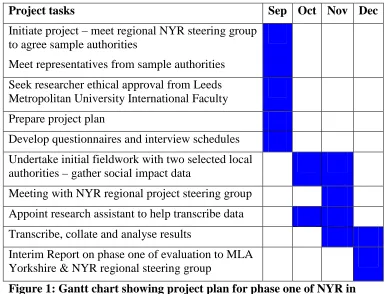
The first phase of the evaluation project in Yorkshire ran between September and December 2008. The project plan for phase one is shown in the Gantt chart in Figure 1 below.
Figure 1: Gantt chart showing project plan for phase one of NYR in Yorkshire
A Gantt chart is a useful, and simple, way of representing the various stages of a research project by showing the key tasks against the timescales for their
completion. It can be a useful tool for research project staff in helping to manage time and also for communicating with client and other stakeholders.
Project tasks Sep Oct Nov Dec
Initiate project – meet regional NYR steering group to agree sample authorities
Meet representatives from sample authorities Seek researcher ethical approval from Leeds Metropolitan University International Faculty Prepare project plan
Develop questionnaires and interview schedules Undertake initial fieldwork with two selected local authorities – gather social impact data
Meeting with NYR regional project steering group
Appoint research assistant to help transcribe data Transcribe, collate and analyse results
_______________________________________________________________________________
The Gantt project chart also provided a starting point for discussing practical planning issues in arranging interview dates and times with busy library staff and co-ordinating field visits to coincide with the steering group meetings in each authority. The transcription of interviews is very labour intensive and given the short timescale available for phase one, the project budget included funding for a research assistant to assist with the transcription and analysis of the data sets. A suitable candidate with appropriate experience was appointed on a temporary contract through the Leeds Metropolitan University Job Shop.
4 Outline of the evaluation
The first phase of the evaluation involved an analysis of the NYR activities in the two case study authorities of Calderdale and North Lincolnshire. Powell (2006), in providing an overview of evaluation research says that it should enhance knowledge and decision making and lead to practical applications. One way of exploring the challenging question of how libraries contribute to the cohesion and development of their communities is to use the concept of social capital.
Measuring impact evaluation is more difficult than collating statistics. This raises questions of how do you know you are making a difference and how can it be proved that a difference is being made. Markless and Streatfield (2006,81) remind about the dangers of getting side tracked and looking at activities and processes when trying to evaluate impact, rather than concentrating on what difference you make. This NYR project has collected a range of qualitative evidence and
quantitative data which can be interpreted to tell the story of the cultural provision in the case study authorities. The more refined the evidence collection, the clearer the picture is gained of the impact of the library service.
If we consider that evidence is information or data gathered to help address research objectives, how much evidence should you gather? According to Markless and Streatfield the pragmatic answer to this is ‘as little as you need to make good decisions’. (2006,90) How much evidence you gather (or need) also depends on why you are collecting it, and in this NYR evaluation the researchers were gathering material as required and specified by the client in the project brief.
5 The theoretical framework for the NYR evaluation project
Three levels of analysis were used to evaluate the NYR impact issues in the case study authorities. The MLA Generic Social Outcome framework (GSOs) and the National Indicators (NI) from The New Performance Framework for Local Authorities & Local Authority Partnerships (Department for Communities & Local Government, 2007) were specified in the project brief. A third level, issues raised by the respondents, was added by the research team to enrich the analysis of the qualitative data.
5.1 The Generic Social Outcomes framework
_______________________________________________________________________________
described by several second level themes. It is a means by which museums, libraries and archives can evidence their contribution to outcomes (Burns Owens Partnership, n.d.; MLA 2008). The GSOs are seen as an important tool because of the increased emphasis on outcomes as well as outputs. Linley and Herman (2008), in a report for MLA Yorkshire, argue that the GSO framework is useful for advocacy with potential partners and for funding applications.
5.2 National Indicators
The national indicator set has been developed as part of the Comprehensive Spending Review 2007 so that it reflects the Government’s national priorities. The national indicator set ‘will be the only measures on which central government will performance manage outcomes delivered by local government delivered alone or in partnerships’. (DCLG 2007,4)
5.3 Individual issues of importance to the respondents
The voice of the practitioner was considered an important aspect of the qualitative research in this evaluation project. Issues raised by respondents during interview were coded to enable the capture of data about individual concerns, interests and experiences.
6 Methodology – an overview of the data collection strategies
This was primarily a qualitative study involving the gathering, analysis, interpretation and presentation of narrative information. A variety of research methods were used to gather the data. Qualitative data was gathered via
interviews and group discussions, which when analysed gave rise to quantitative data. Qualitative and quantitative data was also gathered from the case study authorities using desk research. In order to gain depth and rigour of analysis both the method and the process of analysis were triangulated. Bryman (2008) defines triangulation as the use of more than one method or source of data in the study of social phenomena so that findings may be crosschecked. This was undertaken through combinations and comparisons of multiple data sources, data collection and analysis procedures. In the context of this evaluation the researchers gained different perspectives on outcomes by gathering the views of staff, partners and users, as well as evidence from other sources using desk research. It was
considered important to gather evidence from different groups of people, not just library staff. In this way evidence is more robust and therefore more credible if reinforced by other perspectives. Data was collected through focus group interviews with NYR steering group partners, focus group written responses to key questions, individual interviews and by using a variety of documentation and publicity materials from each authority. In this way rich data from the varied sources was gathered to generate different perspectives and to gain both a holistic picture of the development of the NYR initiatives across both case study local authorities.
6.1 Interviewing
_______________________________________________________________________________
(Teddlie and Tashakkori, 2009, 229). In-depth, face-to-face semi-structured interviews were conducted with key senior library staff in the two case study authorities. It was decided that semi structured interviews would be the most appropriate method to gather data in support of the research questions (Denscombe, 2003). Each local authority ‘setting’ was visited to undertake a range of data collection. There is much to be said about respondents being interviewed in their own environments; it is more probable that this will result in rich data through being embedded within their work context and also where they may feel most confident. Interviewing is an essential tool of enquiry-based research enabling the social science researcher to enter into other peoples’ perspective and so elicit both information and opinions. It is the most frequently used qualitative research method to determine people’s experiences in context and the significance and connotation that these offer (Hollway & Jefferson, 2000). The interviews were conducted as conversations between fellow professionals as these are effective in gaining deeper insights into the realities of particular
situations and the values and views of those participating. This type of qualitative data gathering provides deep insights and rich, detailed responses where there is an emphasis on the interviewee’s point of view. An interview schedule was devised covering key questions about the target beneficiaries and partnership and cross departmental working (see appendix 1). The interview schedule was also designed to enable comparability of interviewing style as two researchers were carrying out the fieldwork. This allowed room for the evaluation team to pursue topics of particular interest or concern to the interviewee. The interviews were digitally recorded with the permission of the interviewees; this facilitated transcription of the data.
6.2 Focus Group Interviews with NYR Steering Group members
Members of the NYR Steering Groups in Calderdale and North Lincolnshire were invited to take part in a group discussion. The focus group methodology has been used for many years in market research and is now being used extensively in social research. There is an emphasis in the questioning on a particular fairly tightly defined topic and the emphasis is on interaction within the group and the joint construction of meaning. This is an effective and efficient way of gaining qualitative data through engaging a small number of people in an informal group discussion (Bloor, 2000, Bryman, 2008, Flick, 2002, Smith 2003). The group discussions focussed on a number of key questions designed to encourage
discussion about partnership working and NYR legacy issues. The representatives of the partner organisations were invited to record their personal views and opinions on the NYR activities. Data gathered during the group interview
discussions were digitally recorded for transcription, analysis and coding, as were written responses to key questions generated during the session by group
members working in pairs. The participants raised issues, discussed their
_______________________________________________________________________________
6.3 Documentary Evidence
A range of supporting material in printed, digital and visual format was provided by the case study authorities and is it important to note that this material was readily available and not created specifically for the purposes of the evaluation research. The documentary evidence included reports, publicity leaflets and brochures, advertisements, photographs and website links. Quantitative data was provided on the increases in library membership and the number of people, families and children attending NYR events. The latter was supported by evaluation feedback from those who participated in local events.
7 Reliability and validity of the evidence gathered
In any research project it is important to provide a clear statement of
methodological stance with a justification of the choice of the research methods to be employed (BERA, 2003, Denscombe, 2003, Robson, 2002). Qualitative
research can be problematic in terms of reliability. Different observers may have different interpretations, data extracts may be brief and interpretations of
interview transcripts may be undermined if everything is not recorded. Silverman (2000, 10) warns that there may be problems of ‘anecdotalism’ - how sound are the explanations if the researcher includes only ‘a few telling examples’ of some apparent phenomenon? It is incumbent on researchers to document procedures to ensure the methods used are reliable, that categories are used consistently and that the conclusions are valid. Researchers need to take care with data management and coding; protocols and instruments require construct validity in order to measure what the researchers intends them to measure. Both respondent
validation and involving ‘informed others’ in the coding and analysis is important so that there is continual objective scrutiny to ensure the analysis is as reliable as possible. As stated earlier, triangulation involves using different approaches to eliciting responses so that it is examined from different perspectives to
corroborate the analysis of recurring issues, patterns and themes. Multi-methods of gathering data provide different kinds of data on the same topic, allowing the researcher to see from different perspectives and to enhance reliability.
7.1 Respondent validation
The individual and group interviews were digitally recorded and then transcribed. The respondents were encouraged to participate actively in the research process and at each stage were asked to validate, respond and evaluate the research. The Data Protection Act confers the right for any person to have access to any
_______________________________________________________________________________
8 Analysing the data – the value of computer-assisted qualitative data analysis software (CAQDAS)
Qualitative data elicited through interview transcripts is notoriously difficult to manage and needs to be well organised and structured to allow for coding and theory building. Good researchers come to know their raw data thoroughly as this facilitates the analysis, develops the emerging theory and aims to avoid any preconceptions (Campbell et al., 2004). Analysing data involves segmenting text and isolating items into categories to look for patterns. These may be particular factors repeated, explicit connections between different issues or consistent perspectives representing a view of a subject (Drever, 1995).
In recent years, one of the most notable developments in qualitative data research has been the development of computer software that can assist in the analysis of the data. Computer-assisted qualitative data analysis software, abbreviated as CAQDAS, handles many of the clerical tasks associated with coding and retrieving data. In this research project the MAXQDA software was used to support the systematic evaluation and interpretation of the data and made the coding and retrieval process more efficient. Coding is one of the key phases in the process of qualitative data analysis and MAXQDA facilitated the categorisation of each of the transcripts in as consistent a way as possible. The advantage of
CAQDAS is that it can be effective in handling large volumes of coded data, enabling the researcher to track; retrieve; map; chart and redefine it quickly and accurately (Silverman, 2000). CAQDAS also enables the researchers to sift backwards and forwards through the data, adding new codes as well as removing those that do not gain enough evidence in the data (Siraj-Blatchford et al., 2002, Bryman, 2008)). It is the researcher who must determine the main areas for the analysis of the research and interpret the data - not the software package (Siraj-Blatchford et al., 2002).
MAXQDA proved to be a very effective tool that enabled the NYR data to be readily accessible and so continually interrogated. The process was extremely valuable in enabling a depth of analysis and interpretation, in developing consistent coding schemes and providing both qualitative and quantitative evidence. The quantitative evidence arises through the frequencies that a code is allocated to the dialogue of the respondents and indicated the strength of their issues, interests and concerns. The qualitative evidence derives from the richness of the individual narratives, group discussions and written responses. To ensure reliability the three members of the research team verified the interpretation and analysis of the way the codes were assigned to the data. The quantification and analysis of the codings within each individual interview and across all the
_______________________________________________________________________________
use of MAXQDA software will facilitate phase two of the NYR evaluation scheduled to be undertaken between September and December 2009. The
software stores the data and the coding structures and will facilitate a comparison of the data gained through the longitudinal study; this evidence can be used as comparative data set for the second phase.
9 Initial findings from phase one of the evaluation study
The brief and specification for the evaluation project required the evaluation to investigate the impact of the NYR in two sample local authorities in relation to target beneficiaries and partnership and cross departmental working. This paper does not identify specific locations for activities but endeavours to present generic findings and the analysis has been effected across all data sets. The sections below discuss the initial findings from the three levels of analysis.
9.1 Initial Findings from the Generic Social Outcomes framework
The phase one evaluation has found considerable evidence of NYR related activities in supporting the three primary social outcomes ‘Stronger and Safer Communities’, ‘Health and Well-Being’ and ‘Strengthening Public Life’.
9.1.1 GSO Stronger and Safer Communities
In examining the project objectives of ‘Target beneficiaries’ and ‘Partnership and cross departmental working’ there is evidence to indicate the second level of social outcome themes. There is very strong evidence for ‘improving group and inter-group dialogue and understanding’, this came from all layers of analysis and from all participating groups. The coding and analysis demonstrated that this was the strongest outcome overall from the NYR activities. ‘Supporting cultural diversity and identity’ was also identified as being a strong theme throughout the data collection. A range of different groups were identified as key target groups and there was varied cultural diversity within the target groups in both case study authorities.
The Manga event brought all sorts of people in to the library who have never been before. I want to go one step further and consult those people about using our service.
‘Encouraging familial ties and relationships’ also merited attention as there was interest in supporting family groups. Some projects focussed on activities aimed at hard to reach groups, some added value to original users while others were new ideas inspired by the opportunities of the NYR partnerships.
We are doing a lot of great stuff, including breakthrough initiatives for some groups e.g. making materials for homeless people. We have never done that before.
_______________________________________________________________________________
9.1.2 GSO Strengthening Public Life
A very strong second tier theme was improving services:
We have various targets and agendas that drive us. The leading agenda is the Equalities Impact Assessment, which in library terms means identifying new communities and providing a service for them. The NYR has pushed towards a service located outside the library. Were it not for the NYR we would have contented ourselves with providing stock within the library and the outreach might not have happened. The actuality is that the NYR gave us the steering group that provided us with the contacts that we needed to do that.
There was also evidence that partnership projects were being used to reach target beneficiaries:
It has been through the partnerships we have been working with – housing benefits, sheltered housing, and the hospital library - we find it hard to reach those target groups. Those kinds of people don’t tend to come into libraries. We need to make contact with the people who work with them on a regular basis.
Other second tier themes that generated an evidence base were ‘Safe, inclusive and trusted public spaces’ and ‘Building the capacity of community and voluntary groups’.
We are taking out of this year a commitment to changing the pattern of city and local libraries, where most things happen. We will hopefully soon have two more places and hopefully we will have more. In terms of redevelopment, a place becomes a hub if it becomes a place where the community gets used to expecting exciting and valuable reading events, workshops, festivals on a regular basis. I hope that will emerge from the NYR.
We suddenly got access to everyone else’s knowledge and could piggy back on other people’s events. The NYR was a way of reaching other staff. People don’t always respond to emails – meeting people makes such a difference.
9.1.3 GSO Health and Well-Being
Within this GSO the strongest second tier theme was ‘Helping children and young people to enjoy life and make a positive contribution’. ‘Encouraging healthy life styles and contributing to mental and physical-well being’ also merited attention. Some of the projects the case study teams have started will last beyond the year of NYR and they hope they will become embedded and so continue to run and not be dependent on individuals
We are reaching the homeless, new immigrants, people with mental health problems – the potential is much more than we are doing. I hope that we will maintain the commitment to be creative.
_______________________________________________________________________________
9.2 Initial Findings from National Indicators
From the evidence gathered, the coding using the National Indicators (NI) mirrored the findings of the GSOs. The analysis using the NI demonstrated that these two case study local authorities have the needs of their target groups at the heart of their work. There was considerable evidence of how they were working to build stronger communities. The coding analysis using the PSA National
Indicators demonstrated that the evidence gathered from the case study authorities held ‘Stronger communities’ to be their most important issue. Obviously the ‘Use of public libraries (N 9) was very strong, but also ‘Belonging to neighbourhood’ and ‘People from different backgrounds’ were significant. The evidence shows that they had the needs of ‘children and young people’, ‘adult health and well-being’ and tackling exclusion and promoting equality inherent in what they do.
9.3 Initial Findings from Interviewees’ Issues
The voice and experiences of the practitioner proved to be a really important level of analysis. Significant issues would be omitted if the views and concerns and issues of the individual were not taken into account. Across all the data sets there were noteworthy issues that are not addressed either the GSO or the NI. For any evaluation of library services to be effective it is important to elicit the voices of those engaged in the management and delivery of the services and the
development of new initiatives. The voice of the practitioner needs to be heard and taken into account by those who are involved in policy making.
The interviewees felt extremely strongly that partnerships were a key aspect of the NYR activities. The steering groups in both case study local authorities had worked successfully in different ways. These were a very positive outcome in the two locations, driven by highly motivated practitioners who were using the NYR as a focal point for drawing together their work, showcasing new projects and refreshing ideas about existing provision. The NYR proved to be an opportunity for stimulation and was effective in further developing existing and new
partnerships. The interviewees reflected positively upon the challenges offered by the NYR. These included initial problems about NYR promotion and publicity and the difficulties of getting the year underway with minimal time to plan and implement. Concerns were raised about the lack of clarity about what the NYR would actually entail, particularly as no additional funding was available. There were issues about personnel and staffing where service provision was already under some considerable pressure.
Legacy was a noteworthy issue raised by the interviewees. There was a feeling that the enthusiasm generated by the NYR focus should be fostered and sustained. There is a real willingness to continue to develop and some early evidence on opportunities for partnership work to be embedded in the planning and delivery of local authority agendas. This will be interesting to review at the next phase of the evaluation as there is a very strong desire to move beyond the need for
dependency on personal contacts and ad hoc arrangements into more sustainable partnerships.
_______________________________________________________________________________
people and children; diverse ethnic communities; migrant workers; specific workforce groups; hard to reach groups such as the homeless and those with mental health needs. The case study data showcases a wide range of activities and events offered under the banner head of the NYR campaign.
10 Results & Implications of the phase one data collection
The analysis of data from the first phase has suggested 6 key themes: • Improving services and sharpening the focus of what is on offer. • Working in partnership and strengthening partnerships
• Dealing with challenges
• The importance of activities and events
• Stronger communities – with a particular emphasis on improving group and inter-group dialogue and understanding and supporting cultural diversity and identity
• Legacy of the NYR
These key issues will help to frame the evidence base for phase two of the evaluation project. Evaluation research should enhance knowledge and decision making and lead to practical applications. The MLA project brief proposes that the same methodology should be used to revisit the same authorities to measure the distance travelled on the areas of investigation from phase one. The researcher team will repeat the process in September - December 2009 using the same theoretical framework. It is anticipated that this will allow sufficient time for a number of the partnership initiatives to have matured and will be leading up to repeat opportunities for some events.
11 Conclusion
These are the issues that have been flagged up following phase one; the phase two study will enable a deeper analysis. In this way, longitudinal study would
illuminate social change and improve the understanding of causal influences over time. The first phase of the NYR evaluation has developed a framework for analysing future data and provides a means of tracking progress. The evaluation research will provide material that local library authorities can use for advocacy with a range of audiences including local and central government. The interim report prepared for MLA Yorkshire responds to the challenging question of how libraries can contribute to the cohesion and development of their communities and how the concept of social capital might be used. Stronger and safer communities and the improvement of group and inter group dialogue and understanding proved to be some of the most significant issues resulting from this phase one evaluation. The NYR has certainly had an impact on the visibility of reading in communities and the analysis of the evidence gives an indication of the enthusiasm and
_______________________________________________________________________________
References
BERA (British Educational Research Association) (2004) Revised ethical
guidelines for educational research. Notts: BERA. URL:
http://www.bera.ac.uk/files/2008/09/ethica1.pdf [accessed 07.09.09].
Bloor, M., Frankland, J., Thomas, M. and Robson, K. (2000) Focus groups in
social research. London: Sage
Burns Owens Partnership (n.d.) MLA: Social outcomes for museums, libraries and
archives. Prototype social outcomes framework. URL:
http://www.malmo.se/download/18.3964bd3611d8d4a5d1c800027714/gso_frame work_12198.pdf [accessed 12.09.09]
Bryman, A. (2008) Social research methods. 3rd Ed. Oxford: Oxford University Press.
Campbell, A., McNamara, O. and Gilroy, P. (2004) Practitioner research and
professional development in education. London: Paul Chapman Publishing.
Cohen, L., Manion, L. and Morrison, K (2003). Research methods in education. 5th Ed. London: Routledge Falmer.
DCLG Department for Communities and Local Government (2007) The new
Performance Framework for Local Authorities and Local Authority Partnerships: Single Set of National Indicators. London: Department for Communities and
Local Authorities.
Denscombe, M. (2003) The good research guide for small scale research
projects. 2nd Ed. Milton Keynes: Open University Press
Drever, E. (1995) Using semi-structured interviews in small scale research. Scottish Council for Research in Education.
Flick, U. (2002) An introduction to qualitative research. London: Sage. Hollway, W. and Jefferson, T. (2000) Doing qualitative research differently. London: Sage.
Linley, R. and Herman, C. (2008) Yorkshire GSO Pilot Programme. Report for MLA Yorkshire.
Markless, S. and Streatfield, D. (2006) Evaluating the impact of your library. London: Facet Publishing.
MLA (2008) Inspiring learning: Generic Social Outcomes. URL:
http://www.inspiringlearningforall.gov.uk/toolstemplates/genericsocial/ [accessed 12.09.09].
Powell, R.R. (2006) Evaluation research: An overview. Library Trends, 55(1), 102-120.
Robson, C. (2002) Real world research: a resource for social scientists and
practitioner-researchers. 2nd Ed. Oxford: Blackwell
_______________________________________________________________________________
Siraj-Blatchford, I., Sylva, K., Muttock, S., Gilden, R. and Bell, D. (2002)
Researching effective pedagogy in the early years. London: Institute of Education.
Smith, J. (2003) Qualitative psychology: a practical guide to research methods. London: Sage.
Teddlie, C. and Tashakkori, A. (2009) Foundations of mixed methods research :
Integrating quantitative and qualitative approaches in the social and behavioural sciences. London: Sage
Woods, P. (1999) Successful writing for qualitative researchers. London: Routledge.
_______________________________
Acknowledgments
_______________________________________________________________________________
Appendix 1
National Year of Reading evaluation project
Interview Schedule for library staff in the Calderdale and North Lincolnshire case study authorities
Section 1: Target beneficiaries
Please can you tell me about what are you doing to promote the NYR in [your authority] with the target groups.
What opportunities has the NYR offered for developing new projects and initiatives?
In what way has the NYR changed the way you are supporting the target groups. What do you think are the likely legacy benefits for the NYR in your authority?
Section 2: Partnership and cross departmental working
How are partnerships with other organisations being used to promote the NYR in [your authority]?
What NYR partnerships activities do you feel are working well in [your authority]?
What are the challenges for your staff in working in NYR partnership activities? How has the NYR effected what you are doing in your everyday work?
_______________________________________________________________________________
_______________________________________________________________________
Author
Cristina Sacco Ritchie is a PhD Researcher at the University of Strathclyde in Glasgow.
Email: [email protected]
Filling a gap: would evidence-based school librarianship work in
the UK?
Cristina Sacco Ritchie
Abstract
School librarians in the UK have a lower status than librarians in other sectors, and research on school librarianship in the UK is sparse. Annual self-evaluation is one way the profession has tried to make itself more visible. Evidence-based school librarianship (EBSL) could assist school librarians in the UK to improve their services, boost their profile, and build their portfolios as part of existing self-evaluation programmes. EBSL is an off-shoot of evidence-based librarianship, which aims to bridge the gap between research and practice, and encourages practitioners to conduct research in the workplace. Most of the current EBSL work is being done in the US, where school librarians are also typically trained teachers, however, EBSL is suitable for adaptation and use in the UK. Appropriate research methods must be chosen in order to make EBSL work in the UK, action research being one such method.
1 Introduction
Constant pressure to cut budgets and make the most of existing resources
_______________________________________________________________________________
such as taking quantitative measures such as stock and issue figures, and moving towards measuring learning outcomes and impacts made by the school library. Some current methods of school library evaluation encourage building a portfolio, documenting actions and achievements of the school library throughout the course of the year.
This paper will look at a potentially valuable tool in the arsenal of school library evaluation, evidence-based school librarianship (EBSL), which facilitates the process of asking what needs improvement, and the process of finding the best way to make those improvements. EBSL also provides a way to build a portfolio of evidence demonstrating professionalism and reflective practice. In the UK, where school librarians have a diminished position compared to librarians in other sectors, EBSL is a potential lifeline, a means to align the school library to the goals of the school, and to show that school libraries and school librarians contribute positively to academic life.
2 School Librarians in the UK
School librarians in the UK are typically solo-workers (Tilke 2002, 32) with no vertical mobility and extremely limited potential for career advancement. Historically, school librarianship has been perceived as a job for new graduates (see, amongst others, School Library Association, 1980, 21; Stimpson, 1976, 26), and this perception persists today. As solo workers, school librarians must carry out a wide range of tasks, including budget management, training, cataloguing, computer help, maintaining a website, marketing, and most importantly, he or she must build and maintain good relationships with patrons of all ages. Despite this wide range of responsibilities, school librarians are not compensated accordingly. Research conducted in 2008 suggests that school librarians in much of Scotland have lower pay ceilings than public librarians, in some cases, even lower than the pay grade specifically for children's librarians (Ritchie, 2009). Fewer prospects for career advancement, and a terminally low salary, however, do not appear to undermine the job satisfaction of school librarians. Recent research in the US found that school librarians are more likely than other types of librarians, such as cataloguers and reference librarians, to exhibit optimism, teamwork, emotional resilience, and a visionary work style (Williamson, Pemberton and Lounsbury, 2008). School librarians in particular enjoy high levels of job satisfaction: Berry writes that 85.6 percent of over 3000 library workers surveyed said that if they were to start over, they would choose a career in librarianship again, and among school librarians the figure is higher at 94 percent (Berry, 2007). There are no published figures for the UK with which to compare, however, as part of a survey undertaken as part of the author's Master's research, 84% of 225 responding school librarians across the UK reported being either "satisfied" or "very satisfied" with their job overall, however, 56% were either "dissatisfied" or "very
dissatisfied" with their pay (Ritchie, 2008).
_______________________________________________________________________________
Stimpson Report, published in 1976 for the Scottish Department of Education, is widely cited as one of the most influential works in the history of school libraries in Scotland (among others, see Valentine and Nelson, 1988, 4; Carroll, 1981, 193). The Stimpson Report recommended that each secondary school with more than 600 pupils have a centralised resource centre staffed by a professional librarian, or a qualified library assistant in schools with fewer than 600 pupils (Stimpson, 1976, 24). The number of qualified librarians in Scottish schools rose from 70 before the Stimpson Report (Stimpson, 1976, 27) to over 300 by 2002 (Knowles, 2002, 174). Scottish school librarians typically have a bachelor’s degree in a subject area and a post-graduate qualification (diploma or Master’s) in Library and Information Science, Library Management, or an equivalent (Herring, 1998). The Stimpson Report did not gain much traction outside of Scotland. In England, many fewer schools employ professional librarians, instead assigning a teacher to run the library (referred to in the literature as “teacher librarians”). According to a UK-wide survey on secondary school library staffing in 2000, 36.6% respondents were full or part-time chartered librarians, 17.6% were full or part-time teachers, and 3.6 were teacher-librarians. Nearly half of those surveyed, 46.8%, fell into the category of “other”, i.e. they were neither fully qualified as teachers nor librarians (Tilke, 2002, 22). Comparing this data with the figures from Scotland, it is reasonable to assume that most of those working in school libraries without qualifications are in England.