R E S E A R C H
Open Access
Sex and genetic differences in
postoperative cognitive dysfunction: a
longitudinal cohort analysis
Katie J. Schenning
1*, Charles F. Murchison
6, Nora C. Mattek
2,3,5, Jeffrey A. Kaye
2,3,4,5and Joseph F. Quinn
2,4,5Abstract
Background:Postoperative cognitive dysfunction (POCD) is a common postoperative complication experienced by patients aged 65 years and older, and these older adults comprise more than one third of the surgical patients in the USA. Because not everyone with a history of exposure to surgery and anesthesia develops POCD, there are likely major biological risk factors involved. There are important gaps in our knowledge regarding whether genetic makeup, biological sex, or other Alzheimer’s disease risk factors predispose older adults to developing POCD. We set out to determine whether biological sex and Apolipoprotein E-ε4 (APOE4) carrier status increase the risk of developing POCD in older adults.
Methods:We performed a cohort analysis of 1033 participants of prospective longitudinal aging studies. Participants underwent regular cognitive test batteries and we compared the annual rate of change over time in various cognitive measures in the women exposed to surgery and general anesthesia compared to the men exposed to surgery and general anesthesia. Mixed-effects statistical models were used to assess the relationship between biological sex,APOE4 carrier status, surgery and anesthesia exposure, and the rate of change in cognitive test scores.
Results:When comparing all men (n= 89) and women (n= 164) who had surgery, there were no significant sex differences in postoperative cognitive outcomes. However, men with an APOE4 allele performed significantly worse on cognitive testing following surgery and anesthesia than women APOE4 carriers, even after adjusting for age, education level, and comorbidities.
Conclusions:Older men withAPOE4allele may be more vulnerable to postoperative cognitive dysfunction than older women withAPOE4allele.
Keywords:Epidemiology, Anesthesia, Surgery, Cognitive decline, Postoperative, Apolipoprotein Eε4 (APOE4), Alzheimer’s disease, Cohort study, Sex influence
Background
Adults 65 years and older represent the fastest-growing age group in the USA and account for one third of all surgical patients. These older adults are at the highest risk for deleterious perioperative neurocognitive disorders (PND) such as postoperative delirium and postoperative cognitive dysfunction (POCD). Postoperative delirium occurs in up to 65% of older adults and is characterized by inattention and confusion [1]. POCD, occurring in up to
40% of older surgical patients [2], is a syndrome characte-rized by an objective decline in cognition postoperatively when compared to preoperative function as measured by a decrease in performance on a neuropsychological test battery. POCD is independently associated with increased mortality, length of hospitalization, healthcare costs, early departure from the workforce, and overall decreased
qua-lity of life [2, 3]. Although postoperative delirium and
POCD are separate entities, it is possible that they are interrelated. Studies show that patients who experience postoperative delirium are at increased risk for POCD and are even at a greater risk of progression to
demen-tia [4,5]. However, because not every older adult exposed
© The Author(s). 2019Open AccessThis article is distributed under the terms of the Creative Commons Attribution 4.0 International License (http://creativecommons.org/licenses/by/4.0/), which permits unrestricted use, distribution, and reproduction in any medium, provided you give appropriate credit to the original author(s) and the source, provide a link to the Creative Commons license, and indicate if changes were made. The Creative Commons Public Domain Dedication waiver (http://creativecommons.org/publicdomain/zero/1.0/) applies to the data made available in this article, unless otherwise stated.
* Correspondence:[email protected]
1Department of Anesthesiology and Perioperative Medicine, Oregon Health
& Science University, Mail Code L459, 3181 SW Sam Jackson Park Rd, Portland, OR 97239, USA
to surgery and anesthesia develops PND, there are likely biological risk factors involved. While there is considerable evidence to support age, education level, and preexisting cognitive dysfunction as risk factors for PND, it is currently unclear whether the interaction of biological sex or genetic risk factors with exposure to surgery and anesthesia leads to either postoperative delirium or POCD [6].
Several recent large epidemiologic studies found that anesthesia and surgery not only lead to postoperative cognitive dysfunction (POCD) but also increase the Alzheimer’s disease (AD) risk [1, 7]. Similarly, a prospec-tive longitudinal study of older men and women under-going cardiac surgery found that the prevalence of dementia 7.5 years after cardiac surgery was greatly increased compared to population prevalence [4]. Human biomarker investigations reveal that ratios of
phosphory-lated tau:amyloid beta (Aβ) in the cerebrospinal fluid
convert to an AD pattern postoperatively [5, 8] and that
surgical patients have increased rates of brain atrophy compared to controls [9,10]. Further, animal studies indi-cate that surgery and anesthesia contribute to cognitive decline and AD-associated neuropathologic changes
including neuroinflammation, Aβ aggregation, and tau
hyperphosphorylation [8,11–15].
It is well established that the gene most strongly
asso-ciated with AD is apolipoprotein E (APOE). However, to
date, there are conflicting reports in the literature
regarding whether the presence of an APOE4allele
con-fers a higher risk for developing postoperative cognitive dysfunction (POCD) [16]. Further, it is known that the
APOE4 allele confers an increased risk of AD in a
sex-dependent manner, disproportionately affecting
women in both prevalence and severity [17]; almost 2/3 of American seniors living with AD are women. On the other hand, several studies have shown that older men are more likely to develop postoperative delirium when compared to older women [18–20].
In order to begin to elucidate the role of genetic factors and biological sex in the development of POCD,
we investigated the associations of sex, APOE4 carrier
status, and exposure to surgery/general anesthesia (GA) with postoperative cognitive decline in 1033 participants from several prospective longitudinal cohort studies of the Oregon Alzheimer’s Disease Center (OADC). We
hypothesized that APOE4+ women and APOE4+ men
exposed to surgery and general anesthesia would expe-rience different rates of postoperative cognitive decline.
Methods
Database sources and study population
We performed a retrospective cohort analysis of 1033 subjects who participated in a number of Oregon Alzheimer’s disease Center (OADC) longitudinal cohort
studies: the Oregon Brain Aging Study (OBAS) (n= 297)
[21,22], the Intelligent Systems for Assessment of Aging
Changes (ISAAC) Study (n= 116) [23], the Klamath
Exceptional Aging Project (KEAP) (n= 175) [24, 25], the
African American Dementia and Aging Project (AADAPt)
(n= 54), the Oregon Community Brain Donor Program
(CBDP) (n= 97), the Oregon Living Laboratory (OLL)
(n= 59), and the Layton Alzheimer’s Disease Center
patient registry (n= 235). All studies were approved by
the Oregon Health & Science University’s institutional review board, and all participants provided written informed consent. Using the above cohorts, we derived a comprehensive longitudinal dataset including
demo-graphic background, known APOE status, (determined
via restriction digest, sequencing a PCR product, or by SNP genotyping) and cognitive decline. In order to appropriately contribute to the longitudinal analyses, all participants were required to have at least one follow-up visit during their study involvement for inclusion into the present cohort. At time zero (study enrollment), all parti-cipants began in the non-surgical group. Partiparti-cipants were then assigned to the surgical group upon undergoing surgery/GA. We compared the rate of change over time
in various cognitive measures (Table 1). Participants
underwent cognitive test batteries annually.
Outcome measures
Dementia assessments included the Mini-Mental State Examination (MMSE), Clinical Dementia Rating (CDR), and CDR sum of boxes. The battery of tests used in the neuropsychological analysis, which have been described previously [11], assessed multiple cognitive domains and included Animal Category Fluency and Trail Making Test B for executive function, the Symbol Digit Modalities Test (SDMT) and Digit Symbol Test for atten-tion and concentraatten-tion, and Logical Memory Delayed Recall and Consortium to Establish a Registry for AD (CERAD) Word List Delayed Recall for memory. The
Table 1Outcome measures
Cognitive domain Specific tests
Global cognitive function tests Mini-Mental State Examination (MMSE), Clinical Dementia Rating (CDR), CDR sum of boxes (CDR-SB)
Executive function Animal Category Fluency, Trail Making Test B
Attention & concentration Symbol Digit Modalities Test (SDMT), Digit Symbol Test
cognitive tests administered are standard, validated mea-sures commonly used in longitudinal aging and dementia studies. The Clinical Dementia Rating is a scale used to stage dementia based on six domains of Memory, Orientation, Judgment and Problem-solving, Community Affairs, Home and Hobbies, and Personal Care. Each domain is rated on a five-point scale. The CDR sum of boxes is the total sum of these six points [26]. Mini-Mental State Examination (MMSE) is a 30-point questionnaire used to measure cognitive impairment and screen for dementia [27]. Animal Fluency is the number of animals a subject can name in 1 min [28]. Trail Making Test Part B requires the subject to draw lines between alternating numbers and letters in sequence as fast as they can. The score is the number of seconds to complete the test up to a maximum of 300 s [29]. Symbol Digit Modal-ities Test (SDMT) asks subjects to substitute numbers for corresponding symbols. Digit Symbol Test asks subjects to follow a key and draw the symbol that belongs with each number displayed in a series of rows. The score is the number of correct symbols drawn in 90 s [30]. Logical Memory Delayed Recall is a story memory test with a 20–30 min delay [31]. CERAD Word List Delayed Recall is a memory test. Ten words are pre-sented and the subject is asked to recall the words again after a delay with distraction [32].
Statistical analysis
Mixed-effects longitudinal regression was used to assess the influence of exposure to surgery/GA on the longitu-dinal change of the previously described response variables and how those alterations contrasted according
to sex andAPOE4carrier status. Main effects of surgery,
sex, and APOE4 carrier status on rates of change were
first considered for subjects before assessment of the interactions between those key study covariates. Con-founders previously identified as influences on the outcomes were selected a priori (age, education level, Cumulative Illness Rating Score (CIRS) at baseline) and were controlled for in all regression models; additionally, baseline values of outcomes were also controlled for when directly assessing rates of change. The Cumulative Illness Rating Score (CIRS) is a validated and reliable method to measure comorbidity previously cited as a key source of variance when evaluating these cohorts [33–35]. The key study covariates of interest, exposure to surgery/GA,
APOE4 status, and sex, were dichotomized to give four
groups for each sex (Surgery-exposed APOE4 carriers,
unexposed APOE4 carriers, exposed non-carriers, and
unexposed non-carriers). Differences in the longitudinal rates of change were then directly contrasted between the groups using the appropriate design matrices to identify the corresponding effects of sex, genotype, and surgical exposure.
Carrier status of theAPOE4allele pooled both
heterozy-gous (APOE2,4andAPOE3,4)and homozygous (APOE4,4)
carriers into a singleAPOE4+group to create the
dichot-omous variable ofAPOE4carriers vs non-carriers. This was
done due to the limited number of APOE2,4carriers and
homozygous APOE4,4 carriers as to avoid overfitting of
model covariates. There were only three participants with homozygosity for E4 with surgical exposure; two men and one woman. In addition, no difference in homozygous vs heterozygous carriers was observed with respect to either sex or surgical exposure.
With multiple distinct longitudinal cohorts used in this study (i.e. OBAS, ISAAC, etc.), the annual rates of change in outcomes were contrasted among the different studies to evaluate any potential cohort dependencies. Cohort-based population differences were observed in the response at entry into the studies but had no in-fluence on rates of change, the principal consideration of the current study, and were therefore considered diffe-rences in natural history for the subjects. With no observable difference in the time-dependent changes in outcomes between the study populations, the multiple cohorts were pooled into a single disposition.
A mixed-effects model framework was used to most appropriately leverage the repeated visits within the studies and correct for serial correlation according to subject. A compound symmetry error covariance model was used with parameters estimated using restricted maximum likelihood procedures with missing data points in the analytical sample considered missing at random. Model diagnostics used a combination of formal fit criteria, specifically Cook’s distance and the observation leverages, and visual inspection of the residual plots to evaluate model fit and integrity. Indivi-dual data points within subjects found to be both outcome outliers as well as having undue and extensive influence on sensitivity of longitudinal change were removed from the final analysis and prevent false signifi-cance. Removal of these overly influential observations were specifically done for MMSE (2 observations: scores of 6 and 2 at study exit), CDR-SB (1 observation: score of 18 at study exit), Digit Symbol (3 observations: scores of 83 and 88 at study entry, score of 7 at study exit), and SDMT (1 observation: score of 1 at study exit). Due to the use of multiple outcomes, results were only consi-dered significant at p< 0.05 after a two-level correction
to the p values. Significance for a given statistic was
required to first meet a false-positive rate of α= 0.05
while maintaining 80% discriminative power. The signifi-cance of this selected set was then further adjusted using the more stringent Holm-Sidak family-wise error rate (FWER) correction to correct for multiple comparisons. Final significance of a given model was based on these
between sex, APOE4 status, and anesthesia exposure was the main variable used to evaluate any longitudinal contrasts between subject sex, genetic factors and surgical/general anesthetic exposure and identify final moderating effects among the three covariates of interest.
Results
Study population
Out of a total of 1033 participants with known APOE
status, there were 382 men and 651 women while 253 participants had surgery/GA after study enrollment
(menn= 89, womenn= 164). The mean follow-up after
study enrollment was 7.3 years (SD = 4.7), and the mean follow-up after surgery/GA was 6.3 years (SD = 4.3). Demographics, past medical history characteristics, and cognitive outcomes at study entry for all participants are
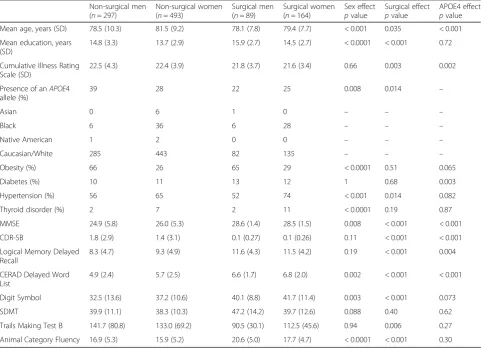
listed in Table 2along with differences according to sex.
For the entire cohort, including all participants regard-less of surgical exposure status, women entered the
studies older (81.0 vs 78.4 years, p< 0.001) while the
men were significantly more educated (15.0 vs 13.9
years, p< 0.0001) and had an increased prevalence of
obesity (63% vs 29%, p < 0.0001). Overall, men were
more likely to beAPOE4 carriers (35% vs 28%p= 0.008)
although this sex disparity was not observed for subjects
with eventual exposure to surgery/GA (p= 0.76). The
analytic cohort was 86% white and 14% non-white (Black, Asian, or Native American). There was no diffe-rence in APOE4 carrier prevalence in non-white
com-pared to white participants (32% vs 20%,p= 0.27). With
regard to participant comorbidities, there was no diffe-rence in average CIRS score nor prevalence of diabetes between the two sexes. There was, however, an increased
prevalence of hypertension (74% vs 52%, p< 0.001) and
thyroid disorders (11 vs 2%,p< 0.01) in the women
ex-posed to surgery/GA when compared to men. Cognitive outcomes saw some sex distinctions at study entry with women showing better performance on MMSE (25.8 vs
26.7,p= 0.008), the CERAD delayed word list (5.4 vs 6.0,
p= 0.002), and Digit Symbol test (34.9 vs 38.6,p= 0.003) while men exhibited better baseline performance on Animal Category Fluency (17.8 vs 16.3, p < 0.001).
Table 2Cohort demographics and cognitive outcomes at study entry
Non-surgical men (n= 297)
Non-surgical women (n= 493)
Surgical men (n= 89)
Surgical women (n= 164)
Sex effect pvalue
Surgical effect pvalue
APOE4 effect pvalue
Mean age, years (SD) 78.5 (10.3) 81.5 (9.2) 78.1 (7.8) 79.4 (7.7) < 0.001 0.035 < 0.001
Mean education, years (SD)
14.8 (3.3) 13.7 (2.9) 15.9 (2.7) 14.5 (2.7) < 0.0001 < 0.001 0.72
Cumulative Illness Rating Scale (SD)
22.5 (4.3) 22.4 (3.9) 21.8 (3.7) 21.6 (3.4) 0.66 0.003 0.002
Presence of anAPOE4 allele (%)
39 28 22 25 0.008 0.014 –
Asian 0 6 1 0 – – –
Black 6 36 6 28 – – –
Native American 1 2 0 0 – – –
Caucasian/White 285 443 82 135 – – –
Obesity (%) 66 26 65 29 < 0.0001 0.51 0.065
Diabetes (%) 10 11 13 12 1 0.68 0.003
Hypertension (%) 56 65 52 74 < 0.001 0.014 0.082
Thyroid disorder (%) 2 7 2 11 < 0.0001 0.19 0.87
MMSE 24.9 (5.8) 26.0 (5.3) 28.6 (1.4) 28.5 (1.5) 0.008 < 0.001 < 0.001
CDR-SB 1.8 (2.9) 1.4 (3.1) 0.1 (0.27) 0.1 (0.26) 0.11 < 0.001 < 0.001
Logical Memory Delayed Recall
8.3 (4.7) 9.3 (4.9) 11.6 (4.3) 11.5 (4.2) 0.19 < 0.001 0.004
CERAD Delayed Word List
4.9 (2.4) 5.7 (2.5) 6.6 (1.7) 6.8 (2.0) 0.002 < 0.001 < 0.001
Digit Symbol 32.5 (13.6) 37.2 (10.6) 40.1 (8.8) 41.7 (11.4) 0.003 < 0.001 0.073
SDMT 39.9 (11.1) 38.3 (10.3) 47.2 (14.2) 39.7 (12.6) 0.088 0.40 0.62
Trails Making Test B 141.7 (80.8) 133.0 (69.2) 90.5 (30.1) 112.5 (45.6) 0.94 0.006 0.27
No sex differences in postoperative cognitive decline after exposure to surgery & general anesthesia
After controlling for age, level of education, APOE4,
Cumulative Illness Rating Scale (CIRS) score, and base-line outcome values, there were many outcomes with altered rates of change after surgical exposure when pooling men and women together and comparing all exposed participants to all unexposed participants (Table3, surgical exposure main effect). However, there were no sex differences in rate of postoperative cognitive decline after exposure to surgery/GA on any of the specific
tests (Table 3, sex effect-surgical exposure). Further,
there were no sex differences in the rate of decline in cognitive test scores when comparing men and women
who were not exposed to surgery/GA (Table 3, sex
effect-no surgical exposure).
Older men withAPOE4+ are at higher risk of postoperative cognitive dysfunction
Next, we divided the above cohort by APOE4 carrier
status, and repeated the analyses comparing the asso-ciations of surgery/GA exposure and sex within the same APOE4 carrier to identify the difference in sex-exposure effects with respect to carrier status. The
only outcome revealing a sex difference among APOE4
non-carriers in rate of decline was CDR-SB: APOE4−
women declined more rapidly after surgery in CDR-SB than APOE4− men (Table 4). For all other outcomes analyzed, there was no interaction between sex and
surgical exposure for APOE4 non-carriers. However,
when we examined the sex-exposure interaction for
APOE4+ carriers, we found that men with at least
one copy of the APOE4 allele who were exposed to
surgery/GA had a more rapid rate of decline in tests of global cognitive function (MMSE and CDR-SB) and
memory (Logical Memory, CERAD word list) (Fig.1 and
Table5). There were no significant differences in decline
on tests of attention or executive function between the two groups. (Tables4and5).
Discussion
Because not every older adult develops POCD following surgery and anesthesia, we explored whether biological risk factors were involved. Our findings demonstrated
novel sex-APOE4 allele interactions for postoperative
cognitive decline. Similar to previous reports, we found that men and women had similar rates of postoperative cognitive decline [36–38]. However, sex differences emerged with stratified analyses, comparing women and
men with the sameAPOE4carrier status. Men with an
APOE4allele had more severe postoperative cognitive
decline compared to women with an APOE4 allele.
These findings suggest a potential explanation for the discordance in the literature regarding the relationship between postoperative cognitive decline and the
APOE4allele [16].
There has been increasing evidence that the presence
of an APOE4 allele confers disease risk in a
sex-dependent manner. Studies have shown that APOE4
confers a greater AD risk in women compared to men
[17]. Women with APOE4 also have an excess of AD
pathology, including neuritic plaques and neurofibrillary
tangles [39, 40]. Furthermore, at advanced ages such as
those under study in this cohort, a much greater propor-tion of women are demented compared to men. We
speculate that these factors create a “ceiling effect” in
women such that the effects of additional brain insults in APOE4 females are not very potent, whereas in men there is more potential for surgery/GA to result in an increase in dementia. Additionally, there is complexity
to the relationship between sex and APOE4 carrier
status. It has also been demonstrated that men who were
Table 3Rates of change in cognitive test scores in men vs. women
Non-surgical men (slope)
Non-surgical women (slope)
Surgical men (slope)
Surgical women (slope)
Surgical exposure main effect (pvalue)
Sex effect—no surgical exposure (pvalue)
Sex effect—surgical exposure
(pvalue)
Global cognitive function tests
MMSE −0.02528 −0.01907 −0.03539 −0.02704 < 0.001 0.13 0.33
CDR-SB 0.3568 0.2991 0.483 0.425 < 0.001 0.24 0.95
Memory-based tests
Logical Memory Delayed Recall
−0.07798 −0.08284 −0.2623 −0.2914 < 0.001 0.86 0.84
CERAD Delayed
Word List −
0.03858 −0.0445 0.05887 −0.05463 < 0.001 0.35 0.13
Attention-based tests
Digit Symbol −0.8686 −0.948 −1.244 −1.271 < 0.001 0.31 0.65
SDMT −1.312 −0.8192 −1.226 −1.134 0.24 0.08 0.74
Executive function tests
Trails Making Test B
5.1 3.419 10.81 9.089 0.12 0.36 0.86
Animal Category Fluency
Table 4Rates of change in postoperative cognitive test scores in men vs. women stratified byAPOE4status—APOE4−carriers
MenAPOE4− non-surgical (slope)
n= 177
WomenAPOE4− non-surgical (slope)
n= 348
MenAPOE4− surgical (slope)
n= 69
WomenAPOE4− surgical (slope) n= 123
Surgical-sex interaction on rate of change—Non-Carriers (pvalue)
Global cognitive function tests
MMSE −0.01485 −0.01571 −0.01948 −0.02411 0.15
CDR-SB 0.2749 0.2654169 0.3305 0.3888 0.02
Memory-based tests
Logical Memory Delayed Recall −
0.05689 −0.05369 −0.1959 −0.2873 0.19
CERAD Delayed Word List
−0.03427 −0.04447 −0.04921 −0.05608 0.64
Attention-based tests
Digit Symbol −0.9422 −0.9187 −1.297 −1.232 0.78
SDMT −0.03789 −0.02705 −0.02942 −0.03062 0.21
Executive function tests Trails Making Test B
7.005 3.892 3.388 6.532 0.96
Animal Category Fluency
−0.4282 −0.3635 −0.5056 −0.5563 0.15
NSnot significant, italicizedpvalues are significant
APOE4 carriers diagnosed with mild cognitive impair-ment (MCI) or AD have higher risks of brain
micro-bleeds compared to APOE4-carrying women with MCI
or AD [41].
The novel sex-APOE4 allele interactions for
postopera-tive cognipostopera-tive decline suggest that APOE4 carrier status
may play an essential role in the male excess of postopera-tive delirium. While several studies have shown greater postoperative delirium among men [18–20], to date there are no investigations revealing a sex difference in post-operative cognitive dysfunction, though none of these
investigations have assessed sex-APOE4 interactions.
Future studies could consider sex-genetic risk factor inter-actions in the incidence of deleterious postoperative neurocognitive outcomes, such as delirium and POCD.
Building knowledge regarding the potential impact of
sex andAPOE4genotype in older adults facing decisions
regarding surgery is important for several reasons. First, if health care providers knew who was at a higher risk for postoperative cognitive decline, they would be able to more accurately counsel these individuals and their families regarding surgical risks and benefits, potentially leading to a decision to forego an elective surgical procedure. Second, this information would also inform key postoperative care and appropriate discharge plan-ning. Many studies have shown that multidisciplinary proactive, personalized discharge planning contributes to increased patient satisfaction, decreased hospital length
of stay, and reduced readmission to the hospital [42,43].
One limitation of this investigation is that the surgical and anesthetic history was obtained by self-report from participants and/or caregivers. However, participants are interviewed twice annually in an attempt to accurately capture this type of health information, increasing
confidence in this data. Because we do not have access to surgical or anesthetic records and are unable to ac-count for potentially important differences including duration of general anesthesia, specific anesthetic agents used, or perioperative complications. Another limitation of this and other POCD studies is that participants undergoing surgery and anesthesia might have funda-mental differences compared to those who did not have a surgical exposure. We did adjust for age, education level, and CIRS in our data analyses in an attempt to
decrease this confounder. Finally, we note that
although we had 1069 total participants in this study, only 57 participants that were exposed to surgery/GA wereAPOE4+.Despite this small number, we were still adequately powered to determine a significant rate of cognitive decline between groups.
Conclusions
Using a retrospective analysis of multiple prospective, lon-gitudinal aging studies, OBAS, ISAAC, KEAP, AADAPt, CBDP, OLL, and the Layton Alzheimer’s Disease Center
patient registry, we have shown that APOE4+ men have
an increased rate of decline in cognition after exposure to
surgery and anesthesia than womenAPOE4carriers. This
study builds upon prior research indicating that APOE4
has sex-based health implications that may affect treat-ments. This study is an important initial step to begin to elucidate the role of sex and genetic variables on post-operative outcomes. Moving forward, researchers should consider testing for the effects of genes implicated in post-operative cognitive decline by sex, rather than combing data for both sexes. These investigations are necessary to move toward personalized strategies to improve post-operative outcomes in older adults.
Table 5Rates of change in postoperative cognitive test scores in men vs. women stratified byAPOE4status—APOE4+carriers
MenAPOE4+ non-surgical (slope) n= 116
WomenAPOE4+ non-surgical (slope) n= 139
MenAPOE4+ surgical (slope) n= 20
WomenAPOE4+ surgical (slope) n= 41
Surgical-sex interaction on rate of change—carriers (pvalue)
Global cognitive function tests
MMSE −0.0664115 −0.0328237 −0.09733 −0.03718 < 0.001
CDR-SB 0.6476 0.4505 1.059 0.581 < 0.001
Memory-based tests
Logical Memory Delayed Recall
−0.1557 −0.2307 −0.5671 −0.2724 0.01
CERAD Delayed
Word List −
0.05731 −0.04418 −0.1063 −0.0451 0.03
Attention-based tests
Digit Symbol −0.4937 −1.074 −1.07 −1.467 0.65
SDMT −0.1192 −0.05094 −0.1983 −0.08353 0.91
Executive function tests
Trails Making Test B
7.437 3.938 6.532 4.561 0.84
Animal Category Fluency
−0.6281 −0.4697 −0.8696 −0.5259 0.31
Abbreviations
AADAPt:African American Dementia and Aging Project; AD: Alzheimer’s disease;APOE: Apolipoprotein E;APOE4: Apolipoprotein E-ε4; Aβ: Amyloidβ; CBDP: Oregon Community Brain Donor Program; CDR: Clinical Dementia Rating; CDR-SB: Clinical Dementia Rating sum of boxes; CERAD: Consortium to Establish a Registry for Alzheimer’s Disease; CIRS: Cumulative Illness Rating Score; FWER: Family-wise error rate; GA: General anesthesia; ISAAC: Intelligent Systems for Assessment of Aging Changes; KEAP: Klamath Exceptional Aging Project; MCI: Mild cognitive impairment; MMSE: Mini-Mental State
Examination; OADC: Oregon Alzheimer’s Disease Center; OBAS: Oregon Brain Aging Study; OLL: Oregon Living Laboratory; POCD: Postoperative cognitive dysfunction; SD: Standard deviation; SDMT: Symbol Digit Modalities Test
Acknowledgements Not applicable
Funding
This study was funded in part by an Agency for Healthcare Research & Quality-funded BIRCWH K12 award (K12 HD 043488) and by grants from the National Institutes of Health (P30AG024978, R01AG024059, P30AG008017), a Merit Review Grant from the Department of Veteran’s Affairs, and an Alzhei-mer’s Association Clinician Scientist Fellowship.
Availability of data and materials
The datasets generated and/or analyzed during the current study are available from the corresponding author on reasonable request.
Authors’contributions
KS conceived of study design and was the primary author of the manuscript. CM analyzed and interpreted participant data regarding effects of surgery/ anesthesia, biological sex, and genotype on cognitive function and was a major contributor in writing the manuscript. NM compiled participant data regarding cognitive test results, exposure to surgery/anesthesia, genotype, and demographics and critically reviewed the manuscript. JK made substantial contributions to study design and acquisition of data and critically reviewed the manuscript. JQ conceived of study design and was a major contributor in writing the manuscript. All authors read and approved the final manuscript.
Ethics approval and consent to participate
All studies were approved by the Oregon Health & Science University’s institutional review board (IRB), and all participants provided written informed consent. Electronic IRB (eIRB) numbers are as follows: eIRB 361 Oregon Brain Aging Study (OBAS), eIRB 2353 Intelligent Systems for Assessment of Aging Changes (ISAAC), eIRB 688 Klamath Exceptional Aging, eIRB 1480 African American Dementia and Aging Project (AADAPt), eIRB 1639 Oregon Community Brain Donor Program (CBDP), eIRB 2765 Oregon Living Laboratory (OLL), eIRB 725 Layton Alzheimer’s Disease Center patient registry. Whenever possible, investigators obtained valid informed consent directly from the research participant. If the research participant lacks decision-making capacity, the investigator obtains consent from an Autho-rized Research Representative (ARR). If at any point the participant expresses resistance or dissent to participation or to the use of ARR consent, the par-ticipant is excluded from the research study. The parpar-ticipant may designate an ARR when the participant has adequate decision-making capacity to do so, or an ARR may be identified by the investigator in the same manner that a decision maker for health care treatment would be identified. An investiga-tor still obtains assent of the participant in addition to consent from the ARR.
Consent for publication Not applicable
Competing interests
The authors declare that they have no competing interests.
Publisher’s Note
Springer Nature remains neutral with regard to jurisdictional claims in published maps and institutional affiliations.
Author details
1Department of Anesthesiology and Perioperative Medicine, Oregon Health
& Science University, Mail Code L459, 3181 SW Sam Jackson Park Rd, Portland, OR 97239, USA.2Department of Neurology, Oregon Health & Science University, Portland, OR 97239, USA.3Oregon Center for Aging and
Technology, Oregon Health & Science University, Portland, OR 97239, USA.
4Department of Neurology, Portland Veterans Affairs Medical Center,
Portland, OR 97239, USA.5Layton Aging and Alzheimer’s Disease Center, Oregon Health & Science University, Portland, OR 97239, USA.6Department
of Biostatistics, University of Alabama at Birmingham, Birmingham, AL 97239, USA.
Received: 20 July 2018 Accepted: 14 March 2019
References
1. Chen PL, et al. Risk of dementia after anaesthesia and surgery. Br J Psychiatry J Ment Sci. 2014;204(3):188–93.
2. Monk TG, et al. Predictors of cognitive dysfunction after major noncardiac surgery. Anesthesiology. 2008;108(1):18–30.
3. Steinmetz J, et al. Long-term consequences of postoperative cognitive dysfunction. Anesthesiology. 2009;110(3):548–55.
4. Evered LA, et al. Prevalence of dementia 7.5 years after coronary artery bypass graft surgery. Anesthesiology. 2016;125(1):62–71.
5. Palotas A, et al. Coronary artery bypass surgery provokes Alzheimer’s disease-like changes in the cerebrospinal fluid. J Alzheimers Dis. 2010;21(4):1153–64. 6. Hogan KJ. Hereditary vulnerabilities to post-operative cognitive
dysfunction and dementia. Prog Neuro-Psychopharmacol Biol Psychiatry. 2013;47:128–34.
7. Chen CW, et al. Increased risk of dementia in people with previous exposure to general anesthesia: a nationwide population-based case-control study. Alzheimers Dement. 2014;10(2):196–204.
8. Tang JX, et al. Human Alzheimer and inflammation biomarkers after anesthesia and surgery. Anesthesiology. 2011;115(4):727–32. 9. Kline RP, et al. Surgery and brain atrophy in cognitively normal elderly
subjects and subjects diagnosed with mild cognitive impairment. Anesthesiology. 2012;116(3):603–12.
10. Schenning KJ, et al. Surgery is associated with ventricular enlargement as well as cognitive and functional decline. Alzheimers Dement. 2016;12(5):590–7. 11. Xie Z, et al. The inhalation anesthetic isoflurane induces a vicious
cycle of apoptosis and amyloid beta-protein accumulation. J Neurosci. 2007;27(6):1247–54.
12. Planel E, et al. Anesthesia leads to tau hyperphosphorylation through inhibition of phosphatase activity by hypothermia. J Neurosci. 2007;27(12):3090–7. 13. Fodale V, et al. Anaesthetics and postoperative cognitive dysfunction: a
pathological mechanism mimicking Alzheimer’s disease. Anaesthesia. 2010;65(4):388–95.
14. Liu H, Weng H. Up-regulation of Alzheimer’s disease-associated proteins may cause enflurane anesthesia induced cognitive decline in aged rats. Neurol Sci. 2014;35(2):185–9.
15. Xu Z, et al. Age-dependent postoperative cognitive impairment and Alzheimer-related neuropathology in mice. Sci Rep. 2014;4:3766. 16. Cao L, et al. Association between APOE epsilon 4 allele and postoperative
cognitive dysfunction: a meta-analysis. Int J Neurosci. 2014;124(7):478–85. 17. Altmann A, et al. Sex modifies the APOE-related risk of developing
Alzheimer disease. Ann Neurol. 2014;75(4):563–73.
18. Oh ES, et al. Sex differences in hip fracture surgery: preoperative risk factors for delirium and postoperative outcomes. J Am Geriatr Soc. 2016;64(8):1616–21. 19. Lee HB, et al. Predisposing factors for postoperative delirium after hip
fracture repair in individuals with and without dementia. J Am Geriatr Soc. 2011;59(12):2306–13.
20. Edlund A, et al. Delirium before and after operation for femoral neck fracture. J Am Geriatr Soc. 2001;49(10):1335–40.
21. Howieson DB, et al. Natural history of cognitive decline in the old old. Neurology. 2003;60(9):1489–94.
22. Howieson DB, et al. Neurologic function in the optimally healthy oldest old. Neuropsychological evaluation. Neurology. 1993;43(10):1882–6.
24. Leahy MJ, Thurber D, Calvert JF Jr. Benefits and challenges of research with the oldest old for participants and nurses. Geriatr Nurs. 2005;26(1):21–8. 25. Goeres LM, et al. Rural-urban differences in chronic disease and drug
utilization in older Oregonians. J Rural Health. 2016;32(3):269–79. 26. Morris JC. The Clinical Dementia Rating (CDR): current version and scoring
rules. Neurology. 1993;43(11):2412–4.
27. Folstein MF, Folstein SE, McHugh PR. Mini-mental state. J Psychiatr Res. 1975;12(3):189–98.
28. Chan AS, et al. Semantic network abnormality predicts rate of cognitive decline in patients with probable Alzheimer’s disease. J Int Neuropsychol Soc. 1995;1(3):297–303.
29. Armitage SG. An analysis of certain psychological tests used for the evaluation of brain injury. Psychol Monogr. 1946;60(1):i-48.
30. Wechsler D. Manual for the Wechsler Adult Intelligence Scale—revised. San Antonio, TX: The Psychological Corporation; 1981.
31. Wechsler D. WMS-R: Wechsler Memory Scale-Revised: manual. San Antonio: Psychological Corporation; 1987.
32. Rosen WG, Mohs RC, Davis KL. A new rating scale for Alzheimer’s disease. Am J Psychiatry. 1984;141(11):1356–64.
33. de Groot V, et al. How to measure comorbidity. A critical review of available methods. J Clin Epidemiol. 2003;56(3):221–9.
34. Parmelee PA, et al. Validation of the cumulative illness rating scale in a geriatric residential population. J Am Geriatr Soc. 1995;43(2):130–7. 35. Linn BS, Linn MW, Gurel L. Cumulative illness rating scale. J Am Geriatr Soc.
1968;16(5):622–6.
36. Hogue CW, et al. Gender influence on cognitive function after cardiac operation. Ann Thorac Surg. 2003;76(4):1119–25.
37. Newman MF, et al. Longitudinal assessment of neurocognitive function after coronary-artery bypass surgery. N Engl J Med. 2001;344(6):395–402. 38. Kadoi Y, et al. Decrease in jugular venous oxygen saturation during
normothermic cardiopulmonary bypass predicts short-term postoperative neurologic dysfunction in elderly patients. J Am Coll Cardiol. 2001;38(5):1450–5.
39. Barnes LL, et al. Sex differences in the clinical manifestations of Alzheimer disease pathology. Arch Gen Psychiatry. 2005;62(6):685–91.
40. Corder EH, et al. The biphasic relationship between regional brain senile plaque and neurofibrillary tangle distributions: modification by age, sex, and APOE polymorphism. Ann N Y Acad Sci. 2004;1019:24–8.
41. Cacciottolo M, et al. The APOE4 allele shows opposite sex bias in microbleeds and Alzheimer’s disease of humans and mice. Neurobiol Aging. 2016;37:47–57.
42. Harari D, et al. Proactive care of older people undergoing surgery (‘POPS’): designing, embedding, evaluating and funding a
comprehensive geriatric assessment service for older elective surgical patients. Age Ageing. 2007;36(2):190–6.