Open Access
Research article
Priority setting: what constitutes success? A conceptual framework
for successful priority setting
Shannon L Sibbald*
1,2, Peter A Singer
3, Ross Upshur
2,4and
Douglas K Martin
1,2Address: 1Department of Health Policy, Management and Evaluation, University of Toronto, Toronto, Canada, 2University of Toronto Joint Centre
for Bioethics, Toronto, Canada, 3The McLaughlin-Rotman Centre for Global Health, Toronto, Canada and 4Sunnybrook Health Science Centre,
Toronto, Canada
Email: Shannon L Sibbald* - [email protected]; Peter A Singer - [email protected]; Ross Upshur - [email protected]; Douglas K Martin - [email protected]
* Corresponding author
Abstract
Background: The sustainability of healthcare systems worldwide is threatened by a growing demand for services and expensive innovative technologies. Decision makers struggle in this environment to set priorities appropriately, particularly because they lack consensus about which values should guide their decisions. One way to approach this problem is to determine what all relevant stakeholders understand successful priority setting to mean. The goal of this research was to develop a conceptual framework for successful priority setting.
Methods: Three separate empirical studies were completed using qualitative data collection methods (one-on-one interviews with healthcare decision makers from across Canada; focus groups with representation of patients, caregivers and policy makers; and Delphi study including scholars and decision makers from five countries).
Results: This paper synthesizes the findings from three studies into a framework of ten separate but interconnected elements germane to successful priority setting: stakeholder understanding, shifted priorities/reallocation of resources, decision making quality, stakeholder acceptance and satisfaction, positive externalities, stakeholder engagement, use of explicit process, information management, consideration of values and context, and revision or appeals mechanism.
Conclusion: The ten elements specify both quantitative and qualitative dimensions of priority setting and relate to both process and outcome components. To our knowledge, this is the first framework that describes successful priority setting. The ten elements identified in this research provide guidance for decision makers and a common language to discuss priority setting success and work toward improving priority setting efforts.
Background
Priority setting, also known as rationing or resource allo-cation, is a complex and difficult problem faced by all
decision makers at all levels of all health systems, includ-ing macro (e.g. governments), meso (e.g. regional health authorities (RHAs), hospitals), and micro (e.g. clinical
Published: 5 March 2009
BMC Health Services Research 2009, 9:43 doi:10.1186/1472-6963-9-43
Received: 17 June 2008 Accepted: 5 March 2009
This article is available from: http://www.biomedcentral.com/1472-6963/9/43 © 2009 Sibbald et al; licensee BioMed Central Ltd.
programs) levels. There is relatively little interaction between decision makers at the three levels, or among institutions, regarding the setting of priorities. Conse-quently, priority setting has been described as a series of unconnected experiments with no systematic mechanism for capturing the lessons, or evaluating the strengths and weaknesses, of each experiment [1]. Hospital administra-tors, constrained by budget restrictions and confronted by increasing demand, find it a particularly difficult chal-lenge to maintain services and quality, while controlling costs; decision makers (or leaders) lack guidance and information for priority setting and are unaware of prior-ity setting tools available to them [2-4]. Mitton and Don-aldson found decision makers were "frustrated with the lack of an explicit priority setting framework" and ques-tioned "the credibility of resource allocation decision-making" ([4]p. 1660). Several studies have reported that leaders desire an explicit framework to guide priority set-ting [4-6] and acknowledged leadership as a key area where improvement can make the most difference [7].
The sustainability of healthcare systems worldwide is threatened by a growing demand for services and expen-sive innovative technologies. Decision makers struggle in this environment to set priorities appropriately, particu-larly because they lack consensus about which values should guide their decisions [8]. One way to approach this problem is to determine what relevant stakeholders understand successful priority setting to mean. Greater insight into stakeholders' attitudes and perceptions of achieving successful priority setting could improve the way in which institutions and healthcare organizations set priorities.
Successful priority setting is a desirable goal for decision makers; however there is no agreed upon definition for successful priority setting, so there is no way of knowing if an organization achieves it. Priority setting is extremely complex – choosing between competing values makes pri-ority setting fundamentally an ethical issue [9]. Different disciplines offer their own perspective on how priority set-ting 'ought' to be done, defining 'good' (or successful) pri-ority setting through values such as efficiency, equity, or justice. Discipline specific approaches and priority setting frameworks can help decision makers with priority set-ting: health economics encourages a focus on efficiency, policy approaches focus on legitimacy, evidence-based medicine looks to effectiveness. Daniels and Sabin created 'accountability for reasonableness' (A4R) with legitimacy and fairness as two key goals of priority setting [10]. Inter-disciplinary approaches are also available such as pro-gram-budgeting and marginal analysis (PBMA)[11], health technology assessment (HTA)[12]. Menon et al. described priority setting in four steps: (1) identification of health care needs, (2) allocation of resources, (3)
com-munication of decisions to stakeholders, and (4) manage-ment of feedback from them [13]. Still, there is no consensus that any one framework provides the 'correct' or 'best' comprehensive definition of successful priority setting.
These normative approaches are necessary because they help identify important values and underlying assump-tions in priority setting, however alone they are insuffi-cient and provide only a piece of a definition of successful priority setting. The problem that remains is: priority set-ting involves the adjudication between many relevant val-ues and that people (and disciplines) will disagree about which values should dominate in any specific priority set-ting context and there is no agreed upon normative approach for resolving the disagreement. When relevant values conflict, decision makers must rely on developing context-specific agreement in order to achieve priority set-ting success.
Empirical studies are also important for understanding current decision making practices within healthcare organizations [14,15]; since they identify current priority setting practices, they provide insight into defining suc-cessful priority setting. In recent years, there have been empirical descriptions of priority setting in various con-texts (e.g. waitlists [16-18], hospitals [19-21], and RHAs [13,22]). Other empirical studies have evaluated actual priority setting against an ethical framework (e.g. [19,23]). Studies have been done detailing factors that influence priority setting practices, including technical factors (such as clinical practice guidelines), non-techni-cal factors (such as alignment with goals) [13] and clusters of factors [24]. Several studies have brought forth compo-nents for improving priority setting or ensuring success in priority setting, such as stakeholder engagement [13] increased dialogue [4], a culture supporting explicit prior-ity setting [6], decision maker/group composition (size and representation) [25], clear information management and clarity of process [5], and local ownership and aware-ness of local politics [26].
a model for ethical standards (including health of patients, professional (clinical) expertise, public health, unmet health needs, advocacy for social policy reform, relationships of special ethical importance (with employ-ees), organizational solvency/survival, and benefit to community) [32]. Together, these studies contribute to our understanding of successful priority setting; but on their own, do not provide a comprehensive definition.
Evaluating success of health care (and other sectors) is possible through many of the aforementioned tools/proc-esses, and different instruments may elicit different results [33]. The problem with these studies is their limited focus (narrow organizational study and/or small range of stake-holders). While we are more cognizant of important fac-tors in successful priority setting, we still do not have a complete picture of it.
Normative approaches tell us what ought to be done, empirical studies tell us what is being done, and we are still left with a lack of consensus on an appropriate approach to successful priority setting. There is a need to define successful priority setting, to provide a common language, and to come to some agreement on conceptual basis for the concept.
A first step to ground such a definition is to collect and synthesize the views of stakeholders with direct priority setting knowledge and experience. Stakeholders include decision makers (particularly in publicly funded health systems, who are under growing pressure to base their decisions on available evidence and to demonstrate the effectiveness of their decision), patients (since the health system exists for them and because they fund the health system through taxes, insurance premiums or out-of-pocket payments), and priority setting scholars (who can provide different theoretical viewpoints on decision mak-ing). Creating a framework that defines success in priority setting is a necessary step toward improving priority set-ting practices in healthcare organizations [34,35].
The purpose of this paper is to present a synthesized defi-nition of successful priority setting brought together from the findings of three empirical studies describing success-ful priority setting from the viewpoint of stakeholders (decision makers, patients, and priority setting scholars). The definition is presented as a conceptual framework
with ten elements. The framework we describe here is a new development for evaluating priority setting; it can provide guidance to decision makers and scholars inter-ested in successful priority setting.
Methods
The findings reported here were derived from three sepa-rate but related empirical studies that used different data collection methods, but similar data analysis techniques. The overarching goal for the three studies was to create a conceptual framework for achieving successful priority setting. Study 1 gathered international perspectives through a Delphi consensus building initiative [36]. Study 2 used qualitative interviews to capture the views of deci-sion makers across the Canadian healthcare system. Study 3 included the perspective of Canadian public/patients and policy makers and used multiple interconnected focus groups called the "circle within a circle" approach (table 1) [37]. Each study used a unique set of partici-pants; there was no overlap. By bringing these three data sets together, we tapped into a diverse and rich knowledge base and captured what we feel to be a comprehensive description of successful priority setting. What follows is a combined description of the methods for all three studies.
Participants
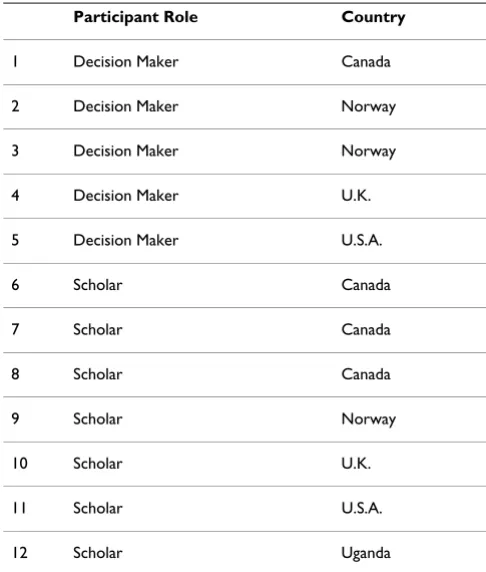
Study 1 (Delphi panel) consisted of 12 priority setting scholars and healthcare decision makers from five differ-ent health systems (table 2), chosen for their experience and interest in priority setting (i.e., published work in the field, different disciplinary approaches to priority setting and international perspectives).
Study 2 consisted of senior or executive level decision makers in healthcare organizations across Canada sam-pled using two methods: (1) theoretical sampling – peo-ple who were involved in a significant aspect of priority setting and (2) 'snowball' sampling – participants were asked to identify others (colleagues) who might have knowledge or insight into priority setting and who should be interviewed. Participants were sought out until concep-tual saturation was reached (i.e. until no new concepts were identified in successive interviews). Participants came from 45 different organizations with representation from every province except Newfoundland and Prince Edward Island (table 3). Attempts were also made to ensure there was representation within provinces –
inter-Table 1: Description of Study 3 Focus Group Design
views did not focus solely on the capital regions of each province.
Study 3 consisted of 13 patients/health system users (one from every province and territory). Patients were identi-fied and approached through various health networks,
organizations and associations. In addition, 13 health policy makers representing different levels of government and different health care contexts (at least one policy maker from each province and territory) were recruited (table 4).
Sample size was not formally calculated for any of the three studies since our goal was not to generate generaliz-able conclusions, but instead to describe characteristics of successful priority setting from the point of view of deci-sion makers.
Data Collection
Study 1 spanned three Delphi 'rounds'. Round 1 was con-ducted in May/June 2003 via email; the ethical framework 'accountability for reasonableness' (A4R) acted as the starting point for discussions [10]. (A4R was chosen as a starting point for discussions because it has traction among decision makers and it is an established frame-work of priority setting researchers internationally; more-over, it is a useful tool and a practical guide to develop, implement, and evaluate fair priority setting processes.)
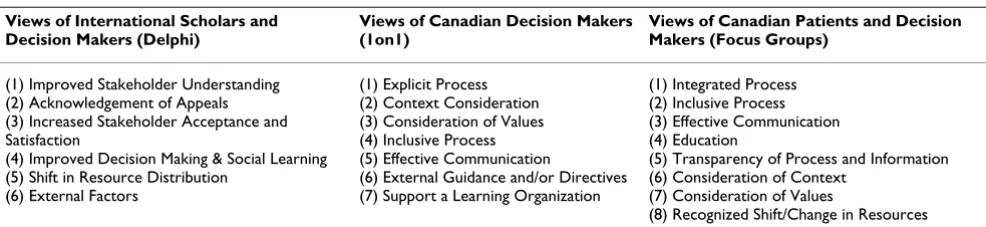
Round 2 had all participants face-to-face; the input was a list of 39 items, generated from Round 1 (see appendix). Round 3 was conducted by email four months after Round 2. Results of Round 2 (now 14 succinct and prior-itized items) were circulated; panelists were asked to make final suggestions and revisions to sharpen the list. Subse-quently, the list was revised down to six items (table 5).
[image:4.612.53.296.100.386.2]Study 2 interviews were conducted in person or by tele-phone from July 2003 to May 2004 and used an interview
Table 2: Summary of Delphi Panelists
Participant Role Country
1 Decision Maker Canada
2 Decision Maker Norway
3 Decision Maker Norway
4 Decision Maker U.K.
5 Decision Maker U.S.A.
6 Scholar Canada
7 Scholar Canada
8 Scholar Canada
9 Scholar Norway
10 Scholar U.K.
11 Scholar U.S.A.
12 Scholar Uganda
Table 3: Summary of Interview Participants
MACRO Provincial Ministry of Health
(British Columbia – 1; Alberta – 1; Saskatchewan – 1; Ontario – 1, New Brunswick – 1; Nova Scotia – 2)
7
MESO Hospital Senior Management
(British Columbia – 2; Alberta – 1; Ontario – 12, Quebec – 2; Nova Scotia – 1)
18
Senior Management of Community Care Access Centres in Ontario 3
Senior Management and Board Members of Regional Health Authorities (British Columbia – 1; Alberta – 6; Saskatchewan – 3)
10
Senior Management of Private Health Care Organizations (Alberta) 2
Directors/Executive Directors of District Health Councils (3) and Public Health Units (2) (Ontario) 5
MICRO Clinician Managers in hospitals
(Alberta – 4, Saskatchewan – 1; Ontario – 1; Quebec – 1; Nova Scotia – 1)
8
Other (policy analyst/consultants, ethics board members) (Alberta – 1; Ontario – 1) 2
[image:4.612.51.555.492.722.2]guide based on previous research and relevant literature. All interviews were audio taped and transcribed – over 800 pages of transcripts were generated.
Study 3 was set around an existing event: an Alberta-based Provincial Health Ethics Network (PHEN) conference (April 2003). The study utilized this conference as a unique opportunity to bring together patients and policy makers in one location. All study participants participated in the PHEN conference. All focus groups were video taped and the discussions were transcribed. Observations were recorded by the researchers in field notes which pro-vided context to the data analysis.
Data analysis
Data from the three studies was first analyzed separately and then synthesized and analyzed in aggregate. Analysis was done using a modified thematic analysis that pro-ceeded in two steps: open and axial coding [38]. In open coding, the data was read and then fractured by identify-ing chunks of data that related to a concept or idea. In axial coding, similar ideas were organized into overarch-ing themes by groupoverarch-ing similar codes. The analysis was facilitated by, and culminated in, writing, which served as an important tool in formalizing elements and making explicit assumptions that influence data interpretation [39].
The validity of the findings was addressed in three ways [40]. First, two researchers (SS and DKM) coded the raw data to ensure accuracy and that one person's biases did not unduly skew the interpretation – differences were resolved through ongoing discussion. Second, all research activities were rigorously documented by the researcher to permit a critical appraisal of the methods [41]. Third, throughout all three studies, participants verified the rea-sonableness of the findings in "member checks" – partic-ipants were invited to read the results from the data analysis and comment on misinterpretations or missing information. Revisions from participants were incorpo-rated into the findings, or where disagreement occurred, were discussed by the research team to determine further action.
Research Ethics
All three studies received research ethics board approval from The Committee on the Use of Human Subjects of the University of Toronto. Where appropriate, written informed consent was obtained from each individual. All data was protected as confidential and available only to the research team. No individuals have been identified in reports without their explicit agreement.
Results
Synthesis of 3 Studies
[image:5.612.56.549.613.726.2]When analyzed independently, the three studies provided insight into key elements which could define successful
Table 4: Summary of Focus Group Participants: Policy Makers
MACRO National level
(Canadian Medical Foundation, Canadian Nurses Association, Health Canada, Western Canada Waiting List Project)
4
Provincial Level
(Provincial Ministry of Health, Provincial Government (other than MOH))
3
MESO Senior Management of Regional Health Authorities (P.E.I, Manitoba, Alberta)
5
Senior Management Hospitals 1
TOTAL 13
Table 5: Elements of Success – Results from 3 Studies
Views of International Scholars and Decision Makers (Delphi)
Views of Canadian Decision Makers (1on1)
Views of Canadian Patients and Decision Makers (Focus Groups)
(1) Improved Stakeholder Understanding (2) Acknowledgement of Appeals (3) Increased Stakeholder Acceptance and Satisfaction
(4) Improved Decision Making & Social Learning (5) Shift in Resource Distribution
(6) External Factors
(1) Explicit Process (2) Context Consideration (3) Consideration of Values (4) Inclusive Process (5) Effective Communication
(6) External Guidance and/or Directives (7) Support a Learning Organization
(1) Integrated Process (2) Inclusive Process (3) Effective Communication (4) Education
(5) Transparency of Process and Information (6) Consideration of Context
(7) Consideration of Values
priority setting; together they provided 21 elements (table 5). In order to make one comprehensive list of elements of successful priority setting, we re-read and re-analyzed raw data to look for similarities; similar items were merged and an amalgamated list was created (e.g., within the views of Canadian decision makers, 'context consider-ations' and 'consideration for values' were merged; in the focus group list, 'consideration of context' and 'considera-tion of values' were merged; combined they created 'con-sideration of context and values'). Effort was made to ensure that the merged list captured the original descrip-tion and meaning.
In the end, a list of ten elements was created (table 6). The research team created the element labels (left column) based on the results of the three studies; where possible, we used labels that were verbatim from the original raw data (i.e. participants themselves used the words).
When there was disagreement or uncertainty about merg-ing items (i.e. can they legitimately be combined, or should they remain separate), we went back to the origi-nal data and re-aorigi-nalyzed the individual and specific meaning of the element and how it originally emerged in the data. There were not many inconsistencies between the derived success elements in each of the three studies. Given the controversial nature of priority setting, this finding might seem out of place; however, it showed that there are common elements reasonable people can agree on [10]. By providing a forum to discuss priority setting, different stakeholders were able to come to some agree-ment on eleagree-ments important to any priority setting
activ-ity. Further, the aim of this conceptual framework was to identify higher-level elements of success, about which there seems to have been a certain amount of consensus across healthcare settings and stakeholder groups.
There were some contradictions within study 2, between the focus groups (patients/health system users and deci-sion/policy makers) mainly to do with procedural ele-ments of priority setting. For example, patients were less concerned with procedural efficiency, but more focused on partnership in public consultation and education. Decision makers saw the importance of public consulta-tion, but spent more time discussing the priority setting process, highlighting (among other things) the impor-tance of efficiency.
[image:6.612.52.564.487.731.2]We circulated the conceptual framework and an explana-tion of the elements using electronic communicaexplana-tions to a selection of participants from the three studies as well as a group of interdisciplinary scholars, for their comments and refinements – a type of 'member check'. Across the studies, 15 participants were invited to comment. Addi-tionally, eight scholars were asked to comment on the framework. Seven participants and all eight scholars replied via email with comments and questions of clarity. Most of the comments had to do with wording of the ele-ments. For example 'information management' was clari-fied and further qualiclari-fied as 'clear and transparent information management'. Another example: 'improved' was added to 'stakeholder understanding' to reflect the idea of change over time. Revisions were made accord-ingly.
Table 6: Merged List
Elements of the Conceptual Framework Delphi 1-on-1 Focus Groups
PROCESS 1. Stakeholder Engagement x x
2. Explicit Process x x
3. Information Management x
4. Consideration of Context & Values x x
5. Revision or Appeals Mechanism x
OUTCOMES 6. Stakeholder understanding x x x
7. Shifted priorities/Reallocation of resources x x
8. Improved Decision Making Quality x x
9. Stakeholder Acceptance &Satisfaction x
Each element is important individually, but is also related to the others, thus forming a robust and comprehensive definition of successful priority setting in a broad concep-tual framework; each of the ten elements is described below.
Process Concepts
1. Stakeholder Engagement
Stakeholder engagement refers to an organization's efforts to identify the relevant internal and external stakeholders and to involve these stakeholders effectively in the deci-sion-making process. This should include, at a minimum, administrators, clinicians, members of the public and patients. To ensure adequate engagement, identifying and engaging stakeholders should involve multiple tech-niques, such as round tables, open forums, departmental meetings. There should be a genuine commitment from the organization to engage stakeholders effectively through partnership and empowerment. Stakeholder engagement is also concerned with stakeholder satisfac-tion regarding the level of their involvement in the deci-sion-making process.
2. Use of Explicit Process
An explicit process is one that is transparent not only to decision makers, but also to other stakeholders. Adhering to a predetermined process can enhance trust and confi-dence in the process. Transparency means knowing who is making the decision, how the decision will be made, and why decisions were made. Communication needs to be well coordinated, systematic and well-planned. All stake-holders (internal and external) should be probed for rele-vant information to the priority setting decisions and information should be communicated effectively using multiple vehicles (town-hall, departmental meetings, memos, emails, etc.).
3. Information Management
Information management refers first to the information made available to decision makers during the priority set-ting process, including what was used and what was per-ceived to be lacking. Second, information management considers how the information was managed, including how it was collected and collated. Relevant information includes, but is not restricted to: health outcomes data, economic data (such as cost effectiveness analyses), com-munity needs assessment, current policies or policy reports, and the experiences of both clinicians and patients.
4. Consideration of Values and Context
Values and context are important considerations in any priority setting process, including the values of the organ-ization, the values of staff within that organorgan-ization, and the values of other stakeholders (such as patients, policy
makers, politicians, and members of the community). The mission, vision and values of the organization should guide priority setting. Priority setting decisions should be based on reasons that are grounded in clear value choices, and those reasons should be made explicit. This also involves not only looking within the organization at pre-vious priority setting decisions, but also observing what other healthcare organizations are doing. This would involve looking at organizations in the local community, at other healthcare organizations with similar mandates, as well as looking at the other levels of healthcare provi-sion. Context is distinct from values and considers the organization's goals in the health care environment artic-ulated in its strategic directions.
5. Revision or Appeal Mechanism
A revision process is a formal mechanism for reviewing decisions and for addressing disagreements construc-tively. It is important to have such a mechanism and to ensure its rules and requirements are communicated clearly ahead of time. The dual purposes of a revision process are to: 1) improve the quality of decisions by pro-viding opportunities for new information to be brought forward, errors to be corrected, and failures in due process to be remedied; and 2) to operationalize the key ethical concept of responsiveness.
Outcome Concepts
1. Improved Stakeholder Understanding
Stakeholder understanding implies more than basic knowledge of the process. It assumes stakeholders have gained insight into the priority setting (e.g. goals of the process, rationale for priority setting and rationale for pri-ority setting decisions) and/or the organization (e.g. mis-sion, vimis-sion, values, and strategic plan). As stakeholder understanding increases, stakeholder acceptance and con-fidence should also increase.
2. Shifted Priorities and/or Reallocated Resources
A successful priority setting process results in the alloca-tion of budgets across portfolios, changes in utilizaalloca-tion of physical resources (e.g. operating theatre schedules, bed allocations) or possibly changes in strategic directions. Effort that does not result in change may encourage the perception among stakeholders that the process was an inefficient use of time or mere window-dressing for pre-determined outcomes. A reaffirmation of previous resource allocation decisions (e.g. the previous year's budget) may, in some circumstances, be seen as a success.
3. Improved Decision Making Quality
pre-scribed process. It also captures the extent to which the institution is learning from its experience to facilitate ongoing improvement. This component is most obvious as subsequent iterations of priority setting are evaluated; where consistency and building on previous priority set-ting would be indicative of a successful process. Institu-tional learning, increased instituInstitu-tionalization of the priorities, more efficient decision making, more consist-ent decision making, or increased compliance with deci-sions (i.e. 'buy-in') are valuable, hard to achieve outcomes of successful priority setting. Institutional learning from its experiences facilitates ongoing institutional improve-ment, which appears as subsequent iterations of priority setting are evaluated.
4. Stakeholder Acceptance and Satisfaction
It is important to consider the satisfaction of all stake-holder groups, both internal to the hospital and external to the hospital (community groups/public and govern-mental health agencies/ministries of health). Successful priority setting leads to increases in satisfaction over mul-tiple decision cycles. Stakeholder acceptance is indicated by continued willingness to participate in the process (i.e. 'buy-in') as well as the degree of contentment with the process. Stakeholders may be able to accept priority set-ting decisions, even if they may not always agree with the outcomes.
5. Positive Externalities
Positive externalities can act as a sort of check and bal-ance, ensuring information is made transparent to stake-holders through various avenues, and/or establishing good practices for budgeting in other healthcare organiza-tions. As an indicator of success, externalities may include positive media coverage (which can contribute to public dialogue, social learning, and improved decision making in subsequent iterations of priority setting), peer-emula-tion or health sector recognipeer-emula-tion (e.g. by other health care organizations, accreditation bodies, etc), changes in poli-cies, and potentially changes to legislations or practice.
Discussion
The primary purpose of this study was to develop a con-ceptual framework for successful priority setting. This research has helped elucidate elements of successful prior-ity setting which can be used to assist organizations in their priority setting efforts.
Priority setting is complex, difficult, contentious and often controversial. Developing a conceptual framework is a necessary first step to approaching the evaluation of successful priority setting. The findings of the three studies described here have been synthesized into a conceptual framework which aims to provide guidance to decision
makers (and other stakeholders) in better understanding successful priority setting.
The conceptual framework contains ten elements ger-mane to successful priority setting. It is an advance in knowledge because it is the first attempt to comprehen-sively describe elements of successful priority setting from the point of view of stakeholders. It provides a way of thinking about successful priority setting and the consid-erations, or components, essential to achieving successful priority setting. It also provides a basis for decision makers to think specifically about successful priority setting and how to achieve it. Finally, it offers a common language for decision makers and stakeholders, within and between institutions, to discuss successful priority setting.
This research is complementary to previous studies that identified pieces of successful priority setting, and it builds and expands upon these previous works by describ-ing a broad range of stakeholders' views about successful priority setting and synthesizes them into one conceptual framework that can be used by decision makers to improve priority setting. Further, this framework focuses both on process and outcomes of priority setting – other descriptive frameworks (e.g. accountability for reasona-bleness) focus only on the fairness of the process.
The ten elements identified in this framework are inter-connected and often interdependent, it is difficult to use these elements in isolation. Elements were not weighted since there was no empirical evidence to suggest one ele-ment was more important than another. All eleele-ments are relative – that is, as conditions, they may be more or less met, and each may be improved.
Although the ten elements are not directly derived from moral theory, they hold normative relevance because they are derived from overlapping consensus of empirical observations involving the participants' reported values. Many of the participants were actual priority setting deci-sion makers who are motivated to improve priority setting because they are directly involved in it. It is important to distinguish here between normative versus positive. This 'fact/value distinction' differentiates statements about what is the case from statements about what ought to be the case. Facts are descriptive, telling us what was done; values are prescriptive, telling us what should be done. The value-relevance of this study comes from the partici-pants' values – i.e. their normative reasoning – not from the data analysis. In this research, we have 'described' par-ticipants' views; the participants have provided what they thought 'should be'.
concepts and outcome concepts. Traditionally in health care, outcome measures refer to health outcomes (e.g. morbidity and mortality) in a selected population. How-ever, the respondents in our three studies did not mention health outcomes as an element of successful priority set-ting. Thus, our framework does not include health out-comes in its list of priority setting outout-comes. Our framework may then be criticized for not including health outcomes. A critic may ask: In an organization dedicated to health care, can a priority setting exercise that results in poorer health outcomes really be considered successful? Future scholarship should examine these divergent views. Health outcomes may be influenced by priority setting decisions, but are also influenced by a myriad other fac-tors, such as quality of care. Outcome measures, such as mortality rates, may be helpful in evaluating the success of a healthcare organization, but there are many complicat-ing factors – e.g. What about organizations that deliber-ately treat very complex cases? According to our respondents, achieving priority setting success is possible by focusing directly on priority setting outcomes, such as improved stakeholder understanding, shifted priorities, improved decision making, stakeholder acceptance, and positive externalities. Ultimately, we suspect that future research may find strong associations between health out-comes and priority setting outout-comes such as stakeholder acceptance.
Our study is supported by previous studies that have reported on pieces of our framework [2,5,6,20]. While other frameworks exist to help decision makers with pri-ority setting, our framework is more comprehensive. For example, Gibson, Mitton et al showed that while PBMA can be effective, it is not comprehensive; they suggested combining PBMA with A4R to achieve optimal benefits with available resources [42]. This framework is an advance because it was derived directly from conversa-tions with people involved in priority setting about prior-ity setting, and because it is the first time they have all been connected together in a comprehensive framework (table 6).
Our study builds and expands upon previous works by, for the first time, describing a broad range of stakeholder's views about successful priority setting and synthesizing them into one conceptual framework that can be used by actual decision makers to improve priority setting.
Limitations
The primary limitation of this research is its generalizabil-ity. The results of this research reflect the views of a wide range of key stakeholders, but most are from the Canadian health system, and they may not represent the views of stakeholders in other countries or cultures. It is also important to note that each country may have additional
contextual elements of success. Moreover, participants were not sampled by a statistical method designed to yield generalizable results. The sampling technique was designed to probe a range of perspectives. Further research is required to determine the wider applicability of the con-cepts described here. Second, it is possible that the views provided by participants were shaped by social desirabil-ity bias, and responses given in the interviews might not correspond to what their organization actually does. However, we found no glaring inconsistencies between the interview data and the documentary support.
Conclusion
Using an innovative and robust mixed-methods approach, we have created a framework which attempts to provide much needed guidance to decision makers (and other stakeholders) to begin to improve the success of pri-ority setting. Health care decision makers need guidance to set priorities. This study has helped elucidate the ele-ments of successful priority setting which can be used to assist organizations in their priority setting efforts. Further research is needed to determine how best to utilize them to evaluate success of priority setting.
Competing interests
The authors declare that they have no competing interests.
Authors' contributions
SS was the primary analyst and principal author of the manuscript. DKM conceived the research, was involved in data collection and analysis, and was co-author of the manuscript. RU and PAS were involved in study concep-tion, analysis and drafting the manuscript. All authors read and approved the final manuscript.
Appendix DELPHI ROUND ONE LIST OF
ITEMS
Directly Related to A4R
Relevance
1) Assessments of the health needs or other interests of the affected populations have been determined and docu-mented. Other interests could take into account conces-sions on health needs for other gains or advantages (job security, education) as result from collective bargaining or political processes.
2) Representatives of different stakeholders groups are represented and meaningfully participate in the allocation decision-making process.
3) Data or generally accepted opinion exist that support specific allocation policies and management practices.
frus-trate access to the allocated health care services either purposely or inadvertently.
5) A systematic search and evaluation of evidence
• Conformance with evidence would require expert judg-ment
• The quality of decisions should be higher because rationales are required, there is less scope for decisions to be based on considerations other than the available evi-dence e.g. lobbying and political pressure, though lobby-ing will still occur.
6) Wide professional consultations
Publicity
7) Communication materials and mechanisms made available by policy makers, and by surveys of stakeholders and direct observation approaches.
8) Decisions are public and accessible
9) Reasons are given in non-technical language
Appeals
10) Policies, rationales, and requirements can be revised as made necessary by changes in objectives to providing allocations or new information or arguments that have a bearing on allocation decisions.
11) Policies and procedures in place addressing surveil-lance needs to determine when changes are necessary to general allocation policies and to adjudicate individual requests from stakeholders for revisions in general poli-cies or individual decisions.
12) Documentation exists showing responses to new information or stakeholder requests for changes in poli-cies or practices
Enforcement
13) Mechanisms exist that ensure the processes are availa-ble and function properly
14) Governmental regulatory requirements for compli-ance to processes.
15) Internal policies and procedures (including auditing functions) to ensure compliance.
16) Voluntary arrangements with independent third-par-ties exist to assess compliance with processes and/or to adjudicate stakeholder requests for changes in policies or for appeals of individual decisions.
Other forms of outcome indicators
Available through interested observers such as govern-mental agencies, courts, news media, and cultural appara-tus; could include, but not be limited to the following:
17) Qualitative and quantitative measures of federal and local legislation and regulation targeting problems meant to be addressed by the main ideas of accountability for reasonableness
18) Qualitative and quantitative measures of complaints and grievances about health care service allocation poli-cies and management practices brought by stakeholders in the process
19) Number of appeals submitted for unavailable health care services that can be tied to insufficient conformance to the main ideas of accountability for reasonableness
20) The number of lawsuits filed and the size of awards provided for problems that correspond to the main ideas of accountability for reasonableness
21) The number and nature of news media accounts of problems with health care service allocation policies and management practices
22) The frequency and nature of content in common cul-tural media (plays, movies, books)
23) Principles or criteria are explainable and justifiable to lay audiences need to have at their core the overriding responsibility to make decisions consistent with the pub-lic's health needs as well as available resources – both present and future.
24) Evaluation that has structure and is somewhat generic
• An evaluation framework for measuring effectiveness of the given priority setting process that provides structure for evaluation but is also generic enough to be adapted in the local context
• Tool provides guidance but is at the same time not overly prescriptive
25) Resource inequalities are compensated
• Re-allocation of resources; improved patient outcomes
with the decision-making structure of the affected organi-zation (who gets to decide what?).
27) The organization must be inclusive enough for the participation of key stakeholders, to be accepted by all parties; The organization must be exclusive enough to reach a limit-setting decision within reasonable time and resources; All key stakeholders have equal access and voice.
28) Stakeholder understanding: greater knowledge of why decisions have been made
29) Impact on stakeholder understanding of limits and their rationales
• Measured in surveys in natural experiments
• Measured in use of web pages or other devices for explaining limits, eg: of pharmacy benefits
30) Satisfaction of the participants: self-rated usefulness by participants; important to draw on the judgments of decision makers themselves and of key stakeholders; whether decisions 'felt fair' – as assessed by decision mak-ers and stakeholdmak-ers, and in the context of what has been achieved in other settings.
31) Policies and mechanisms in place to make affected populations aware of
• Objectives to providing covered health care services
• Health services available and specific conditions/ requirements
• Mechanisms available that facilitate access to covered health services, including appeals processes
• Rationales for allocations, conditions, and requirements
32) Degree to which main ideas become embedded in cul-ture: improvement could be measured by the nature and number of enhancements to the original process
33) Enhancement of market perception: of provider in sit-uations where some providers promote themselves as abiding by A4R
34) High degree of stakeholder acceptance
35) High degree of reasonable public acceptance
Indirectly Related to A4R (but relevant to effectiveness)
36) There needs to be clear objectives/purpose: decision makers need to have clear objectives upon which they agree.
37) Commitment to implementation: without a commit-ment to implecommit-mentation/follow-through based on the results, the process is incomplete and its credibility may be undermined for any subsequent use.
38) Maximization of benefits and minimization of oppor-tunity costs
39) Effectiveness measured by efficiency:
• An efficiently timed process that provides for meaning-ful involvement without demanding excessive time or effort.
• a lengthy time for stakeholder involvement, etc., crucial energy and sustained knowledge/understanding and com-mitment can be compromised.
Acknowledgements
Funding for study provided by a grant from an Interdisciplinary Capacity Enhancement grant from the Canadian Institutes of Health Research.
The views expressed herein are those of the authors, and do not necessar-ily reflect those of the supporting groups. This research was supported by the Canadian Institutes of Health Research and the Charles E. Frosst Foun-dation. SLS is supported by the University of Toronto and through a CIHR grant of the Canadian Priority Setting Research Network. DKM is sup-ported by a Canadian Institutes of Health Research New Investigator award.
All correspondence should be sent to: Dr. Douglas K. Martin, University of Toronto Joint Centre for Bioethics, 88 College Street, Toronto, Ontario, M5G 1L4, Canada, tel: 416-978-6926, fax: 416-978-1911, e-mail: [email protected]
References
1. Martin D, Singer P: Priority Setting and health care technology assessment: beyond evidence-based medicine and cost-effectiveness analysis. In The Global Challenge of Health Care Ration-ing Edited by: Ham C, Coulter A. Buckingham: Open University Press; 2000:135-145.
2. Gibson JL, Martin DK, Singer PA: Setting priorities in health care organizations: criteria, processes, and parameters of suc-cess. BMC Health Serv Res 2004, 4(1):25.
3. Lomas J, Woods J, Veenstra G: Devolving authority for health care in Canada's provinces: 1. An introduction to the issues.
CMAJ 1997, 156(3):371-377.
4. Mitton C, Donaldson C: Setting priorities in Canadian regional health authorities: a survey of key decision makers. Health Pol-icy 2002, 60(1):39-58.
5. Mitton C, Patten S: Evidence based priority setting: what do the decision makers think? Journal of Health Services Research and Policy
2004, 9(3):146-152.
6. Teng F, Mitton C, Mackenzie J: Priority Setting in the Provincial health services authority: survey of key decision makers.
BMC Health Serv Res 2007, 7(84):.
Publish with BioMed Central and every scientist can read your work free of charge "BioMed Central will be the most significant development for disseminating the results of biomedical researc h in our lifetime."
Sir Paul Nurse, Cancer Research UK
Your research papers will be:
available free of charge to the entire biomedical community
peer reviewed and published immediately upon acceptance
cited in PubMed and archived on PubMed Central
yours — you keep the copyright
Submit your manuscript here:
http://www.biomedcentral.com/info/publishing_adv.asp
BioMedcentral
fairness of priority setting in their institutions? BMC Health Serv Res 2005, 5(8):.
8. Holm S: Goodbye to the simple solutions: the second phase of priority setting in health care. British Medical Journal 1998,
317:1000-1002.
9. Singer PA, Mapa J: Ethics of resource allocation: dimensions for healthcare executives. Hosp Q 1998, 1(4):29-31.
10. Daniels N, Sabin J: Limits to health care: Fair procedures, dem-ocratic deliberation and the legitimacy problems for insur-ers. Philosophy and Public Affairs 1997, 26:303-350.
11. Mitton C, Donaldson C: Twenty-five years of programme budg-eting and marginal analysis in the health sector, 1974–1999.
Journal of Health Services Research and Policy 2001, 6(4):239-248. 12. Battista RN, Hodge MJ: The evolving paradigm of health
tech-nology assessment: reflections for the millennium. Canadian Medical Association Journal 1999, 160(19):146-147.
13. Menon D, Stafinski T, Martin D: Priority-setting for healthcare: Who, how, and is it fair? Health Policy 2007, 84(2–3):220-233. 14. Martin D, Singer P: A Strategy to Improve Priority Setting in
Health Care Institutions. Health Care Analysis 2003, 11(1):59-68. 15. Mitton C, Donaldson C: Priority Setting Toolkit: A guide to the use of eco-nomics in healthcare decision making London: BMJ Publishing Group; 2004.
16. Coster C, McMillan S, Brant R, McGurran J, Noseworthy T: Primary Care Panel of the Western Canada Waiting List Project: The Western Canada Waiting List Project: development of a priority referral score for hip and knee arthroplasty. Journal of Evaluation in Clinical Practice 2007, 13:192-197.
17. Gauld , Derrett : Solving the Surgical Waiting List Problem? New Zealand's 'Booking System'. International Journal of Health Planning and Management 2000, 15:259-272.
18. McKeen M, MacKenzie M: Report of the Provincial Wait Time Monitoring Project Steering Committee. Nova Scotia 2004. 19. Bell JA, Hyland S, DePellegrin T, Upshur RE, Bernstein M, Martin DK:
SARS and hospital priority setting: a qualitative case study and evaluation. BMC Health Serv Res 2004, 4(1):36.
20. Madden S, Martin DK, Downey S, Singer PA: Hospital priority set-ting with an appeals process: a qualitative case study and evaluation. Health Policy 2005, 73(1):10-20.
21. Reeleder D, Goel V, Singer P, Martin D: Accountability Agree-ments in Ontario Hospitals: Are They Fair? Journal of Public Administration Research and Theory 2008, 18(1):161-175.
22. Mitton C, Mackenzie J, Cranston L, Teng F: Priority Setting in the Provincial Health Services Authority: Case Study for the 2005/06 Planning Cycle. Healthcare Policy 2006, 2(1):91-106. 23. Martin D, Shulman K, Santiago-Sorrell P, Singer P: Priority-setting
and hospital strategic planning: a qualitative case study. J Health Serv Res Policy 2003, 8(4):197-201.
24. Martin DK, Pater JL, Singer PA: Priority-setting decisions for new cancer drugs: a qualitative case study. Lancet 2001,
358(9294):1676-1681.
25. Cohen D: Messages from Mid Glamorgan: a multi-pro-gramme experiment with marginal analysis Health Policy.
Health Policy 1995, 33(2):147-155.
26. Chappel D, Bailey J, Stacy R, Rodgers H, Thomson R: Implementa-tion and evaluaImplementa-tion of local-level priority setting for stroke.
Public Health 2001, 115(1):21-9.
27. Bate A, Donaldson C, Ray H: Resource Allocation in Orthoped-ics. Clinical Orthopaedics and Related Research 2007, 457:49-56. 28. Williams I, Bryan S: Understanding the limited impact of
eco-nomic evaluation in health care resource allocation: A con-ceptual framework. Health Policy 2007, 80(1):135-143.
29. Peacock S, Ruta D, Mitton C, Donaldson C, Bate A, Murtagh M:
Using economics to set pragmatic and ethical priorities. Brit-ish Medical Journal 2006, 332:482-485.
30. Peacock S: An Evaluation of Program Budgeting and Marginal Analysis Applied in South Australian Hospitals. West Heidel-berg, Australia: Centre for Health Program Evaluation; 1998. 31. Mitton CR, Donaldson C: Setting priorities and allocating
resources in health regions: lessons from a project evaluat-ing program budgetevaluat-ing and marginal analysis (PBMA). Health Policy 2003, 64(3):335-348.
32. Ozar D, Berg J, Werhane P, Emanuel L: Organizational Ethics in Health Care: Toward a Model for Ethical Decision Making by Provider Organization In Institute for Ethics National Work-ing Group Report. American Medical Association 2001.
33. Peck , Asch , Goold , Roter , Ubel , McIntyre , Abbott , Koropchak , Tulsky : Measuring patient expectations: does the instrument affect satisfaction or expectations? Medical Care 2001,
39(1):100-108.
34. Feinstein AR: Clinical Judgment Baltimore: Williams & Wilkins; 1967. 35. Mitton C, Donaldson C: Tools of the trade: a comparative
anal-ysis of approaches to priority setting in healthcare. Health Services Management Research 2003, 2:96-105.
36. Adler M, Ziglio E: Gazing Into the Oracle: The Delphi Method and it's Implications to Social Policy and Public Health London: Jessica Kingsley Publishers; 1996.
37. Gallagher TH, Waterman AD, Ebers AG, Fraser VJ, Levinson W:
Patients' and physicians' attitudes regarding the disclosure of medical errors. Jama 2003, 289(8):1001-1007.
38. Strauss A, Corbin J: Basics of Qualitative Research: Techniques and Pro-cedures of Developing Grounded Theory Thousand Oaks: Sage Publica-tions; 1998.
39. Richardson L: Writing: a method of inquiry. In Handbook of Qual-itative Research Edited by: Denzin NK, Lincoln YS. London: Sage Pub-lications Inc; 1994.
40. Altheide DL, Johsnson JM: Criteria for Assessing Interpretive Validity in Qualitative Research. In Handbook of Qualitative Research Edited by: Denzin NK, Lincoln YS. Thousand Oaks: Sage Pub-lications Inc; 1994:485-499.
41. Mays N, Pope C: Rigour and Qualitative Research. British Medi-cal Journal 1995, 311:109-112.
42. Gibson J, Mitton C, Martin D, Donaldson C, Singer P: Ethics and economics: does programme budgeting and marginal analy-sis contribute to fair priority setting? J Health Serv Res Policy
2006, 11(1):32-37.
Pre-publication history
The pre-publication history for this paper can be accessed here: