Hybrid composite material
________________________________________________________________________________________
ANURAG Mishra
1,Sandeep kumar Mishra
2,Abhay Shankar Mishra
31 2 3
MUIT lucknow
Abstract: The role of natural and man made fibers reinforced hybrid composite materials are growing in a faster rate in the field
of engineering and technology due to its favorable properties. In the present unsustainable environmental condition natural fibers
are serving better material in terms of biodegradability, low cost, high strength and corrosion resistance when compared to
conventional materials. The benefits of components and products designed and produced in hybrid composite materials instead of
metals recognized by many industries. The main objective of this experimental study is to fabricate the glass fibers,knef and bnana
fibe reinforced hybrid composites and to evaluate the mechanical properties such as tensile strength, and impact strength,
hardness and water absorption . The hybrid laminates are fabricated by hand lay-up method by using glass, banana and knef
fibers as reinforcing material with epoxy resin. The specimen is prepared according to ASTM standards and the experiment has
been carried out by using universal testing machine (UTM), Impact testing machine, hardness tester etc. From the experimental
results, it has been observed that the banana-kenaf -glass fibers reinforced hybrid epoxy composites exhibited superior properties
and used as an alternate material for synthetic fiber reinforced composite materials.
Keywords: Mechanical properties, Hybrid composites, Banana-Kenaf-Glass fiber composites,
1. Definition of composite
A Composite material consists of two or more chemically not
the same constituents, on a macroscopic level, having a
different interface separating them. One or more interrupted
phases therefore are embedded in a continuous phase to form a
composite.[1]
The discontinuous phase is usually stronger and harder than
the continuous phase and is called the reinforcement, whereas,
the permanent phase is termed the matrix. A matrix material
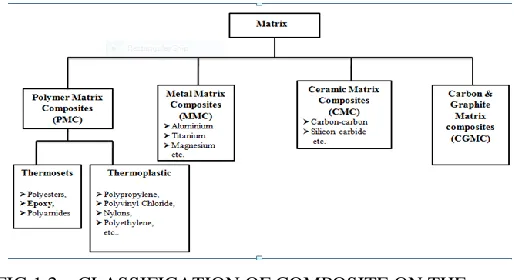
can be ceramic, polymeric and metallic When the matrix is a
polymer, the composite is said polymer matrix composite
(PMC). The reinforcement phase may be either be fibrous or
non-fibrous (particulates) in nature and if the fibers are
orignate from plants or some other living species, they are
called natural fibers. The conventional materials are
subsituting by composite materials, because of its prevaient
properties like high strength,high tensile strength to weight
ratio, low thermal expansion and they reduced completely by
composting process and do not emit any toxic or noxious
component [2]
According to NPTEL “A composite material is superior at a
microscopic scale but statistically homogeneous at macroscopic scale” [3].
In other book the author R. Asthana et al. composite is defined as “Composite materials are material systems that include a
discrete constituent (the reinforcement) distributed in a
permanent phase (the matrix) and that derive their
distinguishing characteristics from the properties and
behaviour of their constituents, from the geometry and
arrangement of the constituents and from the properties of the interfaces between the constituents” [4].
The definition is given by MP Groover “A composite material
is a material system composed of two or more physically
defined phases whose combination produces aggregate properties that are different from those of its constituents.” [5]. According to D. Verma defined as “The composite materials
which differ from alloys by the fact that the individual
components regain their characteristics but are so incorporated
and not of their short comings‖, in order to obtain improved materials” [6].
A composite material is defined as the mixture of two or more
than two materials having distinct properties,combination of
materials having various would give results having better
properties than those of theproperties of the single components
if used alone. In recent years, the conception of natural
resources has gained key importance due to the necessity to
preserve our natural environment.
1.2ADVANTAGE OF COMPOSITE
Composites consist of one or more discontinuous phases
embedded in a continuous phase. The discontinuous phase is
usually harder and stronger than the continuous phase and is called the „reinforcement„ or „reinforcing material‟, whereas the continuous phase is termed as the „ matrix‟. Properties of
composites are strongly dependent on the properties of their
constituent materials, their distribution and the interaction
among them. The composite properties may be the volume
fraction sum of the properties of the constituents or the
constituents may interact in a synergistic way resulting in
improved or better properties. Apart from the nature of the
constituent materials, the geometry of the reinforcement
(shape, size and size distribution) influences the properties of
the composite to a great extent. The concentration distribution
and orientation of the reinforcement also affect the properties.
The shape of the discontinuous phase (which may by
spherical, cylindrical, or rectangular cross-sanctioned prisms
or platelets), the size and size distribution (which controls the
texture of the material) and volume fraction determine the
interfacial area, which plays an important role in determining
the extent of the interaction between the reinforcement and the
matrix. Concentration, usually measured as volume or weight
fraction, determines the contribution of a single constituent to
the overall properties of the composites.
It is not only the single most important parameter influencing
the properties of the composites, but also an easily
controllable manufacturing variable used to alter its properties.
1.3 Composition of a composite material
In its most basic form a composite material is one, which is
composed of at least two elements working together to
produce material properties that are different to the properties
of those elements on their own. In practice, most composites consist of a bulk material (the „matrix‟), and a reinforcement
of some kind, added primarily to increase the strength and
stiffness of the matrix.
FIG. 1.1 - COMPOSITION OF COMPOSITE MATERIAL
FIG.1.2 – CLASSIFICATION OF COMPOSITE ON THE
BASIS OF MATRIX MATERIAL
1.3.1 Matrix
Many materials when they are in a fibrous form exhibit very
good strength property but to achieve these properties the
fibres should be bonded by a suitable matrix. The matrix
isolates the fibres from one another in order to prevent
abrasion and formation of new surface flaws and acts as a
bridge to hold the fibres in place. A good matrix should
possess ability to deform easily under applied load, transfer
the load onto the fibres and evenly distributive stress
concentration.
1.3.2 Reinforcement
The role of the reinforcement in a composite material is
fundamentally one of increasing the mechanical properties
of the neat resin system. All of the different fibres used in
composites have different properties and so affect the
properties of the composite in different ways. For most of
form of sheet, known as a fabric, to make handling
possible.
FIG. 1.3 - CLASSIFICATION OF COMPOSITE ON THE
BASIS OF REINFORCEMENT
1.3.3 Classification of fibres
Particulate composites
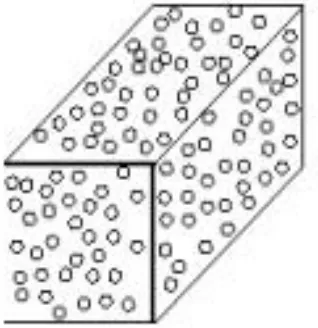
Particle reinforced composites consist of a matrix reinforced
by a dispersed phase in the form of particles. It can beeither of
random orientation or preferred orientation.As the name itself
indicates, the reinforcement is of particle nature (platelets are
also included in this class). It may be spherical, cubic,
tetragonal, a platelet, or of other regular or irregular shape, but
it is approximately equiaxial. In general, particles are not very
effective in improving fracture resistance but they enhance the
stiffness of the composite to a limited extent. Particle fillers
are widely used to improve the properties of matrix materials
such as to modify the thermal and electrical conductivities,
improve performance at elevated temperatures, reduce
friction, increase wear and abrasion resistance, improve
machinability, increase surface hardness and reduce shrinkage.
FIG. 1.5.PARTICULATE COMPOSITES
facilitating applications of conventional compress
techniques to mould the compounds. Resins reinforced
with thermoplastics now comprised an emerging group of
composites. The theme of most experiments in this area to
improve the base properties of the resins and extract the
greatest functional advantages from them in new avenues,
including attempts to replace metals in die-casting
processes.
In crystalline thermoplastics, the reinforcement affects the
morphology to a considerable extent, prompting the
reinforcement to empower nucleation. Whenever crystalline or
amorphous, these resins possess the facility to alter their creep
over an extensive range of temperature.But this range includes
the point at which the usage of resins is constrained, and the
reinforcement in such systems can increase the failure load as
well as creep resistance. This has facilitated easy fabrication
of bulky components, doing away with the more cumbersome
moulding compounds.
1.4 Hybrid Composites
The incorporation of several different types of fibres into a
single matrix has led to the development of hybrid
biocomposites. The behavior of hybrid composites is a
weighed sum of the individual components in which there is a
more favorable balance between the inherent advantages and
disadvantages. Also, using a hybrid composite that contains
two or more types of fibre, the advantages of one type of fibre
could complement with what are lacking in the other. As a
consequence, a balance in cost and performance can be
achieved through proper material design . The properties of a
hybrid composite mainly depend upon the fibre content, length
of individual fibres, orientation, extent of intermingling of
fibres, fibre to matrix bonding and arrangement of both the
fibres. The strength of the hybrid composite is also dependent
on the failure strain of individual fibres. Maximum hybrid
compatible.The term hybrid effect has been used to describe
the phenomenon of an apparent synergistic improvement in
the properties of a composite containing two or more types of
fibre [3]. The selection of the components that make up the
hybrid composite is determined by the purpose of
hybridization, requirements imposed on the material or the
construction being designed. The problem of selecting the type
of compatible fibres and the level of their properties is of
prime importance when designing and producing hybrid
composites. The successful use of hybrid composites is
determined by the chemical, mechanical and physical stability
of the fibre / matrix system .
1.4.1 Types Of Hybrid Composites
There are several types of hybrid composites characterized as:
InterplyOr Tow By-Tow -In which tows of the two
or more constituent types of fiber are mixed in a
regular or random manner;
Sandwich Hybrids- Also known as core-shell, in
which one material is sandwiched between two layers
of another;
InterplyOr Laminated-where alternate layers of the
two (or more) materials are stacked in a regular
manner;
Intimately Mixed Hybrids- where the constituent
fibers are made to mix as randomly as possible so
that no over-concentration of any one type is present
in the material;
hich the diameter is negligible in comparison with the length.
Natural fibres can be classified according to their origin. The
vegetable, or cellulose-base, class includes such important
fibres as cotton, flax, and jute; the animal, or protein-base,
fibres include wool, mohair, and silk; an important fibre in the
mineral class is asbestos.
1.5.1 Synthetic Fibre
Synthetic fibers (British English: synthetic fibres) are fibers
made by humans with chemical synthesis, as opposed to
natural fibers that humans get from living organisms with little
or no chemical changes. They are the result of extensive
research by scientists to improve on naturally occurring
animal fibers and plant fibers. In general, synthetic fibers are
created by extruding fiber-forming materials through
spinnerets into air and water, forming a thread. These fibers
are called synthetic or artificial fibers. Some fibers (such as
the diverse family of rayons) are manufactured from
plant-derived cellulose and are thus semisynthetic, whereas others
are totally synthetic, being made from crudes and
intermediates including petroleum, coal, limestone, air, and
water. In the textile industries, cellulose fibers are usually
differentiated from synthetic fibers in the sense of fully
synthetic ones.
3.1.3 Epoxy Resin
Epoxy resin is used as a matrix material which is a copolymer
and is formed from two different chemicals. These are referred to as the “resin” and the “hardener”. The resin consists of
monomers or short chain polymers with an epoxide group at
either end. Most common epoxy resins are produced from a
reaction between-epichlorohydrin and bisphenol-A, though the
latter may be replaced by similar 45 chemicals.
1.5.2 Banana Fibre
Banana fiber is a natural bast fiber which has wide
range of uses in handicraft product developments such as
mat, rope and twines, but only 10% of its pseudo stem is
being used for making products and remaining is waste or
FIG NO 3.1 BANANA PLANT AND BANANA FIBRE
1.5.3 KenafFibre
Kenaf has a unique combination of long bast and short core
fibers which makes it suitable for a range of paper and
cardboard products. Scientists at the ARS have tested several
kenaf pulping techniques, with the pulps being used to make
several grades of paper including newsprint, bond, coating raw
stock and surfaced sized. Results have been positive,
particularly in terms of paper quality, durability, print quality
and ink absorption.
FIG NO.3.2 KENAF PLANT AND KENAF FIBRE
1.5.4 Glass Fibre
These fiber mesh Roll is non adhesive coated and ideal for
minimizing the risk of cracks between column and bricks wall
joint ,this mesh roll is used before plaster on the wall . which
give protection to the wall and the joint and minimizes the risk
of crack on the wall and give strength to the wall very easy to
use , replaces the traditional iron mesh which was used for this
purpose. Fiberglass mesh is woven by fiberglass yarn and then
coated by alkaline resistant latex. It has alkaline resistance,
high strength, etc. It is an ideal engineering material in
construction. It is mainly used to reinforce cement, stone, wall
materials, roofing and so on. Plastering fiber glass mesh is
used for reinforcement surfaces during plastering, installation
leveling floors, waterproofing, restoration of cracked plaster in
order to prevent cracking or fraying of the plaster. Fiberglass
mesh is cheap material that does not burn and is characterized
by both low weight and high strength. These properties allow
it to be successfully used in the formation of plaster facades,
as well as use on internal wall and ceiling surfaces. This
material is widely used for fastening the surface layer at the
corners of the room. Most widely used standard fiberglass
plaster mesh is the density of 145 GSM for interior and
extcladding and facade work.
FIG.3.3 GLASS FIBRE
1.5.5 Epoxy Resin
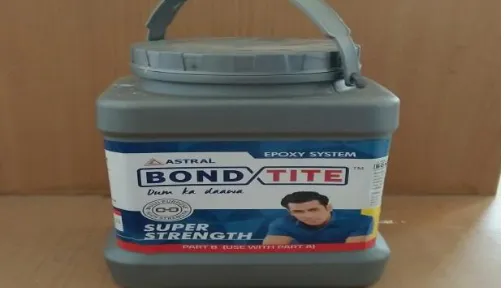
Bondtite Super strength epoxy adhesive (Astral AY 105) made
by ResinovaChemie Limited having the following outstanding
properties has been used as the matrix material.
i. Low coefficient of thermal expansion & low
shrinkage during curing
ii. Excellent adhesion to different materials.
iv. High dimensional stability.
v. Free from internal stresses.
vi. Excellent mechanical and electrical properties.
Fig no. 3.4 Epoxy
1.5.6 Hardner
Hardener is a curing agent for epoxy resin. Epoxy resins
require a hardener to initiate curing. It is also called the
catalyst, the substance that hardens the adhesive when mixed
with resin. It is the specific selection and combination of the
epoxy and hardener components that determine the final
characteristics and suitability of the epoxy coating for a given
environment. Optimum levels of a hardener are used to
formulate epoxy coatings. The ratio differs from product to
product. The use of an improper hardener may result in an
undercatalyzed or overcatalyzed product. In the present work
hardener (HY951) is used. This has a viscosity of 10-20 MPa