The Thirty-Third AAAI Conference on Artificial Intelligence (AAAI-19)
A Pattern-Based Approach to Recognizing Time Expressions
Wentao Ding, Guanji Gao, Linfeng Shi, Yuzhong Qu
National Key Laboratory for Novel Software Technology,Nanjing University, Nanjing, China
{wtding, gjgao, lfshi}@smail.nju.edu.cn, [email protected]
Abstract
Recognizing time expressions is a fundamental and important task in many applications of natural language understand-ing, such as reading comprehension and question answer-ing. Several newest state-of-the-art approaches have achieved good performance on recognizing time expressions. These approaches are black-boxed or based on heuristic rules, which leads to the difficulty in understanding the temporal infor-mation. On the contrary, classic rule-based or semantic pars-ing approaches can capture rich structural information, but their performances on recognition are not so good. In this paper, we propose a pattern-based approach, called PTime, which automatically generates and selects patterns for recog-nizing time expressions. In this approach, time expressions in training text are abstracted into type sequences by using fine-grained token types, thus the problem is transformed to select an appropriate subset of the sequential patterns. We use the Extended Budgeted Maximum Coverage (EBMC) model to optimize the pattern selection. The main idea is to max-imize the correct token sequences matched by the selected patterns while the number of the mistakes should be lim-ited by an adjustable budget. The interpretability of patterns and the adjustability of permitted number of mistakes make PTime a very promising approach for many applications. Ex-perimental results show that PTime achieves a very compet-itive performance as compared with existing state-of-the-art approaches.
1
Introduction
Along with the rapid progress of natural language under-standing research area, underunder-standing temporal information has been increasingly important in various applications such as reading comprehension and question answering. Recog-nizing time expressions, as a first and fundamental step of understanding temporal information, has attracted consider-able attention since last decade. Lots of efforts have been paid on developing standards for modeling temporal infor-mation and annotating time expressions in free text (Puste-jovsky et al. 2005; 2010; Hobbs and Pan 2006). Many anno-tated data corpus, such as the datasets of TempEval (Verha-gen et al. 2010; UzZaman et al. 2013), the WikiWars dataset (Mazur and Dale 2010; Lee et al. 2014) and the Tweets dataset (Zhong, Sun, and Cambria 2017) , were built for
Copyright c2019, Association for the Advancement of Artificial Intelligence (www.aaai.org). All rights reserved.
evaluating the ability of time expression recognizing sys-tems.
Existing approaches for time expression recognizing have achieved good performance on benchmark datasets, espe-cially two recent approaches named SynTime and TOMN. SynTime (Zhong, Sun, and Cambria 2017) improved previ-ous results by grouping tokens to 3 main types, including
time token, modifier andnumeral. It uses the time tokens to trigger time expressions and expand their boundaries by searching modifiers and numeral tokens with heuristic rules. TOMN (Zhong and Cambria 2018) use the three types as pre-tags instead of the classic BIO tagging scheme with a CRF model to achieve state-of-the-art results.
However, TOMN is a black-boxed learning approach, thus its result lacks an interpretability, and has no structure information for further understanding. SynTime expands the boundary of time expression by heuristically searching to-kens of “PREFIX”, “SUFFIX” ornumeral. Though having a good performance, the heuristics also reduced the inter-pretability of SynTime and limited its adaptivity. For ex-ample, the word “in” can appear within a time expression like “hTilate in 2018h/Ti” or in front of a time expression like “finished inhTi2017hTi”, which cannot be distinguished by the heuristics. On the contrary, the classic rule-based or semantic parsing approaches can capture rich structural in-formation, but their performances have a clear gap compar-ing with those newest approaches. Besides, different appli-cations may have different precision-recall requirements on recognizing time expressions, which is not seriously consid-ered in the existing approaches.
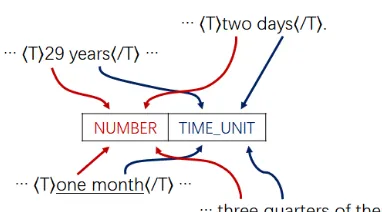
min-utes or 3 months.
Figure 1: An example of pattern and its instances
This brings an interesting question: is it possible to select an appropriate subset of all generated patterns, to achieve a good performance on recognizing time expressions, and meanwhile provides an adjustability on limiting the total mistakes for fitting different precision-recall demands of various applications?
In this paper, we proposed a pattern-based approach to recognizing time expression, PTime. Like many existing rule-based approaches, we use regex patterns to detect and type time-related tokens. We automatically generate candi-date patterns from the training time expressions, and then select an appropriate subset of them to maximize the cor-rect token strings matched by the selected pattern set while the number of total mistakes caused by it is limited. There-fore, the pattern selection problem should be modeled as an optimization on the whole set of candidate patterns. We model the pattern selection problem as the Extended Bud-geted Maximum Coverage (EBMC) Problem (Ding et al. 2015), which is to optimize a coverage function with a linear constraint on the cost of selecting an object. As the EBMC model has an explicit budget to constrain the total cost, a pa-rameterρis introduced to loosely bound the total mistakes caused by the selected patterns. A lowerρallows more mis-takes, which may enlarge their coverage while decreasing the precision, and the result is just the opposite for a higher
ρ.
The rest of this paper is structured as follows. Section 2 re-views related work. In section 3, we present the frame-work of PTime. In section 4, we describe the details in pattern generation. In section 5, we propose our EBMC-based pat-tern selection method and a greedy algorithm to implement the EBMC-based selection method. In section 6, we report our experiment results on three benchmark datasets. Finally, the last section concludes the paper with future work.
2
Related Work
The processing of temporal information can be divided into two subtasks, recognition and normalization of time expres-sions. We focus on the first subtask in this paper. Existing approaches for time expression recognition can be roughly classified as rule-based and learning-based approaches, and semantic parsing approaches can be regarded as a hybrid of them.
Classic rule-based approaches use deterministic hand-engineered rules to recognize and type time-related tokens and strings. Earlier work has shown that the complexity of time expression is bounded, thus finite state automata can be effective for extracting them from text (Hobbs et al. 1997). TempEX (Mani and Wilson 2000), and its expan-sion, GUTime (Verhagen et al. 2005), use both hand-crafted rules and machine-learnt rules for extracting temporal in-formation from text. HeidelTime (Str¨otgen and Gertz 2010; Str¨otgen, Zell, and Gertz 2013; Str¨otgen et al. 2014) manu-ally designs rules for recognizing time tokens and modifiers, combining tokens, and filtering ambiguous expressions. SU-Time (Chang and Manning 2012) proposed a 3-layered tem-poral pattern language. It firstly recognizes single tokens, then expands tokens to strings, and finally composes and fil-ters the strings to get time expressions.
Semantic parsing approaches relies on hand-engineered composition grammars defined on syntactic or semantic units. (Angeli and Uszkoreit 2013) uses an EM-style boot-strapping approach to learn a PCFG parser on pre-defined preterminals. UWTime (Lee et al. 2014), uses a combinatory categorical grammar to construct a compositional mean-ing representations, and trains a context-dependent semantic parser for parsing temporal information.
The above work recognize time expressions with rich structural information, while the recall of their results are unsatisfied. A recent work, SynTime (Zhong, Sun, and Cam-bria 2017), focus on recognition and impressively outper-forms other rule-based approaches. Instead of designing rules in a fixed method, SynTime uses a group of time-related tokens types to trigger time expressions and expands their boundaries by several generic but heuristic rules.
The state-of-the-art black-box learning approaches use classic sequential tagging models (e.g. CRF, Maximum-Entropy Markov model) for the recognition problem. They characterize a token by extracted morphologic or syntac-tic features and temporal types. To capture the structure information coarsely, they tag a token by both its own features and the features of its preceding and following words. ClearTK-TimeML (Bethard 2013) uses a small set of morpho-syntactic features and temporal types of alphanu-meric sub-tokens. TOMN (Zhong and Cambria 2018) uses the same token regex expressions as SynTime to recognize
time token,modifierandnumeralas pre-tags. The new tag-ging scheme outperforms other classic schemes like the BIO scheme with POS-tags as features.
3
The Framework of PTime
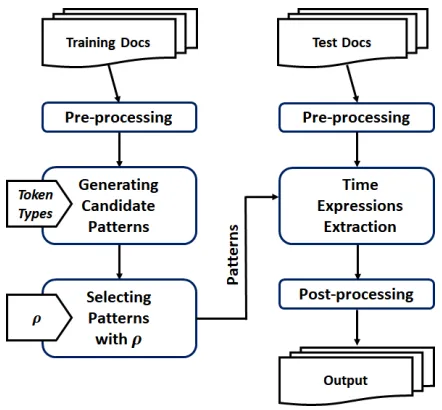
In this section, we explain the framework of PTime. As in-dicated by figure 2. Our approach consists a training process and a test process.
Figure 2: The framework of PTime
3.1
The Training process
In the training process, PTime transforms the input docu-ments to token sequences during pre-processing, generating patterns based on predefined token types, then select an ap-propriate subset of the candidates according to the precision-control parameterρ.
Pre-processing As the first step of our approach, the pre-processing component transforms the input documents to to-ken sequences, we use CoreNLP to get the lemma and the POS-tag of each token. Most of the lemma-POS pairs will be regarded as tokens directly. However, some of the tokens are written as combinations of multiple words in the input texts (e.g. “5days”), and some token strings should be treated as an entirety (e.g. “Thanksgiving day”). To deal with this problem, we use some generic rules listed as follow.
• Multi-tokens that should be combined as one.In most sit-uation, we concatenate their lemmas as pseudo lemma of the combined token, and use the type of it as a pseudo POS-tag.
– Holidays.A set of common holidays mainly collected from other recognizing systems like SUTime, UWTime and SynTime. Including “New Year”, “Valentine Day” and so on.
– Numeral values written as English word(s). We nor-malize these strings and use the numeral value as the pseudo lemma. Some special values will be typed as their corresponding types directly (e.g. “nineteen ninety-six” will be typed as “YEAR”). Others will be tagged with the POS-tag “CD”.
– Some common combination of words representing indefinite quantity. Including phrases like “a few”, “dozens of”.
– Some common combination of words representing inequality among quantities. Including phrases like “more than”, “no less than”, “at least”.
• Single token that should be split.Words containing a “-” or “/” will be split at the position where they appear before tokenization. After annotating by CoreNLP (Manning et al. 2014), if a token is a concatenation of a number and an English character string, and cannot match any of our types, it will be split to 2 tokens. The number is tagged as “CD”, the other parts will be re-lemmatized and inherits the original POS-tag. For example, “5mins/NNS” will be-come “5/CD” and “min/NNS”, and “1990s/NNS” will not be split since it has already matched the DECADE type.
After pre-processing, the inputs are converted to token se-quences. We generate candidate patterns from the training time expressions, then use an optimization method to select patterns. For the range of precision-control parameterρ, we suggest to set it in the range of 0.8 to0.98 in real appli-cations, depends on your demands and the quality of your training dataset(s). Moreover, if the optimizing objective has been clarified (e.g. maximizing the F1 score), the value of
ρcan be determined by a validation procedure on a devel-opment set or cross-validation on your training set. Formal definition and detailed explanation about our implementa-tion of pattern generaimplementa-tion and selecimplementa-tion will be presented in section 4 and 5.
3.2
The Test process
In the test process, PTime reads the test documents and does the same pre-processing as the training process to transform them to token sequences. With the patterns previously se-lected in the training process, PTime scans the transformed token sequences and extracts time expressions from them. After some necessary post-processing, PTime outputs the annotated documents.
Post-processing After extraction, adjacent and overlapped strings will be merged as a longer expression. Besides, as the expressions of ranges are annotated as two sep-arated time expressions in the TIMEX3 standard (Puste-jovsky et al. 2005) (e.g. “hTi1957h/TiandhTi58h/Ti”), our approach may lose some numeral expressions which depend on nearby expressions. Several heuristic rules are designed to recognize them back. The post-processing is similar to other systems like TOMN.
lemma and the POS-tag of the token respectively. Similarly, we identify a string by its document id, start position and end position. For example, the appearance of the time ex-pression “the start of 2015” in that document can be denoted asstr{7,1,4}= (tok{7,1}, . . . , tok{7,4}).
CelebratinghTithe start of 2015h/Tiat the float!! Is anyone here as well? Waiting for Sun Yanzi and . . .
Figure 3: A fragment of the 7th document in Tweet-training
By transforming each token to its corresponding type, we can abstract each string to a sequential pattern.
Definition 1 (Token Type) A token type is a tuple consist-ing a type name and a regex expression, i.e.
typei= (namei, regexi)
In real applications, we require our types to be non-overlapped,
type(tok) =typei.name
iff
tok.lemma/tok.posmatchestypei.regex
Some examples of the token types are shown in table 1.
Table 1: Some examples of our token types
Name Content
DEFINITE DET. (the this that these those)/W?DT
EARLY LATE (before after ago early late)/RB(earlier later)/RBR?
TIME UNIT (second minute hour . . . century era)/NNP?S?
Definition 2 (Pattern) The pattern of a string is defined as the sequence of token types generalized from each corre-sponding token of it. i.e.
pat str{i,l,r}=
type tok{i,l}, type tok{ı,l+1}, ...
..., type tok{i,r}
We denote the set of time expressions in the training texts asE, and abstract the strings inEto get a candidate pattern setP, i.e.
P={pat(e) e∈E}
There are two main problems need to be considered in generating candidates patterns. One is the balance between generality and specificity of types. A good type design should have the generality to ensure the generated patterns can recognize newly appeared time expressions with an ac-ceptable accuracy. Another one is the difficulty of accom-modating all potential time-related tokens with manually de-signed types. A previous study (Zhong, Sun, and Cambria 2017) has shown that domain/dataset based type expansion does improve the performance of recognition.
4.1
Token Types
Designing a type system is a very difficult task which need tremendous domain knowledges and experience. Prior stud-ies have designed many good type systems and verified their types on benchmark datasets. Our type system con-tains 32 fine-grained types classified from the perspective of POS-tags and semantic functions. Most of the types and their corresponding regexs are collected from SUTime1and
SynTime2. We subdivided some types in a finer granular-ity and removed some informal or ambiguous words (e.g. remove the abbreviation “hr” for “hour” because of it is also the abbreviation for “human resources”). The aim of fine-grained classification and adjustment of types is to reduce the amount of probable mistakes caused by over-generalization. A detailed description of the types is attached in the appendix.
4.2
Untyped Tokens
Because of the probable incompleteness of the token types, some tokens may not match any types, like “fiscal” in the TempEval-3 dataset and “war” in the WikiWars dataset. Statistics on training dataset show that there are only 40 to 60 words cannot be typed by our types in each dataset. Therefore, we let the untyped tokens remain unchanged. In other words, we dynamically create one-token types for the untyped tokens. For example, the pattern of the time expression “1 hr” is “NUMBER hr”, where “hr” is a dy-namically created one-token type with a regex “hr/[ ˆ\s]+”, which can only match the word itself. This technique can give our approach the adaptability to various data without over-generalization.
5
Selecting Patterns
After generation, we get the candidate pattern setP, which can extract string from the token sequences of input docu-ments.
Definition 3 (Strings Matched by a Pattern) For a pat-tern p ∈ P, on given input documentsD, we define S(p)
as the set of strings that can be matched by types in pin sequence.
SD(p) =
str{i,l,l+|p|−1} |p|−1
^
k=0
type tok{i,l+k}=pk
However, as previously discussed in section 1, some patterns are over generalized so they will mistakenly ex-tract non-timex strings. In extreme cases, we might have
|S
p∈PStraining(p)| |E|. Therefore, we wish to select an high quality subsetQ⊆Pinstead of using the wholeP, which can still recognize most of correct time expressions.
To ensure the quality of the selected pattern set Q, we measure the quality of each candidate pattern on training texts by a cost function, which is computed by counting the
1
https://github.com/stanfordnlp/CoreNLP/tree/master/src/edu/ stanford/nlp/time/rules
2
number of mistakes caused by it (i.e. the number of strings which are extracted by the pattern but not “contained” in the time expression setE).
Definition 4 (Containing Relationship) We say a string str{i,l,r} is “contained” in a time expression setX, if and
only if it is contained by an expression inX. i.e.
str{i,l,r}bX
iff
∃lx, rx lx≤l∧r≤rx∧str{i,lx,rx}∈X
Definition 5 (Cost Function) For anyp∈P, its cost is de-fined on the training data as
Cost(p) = X
s∈Straining(p)
0 sbE
1 otherwise
The total cost of a setQ⊆P is simply defined as sum-ming up the cost of each pattern in it, i.e.
Cost(Q) =X p∈Q
Cost(p)
We assume the limitation of mistakes should be related to the number correctly recognized time expressions|E|. To fit different precision-recall requirements, we use a parameter
ρto define an adjustable bound.
Definition 6 (The Cost Bound with the parameterρ) The total cost should not exceed a boundB, which is defined as
B=|E| ·(1−ρ)
whereρ∈[0,1].
A higherρmay improve the precision of selected patterns by limiting the number of mistakes caused by them, but may lose some useful patterns.
To measure the gain of selected patterns, a straightforward way is to count the number of time expressions a pattern can match. However, the strict match requirement will un-derrates short patterns, as it ignores the fact that a long ex-pression might be a composition of several short exex-pressions (e.g. “10 a.m. Saturday” is composed by “10 a.m.” and “Sat-urday”). In order to assess the patterns more accurately, we measure the contribution of selected patterns by defining a coverage function for patterns on each time expressions.
Definition 7 (Coverage Function) For a pattern p ∈ P and a tokened expressione ∈ E, we say phas a positive coverageCov(p, e)oneif and only if pcan match a sub-string ofe(or the wholee).
Cov(p, e) = (|p|
|e| ∃s∈Straining(p)sis a substring ofe
0 otherwise
For example,Cov(“ORDINAL WEEK”, “the/DT second/JJ Sunday/NNP”)≈0.67andCov(“ORDINAL WEEK”, “Fri-day/NNP”)= 0.0.
With the coverage function, we could define the gain of a set of selected patterns as follows.
Definition 8 (Gain Function) For a setQ⊆Pof patterns, its gain over the time expression setEis defined as
Gain(Q) =X e∈E
max
p∈Q{Cov(p, e)}
Finally, the problem of selecting patterns can be formal-ized as
Problem 1 (Pattern Selection) Given the candidate pat-tern setP, training documentsD, time expression setEand a control parameterρ, Select a subsetQ⊆P to
Maximize Gain(Q) Subject to Cost(Q)≤B
This optimization problem is a case of maximizing a set cov-erage function with a linear constraint, which has some well-known instances like the Set Cover problem, the Maximum Coverage problem and the Budgeted Maximum Coverage problem (Khuller et al. 1999). And our problem definition is an alternation of the Extended Budgeted Maximum Cov-erage problem (Ding et al. 2015). Efficient approximation algorithms of it has been sufficiently discussed in (Wolsey 1982). Follow the prior studies, we solve our pattern selec-tion problem with algorithm 1.
Algorithm 1:Algorithm for Pattern Selection
Input:the candidate pattern setP, time expression set
Eand the functionsCov,Cost
Output:A subsetQ⊆Pdenotes the selected patterns
Q1←GreedySelect(∅);
p∗= argmaxp∈P{Gain({p})};
ifCost(p∗)>|E| ·(1−ρ)then returnQ1;
Q2←GreedySelect({p∗});
ifGain(Q1)> Gain(Q2)then
returnQ1;
else
returnQ2;
The sub-procedure GreedySelect is described as algo-rithm 2. In each iteration, the algoalgo-rithm ranking the re-main candidates pattern setR, find the patternpiwith a max-imum gain-cost ratio and try to addpito the selected pattern set. The micro valueε 1inCost(pi) +εis just a tech-nique trick to avoid the probable divide-zero error, which will not affect the choice of the algorithm.
Our algorithm 1 is slightly different with the classic ver-sion. We choose a better solution betweenGreedySelect(∅) andGreedySelect({p∗}), but the classic algorithm chooses
a better solution between GreedySelect(∅)and {p∗}. This
difference affects neither the approximation ratio nor the time complexity, since Gain(GreedySelect({p∗}) ≥
Gain({p∗}) always holds and the theoretical complexity
ofGreedySelect({p∗})is the same asGreedySelect(∅).
Algorithm 2:GreedySelect
Input:Initial selected patternsI, and all of the input of algorithm 1
Output:A subsetQ⊆Pdenotes the selected patterns
R←P−I;
Q←I;
repeat
pi ∈R←argmax{
(Gain(Q∪{pi})−Gain(Q)) Cost(pi)+ε };
ifCost(Q∪ {pi})≤ |E| ·(1−ρ)then
Q←Q∪ {pi};
R←R\ {pi};
untilR=∅;
returnQ
6
Evaluation
We evaluate PTime against six state-of-the-art approaches (i.e., HeidelTime, SUTime, SynTime, ClearTK, UWTime, and TOMN) on three datasets namely TempEval-3, Wiki-Wars, and Tweets.
6.1
Experimental Setup
Datasets We evaluate our approach on the TempEval-3 (UzZaman et al. 2013), the WikiWars (Mazur and Dale 2010) and the Tweets (Zhong, Sun, and Cambria 2017). For the TempEval-3, we use the training and test sets splits fol-lowing previous studies (Bethard 2013) i.e. use the Time-Bank (Pustejovsky et al. 2003) corpus as the training set and the platinum-annotated corpus as the test set. For the WikiWars and the Tweets, we follow previously work to set the split of training and test sets (Lee et al. 2014; Zhong, Sun, and Cambria 2017). For development, we per-form a 10-fold cross-validation on each training dataset. De-tailed statistics of the datasets is presented in table 23.
Table 2: Dataset statistics
Dataset #Docs #Words #Timex
TimeBank 183 61,418 1,243
TempEval-3 (test) 20 6,375 138
WikiWars (whole) 22 119,468 2,671
Tweets (whole) 942 18,199 1,127
Comparison Methods We compare our system primar-ily to six state-of-the-art approaches, including HeidelTime (Str¨otgen and Gertz 2010; Str¨otgen et al. 2014), SUTime (Chang and Manning 2012), SynTime (Zhong, Sun, and Cambria 2017), ClearTK (Bethard 2013), UWTime (Lee et al. 2014) and TOMN (Zhong and Cambria 2018). Hedi-alTime, SUTime and SynTime are rule based approaches. UWTime is a semantic parsing approach based on a combi-natory categorial grammar. ClearTK and TOMN are black-boxed approaches with CRFs frameworks. The results of all
3
The statistics of TimeBank, WikiWars, Tweets are cited from (Zhong and Cambria 2018), and the statistics of the test set of TempEval-3 is cited from (Lee et al. 2014)
the comparison approaches are cited from (Zhong and Cam-bria 2018).
Evaluation Metrics We use the evaluation toolkit of TempEval-3 (UzZaman et al. 2013) to measure the results of our approach. We report theP recision, theRecall, and theF1score in terms ofstrict matchandrelaxed match. The strict match means exact match between the extracted time expressions and the ground truth while the relaxed match means that there exists overlap token(s) between them.
Parameter Settings We grid searched the value ofρwith a step of 0.01 for maximizing the strict matchF1 score on each dataset. The values ofρare set to 0.87, 0.94, 0.94 for TempEval-3, WikiWars and Tweets respectively.
6.2
Experimental Results and Analysis
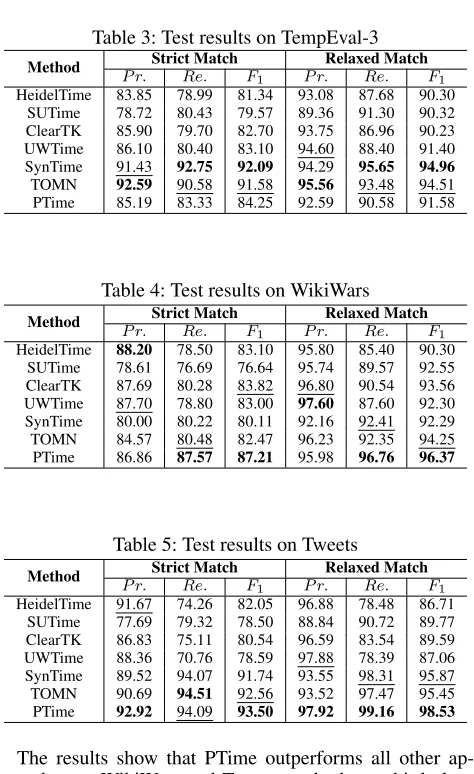
Experimental Results Table 3, table 4 and table 5 report the performance of PTime on givenρand comparison ap-proaches. The best results are inbold faceand the second are underlined.
Table 3: Test results on TempEval-3
Method Strict Match Relaxed Match
P r. Re. F1 P r. Re. F1
HeidelTime 83.85 78.99 81.34 93.08 87.68 90.30 SUTime 78.72 80.43 79.57 89.36 91.30 90.32 ClearTK 85.90 79.70 82.70 93.75 86.96 90.23 UWTime 86.10 80.40 83.10 94.60 88.40 91.40 SynTime 91.43 92.75 92.09 94.29 95.65 94.96
TOMN 92.59 90.58 91.58 95.56 93.48 94.51
PTime 85.19 83.33 84.25 92.59 90.58 91.58
Table 4: Test results on WikiWars
Method Strict Match Relaxed Match
P r. Re. F1 P r. Re. F1
HeidelTime 88.20 78.50 83.10 95.80 85.40 90.30 SUTime 78.61 76.69 76.64 95.74 89.57 92.55 ClearTK 87.69 80.28 83.82 96.80 90.54 93.56 UWTime 87.70 78.80 83.00 97.60 87.60 92.30 SynTime 80.00 80.22 80.11 92.16 92.41 92.29 TOMN 84.57 80.48 82.47 96.23 92.35 94.25 PTime 86.86 87.57 87.21 95.98 96.76 96.37
Table 5: Test results on Tweets
Method Strict Match Relaxed Match
P r. Re. F1 P r. Re. F1
HeidelTime 91.67 74.26 82.05 96.88 78.48 86.71 SUTime 77.69 79.32 78.50 88.84 90.72 89.77 ClearTK 86.83 75.11 80.54 96.59 83.54 89.59 UWTime 88.36 70.76 78.59 97.88 78.39 87.06 SynTime 89.52 94.07 91.74 93.55 98.31 95.87 TOMN 90.69 94.51 92.56 93.52 97.47 95.45 PTime 92.92 94.09 93.50 97.92 99.16 98.53
succeeding work, TOMN, both of which significantly out-performed other systems at least 7% in strict match F1 score. On WikiWars, our approach outperforms all other ap-proaches in recall and F1 without obviously loss in preci-sion. It improves the strict match F1 score by 3.39% and the relaxed matchF1score by 2.12% comparing to the sec-ond best one. On Tweets, we raise the strict matchF1 by 0.94% and outperforms all other systems in all the three of the relaxed match precision, recall andF1score, including a 2.66% improvement in the relaxed matchF1score. Besides, our results maintain a better balance between precision and recall, as the differences between them are relatively small in our results comparing with others.
Besides, The running efficiency of PTime is in the same order comparing to other approaches according to (Ning et al. 2018). The generation of candidate patterns can be fin-ished within 1 minute, running the selection step took 7 minutes in average, and recognizing timexes from test set finished within 3 seconds in average. The above results are achieved by a simple implementation of PTime written by Java and Scala without any optimization, running on a per-sonal workstation with an Intel E3-1226 CPU of 3.30GHz.
Result analysis To analyze our results in details, we com-pared our results with the best performed rule-based ap-proach SynTime. The results of SynTime are generated by using the source code published by its authors4.
We achieved good results on WikiWars and Tweets. One reason is our approach can generate patterns with rich structures, such as “NUMBER TIME UNIT EARLY LATE”, so we can recognize the exact time ex-pression from the sentence“Russia declared war on Japan hTieight days laterh/Ti.”, while SynTime missed the suf-fix “later” because its heuristic rules do not take it as a suffix modifier. PTime can recoginize the time expression “late in 1985” with the pattern “EARLY LATE RELA-TION YEAR”, while not mistaken the border of “1,460 years” in the sentence “The first Roman Emperor in hTi1,460 yearsh/Tiraised”. The patterns of PTime can han-dle some ambiguity of words. For example, though “hr” is not included in any of its types, PTime selected a reasonable and useful pattern “NUMBERhr” for the Tweets dataset, while the deterministic type based approaches might mis-takenly recognize the “hr” from the phrase “Singapore’s HR Manager”.
However, the performance of PTime has a large gap to SynTime on TempEval-3, especially in recall. A main rea-son is that PTime failed to recognize some one-token time expressions like “years”, “days”, i.e. PTime did not select the pattern “TIME UNIT”. We observed the training data and found out some negative samples like “37 years old” or “three - quarters”. These negatives make PTime overrated the cost of the pattern “TIME UNIT”, which leads to the re-sult that it was dropped in selection. This is because PTime can not utilize the contextual information outside a string for disambiguation. Besides, as a data-driven approach, the incompleteness of training set also affected the recognizing ability of PTime. For example, PTime failed to recognize the
4
https://github.com/xszhong/syntime
expression “3:07:35”, because PTime did not see its corre-sponding pattern “TIME” in the training data. If we manu-ally add these common patterns to the selected pattern set, the performance is dramatically improved.
Besides, analysis of the selected patterns showed that there are many meaningful common patterns, including pat-terns like “TIME TIME REFERENCE” and “ORDINAL MONTH YEAR”. It is no doubt that adding the common patterns to PTime can further improve its performance. For example, the common part of selected patterns from the WikiWars and Tweets training datasets have 43 patterns, 14 of which are not appeared in the patterns selected from the TimeBank. If we simply treat these patterns as “com-mon patterns well known to human experts”, theF1-score of PTime on TempEval-3 can be promoted to 87.54%. PTime benefits the formation of common patterns, which in turn can enhance the performance of PTime5.
7
Conclusion
The contributions of this paper are summarized as follows:
• We proposed a pattern-based approach to recognizing time expressions, called PTime. In this approach, sequen-tial patterns are generated from time expressions in train-ing text by ustrain-ing their token types, and the pattern selec-tion is optimized by using the Extended Budgeted Max-imum Coverage (EBMC) model. Especially, a parameter is introduced to meet various precision-recall demands in different applications.
• We implemented the PTime approach, especially, we manually designed 32 fine-grained token types, and de-signed a greedy algorithm for selecting patterns based on EBMC model.
• We evaluated our implementation on three benchmark datasets. The experimental results showed that our ap-proach achieved best F-Measure on two datasets, as com-pared with state-of-the art approaches. It improved the strict matchF1score by 3.39% on the WikiWars dataset and 0.94% on the Tweets dataset comparing with the sec-ond best approach.
In the near future, we will explore (semi-)automatic ways of designing a better token type system. We are also in-terested in enhancing PTime by including common patterns well known to human experts. Furthermore, it is also inter-esting to combine PTime with classic time expression nor-malization techniques for better understanding temporal in-formations.
8
Acknowledgements
This work is supported by the National Natural Science Foundation of China (No. 61772264). We thank our team member Hao Zhang for inspiring discussions at the early stage of the research.
5
References
Angeli, G., and Uszkoreit, J. 2013. Language-independent discriminative parsing of temporal expressions. In Proceed-ings of the 51st Annual Meeting of the Association for Com-putational Linguistics (Volume 1: Long Papers), volume 1, 83–92.
Bethard, S. 2013. Cleartk-timeml: A minimalist approach to tempeval 2013. InProceedings of the 2nd Joint Conference on Lexical and Computational Semantics, volume 2, 10–14.
Chang, A. X., and Manning, C. D. 2012. Sutime: A library for recognizing and normalizing time expressions. In Pro-ceedings of the 8th International Conference on Language Resources and Evaluation, volume 2012, 3735–3740.
Ding, J.; Ding, W.; Hu, W.; and Qu, Y. 2015. An ebmc-based approach to selecting types for entity filtering. In Proceed-ings of the 28th AAAI Conference on Artificial Intelligence, 88–94.
Hobbs, J. R., and Pan, F. 2006. Time ontology in owl.W3C working draft27:133.
Hobbs, J. R.; Appelt, D.; Bear, J.; Israel, D.; Kameyama, M.; Stickel, M.; and Tyson, M. 1997. Fastus: A cascaded finite-state transducer for extracting information from natural-language text.Finite-state language processing383–406.
Khuller, S.; Moss, A.; Naor, J.; et al. 1999. The budgeted maximum coverage problem. Information Processing Let-ters70(1):39–45.
Lee, K.; Artzi, Y.; Dodge, J.; and Zettlemoyer, L. 2014. Context-dependent semantic parsing for time expressions. In Proceedings of the 52nd Annual Meeting of the Associ-ation for ComputAssoci-ational Linguistics, volume 1, 1437–1447.
Mani, I., and Wilson, G. 2000. Robust temporal process-ing of news. InProceedings of the 38th annual meeting on Association for Computational Linguistics, 69–76. ACL.
Manning, C.; Surdeanu, M.; Bauer, J.; Finkel, J.; Bethard, S.; and McClosky, D. 2014. The stanford corenlp natural language processing toolkit. In Proceedings of 52nd an-nual meeting of the association for computational linguis-tics: system demonstrations, 55–60.
Mazur, P., and Dale, R. 2010. Wikiwars: Wikiwars: A new corpus for research on temporal expressions. In Proceed-ings of the 15th Conference on Empirical Methods in Natu-ral Language Processing, 913–922. ACL.
Ning, Q.; Zhou, B.; Feng, Z.; Peng, H.; and Roth, D. 2018. Cogcomptime: A tool for understanding time in natural lan-guage. InProceedings of the 2018 Conference on Empirical Methods in Natural Language Processing: System Demon-strations, 72–77.
Pustejovsky, J.; Hanks, P.; Sauri, R.; See, A.; Gaizauskas, R.; Setzer, A.; Radev, D.; Sundheim, B.; Day, D.; Ferro, L.; et al. 2003. The timebank corpus. InCorpus linguistics, volume 2003, 40. Lancaster, UK.
Pustejovsky, J.; Knippen, R.; Littman, J.; and Saur´ı, R. 2005. Temporal and event information in natural language text.
Language resources and evaluation39(2-3):123–164.
Pustejovsky, J.; Lee, K.; Bunt, H.; and Romary, L. 2010. Iso-timeml: An international standard for semantic annota-tion. InProceedings of the 5th International Conference on Language Resources and Evaluation, volume 10, 394–397. Str¨otgen, J., and Gertz, M. 2010. Heideltime: High quality rule-based extraction and normalization of temporal expres-sions. InProceedings of the 5th International Workshop on Semantic Evaluation, 321–324. ACL.
Str¨otgen, J.; B¨ogel, T.; Zell, J.; Armiti, A.; Van Canh, T.; and Gertz, M. 2014. Extending heideltime for temporal expressions referring to historic dates. InProceedings of the 9th International Conference on Language Resources and Evaluation, 2390–2397. Citeseer.
Str¨otgen, J.; Zell, J.; and Gertz, M. 2013. Heideltime: Tun-ing english and developTun-ing spanish resources for tempeval-3. InProceedings of the 2nd Joint Conference on Lexical and Computational Semantics, volume 2, 15–19.
UzZaman, N.; Llorens, H.; Derczynski, L.; Allen, J.; Verha-gen, M.; and Pustejovsky, J. 2013. Semeval-2013 task 1: Tempeval-3: Evaluating time expressions, events, and tem-poral relations. InProceedings of the 2nd Joint Conference on Lexical and Computational Semantics, volume 2, 1–9. Verhagen, M.; Mani, I.; Sauri, R.; Knippen, R.; Jang, S. B.; Littman, J.; Rumshisky, A.; Phillips, J.; and Pustejovsky, J. 2005. Automating temporal annotation with tarsqi. In Pro-ceedings of the 43rd Annual Meeting of the Association for Computational Linguistics, 81–84. ACL.
Verhagen, M.; Sauri, R.; Caselli, T.; and Pustejovsky, J. 2010. Semeval-2010 task 13: Tempeval-2. InProceedings of the 5th International Workshop on Semantic Evaluation, 57–62. ACL.
Wolsey, L. A. 1982. Maximising real-valued submodular functions: Primal and dual heuristics for location problems.
Mathematics of Operations Research7(3):410–425. Zhong, X., and Cambria, E. 2018. Time expression recogni-tion using a constituent-based tagging scheme. In Proceed-ings of the 27th World Wide Web Conference on World Wide Web, 983–992. WWW.