University of Southampton Research Repository
ePrints Soton
Copyright © and Moral Rights for this thesis are retained by the author and/or other copyright owners. A copy can be downloaded for personal non-commercial
research or study, without prior permission or charge. This thesis cannot be
reproduced or quoted extensively from without first obtaining permission in writing from the copyright holder/s. The content must not be changed in any way or sold commercially in any format or medium without the formal permission of the
copyright holders.
When referring to this work, full bibliographic details including the author, title, awarding institution and date of the thesis must be given e.g.
AN AGENT-BASED FRAMEWORK TO SUPPORT ADAPTIVE
HYPERMEDIA
By
Christopher Paul Bailey
A thesis submitted for the degree of Doctor of Philosophy
Department of Electronics and Computer Science,
University of Southampton,
United Kingdom.
UNIVERSITY OF SOUTHAMPTON
ABSTRACT
FACULTY OF ENGINEERING
ELECTRONICS AND COMPUTER SCIENCE DEPARTMENT
Doctor of Philosophy
AN AGENT-BASED FRAMEWORK TO SUPPORT ADAPTIVE HYPERMEDIA
by Christopher Paul Bailey
The field of adaptive hypermedia is a little over a decade old. It has a rich history
in a range of fields such as artificial intelligence, user modelling, intelligent tutoring
systems and hypertext. Early adaptive hypermedia work concentrated on
application-led research; developing a range of systems for specific purposes. In 1996, Peter
Brusilovsky reviewed the state-of-the-art and proposed a taxonomy of adaptive
hypermedia techniques, thereby providing the means to categorise adaptive hypermedia
systems. Since then, several practical frameworks for adaptive hypermedia applications
have been produced, in addition to formal models for formalising adaptive hypermedia
applications.
This thesis presents a new framework for adaptive hypermedia systems based on
agent technology, a field of research largely ignored within the adaptive community.
Conceptually, this framework occupies a middle ground between the formal reference
models for adaptive hypermedia and application-specific frameworks. This framework
provides the means to implement formal models using variety of architectural
approaches.
Three novel adaptive hypermedia applications have been developed around this
agent-based framework. Each system employs different architectural structures, they
model the user with a variety of profiling techniques, and each provides a different set
of adaptive features. The diversity of these three systems emphasises the flexibility and
Contents
Chapter 1 Introduction ... 1
1.1 Overview of Research ... 2
1.2 Contributions ... 3
1.3 Document Structure... 4
1.4 Declaration... 6
Chapter 2 Adaptive Hypermedia Background ... 7
2.1 Introduction ... 7
2.2 Hypermedia ... 7
2.3 Adaptive Hypermedia... 9
2.3.1 The Origins of Adaptive Hypermedia ... 10
2.4 Techniques of Adaptive Hypermedia ... 11
2.4.1 Adaptive Presentation... 12
2.4.2 Adaptive Navigation Support ... 13
2.5 User Modelling ... 15
2.6 Examples of Adaptive Hypermedia Systems ... 16
2.6.1 INTERBOOK ... 16
2.6.2 AHA! ... 18
2.6.3 PUSH ... 19
2.7 Models and Frameworks for Adaptive Hypermedia ... 21
2.7.1 AHAM ... 21
2.7.2 XAHM ... 24
2.7.3 ELM-ART ... 25
2.7.4 ACE ... 27
2.7.5 MetaLinks ... 29
2.8 Reflections on Adaptive Hypermedia Frameworks... 30
2.8.1 Knowledge Modelling ... 30
2.8.2 Modularisation: The future of application development ... 31
2.8.3 The need to overcome communication difficulties ... 31
2.9 Summary... 32
Chapter 3 Open Hypermedia... 33
3.2 History ... 33
3.2.1 Intermedia... 34
3.2.2 Sun’s Link Service... 34
3.2.3 Microcosm ... 35
3.2.4 DLS... 36
3.2.5 Chimera ... 37
3.2.6 DHM ... 38
3.3 Protocols for Open Hypermedia: OHP, OHP-NAV and FOHM... 39
3.4 FOHM Structures ... 43
3.4.1 Navigational Link ... 43
3.4.2 Tour ... 44
3.4.3 Level of Detail ... 45
3.4.4 Concept... 45
3.5 Summary... 46
Chapter 4 Software Agents ... 48
4.1 Introduction ... 48
4.2 History ... 48
4.3 Agent Characteristics... 49
4.4 Ontologies for Agents... 51
4.5 Standardisation Efforts ... 51
4.6 Agent Frameworks ... 52
4.6.1 JATLite... 53
4.6.2 JADE ... 54
4.6.3 SoFAR ... 55
4.7 Summary... 57
Chapter 5 Recommender Systems... 58
5.1 Collaborative Recommender Systems... 59
5.2 Content-Based Recommendation Systems... 60
5.3 Examples of Recommender Systems ... 60
5.3.1 MEMOIR... 61
5.3.2 QuIC ... 62
5.3.3 Personal WebWatcher ... 63
5.3.4 WebMate ... 65
5.4 Summary... 67
Chapter 6 Initial Work... 68
6.1 Introduction ... 68
6.2 The Microcosm Legacy ... 68
6.2.1 Microcosm as an “Agent-Based” System... 69
6.2.2 Microcosm as an Adaptive Hypermedia System... 70
6.3 PAADS ... 70
6.3.1 The PAADS System Architecture ... 71
6.4 Augmented Linking in Context ... 75
6.4.1 The ALIC System Architecture... 76
6.5 Reflections on PAADS and ALIC... 81
6.6 Summary... 81
Chapter 7 ABAH: An Agent-Based Framework for Adaptive Hypermedia 83 7.1 Introduction ... 83
7.2 The Case for a New Framework... 83
7.2.1 Why Develop an Agent-Based Approach?... 84
7.2.2 Types of Existing Adaptive Hypermedia Systems ... 85
7.2.3 Issues with Existing Frameworks ... 88
7.3 Developing the Framework ... 89
7.3.1 User Modeller ... 90
7.3.2 Adaptation Engine ... 91
7.3.3 Interface Component ... 92
7.4 The ABAH Framework ... 93
7.4.1 User Model Agent ... 94
7.4.2 Adaptation Agent... 94
7.4.3 Interface Agent ... 95
7.5 Advantages of an Agent-Based Adaptive Hypermedia Framework ... 95
7.5.1 Flexibility... 95
7.5.2 A New Definition for Adaptive Web-based Systems... 99
7.5.3 Open Architecture... 100
7.6 Summary... 101
Chapter 8 Evaluating ABAH ... 102
8.1 Introduction ... 102
8.2.1 Overview of the Application ... 103
8.2.2 Choosing a Suitable Domain for HA3L... 103
8.2.3 The HA3L System Architecture... 107
8.2.4 Adaptive Features ... 108
8.2.5 Discussion... 111
8.3 Comparisons with AHAM... 115
8.4 Modelling INTERBOOK with ABAH ... 118
8.5 Discussion... 120
8.6 Summary... 122
Chapter 9 Conclusions... 123
9.1 Summary and Conclusions ... 123
9.1.1 Novel Research in this Thesis ... 126
9.2 Future Work... 126
9.3 The Future of Agent-Based Adaptive Hypermedia Systems... 128
Appendix A. Table of Adaptive Hypermedia Application Architectures... 133
Appendix B. Agent Frameworks ... 134
List of Figures
Figure 2-1. Doug Engelbart demonstrating the NLS in 1968... 8
Figure 2-2. The updated taxonomy of adaptation hypermedia technologies (Brusilovsky, 2001) ... 12
Figure 2-3. An example of adaptive link annotation in INTERBOOK... 17
Figure 2-4. The AHAM Model (Wu et al., 2001) ... 22
Figure 3-1. Chimera's hypertext concepts (Anderson et al., 1994) ... 37
Figure 3-2. The Hypertext Data Model ... 40
Figure 3-3. The essential components of a FOHM structure ... 42
Figure 3-4. A FOHM Navigational Link... 43
Figure 3-5. A FOHM Tour Structure... 44
Figure 3-6. A FOHM Level of Detail Structure... 45
Figure 3-7. A FOHM Concept Structure... 45
Figure 3-8. The process of User Modelling in Auld Linky... 46
Figure 4-1. The FIPA reference model implemented by JADE ... 55
Figure 6-1. The PAADS system architecture ... 71
Figure 6-2. PAADS screenshot of a user accessing their profile ... 72
Figure 6-3. An example of the PAADS query template file ... 73
Figure 6-4. The ALIC system architecture... 77
Figure 6-5. Screenshot of the ALIC client-side application... 78
Figure 6-6. Example of how a page appears when a different linkbases are activated. 80 Figure 7-1. The user modeller ... 90
Figure 7-2. The adaptation engine... 91
Figure 7-3. The interface component ... 92
Figure 7-4. Components of an adaptive hypermedia system... 92
Figure 7-5. The basic ABAH framework ... 93
Figure 7-6. An example of a server-side implementation of ABAH... 96
Figure 7-7. An example of a client-side implementation of ABAH ... 97
Figure 7-8. An example of a hybrid implementation of ABAH... 98
Figure 8-1. A diagram demonstrating JointZone pages expressed as FOHM Structures ... 105
Figure 8-3. The HA3L Architecture... 107
Figure 8-4. A HA3L screenshot ... 109
Figure 8-5. A structural perspective on Brusilovsky’s taxonomy... 113
Figure 8-6. Roles of AHAM components within the Agent Framework ... 116
Figure 8-7. Example of FOHM behaviour for storing pre-requisite information ... 120
Figure 9-1. The Web Service Architecture... 129
List of Tables
Table 6-1. A table comparing the two developed systems, PAADS and ALIC... 76
Table 7-1. Features of server-side adaptive hypermedia systems ... 86
Table 7-2. Features of client-side adaptive hypermedia systems ... 86
Table 7-3. Features of hybrid adaptive hypermedia systems ... 87
Table 7-4. Key components of adaptive hypermedia systems ... 90
Acknowledgements
I’d like to thank Wendy Hall for her excellent supervision and continual faith in
my abilities, Peter Boait, Gary Hall, Stuart Middleton, David Millard and Muan Ng for
taking time out of their busy lives to proof-read this document. I’d also like to mention
all the people I’ve worked with over the course of my PhD, including Samhaa
El-Beltagy, David Millard, Muan Ng and Mark Weal. Special thanks go to my family,
friends and all the IAM members that have helped and supported me over the last three
years.
Definitions and Abbreviations Used
AH Adaptive Hypermedia
AHS Adaptive Hypermedia System
OH Open Hypermedia
OHS Open Hypermedia Systems
Chapter 1
Introduction
Information is everywhere. The exponential growth of the web over a few short
years has brought the wealth of human knowledge to people’s fingertips. This rapid
expansion has no signs of abating. Today the web is a medium for expressing ideas,
stories, facts, records, interests - anything anybody ever wanted to say. The simplicity
of the hypertext model behind the web is the primary reason for its success. However
the sheer corpus of knowledge available to any one person is more than they can
possibly absorb, causing the well documented information overload and lost in
hyperspace problems.
Adaptive Hypermedia (AH) researchers produce systems and techniques aimed at
reducing cognitive overload and decreasing the time users spend in finding specific
information. These systems build a profile of the user, a user model, and use this
knowledge to simplify the browsing experience and guide the user through an
information space (called a domain) to find the right information. Drawing on advances
in the fields of user modelling, artificial intelligence and hypertext research, the AH
community has continued to expand and mature.
This initial chapter introduces the reader to the work documented in this thesis by
presenting a brief overview of the adaptive hypermedia research field, followed by an
outline of the contributions this work makes to the field. This chapter also provides a
description of the thesis structure and concludes with a declaration of authenticity made
1.1
Overview of Research
Adaptive hypermedia research is over a decade old. The formative years saw the
development of a host of adaptive applications and the re-implementation of adaptive
features onto existing systems. In 1996, Peter Brusilovsky revolutionised the field by
developing the first taxonomy of adaptive techniques. This work reviewed the existing
state-of-the-art Adaptive Hypermedia Systems (AHS) and provided methods for
identifying and categorising new adaptive applications. After this, the field saw an
expansion with the development of a broader range of AHS, techniques and the first
official conference in 2000. Today a rich range of skills propagates through the
community, increasing its diversity and strengthening the research.
In addition to the applications still being developed, more and more researchers
are formalising AHS and producing models and frameworks for specifying these
systems. Their objective is to increase the interoperability between approaches.
However, such work is drawing on old techniques developed for hypertext research
from the pre-adaptive hypermedia era. For example, the AHAM model for adaptive
hypertext systems (De Bra et al., 1999b) is based on a hypertext model developed in
1988 (Halasz, 1994) and carries with it the limitations of the underlying model. In
contrast, very little time has been spent looking at the more recent work from other
fields. One example of this is the lack of agent-based adaptive hypermedia systems
within the community. There are many properties of agents that make them well suited
to adaptive environments.
Agents use plans or rules to govern their actions in specific circumstances while
storing information and knowledge in formal knowledge databases. These features can
easily be mapped onto the storage of user models, and the use of adaptive rules for
personalising information to users. In addition, agents have been used in a variety of
fields which have clear parallels with AHS. Personal agents, bidding agents, diary
agents, mail filtering agents and recommender systems are all demonstrations of areas
that could be used for adaptive hypermedia.
A second area of research outside of AH that this thesis draws upon is that of
Open Hypermedia (OH). OH is a field with a similar history to Adaptive Hypermedia,
hypermedia research dealt with the separation of link structures from the contents of
documents, while more recent work has been spent developing models for expressing a
wide variety of hypertext systems.
The effort of researchers at Southampton University has led to the development
of the Southampton Framework for Agent Research (SoFAR). SoFAR is an agent
framework that promotes resource discovery, ontology-based conversation and
knowledge modelling. Using this platform, an implementation-oriented framework for
producing AHS has been developed as part of this thesis. The Agent-Based framework
for Adaptive Hypermedia (ABAH) offers flexible solutions to developing adaptive
hypermedia and adaptive web-based applications and can be used in conjunction with
existing models of adaptive hypermedia. This framework conceptualizes the key
components within all AHS and specifies agent roles for each of them. This, in addition
to explicit knowledge models and methods of user interaction, forms a framework with
which is it possible to implement any adaptive hypermedia or web-based system.
This thesis documents the production of three unique agent-based AHS, which
combine agent technology with several open hypermedia techniques to provide AH.
These applications demonstrate both the validity of using agent approaches in
developing AHS and the benefits open hypermedia research can bring to the domain of
adaptive hypermedia systems.
1.2
Contributions
This thesis documents several key contributions made to the field of adaptive
hypermedia.
Primarily, the proposed agent framework is the first of its kind. It represents the
first use of an agent-based framework for developing adaptive hypermedia applications.
The framework also represents the first general all-purpose framework for adaptive
hypermedia. While models have been developed for expressing the functionality of
adaptive hypermedia applications, and several frameworks exist for implementing
specific classes of adaptive hypermedia applications, ABAH lies between these
approaches, providing a way to implement theoretical models without being limited to
the wide variety of both hypertext and web-based adaptive systems, supporting all
types of existing AHS while the agent grounding facilitates rapid system development
and brings new features to the adaptive applications.
The second contribution this work makes to the adaptive hypermedia field is the
introduction of two different models of context used to provide adaptive functionality.
The first method uses existing machine learning and information retrieval techniques to
form spatial models of the user’s situation and match these up against a set of
linkbases. The second approach to context originated from open hypermedia research
into interoperability standards and is implemented within the contextual link server
Auld Linky. This second method highlights the applicability of open hypermedia
techniques bringing new perspectives, approaches and methodologies to existing AH
development.
In addition to these claims, this work also contains the first example of an
agent-based link service to provide adaptive hypermedia, and uses experience gained from
working with open hypermedia principles to reflect on critical aspects of existing
adaptive research.
1.3
Document Structure
This thesis describes the process of developing an Agent-Based Adaptive
Hypermedia framework (ABAH). While early chapters document existing research and
the initial work of the author in this field, later chapters are concerned with the design,
evaluation and discussion of ABAH.
Chapter 2 presents the field of adaptive hypermedia and examines its history and
development from the author’s perspective. The various techniques of adaptive
hypermedia are documented alongside a selection of example systems and, in prelude
to ABAH, an examination of existing frameworks for adaptive hypermedia.
Chapter 3 presents the field of open hypermedia, a topic that arose from hypertext
research at the end of the 1980’s. Unlike the application led AH field, open hypermedia
hypermedia systems and examined methods of increasing interoperability between
hypertext systems.
Chapter 4 describes the diverse field of software agents; another influencing
factor in this thesis. Originating from work in artificial intelligence, agent-based
computing extends existing object-oriented paradigms to present new approaches to
developing distributed systems. Agent-based computing attracts many diverse opinions,
this chapter describes some of the them, including the problems and benefits associated
with agent-based research.
Chapter 5 presents an overview of recommender systems; an independent
research field that incorporates many of the techniques found within adaptive
hypermedia, but differs in its heavy reliance on agent technology. These first 4 chapters
complete the overview and background research sections of this thesis.
Chapter 6 documents the author’s early work in building AHS using agents.
These systems incorporate principles from the open hypermedia field to power adaptive
hypermedia applications. PAADS and ALIC are two agent-based systems developed by
the author which use various techniques to capture and maintain user models and
provide link augmentation by matching user profiles to link databases. Integral to both
systems is the concept of link services; an open hypermedia approach to creating and
maintaining independent sets of links.
Chapter 7 details the development of ABAH, an agent-based framework for
adaptive hypermedia applications. The early sections state the need for a new
framework and identify the core components of existing AHS. Agent roles are then
assigned to these components before being combined to form the ABAH framework.
This chapter concludes with an analysis of some of the advantages that this framework
provides, such as a new definition for adaptive web-based systems, a flexible approach
to system development and an open architecture for future agent-based AHS.
Chapter 8 evaluates ABAH with the development of HA3L, an adaptive web site that incorporates an open hypermedia contextual link server into the ABAH framework
ABAH would take in implementing systems expressed in the formal adaptive
hypermedia model AHAM, and how it could be used to realise an existing classical
adaptive hypermedia application such as INTERBOOK. The chapter finishes with a
critical look at situations where a framework such as ABAH would be unnecessary or
impede system development.
Chapter 9 concludes the thesis, summarising this work and reflecting on ABAH,
its advantages, disadvantages and implications for future AH system designers. This
chapter also presents some of the possible areas of future work, in terms of extending
ABAH in the short-term, and a look towards future for the World Wide Web and the
role agents and adaptive hypermedia will have in its development.
1.4
Declaration
This thesis describes the research undertaken by the author while working within
a collaborative research environment. This report documents the original work of the
author except in the following sections. Section 6.4 incorporates the TFIDF algorithm
developed by Samhaa El-Beltagy for the QuIC project (supported by EPSRC grant
GR/M77086). Section 8.2 describes the involvement of Auld Linky, a contextual link
server produced in conjunction with the EQUATOR project by the researchers David
Millard, Danius Michaelides and Mark Weal (supported by the EPSRC grant
GR/N15986/01). Section 8.2.5 presents a discussion on the reflections of using FOHM
to support adaptive techniques. The discussion was assisted by David Millard and Mark
Chapter 2
Adaptive Hypermedia Background
2.1
Introduction
The following three chapters present a background to the various research fields
which have influenced this work. This first chapter centres on the field of Adaptive
Hypermedia (AH) which is the primary research area of the work documented in this
thesis. This chapter introduces the field and details some of the techniques and
developments that have been made since its creation. As this work focuses on
describing a framework for adaptive hypermedia, the second half of this chapter looks
at the existing application-based and theoretical frameworks that have been developed
for AH.
2.2
Hypermedia
In 1945 Vannevar Bush, a science advisor to US president Roosevelt, wrote a
pioneering paper titled ‘As We May Think’ (Bush, 1945) in which he describes an
automated library of records indexed not sequentially but associatively thereby
mimicking the structure of the human brain. This machine, which he called the Memex,
would be designed to augment human memory, providing its user with instant access to
books, film, photographs, newspapers and whatever else would interest them. As they
interact with the machine, people could build up trails through this information space,
which could be annotated and shared with others to incorporate into their own Memex
records. Vannevar’s machines would form huge repositories of human knowledge and
be accessible to all; from lawyers and patent attorneys to physicians and historians.
The Memex, while futuristic and fanciful in 1945, provided researchers with a
1960s, saw the development of the first hypertext oNLine System (NLS) (Engelbart,
1963), see Figure 2-1, although it wasn’t until 1965 that the term hypertext was coined
by Ted Nelson (Nelson, 1965).
Figure 2-1. Doug Engelbart demonstrating the NLS in 1968
In the following years, many different hypertext systems were developed and as
different media became cheaper and more accessible, hypertext systems evolved into
hypermedia systems (a term also invented by Ted Nelson). Today the terms hypertext
and hypermedia are used interchangeably. In 1994 Tim Berners-Lee’s concept of a
simple hypertext client-server approach took off on a global scale (Berners-Lee, 1999)
producing what today is known as the World Wide Web (WWW) or more simply the
Web. The Web, like any hypermedia system, uses the concept of documents, nodes or
pages interrelated by a set of navigational hyperlinks (or simply called links). When
reading a document, links are presented to the user who can choose to follow any one
and be re-directed to a new document containing related information. This associative
relation between information is an essential component of all hypermedia systems
(Lowe & Hall, 1999). Grouping these traversed links in chronological order forms a
user trail, identical to those envisaged by Vannevar Bush half a century before the
Web.
In the decade since its birth, the Web’s popularity has continued to grow and
today there are an estimated 544.2 millions users online (NUA, 2002) and more than
9
10
popularity also highlights the shortcomings in the Web, issues which hypertext
researchers identified in the late 1980’s.
• Information Overload. Large hypertext systems present users with more
information then they can reasonably absorb in any one session. This situation,
which is becoming an increasing problem on the Web, is often referred to as
information overload.
• Lost in Hyperspace. The second difficulty facing hypermedia systems is that
their navigational structures are often poorly conceived or built in an ad-hoc
manor, causing users to get mentally disorientated while they browse through
many documents. This is known as the “lost in hyperspace problem” (Conklin,
1987)(Nielsen & Lyngbaek, 1990).
To tackle these problems, hypermedia systems need to guide users through the
information by bringing to the user’s attention documents that contain relevant, useful
or interesting data. This task requires a substantial amount of understanding about the
user, not just discovering their goals and interests, but also in determining how much
help to give the user. Future hypermedia systems will need to build upon Bush’s vision
by understanding the needs of their users and providing the intelligence needed to
deliver this information appropriately.
2.3
Adaptive Hypermedia
While many definitions exist for the term adaptive hypermedia, there is little
disagreement within the community about what AH means. In his recent review of the
field, Brusilovsky states the following.
“Adaptive hypermedia systems build a model of the goals, preferences and
knowledge of each individual user, and use this model throughout the
interaction with the user, in order to adapt to the needs of that user.”
Whereas traditional ‘static’ hypermedia systems show the same content and links
to all users, AH systems maintain a repository of knowledge about their users, known
as a user model, and use this information to adapt the presentation of the hypermedia
system. This adaptation can change or personalise the content of a document; the
information provided to the user, or guide the user through the information by
providing links to other documents or information that may be of interest to the user;
tailoring the navigation between documents. Adaptive hypermedia systems tackle both
the information overload and lost-in-hyperspace problems described above. Recent
technological advances in the miniaturisation and mobilisation of computing devices
and increasing use of web standards has seen the field of adaptive hypermedia expand
to include a wider range of applications which this thesis will term adaptive web-based
systems. Although the devices and applications might change, adaptive web-based
systems sill rely on exactly the same principals as developed for traditional AH.
2.3.1 The Origins of Adaptive Hypermedia
1950-1980
The history of AH begins in the AI field of the late 1950’s and early 1960’s. Key
players such as Alan Turing: the Turing machine (Turing, 1950), Marvin Minsky:
Neural Networks, Symbolic systems and the Society of Mind, John McCarthy: Logical
AI (McCarthy, 1959) and Allen Newell: the General Problem Solver (Newell et al.,
1960), led AI research with the belief that it would soon be possible to make computers
‘think’ as humans did. The work in programmed instruction and teaching machines led
to the first Computer Assisted Instruction (CAI) systems that generated sets of
problems designed to enhance student performance (Urban-Lurain, 1996)(Venezky &
Osin, 1991). It was during the 1970’s, that CAI systems were empowered with the first
student models designed to help the system anticipate the student’s responses. While
the realisation of the limitations of existing computerised systems brought about the
decline of AI in the 1970’s and early 1980’s, CAI research continued to grow with
input from educational and psychology experts.
1980-1990
In 1982, the book ‘Intelligent Tutoring Systems’ (Sleeman & Brown, 1982)
reviewed the state-of-the-art in CAI systems and first coined the term Intelligent
instruct students. ITS became test beds for AI researchers seeking to refine their
representation of the learner. However, it quickly became clear that these models also
needed to include information about the student’s knowledge of the information
domain. ITS research continued to develop throughout the 1980’s and features such as
computerised assessment were introduced as a means of promoting more effective
learning (Hammond & Allinson, 1989). These electronic tests gave detailed feedback to
the user model and allowed the ITS to provide the notion of concept re-visitation.
1990-2000
When the Web became the primary hypermedia system for information delivery
in the early 1990’s, the next generation of ITS’s, called adaptive educational
hypermedia systems, took advantage of this new format which provided the best
solution to organizing on-line learning material (Brusilovsky, 2000). This work,
together with the user modelling techniques, led to Adaptive Hypermedia Systems
(AHS) that combined ideas from each of these fields. AHS refer to any system that
captures the features or actions of a user and uses this information to provide some
form of visible information adaptation (Brusilovsky, 1996b). The focus of these
systems moved away from student education and now covers a much wider range of
topics such as information systems, electronic archives, online help systems,
personalised news and TV guide. While there is much overlap in the techniques used in
both ITS and AH systems, each is still considered to be an independent research field
(Murray, 1999).
2.4
Techniques of Adaptive Hypermedia
In his seminal paper of 1996, Brusilovsky (Brusilovsky, 1996b) developed a
taxonomy to help identify and classify AHS. He also reviewed the current state of the
art and helped define a set of criteria for AH. The taxonomy provided a way to segment
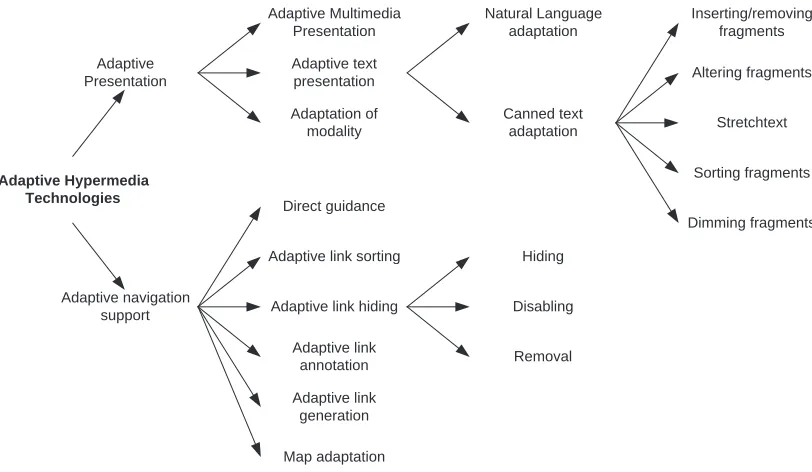
adaptive research into two categories, which Brusilovsky labelled Adaptive
Presentation and Adaptive Navigation Support. Adaptive presentation, the first
technique developed for AH, alters the content of the document for different users,
while adaptive navigation support tailors the links between these documents.
The terms and definitions used in the taxonomy have been under some debate
et al., 2002) however it quickly became the defacto standard for describing AH
technologies due in part to a lack of alternatives. An update to the taxonmony in 2001,
shown in Figure 2-2, widened the taxonomy in light of more recent research
(Brusilovsky, 2001), although it retained its syntactic problems. Additional issues with
this taxonomy are discussed in Section 8.2.5
Adaptive Hypermedia Technologies Adaptive Presentation Adaptive Multimedia Presentation Adaptive text presentation Adaptation of modality Natural Language adaptation Canned text adaptation Inserting/removing fragments Altering fragments Stretchtext Sorting fragments Dimming fragments Adaptive navigation support Direct guidance
Adaptive link sorting
Adaptive link hiding
[image:23.595.109.515.186.422.2]Adaptive link annotation Adaptive link generation Map adaptation Hiding Disabling Removal
Figure 2-2. The updated taxonomy of adaptation hypermedia technologies (Brusilovsky, 2001)
2.4.1 Adaptive Presentation
Adaptive presentation is a collection of techniques for altering the content of
information to the needs of a particular user, or group of users. Most adaptive
presentation systems employ the idea of a concept. A concept is a chunk of information
or atomic unit (De Bra, 1999) that describes an item of knowledge. System designers
usually decide the level of granularity of these concepts, and the most common types
include pages, paragraphs, sentences, images, audio clips or even whole documents.
The major problem with adaptive presentation systems is that they require a very
high level of domain understanding if they are required to change the presentation of
concepts. This prior knowledge usually consists of explicit relationships between
concepts. Examples of these relationships include: A is a pre-requisite of B, A is a type
of B, A is an example of B and A&B describe the same concept. For example, a page
understands ‘basic chemical interactions’ (pre-requisite relation) and might provide
links to related information such as ‘nuclear fusion’ (type-of relation), and ‘nuclear
fission’ (type-of relation).
Due to the need for a large amount of prior knowledge about the information
domain, systems employing adaptive presentation techniques are usually restricted to
providing tailored content for an individual web site. In an attempt to reduce this
problem, adaptive presentation systems try to achieve domain independence whenever
possible using content abstraction.
Canned Text Adaptation
Although there are various techniques under the banner of adaptive presentation,
the majority of work in this area has been categorised by Brusilovsky as canned text
adaptation. This term includes fragment processing; such as fragment altering,
inclusion, removal, sorting and dimming. Stretchtext, also to be found in this section, is
a technique where fragments are embedded in a web page and initially hidden to the
user, however the system will show these fragments inline at the request of the user.
Systems that provide adaptive presentation include AHA! (De Bra & Calvi,
1998), which can insert, remove, alter and dim fragments, HYPADAPTER (Hohl et al.,
1996), which alters, inserts and removes fragments, and the SaD system devised by
Hothi (Hothi, 2001) which implemented a method of fragment shading, later termed
fragment dimming by Brusilovsky (Brusilovsky, 2001).
2.4.2 Adaptive Navigation Support
Adaptive navigation support modifies or augments the existing set of hyperlinks
shown to the user to aid them in finding relevant information. While adaptive
presentation changes the informational content of a document, navigation support
changes the structure of the relationships between documents. This branch of the
adaptive taxonomy contains several different techniques which can be used
Link Sorting
Hyperlinks are sorted with the topmost items having the most relevance to users.
For each user, the system assigns a relevance weight to every link based on the contents
of the user model, and this weighing forms the basis of a sorting algorithm. Reordering
links has the potential to damage the existing page’s navigational structure, and as a
result the AHS that implement link sorting, such as ELM-ART II (Weber & Specht,
1997), INTERBOOK (Brusilovsky et al., 1998) and HYPADAPTER (Hohl et al.,
1996), create their own set of dynamic links which can then be safely reordered with no
adverse affects to the original page.
Link Annotation, Link Hiding and Direct Guidance
Link annotation is a very powerful technique that changes a link’s text, style, and
appearance. If the link’s destination is determined to be undesirable for the user, for
instance if the destination page uses terminology that a user doesn’t understand, then
links can be rendered in the same style as the surrounding text, effectively hiding the
link even though it is still active (link hiding). Emphasizing a link with a brighter
colour, a bigger font or with an additional icon can indicate a link’s importance or
usefulness to the user and act as a form of direct guidance. Like link sorting, care needs
to be taken when annotating links so as not to upset the original style of the document.
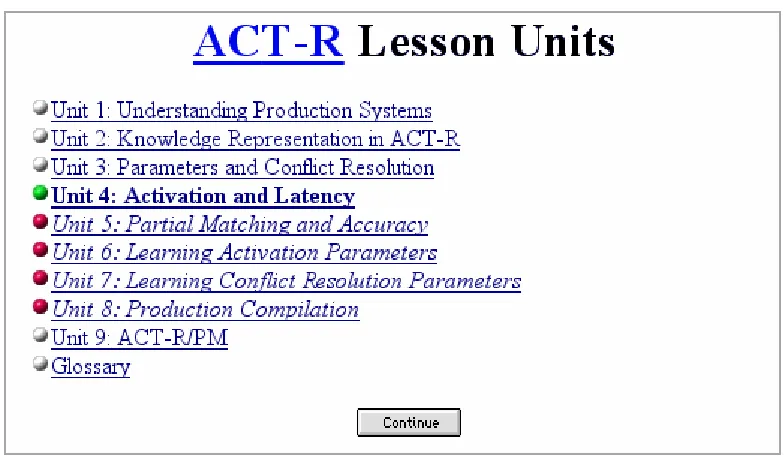
An example of link annotation can be seen in the INTERBOOK screenshot in Figure
2-3.
Link annotation is a popular technique and can be found in many systems
including AHA! (De Bra & Calvi, 1998), INTERBOOK (Brusilovsky et al., 1998),
ELM-ART II (Weber & Specht, 1997), CHEOPS (Ferrandio et al., 1997), COOL Links
(Wantz & Miller, 1997) and Personal WebWatcher (Mladenic, 1996).
Link Augmentation
The technique of link augmentation involves the insertion of additional links (to
useful or related information) to an existing page. These links are added on top of the
existing hyperlinks found in the source document. With link augmentation, users see
the page’s original hyperlinks but are also presented with a set of additional links,
which are often embedded in the text of the page. While link augmentation is not to be
technique that has been used in several AH systems (Maglio & Farrell, 2000)(Bailey &
Hall, 2000)(Bailey et al., 2001)(Bailey et al., 2002). In comparison to link sorting or
annotation, link augmentation is less destructive to the original format of the page
because the page’s existing navigational hyperlinks remain unaltered. The main issue
with link augmentation is in making sure that the user does not face a navigational
overload, as the page could appear to have a greater number of links on it.
2.5
User Modelling
User Modelling (UM) is the process of building up knowledge about a user in an
effort to form a representation of their mental state. Typical information stored in a UM
includes a person’s knowledge, expertise, skills, desires and goals. The field of UM
provides techniques to collect user information, maintain user profiles and deploy this
information to provide personalised services to users. It is applicable in a wide range of
disciplines including among others, Adaptive Hypermedia, Recommender systems,
Intelligent Interfaces, Human-Computer Interactions and Expert systems (Kobsa,
1993).
To populate user models, systems can employ either explicit or implicit
modelling techniques. When using an explicit approach, data is obtained by directly
questioning users or requesting ratings about various products or services. While this
method obtains accurate results (Watson & Sasse, 1998), it can disrupt normal
browsing behaviour (Claypool et al., 2001) and reduce the quality and quantity of
feedback if there is a lack of perceived benefit to the user (Grundin, 1994).
In contrast to this, the non-intrusive method of implicit modelling relies solely on
the observations of the user’s actions. Systems track users and record their activities as
they interact with the system. Activities such as reading a document, printing a
document, searching a domain or purchasing a product can be used as indications of a
users’ desires. Such over-the-shoulder observations, while never as accurate as explicit
questioning, can always be combined with explicit techniques to produce a more
complete user model (Claypool et al., 2001).
Once created, it is possible to process user models using a variety of existing
recommendation, it is useful to group or cluster user models together using a
classification algorithm such as a neural network, k-nearest neighbour clustering, or
Bayesian classifier. Alternately if a model contains a user’s trail, analysis of this trail
using an information retrieval techniques such as Latent Semantic Indexing (LSI)
(Deerwester et al., 1990), or Term-Frequency / Inverse Document Frequency (TFIDF)
(Salton, 1991) analysis may yield further information about the user interests
(Mladenic, 1999).
2.6
Examples of Adaptive Hypermedia Systems
The primarily application-led adaptive hypermedia research has produced many
different adaptive hypermedia systems, although the majority of them are academic
research efforts based on the variety of existing web formats, protocols and
technologies. With the advent of mobile phones and personal digital assistants, which
have a restricted screen size, limited memory and reduced bandwidth, new applications
and techniques are being produced with these devices in mind (Billsus et al.,
2002)(Cotter & Smyth, 2000). As an exhaustive review of AH is out of the scope of
this thesis, three classic systems have been chosen to demonstrate how many of the
adaptive techniques from Brusilovsky’s taxonomy have been implemented in existing
hypermedia systems.
2.6.1 INTERBOOK
One of the most successful systems employing adaptive navigational support is
INTERBOOK (Brusilovsky et al., 1996b)(Brusilovsky et al., 1998)(Wu, 2002), which
provides the means for authoring and delivering electronic textbooks on the web.
INTERBOOK resides on a web server and provides pages to any frame-enabled
browser. INTERBOOK stores a domain model of concepts and their structure, and a
specific type of student model called an overlay model. Overlay models allow the
system to independently measure the user’s knowledge in different topics. This model
is built from the pages a user visits. The authors of an INTERBOOK application create
the domain knowledge, organised hierarchically, along with concept information, and
requirement and outcome relationships between the domain and concept information.
This knowledge can then be used by INTERBOOK to generate pages, tailor font styles
based on their user model (Figure 2-3). Pages that offer no new information are marked
as nothing-new (white), pages with the pre-requisite condition met are labelled as
‘ready-to-be-learned’ (green) and pages that fail any pre-requisite conditions are
labelled as ‘not-ready-to-be-learned’ (red). Visited pages have a check mark placed
next to them. This allows the user to visually gauge a link’s condition and then make a
more informed choice as to which page to visit next.
In addition to this adaptation, INTERBOOK also provides several other features
to the user. The system provides direct guidance in the form of a ‘Teach me’ button by
applying a set of heuristics to automatically choose the most suitable node from those
ready to be learned. There is a ‘Help’ button which provides adaptively-sorted links to
sections that present information about background concepts of the current section.
INTERBOOK also supports a glossary index of concepts. Links to glossary items are
generated automatically by INTERBOOK, and each glossary item contains a set of
[image:28.595.117.509.388.618.2]links back to pages describing that concept.
Figure 2-3. An example of adaptive link annotation in INTERBOOK
INTERBOOK is implemented using a set of CGI scripts and provides authoring
tools in the form of Microsoft Word templates, which allow authors to convert their
existing documents into a form that INTERBOOK can adapt.
A major study of INTERBOOK undertaken in 1998 (Brusilovsky & Eklund,
1998), found that the participants who put their faith in the system to decide the best
route, followed less linear paths. They also spent longer on pages marked as
‘ready-to-be-learned’ and skipped quickly though those labelled as ‘nothing new’. Although
these results look promising, there were two major inhibiting factors in the experiment.
The first was that only 17 people spent long enough on the system to warrant using
their data. The second problem is that the adaptive features of INTERBOOK
contributed only 20% of the total navigational tools on offer to the students, which led
students to use more non-adaptive features than desired. This became obvious when
analysing the non-adapted Continue button, which has a higher usage rating than all the
other navigational tools combined. While not the only study of INTERBOOK, this is
one of the most comprehensive and its conclusions continue to be relevant for future
AH system designers.
2.6.2 AHA!
The Adaptive Hypermedia Architecture (AHA!) (De Bra & Calvi, 1998)
developed in 1998 and which has since undergone several revisions (De Bra et al.,
2000)(Wu, 2002), is a server-side architecture for creating adaptive hypermedia
applications on the web. To create an AHA! application, authors write a set of web
pages which also contain conditional blocks of XHTML code, while at the same time
creating ‘concept’ documents for each page to specify the required user knowledge for
that page. The concept pages also contain the processing actions to apply to the user
model once the page has been read. The AHA! system internally stores a user model
which results from the pages concepts the user has read. The adaptive content on new
pages are provided by combining the concept rules, conditional statements and user
data together. Since its initial development, the experiences with AHA! led the authors
to form an abstract model for AH systems, AHAM (see Section 2.7.1), and recent work
on AHA! has seen it more closely adhere to this framework (De Bra et al., 2002).
The conditional statements are a powerful way of producing a range of adaptive
techniques. Each statement contains valid XHTML data which includes links, images
paragraphs or entire pages of data. Each statement specifies which concepts are needed
to display the data inside. An example of a conditional statement is shown below.
<if expr=”(aAHS.introduction=80) && ((aAHS.history>50) || (aAHS.history=50))”>
<block>
This text will only appear if the user has gained the required knowledge
in the ‘introduction’ and ‘history’ concepts.
</block>
<block>
If this is not the case then this alternative is presented instead.
</block>
</if>
These statements were designed as a means to provide adaptive presentation,
although adaptive link annotation and link augmentation can also be implemented as
any XHTML can be placed inside the conditional text. Single words, paragraphs,
hyperlinks, images and movies can be constrained to the concepts understood by the
user.
When all the pages have been written, the author then writes a series of concept
documents that formalise the knowledge within the system. These documents can
specify pre-requisite information for a page, and any post-access actions, or they can be
used to store code that is applied to a set of pages. This information is then used by
AHA! to create the adaptation. Users access the web pages through a set of java
servlets. These servlets apply the rules in the concept documents to the current user
model. If the user is allowed to view the page, AHA! then applies the user model to the
conditional rules in the accessed page to produce a personalised version of that page.
The user model is built from post-access rules also specified in the concept documents.
This knowledge is stored as concept-value pairs with integer values between 1-100.
AHA! also lets the author specify link classes, which are rendered in different
colours with cascading style sheets. This allows an additional form of adaptive link
annotation and makes it easy to provide link hiding. This hides complex information
from the user while still providing access to that information if required.
2.6.3 PUSH
PUSH (Espinoza & Höök, 1996) is a web interface, via a Web browser, to an
techniques to provide the user with a clear view of the domain and help reduce
information overload.
PUSH relies on the user to provide most of the adaptability of the system. It
generates two ways to navigate through the information space; menus and graphs,
although neither method relies on traditional hyperlinks. Menus are defined by the
system prior to run time, and provide a reliable way of letting the user pose questions to
the system such as ‘Describe process X’ or ‘Provide an example of Y’. Questions
appear as a drop down list menu list that the user can select. If the user wants to submit
a question that is not on the list, then they may enter it into a text box provided by the
system.
The second technique is a form of map adaptation. When the browser loads a new
page, the PUSH system processes the local domain structure and constructs a graph
displaying all objects related to the current page as well as their relative positions. This
provides a very clear view to the user of their current position and gives an idea of the
local information space around them. By making each node of the graph a pointer to a
web page describing it in more detail, the graphs become the primary method of
navigation within the information domain.
Each page, which has been generated dynamically with Common Gateway
Interface (CGI) scripts, contains a textual description of a subject. This information is
specific to the goal of the user and is obtained, either by deduction or prior expression
by the user (Brusilovsky, 1996b). PUSH then augments this with a list of hyperlinks
describing other aspects of the concept. When the user clicks on one of these, instead of
navigating to a new page, the system inserts the new information just below the current
text. By clicking on the hyperlink again, the description is removed. This stretchtext
technique essentially allows the user to create their own view of the web pages, adding
or removing information and thereby providing the adaptation themselves. The idea is
extended further into what Espinoza and Höök call ‘hotwords’. These are words in bold
that, when clicked on, yield questions relating to the word that the user might want to
ask. When a question is selected, the answer appears in the browser window below the
current information. This additional information can aid the user in understanding the
2.7
Models and Frameworks for Adaptive Hypermedia
For over a decade the AH community has produced a wide range of applications
in many varied domains, however there are very few frameworks for AH and even
fewer models. The models describe, at a conceptual level, the components and
descriptive languages used for specifying generalised adaptive hypermedia systems.
The frameworks represent real systems that the authors claim can be used in a variety
of adaptive applications, however in practice they are usually limited to a specific
application or area, such as adaptive learning environments, adaptive hyperbooks or
distance learning courses.
2.7.1 AHAM
The Adaptive Hypermedia Application Model, AHAM (De Bra et al., 1999b)
was developed after work on AHA! (see Section 2.6.2) highlighted the desire to
produce a reference model that could be used to express the functionality of any
adaptive hypermedia system (De Bra et al., 2002). Since the development of AHAM,
AHA! has been further modified to better fit into the AHAM model.
AHAM is based on DEXTER, a formal reference model for hypertext systems
developed in 1988 (Halasz & Schwartz, 1994). The goal of DEXTER was to produce a
model that captures the important formal and informal abstractions found in existing
hypertext systems, as well as provide a common set of terms for describing such
systems. The model allows the properties of a system to be expressed in DEXTER and
then compared against the functionality of other systems. It was the hope of the
designers for this model to be the basis for interoperability standards for hypertext
systems. DEXTER separates the components of a hypertext system into three major
layers; the within component layer which stores the contents of the domain, the storage
layer which contains the structure (nodes and links) between objects in the component
layer, and the runtime layer which presents the hypertext information to the user. The
DEXTER model also includes two smaller layers; an anchoring layer to allow
addressing of individual chunks of data within the component layer, and a presentation
specification layer to provide the runtime layer with information on how to present
While DEXTER would successfully describe most hypertexts of the time, indeed
the web today can be mapped onto this model, the authors of AHAM were driven by
the realisation that DEXTER needs to be extended if it is to be used to describe the new
field of AH. The AHAM structure uses identical within component, anchoring and
runtime layers, however the AHAM model modifies the storage layer to include a user
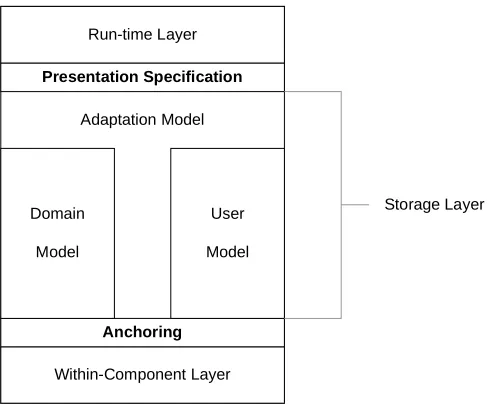
model, a domain model and an adaptation model as seen in Figure 2-4.
Run-time Layer
Within-Component Layer
Anchoring Presentation Specification
Domain
Model
User
Model Adaptation Model
[image:33.595.206.451.205.407.2]Storage Layer
Figure 2-4. The AHAM Model (Wu et al., 2001)
The domain model contains atomic concepts, which describe components within
the component layer, and composite concepts, which contain a set of atomic concepts.
In AHAM, these concepts can represent whole pages or fragments of pages. All
concepts are uniquely addressed though the anchoring layer. The domain layer also
contains sets of tuples that describe the relation between concepts.
The user model in AHAM expresses individual user data as attributes of concepts
using the object-oriented convention of <object>.<property>=<value>. For
example, the following statement describes a user having learned the concept
‘JavaPrograming’:-
true learned mming
JavaProgra . =
Other UM information, such as background knowledge, preferences, age, etc.,
attributes. To facilitate communication between AH systems, AHAM also defines two
externally accessible accessor functions, getValue() and setValue(), for exchanging
user model information. However it is acknowledged that such exchanges require a
semantic understanding of the data; an issue to which at present AHAM offers no
solution.
The adaptation model employed by AHAM, originally referred to as the teaching
model, is represented as a set of event-driven adaptive rules, expressed as tuples, that
change variables within the system depending on a user’s actions. For example, a rule
could be written that would set the user’s ‘read’ field for a given concept to true when
the user visits that concept.
true post true read C C
access( )⇒ . = , ,
The second component of this tuple indicates the phases for that rule: a pre phase
indicates the rule is executed on the current user model before responding to the user,
and a post phase occurs after a user has followed a link. The last component of the
tuple is a propagate flag that indicates whether the triggering of one rule can propagate
to other rules.
The final component of the AHAM model also found in the DEXTER model is
the presentation specification, which contains a collection of rules in the same format
as those used in the adaptation model. These presentation rules can set the value of
presentation attributes to, among other values, GOOD, BAD or NEUTRAL depending
on the appropriateness of the concept or link for the current user.
Using these modules, AHAM specifies an adaptation engine the role of which is
to retrieve the user model, instantiate the adaptation rules using the user model and then
execute all pre phase rules. The engine builds up the page using the presentation rules
and displays it to the user in their browser window. On selection of a link, the post rules
are triggered and the user model is updated with the new values.
Using these components, any adaptive hypermedia system (AHS) can be defined
gine AdaptiveEn Model
Adaptation UserModel
l DomainMode
AHS = , , ,
AHAM is not the only model based on Dexter. The Munich Reference Model
(Koch & Wirsing, 2002)(Koch & Wirsing, 2001) follows the same approach taken in
AHAM by extending Dexter’s storage model and adding user and adaptive models.
Architecturally, the two reference models are almost identical. The major difference
between the two approaches is that AHAM specifies an adaptation rule language, while
the Munich model contains an object-oriented specification written in the Unified
Modelling Language (UML). UML provides a visualisation of the reference model that
can be supplemented with formal semantic information. The Munich model forms the
basis of UML-based Web Engineering (UWE) (Koch & Kraus, 2002), an extension to
UML that supports application design and lifecycle development. UWE guides the
programmer through the process of developing an adaptive application, from
requirements analysis, scenario development, task modelling and design to limited
automatic code generation.
2.7.2 XAHM
The proposed XML Adaptive Hypermedia Model (XAHM) (Cannataro &
Pugliese, 2001)(Cannataro, et al., 2002) is a XML-based object-oriented model for
AHS. XAHM defines a multidimensional approach, where each part of the AHS is
described along three different “adaptivity dimensions” within an adaptation space.
• User’s Behaviour - Browsing activities, preferences, etc.
• External Environment - Factors such as location (temporal, spatial), language,
politics, etc.
• Technology - Network bandwidth, quality of service, etc.
These three dimensions form the space within which the user is tracked. The user
model is generated using a mapping algorithm which maps the values in each of the
three dimensions onto a stereotype user model. As the user’s dimensionality changes,
The application domain model is a layered model which represents the use of
XAHM for a specific domain.
1. At the basic level there are information fragments consisting of text, sounds,
images or videos. This data can be stored in any representation, structured or
unstructured, and each is accompanied by an XML metadata element.
2. Presentation descriptions specify the layout and format of specific information
fragments. These descriptions are specified by Document Type Definition
(DTD)-constrained XML documents.
3. Elementary abstract concepts combine presentation descriptions to represent
larger units of information. Represented as a directed graph (a digraph), the
abstract concepts relate together presentation descriptions by weighted links.
The arcs represent relationships between concepts, while the weights represent
their relevance with respect to each other.
4. The top level Adaptive Hypermedia represents the elementary abstract concepts
organised as a digraph. Arcs represent relationships between elementary
abstract concepts, distinguished by the user’s behaviour dimension. In the
Adaptive Hypermedia, the arcs have no weighting attached to them.
The run-time system component of XAHM follows a three-tier architecture
comprising of a presentation layer, an application layer and a data layer. The
presentation layer receives and displays the pages. The application layer consists of a
user modelling component, which calculates the user’s position in the adaptation space
and applies the mapping algorithm to determine the stereotype model, and an adaptive
hypermedia application server, which extracts the presentation description and applies
the logics contained within the stereotype model. Finally, the data layer stores
persistent data such as information fragments and user data, and provides access
methods to this data.
2.7.3 ELM-ART
The Episodic Learner Model-Adaptive Remote Tutor (ELM-ART) (Weber &
Möllenberg, 1994)(Brusilovsky et al., 1996a) is described as an adaptive, intelligent,
web-based educational system. It is based on the earlier ELM-PE system that taught a
Environment with example-based programming. In 1996, the user base of ELM-PE was
being limited by the inherent platform-dependent user interface and large processor
requirements (Weber & Brusilovsky, 2001). These issues caused the developers to first
translate the course material into Web pages and then port the functionality of ELM-PE
to the Web, forming EML-ART in the process. Now the application has been
generalised into a framework which has spawned several related adaptive applications.
Experience with ELM-ART and the related system INTERBOOK, highlighted
areas for improvement particularly in regard to the restricted user model, basic adaptive
features and issues involved with transferring a sequential book into an electronic
hyperbook. This lead to the new enhanced ELM-ART II (Weber & Specht, 1997) that
supported student-tutor and student-student communication, online exercises and tests,
and a more expressive user model which provides greater feedback on previously
visited concepts. The latest version of ELM-ART has been used as the basis for
NetCoach (Weber et al., 2001), an authoring tool to develop web-based courses.
ELM-ART stores a domain model containing units organised hierarchically into
lessons, sections, subsections, and terminal pages. Terminal pages are shown at the end
of units and can present the user with tests to work on, problem-solving examples or
new concepts. Each unit contains information such as the main page text, associations
with other concepts, concepts learnt by the user after completing the unit and test items.
After the user has studied the unit and successfully answered the relevant test items, the
user model is updated with the new learned concepts.
The user model also records the approach taken by students in solving
programming problems posed by the system. These problems map onto the domain
concepts of the course, and hierarchical generalizations are used to interpret student
code. These generalizations contain plans and data pertaining to a particular aspect of
the domain which ELM-ART uses to analyse the results of examinations. The complete
student model (both the domain concepts learnt and approach to problems) can be used
by ELM-ART to diagnose incorrect and incomplete student programs.
The latest version of ELM-ART has many adaptive features. It extends the link
INTERBOOK (shown in Figure 2-3) with an extended metaphor that uses white balls
to indicate solved problems or visited pages, and orange balls placed next to
uncompleted exercises or concepts that the system infers are known to the user. There
is additional support for both direct guidance and exploratory learning and ELM-ART
provides adaptive link ordering and adaptive testing using the information contained in
the user model.
While being limited to courseware environments, ELM-ART has had much
success in that area and there have been empirical studies analysing various aspects of
the system, such as the direct guidance employed by ELM-ART II (Weber & Specht,
1997). ELM-ART’s strength as a framework lies in the applications it has inspired,
such as INTERBOOK (Section 2.6.1), ACE (Section 2.7.4), NetCoach (Weber et al.,
2001) and the various incarnations of the ELM system itself.
2.7.4 ACE
Motivated by work on the earlier system ELM-ART II, Adaptive Courseware
Environment (ACE) has been developed as a Web-based environment to support
adaptive learning (Specht & Oppermann, 1998). The approach taken in ACE is from a
knowledge representation perspective, which has led to the modelling of three areas of
knowledge implicit to the psychology of learning.
Domain Expert Model - A representation of the course material. This consists of a
database of structured information, known as a knowledgebase, containing concepts
(units), interrelations and dependences. Associated with each concept are learning
materials such as examples, demonstrations, interactive playgrounds and tests. The
author of this model can also cluster the concepts using an interest field, and specify
curriculum sequence relations, which act as a default guide through the domain.
Pedagogical Expert Model - Contained in this module are the strategies and
techniques related to teaching. By following the techniques of real teachers, specifically
examining how they switch approaches when explaining a difficult concept or aiding a
particular student, these techniques can be expressed as a set of strategies, such as
Learn-by-doing, learn-by-reading or learn-by-example. A particular rule might check if
to this concept. The Pedagogical Model in ACE also holds diagnostic information
describing how to interpret test results and how such results impact on the various
concepts related to the test (similar to the generalisations using in ELM-ART).
Learner Model - This model stores the learner settings, knowledge model and an
interests model. The learner settings store profile information obtained from new users
through direct questioning to obtain background knowledge, preferences and goals. The
knowledge model contains a list of units the user has worked on; both completed and
partially learnt. Finally, the interests model stores information relating to a user’s
interest in various concept clusters. If the user requests a given percentage of units from
a cluster, the system will recommend further units from this cluster.
Using these three knowledge models, ACE can provide a variety of adaptive
techniques. Adaptive link annotation, in the form of links marked as ‘visited’, ‘not
ready to be learnt’ or ‘recommended’, is supported using information in the domain
model. This model also provides direct guidance using the curriculum sequences
defined by the author. This form of adaptive sequencing acts both at a course level,
automatically selecting the next unit to visit, as well as at a unit level by sequencing the
media within the unit. Finally, the system can also adaptively select a teaching strategy,
overriding the default strategy, based on the concept material and key user features
gained from the learner model.
Analysing ACE as a framework it is clear that the three knowledge modules
provide a good level of abstraction away from the information domain. ACE has
implemented a range of adaptive features drawing from both adaptive navigation and
adaptive presentation technologies. ACE has been successfully implemented in two
different courses; statistics (Specht et al., 1997) and narcotics (Schoech et al., 1998).
The latest implementation includes an editor allowing an easy method for authors to
create and modify courseware. Authors have an added ability to specify rules for
adaptive instruction within their curricula, thereby giving authors some level of control
2.7.5 MetaLinks
MetaLinks (Murray, 2002) is a complete system for authoring and presenting
adaptive hypermedia books (hyperbooks), closely related to previous systems such as
INTERBOOK (Section 2.6.1) and ELM-ART (Section 2.7.3). Its application is aimed
at large sources of interconnected online material. MetaLinks stores this material in a
relational database, and authors use the FileMaker Pro software package to enter and
structure the material. All content is centred on the chapter, section and subsection
model. Authors can choose different styles and layouts for the presentation of the
pages. Users connect