81
Copyright © 2011-15. Vandana Publications. All Rights Reserved.
Volume-5, Issue-2, April-2015
International Journal of Engineering and Management Research
Page Number: 81-89
An Integrated Model of Factors Affecting Information Technology
Implementation Success in Organizations
Ayana Johny1, Prof.Dr. M.Bhasi2 1
Research Scholar, School of Management Studies, Cochin University of science & Technology,Kerala, INDIA 2
Professor, School of Management Studies, Cochin University of science & Technology, Kerala, INDIA
ABSTRACT
The impact of Information Technology on individuals, organization and society is changing everything. The extent of technological revolution that the world is presently witnessing is that Information Technology has become the vehicle or major engine of the information age which has reduce the world to a global village. This new technological epoch is apparent through the intensified investment in computer-processing and data preparation appliance in the manufacturing and service industry and telecommunications infrastructure, and its widespread usage in government agencies, educational organizations, and, more recently, in the households. Owing to these technological progressions, the implementation and application of Information Technology is a significant driving force behind many socioeconomic changes. The Implementation and the subsequent use of IT is a process of interrelated steps, slipping at any of the implementation stages may actually increase inefficiency, ineffectiveness and promote a number of uncertainties. This paper tries to identify different factors which help for a successful IT implementation in organizations. Merging the factors so identified into IT implementation stages the author tries to develop a framework for successful Information technology implementation. Extensive review of literature and expert advice has been sought in developing the framework which we hope to get fee back on publication. The outcome of the study will be a model which helps organizations to understand which are the critical factors for a successful Information technology Implementation and the relation between these factors.
Keywords---- Information Technology , Implementation,
Implementation Stages, Information technology Innovation, Information technology adoption and diffusion
I.
INTRODUCTION
Present day most of the organizations rely heavily on Information and communication technology.
Information and Communication Technology directly affects how managers decide, how they plan and what products and services are offered in the industry. Information Technology has strategic significance. In an information rich economy, a company can use information technology to reduce cost, upgrade product quality, improve customer service, or even integrate customers operations with its own operations, thus assuring repeated
business[1]. Thus in an organization successful
82
Copyright © 2011-15. Vandana Publications. All Rights Reserved.
framework of factors for a successful Informationtechnology implementation was developed.
II.
METHODOLOGY
The comprehensive frame work for factors affecting Information Technology implementation success was developed through the following stages.
Stage I: The author conducted an extensive literature review of the concept of Information technology, technology implementation and factors affecting the successful Information Technology implementation. The outcome was that the innovation concept of technology and implementation was adopted to be studied and a complete database of factors affecting technology implementation and adoption was developed.
Stage II: This factor database was given for review to the subject experts to and a comprehensive list of factors which was important for the study and their shared meanings were developed.
Stage III: further literature survey was conducted to identify relationship between the variables and assigns factors to the particular implementation stage and to investigate what impact they possess during the particular implementation stage on the IS implementation outcome
III.
PREVIOUS STUDIES
Information Technology (IT) is concerned with processing, storage and dissemination of vocal, pictorial, textual and numerical information by based combination are its main fields. The term in its modern sense first
appeared in a 1958 article published in the
commented that "the new technology does not yet have a single established name. We shall call it information technology (IT)." Most of the former studies of application
and adoption of Information Technology in organization looks technology as an innovation concept. - The Klein and Sorra [12] article defines technology innovation as, "a technology or a practice used for the first time by members of the organization, whether or not other organizations have used it previously". So taking the innovation concept of technology, Information technology implementation can be described as“Implementation is a critical gateway between the decision to adopt innovation and the routine use of the innovation within an organization. For implementation to be a success, the application should be no longer perceived as something new, and the “targeted employees use a given innovation consistently and well” [12]. To understand what are the important steps that take place during this critical gateway, and to know what issues should be raised and resolved throughout implementation process, would allow for better control over the outcome of IS implementation, thus increasing odds of success of the innovation. The main studies in this field is categorized as follows, 1) Information technology adoption and diffusion Literature 2) Literature related to Implementation Factors 3) Implementation process literature.
a) Information technology adoption and diffusion
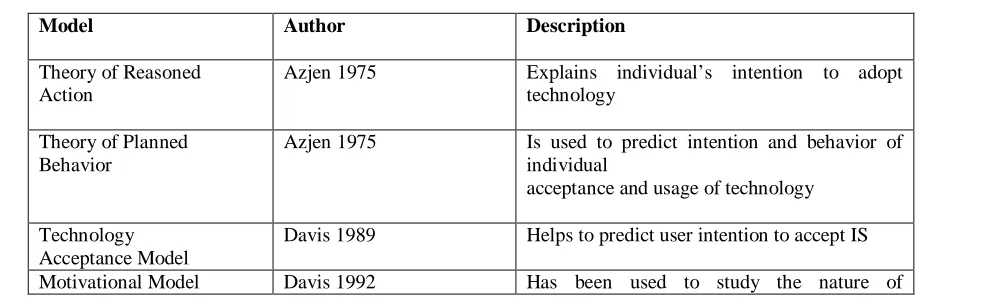
literature – The IT innovation field is concerned with understanding the factors that facilitate or inhibit the adoption and diffusion of IT in an organization. These adopters can be individual, organizational or groups of inter related firms. This research stream produced an assortment of factors that seem to influence IS acceptance and utilization. In addition, a number of models and theories of individual acceptance have been developed. These models provide an important theoretical foundation for studying how various users, and technological and environmental influences, can predict, explain and determine the use of IS. The table below shows the theories related to IT adoption and diffusion.
Table 1
Model
Models and Theories on Individual IS Acceptance
Author Description
Theory of Reasoned Action
Azjen 1975 Explains individual’s intention to adopt
technology
Theory of Planned Behavior
Azjen 1975 Is used to predict intention and behavior of
individual
acceptance and usage of technology
Technology Acceptance Model
Davis 1989 Helps to predict user intention to accept IS
83
Copyright © 2011-15. Vandana Publications. All Rights Reserved.
motivation that explains user behavior towards technologyInnovation Diffusion Theory
Rogers 1995 Postulates that characteristics of adopters and
innovation have
an influence on the spread of innovation Task Technology
Fit Model
Goodhue 1995 Showed that success of adopting technology
may be explained
by compatibility of its characteristics with the characteristics of
the task
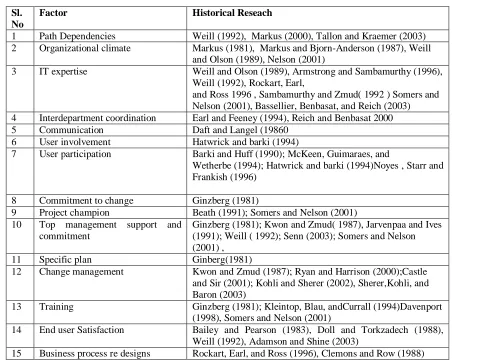
b) Implementation factor Literature The end result is a fragmented summary of
disparate factors. The important and most repetitive factors from the given studies and those factors which the researcher found to be important for the present study is given below. – factor research
has identified various elements of the organizations internal and external enviouenment factors that are likely to lead to a successful implementation. The author conducted a literature review of the factors as early as 1980’s to 2000.
Table 2
Sl. No
Comprehensive table of the factors identified
Factor Historical Reseach
1 Path Dependencies Weill (1992), Markus (2000), Tallon and Kraemer (2003)
2 Organizational climate Markus (1981), Markus and Bjorn-Anderson (1987), Weill
and Olson (1989), Nelson (2001)
3 IT expertise Weill and Olson (1989), Armstrong and Sambamurthy (1996),
Weill (1992), Rockart, Earl,
and Ross 1996 , Sambamurthy and Zmud( 1992 ) Somers and Nelson (2001), Bassellier, Benbasat, and Reich (2003)
4 Interdepartment coordination Earl and Feeney (1994), Reich and Benbasat 2000
5 Communication Daft and Langel (19860
6 User involvement Hatwrick and barki (1994)
7 User participation Barki and Huff (1990); McKeen, Guimaraes, and
Wetherbe (1994); Hatwrick and barki (1994)Noyes , Starr and Frankish (1996)
8 Commitment to change Ginzberg (1981)
9 Project champion Beath (1991); Somers and Nelson (2001)
10 Top management support and
commitment
Ginzberg (1981); Kwon and Zmud( 1987), Jarvenpaa and Ives (1991); Weill ( 1992); Senn (2003); Somers and Nelson (2001) ,
11 Specific plan Ginberg(1981)
12 Change management Kwon and Zmud (1987); Ryan and Harrison (2000);Castle
and Sir (2001); Kohli and Sherer (2002), Sherer,Kohli, and Baron (2003)
13 Training Ginzberg (1981); Kleintop, Blau, andCurrall (1994)Davenport
(1998), Somers and Nelson (2001)
14 End user Satisfaction Bailey and Pearson (1983), Doll and Torkzadech (1988),
Weill (1992), Adamson and Shine (2003)
84
Copyright © 2011-15. Vandana Publications. All Rights Reserved.
16 External enviournments Seddon, Staples, Patnayakuni, and Bowtell (1998)
17 Dedicated resources Somers and Nelson (2001)
18 Commitment to change Ginzberg (1981)
19 Compatibility –Task fit Moore and Benbasat (1991), Goodjue (1995)
20 Personal innovations Agarwal and Prasad (1998)
21 Trialability Rogers (1994)
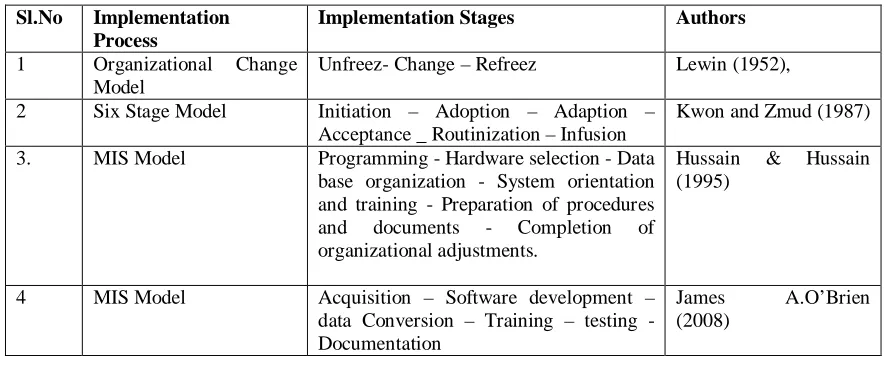
c. Implementation process Literature – implementation process literature looks at the various stages an organization goes through for the implementation of any new technology. Earlier studies looked at these stages as a process of change for the entire organization. The management information Literature looks at implementation stages purely from the technical angle.
Among the most prominent models that look at implementation as a process of change are Lewin .Kolb and Frohman,Kwon and Zmud Joshi [15, 13, 14,8]. The prominent studies in the field of MIS literature was done by Hussain & Hussain and James A.O’Brien [6,7]. The table below shows the major implementation process stages.
Table 3
Sl.No
The Implementation Stages
Implementation Process
Implementation Stages Authors
1 Organizational Change
Model
Unfreez- Change – Refreez Lewin (1952),
2 Six Stage Model Initiation – Adoption – Adaption –
Acceptance _ Routinization – Infusion
Kwon and Zmud (1987)
3. MIS Model Programming - Hardware selection - Data
base organization - System orientation and training - Preparation of procedures
and documents - Completion of
organizational adjustments.
Hussain & Hussain (1995)
4 MIS Model Acquisition – Software development –
data Conversion – Training – testing -Documentation
James A.O’Brien (2008)
IV.
RESEARCH GAPS AND
OBJECTIVES
We have seen above the different studies relating to information technology implementation. But the historical studies have the following gaps. The technology adoption and diffusion literature has led to development of various individual acceptances of technology models. The main issue is that these models look at only the factors for individual factors. Factor research looks at individual factors in a specific enviournment, without exploring the relationship among the factors and how the factors can be applied to other enterprises. Implementation process research list out the stages of implementation, but lacks in clarity of the factors in each stage. Hence the objective is to combine all theses researches a develop framework for
understanding and controlling the factors for successful IT implementation.
V.
MODEL DEVELOPMENT
85
Copyright © 2011-15. Vandana Publications. All Rights Reserved.
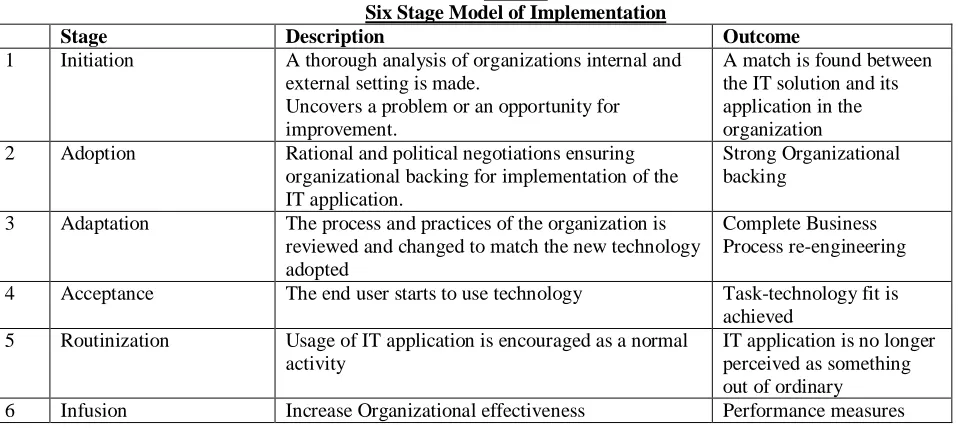
Table 4Six Stage Model of Implementation
Stage Description Outcome
1 Initiation A thorough analysis of organizations internal and
external setting is made.
Uncovers a problem or an opportunity for improvement.
A match is found between the IT solution and its application in the organization
2 Adoption Rational and political negotiations ensuring
organizational backing for implementation of the IT application.
Strong Organizational backing
3 Adaptation The process and practices of the organization is
reviewed and changed to match the new technology adopted
Complete Business Process re-engineering
4 Acceptance The end user starts to use technology Task-technology fit is
achieved
5 Routinization Usage of IT application is encouraged as a normal
activity
IT application is no longer perceived as something out of ordinary
6 Infusion Increase Organizational effectiveness Performance measures
a. Stage I – Initiation
The first variable in this stage is Path dependencies.
Weil’s [20] conversion model talks about Path
dependencies, it means that technology decisions are not
made solely in response to the current business environment. Today’s decisions are affected by past technology decisions, which may either limit or increase the range of current choices. The author feels that every organization should assess where they stand before embarking any new Information technology. Second
important variable is Organizational climate.
Organizational climate can be defined through organizational politics, Institutional leadership, confidence of employees with their management, the reward systems, and organization size and goals [18]. There are no organizations that would possess identical organizational environments, simply because they would have different people working for them. In fact resistance to new technology can be attributed to internal political issues and the power associated with them [16,17].If the organization’s context, such as social or political culture, is not compatible with the design features of the new technology; it will be difficult to gain end user support. Thus, a deeper understanding of an organization’s climate would aid in shaping the right implementation plan and creating a conductive environment for implementation. Once the organizational characteristics are understood an
investigation to the user characteristics or work group
characteristics will help to plan implementation which
best suit the work group. The work group characteristics are taken from the work of [18,14], Which can be seen as, collaboration among workers it was shown that if groups are collaborative in the way they interact, it is easier to
encourage innovative behavior among them [18], job
tenure [18], computer literarcy level of the workers [14]. Reviewing what exposure to various technologies the users
had in the past, and how confident they are in their computer capabilities, can help define what additional computing support or computer training should be
provided [23] Also, knowing the users’ attitude toward
computers and innovations can give an extra key to
successful implementation as it would help to recognize how users will feel about the new system [19,23].Careful consideration of the current job characteristics [18] or as [14] name it characteristics of the task that include the
level of autonomy, control over work quality, and
responsibility for the outcome, would give better guidance toward what job changes may occur due to the new IS implementation, and would help managers to prepare users for changes as well as anticipate possible source of resistance later in the implementation [18]. In summary, during the initiation stage, an organization identifies an opportunity for change and evaluates specific IS solution to engage in. However no commitment from either potential users or the IS department is made during initiation stage.
b. Stage 2 - Adoption
To increase the odds of successful implementation, it is crucial to gain early support from key participants including potential IS users and their management.
Research suggests that user involvementand management
support increases user IS acceptance [16,17,24,25].
86
Copyright © 2011-15. Vandana Publications. All Rights Reserved.
unstructured or ambiguous, and the more complex thesystem, the more essential the user’s participation is in user satisfaction and consequently to system success [26]. Therefore, placing user involvement and user participation into the adoption phase of the implementation model helps in establishing strategies that would first seize user involvement and then transform it into active user participation throughout implementation process, thus ensure full backing for implementation from those who might potentially resist the project.
User participation does not happen on its own; management plays a critical role in facilitating and influencing user’s participation in the implementation [27].
Previous studies have recognized management support as
one of the key reoccurring factors affecting system success [5,8,14,20]. Management that can ensure sufficient resources to the implementation effort, that is willing to accept risks, and that acts as a change agent to create more conducting environment through encouraging and promoting IS use,is associated with greater system success.
Another concern is commitment to the change. An
organization where its members are unwilling to accommodate to the change is unlikely to have a successful implementation [5]. Both commitment to the project and commitment to the change require attention from management and users. Commitment to change can
be obtained by proper communication and inter
department co ordination of the need for new system
adoption and its impact on the task of the workers. If proper communication is not maintained it will lead to two factors, uncertainty – where information is not available and equivocality – an ambiguous situation that is subjected to multiple interpretations. They say that this can be avoided through face to face meetings or any optimal form of communication. The allocation of sufficient resources has been cited as affecting IS success [28]. Whether a particular project has enough resources or not is a direct result of how committed and supportive management and the organization are, and therefore an allowance needs to be made for this stage as well. Types of resources that are common to support implementation effort are personnel, equipment, time, money and implementer’s skills.Upper management is responsible to assure that properly skilled personnel are available to work on the project for the necessary time periods. They also state that key task such as project management should be held by qualified in – house members and not consultants [18]. It is at this stage that the management should see the skill level of its employees and a decision to appoint external consultants should be taken.
One more factor that was shown to have a positive effect on the implementation success and thus
included in the model is project champion presence. A
champion is an individual in the organization that has a previous experience with the technology; possesses a great level of confidence in the new system and its potential
benefits; and is enthusiastic about the technology and change it represents [2]. The champion can be an opinion leader and change agent that inspires others to adopt innovation and accept the change.
c. Stage 3 - Adaptation
The emphasis of this stage is on preparing the organization and its users for the use of the new system. This is a time when management commitment to the project, users’ involvement and user participation established during the adoption phase, needs to be effectively utilized. To do so, the implementation project should be carefully planned. This stage looks at the following important variables: extent of project definition
and planning [5] project uncertainty [5] and
implementation team composition [24].
In identifying issues in the IS implementation,
Ginsberg [5] demonstrated that the extent of project
definition and planning are factors that should be viewed
as a placing demand on both management and users.
Having a project plan will decrease project uncertaintyby assessing organizational needs, system fit into work
practices, training requirements, evaluation criteria and
specifying the roles of project team members. “The more thorough the planning effort, the less likely are unforeseen
circumstances which could endanger the project” [5]. To
carry out the implementation plan, an implementation team should be comprised of members with the right skill-sets and knowledge-sets within the interpersonal, computer systems, and organizational areas [24] The skills and experience of the implementation team as well as ability to build strong relationship between the user and the provider of the new IS represents a significant factor in the success of failure of an implementation effort [24] and thus needs to be added to the model.
With every new technological adaptation there is a period of adjustment and change of a new system within a given organizational setting. The more compatible the innovation with the existing values, past experience, and needs of adopters, the more likely it is to be adopted
[14,29,30]. Moore and Benbasat [30] confirmed
compatibility to be a good predictor of usage
behavior.Cooper and Zmud [3] concluded that
compatibility is a factor affecting adoption. However, when we look at the adaptation stage, the users start to learn about new technology characteristics and functionalities, they will gain a better understanding of how compatible the technology is with their tasks and workflow content during this stage.
An study [31]suggests that personal
innovativeness positively moderates the relationship
87
Copyright © 2011-15. Vandana Publications. All Rights Reserved.
can create a different support structure to motivate thosewho are less innovative, and utilize those who are more enthusiastic about innovation-as champions for instance. studies also focused on the role of institutional structure in successful implementations [32]. The main observation made is that the institutional context - key aspects of which are workflow patterns, work procedures, routines, reward systems, control and coordination mechanisms - affects the end users’ ability and motivation to successfully adopt and use IS innovations. The organizational structure needs to be shaped in ways that facilitate an appropriate use of technology to accomplish work. The actions that can be undertaken to ensure successful implementations are: instituting new structures, new performance control systems, new coordination mechanisms, and changes to performance goals [32].
Another factor that plays an important role in new
system implementation is user training and education
about new system [14] Careful planning and
implementation of a training program may facilitate
acceptance of the system by users. Training influences
system usage by building confidence in the new system
use, thus increasing users’ satisfaction. While preparing for
implementation users need to understand why the
particular IS is being introduced and how the project will
affect them both during and after its implementation.
Without such knowledge, ignorance and uncertainty will lead to: project resistance, a lack of participation and eventual disassociation from the IS. Another factor that is important to consider is whether the user will have a chance to experiment with the new system before
committing to its use. Trailability has been generally
considered positively related to innovation [29] Having an option for trying out the new system offline for a period of time can give the potential user an opportunity to become familiar and proficient with it without worrying that it may cause downtimes at work. In summary, the center of adaptation stage is the process of mutual adaptation of technology and organization environment. During this phase the existing institutional context is revised; IS innovation functions and features are evaluated in terms of fit for a particular setting; new systems and support mechanism are established to promote long-term acceptance and usage of the technology; and training programs are designed to satisfy the needs of different groups are carried out. Strong management support and user participation are critical at this stage.
d. Stage 4 - Acceptance
Goodhue [33] studied user evaluation of the IS
through applying the task technology fit construct as a
measure of IS success. He argued that users give
evaluations based not only on inherent system
characteristics, but also on the extent to which that system meets their task needs and their individual abilities. The
value of technology appears to differ depending on the
tasks of the user; users view their systems as tools that
assist or hinderthem in the performance of their tasks [33].
The more closely the system meets users’ needs and
abilities, the higher the performance level users can reach. Seddon [34] defined “the degree to which the stakeholder
believes that using particular system has enhanced his or
her job performance, or his or her group’s or
organization’s performance” as a Perceived Usefulness
[34]. He developed the Perceived Usefulness concept
when extending McLean and DeLone (1992) IS Success
model, which uses the Individual Impact category as a
measure of realized benefits from system use. Seddon [34] model concluded that Perceived Usefulness affects User Satisfaction, which influences expectations about future benefits, thereby influencing IS use..To evaluate the level
user satisfaction with the new IS, System Quality and
Information Quality are the most studied dimension in the IS research along which users evaluate IS [34]. Moore and
Benbasat [30] defined ease of use as a degree to which
potential adopters view usage of target technology to be relatively free of effort. Theyfound it to be a significant predictor of innovation adoption. The more the system was perceived as relativelydifficult to understand and use, the less the probability that it would be used. The most extensively studied attributes of Information Quality are content, accuracy and format, error less, flexibility, access, security , integration . Implementation of the new technology affects business functions and influences users directly. Due to changes in the job content and uncertainty
of the new system target, users may become resistance to
an implemented change. Markus [16] explained resistance
to the IS implementation as a power distribution misfit of IS that can lead to different power and resource allocations. Copper and Zmud [3] also suggested that organizational resistance and lack of technology understanding had more explanatory power of inhibiting new system infusion within its work environment then the task technology fit. Research on individual acceptance of information technology found facilitating conditions to be
a direct determinant of usage behavior. The facilitating
conditions are defined as the degree to which an individual believes that an organizational and technical infrastructure exists to support use of the system [35].
e. Stage 5 - Routinization
The fifth stage in Kwonz and Lewin model is routinization. At this stage the usage of IT application is encouraged as a normal activity. The organizations governance systems are adjusted to account for the IT application, the It application is no longer perceived as something out of ordinary. Not many literature is available for this stage of IT implementation. When we go through the MIS literature the important variable at this stage is
documentation. James O’Brien [7] describes
88
Copyright © 2011-15. Vandana Publications. All Rights Reserved.
the organization. The next variable is maintenance. Thiscan be defined as the monitoring, evaluating and modifying of operational business systems to make desirable necessary improvements. The last variable is the termination of contract. According to Hussain & Hussain[6] it means confirming new behaviors patterns and completing transfer of responsibility to users.
f. Stage 6 - Infusion
This stage is seen as the outcome stage of a successful information technology implementation. Increased organizational effectiveness is obtained by using IT application. Successful implementation of IT can lead to cost reduction, quality of service delivery, improved decision making, transparency, increased efficiency, improved access to information and other technological benefits such as cheaper and efficient and access to large storage capacities within larger and more advanced computers. The author feels that the outcome of the IT
implementation can be evaluated using two variables Cost
and Time
The figure given below depicts the comprehensive model developed from the above literature.
VI.
CONCLUSION
In this paper ,based on review of the literature and interaction with large number of experts, the author have developed a model to study the factors affecting success of information technology implementation in organizations This model will help researchers to understand information
technology implementation success. It will also pave way to design of tools to measure likely hood of success and to diagonize areas where improvements and risk management is necessary in IT implementation projects. The first level variables under each head are only discussed in this paper, which is a part of the ongoing doctoral work. Second level factors under the first level and items to be used for measurement of factors and sub factors need to be worked out. The model so developed also needs to be tested and validated. However publication at this stage will help other researchers to branch off in different directions of research from this basic model. It will also help the researcher to have a discussion initiated so that the model is enriched.
REFERENCES
[1] Bassellier, G., Benbasat, I. and Reich, B. (2003), “The influence of business managers’ IT competence on championing IT”, Information Systems Research, Vol. 14 No. 4.
[2] Beath, C.M., “Supporting the Information Technology Champion,” MIS Quarterly (15:2),1991 pp.355-372 [3] Cooper, D.R. & Schindler, P.S, “Business Research Methods”.New York, NY: Mc Graw Hill, 2008.
[4] Cooper, R.B. & Zmud, R.W. “Information technology implementation research :a technological diffusion approach.”Management Science, Vol. 36 No. 2,. pp.123-39.1990
[5] Ginzberg, M.J. “Early Diagnosis of MIS
Implementation Failure: Promising Results and Unanswered Questions,” Management Science (27:4), 1981a pp.459–478
[6] Hussain & Hussain, “Information Systems – Analysis Design & Implementation”, Tata Mc Graw Publishing , 1995.
[7] James A. O’Brien, “Introduction to Information
Systems”,12th edition, Tata McGraw Publishing Company
Limited, 2008
[8] Joshi, K., “A Model of Users Perspective on Change –
The Case of Information-System Technology
Implementation,” MIS Quarterly (15:2), 1991
[9] Joshi, K., and lauer, T. “Impact of Information Technology on Users’ Work Environment: A Case of Computer Aided Design (CAD) System Implementation,” Information and Management (34), 1998
[10] Keil, M. “Pulling the Plug: Software Project Management and the Problem of Project Escalation,” MIS Quarterly (19:4), 1995 pp.421-447.
[11] Klein, H. K. and Myers, M.D. “A Set of Principles for Conducting and Evaluating Interpretive Field Studies in Information Systems,” MIS Quarterly, Special Issue on Intensive Research (23:1), 1999, pp.67-93.
89
Copyright © 2011-15. Vandana Publications. All Rights Reserved.
[13] Kolb, D., and Frohman, A. “An OrganizationDevelopment Approach to Consulting,” SloanManagement Review (12:1), 1970 pp.51–65.
[14] Kwon, Tae H. and Robert W. Zmud, “Unifying the Fragmented Models of InformationSystems Implementation," in R.J. Boland and R. Hirschheim (Eds.), Critical Issues in Information Systems Research, John Wiley, Chichester, England, 1987, pp.227-251
[15] Lewin, K., "Group Decision and Social Change," in Newcomb and Hartley (Eds.), Readings in Social Psychology, Henry Holt and Company, New York, 1952, 459-473.
[16] Markus, M L (1983) “Power, Politics and MIS Implementation”, Communications of the ACM, June 26 (6)
[17] Markus, M L and Benjamin, R I (1996), “Change Agentry -The Next IS Frontier”, MIS Quarterly, December 20 (4)
[18] Nelson, R.R., and Cheney, P.H. “Training End-Users: An Exploratory Study,” MIS Quarterly(11:4), 1987 pp.547–559
[19] Webster, J., and Martocchio, J.J. “Microcomputer Playfulness: Development of a Measure with Workplace Implications,” MIS Quarterly (16:2), 1992 pp201-226. [20] Weill, P. and M. Olson, “Managing Investment in Information Technology: Mini Case Examples and Implications,” MIS Quarterly, March 1989, 12:1, 3-17. [21] Weill, P., “The Relationship between Investment in Information Technology and Firm Performance: AStudy of the Valve Manufacturing Sector,” Information Systems Research, 1992, 3:4, 307-333
[22] Zmud, R. W., and Cox, J.F. “The Implemenation Process: A Change Approach,” MIS Quarterly (3:2), 1979 pp.35-43.
[23] Hiltz, S.R., and Johnson, K. “User Satisfaction with Computer-Mediated Communication Systems,” Management Science (36:6), 1990 pp.739–764.
[24] Baronas, A-M K and Louis, M R (1988), “Restoring a Sense of Control During Implementation: How User Involvement Leads to System Acceptance”, MIS Quarterly, March 12 (1) pp 111-124.
[25] Ives, B., and Olson, M.H. “User Involvement and MIS Success: A Review of Research,” Management Science (30: 5), 1984 pp.586–603.
[26] McKeen, J.D., and Guimaraes, T. “The Relationship between User Satisfaction and User Participation: An Investigation of Four Contingency Factors,” MIS Quarterly (18:4), 1994 pp.427–451.
[27] Hartwick, J., and Barki, H. “Explaining the Role of
User Participation in Information System Use,”
Management Science (40:4), 1994 pp.440–465
[28] Marble, R.P. “A System Implementation Study: Management Commitment to Project Management,” Information and Management (41), 2003 pp.111-123. [29] ROGERS, EVERETT M., Diffusion of Innovations, Third Ed., The Free Press, New York, 1983.
[30] Moore, G.C., and Benbasat, I. “Development of An Instrument to Measure the Perceptions of Adopting an Information Technology Innovation,” Information Systems Research (2:3), 1991pp.192–222.
[31] Agarwal, R., and Prasad, J. “The Antecedents and Consequents of User Perceptions inInformation Technology Adoption,” Decision Support Systems (22:1), 1998 pp.15–29
[32] Orlikowski, W.J. & Baroudi, J.J. "Studying Information Technology in Organizations:Research Approaches and Assumptions", Information Systems Research (2) 1991, pp.1-28.
[33] Goodhue, D.L. “Task-technology Fit and Individual Performance,” MIS Quarterly (19:2),1995 pp.213–236. [34] Seddon, P.B. “A Respecification and Extension of the Delone and McLean Model of IS Success,” Information Systems Research (8:3), 1997 pp.240-253.