The Thirty-Third AAAI Conference on Artificial Intelligence (AAAI-19)
Composite Binary Decomposition Networks
You Qiaoben,
1Zheng Wang,
2Jianguo Li,
3Yinpeng Dong,
1Yu-Gang Jiang,
2Jun Zhu
11Dept. of Comp. Sci. & Tech., State Key Lab for Intell. Tech. & Sys., Institute for AI, Tsinghua University 2School of Computer Science, Fudan University
3Intel Labs China
qby [email protected],{zhengwang17,ygj}@fudan.edu.cn, [email protected],{dyp17@mails., dcszj@}tsinghua.edu.cn
Abstract
Binary neural networks have great resource and computing efficiency, while suffer from long training procedure and non-negligible accuracy drops, when comparing to the full-precision counterparts. In this paper, we propose the com-posite binary decomposition networks (CBDNet), which first compose real-valued tensor of each layer with a limited num-ber of binary tensors, and then decompose some conditioned binary tensors into two low-rank binary tensors, so that the number of parameters and operations are greatly reduced comparing to the original ones. Experiments demonstrate the effectiveness of the proposed method, as CBDNet can ap-proximate image classification network ResNet-18 using 5.25 bits, VGG-16 using 5.47 bits, DenseNet-121 using 5.72 bits, object detection networks SSD300 using 4.38 bits, and se-mantic segmentation networks SegNet using 5.18 bits, all with minor accuracy drops.1
Introduction
With the remarkable improvements of Convolutional Neural Networks (CNNs), varied excellent performance has been achieved in a wide range of pattern recognition tasks, such as image classification (Krizhevsky et al. 2012; Szegedy et al. 2015; He et al. 2016; Huang et al. 2017), object detection (Girshick et al. 2014; Ren et al. 2015; Shen et al. 2017) and semantic segmentation (Long et al. 2015; Badrinarayanan et al. 2017), etc. A well-performed CNN based systems usually need considerable storage and com-putation power to store and calculate millions of parame-ters in tens or even hundreds of CNN layers. Therefore,the deployment of CNNs to some resource limited scenarios is hindered, especially low-power embedded devices in the emerging Internet-of-Things (IoT) domain.
Many efforts have been devoted to optimizing the infer-ence resource requirement of CNNs, which can be roughly divided into three categories according to the life cycle of deep models. First, design-time network optimization con-siders designing efficient network structures from scratch in a handcraft way such as MobileNet (Howard et al. 2017), interlacing/shuffle networks (Zhang et al. 2017; 2018), or
Copyright c2019, Association for the Advancement of Artificial Intelligence (www.aaai.org). All rights reserved.
1
This work was done when You Qiaoben and Zheng Wang were interns at Intel Labs. Jianguo Li is the corresponding author.
𝑊
𝑛 × 𝑚 × 𝑘 × 𝑘
normalization tensor flatten
𝑛 × 𝑘
binary spatial decomposition binary composition
𝑚 × 𝑘 𝑚 × 𝑘 𝑛 × 𝑘
𝑊𝑡
𝑊𝑡
1 1 0 0
1
0
𝐴−1 1
𝐴0 0
𝐴1 1
𝐴2 1
𝐴3
rank(𝐴−1)
rank(𝐴0) *
* rank(𝐴−1)
rank(𝐴0)
𝑚 × 𝑘
𝜔
𝐴𝑖= 𝐵𝑖𝐶𝑖 𝑊 =
𝑖=−𝑞 𝐽−𝑞−2
𝐴𝑖∗ 2−𝑖
𝑛 × 𝑚 × 𝑘 × 𝑘
𝑛 × 𝑘
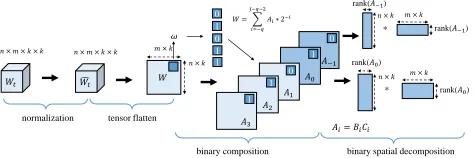
Figure 1: Overall framework illustration of CBDNet.
even automatic search way such as NASNet (Zoph and Le 2016), PNASNet (Liu et al. 2017a). Second, training-time network optimization tries to simplify the pre-defined net-work structures on neural connections (Han et al. 2015; 2016), filter structures (Wen et al. 2016; Li et al. 2017; Liu et al. 2017b), and even weight precisions (Chen et al. 2015; Courbariaux et al. 2016; Rastegari et al. 2016) through regu-larized retraining or fine-tuning or even knowledge distilling (Hinton et al. 2015).Third, deploy-time network optimiza-tiontries to replace heavy/redundant components/structures in pre-trained CNN models with efficient/lightweight ones in a training-free way. Typical works include low-rank de-composition (Denton et al. 2014), spatial dede-composition (Jaderberg et al. 2014), channel decomposition (Zhang et al. 2016) and network decoupling (Guo et al. 2018).
To produce desired outputs, it is obvious that the first two categories of methods require a time-consuming train-ing procedure with full traintrain-ing-set available, while methods of the third category may not require training-set, or in some cases require a small dataset (e.g., 5000 images) to calibrate some parameters. The optimization process can be typically done within dozens of minutes. Therefore, in case that the customers can’t provide training data due to privacy or con-fidential issues, it is of great value when software/hardware vendors help their customers optimize CNN based solutions. It also opens the possibility for on-device learning to com-pression, and online learning with new ingress data. In con-sequence, there is a strong demand for modern deep learn-ing frameworks or hardware (GPU/ASIC/FPGA) vendors to provide deploy-time model optimizing tools.
neu-ral networks (Courbariaux et al. 2015; 2016), which aim for training CNNs with binary weights or even binary activa-tions, attract much more attention due to their high com-pression rate and computing efficiency. However, binary net-works generally suffer much from a long training procedure and non-negligible accuracy drops, when comparing to the full-precision (FP32) counterparts. Many efforts have been spent to alleviate this problem in training-time optimization (Rastegari et al. 2016; Zhou et al. 2016). This paper con-siders the problem from a different perspective via raising the question:is it possible to directly transfer full-precision networks into binary networks at deploy-time in a training-free way?We study this problem, and give a positive answer by proposing a solution named composite binary decompo-sition networks (CBDNet). Figure 1 illustrates the overall framework of the proposed method. The main contributions of this paper are summarized as below:
• We show that full-precision CNN models can be directly transferred into highly parameter and computing efficient multi-bits binary network models in a training-free way by the proposed CBDNet.
• We propose an algorithm to first expand full-precision tensors of each conv-layer with a limited number of nary tensors, and then decompose some conditioned bi-nary tensors into two low-rank bibi-nary tensors. To our best knowledge, we are the first to study the network sparsity and the low-rank decomposition in the binary space.
• We demonstrate the effectiveness of CBDNet on differ-ent classification networks including VGGNet, ResNet, DenseNet as well as detection network SSD300 and se-mantic segmentation network SegNet. This verifies that CBDNet is widely applicable.
Related Work
Binary Neural Networks
Binary neural networks (Courbariaux et al. 2015; 2016; Rastegari et al. 2016) with high compression rate and great computing efficiency, have progressively attracted attentions owing to their great inference performance.
Particularly, BinaryConnect (BNN) (Courbariaux et al. 2015) binarizes weights to+1and−1and substitutes mul-tiplications with additions and subtractions to speed up the computation. As well as binarizing weight values plus one scaling factor for each filter channel, Binary weighted net-works (BWN) (Rastegari et al. 2016) extends it to XNOR-Net with both weights and activations binarized. DoReFaXNOR-Net (Zhou et al. 2016) binarizes not merely weights and acti-vations, but also gradients for the purpose of fast training. However, binary networks are facing the challenge that ac-curacy may drops non-negligibly, especially for very deep models (e.g., ResNet). In spite of the fact that (Hou et al. 2017) directly consider the loss to mitigate possible accu-racy drops to mitigate during binarization, which gain more accurate results than BWN and XNOR-Net, it still has gap to the full-precision counterparts. A novel training procedure named stochastic quantization (Dong et al. 2017) was intro-duced to narrow down such gaps. All these works belongs to the training-time optimization category in summary.
Deploy-time Network Optimization
Deploy-time network optimization tries to replace some heavy CNN structures in pre-trained CNN models with ef-ficient ones in a training-free way. Low-rank decomposition (Denton et al. 2014) exploits low-rank nature within CNN layers, and shows that fully-connected (FC) layers can be ef-ficiently compressed and accelerated with low-rank approx-imations, while conv-layers can not. Spatial decomposition (Jaderberg et al. 2014) factorizes thekh×kwconvolutional
filters into a linear combination of a horizontal filter 1×kw
and a vertical filterkh×1. Channel decomposition (Zhang et
al. 2016) decomposes one conv-layer into two layers, while the first layer has the same filter-size but with less channels, and the second layer uses a 1×1 convolution to mix output of the first one. Network decoupling (Guo et al. 2018) decom-poses the regular convolution into the successive combina-tion of depthwise convolucombina-tion and pointwise convolucombina-tion.
Due to its simplicity, deploy-time optimization has many potential applications for software/hardware vendors as aforementioned. However, it suffers from relatively limited optimization gains (2∼4× in compression/speedup) over original full-precision models.
Binary Network Decomposition
Few existing works like us consider transferring full-precision networks into multi-bits binary networks in a training-free way. Binary weighted decomposition (BWD) (Kamiya et al. 2017) takes each filter as a basic unit as BWN, and expands each filter into a linear combination of binary filters and a FP32 scalar. ABC-Net (Lin et al. 2017) approxi-mates full-precision tensor with a linear combination of mul-tiple binary tensors and FP32 scalar weights during training-procedure to obtain multi-bits binary networks. Our method is quite different to these two works. We further consider the redundance and sparsity in the expanded binary tensors, and try to decompose binary tensors. The decomposition is sim-ilar to spatial decomposition (Jaderberg et al. 2014) but in the binary space. Hence, our binary decomposition step can also be viewed as binary spatial decomposition.
Method
As is known, parameters of each conv-layer in CNNs could be represented as a 4-dimensional (4D) tensor. We take ten-sor as our study target. We first present how to expand full-precision tensors into a limited number of binary tensors. Then we show some binary tensors that fulfill certain condi-tions can be decomposed into two low-rank binary tensors, and propose an algorithm for that purpose.
Tensor Binary Composition
Suppose the weight parameters of a conv-layer are repre-sented by a 4D tensorWt ∈ Rn×k×k×m, wherenis the
number of input channels,mis the number of output chan-nels, andk×kis the convolution kernel size. For each ele-mentw∈Wt, we first normalize it with
˜
w=w/wmax, (1)
wherewmax= maxwi∈Wt{|wi|}. The normalized tensor is
5 6 7 8 J
20 30 40 50 60 70
top-1 accuracy
Resnet-18 DenseNet-121 VGG-16
(a)
5 6 7 8
J 30
40 50 60 70 80 90
top-5 accuracy
Resnet-18 DenseNet-121 VGG-16
(b)
Figure 2: Performance on ImageNet for different networks with binary tensor expansion using differentJ bits. Dashed-line indicates FP32 accuracy. Left is for 1, right is for top-5.
1.00 0.75 0.50 0.25 0.00 0.25 0.50 0.75 1.00 Normalized weights
100
101
102
103
104
105
106
Relative scale [log(count)]
(a)
29 27 25 23 21
quantized value of weights 0.00
0.05 0.10 0.15 0.20
sparse ratio
(b)
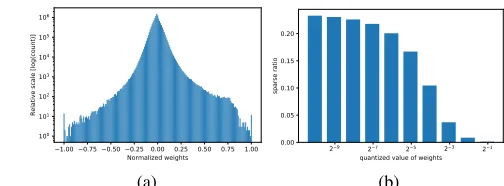
Figure 3: Weight distribution of all conv-layers for ResNet-18. (a) normalized weights, (b) sparse-ratio of each binary quan-tized weight.
within range[−1,1]. For simplicity, we denote the magni-tude ofw˜aswˆ, i.e.,w˜=sign( ˜w) ˆw, wheresign(·)is a sign function which equals to -1 whenw <˜ 0, otherwise 1. And
ˆ
w∈[0,1]can be expressed by the composite of a series of fixed-point basis as
ˆ
w≈XJ−2
i=0 ai∗2
−i
, (2)
where ai ∈ {0,1} is a binary coefficient indicating whether certain power-of-two term is activated or not,i ∈ {0,· · ·, J −2}means totallyJ −1 bits is needed for the representation. When taking the sign bit into consideration,
˜
wrequiresJbits to represent.
Denote the magnitude of the normalized tensor as Wˆ t.
Tensor binary composition is a kind of tensor expansion, when each element of the tensor is binary expanded and ex-pressed by the same bit rateJ as
ˆ
Wt≈
XJ−2
i=0 Ai∗2
−i
, (3)
whereAi∈ {0,1}n×k×k×mis 4D binary tensor.J will
im-pact the approximation accuracy, while largerJ gives more accurate results. We empirically study three different Ima-geNet CNN models. Figure 2 shows thatJ = 7is already sufficiently good to keep a balance between the accuracy and the efficiency of the expansion.
DifferentAimay have different sparsity, which could be further utilized to compress the binary tensor. Figure 3a il-lustrates the distribution of normalized weightsw˜in all the layers of ResNet-18, which looks like a Laplacian distri-bution, where most weight values concentrate in the range
(−0.5,0.5). This suggests that 1 is very rare in some binary tensorAiwith smalleri, since smallericorresponds to big-ger values in the power-of-two expansion. Figure 3b further shows the average sparsity of each binary tensorAi, which also verifies thatAiwith smalleriis much more sparse. Due to the sparsity ofAi, we next perform binary tensor decom-position to further reduce the computation complexity, as in-troduced in the next section.
Binary expansion with α scaling factor The non-saturation direct expansion from FP32 to low-bits will yield non-negligible accuracy loss as shown in (Migacz 2017;
Krishnamoort 2018). A scaling factor is usually introduced and learnt to minimize the loss through an additional cali-bration procedure (Migacz 2017; Krishnamoort 2018). Sim-ilarly, we impose a scaling factorαto Eq.(1) as
˜
w=α∗w/wmax, (4)
whereα ≥ 1 is a parameter to control the range of w˜ ∈ [−α, α]. When the scaling factorαis allowed, the normal-ized weightwˆ∈[0, α]can be expressed with a composite of power-of-two terms as below:
ˆ
w≈XJ−q−2
i=−q ai∗2
−i
, (5)
whereq =dlog2αeandJ also denotes the number bits of the weight, includingJ −1 bits for magnitude and 1 sign bit. The corresponding tensor form can be written as
ˆ
Wαt ≈
XJ−q−2
i=−q Ai∗2
−i
. (6)
Note that the scaling factor α will shift the power-of-two bases from {20,2−1,· · · ,2−J+2} for Eq.(3) to
{2q,· · · ,20,· · · ,2−J+q+2} for Eq.(6). Whenα = 1, we
haveq= dlog2αe= 0, which makes Eq.(6) reduce to the case without scaling factor as in Eq.(3).
Binary Tensor Decomposition
We have shown that some binary tensors Ai are sparse. As sparse operations require specific hardware/software ac-celerators, it is not preferred in many practical usages. In deploy-time network optimization, researches show that full-precision tensor could be factorized into two much smaller and more efficient tensors (Jaderberg et al. 2014; Zhang et al. 2016). Here, we attempt to extend the spatial-decomposition (Jaderberg et al. 2014) to our binary case.
For the simplicity of analysis, we flatten the 4D ten-sor Wˆt ∈ Rn×k×k×m into the weight matrix W ∈ R(n×k)×(k×m), so does for eachAi. Here the matrix height
and width aren×kandk×mrespectively. We then factorize a sparse matrixAinto two smaller matrices as
A=B∗C, (7)
where matrix B ∈ {0,1}(n×k)×c and matrix C ∈
{0,1}c×(k×m). Note that our method is significantly
2017), which keeps B binary, the other full-precision. On the contrary, we keep bothBandCbinary. This decompo-sition has the special meaning in conv-layers. It decomposes a conv-layer withk×kspatial filters into two layers—one layer withk×1spatial filters and the other with1×kspatial filters. Suppose the feature map size ish×w, then the num-ber of operations isn×m×k2×h×wfor matrixA, while the
number of operations reduces to(m+n)×c×k×h×w
for B∗C. We have the following lemma regarding to the difference before and after binary decomposition.
Lemma 1 (1) The computing cost ratio forAoverB∗Cis
n×m×k/c×(m+n). (2) The bit-rate compression ratio fromA
toB∗Cis alson×m×k/c×(m+n). (3)c < n×m×k
(m+n) can yield
real parameter and computing operation reduction.
Binary Matrix Decomposition We first review the prop-erty of matrix rank:
rank(B∗C)≤min{rank(B), rank(C)}. (8)
Comparing with binary matrix factorization methods (Zhang et al. 2007; Miettinen 2010), which tend to minimize certain kind of loss like|A−B ∗C| and find matricesB andC
iteratively, we attempt to decomposeAinto matricesBand
Cwithout any loss whenc≥rank(A)is satisfied.
Theorem 1 If c ≥ rank(A), binary matrix A ∈ {0,1}(n×k)×(k×m)can be losslessly factorized into binary
matricesB∈ {0,1}(n×k)×candC∈ {0,1}c×(k×m).
ProofAccording to the Gaussian elimination method, ma-trix A can be converted to an upper triangular matrix D. Our intuition is to construct matricesB andCthrough the process of Gaussian elimination. Assumen≤m,Piis the transform matrix representing thei-th primary transforma-tion, matrixDcan be expressed as:
D=
k
Y
i=0
Pk−i⊗A, (9)
where⊗is element-wise binary multiply operator so that
A⊗B= (A∗B) mod 2.
For simplicity, we use ∗ instead of ⊗ here. As Pi ∈ {0,1}(n×k)×(n×k)is the permutation transform matrix, the
inverse matrix ofPiexists. Therefore,Acan be decomposed into the following form:
A=
k
Y
i=0
Pi−1∗D (10)
SinceDonly contains value1in the firstrrows wherer=
rank(A),Dcan be decomposed into two matrices:
D=
D1
0
=
I
0
∗
D1 (11)
whereD1∈ {0,1}r×(k×m)is the firstrrows of matrixD, Iis ar×ridentity matrix. Then matrix A can be written as:
A= (
k
Y
i=0
Pi−1∗
I
0
)∗
D1 . (12)
Algorithm 1Binary matrix decomposition
Input:binary matrixAwith sizehA×wA
Output:matrix rankr, matrixB, matrixC(A=B∗C)
1: functionBINARYMATDECOMPOSITION(A)
2: ifhA≤wA then
3: A←AT
4: transpose=T rue
5: end if
6: r←0;
7: B←identity matrixhA×wA
8: forc←1 towAdo
9: l←first raw satisfy the constraints:A[l, c] = 1andl≥r+ 1
10: Reverse rowl&r+ 1,P←corresponding transition matrix
11: r←r+ 1;
12: B←B∗P−1
13: forrow←r+ 1tohAdo
14: ifA[row, c]>0then
15: A[row,:]←(A[r,:] +A[row,:])mod 2
16: P←corresponding transition matrix
17: B←B∗P−1
18: end if
19: end for
20: end for
21: C←firstrrows of A
22: P←firstrrows are identity matrix, otherhA−rrows are zeros.
23: B←B∗P
24: iftransposethen
25: Returnr,CT,BT
26: else
27: Returnr,B,C
28: end if
29: end function
We then obtain the size (n×k)×r matrix B as B =
Qk
i=0P
−1
i ∗
I
0
, and the sizer×(k×m)matrixC as
C=D1exactly without any loss. This procedure also
indi-cates that the minimum bottleneck parametercisrank(A), i.e.,c≥rank(A). This ends the proof.
Based on this proof, we outline the binary matrix de-composition procedure in Algorithm 1. From the proof, we should also point out that the proposed binary decomposi-tion is suitable for both conv-layers and FC-layers. Note that for binary permutation matrixP, its inverse matrixP−1
equals to itself, i.e., P−1 = P. Suppose hA and wA are height and width of matrixA, the computing complexity of
B∗Pis justO(hA)asPis a permutation matrix. The com-puting complexity of Algorithm 1 isO(wA×h2A).
Losslessly Compressible of Ai? Theorem 1 shows that
only whenc ≥ rank(A), our method could produce loss-less binary decomposition, while Lemma 1 shows that only
c < n(×mm+×n)k could yield practical parameter and computing
operations reduction. We have the following corollary:
Corollary 1 Binary matrix A is losslessly compressible
based on Theorem 1 whenrank(A)≤c < n×m×k (m+n).
1 2 3 4 5 6 7 8 9 10 11 12 13 14 15 16 17 18 19 20 21 22 0.0
0.1 0.2 0.3 0.4 0.5 0.6 0.7 0.8
m
ax
ra
nk
(Iw
0
2
)
ra
nk
(Iw
0
1
)
(a)
1 2 3 4 5 6 7 8 9 10 11 12 13 14 15 16 17 18 19 20 21 22 0.0
0.1 0.2 0.3 0.4 0.5 0.6
m
ax
ra
nk
(Iw
0
3
)
ra
nk
(Iw
0
1
)
(b)
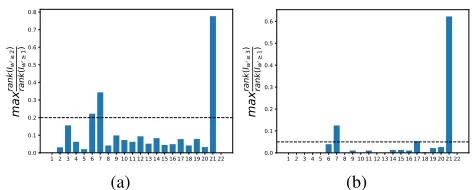
Figure 4: Maximum rank ratio per-layer of ResNet-18.
heuristic cue to estimate which subset of{Ai}could be loss-lessly compressible. According to Figure 3,Aiwith smaller iis more sparse than that with biggeri. Empirically, more sparsity corresponds to smallerrank(Ai). Based on
Theo-rem 1, this pushes us to seek the watershed valuejso that those Ai where i ≤ j are losslessly compressible, while otherAi (i > j) are not. This requires introducing a
vari-able into the definition ofAi, so that we choose theAi de-fined by Eq.(6) rather than Eq.(3). As is known, theAi
se-quence defined by Eq.(6) is{A−q,· · ·, A0,· · · , AJ−q−2}
whereq = dlog2αe. Here, we seek for the optimal α, so thatj = 0is the watershed, i.e., {A−q,· · ·, A0}are
loss-lessly compressible.
For simplicity, we still denote the flatten matrix of the ten-sorWˆ α
t in Eq.(6) asW∈R(n×k)×(k×m). We propose to use
the indicator matrix described below for easy analysis. Definition 1 The indicator matrix of W is defined as
Iw>β ∈ {0,1}(n×k)×(k×m), in which the value at position
(x, y)isIw>β[x, y] =If(W[x, y] > β), whereβ ∈ [0, α]
is a parameter,If(·)is an element-wise indication function,
which equals to 1 when the prediction is true, otherwise 0. Based on this definition,Aiin Eq.(6) can be written as
Ai[x, y] =If(b
W[x, y] + ∆w
2−i c mod 2 = 1), (13) where∆w= 2−J+q+1is the largest throwing-away
power-of-two terms in Eq.(6).
Definew0 = w+ ∆w, according to Eq.(6), the rank of matrixA0can be expressed as:
rank(A0) =rank(
XdnI/2e−1
i=0 I(2i+1)≤w
0<(2i+2))
=rank(XnI i=1Iw
0≥i),
wherenI =dαe. Based on the matrix rank property
rank(A+B)≤rank(A) +rank(B), (14)
we derive the upper bound of therank(Ai)as:
rank(A0)≤
XnI
i=1rank(Iw
0≥i). (15)
The empirical results show that when rank(Iw0≥1) ≤
0.5∗min{n×k, m×k}, and the rank of the indicator matrix satisfies the following constraints:
(1)rank(Iw0≥2)
rank(Iw0≥1) ≤C0,
(2)max{rank(Iw0≥i)
rank(Iw0≥1)} ≤C1,3≤i≤nI.
(16)
Algorithm 2Binary searchαto satisfy rank condition.
Input:weight matrixW, expected rankc
Output:scalar valueα
1: functionSCALARVALUESEARCH(W,c)
2: min←0,max←max number of 1 value in a full rank matrix
3: sortWin a descending order to a vectorv
4: whilemin≤maxdo
5: center←(min+max)/2
6: α←1/v[center]
7: Compute indicator matrixIw≥1
8: Compute rankrofIw≥1
9: ifr > cthen
10: max←center−1
11: else ifr < cthen
12: min←center+ 1
13: else
14: Returnα
15: end if
16: end while
17: Returnα= 1/v[max]
18: end function
With the bound (15), we get the bound of the rank by the indicator matrixIw0≥1:
rank(A0)≤((α−2)+∗C1+C0+ 1)∗rank(Iw0≥1), (17)
where(x)+ equals to xif x > 0, otherwise 0. We make
some empirical study on ResNet-18, and find thatC0≤0.2
in most of the layers as in Figure 4a,C1 ≤0.05in most of
the layers as in Figure 4b, andα≤8in all the layers. Hence, we have a simpler method to estimaterank(A0)by:
rank(A0)≤(4∗0.05 + 0.2 + 1)∗rank(Iw0≥1)
= 1.4∗rank(Iw0≥1).
Therefore, we transfer the optimization ofαto the optimiza-tion ofrank(Iw0≥1).
A binary search algorithm for scaling factor
a
In practice, we may give an expected upper bound c for
rank(Iw≥1), and search the optimalαto satisfy
rank(Iw≥1)≤c. (18)
Asw ∈ [0, α] andα > 1,w ∈ [0,1]only corresponds to
1/αportion of the whole range ofw.
Generally, weight matrix W should be sorted and tra-versed to compute the rank(Iw≥1). Instead of using this
time-consuming method, we propose an efficient solution based on the binary search algorithm.
Suppose that every element in weight matrix W has a unique value, we sort W to be a vector v with length
N = n×m ×k2 in descending order, so that v[1] is
the largest element. Assume index isatisfy the constraint:
v[i] ≥ 1 > v[i+ 1], then the indicator matrix can be ex-pressed as:
Iw≥1=Ip(w)<i+1 (19) wherep(w)is the index position of the elementwin array
v, i.e.,v[p(w)] =w. Hence, there areiones in the indicator matrix while others are zeros. Comparing matrixIp(w)<i+1
with matrixIp(w)<i, we have the property:
Ip(w)<i+1[x, y] =
(
Ip(w)<i[x, y] p(w[x, y])6=i
Model top-1(%) top-5(%)FP32 size-MB top-1(%) CBDNettop-5(%) size-MB Bitrate
ResNet-18 66.41 87.37 44.57 65.27(-1.14) 86.62(-0.75) 7.31 5.25 VGG-16 68.36 88.44 527.7 67.36(-1.00) 87.81(-0.63) 90.3 5.47 DenseNet-121 74.41 92.14 30.11 73.13(-1.28) 91.29(-0.85) 5.38 5.72
Table 1: Performance of different CNNs on ImageNet and CBDNet. Numbers in bracket indicates accuracy drop rela-tive to FP32 models. Last-column lists bitrate of CBDNet.
With the property of Eq.(14), we get the relation between the indicator matrices with adjacent index:
|rank(Ip(w)<i+1)−rank(Ip(w)<i)| ≤1. (21)
This indicates thatrank(Ip(w)<i) are continuous integers.
Hence,i∈[i1, i2]always exists to satisfy below constraints:
rank(Ip(w)<i) =c,
(rank(Ip(w)<i1)−c)∗(rank(Ip(w)<i2)−c)<0.
(22)
Eq.(22) provides the property to design a binary search al-gorithm as outlined in Alal-gorithm 2, which could find the local optimal of α when matrix W has some identical elements. The computing complexity of this algorithm is
O(Nlog(N)), whereN =n×k2×m.
Here,cis a tunable hyper-parameter. In practice, we did not directly givecsince different layers may require differ-ent c. Instead, we assume m ≥ n and defineb = c/n×k
as bottleneck ratio, since we reduce the neuron number from n×k to c by the binary matrix B. Then we tune
b and make it constant over all the layers, while b < 0.5
could provide compression effect. After gettingα, we ob-tainq=dlog2αe, and only do binary decomposition for the subset{A−q,· · · , A0}as they arelosslessly compressible.
Experiments
This section conducts experiments to verify the effective-ness of CBDNet on various ImageNet classification net-works (Russakovsky et al. 2015), as well as object detection network SSD300 (Liu et al. 2016) and semantic segmenta-tion network SegNet (Badrinarayanan et al. 2017).
Classification Networks on ImageNet
The ImageNet dataset contains 1.2 million training images, 100k test images, and 50k validation images. Each image is classified into one of 1000 object categories. The images are cropped to224×224before fed into the networks. We use the validation set for evaluation and report the classification performance via top-1 and top-5 accuracies. Table 1 gives an overall performance of different evaluated networks. Note we decomposed all the conv-layers and FC-layers with the proposed method in this study. The resulted bit-rate is de-fined by32×size(CBDNet)/size(FP32), wheresize(x)
gives the model size of modelx.
Model 1: ResNet-18(He et al. 2016) consists of 21 conv-layers and 1 FC-layer. The top-1/top-5 accuracy of the FP32 model is66.41/87.37in our single center crop evaluation. Figure 5 shows the accuracy and the bit-rate of CBDNet at different bottleneck ratios. The effective bit-rate of CBDNet is 5.25 withb=0.3andJ=7, while the top-1/top-5 accuracy drops by 1.14% and 0.75% respectively.
Model FP32 BWD CBDNet
top-5(%) top-5(%) Bitrate top-5(%) Bitrate
ResNet-152 92.11 90.25(-1.86) 6 91.61(-0.5) 5.37
VGG-16 88.44 86.28(-2.16) 6 87.81(-0.63) 5.47
Table 2: CBDNet vs BWD on ResNet and VGGNet.
Model 2: VGG-16(Simonyan and Zisserman 2015) con-sists of 13 conv-layers and 3 FC-layers. The top-1/top-5 ac-curacy of the FP32 model is68.36/88.44in our single center crop evaluation. Figure 6 shows the accuracy and the bit-rate of CBDNet at different bottleneck ratios. The effective bit-rate of CBDNet is 5.47 withb=0.3andJ=7, while the top-1/top-5 accuracy drops by 1% and 0.63% respectively.
Model 3: DenseNet-121(Huang et al. 2017) consists of 121 layers. The top-1/top-5 accuracy of the FP32 model is
74.41/92.14in our single center crop evaluation. Figure 7 shows the accuracy and the bit-rate of CBDNet at different bottleneck ratios. The effective bit-rate is 5.72 withb= 0.4
andJ = 7, while the top-1/top-5 accuracy drops by 1.28% and 0.85% respectively.
Comparison to State-of-the-art We further compare the accuracy and bit-rate to the prior art binary weighted de-composition (BWD) (Kamiya et al. 2017). Table 2 lists the comparison results on ResNet-152 and VGG-16. Note that, BWD keeps the first conv-layer un-decomposed to ensure no significant accuracy drops, while our CBDNet decomposes all the layers. It shows that our CBDNet achieves much less accuracy drops even with smaller bit-rate.
Detection Networks
We apply CBDNet to the object detection network SSD300 (Liu et al. 2016). The evaluation is performed on the VOC0712 dataset. SSD300 is trained with the combined training set from VOC 2007 trainval and VOC 2012 trainval (“07+12”), and tested on the VOC 2007 test-set. We compare the performance between original SSD300 and our CBDNet. Figure 8a shows the comparison results, in which we also include the composite-only (without binary decomposition) results.
The effective bit-rate of CBDNet is 4.38, with 1.34% drop of the mean Average Precision (mAP). That verifies the ef-fectiveness of our CBDNet on object detection networks.
Semantic Segmentation Networks
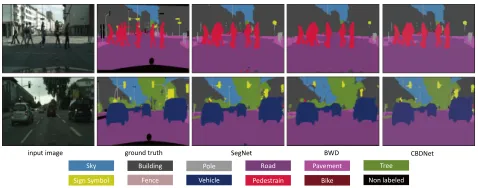
We also perform an evaluation on the semantic segmentation network SegNet (Badrinarayanan et al. 2017). The experi-ment is conducted on the Cityscapes dataset (Cordts et al. 2016) of the 11 class version, for fair comparison to results by (Kamiya et al. 2017). We use the public available SegNet model, and test on the Cityscapes validation set. Figure 8b shows the comparison results, in which the composite-only results are also included.
4.5 5.0 5.5 6.0 6.5
bits
56 58 60 62 64 66
top-1 accuracy b: 0.5 b: 0.4 b: 0.3 b: 0.2
(a)
4.5 5.0 5.5 6.0 6.5
bits
80 81 82 83 84 85 86 87
top-5 accuracy b: 0.5 b: 0.4 b: 0.3 b: 0.2
(b)
Figure 5: CBDNet accuracy on ImageNet for ResNet-18. Dashed-line indicates FP32 accuracy. ‘b’ for bottleneck ratio.
4.5 5.0 5.5 6.0 6.5 7.0
bits
30 40 50 60 70
top-1 accuracy b: 0.5 b: 0.4 b: 0.3 b: 0.2
(a)
4.5 5.0 5.5 6.0 6.5 7.0
bits
50 55 60 65 70 75 80 85 90
top-5 accuracy b: 0.5 b: 0.4 b: 0.3 b: 0.2
(b)
Figure 6: CBDNet accuracy on ImageNet for VGG-16. Dashed-line indicates FP32 accuracy. ‘b’ for bottleneck ratio.
5.0 5.5 6.0 6.5 7.0
bits
60 62 64 66 68 70 72 74
top-1 accuracy b: 0.5 b: 0.4 b: 0.3 b: 0.2
(a)
5.0 5.5 6.0 6.5 7.0
bits
84 86 88 90 92
top-5 accuracy b: 0.5 b: 0.4 b: 0.3 b: 0.2
(b)
Figure 7: CBDNet accuracy on ImageNet for DenseNet-121. Dashed-line indicates FP32 accuracy. ‘b’ for bottleneck ratio.
3 4 5 6 7 8
bits
0 10 20 30 40 50 60 70 80
mAP
original SSD300 SSD300 Composite J-bits SSD300 with CBDNet
(a)
3 4 5 6 7
bits
10 20 30 40 50 60
mIOU
original SegNet SegNet Composite J-bits SegNet with CBDNet
(b)
Figure 8: Accuracy comparison on (a) SSD300 and (b) Seg-Net.
Sky
Fence Vehicle Pedestrain Bike Non labeled Tree Road
Pole Building Sign Symbol
Pavement
input image ground truth SegNet BWD CBDNet
Figure 9: Semantic segmentation results on CityScapes. CBDNet is better than BWD on “sign” and “pole”.
from ground truth, SegNet, BWD, and our CBDNet. It is ob-vious that our CBDNet gives better results than BWD. That verifies the effectiveness of our CBDNet on semantic seg-mentation networks.
Inference Speed with CBDNet
We make the inference speed comparison between CBD-Net and the FP32 version on Intel Core i7-6700 CPU with 32GB RAM. We optimize one conv-layer of VGG-16 us-ing SSE4.2 instructions (128-bit SIMD) for both the FP32 version and our CBDNet version. For CBDNet, we quan-tize the input into 8-bits using the TensorFlow quanquan-tizer (Kr-ishnamoort 2018), and then perform bitwise operations. We project results in this layer to the whole network based on operation numbers per-layer, and show that our CBDNet is about 4.02×faster than the FP32 counterpart. In
compar-ison, BWD only gives 2.07×speedup over the FP32 ver-sion with SSE4.2 optimization, under 6-bits weight quanti-zation. This clearly demonstrates our advantage over BWD (Kamiya et al. 2017). We believe specific designed hardware with dedicated bitwise accelerators could realize ultra effi-cient inference for our CBDNet.
Conclusion
This paper proposes composite binary decomposition net-works (CBDNet), which can directly transfer pre-trained full-precision CNN models into multi-bits binary network models in a training-free way, while remain model accuracy and computing efficiency. The method contains two steps, composite real-valued tensors into a limited number of bi-nary tensors, and decomposing certain conditioned bibi-nary tensors into two low-rank tensors for parameter and comput-ing efficiency. Experiments demonstrate the effectiveness of the proposed method on various classification networks like ResNet, DenseNet, VGGNet, as well as object detection net-work SSD300, and semantic segmentation netnet-work SegNet.
References
Badrinarayanan, V.; Kendall, A.; Cipolla, R.; et al. 2017. SegNet: A deep convolutional encoder-decoder architecture for image segmentation.IEEE Trans PAMI39.
Chen, W.; Wilson, J.; S, T.; et al. 2015. Compressing neural networks with the hashing trick. InICML.
Cordts, M.; Omran, M.; Ramos, S.; et al. 2016. The cityscapes dataset for semantic urban scene understanding. InCVPR.
Courbariaux, M.; Bengio, Y.; David, J.-P.; et al. 2015. Binaryconnect: Training deep neural networks with binary weights during propagations. InNIPS.
Courbariaux, M.; Bengio, Y.; David, J.-P.; et al. 2016. Bina-rynet: Training deep neural networks with weights and acti-vations constrained to+ 1 or-1. InICLR.
Denton, E.; Zaremba; Lecun, Y.; et al. 2014. Exploiting linear structure within convolutional networks for efficient evaluation. InNIPS.
Dong, Y.; Ni, R.; Li, J.; et al. 2017. Learning accurate low-bit deep neural networks with stochastic quantization. In BMVC.
Girshick, R.; Donahue, J.; Darrell, T.; et al. 2014. Rich fea-ture hierarchies for accurate object detection and semantic segmentation. InCVPR.
Guo, J.; Li, Y.; Lin, W.; et al. 2018. Network decou-pling: From regular to depthwise separable convolutions. In BMVC.
Han, S.; Pool, J.; Tran, J.; Dally, W.; et al. 2015. Learning both weights and connections for efficient neural network. InNIPS.
Han, S.; Mao, H.; Dally, W. J.; et al. 2016. Deep com-pression: Compressing deep neural network with pruning, trained quantization and huffman coding. InICLR.
He, K.; Zhang, X.; Ren, S.; and Sun, J. 2016. Deep residual learning for image recognition. InCVPR.
Hinton, G.; Vinyals, O.; Dean, J.; et al. 2015. Distill-ing the knowledge in a neural network. arXiv preprint arXiv:1503.02531.
Hou, L.; Yao, Q.; Kwok, J. T.; et al. 2017. Loss-aware binarization of deep networks. InICLR.
Howard, A. G.; Zhu, M.; Chen, B.; et al. 2017. Mobilenets: Efficient convolutional neural networks for mobile vision applications.arXiv preprint arXiv:1704.04861.
Huang, G.; Liu, Z.; Weinberger, K. Q.; et al. 2017. Densely connected convolutional networks. InCVPR.
Jaderberg, M.; Vedaldi, A.; Zisserman, A.; et al. 2014. Speeding up convolutional neural networks with low rank expansions. InBMVC.
Kamiya, R.; Yamashita, T.; Ambai, M.; et al. 2017. Binary-decomposed dcnn for accelerating computation and com-pressing model without retraining. InICCV Workshop. Krishnamoort, R. 2018. Quantizing deep convolutional net-works for efficient inference: A whitepaper. arXiv preprint arXiv:1805.07941.
Krizhevsky, A.; Sutskever, I.; Hinton, G. E.; et al. 2012. Imagenet classification with deep convolutional neural net-works. InNIPS.
Li, H.; Kadav, A.; I, D.; et al. 2017. Pruning filters for efficient convnets. InICLR.
Lin, X.; Zhao, C.; Pan, W.; et al. 2017. Towards accurate binary convolutional neural network. InNIPS.
Liu, W.; Anguelov, D.; Erhan, D.; et al. 2016. SSD: Single shot multibox detector. InECCV.
Liu, C.; Zoph, B.; Neumann, M.; et al. 2017a. Pro-gressive neural architecture search. arXiv preprint arXiv:1712.00559.
Liu, Z.; Li, J.; Shen, Z.; et al. 2017b. Learning efficient con-volutional networks through network slimming. InICCV. Long, J.; Shelhamer, E.; Darrell, T.; et al. 2015. Fully con-volutional networks for semantic segmentation. InCVPR. Miettinen, P. 2010. Sparse boolean matrix factorizations. In ICDM.
Migacz, S. 2017. 8-bit inference with TensorRT. Technical report, NVidia.
Rastegari, M.; Ordonez, V.; Redmon, J.; and Farhadi, A. 2016. XNOR-Net: Imagenet classification using binary con-volutional neural networks. InECCV.
Ren, S.; He, K.; Girshick, R.; and Sun, J. 2015. Faster R-CNN: Towards real-time object detection with region pro-posal networks. InNIPS.
Russakovsky, O.; Deng, J.; Su, H.; Krause, J.; et al. 2015. ImageNet Large Scale Visual Recognition Challenge. IJCV 115(3).
Shen, Z.; Liu, Z.; Li, J.; et al. 2017. DSOD: Learning deeply supervised object detectors from scratch. InICCV.
Simonyan, K., and Zisserman, A. 2015. Very deep convolu-tional networks for large-scale image recognition. InICLR. Szegedy, C.; Liu, W.; Jia, Y.; et al. 2015. Going deeper with convolutions. InCVPR.
Wen, W.; Wu, C.; Wang, Y.; et al. 2016. Learning structured sparsity in deep neural networks. InNIPS.
Zhang, Z.; Li, T.; Ding, C.; and Zhang, X. 2007. Binary matrix factorization with applications. InICDM.
Zhang, X.; Zou, J.; Sun, J.; et al. 2016. Accelerating very deep convolutional networks for classification and detection. IEEE Trans PAMI38(10).
Zhang, T.; Qi, G.; Wang, J.; et al. 2017. Interleaved group convolutions. InICCV.
Zhang, X.; Zhou, X.; Sun, J.; et al. 2018. Shufflenet: An extremely efficient convolutional neural network for mobile devices. InCVPR.