The Thirty-Third AAAI Conference on Artificial Intelligence (AAAI-19)
Exploiting Coarse-to-Fine Task Transfer
for Aspect-Level Sentiment Classification
∗Zheng Li,
1Ying Wei,
2Yu Zhang,
1Xiang Zhang,
1Xin Li
3 1Hong Kong University of Science and Technology, Hong Kong2Tencent AI Lab, Shenzhen, China
3The Chinese University of Hong Kong, Hong Kong
[email protected], [email protected], [email protected], [email protected], [email protected]
Abstract
Aspect-level sentiment classification (ASC) aims at identify-ing sentiment polarities towards aspects in a sentence, where the aspect can behave as a general Aspect Category (AC) or a specificAspect Term(AT). However, due to the espe-cially expensive and labor-intensive labeling, existing pub-lic corpora in AT-level are all relatively small. Meanwhile, most of the previous methods rely on complicated structures with given scarce data, which largely limits the efficacy of the neural models. In this paper, we exploit a new direction namedcoarse-to-fine task transfer, which aims to leverage knowledge learned from a rich-resource source domain of the coarse-grained AC task, which is more easily accessible, to improve the learning in a low-resource target domain of the fine-grained AT task. To resolve both the aspect granular-ity inconsistency and feature mismatch between domains, we propose a Multi-Granularity Alignment Network (MGAN). In MGAN, a novel Coarse2Fine attention guided by an aux-iliary task can help the AC task modeling at the same fine-grained level with the AT task. To alleviate the feature false alignment, a contrastive feature alignment method is adopted to align aspect-specific feature representations semantically. In addition, a large-scale multi-domain dataset for the AC task is provided. Empirically, extensive experiments demon-strate the effectiveness of the MGAN.
Introduction
Aspect-level sentiment classification (ASC) aims to infer sentiment polarities over aspect categories (AC) or aspect terms (AT) distributed in sentences (Pang, Lee, and others 2008; Liu 2012). An aspect category implicitly appears in the sentence, which describes a general category of the enti-ties. For example, in the sentence “The salmon is tasty while the waiter is very rude”, the user speaks positively and nega-tively towards two aspect categories“food”and“service”, respectively. An aspect term characterizes a specific entity that explicitly occurs in the sentence. Considering the same sentence “Thesalmonis tasty while thewaiteris very rude”, the aspect terms are “salmon” and “waiter”, and the user expresses positive and negative sentiments over them,
re-∗
This work is supported by Hong Kong CERG grants (16209715 and 16244616), and NSFC (61473087 and 61673202). Copyright c2019, Association for the Advancement of Artificial Intelligence (www.aaai.org). All rights reserved.
spectively. In terms of the aspect granularity, the AC task is coarse-grained while the AT task is fine-grained.
To model aspect-oriented sentiment analysis, equipping Recurrent Neural Networks (RNNs) with the attention mechanism has become a mainstream approach (Tang et al. 2015; Wang et al. 2016; Ma et al. 2017; Chen et al. 2017), where RNNs aim to capture sequential patterns and the attention mechanism is to emphasize appropriate context features for encoding aspect-specific representations. Typi-cally, attention-based RNN models can achieve good per-formance only when large corpora are available. However, AT-level datasets require the aspect terms to be comprehen-sively manually labeled or extracted by sequence labeling algorithms from the sentences, which is especially costly to obtain. Thus, existing public AT-level datasets are all rela-tively small, which limits the potential of neural models.
Nonetheless, we observe that plentiful AC-level corpora are more easily accessible. This is because that aspect cate-gories are usually in a small set of general aspects that can be pdefined. For example, commercial services such as re-view sites or social media can define a set of valuable aspect categories towards products or events in a particular domain (e.g., “food”, “service”, “speed”, and “price” in the Restau-rantdomain). As a result, the mass collections of user pref-erences towards different aspect categories become practica-ble. Motivated by this observation, we propose a new prob-lem namedcoarse-to-fine task transferacross both domain and granularity, with the aim of borrowing knowledge from an abundant source domain of the coarse-grained AC task to a small-scale target domain of the fine-grained AT task.
aspect term “mouse” in the targetLaptopdomain.
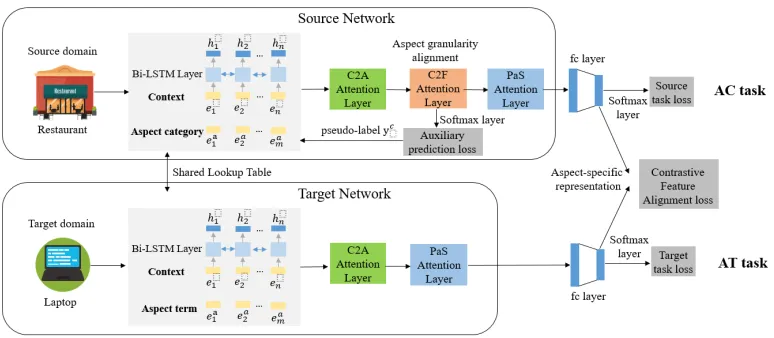
To resolve the challenges, we propose a novel framework namedMulti-GranularityAlignmentNetwork (MGAN) to simultaneously align aspect granularity and aspect-specific feature representations across domains. Specifically, the MGAN consists of two networks for learning aspect-specific representations for the two domains, respectively. First, to reduce the task discrepancy between domains, i.e., model-ing the two tasks at the same fine-grained level, we pro-pose a novel Coarse2Fine (C2F) attention module to help the source task automatically capture the corresponding as-pect term in the context towards the given asas-pect category (e.g., “salmon” to the “food”). Without any additional label-ing, the C2F attention module can learn the coarse-to-fine process by an auxiliary task. Actually, more specific aspect terms and their position information are most directly perti-nent to the expression of sentiment. The C2F module makes up these missing information for the source task, which ef-fectively reduces the aspect granularity gap between tasks and facilitates the subsequent feature alignment.
Second, considering that a sentence may contain multiple aspects with different sentiments, thus capturing incorrect sentiment features towards the aspect can mislead feature alignment. To prevent false alignment, we adopt the Con-trastive Feature Alignment (CFA) (Motiian et al. 2017) to semantically align aspect-specific representations. The CFA considers both semantic alignment by maximally ensuring the equivalent distributions from different domains but the same class, and semantic separation by guaranteeing distri-butions from both different classes and domains to be as dis-similar as possible. Moreover, we build a large-scale multi-domain dataset named YelpAspect with 100K samples for each domain to serve as highly beneficial source domains. Empirically, extensive experiments demonstrate that the pro-posed MGAN model can achieve superior performances on two AT-level datasets from SemEval‘14 ABSA challenge and an ungrammatical AT-level twitter dataset.
Our contributions of this paper are four-fold: (1) to the best of our knowledge, a novel transfer setting cross both do-main and granularity is first proposed for aspect-level senti-ment analysis; (2) a new large-scale, multi-domain AC-level dataset is constructed; (3) the novel Coarse2Fine attention is proposed to effectively reduce the aspect granularity gap between tasks; (4) empirical studies verify the effectiveness of the proposed model on three AT-level benchmarks.
Related Work
Traditional supervised learning algorithms highly depend on extensive handcrafted features to solve aspect-level sen-timent classification (Jiang et al. 2011; Kiritchenko et al. 2014). These models fail to capture semantic relatedness be-tween the aspect and its context. To overcome this issue, the attention mechanism, which has been successfully ap-plied in many NLP tasks (Bahdanau, Cho, and Bengio 2014; Sukhbaatar et al. 2015; Yang et al. 2016; Shen et al. 2017), can help the model explicitly capture intrinsic aspect-context association (Tang et al. 2015; Tang, Qin, and Liu 2016; Wang et al. 2016; Ma et al. 2017; Chen et al. 2017; Ma, Peng, and Cambria 2018; Li et al. 2018a). However,
most of these methods highly rely on data-driven RNNs or tailor-made structures to deal with complicated cases, which requires substantial AT-level data to train effective neural models. Different from them, the proposed model can highly benefit from useful knowledge learned from a related abun-dant domain of the AC-level task.
Existing domain adaptation tasks for sentiment analysis focus on traditional sentiment classification without consid-ering the aspect (Blitzer, Dredze, and Pereira 2007; Pan et al. 2010; Glorot, Bordes, and Bengio 2011; Chen et al. 2012; Bollegala, Weir, and Carroll 2013; Yu and Jiang 2016; Li et al. 2017; 2018b). In terms of data scarcity and the value of task, transfer learning is more urgent for aspect-level sentiment analysis that characterizes users‘ different preferences. To the best of our knowledge, only a few stud-ies have explored to transfer from a single aspect category to another in a same domain based on adversarial train-ing (Zhang, Barzilay, and Jaakkola 2017). Different from that, we explore a motivated and challenging setting which aims to transfer cross both aspect granularity and domain.
Multi-Granularity Alignment Network
In this section, we introduce the proposed MGAN model. We first present the problem definition and notations, fol-lowed by an overview of the model. Then we detail the model with each components.
Problem Definition and Notations
Coarse-to-fine task transfer Suppose that we have suf-ficient AC-level labeled data Xs={(xsk,ask), ysk}Nk=1s in a source domainDs, whereyksis the sentiment label for the
k-th sentence-aspect pair (xsk,ask). Besides, only a small amount of AT-level labeled dataXt={(xtk0,atk0), ytk0}
Nt
k0=1is available in a target domainDt. Note that each source aspect as
kbelongs to a set of pre-defined aspect categoriesCwhile
each target aspectat
k0 is a sub-sequence ofxtk0, i.e., aspect term. The goal of this task is to learn an accurate classifier to predict the sentiment polarity of target testing data.
An Overview of the MGAN model
Figure 1: The architecture of the Multi-Granularity Alignment Network (MGAN) model.
Moreover, we build a Coarse2Fine (C2F) attention upon the C2A module to specifically model the source aspect be-fore feeding to the PaS module. The C2F module uses the source aspect representation to attend corresponding aspect terms in the context and then the attended context features is conversely predicted the category of the source aspect (pseudo-label). After obtaining aspect-specific representa-tions, the knowledge transfer between the two tasks is via the contrastive feature alignment. In summary, the source network acts as a “teacher”, which consists of three-level attention hops (C2A+C2F+PaS) for the AC task, while the target network is like a “student” that only uses two basic attention hops (C2A+PaS) for the AT task. In the following sections, we introduce each component of MGAN in details.
Bi-directional LSTM layer
Given a sentence-aspect pair (x, a) from the source or target domain, we assume that the sentence consists of n words, i.e., x={w1, w2, ..., wn}, and the aspect
con-tains m words, i.e., a={wa
1, wa2, ..., wam}. Then we map
them into its embedding vectors e={ei}in=1∈Rn×dw and ea={eaj}jm=1∈Rm×dwrespectively. To capture phrase-level
sentiment features in the context (e.g., “not satisfactory”), we employ a Bi-directional LSTM (Bi-LSTM) to preserve the contextual information for each word of the input sen-tence. The Bi-LSTM transforms the input einto the con-textualized word representationsh={hi}
n i=1∈R
n×2dh (i.e.
hidden states of Bi-LSTM). For simplicity, we denote the operation of an LSTM unit onei as LSTM(ei). Thus, the
contextualized word representationhi∈R2dh is obtained as
hi= [
−−−−→ LSTM(ei);
←−−−−
LSTM(ei)], i∈[1, n], (1)
where “;” denotes the vector concatenation.
Context2Aspect (C2A) Attention
Not all aspect words contribute equally to the semantic of the aspect. For example, in the aspect term “techs at HP”, the sentiment is usually expressed over the headword “techs” but seldom over modifiers like the brand name “HP”. Thus,
“techs” is more important than “at” and “HP”. This also ap-plies to the aspect category (e.g., “food seafood fish”). Thus, we propose the Context2Aspect (C2A) attention to measure the importance of the aspect words with regards to each con-text word. Formally, we calculate a pair-wise alignment ma-trixM∈Rn×mbetween the context and the aspect, where
the alignment scoreM(i, j)between thei-th context word and thej-th aspect word is obtained as
M(i, j) = tanh(Wa[hi;eaj] +ba), (2)
whereWaandbaare learnable parameters. Then, we apply
a row-wise softmax function to get probability distributions in each row. By definingδ(i)∈Rmas the individual
aspect-level attention given thei-th context word, we average all theδ(i)’s to get the C2A attention asα=1
n Pn
i=1δ(i). The C2A attention further contributes the context-aware aspect representation byha
∗=
Pm
j=1αjeaj, where∗ ∈ {s, t}denotes
the source or target domain. We tackle the aspect represen-tationha
∗for the two tasks differently, wherehasis fed to the
C2F module whileha
t is directly fed to the PaS module.
Coarse2Fine (C2F) Attention
Aspect terms, which act as the true “opinion entity”, are the most directly pertinent to the expression of sentiment. How-ever, source task concerns with coarse-grained aspect cate-gories that lack of detailed position information in the con-text. We wish to achieve task alignment such that the tar-get task can leverage more useful knowledge learned from the source task at the same fine-grained level. It is observed that the number of source aspects is much smaller and many instances contain same aspect category, but the underlying entities can behave diversely in different contexts. For ex-ample, the aspect category “food seafood fish” can be in-stantiated as “salmon”, “tuna”, “taste” and etc.
but also as a pseudo-label (category of the aspect)yc, where c∈CandCis a set of aspect categories. We utilize the ob-tained aspect representationha
s forasto attend the context
and then the induced attention scores aggregate the context information to conversely predict the pseudo category label ofasitself. If the context contains the aspect term correlated
closely to the source aspect, then the attention mechanism can emphasize it for better prediction. We denote this mech-anism as Coarse2Fine attention, which is calculated as:
zif= (uf) T
tanh(Wf[hi;has] +bf), (3)
βif=
exp(zfi)
Pn
i0=1exp(zfi0)
, (4)
va=
n
X
i=1
βifhi, (5)
whereWf∈Rdu×(2dh+de),b
f∈Rdu andu
f∈Rdu are the
weights of the layer. We feed the attended representationva
to asoftmax layer for the auxiliary task prediction, which is trained by minimizing the cross-entropy loss between the predicted pseudo-labelyˆc
kand its ground-truthyckas:
Laux=−
1 Ns Ns X k=1 X c∈C ykclog ˆy
c
k. (6)
However, there may not exist corresponding aspect term when the context implicitly expresses a sentiment toward the aspect category. To overcome this issue, similar to the gate mechanism in RNN variants (Jozefowicz, Zaremba, and Sutskever 2015), we adopt a fusion gateFto adaptively con-trols the passed proportions ofha
s andva towards a more
specific source aspect representationra s:
F= sigmoid(W[va;has]+b), (7)
ras=Fh a
s+ (1−F)W 0
va, (8)
whereW∈Rde×(de+2dh)andb∈
Rdeare the weights of the
gate, W0∈Rde×2dh performs dimension reduction, and
denotes element-wise multiplication.
Position-aware Sentiment (PaS) Attention
Following an important observation found in (Tang, Qin, and Liu 2016; Chen et al. 2017) that a closer sentiment word is more likely to be the actual modifier of the aspect term (e.g., in “great food but the service is dreadful”, “great” is more closer to “food” than “service”), we take the position infor-mation of the aspect term into consideration for designing the PaS attention. For the target domain, we adopt a proxim-ity strategy to calculate the target position relevance between thei-th context word and aspect term as follows:
pti=
1−m0−i
n i < m0
0 m0≤i≤m0+m
1−i−(m0+m)
n i > m0+m
, (9)
wherem0is the index of the first aspect word,nandmare the length of the sentence and aspect, respectively.
Unfortunately, in the source domain where aspect cate-gory is given, the exact position of the corresponding aspect term is not directly accessible. Instead, the C2F attention vectorβf ∈Rn, indicating the probability of each context
word being an aspect term, can help establish the position
relevance. We first define a location matrixL∈Rn×nto
rep-resent the proximity of each word in the sentence:
Lii0= 1−|i−i 0
| n , i, i
0
∈[1, n]. (10)
Then we calculate the source position relevance for i -th context word wi-th -the aid of C2F attention weights by psi =Liβf. Obviously, thei-th context word closer to a
pos-sible aspect term with a large value inβf will have a larger
position relevanceps
i. Finally, the PaS attention is calculated
by a general form for both domains:
zoi= (uo)Ttanh(Wo[hi;ra∗] +bo), (11)
γio=
exp(p∗iz o i)
Pn
i0=1exp(p∗i0zoi0)
, (12)
vo=
n
X
i=1
γiohi, (13)
wherep∗i is the position relevance andra∗ is the input as-pect representation, with ∗ ∈ {s, t} denoting the source or target domain (note thatrat =hat). Then we pass the
aspect-specific representation vo to a fully-connected layer and
asoftmax layer for sentiment classification. The sentiment classification tasks for both domain are trained by minimiz-ing two cross-entropy lossesLs
senandLtsen, respectively.
Contrastive Feature Alignment
After obtaining aspect-specific representations of two do-mains at the same granularity, we would further bridge the distribution gap across domains. The prevalent unsu-pervised domain adaptation methods (Gretton et al. 2007; Ganin et al. 2016) require enormous unlabeled target data to achieve satisfactory performances, which is impractical in our problem where collecting unlabeled data needs labor-intensive annotations of all aspect terms in the sentences. Therefore, inspired by (Motiian et al. 2017), we perform Contrastive Feature Alignment (CFA) by fully utilizing the limited target labeled data to semantically align representa-tions across domains. Mathematically, we parameterize the two networks bygsandgt, and denote the probability
dis-tribution by P. Specifically, the CFA consisits of semantic
alignment (SA) and semantic separation (SS). The SA aims to ensure identical distributions of feature representations
P(gs(Xs))andP(gt(Xt))conditioned on different domains
but the same class, while the SS further alleviates false align-ment by guaranteeing P(gs(Xs))and P(gt(Xt)) to be as
dissimilar as possible conditioned on both different domains and classes. Considering that only a small amount of target labeled data is available, we revert the CFA characterizing distributions with enough data to pair-wise surrogates as:
Lcf a= X
k,k0
ω(gs(xsk,a s
k), gt(xtk0,atk0)), (14)
whereω(·,·)is a contrastive function that performs semantic alignment or separation in terms of supervised information from both domains. Formally,ω(·,·)is defined as:
ω(u,v) =
ku−vk2
if ys k=ytk0,
max(0, D−ku−vk2)
if ys k6=ytk0,
(15)
Alternating Training
Combining the losses we introduced before together with a`2 regularization, we constitute the overall losses for the source and target networks as:
Lsrc = Lssen+Laux+λLcf a+ρLsreg, (16)
Ltar = Ltsen+λLcf a+ρLtreg, (17)
whereλ, ρbalance the effect of the CFA loss and the`2 reg-ularization loss, respectively. The source network has one more auxiliary lossLaux compared with the target one to
achieve task alignment. The whole training procedure con-sists of two stages: (1) To prevent early overfitting of the target domain, the source networkSis individually trained on the source domain by optimizingLs
sen+Laux+ρLsreg.
Then, S and the BiLSTM, C2A, and PaS modules of S are used to initialize the source and target networks of the MGAN, respectively. (2) We alternately optimizeLsrcfor
the source network andLtarfor the target network.
Experiments
Datasets
Source: AC-level We build a large-scale, multi-domain dataset namedYelpAspectas source domains, which is ob-tained similarly as the Yelp recommendation dataset (Bau-man, Liu, and Tuzhilin 2017). Specifically, YelpAspect con-tains three domains: Restaurant (R1), Beautyspa (B), and Hotel (H). The statistics of the YelpAspect dataset are sum-marized in Table 1. Yelp reviews are collected in US cities over six years. Aspect categories and sentiment labels are identified by the “industrial-strength” Opinion Parser (OP) system (Qiu et al. 2011; Liu 2015). To be consistent with the target domain datasets, YelpAspect is preprocessed in the sentence level by OP, while the dataset in (Bauman, Liu, and Tuzhilin 2017) is in the document level. More-over, we manually double-check to correct wrong annota-tions produced by OP system and purposely select more negation, contrastive and question instances to make it more challenging. The dataset is available at https://github.com/ hsqmlzno1/MGAN.
Source domain #Pos #Neu #Neg #Asp
Restaurant (R1) Train 46,315 45,815 16,020 68 Test 5,207 4,944 1,743
Beautyspa (B) Train 45,770 42,580 16,023 45 Test 5,056 4,793 1,823
Hotel (H) Train 40,775 36,901 20,864 44 Test 4,418 4,048 2,450
Table 1: The YelpAspect dataset. #Asp denotes the number of aspect categories.
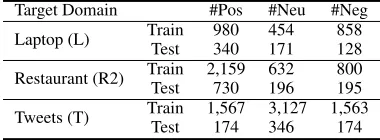
Target: AT-level For target domains, we use three public benchmark datasets: Laptop (L), Restaurant (R2) and Twit-ter (T). The Laptop and Restaurant are from SemEval’14 ABSA challenge (Kiritchenko et al. 2014) by removing a few examples which have “conflict labels” as done in (Chen et al. 2017). The Twitter dataset is collected by (Dong et al. 2014), containing ungrammatical twitter posts. Table 2 sum-marizes the statistics of the target domain datasets.
Target Domain #Pos #Neu #Neg
Laptop (L) Train 980 454 858 Test 340 171 128
Restaurant (R2) Train 2,159 632 800 Test 730 196 195
Tweets (T) Train 1,567 3,127 1,563 Test 174 346 174
Table 2: Statistics of the target domain datasets.
Experimental Setup
To evaluate our proposed method, we construct eight coarse-to-fine transfer tasks: R1→L, H→L, B→L, H→R2, B→R2, R1→T, H→T, B→T, where we do not use the pair (R1, R2) as they come from the same domain. For each transfer pair Ds→Dt, the training data from domainDs and randomly
sampled 90% training data from domain Dt are used for
training, the rest 10% training data fromDtis used for
vali-dation, and the testing data fromDtis used for testing.
Eval-uation metrics are Accuracy and Macro-Average F1, where the latter is more suitable for imbalanced datasets.
Implementation Details
The word embeddings are initialized with 200-dimension GloVE vectors (Pennington, Socher, and Manning 2014) and fine-tuned during the training. de, dh, du are set to be
200, 150 and 100, respectively. The fc layer size is 300. The Adam (Kingma and Ba 2014) is used as the optimizer with the initial learning rate10−4. Gradients with the `2 norm larger than 40 are normalized to be 40. All weights in net-works are randomly initialized from a uniform distribution U(−0.01,0.01). The batch sizes are 64 and 32 for source and target domains, respectively. The control-off factorsλ,ρ are set to be 0.1 and10−6. To alleviate overfitting, we apply dropout on the word embeddings of the context with dropout rate 0.5. We also perform early stopping on the validation set during the training process. The hyperparameters are tuned on 10% randomly held-out training data of the target domain in R1→L task and are fixed to be used in all transfer pairs.
Baseline Methods
The baseline methods are divided into two groups:
Non-TransferTo demonstrate the benefits from coarse-to-fine task transfer, we compare with the following state-of-the-art AT-level methods without transfer:
• TD-LSTM(Tang et al. 2015): It employs two LSTMs to model the left and right contexts of the aspect and then concatenates the context representations for prediction. • AE-LSTM, andATAE-LSTM (Wang et al. 2016):
AE-LSTM is a simple AE-LSTM model incorporating the aspect embedding as input, while ATLSTM extends AE-LSTM with the attention mechanism.
• MemNet(Tang, Qin, and Liu 2016): it applies a memory network with multi-hops attentions and predicts sentiment based on the top-most context representations.
Model L R2 T
Acc Macro-F1 Acc Macro-F1 Acc Macro-F1
Baselines
AE-LSTM (Wang et al. 2016) 68.97 62.50 76.25 64.32 69.42 56.28 ATAE-LSTM (Wang et al. 2016) 68.65 62.45 77.23 64.95 69.58 56.72 TD-LSTM (Tang et al. 2015) 68.18 62.28 75.63 64.16 66.62 64.01
IAN (Ma et al. 2017) 72.10 - 78.60 - -
-MemNet (Tang, Qin, and Liu 2016) 70.33 64.09 78.16 65.83 68.50 66.91 RAM (Chen et al. 2017) 72.08 68.43 78.48 68.54 69.36 67.30 Base Model TN 70.58 65.34 77.91 65.75 71.68 71.02
Average results over each target domain
Ablated Models MGAN w/o PI 72.98 67.71 78.99 66.41 72.88 71.57
MGAN w/o C2F 74.80 69.63 80.46 67.86 73.53 72.37
Full Model MGAN 76.21†‡ 71.42†‡ 81.49†‡ 71.48†‡ 74.62†‡ 73.53†‡
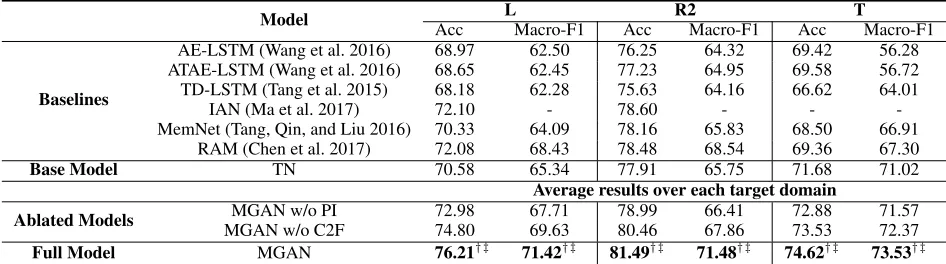
Table 3: Experimental results (%). The marker† refers top-value<0.05 when comparing with MGAN w/o C2F , while the marker‡refers top-value<0.05 when comparing with RAM.
• RAM(Chen et al. 2017): It employs multiple attentions with a GRU cell to non-linearly combine the aggregation of word features in each layer.
• Target Network (TN): It is our proposed base model (BiLSTM+C2A+Pas) trained onDtfor the target task.
For IAN, we report the results in the original paper and use the source codes of other methods for experiments.
Transfer To investigate the effectiveness of the CFA , we also compare the following transfer methods:
• Source-only (SO): It uses a source network trained onDs
to initialize a target network and then tests it onDt.
• Fine-tuning (FT): It advances SO with further fine-tuning the target network onDt.
• M-DAN: It is a multi-adversarial version of Domain Ad-versarial Network (DAN) (Ganin et al. 2016) based on multiple domain discriminators. All discriminators are built upon the PaS layers of the two networks, each of which aligns one class distribution between domains. • M-MMD: Similar with M-DAN, M-MMD aligns
differ-ent class distributions between domains based on multi-ple Maximum Mean Discrepancy (MMD) (Gretton et al. 2007). For each MMD, following the (Bousmalis et al. 2016), we use a linear combination of 19 RBF kernels with the width parameters ranging from10−6to106. The original DAN and MMD are unsupervised domain adaptation methods. Thus, for fair comparison, we use the source code of DAN and MMD, and extend them to M-DAN and M-MMD that utilize target supervised information and have higher performances, respectively.
Result Analysis
Comparison with Non-TransferNote that we are the first to explore transfer techniques and achieve the best perfor-mances in this task. Thus, it is necessary to show our im-provements over current superior non-transfer methods. The classification results are shown in Table 3. The results of our full model and its ablations are calculated by averaging over each target domain among eight transfer pairs (e.g., R2 is ob-tained by averaging over H→R2 and B→R2). Based on the
Acc
SO FT M-DAN M-MMD MGAN w/o SS MGAN Macro-F1
R1→L 69.80 74.80 75.74 75.90 77.00 77.62 67.05 69.84 71.13 70.95 71.31 72.26
B→L 70.2766.84 71.9967.13 72.4668.69 74.0269.36 74.4969.94 75.7471.65
H→L 70.74 72.77 75.43 73.71 74.02 75.27 67.89 67.75 71.40 69.16 69.31 70.34
B→R2 72.9064.36 79.1666.78 79.9668.73 81.3170.54 81.8471.80 81.6671.72
H→R2 72.36 80.59 79.87 79.87 80.95 81.31 62.48 69.57 69.19 67.58 70.57 71.24
R1→T 46.39 72.83 72.11 73.41 73.41 75.00 45.74 72.10 70.69 72.52 72.76 74.00
B→T 46.39 72.25 72.98 73.27 73.27 74.00 45.62 70.30 71.88 72.34 71.79 72.87
H→T 47.40 71.82 72.55 73.27 73.99 74.86 46.71 70.05 71.07 72.11 72.32 73.73
Average 62.03 74.53 75.13 75.60 76.12 76.93
†
58.34 69.19 70.33 70. 57 71.23 72.23†
Table 4: Experimental results (%). The marker † refers to p-value<0.05 when comparing with MGAN w/o SS.
table, we have the following observations: (1) Our full model MGAN consistently and significantly achieves the best re-sults in all target domains, outperforming the strongest base-line RAM by 4.13%, 3.58%, 5.26% for accuracy and 2.99%, 2.94% and 6.23% for Macro-F1 on average. Our base model TN that does not utilize the knowledge from the source task, can only compete against with the baselines. It could be more convincing that the MGAN can achieve superior performances even with a simple model for the target task. This also indicates that the efficacy of MGAN benefits from leveraging useful knowledge learned from the source task. (2) MGAN consistently outperforms the MGAN w/o C2F, where C2F module of the source network is removed and the source position information is missed (we set allps
i to
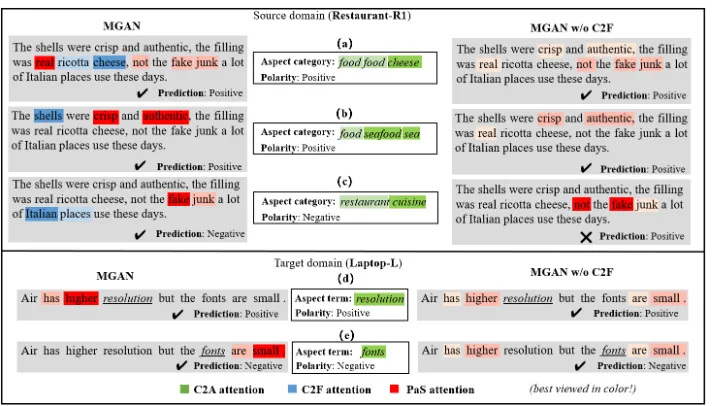
Figure 2: Visualization of attention: MGAN versus MGAN w/o C2F in the R1→L task. Deeper color denotes higher weights.
Figure 3: Associated aspect terms towards different aspect categories captured by C2F attention in the R1→L task.
Comparison with Transfer To avoid the effect of aspect granularity gap, all these models keep the C2F module. The compared results are shown in Table 4. SO performs poorly due to no adaptation applied. The popular technique FT can-not achieve satisfactory results since fine-tuning may cause the oblivion of useful knowledge from the source task. The full model MGAN outperforms M-DAN and M-MMD by 1.80% and 1.33% for accuracy and 1.90% and 1.66% for Marco-F1 on average, respectively. We derive two possible reasons: First, enormous target data is unavailable since it is hard to obtain, thus, it may be insufficient to represent tar-get distributions by limited tartar-get labeled data for the distri-bution alignment based methods; Second, DAN and M-MMD focus on the semantic alignment but ignore semantic separation. Remarkably, MGAN considers both of them in a point-wise surrogate, which altogether improves the perfor-mance of our method. Besides, MGAN outperforms its ab-lation MGAN w/o SS removing the semantic separation loss of the CFA by 0.81% for accuracy and 1.00% for Macro-F1 on average, which implies that the semantic separation plays an important role in alleviating false alignment.
Effect of C2F Attention Module
Conclusion and Future Work
In this paper, we explore a motivated direction for aspect-level sentiment classification named coarse-to-fine task transferand build a large-scale YelpAspect dataset as highly beneficial source benchmarks. A novel MGAN model is pro-posed to solve both aspect granularity inconsistency and do-main feature mismatch problems, and achieves superior per-formances. Moreover, there are many other potential direc-tions, like transferring between different aspect categories across domains, transferring to a AT-level task where the as-pect terms are also not given and need to be firstly identified. We believe all these can help improve the ASC task and there will be more effective solutions coming in the near future.
References
Bahdanau, D.; Cho, K.; and Bengio, Y. 2014. Neural machine translation by jointly learning to align and translate.arXiv preprint arXiv:1409.0473.
Bauman, K.; Liu, B.; and Tuzhilin, A. 2017. Aspect based recom-mendations: Recommending items with the most valuable aspects based on user reviews. InKDD, 717–725. ACM.
Bengio, Y.; Lamblin, P.; Popovici, D.; and Larochelle, H. 2007. Greedy layer-wise training of deep networks. InNIPS, 153–160. Blitzer, J.; Dredze, M.; and Pereira, F. 2007. Biographies, bolly-wood, boom-boxes and blenders: Domain adaptation for sentiment classification. InACL.
Bollegala, D.; Weir, D.; and Carroll, J. 2013. Cross-domain sen-timent classification using a sensen-timent sensitive thesaurus. TKDE
25(8):1719–1731.
Bousmalis, K.; Trigeorgis, G.; Silberman, N.; Krishnan, D.; and Erhan, D. 2016. Domain separation networks. InNIPS, 343–351. Chen, M.; Xu, Z.; Sha, F.; and Weinberger, K. Q. 2012. Marginal-ized denoising autoencoders for domain adaptation. InICML, 767– 774.
Chen, P.; Sun, Z.; Bing, L.; and Yang, W. 2017. Recurrent attention network on memory for aspect sentiment analysis. InEMNLP, 452–461.
Dong, L.; Wei, F.; Tan, C.; Tang, D.; Zhou, M.; and Xu, K. 2014. Adaptive recursive neural network for target-dependent twitter sen-timent classification. InACL, volume 2, 49–54.
Ganin, Y.; Ustinova, E.; Ajakan, H.; Germain, P.; Larochelle, H.; Laviolette, F.; Marchand, M.; and Lempitsky, V. 2016. Domain-adversarial training of neural networks.JMLR17(1):2096–2030. Glorot, X.; Bordes, A.; and Bengio, Y. 2011. Domain adaptation for large-scale sentiment classification: A deep learning approach. InICML, 513–520.
Gretton, A.; Borgwardt, K. M.; Rasch, M.; Sch¨olkopf, B.; and Smola, A. J. 2007. A kernel method for the two-sample-problem. InNIPS, 513–520.
Jiang, L.; Yu, M.; Zhou, M.; Liu, X.; and Zhao, T. 2011. Target-dependent twitter sentiment classification. InACL-HLT, 151–160. Association for Computational Linguistics.
Jozefowicz, R.; Zaremba, W.; and Sutskever, I. 2015. An empirical exploration of recurrent network architectures. InICML, 2342– 2350.
Kingma, D. P., and Ba, J. 2014. Adam: A method for stochastic optimization.arXiv preprint arXiv:1412.6980.
Kiritchenko, S.; Zhu, X.; Cherry, C.; and Mohammad, S. 2014. Nrc-canada-2014: Detecting aspects and sentiment in customer re-views. InSemEval, 437–442.
Li, Z.; Zhang, Y.; Wei, Y.; Wu, Y.; and Yang, Q. 2017. End-to-end adversarial memory network for cross-domain sentiment classifi-cation. InIJCAI, 2237.
Li, X.; Bing, L.; Lam, W.; and Shi, B. 2018a. Transformation networks for target-oriented sentiment classification. InACL, 946– 956.
Li, Z.; Wei, Y.; Zhang, Y.; and Yang, Q. 2018b. Hierarchical atten-tion transfer network for cross-domain sentiment classificaatten-tion. In
AAAI.
Liu, B. 2012. Sentiment analysis and opinion mining. Synthesis lectures on human language technologies5(1):1–167.
Liu, B. 2015. Sentiment analysis: Mining opinions, sentiments, and emotions. Cambridge University Press.
Ma, D.; Li, S.; Zhang, X.; and Wang, H. 2017. Interactive attention networks for aspect-level sentiment classification. arXiv preprint arXiv:1709.00893.
Ma, Y.; Peng, H.; and Cambria, E. 2018. Targeted aspect-based sentiment analysis via embedding commonsense knowledge into an attentive lstm. InAAAI.
Motiian, S.; Piccirilli, M.; Adjeroh, D. A.; and Doretto, G. 2017. Unified deep supervised domain adaptation and generalization. In
ICCV, volume 2, 3.
Pan, S. J.; Ni, X.; Sun, J.-T.; Yang, Q.; and Chen, Z. 2010. Cross-domain sentiment classification via spectral feature alignment. In
WWW, 751–760. ACM.
Pang, B.; Lee, L.; et al. 2008. Opinion mining and sentiment analy-sis.Foundations and TrendsR in Information Retrieval2(1–2):1–
135.
Pennington, J.; Socher, R.; and Manning, C. 2014. Glove: Global vectors for word representation. InEMNLP, 1532–1543.
Qiu, G.; Liu, B.; Bu, J.; and Chen, C. 2011. Opinion word expan-sion and target extraction through double propagation. Computa-tional linguistics37(1):9–27.
Shen, T.; Zhou, T.; Long, G.; Jiang, J.; Pan, S.; and Zhang, C. 2017. Disan: Directional self-attention network for rnn/cnn-free language understanding.arXiv preprint arXiv:1709.04696.
Sukhbaatar, S.; Weston, J.; Fergus, R.; et al. 2015. End-to-end memory networks. InNIPS, 2440–2448.
Tang, D.; Qin, B.; Feng, X.; and Liu, T. 2015. Effective lstms for target-dependent sentiment classification. arXiv preprint arXiv:1512.01100.
Tang, D.; Qin, B.; and Liu, T. 2016. Aspect level senti-ment classification with deep memory network. arXiv preprint arXiv:1605.08900.
Wang, Y.; Huang, M.; Zhao, L.; et al. 2016. Attention-based lstm for aspect-level sentiment classification. InEMNLP, 606–615. Yang, Z.; Yang, D.; Dyer, C.; He, X.; Smola, A.; and Hovy, E. 2016. Hierarchical attention networks for document classification. InNAACL-HLT, 1480–1489.