
Volume 2, Issue 6, June 2013
Page 534
ABSTRACT
Digital images are the most common application of now day’s world. In almost every era of life and technology, the digital images are playing their roles. The problem with images is that, their quality depends on a number of other factors like lighting at the image capturing location, proficiency of the operator, and noise. A lot of techniques have been suggested earlier for the enhancement of the color images which works on histogram of the image or on some particular region. Region based techniques using texture analysis are simple and more effective as they work according to the specified regions of the image. Seed selection is an optimal method for initiate any spatial enhancement. This paper suggests a new hybrid approach for enhancement of the digital images. The suggested technique is based on region growing segmentation and works adaptively for enhancement of the image. Further, the technique is seed dependent so selection of seed is very important in this algorithm. A seed chosen in darker regions will give better results than the seed chosen in brighter region, because it is assumed that user will require enhancing the darker portions of the image. In this paper the process of color image enhancement uses three modules. Initial seed selection is our first module. Our second module is region growing it is used to segment the image based on seed regions. The third and last module is region merging and used morphological operations as texture analysis.
Keywords: Digital Image, Region Based, Seed Selection, Segmentation, Image Enhancement, Adaptive, Texture analysis.
1. INTRODUTCTION
Images are being used for representation of facts and scenes since centuries. With the evolution of computers the image has been converted in digital format and thus called as Digital Image. The Digital images are being used for both research and general purposes. The color images are being used widely in the industry and entertainment fields along the research areas. The images being used in different eras of life are usually captured by some digital cameras or scanners. Though there are high quality devices are available for the better quality of images but still all the devices are operator and light dependent. As in lesser light it is difficult to capture a higher contrast picture. Similarly, the images captured in space by some satellites also suffer from the problem of low contrast due to distance and negligible lighting in space. The images suffering from the problem of low contrast, needs to be enhanced. The image can be enhanced with the help of various techniques and algorithms of image enhancement [1].
Image enhancement techniques are the algorithms which improve the quality of images by removing blurring and noise, increasing contrast and sharpness of digital medical images. There are many image enhancement approaches (theories) like Contrast stretching, Range compression, Histogram equalization and noise smoothing. These are all old techniques which will not provide exact enhanced images and gives poor performance in terms of Mean Square Error (MSE), Entropy and Tenangrad. There is no general theory of image enhancement. When an image is processed for visual interpretation, the viewer is the ultimate judge of how well a particular method works [2].
Color image processing and enhancement is a more complicated process than its counterpart of black-and-white images [3] due to the involvement of multiple color channels and the need to preserve the color information content [4] while enhancing the images. The viewers of some image are usually interested in some specific portion of the image. These parts are more important in the user’s view and are considered as foreground of the image whereas the other portion is called as background. For enhancement of the image, the respective algorithm usually targets to the foreground portion of the image. Image segmentation is one of the key steps of image processing. It enables the user to divide an image in various parts. This division can be automatic or user defined approach. Image segmentation is a technique and process which divide the image into different feature of region and extract out the interested target. The technique is seed dependent so selection of seed is very important in this algorithm. A seed chosen in darker regions will give better results than the seed chosen in brighter region, because it is assumed that user will require enhancing the darker portions of the image. Here features can be pixel grayscale, color, texture, etc.
Spatial Image Enhancement of Color Images
Using Texture Analysis
Ashamdeep Singh1 and Navdeep Kanwal2
1
M.Tech, Student UCoE, Punjabi University, Patiala
2
Volume 2, Issue 6, June 2013
Page 535
2. R
EGIONG
ROWING ANDT
EXTURE ANALYSISM
ETHODOLOGYRegion growing is referred as region based image segmentation method. An image can be segmented in the regions on the basis of some fixed criteria. Region growing approaches generally use a seed pixel for start and then the process continue by evaluating neighboring pixels one by one. As the first step of the approach some pixel is chosen as the seed point. Some threshold value in accordance to seed value can be defined to make the approach adaptive. In the second step, the neighboring pixels are checked one by one against the given criteria. The pixels fulfilling criteria are considered to be connected and are added to the region, otherwise skipped this process is called Region merging. The procedure is iterative: at each step, a pixel is merged according to the homogeneity criterion. This process is repeated until no more voxels are assigned to the region. This process remain continue in the whole image, until all the pixels get processed. In the end all the connected pixels make a single region. The pixels are used to be processed in 4-connected or 8-4-connected approach.
In case of Texture Analysis although there is no strict definition of the image texture, it is rich source of visual information about the nature and shape of physical objects. Generally speaking, textures are complex visual patterns composed of entities, or sub patterns that have characteristic brightness, color, size, etc. The local sub pattern properties give rise to the perceived lightness, roughness, regularity, linearity, frequency, directionality, randomness, fineness, smoothness etc [5].
3.
P
ROPOSEDA
LGORITHMEarlier studies have proved that the digital images face different type of problem due to the various factors. The factors may include the lesser light in the capturing area, low lens power of the capturing device and operator proficiency. For the betterment of the images, a number of image enhancement methods have been proposed for the purpose as discussed above. Classical image enhancement techniques cannot adapt to the varying characteristics of images. The proposed technique works on adaptively and region growing technique jointly. The region grows in the suggested technique on the basis of a threshold value. It evaluates for the pixels connected in the 4-neighbouring. The image is enhanced for the foreground part and clubbed with its original gradient and performs the morphological operations as texture analysis in the end. The detailed steps of the methodology are as below:
Step I. Remove speckle noise from the image using median filter.
Step II. Analyze the entire image statistically and select a pixel in the input image that will work as the seed point.
Step III. Repeat Step-IV to Step-VI for RGB color components of input image individually.
Step IV. Perform seeded region growing in the image for respective color component to generate Foreground and Background on the basis of 4-connectivity and threshold value of 0.4
Step V. Apply CLAHE on the foreground region to enhance contrast of foreground layer.
Step VI. Apply morphological processing (dilation) on background layer according to Texture Analysis.
Step VII. Combine the foreground and background layer.
Step VIII. Combine all enhanced outcomes of ‘Red’, ‘Green’ & ‘Blue’ to form the enhanced RGB image.
Step IX. Perform Texture refinement and Edge enhancement on the image obtained from Step VII.
Step X
.
Display the final enhanced image of Step IX.4. Q
UALITYE
VALUATIONVolume 2, Issue 6, June 2013
Page 536
MATHEMATICAL FORMULAS FOR QUALITY FACTORS
Sr. No.
Quality Factor Implementation
1. Tenangrad Measurement (TEN)
for S(x, y) > T
2. Entropy sum(p.*log2(p))
3. Mean Square Error (MSE)
TEN involves computing gradient magnitude at every location in image and sums all magnitudes greater than a threshold T. The entropy is an important factor to estimate whether the digital image is basically the same with the original image. While comparing results for images, higher value of TEN and Entropy represent better edges and contrast respectively.
Mean square error or MSE is a quality metric which describe the difference between the estimate value and the true value of the quantity being estimated [6]. It represents the cumulative squared error between the compressed and the original image. Lower the value of MSE, lower the error.
5.
R
ESULTS ANDD
ISCUSSION5.1 Test Images
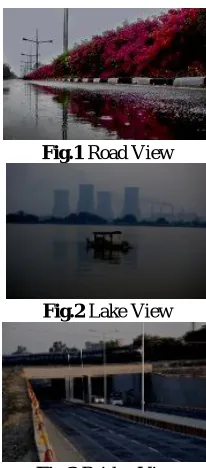
Fig.1 is image of a road Fig.2 is another captured view of Lake and Fig.3 is a captured view of a bridge. All of these images are low quality images. The clarity of these images is very low. Therefore the proposed algorithm is applied to enhance these images. The results of Image enhancement are discussed in next section.
Fig.1 Road View
Fig.2 Lake View
Volume 2, Issue 6, June 2013
Page 537
5.2RESULTS
The Test images have been enhanced using proposed algorithm. Fig.1 represents visual results for the first test image (Road view). In visual analysis it is observed that clarity of image has been enhanced to various levels using algorithms i.e. Algorithm_A, Algorithm_B and proposed one. But the proposed algorithm is enhancing the image more precisely in comparison to other algorithms.
Algorithm_A: Method Proposed by Sk. Khwaja Moinuddin and Ch. Madhuri Devi [7]. Algorithm_B: Method Proposed by Gurudev B. Sawarkar [8].
Though visual results are appearing better but the human visualization is not considered as benchmark for image quality, so to evaluate the performance of above mentioned algorithms quality metrics have been calculated for the output images. Values for Mean Square Error (MSE), Entropy and Tenangrad (TEN) Measurement have been calculated for the resultant images in comparison to the original image. The evaluation derives that Proposed Enhancement technique produces better quality values for enhanced image. Visual results and Quality test metrics for the mentioned algorithms have also been evaluated for the other two images i.e. Fig. 2 and Fig. 3. Table 2 is displaying metric values for the results of Fig. 1.
(a) (b)
(c) (d) Fig.4 (a) Original Image (b) Image Enhanced using Algorithm_A
(c) Image Enhanced using Algorithm_B (d) Image Enhanced using proposed method
Table2: Performance Evaluation for Fig.1
Quality Parameter Algorithm_A Algorithm_B Proposed Algorithm
Mean Square Error (MSE) 120.37 121.22 112.04
Tenangrad (TEN) 9705506 9335535 10790161
Entropy 3.2277 3.1847 3.3789
Fig.5 is representing visual results for the Fig.2, whereas Fig.6 is elaborating the results for Fig.3. Similarly Table 3 and Table 4 are representing the numerical values for the quality metrics of resultant images respectively.
(a) (b)
Volume 2, Issue 6, June 2013
Page 538
(c) Image Enhanced using Algorithm_B (d) Image Enhanced using proposed method Table3: Performance Evaluation for Fig.2
Quality Parameter Algorithm_A Algorithm_B Proposed Algorithm
Mean Square Error (MSE)
129.04 129.25 119.81
Tenangrad (TEN) 7088397 10031963 13166185
Entropy 3.3290 3.2294 3.7572
(a) (b)
(c) (d)
Fig.6 (a) Original Image (b) Image Enhanced using Algorithm_A
(c) Image Enhanced using Algorithm_B (d) Image Enhanced using proposed method
Table4: Performance Evaluation for Fig.3
Quality Parameter Algorithm_A Algorithm_B Proposed Algorithm
Mean Square Error (MSE) 123.49 121.48 119.08
Tenangrad (TEN) 11363663 10879155 13745179
Entropy 3.4046 3.3700 3.6365
For all the images considered, the proposed technique is producing better results. The quantitative metrics are representing a significant growth in the metric values.
6. C
ONCLUSIONThe paper is describing a hybrid approach for the enhancement of digital image. The images having less image clarity can be enhanced by the technique suggested above. A manual seed selection method has been used to implement region growing segmentation for enhancement of the color images. Gradient of the image has also been improved to make the edges of the regions more strong. The algorithm works on an adaptive approach as the connectivity of the pixels in the region are tested against a threshold value. In the end of the paper the results of the proposed technique have been compared with existing technique of image enhancement. The results are justifying the proposed technique as the better one.
7. F
UTURES
COPEFuture work in this domain may include implementation of multiple seed points. Further, the selection of seed point can be made automatic. The approach may be adopted for medical images. The algorithm may be used with some denoising technique to deal with high noise images.
References
Volume 2, Issue 6, June 2013
Page 539
[2.]Preethi S.J and K. Rajeswari, “Image Enhancement Techniques for Improving the Quality of Colour and Gray scale Medical Images”, International Journal on Computer Science and Engineering (IJCSE), p.p.18-23, 2010. [3.]N. M. Kwok, Q. P. Ha, D. Liu, and G. Fang (2009), “Contrast enhancement and intensity preservation for
gray-level images using multi objective particle swarm optimization,” IEEE Trans. on Automation Science and Engineering, vol. 6, no. 1, pp. 145–155.
[4.]S. K. Naik and C. A. Murhty (2003), “Hue-preserving color image enhancement without gamut problem,” IEEE Trans. on Image Processing, vol. 12, no. 12, pp. 1591–1598.
[5.]A. Materka and M. Strzelecki, “Texture Analysis Methods – A Review”, Technical University of Lodz, Institute of Electronics, COST B11 report, Brussels 1998.
[6.]Ashamdeep Singh & Navdeep Kanwal, “Qualitative comparative study of various contrast enhancement techniques”, International Journal of Computer Science Engineering and Information Technology Research
(IJCSEITR), Vol.3, Issue 1, Mar 2013, pp. 19-24.
[7.]Sk. Khwaja Moinuddin and Ch. Madhuri Devi “Traditional Color Image Enhancement Based On Adaptive Filter”,
International Journal of Engineering Research and Applications (IJERA), Vol. 2, Issue4, July-August 2012, pp.2216-2218.
[8.]Gurudev B. Sawarkar “Color Image Enhancement with Noise Reduction”, International Journal of Advanced Technology & Engineering Research (IJATER) , Volume 2, Issue 5, Sept 2012, pp.28-33.
[9.]Anish Kumar Vishwakarma, “Color Image Enhancement Techniques: A Critical Review”, Indian Journal of Computer Science and Engineering (IJCSE), Vol. 3, No. 1, pp. 39-45, Feb -Mar 2012.
[10.]Sunita Dhariwal, “Comparative Analysis of Various Image Enhancement Techniques”, International Journal of Electronics & Communication Technology (IJECT), Vol. 2, Issue 3, pp. 91-95, Sept. 2011.
 triangulo triruthenium](data:image/gif;base64,R0lGODlhAQABAIAAAP///wAAACH5BAEAAAAALAAAAAABAAEAAAICRAEAOw==)