ISSN: 2252-8938, DOI: 10.11591/ijai.v6.i1.pp1-7 1
Fuzzy Information Modeling in a Database System
Salam Ismaeel1, Ayman Al-Khazraji2, Karama Al-delimi3 1
Department of Computer Science, Ryerson University
2
Department of Electrical and Computer Engineering, Caledonian College of Engineering
3Department of Mathematics, Al-Nahrain University
Article Info ABSTRACT
Article history: Received Nov 2, 2016 Revised Jan 6, 2017 Accepted Feb 15, 2017
A Fuzzy logic (FL) provides a remarkably simple way to draw definite conclusions from vague, ambiguous or imprecise information. In a sense, fuzzy logic resembles human decision making with its ability to work from approximate data and find precise solutions. In this paper a fuzzy information modeling system was developed then used in a database, which contains fuzzy data and real data, to create new information assistance capable of making any decision about this data. The proposed system is implemented on a special database used to evaluation workers or users in any formal organizations.
Keyword: Data fuzziness Database Fuzzy Decision Fuzzy logic
Information Modeling Copyright © 2017 Institute of Advanced Engineering and Science. All rights reserved. Corresponding Author:
Ayman Al-Khazraji,
Department of Electrical and Computer Engineering, Caledonian College University,
CPO Seeb 111, Oman.
Email: [email protected]
1. INTRODUCTION
Database (DB) has become an essential component of everyday life in modern society. In essence, a DB is nothing more than a collection of data that exists over a long period of time [1], [2]. In real-world, data may be noisy while sure form may have missing values. Nevertheless, it will be important that intelligent machines handle this type of data.
On the other hand, in many database systems, an important portion of information comes from human expert as well as numerical data, which is collected from various sources or obtained according to physical laws [3], [4]. Usually expert information is not precise and can be represented by terms like small, large, not very large, and so on. The superiority of fuzzy system is due to its ability of integrating linguistic descriptions which permits the exploitation of human information [5], [6].
Artificial intelligence (AI) is the field of study that deals with the capturing, modeling, and storage of human intelligence within information technology (IT) systems so that the system can facilitate decision-making processes that normally would be undertaken by people. One of the AI tools is the expert system. An expert system helps in decision making by capturing and using the expertise, logic patterns, and thought processes of an expert. These are called rule-based expert systems [7], [8].
Since fuzzy systems can realistically model imprecise and uncertain information, a fuzzy information modeling in database (FIDB) system is proposed in this paper as an expert system. Accordingly, it will be possible to make use of human experience and other linguistic or imprecise date in decision making process with the proposed system.
2. FIDB DATABASE
As stated, the main goal of this paper is to design the FIDB system capable of creating new information from fuzzy data and add it into the database file.
FIDB system uses two type of database file: 1) an external database file and 2) an internal database files. The external DB file will contain fuzzy data. For the internal database files, it will save all helpful definitions to create and add fuzzy information into the database file.
Fuzzy files include the following elements:
1. Structure file: it defines the structure of the fields using the database file. This file will be used to create the fuzzy information.
2. Fuzzy inputs and outputs groups’ files: the groups of membership’s functions for the inputs and outputs data will be determined first in these files.
3. Membership values for inputs and outputs files: the membership values (or the fuzzy sets) that are calculated by membership functions will be contained in this files. These values are used for the inputs and outputs data in the database files.
4. Rule file: it contains the definition rules that uses for database files. Usually, a human expert is used to define these rules.
All database files must contain the same fields with the name (Field_no). This field helps to create relationships between database files.
3. FIDB MODEL
Consider the designed FIDB model is illustrated in Figure 1. It uses a special model to create fuzzy information from database file which enables computing with word operation [9]. The working procedure is given by the following steps:
Figure 1. FIDB Model
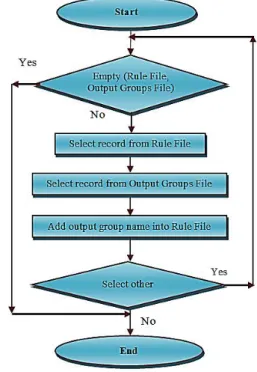
Figure 2. Link Fuzzy Groups and Create Fuzzy Rules
3.1. Fuzzy Files Creation:
Creating fuzzy files is very important, and can be created from: 1. Files contain old data and used from other database file.
3.2. Selection and Convection of Data File to DB File:
This step is used to choose data file and convert it to database file that will be used in the FIDB system.
3.3. Fuzzy Fields Selection:
It concerns any database file having one or more fields with fuzzy data. 3.4. I/O Groups Definition:
In FIDB system the groups of membership functions must be defined. The steps of defining groups for input or output file are:
1. Select the fuzzy fields from structure file.
2. Define groups of membership functions containing the values. 3. Check groups.
4. Save groups with all definitions in fuzzy groups file. 3.5. Fuzzy Sets Creation (Membership Values for I/O Data):
To define the fuzzy sets for input and output data according to the standard functions, the program should be able to [5]:
1. Select record which contain the values (from, to, center), group name and type of membership function from fuzzy groups file.
2. Check function type. 3. Calculate standard functions. 4. Check fuzzy groups file.
Equations (1)-(3), represent the standard membership functions S, PI, Z of fuzzy sets used in this work [10]:
c c c a a c a c a a a c a a c a S 1 2 2 1 2 2 0 ) , , ( 2 2 (1) ) , , ( 1 ) , ,
( ac S a c
Z (2)
b c a Z b c a S c a PI ) , , ( ) , , ( ) , , ( (3)
Where µ: input variable, b: center of the PI function, a and c are respectively start and end of the standard membership functions.
3.6. Define Fuzzy Rules:
FIDB system defines the rules according to the fuzzy inputs groups. The steps to define fuzzy rules can be divided into two steps:
3.6.1. Counting Fuzzy Rules.
Here, the number of required rules is counted depending on the input/output membership functions. 3.6.2. Linking the Fuzzy Groups to Create Fuzzy Rules.
The proposed algorithm which can be used to create links is shown in Figure 2, which contains the five main steps:
1. Check rule file.
2. Check fuzzy output groups file.
3. Select record from rule file and select record from output groups file. 4. Add output group name into rule file.
5. Check rules. 3.7. Check selections:
This step represents the verification of the constructed system for errors in: 1. Database file.
2. Fuzzy file. 3. Fuzzy fields.
3.8. Add Fuzzy Information into Database File:
The steps to add fuzzy information which consists of: 1. Check fuzzy files and DB file.
2. Select record from DB file.
3. Select value of fuzzy fields from DB file and check value with other values in membership file. 4. Select Min (value) for the relevant rules in the rule file.
5. Create membership for output.
6. Calculate output values using center of gravity (COG) defuzzification according to equation (4) [11], [12]:
A 1
A 1
µ ( )
output =
µ ( )
i M
i i i i
M i i
y
y
y
(4)
Where M is the number of fuzzy rules, yi is the center of fuzzy set Ai, is a point in the universe of discourse, and µAi is the membership value of the fuzzy set Ai.
Add results of COG and Max (membership) output into database file.
4. SYSTEM IMPLEMENTATION
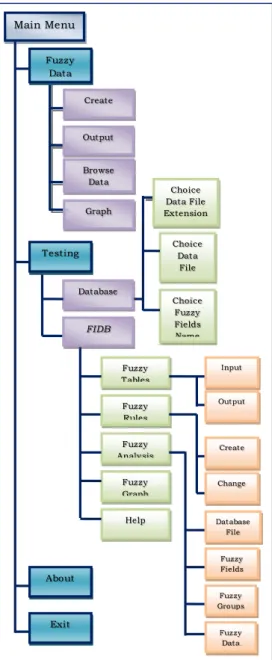
FIDB is a software application developed using Visual C++. It is designed for a database system containing fuzzy data and process data to make decision by a set of rules. This system can be used by any user. Figure 3 gives the main menu architecture of the FIDB system.
5. RESULTS AND ANALYSIS
In order to illustrate the FIDB, we consider the problem of choosing an employer from a group of employers as a case study. The selection depends on the evaluation in English language (En_degree field), experience of the employer (Em_degree field), and age of the employer (Age field). Here, En_degree and Em_degree are the un-relational field (not have weights, i.e. fuzzy variables), While the Age field can have any weight (non-fuzzy variable). Table “TEST.xls” given in Figure 4, shows the name of employer and their corresponding values.
The problem is to implement the FIDB system to choose the proper employer from the unrelated database depending on the human expert. Table 1 shows the description of fields in database file, which is used in FIDB system. After the selection of the inputs and output groups and inputs membership’s values as in Tables 2, 3 and Figures 5, respectively, where 6 rules are used first as in Table 4, the output of the FIDB system is shown in Figure 6. The output data are not clear because the definitions of fuzzy set of inputs and output are not clear, some of membership of data equal zero (0) like (80, 70). The relation between fuzzy fields (En_degree, Em_degree) is direct, if value in (En_degree) is high and value in (Em_degree) is high then output is high too, so the type of some membership functions is (S).
Change fuzzy inputs sets as in Table 5, and Figure 7, for the same example, and for 4 rules as in Table 6, the output give more accurate result as shown in Figure 8. Where the result shows that the proposed system gives exactly the same results given by an expert user.
6. CONCLUSION
In this work, it has been proven that fuzzy logic can be used as a powerful tool to make decision from fuzzy data in a database. FIDB system can be used in different applications by selection rules and membership functions depending on human expert in that application. Large number of rules in a rule base system does not always give good results. The results are largely affected by good representation of these rules in the system.
Figure 2. Link Fuzzy Groups and Create Fuzzy Rules
Figure 4. Table “TEST.xls” Figure 3. Main Menu Architecture of FIDB System Table 1. Fields in Case Study DB file
Field Name Descriptions
Name Employ Name.
Age Employ Age.
En_degree Evaluation of English Language (numerical type), fuzzy data.
Em_degree Evaluation of Employer (numerical type), fuzzy data.
Table 2. Inputs Groups for the Case Study
Field No. From To Function
Type Center
Group Name
1 30 70 PI 50 En_1
1 70 80 PI 75 En_2
1 80 100 Z 0 En_3
2 40 70 PI 37 Em_1
2 70 100 PI 85 Em_2
Main Menu
Testing
About
Exit
Create
Browse Data
Fuzzy Tables
Fuzzy Rules
Fuzzy Analysis
Fuzzy Graph
Help
Input
Output
Create
Change
Database File Fuzzy Fields
Database
Choice Data
File
Choice Fuzzy Fields Name
Fuzzy Data Fuzzy Groups
Graph
FIDB Output
Fuzzy Data
Choice Data File Extension
Table 3. Output Groups for the Case Study Field
No. From To
Function
Type Center
Group Name
9 0 24 S 0 V.good
9 32 75 S 0 Good
9 66 100 S 0 Bad
Figure 5. Inputs Graph Select
Table 4. Rules Definition of the Problem En_degree
En_1 En_2 En_3
Em_degree Em_1 Bad Good V.good
Em_2 Bad Good V.good
Figure 6. Output Graph
Table 5. New Definitions for Inputs Groups Field
No. From To
Function
Type Center
Group Name
1 0 49 S 0 En_1
1 49 111 S 0 En_2
2 0 50 PI 25 Em_1
2 30 100 S 0 Em_2
Figure 7. New Inputs Graphs
Table 6. New Definitions for Rules Definition En_degree
En_1 En_2
Em_degree Em_1 Bad Good
Em_2 Good V.good
Figure 8. New Output Graph
REFERENCES
[1] Garcia-Molina, H. Database systems: the complete book. 2008: Pearson Education India.
[2] Laday, RK, H Sukoco, Y Nurhadryani. Distributed System and Multimaster Replication Model on Reliability Optimation Database. TELKOMNIKA Indonesian Journal of Electrical Engineering. 2015; 13(3): 529-536. [3] Bosc, P, O Pivert, A Mokhtari. Top-k queries with contextual fuzzy preferences. In Database and Expert Systems
Applications. 2009. Springer.
[4] Kacprzyk, J, S Zadrożny, G De Tré. Fuzziness in database management systems: Half a century of developments and future prospects. Fuzzy Sets and Systems.
[5] Sela, EI, et al. Feature Selection of the Combination of Porous Trabecular with Anthropometric Features for Osteoporosis Screening. International Journal of Electrical and Computer Engineering (IJECE), 2015; 5(1): 78-83. [6] Al-Khazraji, A, KM Aljebory, Robust Adaptive Type-2 Fuzzy Sliding Mode Control for Non-Linear uncertain
SISO systems. Journal of Control Eng. and Technology. 2014; 4(4): 243-256.
[7] Grosan, C, A Abraham. Rule-based expert systems. In Intelligent Systems. 2011: 149-185.
[8] Kosko, B, Additive Fuzzy Systems as Generalized Probability Mixture Models, in Fifty Years of Fuzzy Logic and its Applications. Springer. 2015: 245-265.
[9] Martinez, L, D Ruan, F Herrera. Computing with words in decision support systems: an overview on models and applications. Int. Journal of Computational Intelligence Systems. 2010; 3(4): 382-395.
[10] Bridges, SM, RB Vaughn. Fuzzy Data Mining And Genetic Algorithms Applied To Intrusion Detection. In 23rd National Information Systems Security Conference (NISSC}. 2000. Baltimore, U.S.A.
[11] Driankov, D, H Hellendoorn, M Reinfrank. An introduction to fuzzy control. 2013: Springer Science & Business Media.
[12] Anastassiou, GA, Fuzzy mathematics: Approximation theory. 2010; 251. Springer.
BIOGRAPHIES OF AUTHORS
Salam Ismaeel: (email: [email protected]) received the Ph.D. degree in Computer Eng. at Al-Nahrain University, Baghdad, Iraq in 2003. After getting the Ph.D., he joined the Iraqi Commission for Computer and Informatics as an Assist. Prof. After about two decades of academic experience, Mr. Ismaeel joined recently the department of computer science at Ryerson University. His main research interest covers the implementation of adaptive neuro-fuzzy inference system (ANFIS) in GPS/INS system integration, cloud computing, robotics, artificial intelligent use in navigation and data mining.
Ayman Al-khazraji (email: [email protected]) received the Ph.D. degree in Control Engineering from Reims University, France. His 15 years of experience includes academic and industrial establishments. He has more than 20 publications including book chapters, papers, conferences and technical reports. Recently, he received the prestigious IFAC award for best published paper during last three years. Dr Al-khazraji worked as an expert for different industrial enterprises such as General Electric and Alstom Power systems. His research interesting includes Embeded systems, fuzzy logic, artificial intelligent applications in control, robotics and nonlinear control systems.
Karama Al-delimi (email: [email protected]) received the B.Sc. in mathematics from Diyala University in 2008. After graduation, she joined the department of mathematics at Al-nahrain University. She has an extensive experience in mathematics application in engineering and programming especially using Visual C++ and Matlab/Simulink. Her research interest includes Fuzzy mathematics and Intelligent Computation.