Sharif University of Technology
Scientia IranicaTransactions F: Nanotechnology www.scientiairanica.com
Eects of elastic contributions on the evolution of
nano-structure Al3Sc phase: A phase-eld study
Z. Ebrahimi
a;and H. Ebrahimi
ba. Department of Mechanical Engineering, Payame Noor University, Tehran, P.O. Box 19395-3697, Iran.
b. Department of Materials Science and Engineering, Sharif University of Technology, Tehran, P.O. Box 11365-9466, Iran. Received 21 March 2015; received in revised form 19 December 2015; accepted 13 February 2016
KEYWORDS Phase-eld model; Al3Sc precipitates;
Mist stress; Coherency.
Abstract.A micromechanical phase-eld model is utilized to study the evolution of nano-structure Al3Sc phase in Al-Sc alloy. We study the formation of Al3Sc precipitates in an
Al-Sc alloy by using an elastic phase-eld model. Since the precipitates of Al3Sc phase are
fully coherent with the Al matrix, the elastic energy will have an inuence on the resulting morphology. We have studied the eects of elastic strain energies on shape evolution of Al3Sc phase, numerically. The simulated nano-structures evolve from spherical to cubic
shapes. The equilibrium shape of the coherent Al3Sc phase is found to be determined by
minimizing the sum of the elastic and interfacial energies through the phase-eld equations. A coherency loss is observed when the precipitates reach a specic size. The simulation results show good agreements with previous experimental studies.
© 2016 Sharif University of Technology. All rights reserved.
1. Introduction
Due to their light weight, high strength, and corrosion resistance, Al-Sc alloys are of great interest for high-performance structural applications. As a promising and attractive age-hardened aluminum alloy, Al-Sc alloy has been extensively investigated in experimental and numerical studies [1-4]. In binary Al-Sc alloys, Sc additions provide an excellent improvement in me-chanical properties owing to the formation of a high-number density of nano-scale L12-Al3Sc precipitates
during aging [5-8].
In addition of dilute amounts of Sc to Al, the most important intermetallic compound is the Al3Sc
phase. The L12-Al3Sc precipitates are coherent with
the -Al matrix with a little lattice mist of about 1% and form the -Al/L12-Al3Sc interface and a two-phase
microstructure. These precipitates have an ordered structure based on the Al fcc lattice with Sc atoms at the face center of unit cells and are very stable
*. Corresponding author. Tel./Fax: +98 71 36222255 E-mail address: [email protected] (Z. Ebrahimi)
with respect to coarsening [8,5]. Due to the similarity between crystal lattice of Al3Sc phase and the Al
matrix in terms of their structures and dimensions, the spherical Al3Sc phase particles precipitate fully
coherently with the matrix during decomposition of solid solution [7]. Therefore, in the decomposition of supersaturated solid solution of Al(Sc), formation of nano-scale Al3Sc phase and its morphology will depend
on elastic energies as well. Therefore, the resulted morphology is determined by the elastic energies and elastic interactions between the precipitates and the matrix. In this paper, we aim to study the elastic contributions in evolution of these phase particles by using a phase-eld approach.
The phase-eld method has emerged as a pow-erful tool to predict microstructure evolution in many material systems like coherent solid-state phase tran-sitions [9,10] and multiphase growth [11,12]. It is a genuine representation of the original free-boundary problem in sharp-interface limit as the interface thick-ness tends to zero. In the phase-eld concept, the interfacial conditions are avoided by introducing a set of smooth variables, the so-called phase-eld variables,
which characterize time and spatial evolutions of bulk phases in the underlying system [13]. The phase-eld model has successfully been applied to study the coherent precipitation of L12 ordered intermetallics
from a disordered fcc solid solution in Ni-base al-loys [14], in which the formulation of the free energy is based on the concentration wave representation of the ordered state. In a dierent way, Folch and Plapp have developed a phase-eld model for eutectic and peritectic solidication, in which a smooth free energy functional is used to connect any two phase [15]. The work of Folch and Plapp has further been extended to include anisotropic elasticity and misorientations in eutectic growth [16,17], in which the free energy of the system consists of a chemical free energy and an elastic free energy.
Here, the previous elastic phase-eld model [16] is rst adapted to phase transitions in solids with cubic anisotropy and then applied to model the evolution of Al3Sc precipitates in an Al-Sc system. This extension
of the Folch and Plapp model to precipitate growth is new and has not been reported in the literature. We have represented the related phase-eld equations in the rst part of this paper. The eects of elastic mist in precipitation of Al3Sc particles are discussed later
and the simulation results are illustrated. 2. Phase-eld model
Consider the precipitate growth in a matrix with an interface of width, W . The distinct entities which should be considered in precipitate growth are the precipitate, the matrix, and the interface between them. Here, we aim to study the formation of Al3Sc
precipitates in an Al-Sc alloy by using an elastic phase-eld model. In the phase-phase-eld method, we represent the entire microstructure by continuous scalar vari-ables, the so-called phase-eld varivari-ables, as the volume fraction of the existing phases in the system. Each phase-eld variable, which is denoted by i, is unity
in the corresponding ith single phase region and zero outside that phase, i.e. i2 [0; 1], and smoothly varies
between these two values. i = 1 then represents
the domain where phase i exists, i = 0 where it is
absent, and 0 < i < 1 is its bounding interfaces [16].
The phase-eld variables should satisfyPii = 1. In
precipitate growth, the index i represents the matrix and the precipitate phases, respectively.
Traditional phase-eld models are connected to thermodynamics by a phenomenological free energy functional, written in terms of the phase-eld and other elds, such as temperature, concentration, and strain. Through a dissipative minimization of this free energy, the dynamics of one or more order parameters, as well as those of heat or mass transfer are governed by set of non-linear partial dierential equations. In
phase-eld models of coherent binary alloys considered here, the free energy density is a functional of two phase-led variables, ~ = (p; m), a concentration, c, a
temperature, T , and vector of elastic displacements, ~u. The total free energy of the material system is described by the volume integrals of the free energy density, as introduced in [16]:
F = Z
Vf(~; c; T; ~u)dV; (1)
where the bulk free energy density, f(~; c; T; ~u), is given by:
f(~; c; T; ~u) =2j~r~j2 2 + Hfp(i) + Xfch(i; c; T )
+ Y fel(~; ~u); (2)
where =pHW is a constant that sets the interface
energy and has the unit of energy per unit length, [J/m]1=2, and the gradient term on rhs of Eq. (2) is the
kinetic part of the free energy density. The constant W sets the length scale of the interface between matrix and precipitate phases. The constants H, X, and Y have the dimension of energy per unit volume [J/m3].
The dimensionless functions fp, fch, and fel
must have two local minima to account for two pos-sible phases, which are the matrix m and precipitate phase, p. The elastic interactions are included in the phase-led model by dening an elastic free energy density, fel, which is described in Eq. (11). The
function fp is the double well potential, which has two
minima for p and m, corresponding to the
phase-eld variables of the matrix and precipitate phases, respectively. The simplest choice for fp, which is
usually used in the phase-led models, is: fp(i) =
X
i
2
i(1 i)2 for i = m; p: (3)
Structural transformations in alloys involve the precip-itation of one or more ordered phase from a disordered phase and mass transport. The transformation that we consider here is the precipitation of Al3Sc phase
particles from the Al matrix. Two concentration elds are dened in this case, one for the precipitate phase, cp, and another for the matrix phase, cm. The
concentrations cp and cm are restricted to satisfy a
constant chemical potential by imposing the condition @Bp(cp)=@c = @Bm(cm)=@c, where Bp and Bmare the
free energies of the precipitate and the matrix phases, respectively. This implies that any diuse interface is a mixture of matrix and precipitate phases with a constant chemical potential.
The function fch is the chemical free energy
density, which determines the phase-diagram of the alloy and is dened as:
fch(i; c; T ) = 12(c
X
i
cigi(i)2+
X
i
Bi(T )gi(i);
for i = m; p; (4)
where ci is the concentration of the phase i in
equi-librium with another phase and Bi is the free energy
density of phase i.
The relative stability of the phases depends on the concentration values. This requires adding a function to the free energy density that well tilts the double by an amount proportional to the local driving forces [15]. We construct a function, gi, that well tilts the double
and besides keeps the minima of the free energy at xed values i= 0, 1 independent of the value of c. In other
words, gi(i) should be a monotonic function satisfying
gi(i = 0) = 0 and gi(i = 1) = 1. We construct the
tilting function, gi, analogous to the available models
of single-phase solidication [18] as follows:
gi(i) = 3i(62i 15i+ 10); (5)
where the index i represents the ith phase region, which could be the precipitate or the matrix phase. We dene the chemical potential as the variation of F with respect to the concentration c:
= F c = c
X
i
cigi(i) for i = m: (6)
The concentration eld c evolves according to mass conservation equation:
@c @t = ~r
M(~)~rFc
; (7)
where M(~) is the chemical mobility. Substituting the chemical potential given by Eq. (6) in Eq. (7), the mass conservation equation becomes:
@ @t = ~r
D(~)~r X
i
ci@gi@t(i); (8)
where D(~) = XM(~) is a phase-dependent diusivity. In our model, we consider the diusivity as D(~) = Dm, where D is the solute diusion coecient.
To describe the elastic stresses in evolution of coherent precipitates, we consider uni-directional mist applied on the interface of two dierent solid phases. The mist strain maccommodates the mist stress ijm
on the boundary between two solid phases as described in [16]. The constitutive law for a material with cubic-anisotropy is established by only 3 material constants, C11, C12, and C44. In two-dimensional model, the
displacement vector is ~u = (u1; u2) and the stress and
the strain tensors are ~ = (11; 22; 212 and ~ =
(11; 22; 212), respectively. We write a general
stress-strain relation according to linear elasticity to relate the stress and strain tensors, ij and ij, respectively:
ij =12
@ui
@xj +
@uj
@xi
; (9)
s
ij= csijklkl ijmij; s = m; p; (10)
where i; j = 1; 2 in our phase-eld model.
The elastic free energy fel(~; ~u), which
incorpo-rates the elastic interactions due to the lattice mist between the precipitate and the matrix phases in the phase-eld model, is dened as:
fel =
X
s=m;p
h(s)fels; (11)
fs
el =Y1csijkl(kl mij)2; (12)
where cijkl is the forth-order stiness tensor. The
phase-dependent elastic free energy density of the system fel is constructed by the sum of the elastic free
energy densities of individual phases fs
el weighted by
a function h(s). We choose h(s) = 2s(3 2s),
which satises h(s = 1) = 1, h(s = 0) = 0 and
h0(
s = 0; 1) = 0. The mist strain m is included
in Eq. (12) to incorporate the inuence of the mist between eutectic lamellae.
The temporal evolution of the two non-conserved phase-eld variables m and p gives the location of
interface between the precipitate and the matrix phases and is a relaxation toward the minimum of the free-energy functional F :
(~)@@ti = H1 F
ijm+p=1; for i = m; p: (13)
(~) is a relaxation time and controls the time of attachment of atoms to solid interfaces. Since we have the constraint p+ m = 1 in our phase-eld model,
we can consider the equation of motion (Eq. (13)) for the precipitate phase only. The evolution of the matrix phase is then computed as m= 1 p. The derivative
F=ijp+m = 1 in Eq. (13) can be evaluated by
the method of Lagrange multipliers analogous to [15]. Using this and replacing the components of the free energy density, fp (Eq. (3)), fch (Eq. (4)), and fel
(Eq. (11)) in Eq. (13), we obtain the evolution of p
as:
(~)@@tp =W2
r2p 2p(1 p)(1 2p)
c
2
@gp(p)
@p [(cm cp) (Bm Bp)]
e
3
2@h(@p)
p f p
el @h(@m) m f
m el
; (14)
By taking the derivatives @g(p)=@pand @h(p)=@p,
Eq. (15) is then simplied to: (~)@@tp =W2
r2p 2p(1 p)(1 2p)
15c2p(1 p)2[(cm cp)
(Bm Bp)] 2e[2p(1 p)felp
m(1 m)felm]; (15)
where W = =pH is the thickness of the interface
between the precipitate and the matrix phase. c =
X=H is a coupling constant that connects the eld model to the material parameters and the phase-diagram of the alloy. The constant e = Y=H
also couples the elastic interactions to the phase-eld equation.
We evaluate the elastic displacements (u1; u2) by
a set of nonlinear equations, which are obtained by writing the mechanical equilibrium equation within the alloy system:
@ @xj
X
s
h(s)ijs
!
= 0 for s = m; p: (16) An elastic phase-eld model with cubic-anisotropy for eutectic solidication is developed in [16]. We modify this model to account for elastic interactions in precipitation of Al3Sc phase from the Al matrix. The
elastic free energy of the individual phases in Eq. (12) for cubic-anisotropy is given by:
fs
el=Y1[(C11s + C12s)(211+ 222) + 2212C44s+
22
m(C11s +C12s ) 2m(C11s +C12s )(11+22)]:
(17) Substituting ij and ij from Eqs. (10) and (9) in
Eq. (16) and taking the derivatives for i, j = 1; 2, results in a system of two dierential equations in terms of the displacement elds, u1 and u2 (see Ref. [16]
for more details). Once the displacements are found by solving Eq. (16), the corresponding strains are computed from the linear elasticity theory, Eq. (9). After that, the calculated components of the strain tensor will be substituted in the phase-eld evolution equation (Eq. (15)). The phase-led equation is solved together with the diusion equation (Eq. (8)) and the phase-led variables p and mand the concentration
c are evaluated at each time step. 3. Numerical simulations 3.1. Model parameters
We consider a supersaturated Al-Sc solid solution, which can decompose via a precipitation reaction to
form coherent precipitates of the Al3Sc phase. In our
phase-eld model, the temperature is kept constant when an isolated precipitate of phase p is growing into a matrix of phase m. The compositions of Al matrix and Al3Sc precipitates are normalized in such a way that
the scaled equilibrium composition of phase m is zero and that of phase p is one. The radius of the particle precipitates is r0 with composition of cp. The initial
composition outside the particle is c1. We dene the
matrix supersaturation parameter (equilibrium volume fraction) as = (c1 cm)=(cp cm), where cm
is the equilibrium matrix composition obtained from phase diagram and the precipitates grow under a supersaturation of (c1 cm). We use estimated values
of D = 5:210 4m2/s and = 0:1 for the simulations.
Uniaxial compression tests of Al-Sc alloy show that the Al3Sc intermetallic compound is harder than
pure Al phase. The mechanical properties of L12
-Al3Sc precipitates are widely investigated [19,20]. The
used values of the elastic constants of the precipitates and the matrix are listed in Table 1. As in the standard phase-eld models [18], the interface thickness W should be larger than the average capillary length, d, to make the phase-eld simulations feasible. Therefore, we choose W= d as the resolution for our model in a way that it fullls the above requirement. We dene the phase-dependent relaxation time as:
(~) = +m2 p(m p
m+ p); (18)
where i (i = m; p) is the time relaxation of each
individual phase and = (m+p)=2. We scale lengths
by W and time by and get the following dimensionless parameters:
~(~) =(~)
; D =~ D
W2 and ~t=
t
: (19)
The elastic coupling constant e is xed by e= c so
that Y = X.
We use a standard nite dierence approach to discretize the model equations with a grid spacing x=W = 0:8. The time-independent mechanical equi-librium equations, Eq. (16), are solved together with the phase eld and the diusion equations, Eqs. (15) and (8), which are simulated by a rst-order Euler Scheme with a time step t= = 0:06.
A series of two-dimensional simulations are per-formed in a rectangular box with symmetric boundary conditions. The simulations are started with several
Table 1. Elastic constants for pure Al and Al3Sc phase as
reported in [8].
C11 C12 C44 Ad
Al 108 61.3 28.5 1.21 Al3Sc 189 43 66 0.9
spherical precipitates of initial radius r0 and
composi-tion of cp. We choose the input parameters W= d =
15:085 and Y = X = 14:22 MPa. The coupling constants c= eare set to 14.26.
3.2. Results and discussions
A series of runs with ve precipitate particles of initial radius r0 = 2 nm are performed to examine the
evolution of Al3Sc phase. One of these particles is
placed in the center of the simulation box and one in each corner. All of the particles initially have the same size. The mist strain is set to m = 0:0125,
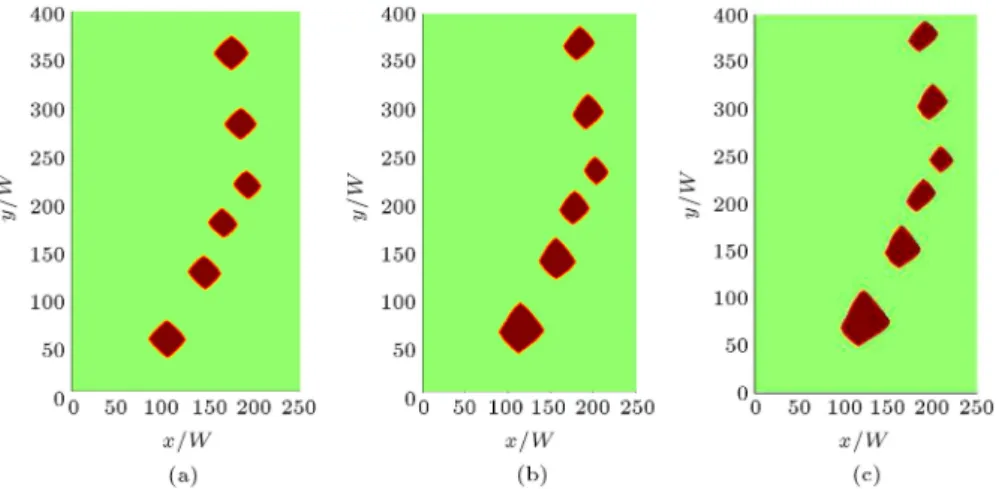
as reported in [8]. Figure 1 shows the morphology of the Al3Sc precipitates after 16000, 38000, and 48000
time cycles. The shape variations of the coherent pre-cipitates are understood by comparing these pictures. As we can see, the precipitate particles evolve from a spherical shape to cubic shapes, Figure 1(a). According to experimental investigations of Al3Sc evolution [8],
coherency loss usually occurs when the precipitate size is large enough. For precipitate radius greater than 20 nm, mist dislocations are observed, which result in coherency loss, while precipitates with 5 nm of size are coherent [8]. Marquis et al. [8] have observed loss of coherency, detected from the presence of interfacial dislocations, when the precipitate size reaches about dcr = 40 nm in diameter, where dcr is dened as a
critical diameter for loss of coherency. In the presented
simulation, we have imposed the perfect coherency between the Al and Al3Sc phases until the end of the
simulation time. The precipitate cuboids in Figure 1(a) have about 40 nm size. After that cuboids reach this critical value in diameter, a change in the pre-cipitates' shape of trapezoids is observed, Figure 1(b) and (c), which is not a usual shape in precipitate growth. This morphology change can be interpreted as the inuence of the coherency strain between the matrix and precipitates, which is still applied in the phase-eld model after that the cuboidal size reaches dcr. This veries the founding about coherency loss
of precipitates reported in [8]. Therefore, a loss of coherency should be imposed on the model after a specic time.
To elucidate the eects of strain energy on pre-cipitate evolution, we have performed a series of runs with dierent mists, m. The initial conditions are
the same as those of the previous simulation. Figure 2 represents the morphology of Al3Sc phase after 8000
time steps for = 0:01, 0.02, and 0.04. For m =
0:01, cuboidal precipitates are observed, while for larger values of mist, i.e. m = 0:04 and 0.06, the
cuboidal shapes are changed to some trapezoids and some cup-like structures, respectively. This means that the increase in precipitates radius is accelerated with increasing the mist parameter. Therefore, the elastic interactions play a role in the evolution of precipitates.
Figure 1. Evolution of the Al3Sc precipitate in Al-Sc alloy with m= 0:0125. The microstructure at (a) t = 16000 cycles,
(b) t = 38000 cycles, and (c) t = 48000 cycles.
Figure 2. Eects of mist strain on evolution of the Al3Sc precipitate in Al-Sc alloy at t = 8000 cycles: (a) m= 0:01, (b)
We have also calculated the elastic stress and dis-placements in the evolution of Al3Sc phase. The elastic
displacements u1 and u2 are obtained by solving the
mechanical equilibrium equation, Eq. (16). Figure 3 shows the displacements u1and u2 for m= 0:0125 at
t = 8000 cycles. The components of stress tensor are given in Eq. (10). The normal stress 11is illustrated in
Figure 4(a). In Figure 4(b), we have plotted the three
Figure 3. Elastic displacements in evolution of Al3Sc
precipitate at t = 8000 cycles and m= 0:0125: (a) The
displacements u1; and (b) the displacement u2.
Figure 4. (a) The stress component 11in evolution of
Al3Sc precipitate with m= 0:0125. (b) The plot of three
stress components.
stress components 11, 12, and 22along y=W = 100,
where the interface of the precipitates and the matrix is demonstrated by a sharp change in stress values (from positive to negative values). The normalized value of 11changes between -0.11 to 0.15 between the
precipitates and the matrix; that of 22 varies from
-0.03 to 0.1, and 12 from zero to 0.1.
Formation of coherent rod-like precipitates of Al3Sc has been reported in some experimental
stud-ies [8,5]. Therefore, we have performed some simu-lations of precipitate particles organized in an array. Figure 5 illustrates the evolution of an array of Al3Sc
precipitates with m = 0:0125. The rod-like
nano-structure after 8000, 24000, and 36000 time steps is presented in this gure. The initial spherical particles of Al3Sc with radius of r0 = 2 nm evolve to cuboids,
Figure 5(a). One can see that the cuboids at the ends of the rod have the largest size, while those in the middle of the rod have the smallest diameter. This diameter variation is due to the coherency between the Al3Sc
precipitates and Al matrix and one can understand that elastic interactions between these closely spaced precipitates play a role.
When the rst cuboid in the array reaches about 40 nm in diameter, its shape changes to trapezoid (Figure 5(b)). After that, the height of this trapezoid increases in time. Since formation of trapezoid precipi-tates is not reported in the literature, we can conclude that a coherency loss is required when the precipitate size reaches a specic value. Another interesting observation in Figure 5 is that the smallest cuboid (the third one from the top) has retained its cubic shape during the simulation. This also veries the dependence of the elastic interactions on precipitate's size during the evolution of Al3Sc phase.
The eect of mist strain on evolution of rod-like structures of Al3Sc is shown in Figure 6, where the
array of precipitates is evaluated for three values of mists, m = 0:01, 0.02, and 0.04. The acceleration
Figure 5. Evolution of Al3Sc and array of cuboidal precipitates in Al-Sc alloy with m= 0:0125. The microstructure at
Figure 6. Eects of mist strain on evolution of the rod-like Al3Sc precipitates. The array of cuboidal precipitates in
Al-Sc alloy is presented: (a) m= 0; (b) m= 0:02; and (c) m= 0:04.
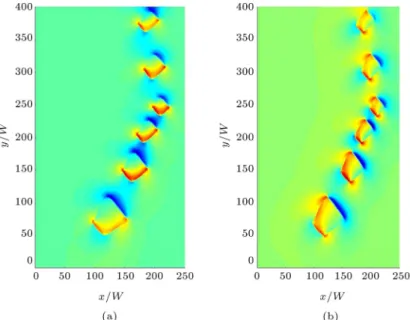
Figure 7. Elastic displacements in an array of cuboidal Al3Sc precipitates with m= 0:0125: (a) The displacements u1;
and (b) displacement u2.
of growth kinetics with increasing the mist strain is observed here as well.
At the end of the presented study, we have evaluated the mechanical displacements and stresses in the rod-like structure. The two displacements u1 and
u2 are illustrated in Figure 7 for m = 0:0125. The
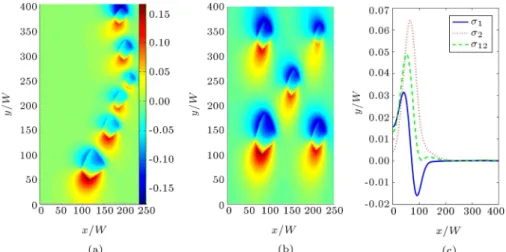
normal stresses, 11 and 22, for the same simulation
are shown in Figure 8(a) and (b), respectively. Stress components are plotted along the line y=W = 100 in Figure 8(c).
Finally, the eect of mist strain on normal stress 11in the rod-like structure is investigated. Three runs
with m = 0:02, 0.04, and 0.06 are carried out and
the corresponding stress elds are plotted in Figure 9. Obviously, the value of 11increases with increasing the
mist strain. Hence, the elastic interactions between
the precipitates and the matrix will increase. 4. Summary and conclusion
We have used an elastic phase-eld model to investigate the evolution of nano-structure Al3Sc precipitates in
Al-Sc alloy. The eects of elastic interactions on formation of Al3Sc precipitates have been studied. The
simulation results have detected a coherency loss after that the precipitates size reaches a specic value, which is in agreement with previous experimental studies. We have also shown that elastic energy plays a role in evolution of the Al3Sc phase. We have observed
that the spherical precipitates are changed to cuboids due to the coherency between the matrix and the precipitates. The rod-like structures of Al3Sc phase
Figure 8. (a) and (b) The stress components of 11, and 22, respectively, in evolution of Al3Sc precipitate with
m= 0:0125. (c) The plot of three stress components.
Figure 9. The eect of mist strain on stress component 11: (a) m= 0:02; (b) m= 0:04; and (c) m= 0:06.
have also been investigated in this study. Finally, the eects of mist strain on the array of cuboids and the related stress components and elastic displacements have been evaluated.
References
1. Phillips, M.A., Clemens, B.M. and Nix, W.D. \Microstructure and nanoindenta- tion hardness of Al/Al3Sc multilayers", Acta Mater., 51, pp. 3171-3184 (2003).
2. Jindal, V., De, P.K. and Venkateswarlu, K. \Eect of Al3Sc precipitates on the work hardening behavior of aluminumscandium alloys", Mater. Lett., 60, pp. 3373-3375 (2006).
3. Fazeli, F., Poole, W.J. and Sinclair, C.W. \Modeling the eect of Al3Sc precipitates on the yield stress and work hardening of an AlMgSc alloy", Acta Mater., 56, pp. 1909-1918 (2008).
4. Haidemenopoulos, G.N., Katsamas, A.I. and Kamout-si, H. \Thermodynamics-based computational design of Al-Mg-Sc-Zr Alloys", Metall. and Mater., Trans. A, 41A, pp. 888-899 (2010).
5. Norman, A.F., Prangnell, P.B. and McEWEN, R.S. \The solidication behavior of dilute aluminum-scandium alloys", Acta Mater., 46(16), pp. 5715-5732 (1998).
6. Novotny, G.M. and Ardell, A.J. \Precipitation of Al3Sc in binary AlSc alloys", Mater. Sci. and Eng., A, 318, pp. 144-154 (2001).
7. Davydov, V.G., Rostova, T.D., Zakharov, V.V., Fi-latov, Y.A. and Yelagin V.I. \Scientic principles of making an alloying addition of scandium to aluminum alloys", Mater. Sci. and Eng., A, 280(1), pp. 30-36 (2000).
8. Marquis, E.A. and Seidman, D.N. \Nanoscale struc-ture evolution of Al3 Sc precipitates in Al(Sc) alloys", Acta Mater., 49, pp. 1909-1919 (2001).
9. Fratzl, P., Penrose, O. and Lebowitz, J.L. \Modeling of phase separation in Alloys with coherent elastic mist", J. of Stat. Phy., 95(5), pp. 1429-1503 (1999).
10. Thornton, K., Agren, J. and Voorhees, P.W. \Model-ing the evolution of phase boundaries in solids at the meso- and nano-scales", Acta Mater., 51, pp. 5675-5710 (2003).
11. Echebarria, B., Folch, R., Karma, A. and Plapp, M. \Quantitative phase-eld model of alloy solidication", Phys. Rev. E, 70, p. 061604 (2004).
12. Tiaden, J., Nestler, B., Diepers, H.J. and Steinbach, I. \The multiphase-eld model with an integrated concept for modeling solute diusion", Physica D., 115, pp. 73-86 (1998).
13. Qin, R.S. and Bhadeshia, H.K. \Phase eld method", Mater. Sci. and Technol., 26(7), pp. 803-811 (2010).
14. Wang, Y., Banerjee, D., Su, C.C. and Khachaturyan, A.G. \Field kinetic model and computer simulation of precipitation of L1 2 ordered intermetallics from f.c.c. solid solution", Acta Mater., 46(9), pp. 2983-3001 (1998).
15. Folch, R. and Plapp, M. \Quantitative phase-eld modeling of two-phase growth", Phys. Rev. E, 72, p. 011602 (2005).
16. Ebrahimi, Z., Rezende, J.L. and Kundin, J. \Phase-eld modeling of microelastically controlled eutectic lamellar growth in a TiFe system", J. of Cryst. Growth, 349, pp. 36-42 (2012).
17. Ebrahimi, Z., Rezende, J.L. and Emmerich, H. \Phase-eld modeling of Eu- tectic growth in a Ti-Fe system with multiple nuclei and misorientations", Metall. Mater. Trans. A, 44, pp. 1925-1936 (2013).
18. Karma, A. and Rappel, W.J. \Quantitative phase-eld modeling of dendritic growth in two and three dimensions", Phys. Rev. E, 57, pp. 4323-4349 (1998).
19. Duan, Y.H., Sun, Y., Peng, M.J. and Zhou, S.G. \Ab-initio investigations on elastic properties in L12 structure Al3Sc and Al3Y under high pressure", J. of Alloys Compd., 585, pp. 587-593 (2014).
20. Hu, W.C., Liu, Y., Li, D.J., Zeng, X.Q. and Xu, C.S. \Mechanical and thermo-dynamic properties of
Al.sub.3Sc and Al.sub.3Li precipitates in Al-Li-Sc alloys from rst-principles calculations", Physica B, 427, pp. 85-90 (2013).
Biographies
Zohreh Ebrahimi received the BE degree in Mechan-ical Engineering from Shiraz University in 2004 and the MSc degree in Mechanical Engineering from Stuttgart University, Germany, in 2007. She has performed her Master Thesis in conjugation with German Aerospace Center (DLR) in Stuttgart. She received her PhD degree from RWTH Aachen University of Technology in November 2010 in Germany; her thesis was on development of a micromechanical phase-eld model of eutectic growth. She is an expert in the area of phase-eld modeling and has a variety of publications in this respect. Since January 2011, she has joined the Depart-ment of Engineering at Payame Noor University where she is currently an Assistant Professor in Mechanical Engineering group. Her research interests include dif-ferent applications of the phase-eld model, modeling and simulation, nite element modeling, damage and impact mechanics, fracture mechanics during fatigue and creep, elasticity and plasticity in material systems, and micro- and nano-mechanics.
Hosein Ebrahimi received the BE degree in Material Science and Engineering from Shiraz University in 2013. He was awarded as the best student as he graduated from Shiraz University. He received the MSc degree from Sharif University of Technology in Tehran, in December 2015, in the Department of Ma-terial Science and Technology; he obtained the highest records in his studies. His main research interests include modeling of material systems, nite element modeling, numerical simulations, metal forming, and material characterization.