ARTIGO ORIGINAL
RESUMO
Introdução: A Convenção sobre os Direitos das Crianças e normas nacionais da Direção Geral da Saúde conferem aos adolescentes
o direito às decisões sobre a sua saúde. O objectivo deste estudo foi identificar as dinâmicas de implementação do assentimento e do consentimento informado, em ambiente hospitalar.
Material e Métodos: Estudo transversal e multicêntrico realizado a partir de inquéritos. Incluídos adolescentes dos 14 aos 18 anos e pais respectivos. Foram ainda entrevistados os diretores de serviço e assistentes hospitalares.
Resultados: Obtiveram-se 194 respostas de adolescentes e pais e efetuaram-se 46 entrevistas a médicos e diretores dos serviços.
Adolescentes e pais consideram importante a participação no processo de decisão mas os pais valorizam de forma significativamente superior a sua participação (91,7% vs 47,8%, p < 0,001 no grupo 14 - 15 anos; 91,8% vs 53,1%, p = 0,001, no grupo 16 - 17 anos), bem como a do médico (89,6% vs 69,6%, p = 0,016 no grupo 14 - 15 anos; 91,8% vs 69,4%, p = 0,005 no grupo 16 - 17 anos). Os folhetos informativos são pouco perceptíveis pelos adolescentes. Os oito diretores consideraram que os médicos estão sensibilizados para comunicar com os adolescentes mas têm pouco tempo disponível. Dos 38 assistentes, 36 afirma ter aprendido com os colegas mais velhos e confirmam lacunas na formação pós graduada.
Discussão: Este estudo pioneiro em Portugal permitiu a identificação de áreas passíveis de otimização, através de programas da
educação para a saúde para pais e adolescentes, informação escrita adequada à idade e formação no ensino pré graduado para estudantes de Medicina e educação nas instituições de saúde para os profissionais.
Conclusão: Os adolescentes e pais desconhecem as normas legais e éticas quanto ao consentimento e assentimento. Não fica
demonstrada a implementação do direito dos adolescentes ao assentimento informado / consentimento informado. Propõem-se pro-gramas locais de sensibilização para adolescentes e pais.
Palavras-chave: Adolescente; Consentimento Informado; Pais; Pessoal de Saúde; Portugal; Tomada de Decisões
Informed Consent - Vision and Perspectives of Adolescents,
Parents and Professionals: Multicentric Study in Six
Hospitals
Consentimento Informado - Visão e Perspetivas de
Adolescentes, Pais e Profissionais: Estudo Multicêntrico
em Seis Hospitais
1. Departamento de Pediatria. Faculdade de Medicina de Lisboa. Lisboa. Portugal. 2. Serviço de Pediatria. Hospital Beatriz Ângelo. Loures. Portugal.
3. Serviço de Pediatria Médica. Hospital Santa Maria. Lisboa. Portugal. 4. Departamento de Pediatria. Hospital Pediátrico de Coimbra. Coimbra. Portugal. 5. Serviço de Pediatria. Hospital de Faro. Faro. Portugal.
6. Serviço de Pediatria. Hospital do Espírito Santo. Évora. Portugal. 7. Serviço de Pediatria Médica. Hospital de S João. Porto. Portugal. 8. Consultora Independente para os Direitos da Criança. Portugal.
Autor correspondente: Maria do Céu Machado. [email protected]
Recebido: 22 de maio de 2018 - Aceite: 20 de dezembro de 2018 | Copyright © Ordem dos Médicos 2019
Maria do Céu MACHADO1, Rodrigo SOUSA2, Rosário STONE1,3, Maria Inês BARRETO4, Filipa GARCÊS5, Carla CRUZ6, Susana GOMES6, Mariana RODRIGUES7, Ana Isabel GUERREIRO8
Acta Med Port 2019 Jan;32(1):61-69 ▪ https://doi.org/10.20344/amp.10826
ABSTRACT
Introduction: According to the Convention on the Rights of Children and the national standards of the Portuguese Directorate-General for Health, adolescents have the right to make decisions about their own health. The aim of this study was to identify the dynamics of the implementation of assent and informed consent in hospital settings.
Material and Methods: Cross-sectional and multicentre study based on surveys, which included adolescents from 14 to 18 years and
their parents. Heads of departments of Pediatrics and attending physicians were also interviewed.
Results: 194 responses from adolescents and parents were collected, and 46 interviews were conducted with physicians and heads
of department. Adolescents and parents consider participation in decision making important, but parents value their own participation significantly higher (91.7% vs 47.8%, p < 0.001 in the 14 - 15 year group, 91.8% vs 53, (89.6% vs 69.6%, p = 0.016 in the 14 - 15 year group, 91.8% vs 69.4%, p = 0.005 in the 16 - 17 years group). Information leaflets are difficult to understand by teenagers. The eight heads of department felt that doctors have awareness towards communication with teenagers but have little time available. Of the 38 attending physicians, 36 said they had learned from their older colleagues and confirmed gaps in postgraduate training.
Discussion: This pioneering study in Portugal enabled the identification of areas that can be optimized, through health education
programs for parents and adolescents, written information that is adequate to the different age groups, training in undergraduate education for medical students and also education in health institutions for professionals.
Conclusion: Adolescents and parents, are unaware of legal and ethical standards for consent and assent. The implementation of
the adolescents’ right to informed assent / informed consent was not observed. Our proposal is to implement local programs for adolescents and parents.
ARTIGO ORIGINAL INTRODUCTIONThe 25th anniversary of the ratification of the Convention on the Rights of the Child was celebrated by the Portuguese Parliament in 2015. A reflection on the implications of the Convention in Portugal is therefore very relevant, namely regarding the implementation of meaningful shared deci-sion making (SDM) in clinical settings.1,2
The patient’s right to informed consent (IC) from the age of 16 has been already approved by different Euro-pean countries including Portugal, Spain, The Netherlands, Poland and Norway.3 The capacity to consent a medical intervention is ensured under the article 38, no.3 of the Portuguese Criminal Code to all minors aged 16 with the adequate discernment to assess the sense and range of consent at the time when it has been provided.4
Consent or refusal of a proposed diagnostic or thera-peutic action can be given by any minor aged 16 and over and with the necessary discernment to assess its sense and range, as considered in the norm 15/2013 of the Portu-guese Directorate-General of Health (DGS).5
The use of patient’s age to define whether an adoles-cent has the ability or not to give consent is measurable and objective, even though individual variability is not taken into account. Empiric research has allowed for the implementa-tion of standard instruments aimed at the assessment of child’s capacity to consent, from which the modified Mac-Arthur Competence Assessment Tool for Clinical Research (MacCAT-CR) is an example. The application of this scale has shown that, from the age of 11.2, a child can probably be considered decision-making competent6 wherefore Hein
has proposed that patient’s informed assent (IA) should be replaced by consent in clinical trials from the age of 12.7 There is a trend towards a progressive autonomy of minors in health and not only beyond any pre-established age,9 according to the recommendations of the Committee on the Rights of the Child8 and the European Convention on Human Rights and Biomedicine.10 In England, the practice
of consent based on the minor’s capacity was introduced following the case Gillick vs. West Norfolk and Wisbech (1986). A child/adolescent with adequate maturity and intel-ligence to fully understand the nature and outcomes of a proposed intervention should also have the capacity to con-sent the same intervention is a summary of the concept of ‘Gillick’s competence’,11 which has been gradually applied
in Northern Ireland, England, Scotland and Wales.3 Even though the right to IC has been laid down in na-tional and internana-tional legislation, current studies on hospi-tal practice have shown an experience of youngsters which was variable between hospitals and within the same hos-pital.12,13 Gaps in communication with hospitalised children have been described by different studies.4,15-17
Children education and culture, the attitude and role of parents/caregivers, communication ability, available work-ing time and the own physician’s knowledge and awareness are included amongst the major factors with an influence on the process of obtaining an IA or IC.13, 17-19
This was a prospective study with Portuguese
adoles-cents and their parents/caregivers, supplemented by an in-terview with physicians from different hospital departments, aimed at understanding the dynamics regarding the imple-mentation of in-hospital right of adolescents aged 14-15 and 16-17 to IA and IC, respectively.
MATERIAL AND METHODS
This was a cross-sectional multi-centric study devel-oped from ad hoc research surveys based on instruments of evaluation in hospital environment and previously applied in international studies.20
The study took place at admission and in outpatient units from six departments of paediatrics at the Hospital de Santa Maria (HSM), São João (HSJ), Pediátrico de Coim-bra (HPC), Espírito Santo de Évora (HES), Faro (HF) and Instituto Português de Oncologia de Lisboa (IPO) between July 2015 and August 2016.
Adolescents aged 14-18 and their parents/caregivers were included in the study. At the same time, heads of de-partment and consultant paediatricians and consultants of other paediatric specialties were interviewed based on a specific questionnaire.
Adolescents aged 14 to 15 and 364 days (described as group G14-15) were asked to complete a questionnaire on informed assent and those aged 16 to 17 and 364 days (de-scribed as group G16-17) to complete a questionnaire on informed consent, in order to understand their perception on the information and communication with healthcare pro-fessionals. The same was autonomous and independently asked to parents/caregivers.
Data were analysed by use of the SPSS (version 20.0; SPSS Inc., Chicago, IL) software. Statistical significance of the associations was assessed through the application of chi-square test and Fisher’s exact test, whenever appropri-ate. Values of p < 0.05 were considered as statistically sig-nificant.
Research team was coordinated by the Department of Paediatrics of the Hospital de Santa Maria and the research project was submitted to the Ethics Committee of the Cen-tro Académico de Medicina de Lisboa (including HSM and the Faculty of Medicine of the University of Lisbon) and ap-proved in February 2015.
RESULTS Global
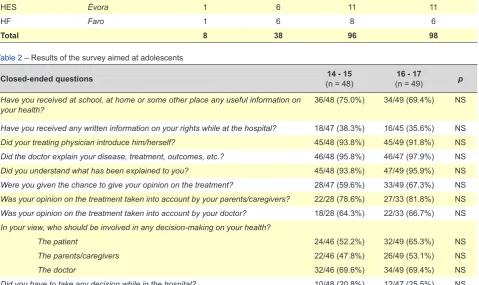
A total of 194 responses to the questionnaire aimed at adolescents and parents/caregivers were obtained and 46 physicians and heads of department were interviewed. Data on the global sample of 240 respondents are shown in Table 1.
Positive results are shown in Table 2, 3, 4 and 5. Responses from all the centres and the different groups were obtained, despite the non-homogeneous distribution.
Adolescents aged 14-18
ARTIGO ORIGINAL G14-15 (49.5%) and 49 (50.5%) in G16-17 (Table 2).
Adolescents (mainly in G14-15) have described having been provided with useful information on their health, at school or at home.
Approximately 1/3 of them were provided at the hospital with written information on their rights and more than 90% have described that the physician presented him/herself and explained things in an understandable way, including the patient’s clinical situation and the proposed intervention, with no significant differences between both groups. More than half of respondents in G14-15 (59.6%) and around 2/3 in the G16-17 (67.3%) had the opportunity to give their opinion on the treatment, even though with a dif-ferent awareness on having been heard and their assent (younger group) or consent (older group) having been taken into account (78.6% vs. 81.8% by the parents and 64.3% vs. 66.7% by physicians), with no statistical significance. Around half of the adolescents have described as be-lieving that parents should have a participation in the pro-cess and around 2/3 have valued the inclusion of physi-cians, with no significant differences between the groups. Respondents in group G16-17 have valued more highly
their participation in SDM when compared to those in G14-15 (65.3% vs. 52.2%), with no statistically significant differ-ences. Meaningful SDM was described by only 20.8% of the younger adolescents and 25.5% of the older during their stay in the hospital.
Parents/caregivers of adolescents aged 14-18
Questionnaires were sent over to 97 parents/caregiv-ers, 48 in G14-15 and 49 in G16-17 (Table 3) – 74 mothers (76.3%): 37 (77.1%) in G14-15 and 37 (75.5%) in G16 - 17. Most parents/caregivers in both groups have considered as having been provided with comprehensible explanations by physicians regarding their children’s clinical condition. In addition, most of them have considered that physicians have adequately explained the situation to patients. A posi-tive perception on the written information that was provided during the patient’s hospital stay has been described by around 60% of G14-15 parents and 50% of the G16-17 par-ents.
Approximately 2/3 of the parents/caregivers in both groups have described that patients had the opportunity to give their opinion on the treatment. According to parents/
Table 1 – Distribution of the group of respondents by centre and subgroup (n = 240)
Hospital City
Heads of department
(n = 8) Consultants (n = 38)
Adolescents + parents/caregivers 14 - 15
(n = 48+48) (n = 49+49)16 - 17
HSM Lisboa 3 9 4 6
IPO Lisboa 1 6 4 0
HSJ Porto 1 5 12 10
HPC Coimbra 1 6 9 16
HES Évora 1 6 11 11
HF Faro 1 6 8 6
Total 8 38 96 98
Table 2 – Results of the survey aimed at adolescents
Closed-ended questions (n = 48)14 - 15 (n = 49)16 - 17 p
Have you received at school, at home or some other place any useful information on
your health? 36/48 (75.0%) 34/49 (69.4%) NS
Have you received any written information on your rights while at the hospital? 18/47 (38.3%) 16/45 (35.6%) NS
Did your treating physician introduce him/herself? 45/48 (93.8%) 45/49 (91.8%) NS
Did the doctor explain your disease, treatment, outcomes, etc.? 46/48 (95.8%) 46/47 (97.9%) NS
Did you understand what has been explained to you? 45/48 (93.8%) 47/49 (95.9%) NS
Were you given the chance to give your opinion on the treatment? 28/47 (59.6%) 33/49 (67.3%) NS
Was your opinion on the treatment taken into account by your parents/caregivers? 22/28 (78.6%) 27/33 (81.8%) NS
Was your opinion on the treatment taken into account by your doctor? 18/28 (64.3%) 22/33 (66.7%) NS
In your view, who should be involved in any decision-making on your health?
The patient 24/46 (52.2%) 32/49 (65.3%) NS
The parents/caregivers 22/46 (47.8%) 26/49 (53.1%) NS
The doctor 32/46 (69.6%) 34/49 (69.4%) NS
ARTIGO ORIGINAL caregivers, this opinion was taken into account in 80 and 75% of the situations, respectively in G14-15 and G16-17. In addition, these have considered that physicians took into account the patient’s opinion in slightly above 60% of the cases. Approximately 40% of the parents in both groups have described as having had to take some oral or written decision regarding their children’s treatment.
As regards SDM in group G14-15, the role of physicians, as well as the role of parents/caregivers have been valued by approximately 90% of the parents/caregivers in both groups. The role of adolescents in SDM was considered as important by slightly more than 55% of parents/caregivers in both groups.
As regards SDM in group G16-17, similar response rates were obtained regarding the role of parents/caregiv-ers and physicians (around 90%), while an increasing rate has been found regarding the role of adolescents in SDM (68.1% of parents/caregivers in G14-15 and 75.5% of par-ents/caregivers in G16-17).
Physicians
Heads of department
Eight heads of department [including departments of paediatrics (5), neonatology (1), paediatric surgery (1) and medical genetics (1)] were interviewed (Table 4).
The presence of guidelines regarding IC and IA was described by seven, while their monitoring was described by six heads of department. The presence of awareness raising initiatives was described in four departments and actions on SDM were described in five. All heads of depart-ment have considered that healthcare professionals have the adequate training and awareness to communicate with adolescents, even though with not enough working time to do this.
Consultants
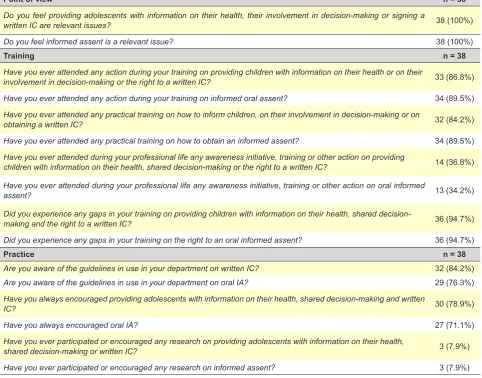
A total of 38 consultants (31 paediatricians, 2 neonatolo-gists and 5 paediatric surgeons) were interviewed (Table 5). Providing adolescents with information, SDM and writ-ten IC and oral IA were all considered by all respondents
Table 3 – Results of the survey aimed at parents/caregivers
Closed-ended questions (n = 48)14 - 15 (n = 49)16 - 17 p
Have you received any written or useful information on your rights? 29/47 (61.7%) 25/49 (51%) NS
Has your child’s treating physician explained the disease, treatment, outcomes, etc.? 47/48 (97.9%) 44/47 (93.6%) NS
Have you understood what has been explained to you? 46/46 (100%) 48/49 (98%) NS
Has the doctor explained to your child his/her disease, treatment, outcomes, etc.? 48/48 (100%) 48/49 (98%) NS
In your view, was the doctor able to speak with your child in a way that he/she could
understand? 47/47 (100%) 45/47 (95.7%) NS
Was your child provided the opportunity to be heard on the treatment? 31/48 (64.6%) 32/47 (68.1%) NS
Have you taken into account your child’s opinion? 22/31 (80.0%) 24/32 (75.0%) NS
Was your child’s opinion taken into account by the doctor? 19/31 (61.3%) 20/32 (62.5%) NS
Were you asked to give any oral or written decision regarding the treatment of your
child? 20/48 (41.7%) 20/48 (41.7%) NS
In your view, who should be involved in any decision-making on the health of adolescents aged 14 to 15 and 364 days?
The patient 28/48 (58.3%) 27/49 (55.1%) NS
The parents/caregivers 44/48 (91.7%) 46/49 (93.9%) NS
The doctor 43/48 (89.6%) 45/49 (91.8%) NS
In our view, who should be involved in any decision-making on the health of adolescents aged 15 to 16 and 364 days?
The patient 32/47 (68.1%) 37/49 (75.5%) NS
The parents/caregivers 43/47 (91.5%) 45/49 (91.8%) NS
The doctor 42/47 (89.4%) 45/49 (91.8%) NS
Do you feel shared decision making with adolescents aged 14 to 15 and 364 days is
a relevant issue? 40/46 (87%) 31/48 (64.6%) NS
Do you feel shared decision making with adolescents aged 16 to 17 and 364 days is
a relevant issue? 44/47 (93.6%) 40/49 (81.6%) NS
Is your child usually involved in any family decision (leisure, holidays, type of meals,
ARTIGO ORIGINAL
as very relevant. Undergraduate training and experience on written IC and oral IA during their specialty training and/or postgraduate training were described by most respondents. The participation in awareness raising initiatives on IC and AI was only described by 30% and the presence of
gaps in training on this subject was described by 36 out of 38 (94.7%) respondents.
The awareness of department guidelines on written IC (84.2%) and oral IA (76.3%) has been described by most respondents. Awareness raising, SDM and obtaining IC and
Table 4 – Results of the questionnaire aimed at heads of department
Guidelines and monitoring n = 8
Is there any guideline in use in your department on written IC and oral IA? 7
Is there any ongoing monitoring of the effective implementation of IC in the department? 6
Training and practice n = 8
Were the guidelines on IC ever disclosed to physicians over the past five years? 8 Were the guidelines on IA ever disclosed to physicians over the past five years? 7 Was any awareness-raising initiative ever carried out in your department over the past five years on providing adolescents
access to their health information? 4
Was any awareness-raising initiative ever carried out in your department over the past five years on providing adolescents
access to shared decision-making or the right to a written IC? 5
Was any awareness-raising initiative ever carried out in your department over the past five years on providing adolescents
access to the right to oral IA? 5
Is your clinical staff adequately trained to communicate with adolescents? 8
Do your clinical staff have the adequate available working time to communicate with adolescents? 5
Table 5 – Results of the questionnaire aimed at consultants
Point of view n = 38
Do you feel providing adolescents with information on their health, their involvement in decision-making or signing a
written IC are relevant issues? 38 (100%)
Do you feel informed assent is a relevant issue? 38 (100%)
Training n = 38
Have you ever attended any action during your training on providing children with information on their health or on their
involvement in decision-making or the right to a written IC? 33 (86.8%)
Have you ever attended any action during your training on informed oral assent? 34 (89.5%)
Have you ever attended any practical training on how to inform children, on their involvement in decision-making or on
obtaining a written IC? 32 (84.2%)
Have you ever attended any practical training on how to obtain an informed assent? 34 (89.5%)
Have you ever attended during your professional life any awareness initiative, training or other action on providing
children with information on their health, shared decision-making or the right to a written IC? 14 (36.8%)
Have you ever attended during your professional life any awareness initiative, training or other action on oral informed
assent? 13 (34.2%)
Did you experience any gaps in your training on providing children with information on their health, shared
decision-making and the right to a written IC? 36 (94.7%)
Did you experience any gaps in your training on the right to an oral informed assent? 36 (94.7%)
Practice n = 38
Are you aware of the guidelines in use in your department on written IC? 32 (84.2%)
Are you aware of the guidelines in use in your department on oral IA? 29 (76.3%)
Have you always encouraged providing adolescents with information on their health, shared decision-making and written
IC? 30 (78.9%)
Have you always encouraged oral IA? 27 (71.1%)
Have you ever participated or encouraged any research on providing adolescents with information on their health,
shared decision-making or written IC? 3 (7.9%)
ARTIGO ORIGINAL IA have been described by around 3/4 of respondents. Only 7.9% of physicians have participated in research.
Shared decision making in clinical settings: adoles-cents and parents/caregivers
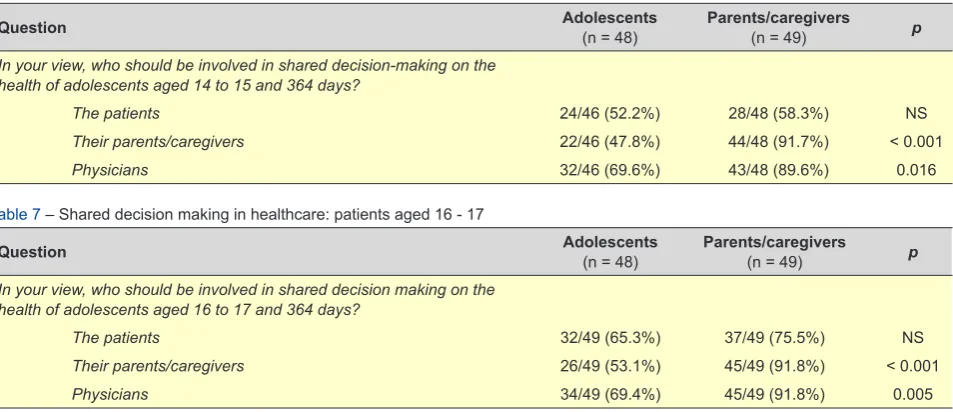
SDM was valued in a similar way by G14-15 patients and their parents, according to a sub-analysis of responses (Table 6).
Nevertheless, SDM with parents (91.7% vs. 47.8%; p < 0.001) and physicians (89.6% vs. 69.6%; p = 0.016) was significantly more valued.
Similar results were found in group G16-17, in which SDM with parents (91.8% vs. 53.1%; p < 0.001) and with physicians (91.8% vs. 69.4%; p = 0.005) was significantly more valued (Table 7).
DISCUSSION
The informed consent and its application to the paedi-atric population is the greatest ethical challenge in the past few decades.
This was the first Portuguese study on the perspective of parents and physicians regarding IC in adolescents and has bridged one important gap in national research. The conclusions of less specific studies on the assessment of the right of the child at the hospital were confirmed by re-sults, namely those regarding the discrepancy between ex-isting policies, knowledge and practice of healthcare profes-sionals, as well as the experience of adolescents and their parents/caregivers.21-24
According to the commitment of the Portuguese govern-ment regarding the ratification of the Convention of the Right of the Child and the Oviedo Convention, all children should have access to the same rights. Therefore, not only the ap-plication of the right of the child to be heard corresponds to the presence of legislation but to the development of norms, the adoption of hospital policies, the adequate training of those involved and the information of adolescents and their parents regarding their rights as well.1
Our results have shown the need for the implementation of the signed conventions and the legislation in force. The development of inter-institutional national committees with the representation of the Ministry of Health and Science and of the National Ombudsman among others has been recommended by the World Health Organization aimed at the implementation of the right of the child. This task should be carried out through under and postgraduate training, monitoring and assessment of the quality of healthcare, including the right of the child and the creation of partner-ships between cooperation and supervision networks and between hospitals and healthcare centres.24 The results of this research could be included in the regular report of the Portuguese Government to the Committee on the Rights of the Child regarding the achievement of the right of the child in Portugal.25
Everyone within the 0-18 age group is considered as a child, according to the Convention on the Right of the Child and the introduction of age criteria for IC were already rec-ommended in 20091 while even in 1997 a trend towards the
practice of a progressive autonomy of minors in health and not only from a pre-established age was suggested by the European Council.10 The right of patients to freedom and
self-determination is ensured by the Constitution (article 26 of the Constitution of the Portuguese Republic) and is the ethical principle underlying the requirement for an IC in medical practice, according to Beauchamp and Childress (1993).
The age of criminal responsibility has been set at 16 by the Portuguese Criminal Code, while varying age limits as well as other criteria for IC have been set in other countries, reflecting the opinion that physicians are able to assess child’s maturity and consider him/her for SDM from the age of 12.26
The ability of adolescents to understand and protect their own rights was not considered as significantly different between the age of 15 and 21 by Belter and Grisso (1984), suggesting that adolescents aged 15 have full capacity to
Table 6 – Shared decision making in healthcare: patients aged 14 - 15
Question Adolescents(n = 48) Parents/caregivers(n = 49) p
In your view, who should be involved in shared decision-making on the health of adolescents aged 14 to 15 and 364 days?
The patients 24/46 (52.2%) 28/48 (58.3%) NS
Their parents/caregivers 22/46 (47.8%) 44/48 (91.7%) < 0.001
Physicians 32/46 (69.6%) 43/48 (89.6%) 0.016
Table 7 – Shared decision making in healthcare: patients aged 16 - 17
Question Adolescents(n = 48) Parents/caregivers(n = 49) p
In your view, who should be involved in shared decision making on the health of adolescents aged 16 to 17 and 364 days?
The patients 32/49 (65.3%) 37/49 (75.5%) NS
Their parents/caregivers 26/49 (53.1%) 45/49 (91.8%) < 0.001
ARTIGO ORIGINAL understand and exercise their own rights.27
Competence in children is developed in response to their own experiences and expectations and not simply or gradually by phases or ages, according to Alderson, refer-enced by Runeson et al.17
A consensus has been established in many European countries that from the age of 16 an IC should be obtained from adequately informed children while, between age 14 and 16, an informed assent following an appropriate ex-planation should be obtained together with parent’s con-sent.28-30
However, as outlined above, there are other criteria based on maturity and competence of children in the United Kingdom, such as Gillick criteria. In the Australian state of New South Wales, legislation has established that ‘children from the age of 14 are allowed to consent their treatment as long as they adequately understand and evaluate the nature and outcomes of a proposed operation, intervention or treatment’. However, obtaining parent’s or caregiver’s consent in the case of adolescents aged 14-15 is a prudent measure, except in case of patient refusal.3
This study was aimed at understanding whether the law and ethical principles are accepted and complied with in Portuguese departments of paediatrics and also whether physicians had any awareness and knowledge on this mat-ter.
A group of 240 testimonies were included in the study, 194 of which were represented by responses to question-naires aimed at adolescents and parents, in addition to 46 interviews with questionnaires aimed at physicians from six hospital centres, with an irregular distribution. This multi-centric study has shown that sufficient ‘critical mass’ for the international acceptance of this Portuguese research can be obtained from working together.
Globally, even though no major differences were found between both age groups, statistically significant differenc-es in adoldifferenc-escent’s awarendifferenc-ess have been found when the results in adolescents, parents and physicians were ana-lysed.
It is worth mentioning that school and science discipline have been described by respondents in both groups as the main source of health education. However, little information seems to exist in healthcare institutions and restricted to each specific disease. Healthcare institutions should adopt a strategy aimed at improving health literacy of young peo-ple and their parents, in compliance with a comprehensive and outreach medicine as recommended by the WHO. The presence of little organised information on the rights at the hospital has been recognised, almost restricted to ac-credited departments. The charter of the rights of children in the hospital is used as a leaflet, even though this informa-tion is mainly aimed at parents.
The physician’s assertiveness and proactivity is worth emphasizing as more than 90% have presented them-selves and provided a satisfactory explanation on the pa-tient’s clinical situation. No differences were found between both groups.
However, only around 60% from those having under-stood the information could give their opinion and non-significant differences were found between both groups regarding the role of adolescents in their own awareness. Meaningful SDM was only described by only 20 to 25% of adolescents, probably showing that no real chances were given to adolescents, with greater concern found in the group G16-17, in line with what has been described by Coyne and Gallagher.12
Parents/caregivers not always support their children in difficult situations and children are usually informed by the healthcare team on what will happen, with no information on treatment alternatives or without asking for their opinions, as described in the observational study by Runeson et al.13 Adolescents and parents/caregivers have described that their involvement and decision-making capacity depend on the level of maturity, providing a greater responsibility and better compliance with therapy, which is very relevant in pa-tients with chronic disorders.
Compliance with medical recommendations is crucial in every aspect of paediatrics, particularly for a successful out-come, in disease prevention and in health promotion. In this context, Winnick et al. have supported that communication between physicians and patients is a crucial element.31 Most parents/caregivers have received information aimed at themselves rather than at adolescents (30% - 40% vs. 50 - 60%), with a positive perception of satisfaction with the quality of the information, similar to their children. According to parents/caregivers, their children gave more opinions than they would consider. Oral or written de-cisions were taken by less than half of the respondents. No progression has been found from the age of 14 to 16 regarding an effective decision making, both in the group of adolescents and parents. It is worth mentioning that parents/caregivers of the younger adolescents have considered that, at the age of 16, children should be able to decide, which was considered by a lower percentage of parents of the older adolescents. Health and illness seem areas of adolescent infantilisation with a successive post-ponement of accountability by parents.
The role of physicians and of the own adolescents in SDM has been mostly valued by these and it is worth men-tioning that 30% of the adolescents have not included phy-sicians in SDM.
The presence of guidelines, their disclosure and moni-toring has been described by all the heads of department, even though not enough available working time has been recognised as a possible constraint to their implementation. The relevance of this subject has been recognised by all the 38 consultants, while these have mostly described under but not postgraduate specific training and having learned from their own clinical practice as well as from more experienced colleagues. Some have assumed having spo-ken as little as possible with their patients and only where absolutely necessary to obtain an IC.
ARTIGO ORIGINAL the final decision, even though SDM cuts across the groups of parents/caregivers and physicians.
Limitations of the study
This study was carried out in tertiary hospitals involving predominantly patients with chronic diseases, with higher contact with healthcare services and submitted to more in-vasive procedures, probably leading to better results that cannot be extrapolated to the national level.
Patient’s gender was not identified and any gender-re-lated differences would be relevant, due to the presence of a variable maturity between genders.
Parent’s or caregiver’s level of education was not in-cluded in the questionnaire and this could correspond to a possible bias factor.
CONCLUSION
Adolescents, parents/caregivers and physicians are not aware of the legal and ethical norms regarding informed as-sent (IA) and conas-sent (IC) at the age of 14-15 and 16-17, respectively; therefore, a change in the norm is mandatory, including (i) reasoned explanation and the development of programs in secondary schools within the education for health, (ii) information for parents/caregivers in healthcare institutions and (iii) under and postgraduate training for pro-fessionals in order to improve knowledge on the implemen-tation of the right of adolescents to IA/IC.
The implementation of the right of the adolescent to IA/ IC has not been proven and further completion is necessary with a retrospective study of the year of 2017 regarding the involved departments and monitoring of the practice of IA/ IC with the inclusion of other centres.
Leaflets are not appropriate for adolescents and there-fore new leaflets aimed at this age group are needed, in-volving patients with a chronic disease.
Training and awareness of physicians and healthcare professionals can be improved through a training program for medicine students and healthcare professionals with the support of the Sociedade Portuguesa de Pediatria and the
Conselho Nacional de Ética para as Ciências da Vida. Adolescents and parents/caregivers have not enough information and the development of local awareness-raising initiatives is crucial.
The cooperation with national entities for greater har-mony between legislation, professional training, hospital policies and monitoring, assessment and improved accom-plishment of the right of the child is also clearly relevant.
ACKNOWLEDGMENTS
The authors wish to acknowledge all the members of the research team at the different departments of paediat-rics in Portuguese hospitals:Rodrigo Sousa, Maria do Céu Machado, Rosário Stone, Sara Azevedo, Francisca Palha (Hospital Santa Maria), Filipa Garcês and Noémia Silva (Hospital de Faro), Carla Cruz and Susana Gomes (Hospi-tal de Évora), Paulo Fonseca, Maria João Dallot and Maria Inês Barreto (Hospital Pediátrico de Coimbra), António Cal-das Afonso and Mariana Rodrigues (Hospital de S João), Cristina Mendes (IPO de Lisboa), Ana Isabel Guerreiro (in-dependent consultant on the right of the child).
HUMAN AND ANIMAL PROTECTION
The authors declare that the followed procedures were according to regulations established by the Ethics and Clini-cal Research Committee and according to the Helsinki Dec-laration of the World Medical Association.
DATA CONFIDENTIALITY
The authors declare that they have followed the proto-cols of their work centre on the publication of patient data.
CONFLICTS OF INTEREST
The authors declare that there were no conflicts of inter-est in writing this manuscript.
FINANCIAL SUPPORT
The authors declare that there was no financial support in writing this manuscript.
REFERENCES
1. United Nations. Committee on the Rights of the Child. General Comment 12 on the Right of the Child to be heard. Geneva:UN; 2009.
2. United Nations. Committee on the Rights of the Child. General Comment 15 on the right of the child to the enjoyment of the highest attainable standard of health, Geneva:UN; 2013.
3. Guerreiro AIF, Fløtten K. Article 12: The Translation into Practice of Children’s Right to Participation in Health Care: in Liefaard T and Sloth-Nielsen J (eds) Conference Book, The United Nations Convention on the Rights of the Child: Taking Stock after 25 Years and Looking Ahead. Leiden: Leiden University; 2016.
4. Entidade Reguladora da Saúde. Consentimento Informado – Relatório Final. Porto:ERS; 2009.
5. Direcção Geral da Saúde. Norma nº 015/2013 de 03/10/2013 atualizada a 04/11/2015, Lisboa: DGS; 2015.
6. Schaefer LA. MacArthur Competence Assessment Tools. In: Kreutzer JS, DeLuca J, Caplan B, editors. Encyclopedia of Clinical Neuropsychology. New York: Springer; 2011.
7. Hein IM, de Vries MC, Troost PW, Meynen G, van Goudoever JB, Lindauer RJ. Informed consent instead of assent is appropriate in
children from the age of twelve: Policy implications of new findings on children’s competence to consent to clinical research. BMC Med Ethics. 2015;16:76.
8. Assembleia da República (Resolução). Convenção das Nações Unidas para os Direitos das Crianças. Diário da República n.º 211/1990, 1º Suplemento, Série I, Lisboa Setembro 1990.
9. Assembleia da República (Resolução). Convenção para a Protecção dos Direitos do Homem e da Dignidade do Ser Humano face às Aplicações da Biologia, Ser Humano e da Medicina. Diário da República n.º 2/2001, Série I-A, Lisboa Janeiro 2001.
10. Council of Europe. Convention for the Protection of Human Rights and Dignity of the Human Being with regard to the Application of Biology and Medicine: Convention on Human Rights and Biomedicine. Oviedo: CE; 1997.
11. Hastings AM, Redsell S. Listening to Children and Young People in Healthcare Consultations. Oxford: Radcliff Publishing; 2010.
12. Coyne I. Consultation with children in hospital: children, parents’ and nurses’ perspectives. J Clin Nurs. 2006;15:61-71.
ARTIGO ORIGINAL in the Decision-Making Process During Hospitalization: an observational
study. Nurs Ethics. 2002;9:583-98.
14. Livesey L. Children’s experiences as hospital in-patients: Voice, competence and work. Messages for nursing from a critical ethnographic study. Int J Nurs Studies. 2013;50:1292–303.
15. Coyne I, Gallagher P. Participation in communication and decision-making: children and young people’s experiences in a hospital setting. J Clin Nursing. 2011;20:2334-43.
16. Lambert V, Glacken M, McCarron M. `Visible-ness’: the nature of communication for children admitted to a specialist children’s hospital in the Republic of Ireland. J Clinl Nurs. 2008;17:3092-102.
17. Runeson I, Enskar K, Elander G, Hermerén G. Professionals’ perceptions of children’s participation in decision making in healthcare. J Clin Nurs. 2001;10:70-8.
18. Cox ED, Smith MA, Brown RL. Learning to participate: effect of child age and parental education on participation in pediatric visits. Health Commun. 2009;24:249-58.
19. Beresford BA, Sloper P. Chronically Ill adolescents’ experiences of communicating with doctors: a qualitative study. J Adolesc Health. 2003;33:172–9.
20. Guerreiro AIF, Kuttumuratova A, Monolbaev K, Boderscova L, Pirova Z, Weber MW. Assessing and improving children’s rights in hospitals: Case-studies from Kyrgyzstan, Tajikistan and Moldova. Harvard J Health Hum Rights. 2016;18:235-48.
21. Alto Comissariado da Saúde e Comissão Nacional de Saúde Materna, da Criança e do Adolescente. Relatório de resultados: Questionário sobre Consentimento Informado, Acompanhamento de crianças até aos
18 anos de idade e visitas a doentes no internamento hospitalar. Lisboa: ACS, CNSMCA; 2011.
22. World Health Organization Regional Office for Europe. Assessing the respect of children’s rights in hospitals in Moldova. Copenhagen:WHO; 2014.
23. World Health Organization Regional Office for Europe. Assessing the respect of children’s rights in hospitals in Kyrgyzstan and Tajikistan. Copenhagen:WHO; 2014.
24. American Academy of Pediatrics. Informed Consent in Decision-making in Pediatric Practice. Committee on Bioethics. Pediatrics 2016;138:e20161484.
25. Ogando B, García C. Consentimiento informado y capacidad para decidir del niño maduro. Pediat Integral. 2007;11:877-83.
26. Henkelman JJ, Everall RD. Informed consent with children: ethical and practical implications. Can J Counselling. 2001;35:109.
27. American Academy of Pediatrics. Committee on Bioethics. Informed consent, parental permission and assent in pediatric practice. Pediatrics 1995;95:314-7.
28. Davidson AJ, O’Brian M. Ethics and medical research in children. Paediatr Anaesth. 2009;19:994-1004.
29. Committee on Bioethics. Informed Consent, Parental Permission, and Assent in Pediatric. Pediatrics. 1995;95:314-7.
30. Wyatt KD, Lopez GP, Garces JP, Erwin P, Brinkman WB, Montori VM, LeBlanc A. Study protocol: a systematic review of pediatric shared decision making. Syst Rev. 2013;2:48.