Research Article
a
August
2017
Computer Science and Software Engineering
ISSN: 2277-128X (Volume-7, Issue-8)
Effective Methodologies for Enhancing Cloud Management
in New Modern Enterprises
Dr. L. Aruna
Associate Professor, P.G & Research Department of Computer Science, Annai Vailankanni Arts and Science College, Thanjavur, Tamil Nadu, India
DOI: 10.23956/ijarcsse/V7I8/0118
Abstract: Today Cloud computing is altering the way industries and enterprises do their businesses in that with passion scalable and virtualized assets are provided as a service over the Internet. This new model creates a brand new chance for enterprises. In this paper, some of the essential features of effective methodologies for cloud computing in the modern enterprise are briefly discussed with regard to the end-users, enterprises that use the cloud as a platform, and cloud providers themselves. Cloud Computing is capable as one of the main enablers for the all new manufacturing industry, it can transform the usual manufacturing business model, help it to align product innovation with business strategy, and create intelligent factory networks that support successful collaboration. Cloud computing has been in some of the major key areas of manufacturing industries such as IT, pay-as-you-go business models, productions calling up and down per require, and elasticity in deploying and customizing solutions. Clients can use cloud services according to their requirements. Cloud users can request services ranging from product design, manufacturing, testing, management, and all others tags of a product life cycle. Cloud Managed service provider (CMSP) is a company that distantly manages a customer's IT communications and/or end-user systems, typically on a proactive basis and under a subscription model.
Key words: Cloud computing, Cloud Managed service provider, Modern Cloud Enterprise, Cloud Management
Platform.
I. INTRODUCTION
Internet of things and Cloud computing have been identified as key business technology trends that will help to remodel enterprises of worldwide. The manufacturing industry and enterprise is undergoing a major changes enabled by IT and related modern technologies. Cloud computing is one of such modern smart technologies. The main power of Cloud computing is to provide on-demand computing various services with high availability, scalability and reliability in a distributed cloud computing environment. The cloud management network access to a shared pool of configurable computing resources (e.g., networks, servers, storage, applications, and services) that can be rapidly provisioned and released with minimal management effort or service provider interaction. In Cloud computing, everything is treated as a service like (i.e. XaaS), e.g. SaaS (Software as a Service), PaaS (Platform as a Service) and IaaS (Infrastructure as a Service). Implementing cloud computing management means a hypothesis shift of business and IT related infrastructure, where computing power, data storage and services are outsourced to third parties and made available as products to enterprises and customers.
II. ROADMAP FOR THE MODERN CLOUD ENTERPRISE (MCE).
In order to stay lean, organizations need to understand how to optimize costs, make sure proper controls are in place, and minimize waste. We need to ensure that our foundation is strong so that we can go fast and stay safe.
2.1 Cloud First:
Enterprises are adapting to the world of cloud computing the same way that software developers adapted to mobile computing. Just as the “Mobile First” trend saw developers creating applications specifically for native mobile or responsive “mobile friendly” websites, savvy enterprises are taking a “Cloud First” approach to computing resources. storage, public cloud infrastructure is the new norm. “Cloud First” is a smart idea, as businesses can scale up or down as easily as clicking a button. The cloud has the potential to eliminate overhead, waste, security risks, and human error, without the hassles of running a traditional data center. The cloud can also be a major competitive advantage, enabling organizations to stay lean and increase operational efficiencies, mitigate risks, and save money as they grow.
2.2 Modern Enterprises:
ISSN(E): 2277-128X, ISSN(P): 2277-6451, DOI: 10.23956/ijarcsse/V7I8/0118, pp. 133-137
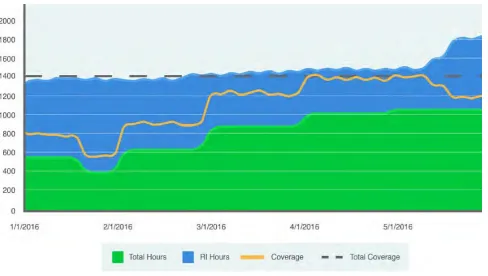
traditional data center issues. Still, moving to the cloud introduces new issues in addition to some familiar ones. For example, Figure-1 shows the represents of modern cloud enterprises using the resources and save money by moving to the cloud. However, it’s still easy to overspend on the cloud, perhaps more easily than with a traditional data center.
Figure 1 Benefits of a Cloud Management Platform(CMP).
This is why modern enterprises need a Cloud Management Platform (CMP). There are a host of benefits that a CMP offers. A CMP can identify when assets could be better allocated to get better efficiency. Moreover, CMPs enable refined security controls, such as minimizing executive privileges, to make sure only a small set of endorsed and current users are able to make changes. Most excellent Practices to optimize your cloud utilization, increase security, and save on our cloud spend. The last thing modern enterprises want is to work with many vendors that don’t integrate with each other. Modern enterprises need to take proactive steps to mitigate risks and prevent threats.
2.3 Cost Management for the Modern Enterprise:
When cloud security is combined with cloud cost management, enterprise organizations can ensure their communications spend goes out of, enabling them to grow the business faster while staying safe and compliant. Modern enterprises embraced the cloud primarily as a way to save money. To growing and evolving set of public cloud services in a dynamic environment can easily get out of hand. To further complicate the cost of the cloud, instances can be purchased at different rates, depending on how and when they are used. When left to persons across different departments, teams, and business units, purchase decisions are less than optimal. The Cloud Checkr cloud running platform unifies charge, security, and inventory management with visibility and aptitude to ease security risks, optimize costs, and increase effective efficiencies across cloud infrastructure.
III. KEY CHALLENGES OF CLOUD MANAGED SERVICE PROVIDER (CMSP)
ISSN(E): 2277-128X, ISSN(P): 2277-6451, DOI: 10.23956/ijarcsse/V7I8/0118, pp. 133-137 3.1 Migration:
The first key challenges of cloud managed service provider are the migration of cloud environment. A fashionable model of cloud acceptance is lift and move migration. Lift and move means that rather than rearchitecting a entire application, an organization migrates the environment as is, then gradually equipment the cloud design values on the architecture. The assumption is that this transition will happen after a quarter may be two. But in reality, once a company migrates a workload to the cloud organization immediately begins using the production environment of the cloud. Some MSP customers maintain older versions of databases and large datasets that ensure data migration remains a never-ending task. The following issues are consider for migration of cloud environment, lack of on boarding, outdated design, inheritance databases, need of planning, and also identifying potential issues, planning ahead and documenting those in advance for the customer, the MSP is guaranteed a smoother transition and a happier customer.
3.2 Inventory Management:
The Second key challenges of cloud managed service provider are the inventory management of cloud environment. The following issues are consider for inventory management of cloud environment, complexity and clear visibility, keeping up-to-date inventory and maintaining compliance. A growing environment in which hundreds of resources are provisioned and decommissioned across an MSP’s customer environment, it is necessary to have proper inventory management controls to ensure complete visibility to locate any issues or gaps in the environment. Initially, to handle this, MSPs began adopting configuration management databases (CMDBs). This is essential to maintaining cloud cost efficiency because they simply can’t manage what they don’t know they have. But, by offering real time data and analytics, modified reporting, and actionable aptitude, MSPs can help their customers identify idle or underutilized resources and achieve their cloud optimization goals.
3.3 Security:
The Third key challenges of cloud managed service provider are the security of cloud environment. The following issues are considering for security of cloud environment, managing disparate security requirements, maintaining control and transparency and identifying potential security issues. Security is very often a concern for organizations who want to move to the cloud. For the MSP, fulfilling every customer’s specific security needs can be challenging as compliance requirements vary from organization to organization, industry to industry. Ideally, the MSP will have their own security and compliance standards rather than attempting to craft out controls based on each customer’s preferences and requests. Another security-related concern for the MSP comes into play when customers or their internal teams (development, operations, security, etc.) make changes to their environments without informing their partners. Identifying possible security risks is a significant accountability for the MSP, who would be wise to assign a committed team to deal with this task.
3.4 Robust Integration and Delivery:
The fourth key challenges of cloud managed service provider are the robust integration and delivery of cloud environment. The following issues are considering for robust integration and delivery of cloud environment are adapting workloads to a different environment, rationalizing the operational lifecycle , maintaining consistent and robust infrastructure. One of the key challenges faced by MSPs revolves around mixing between the customer’s application and cloud principles. The cloud design principle is taking a step by step approach to preparing the cloud customer’s environment so it adheres to standards.
3.5 Meeting the SLA:
The fifth key challenges of cloud managed service provider are the meeting the service level agreement of cloud environment. The following issues are considering for meeting the SLA of cloud environments are meeting SLA obligations, automating procedures and recovery planning. The Service Level Agreement (SLA) signed with each cloud customer, as any violate leads to penalties. As each customer has its own structural design, formation, and model, it is a formidable task to be aware of and informed about every customer’s environment. Automation brings reliability to the system and ensures there are no human errors. The SLA of federated cloud architecture environment is also considered based on the cost, reliable, flexibility, and performance.
3.6 Cost Management:
ISSN(E): 2277-128X, ISSN(P): 2277-6451, DOI: 10.23956/ijarcsse/V7I8/0118, pp. 133-137 3.7 Account Management and Billing:
The Seventh key challenges of cloud managed service provider are the account management and billing of cloud environment. The following issues are considering for meeting the account management and billing of cloud environments are dealing with complexity, issues with consolidated bills and cost allocation of discounted resources. The increased adoption of a multi-cloud strategy and multiple account deployments, consolidation of accounts becomes quite a challenge for the new modern MSP. Internal managerial organization is critical for public cloud providers, as they take on consolidated billing. It is feasible to do cost management for a handful of customer deployments, but becomes tricky to do so when the number of accounts runs into the double and triple digits. Multiple cloud management platforms in the cloud network have emerged to solve cost management problems for MSPs, such as invoice generation, charge backs, and billing while offering recommendations for possible cost savings.
IV. CONCLUSION
The New modern enterprises and companies believe the secret to their success lies in the way they help their customers build roadmaps right at the beginning to ensure smooth, sustainable, and scalable deployments. Cloud computing is altering the way industries and enterprises do their businesses. The world wide cloud adoption, access to business significant data and analytics will not just help enterprises stay ahead, it will also be essential to their existence. There are three important features of cloud computing in terms of the requirements of end users, enterprises that use the cloud as a platform, and cloud providers themselves. The search it real features play a major role in the adoption of the cloud computing paradigm as a mainstream goods in the enterprise world. Cloud computing is promising as one of the major enablers for the new manufacturing industry, transforming its production models, helping it align product innovation with business strategy, and creating intelligent factory networks that encourage effective collaboration. Cloud computing can be effective in submission Business-to-Business solutions for commerce transactions between businesses, such as between a modern new enterprise manufacturer and a wholesaler, or between a wholesaler and a retailer of new modern enterprise world.
REFERENCES
[1] K. Ren, C. Wang, and Q. Wang, “Security challenges for the public cloud,” Internet Computing, IEEE, vol. 16, no. 1, jan.-feb. 2012, pp. 69 –73.
[2] P. Silva, C. Westphall, C. Westphall, M. Mattos, and D. Santos, “An architecture for risk analysis in cloud,” in ICNS 2014, The Tenth International Conference on Networking and Services, 2014, pp. 29–33.
[3] F. Shaikh and S. Haider, “Security threats in cloud computing,” in Internet Technology and Secured Transactions (ICITST), 2011 International Conference for, 2011, pp. 214–219.
[4] R. B. Uriarte and C. B. Westphall, “Panoptes: A monitoring architecture and framework for supporting autonomic clouds,” in Network Operations and Management Symposium (NOMS), 2014 IEEE. IEEE, 2014, pp. 1–5.
[5] D. Fernandes, L. Soares, J. Gomes, M. Freire, and P. Incio, “Security issues in cloud environments: a survey,” International Journal of Information Security, vol. 13, no. 2, 2014, pp. 113–170. [Online]. Available: http://dx.doi.org/10.1007/s10207-013-0208-7 [retrieved: Sept, 2014]
[6] T. T. W. Group et al., “The notorious nine: cloud computing top threats in 2013,” Cloud Security Alliance, 2013.
[7] M. Mukhtarov, N. Miloslavskaya, and A. Tolstoy, “Cloud network security monitoring and response system,” vol. 8, no. Special Issue on Cloud Computing and Services. sai: itssa.0008.2012.020 ITSSA, 2012, pp. 71–83. [8] B. Grobauer, T. Walloschek, and E. Stocker, “Understanding cloud computing vulnerabilities,” Security
Privacy, IEEE, vol. 9, no. 2, marchapril 2011, pp. 50 –57.
[9] X. Tan and B. Ai, “The issues of cloud computing security in high-speed railway,” in Electronic and Mechanical Engineering and Information Technology (EMEIT), 2011 International Conference on, vol. 8, 2011, pp. 4358– 4363.
[10] F. Sabahi, “Cloud computing security threats and responses,” in Communication Software and Networks (ICCSN), 2011 IEEE 3rd International Conference on, 2011, pp. 245–249.
[11] K. Vieira, A. Schulter, C. Westphall, and C. Westphall, “Intrusion detection for grid and cloud computing,” IT Professional, vol. 12, no. 4, 2010, pp. 38–43.
[12] https://cloudacademy.com/blog/aws-best-practices.
[13] https://www.slideshare.net/AmazonWebServices/best-practices-for-security-at-scale.
[14] Aljawarneh, S., 2011. Cloud Security Engineering. International Journal of Cloud Applications and Computing, Volume 1(2), pp. 64–70.
[15] L.Aruna and Dr.M.Aramudhan, text book for ”Fundamentals of Cloud Computing”, ISBN No: 978-93- 5137- 266-0.
ISSN(E): 2277-128X, ISSN(P): 2277-6451, DOI: 10.23956/ijarcsse/V7I8/0118, pp. 133-137
[17] http://cloudcomputing.sys-con.com/node/2261725.
[18] XuX,WangH, MaoJ, NewmanST, KramerTR, ProctorFM, MichaloskiJ L, STEP CompliantNC. Research:the search for intelligent CAD / CAPP / CAM / CNC integration.InternationalJournalofProductionResearch.2005;43(17): 3703–43.
[19] XuX,NeeAYC, editors.Advanced design and manufacturing based on STEP. Springer Verlag; 2010. ISBN:978-1-84882-738-7.