International Journal of Mathematical Archive-9(5), 2018,
51-57
Available online throug
ISSN 2229 – 5046
International Journal of Mathematical Archive- 9(5), May – 2018 51
ASSIGNMENT PROBLEM BASED
ON NEW SIMILARITY MEASURES OF INTUITIONISTIC FUZZY SETS
B. POTHIRAJ
1AND S. RAJARAM
21
Assistant Professor, Department of Mathematics,
Sri S. R. N. M. College, Sattur-626203, Virudhunagar (Dt.), Tamil Nadu, India.
2
Associate Professor, Department of Mathematics,
Sri S. R. N. M. College, Sattur-626203, Virudhunagar (Dt.), Tamil Nadu, India.
E-mail: [email protected]1 and [email protected]2
ABSTRACT
I
n this paper we introduce some new similarity measures of intuitionistic fuzzy sets. These similarity measures can beapplied in models of multi-attribute decision. We propose an assignment model based on similarity measures of intuitionistic fuzzy sets. A numerical example is given to clarify the developed approach under intuitionistic fuzzy environment.
AMS Mathematics subject classification: 90C08, 90C70.
Keywords – Intuitionistic fuzzy set; Similarity measures; Assignment model.
1. INTRODUCTION
In decision-making situations we have to assign tasks to machines, workers to jobs, salesmen to regions, drivers to trucks, trucks to routes requirements to suppliers etc are mainly tackled with the help of Assignment Problems. In day to day problems various calculations should be solved with uncertainty and inexactness accuracy, errors in computation leads to uncertainty and in exactness. In order to deal with this uncertainty we use fuzzy assignment problems instead of classical assignment problems. The measures of distance and similarity are used to estimate the degree of closeness between two sets. In the model of multi-attribute decision, the distance and the similarity between two IFS is very important.
Szmidt and Kacprzyk [20], Hung and Yang [10] showed several measures for the distance between two IFS and the way of associated similarity measure is constructed. Li Qin and Olson [13] made a comparative analysis of different defined measures of similarity between two IFS. Xu [22] developed some similarity measures of IFS and define the notions of positive and negative ideals IFS.
In 1952 Votaw and Orden [21] first proposed the assignment problem. Lin and Wen [14] concentrate on the assignment problem where costs are not deterministic numbers but imprecise ones. Huang and Zhang [16] proposed a mathematical model for the fuzzy assignment problem with restriction on qualification. Chen [6] introduced a fuzzy assignment model that considers all individuals have same skills. Kuhn [12] developed the Hungarian algorithm for the assignment problem. Balinski and Gomory [4] introduced a labeling algorithm for solving assignment problem. Aggarwal et al. [1] developed an algorithm for bottleneck assignment problem. Liu and Gao [15] introduced fuzzy weighted equilibrium multi-job assignment problem and genetic algorithm. Yang and Liu [24] proposed a multi – objective fuzzy assignment problem. Mukherjee and Basu [17] proposed intuitionistic fuzzy assignment problem using similarity measures and score functions. Sakawa et al. [19] dealt with problems on production and work force assignment in a firm.
2. PRELIMINARIES ON INTUITIONISTIC FUZZY SETS
2.1. Intuitionistic Fuzzy Sets (IFS)
Let 𝑋= {𝑥1,𝑥2, … ,𝑥𝑛} be a universe of discourse. A fuzzy set𝐴=�〈𝑥𝑗,𝜇𝐴�𝑥𝑗�〉|𝑥𝑗∈ 𝑋� defined by Zadeh [25] is characterized by a membership function 𝜇𝐴:𝑋 →[0,1] where 𝜇𝐴�𝑥𝑗� denotes the degree of membership of the element
𝑥𝑗 to the set 𝐴.
Atanassov [3] introduced a generalized fuzzy set called IFS as follows:
An Intuitionistic Fuzzy Set (IFS) 𝐴 in 𝑋 is an object having the form: 𝐴=�〈𝑥𝑗,𝜇𝐴�𝑥𝑗�,𝜗𝐴�𝑥𝑗�〉|𝑥𝑗∈ 𝑋�which is characterized by a membership function 𝜇𝐴 and a nonmembership function 𝜗𝐴 where 𝜇𝐴:𝑋 →[0,1], 𝜗𝐴:𝑋 →[0,1] with the condition 𝜇𝐴�𝑥𝑗�+𝜗𝐴�𝑥𝑗� ≤1 for all 𝑥𝑗∈ 𝑋. Attanassov defined 𝜋𝐴�𝑥𝑗�= 1− 𝜇𝐴�𝑥𝑗� − 𝜗𝐴�𝑥𝑗�, for all
𝑥𝑗∈ 𝑋 as the degree of indeterminacy or hesitancy of 𝑥𝑗 to 𝐴 where 𝐴 is an IFS in 𝑋. Especially, if 𝜋𝐴�𝑥𝑗�= 1− 𝜇𝐴�𝑥𝑗� − 𝜗𝐴�𝑥𝑗�= 0 for each 𝑥𝑗∈ 𝑋 then the IFS A is reduced to a fuzzy set.
2.2 Intuitionistic Fuzzy Number ( IFN)
An Intuitionistic fuzzy number A is defined as follows: (i) intuitionistic fuzzy sub set of the real line.
(ii) normal i.e. there is any 𝑥0∈ ℝ such that 𝜇𝐴(𝑥0) = 1 ( so 𝜗𝐴(𝑥0) = 0 )
(iii)a convex set for the membership function 𝜇𝐴(𝑥)
i. e 𝜇𝐴(𝜆𝑥1+ (1− 𝜆)𝑥2)≥min (𝜇𝐴(𝑥1),𝜇𝐴(𝑥2)) for all 𝑥1,𝑥2∈ ℝ ,𝜆 ∈[0,1]
(iv)a concave set for the non membership function 𝜗𝐴(𝑥)
i.e 𝜗𝐴(𝜆𝑥1+ (1− 𝜆)𝑥2)≤max (𝜗𝐴(𝑥1),𝜗𝐴(𝑥2)) for all 𝑥1,𝑥2∈ ℝ ,𝜆 ∈[0,1]
2.3 Ranking of Intuitionistic Fuzzy Number
Let 𝑎= (𝜇1,𝜗1) be an intuitionistic fuzzy number. Chen T.Y [8] introduced a score function S of an intuitionistic fuzzy value, which is represented as follows:
𝑆(𝑎) =𝜇1− 𝜋1𝜗1 where 𝑆(𝑎)∈[−1,1]. (1)
2.4 Similarity Measures of Intuitionistic Fuzzy sets [23]
Let Φ(𝑋) be the set of all IFSs of X. Let 𝑆 ∶ Φ(X)2→[0,1], then the degree of similarity between 𝐴 ∈ Φ(𝑋) and
𝐵 ∈ Φ(𝑋) is defined as 𝑆(𝐴,𝐵), which satisfies the following properties: 1. 0≤ 𝑆(𝐴,𝐵)≤1;
2. 𝑆(𝐴,𝐵) = 1 𝑖𝑓𝑓𝐴=𝐵
3. 𝑆(𝐴,𝐵) =𝑆(𝐵,𝐴);
4. 𝑆(𝐴,𝐶)≤ 𝑆(𝐴,𝐵) 𝑎𝑛𝑑𝑆(𝐴,𝐶)≤ 𝑆(𝐵,𝐶), if ⊆ 𝐵 ⊆ 𝐶,𝐶 ∈ Φ(𝑋).
2.5 New similarity measures
The new similarity measures are defined by
SB1(A, B) = 1−3n1 ∑ �|(Max. of |(Max. of μϑAand Aand μϑB)B)−−(A. M of (G. M of μϑAand Aand μϑB) | +B)| +
|(Max. of πAand πB)−(H. M of πAand πB)|.
� n
i=0 (2)
SB2(A, B) = 1−3n1 ∑ �|(Max. of |(Max. of μϑAand Aand μϑB)B)−−(A. M of (A. M of μϑAand Aand μϑB) | +B)| +
|(Max. of πAand πB)−(A. M of πAand πB)|.
� n
i=0 (3)
SB3(A, B) = 1−3n1 ∑ �|(Max. of |(Max. of μϑAAand and μϑBB))−−(G. M of (G. M of μϑAAand and μϑBB)| +) | +
|(Max. of πAand πB)−(G. M of πAand πB)|.
� n
i=0 (4)
SB4(A, B) = 1−3n1 ∑ �|(Max. of |(Max. of μϑAand Aand μϑBB))−−(H. M of (H. M of μϑAand Aand μϑB) | +B)| +
|(Max. of πAand πB)−(H. M of πAand πB)|. �
n
i=0 (5)
3. MATHEMATICAL MODEL OF INTUITIONISTIC FUZZY ASSIGNMENT PROBLEM
An assignment problem is a special type of transporation problem which can be stated in the form of 𝑛×𝑛 cost matrix
© 2018, IJMA. All Rights Reserved 53 Table-1: Cost matrix of an assignment problem
Job
Person 1 2 … 𝑛
1 𝑐̃11 𝑐̃12 … 𝑐̃1𝑛 2 𝑐̃21 𝑐̃22 … 𝑐̃2𝑛
⋮ ⋮ ⋮ ⋮ ⋮
n 𝑐̃𝑛1 𝑐̃𝑛2 … 𝑐̃𝑛𝑛
The objective is to assign a number of origins to an equal number of destinations at a minimum cost or maximum profit. Each job must be done by exactly one person and one person can do, at most one job. Mathematically assignment problem can be denoted as
Min𝑍=∑𝑛𝑖=1∑𝑛𝑗=1𝑐̃𝑖𝑗𝑥𝑖𝑗
subject to
∑𝑛𝑗=1𝑥𝑖𝑗 = 1, 𝑖= 1,2, … ,𝑛 (6) ∑𝑛𝑖=1𝑥𝑖𝑗 = 1, 𝑗= 1,2, … ,𝑛 (7)
where 𝑥𝑖𝑗 is the decision variable defined as
𝑥𝑖𝑗 =�1,𝑖𝑓𝑡ℎ𝑒𝑖
𝑡ℎ𝑝𝑒𝑟𝑠𝑜𝑛𝑖𝑠𝑎𝑠𝑠𝑖𝑔𝑛𝑒𝑑𝑡𝑜𝑡ℎ𝑒𝑗𝑡ℎ𝑗𝑜𝑏; 𝑤ℎ𝑒𝑟𝑒𝑖,𝑗= 1,2, … ,𝑛. 0,𝑜𝑡ℎ𝑒𝑟𝑤𝑖𝑠𝑒
The cost of a person 𝑖 doing the job 𝑗 is considered as an intuitionistic fuzzy number
𝑐̃𝑖𝑗 = {�𝜇𝑖𝑗,𝜗𝑖𝑗�,𝑖,𝑗= 1,2, … ,𝑛} where 𝜇𝑖𝑗denotes the degree of acceptance and 𝜗𝑖𝑗 denotes the degree of rejection.
As our objective is to minimize the cost and maximize the profit, we should go for maximize the acceptance degree 𝜇𝑖𝑗 and minimize the rejection degree 𝜗𝑖𝑗.
Then the objective function becomes a multi-objective function as
𝑀𝑎𝑥𝑧1=∑𝑛𝑖=1∑𝑛𝑗=1𝜇𝑖𝑗𝑥𝑖𝑗 and
𝑀𝑖𝑛𝑧2=� � 𝜗𝑖𝑗 𝑛
𝑗=1 𝑥𝑖𝑗 𝑛
𝑖=1
subject to �𝜇𝑖𝑗+𝜗𝑖𝑗−1�𝑥𝑖𝑗 ≤0 (8)
𝜇𝑖𝑗𝑥𝑖𝑗 ≥ 𝜗𝑖𝑗𝑥𝑖𝑗 (9) 𝜗𝑖𝑗𝑥𝑖𝑗 ≥0 (10)
Thus the model becomes
max𝑍=∑𝑖=1𝑛 ∑𝑗=1𝑛 (𝜇𝑖𝑗−𝜗𝑖𝑗)𝑥𝑖𝑗.
subject to the conditions (6), (7), (8), (9) and (10).
5. SOLUTION PROCEDURE
Algorithm 1:
Step-1: Determine the positive-ideal and negative-ideal solution based on intuitionistic fuzzy numbers, defined as follows
𝐴+= {〈𝜇
𝐴+(𝐶),𝜗𝐴+(𝐶)〉} (11)
𝐴−= {〈𝜇
𝐴−(𝐶),𝜗𝐴−(𝐶)〉} (12)
where 𝜇𝐴+(𝐶) = max�𝜇𝐴𝑖�𝐶𝑖𝑗��,𝜗𝐴+(𝐶) = min {(𝜗𝐴𝑖�𝐶𝑖𝑗�} and 𝜋𝐴+(𝐶) = 1− 𝜇𝐴+(𝐶)− 𝜗𝐴+(𝐶) (13)
𝜇𝐴−(𝐶) = min�𝜇𝐴𝑖�𝐶𝑖𝑗��, 𝜗𝐴−(𝐶) = max {(𝜗𝐴𝑖(𝐶)} and 𝜋𝐴−(𝐶) = 1− 𝜇𝐴−(𝐶)− 𝜗𝐴−(𝐶) (14)
Step-2: Based on the equation (2), the following similarity measures of IFSs have been defined. Calculate the degree of similarity of positive ideal IFS 𝐴+ and the alternative 𝐴𝑖, and the degree of similarity of negative ideal IFS 𝐴− and the alternative 𝐴𝑖, using the following equations respectively. The degree of similarity of each alternative 𝐴𝑖 and the positive ideal IFS 𝐴+ is defined as:
𝑆𝐵1(𝐴+,𝐴𝑖) = 1−13�
��𝑀𝑎𝑥.𝑜𝑓𝜇𝐴+𝑎𝑛𝑑𝜇𝐴𝑖� −(𝐴.𝑀𝑜𝑓𝜇𝐴+𝑎𝑛𝑑𝜇𝐴𝑖) �+
��𝑀𝑎𝑥.𝑜𝑓𝜗𝐴+𝑎𝑛𝑑𝜗𝐴𝑖� − �𝐺.𝑀𝑜𝑓𝜗𝐴+𝑎𝑛𝑑𝜗𝐴𝑖��+
��𝑀𝑎𝑥.𝑜𝑓𝜋𝐴+𝑎𝑛𝑑𝜋𝐴𝑖� − �𝐻.𝑀𝑜𝑓𝜋𝐴+𝑎𝑛𝑑𝜋𝐴𝑖��.
� (15)
Similarly, degree of similarity of each alternative 𝐴𝑖 and the negative ideal IFS 𝐴− is defined as:
𝑆𝐵1(𝐴− ,𝐴𝑖) = 1−13�
��𝑀𝑎𝑥.𝑜𝑓𝜇𝐴−𝑎𝑛𝑑𝜇𝐴𝑖� −(𝐴.𝑀𝑜𝑓𝜇𝐴−𝑎𝑛𝑑𝜇𝐴𝑖) �+
��𝑀𝑎𝑥.𝑜𝑓𝜗𝐴−𝑎𝑛𝑑𝜗𝐴𝑖� − �𝐺.𝑀𝑜𝑓𝜗𝐴−𝑎𝑛𝑑𝜗𝐴𝑖��+
��𝑀𝑎𝑥.𝑜𝑓𝜋𝐴−𝑎𝑛𝑑𝜋𝐴𝑖� − �𝐻.𝑀𝑜𝑓𝜋𝐴−𝑎𝑛𝑑𝜋𝐴𝑖��.
� (16)
𝑖= 1,2,3, …𝑛;𝑗= 1,2,3, … ,𝑛 . similarly to calculate positive and negative ideals for equations (3) (4) and (5).
Step-3: Using (15) and (16) calculate the relative similarity measure 𝑑𝑖 corresponding to the alternative 𝐴𝑖 as
𝑑𝑖= 𝑺𝑩𝟏�𝑨
+,𝑨𝒊�
𝑺𝑩𝟏(𝑨+,𝑨𝒊)+𝑺𝑩𝟏(𝐴− ,𝑨𝒊) , 𝑖= 1,2,3, … ,𝑛. (17)
Step-4: Then considering the relative similarity matrix as the initial table for an assignment problem in the maximization type and we solved by Hungarian method or by any standard software to find the optimal assignment.
Algorithm 2:
Step-1: Find the score function matrix of the given cost matrix with data in the form of IFN by using (1).
Step-2: Considering this score function matrix as the maximization form and solve Hungarian method or standard software to find the optimal assignment.
6. ILLUSTRATIVE EXAMPLE
Let us consider an Intuitionistic fuzzy assignment problem having three persons and three jobs where the cost matrix contains intuitionistic fuzzy elements denoting time for completing the jth job by the ith person. The cost matrix is given in Table 2. It is required to find the optimal assignment of jobs to machines.
Table-2: Intuitionistic fuzzy cost matrix
𝐽1 𝐽2 𝐽3
𝑃1 (0.4, 0.5) (0.6, 0.2) (0.5, 0.2) 𝑃2 (0.2, 0.7) (0.8, 0.1) (0.6, 0.3) 𝑃3 (0.7, 0.1) (0.3, 0.6) (0.4, 0.3)
Similarity measure for 𝐒𝐁𝟏(𝐀,𝐁)
Apply Algorithm1 in table 2. The positive-ideal and negative-ideal by using (15) and (16) are as in table 3 and table 4.
Table-3: Positive ideal
𝑺𝑩𝟏(𝑨+,𝑨𝒊) 𝐽1 𝐽2 𝐽3
𝑃1 0.841 0.925 0.88
𝑃2 0.755 1 0.924
𝑃3 0.961 0.798 0.841
Table-4: Negative ideals
𝑺𝑩𝟏(𝐴− ,𝑨𝒊) 𝐽1 𝐽2 𝐽3
𝑃1 0.931 0.802 0.791
𝑃2 1 0.755 0.853
𝑃3 0.749 0.966 0.836
To calculate Relative similarity by using (17) we get
Table-5: Relative similarity
𝑑𝑖 𝐽1 𝐽2 𝐽3
𝑃1 0.475 0.536 0.527
𝑃2 0.43 0.57 0.52
𝑃3 0.562 0.452 0.501
© 2018, IJMA. All Rights Reserved 55 The optimal assignment is
1st job is assigned to the 2nd person. 2nd job is assigned to the 3rd person. 3rd job is assigned to the 1st person.
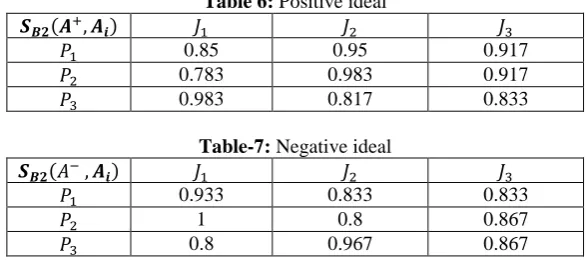
Similarity measure for 𝐒𝐁𝟐(𝐀,𝐁)
Apply Algorithm1 in table 2. The positive-ideal and negative-ideal by using 𝑆𝐵2(𝐴+,𝐴𝑖) and 𝑆𝐵2(𝐴−,𝐴𝑖) we get
Table 6: Positive ideal
𝑺𝑩𝟐(𝑨+,𝑨𝒊) 𝐽1 𝐽2 𝐽3
𝑃1 0.85 0.95 0.917
𝑃2 0.783 0.983 0.917 𝑃3 0.983 0.817 0.833
Table-7: Negative ideal
𝑺𝑩𝟐(𝐴− ,𝑨𝒊) 𝐽1 𝐽2 𝐽3
𝑃1 0.933 0.833 0.833
𝑃2 1 0.8 0.867
𝑃3 0.8 0.967 0.867
To calculate Relative similarity by using (17) we get
Table-8: Relative similarity
𝑑𝑖 𝐽1 𝐽2 𝐽3
𝑃1 0.477 0.533 0.524 𝑃2 0.439 0.551 0.514 𝑃3 0.551 0.458 0.505
By using step4 and we calculate optimal assignment for Table 8.
The optimal assignment is 1st job is assigned to the 2nd person. 2nd job is assigned to the 3rd person. 3rd job is assigned to the 1st person.
Similarity measure for 𝐒𝐁𝟑(𝐀,𝐁)
Apply Algorithm1 in table 2. The positive-ideal and negative-ideal by using 𝑆𝐵3(𝐴+,𝐴𝑖) and 𝑆𝐵3(𝐴−,𝐴𝑖) we get
Table-9: Positive ideal
𝑺𝑩𝟑(𝑨+,𝑨𝒊) 𝐽1 𝐽2 𝐽3
𝑃1 0.83 0.925 0.882
𝑃2 0.722 1 0.922
𝑃3 0.963 0.778 0.837
Table-10: Negative ideal
𝑺𝑩𝟑(𝐴− ,𝑨𝒊) 𝐽1 𝐽2 𝐽3
𝑃1 0.925 0.787 0.788
𝑃2 1 0.722 0.835
𝑃3 0.727 0.964 0.838
To calculate Relative similarity by using (17) we get
Table-11: Relative similarity
𝑑𝑖 𝐽1 𝐽2 𝐽3
𝑃1 0.473 0.54 0.528
𝑃2 0.419 0.581 0.525
By using step4 and we calculate optimal assignment for Table 11
The optimal assignment is 1st job is assigned to the 2nd person. 2nd job is assigned to the 3rd person. 3rd job is assigned to the 1st person.
Similarity measure for 𝐒𝐁𝟒(𝐀,𝐁)
Apply Algorithm1 in table 2. The positive-ideal and negative-ideal by using 𝑆𝐵4(𝐴+,𝐴𝑖) and 𝑆𝐵4(𝐴−,𝐴𝑖) we get
Table-12: Positive ideal
𝑺𝑩𝟒(𝑨+,𝑨𝒊) 𝐽1 𝐽2 𝐽3
𝑃1 0.8 0.917 0.866
𝑃2 0.665 1 0.912
𝑃3 0.96 0.736 0.811
Table-13: Negative ideal
𝑺𝑩𝟒(𝐴− ,𝑨𝒊) 𝐽1 𝐽2 𝐽3
𝑃1 0.917 0.748 0.749
𝑃2 1 0.665 0.807
𝑃3 0.673 0.962 0.812
To calculate Relative similarity by using (17) we get
Table-14: Relative similarity
𝑑𝑖 𝐽1 𝐽2 𝐽3
𝑃1 0.466 0.551 0.536 𝑃2 0.399 0.601 0.531
𝑃3 0.588 0.433 0.5
By using step4 and we calculate optimal assignment for Table 14
The optimal assignment is 1st job is assigned to the 2nd person. 2nd job is assigned to the 3rd person. 3rd job is assigned to the 1st person.
Hungarian method
By using score function (1) for given table then we get
Table-14: Score value
𝐽1 𝐽2 𝐽3
𝑃1 0.35 0.56 0.44
𝑃2 0.13 0.79 0.57
𝑃3 0.68 0.24 0.31
Apply Algorithm 2 for the above table we get the following optimal assignment.
The optimal assignment is 1st job is assigned to the 2nd person. 2nd job is assigned to the 3rd person. 3rd job is assigned to the 1st person.
7. CONCLUSION
© 2018, IJMA. All Rights Reserved 57 REFERENCES
1. Aggarwal V, Tikekar V G, Hsu L F., Bottleneck assignment problems under categorization, Computers and Operation Research 13 (1986), 11 −26.
2. Angelov P P., Optimization in an intuitionistic fuzzy environment, Fuzzy Sets and Systems 86 (1997), 299 − 306.
3. Atanassov K T., Intuitionistic fuzzy sets, Fuzzy Sets and Systems 20(1986), 87 – 96.
4. Balinski M L, Gomory R E., A primal method for the assignment and transportation problems, Management Science 10 (1967), 578 – 593.
5. Burillo P, Bustince H, Mohedano V., Some definition of Intuitionistic Fuzzy Numbers, First Properties, In Proceedings of the 1st workshop on Fuzzy Based Expert Systems, D.Lakoy (Ed.) (1994), 53-55.
6. Chen M S., On a fuzzy assignment problem, Tamkang Journal 22 (1985), 407–411.
7. Chen S M, Tan J M., Handling multicriteria fuzzy decision-making problems based on vague set theory, Fuzzy sets and Systems 67 (1994), 163–172.
8. Chen T Y., A comparitive analysis of score functions for multiple criteria decision making in intuitionistic fuzzy sets, Information Sciences 181 (2011), 3652 – 3676.
9. Hong D H, Choi C H., Multicriteria fuzzy decision-making problems based on vague set theory, Fuzzy Sets and Systems 114 (2000), 103–113.
10. Hung W L, Yang M S., Similarity measure of Intuitionistic fuzzy set based on Hausdorff distance, Pattern Recognition Letters 25 (2004), 1613 – 1611.
11. Hung W L, Yang M S., On Similarity measures between Intuitionistic fuzzy sets, International Journal of Intelligent Systems 23 (2008), 364 – 383.
12. Kuhn H W., The Hungarian method for the assignment and transportation problems, Naval Research Logistics Quartely 2 (1955), 83 – 97.
13. Li Y, Olson D, Qin Z., Similarity measures between Intuitionistic fuzzy sets, a comparative analysis, Pattern recognition Letters 28 (2007), 278 – 285.
14. Lin Chi – Jen, Wen Ue – pyng., A labeling algorithm for the fuzzy assignment problem, Fuzzy Sets and Systems 142 (2004), 373 – 391.
15. Liu C J, and Gao X., Fuzzy weighted equilibrium multi – objective assignment problem and genetic algorithm. Applied Mathematical Modelling 33 (2009), 3926 – 3935.
16. Long – Sheng, Huang Li – pu, Zhang., Solution method for Fuzzy Assignment Problem with Restriction of Qualification, Proceedings of the Sixth International Conference on Intelligent Systems Design and Applications (2006), (ISDA’06).
17. Mukherjee S, Basu K., Solving intuitionistic fuzzy assignment problem by using similarity measures and score Functions , International journal of pure and Applied Sciences and Technology 2 (2011), pp 1 – 18. 18. Mukherjee S, Basu K ., Solution of a class of Intuitionistic Fuzzy Assignment Problem by using similarity
measures. Knowledge – Based Systems 27 (2012), 170 – 179.
19. Sakawa M, Nishizaki I, Uemura Y., Interactive fuzzy programming for two – level linear and linear fractional production and assignment problems: a case study, European Journal on Operation Research 135 (2001), 142 – 157.
20. Szmidt E, Kacprzyk J., distance between intuitionistic fuzzy sets, Fuzzy set and System 114 (2000) 505 – 518. 21. Votaw D F, Orden A., The personal assignment problem, symposium on linear inequalities and programming,
Project SCOOP 10,US Air Force, Washington (1952), 155 – 163.
22. Xu Z., Some similarity measures of intuitionistic fuzzy sets and their applications to multiple attribute decision making 6 (2007), 109 – 121.
23. Xu Z S, Chen J., An overview of distance and similarity measures of Intuitionistic fuzzy sets, International Journal of uncertainity, Fuzziness and Knowledge Based system,16 (2008) 529 – 555.
24. Yang L, Liu B., A multi – objective fuzzy assignment problem New model and algorithm, IEEE International conference on Fuzzy Systems (2005), 551 – 556.
25. Zadeh L., A Fuzzy sets, Information and Control 8 (1965), 338–353.
Source of support: Proceedings of National Conference March 1st - 2018, On “Recent Advances in Pure and