© 2020 by the Serbian Biological Society How to cite this article: Koiou K, Vasilakoglou I, Dhima K. Herbicidal potential of 223 lavender (Lavandula angustifolia Mill.) essential oil components on bristly foxtail
(Setaria verticillata (L.) P. Beauv.): comparison with carvacrol, carvone, thymol and eugenol. Arch Biol Sci. 2020;72(2):223-31.
Herbicidal potential of lavender (
Lavandula angustifolia
Mill.) essential oil components
on bristly foxtail (
Setaria verticillata
(L.) P. Beauv.): comparison with carvacrol, carvone,
thymol and eugenol
Katerina Koiou1, Ioannis Vasilakoglou2,* and Kico Dhima1
1Department of Agriculture, International Hellenic University, 574 00 Echedoros, Greece
2Department of Agriculture - Agrotechnology, University of Thessaly, Geopolis of Larissa, 415 00 Larissa, Greece
*Corresponding author: [email protected]
Received: January 6, 2020; Revised: April 10, 2020; Accepted: April 11, 2020; Published online: April 22, 2020
Abstract: Essential oils are a plentiful source of plant compounds for potential use in the development of natural herbicides. With this in mind, the phytotoxicity of ten major essential oil components of lavender (Lavandula angustifolia Mill.) on the weed species bristly foxtail (Setaria verticillata (L.) P. Beauv.) was determined using a perlite-based Petri-dish bioassay. Their phytotoxicity was also compared with that of well-known phytotoxic essential oil components (carvacrol, thymol, carvone and eugenol) of oregano (Origanum vulgare L.) and clove (Syzygium aromaticum (L.) Merr. & L.M. Perry) essential oils. Potential synergistic or antagonistic effects between carvacrol or eugenol with other components of lavender essential oil were investigated. Regarding the most phytotoxic components, terpinen-4-ol at 80 nL/cm3 completely inhibited the
germina-tion and root length of bristly foxtail, displaying similar phytotoxicity to carvone and thymol. Like carvacrol, lavandulol and linalyl acetate caused total (100%) germination and root length reduction of bristly foxtail at 160 nL/cm3, while the same
effect was achieved by lavandulyl acetate at 320 nL/cm3. A synergistic effect was also observed when carvacrol or eugenol
were combined with ocimene, 3-octanone, α-terpineol or terpinen-4-ol. Focusing on the development of alternative weed control strategies, lavender essential oils containing high concentrations of terpinen-4-ol, lavandulol or linalyl acetate could be useful for the production of natural herbicides. These essential oil components combined with selected oregano or clove essential oil components, increase phytotoxicity and weed control due to the synergistic effect observed when in mixture.
Keywords: bioassay; natural herbicide; phytotoxicity; synergy; whole-range assessment
INTRODUCTION
The essential oils of some aromatic plants exhibit contact and fumigant insecticidal, bactericidal and fungicidal actions [1-2]. Additionally, phenolic and terpenic components of essential oils have been reported by several researchers as inhibitors of vegetation and growth [3-12]. In the course of evaluation of lemon-scented gum (Eucalyptuscitriodora Hook.), English lavender (Lavandula angustifolia Mill.) and Scots pine (Pinussylvestris L.) essential oils, it was found that English lavender oil was the most phytotoxic on common purslane (Portulaca oleracea L.), annual ryegrass (Lolium multiflorum Lam.) and barnyardgrass (Echinochloa crus-galli (L.) P. Beauv.) [6]. Similarly, it was found that the lavender (Lavandula spp.) es-sential oil caused phytotoxic effects on rigid ryegrass
(Lolium rigidum Gaudin) [6], and that the English lavender aqueous extracts were phytotoxic to the weed species redroot pigweed (Amaranthus retroflexus L.) and nettleleaf goosefoot (Chenopodium murale L.) [8]. Further, it was established that the essential oil of English lavender and French lavender (Lavandula stoechas L.) were phytotoxic to redroot pigweed and common purslane [9]. Oregano (Origanum vulgare
Watson), redroot pigweed, common lambsquarters (Chenopodium album L.) and barnyardgrass [4,11,12].
It is well-known that the phytotoxic effect of any es-sential oil is related to its chemical composition, whereas essential oils with a high content of monoterpenes are the most potent inhibitors [13]. The essential oil of Sydney blue gum (Eucalyptus saligna Sm.) contained phytotoxic compounds (monoterpenes, mainly α-pinene and 1,8-cineole), induced oxidative stress and caused damage to cell membranes, resulting in inhibition of seed germination and growth of the seedling [14]. Red thyme (Thymus vulgaris L.), clove and cinna-mon (Cinnamomum zeylanicum Blume) essential oils caused electrolyte leakage on dandelion (Taraxacum officinale F.H. Wigg.), resulting in dandelion cell death [15]. Similarly, eugenol and clove essential oil caused changes in leaf cell membrane integrity, resulting in great electrolytic leakage in susceptible species [12]. Furthermore, volatile monoterpenes such as cineoles inhibited mitosis [16,17]. Also, citral sprayed on young plants of sensitive weeds reduced the photochemical quenching in photosystem II [5], and limonene and citral caused alterations in mitosis of garden onion (Allium cepa L.) root cells [18].
Lavender (Lavandula spp.) is one of the most im-portant aromatic plants cultivated around the Mediter-ranean basin. There are four main species of lavender (L.angustifolia Mill., L. stoechas L., L. latifolia Medik. and Lavandula x intermedia) with various genotypes differing in the chemical composition of the essential oil. English lavender is the most widely cultivated species, and effective weed control is the most serious problem in lavender crops [19,20]. Bristly foxtail [Setaria ver-ticillata (L.) P. Beauv.] is one of the most competitive grass weeds in summer cropsworldwide [21]. Its high tillering ability and the C4 photosynthetic mechanism contribute to its rapid growth, while its sticky seed-heads contribute to its effective dispersal [22].
Regarding the abovementioned, essential oils could be a useful tool for the development of natural pesticides, while aromatic plants could play an important role in establishing sustainable agriculture due to their ability to provide these oils [23]. In particular, essential oils or some of their components might be used as active ingredients for the production of natural herbicides. Essential oils show a high variability in weed-control
effectiveness, strongly depending on the aromatic plant species and the effect of each essential oil component on germination and initial growth of a wide range of detrimental weeds; however, any potential essential oil component synergistic or antagonistic effect have not been extensively studied [24]. Furthermore, more ef-fective mixtures of different essential oil components, with a possible opportunity for their low rate applica-tion, could be achieved by the investigation of essential oil components with the highest synergistic activity in complex mixtures. Therefore, the objectives of this re-search were to investigate the effect of the concentration of ten major essential oil components of English lavender essential oil on germination and root growth of bristly foxtail, to compare the phytotoxicity of English lavender components with that of other known major phytotoxic components (carvacrol, carvone, thymol and eugenol) produced by oregano or clove [24], and to test for any possible synergy or antagonism between two of the major phytotoxic components (carvacrol and eugenol) with other components of English lavender essential oil.
MATERIALS AND METHODS Essential oil components
Ten major components of English lavender essential oil were used in the experiment (compounds 5-14, Supplementary Table 1S) and compared with the phytotoxic components (carvacrol, thymol, carvone and eugenol) found in oregano or clove essential oils (compounds 1-4; Supplementary Table 1S). The chemical names and their manufacturers of essential oil components used are presented in Table 1S. Bristly foxtail seeds were collected from mature plants in fields near Thessaloniki (Greece, longitude 22°43΄ E, latitude 40°42΄ N) in July 2013. All seeds were dried in a greenhouse, air-cleaned to remove non-viable seeds and other plant residues and stored at 3 to 6oC
until use. The germinability of bristly foxtail seeds was approximately 35% as evaluated by Petri dish experi-ments in a growth chamber before their use.
Phytotoxicity of essential oil components
a substrate that does not adsorb organic compounds) following the reported method [24]. Sixty bristly foxtail seeds were placed in the bottom of 8-cm-diameter glass disposable Petri dishes (about 20 seeds were germinated in each control Petri dish). The seeds were covered with 5 g of perlite and moistened with 10 mL of deionized water. Additionally, each of the essential oil components was added at 0, 1.0, 2.0, 4.0, 8.0 and 16.0 μL per Petri dish (total volume of 50 cm3 in each
Petri dish) to achieve the respective concentrations of 0, 20, 40, 80, 160 and 320 nL/cm3. A hand-made cup of
aluminum was used and placed in the center of each Petri dish (Supplementary Fig. 1S). Each essential oil component was placed in this cup by a micropipette so that the bristly foxtail seeds could be influenced only by the vapors of each essential oil component. The Petri dishes were closed and sealed with film to avoid vapor losses of the essential oil components. The conditions in the sealed Petri dishes did not affect the germination of the bristly foxtail seeds [4]. The sealed Petri dishes were placed on shallow trays, covered with plastic bags, moved into and kept in a growth chamber for 10 days at 27±2oC. After this incubation period,
the perlite was carefully washed from the bristly foxtail plants. The average germination and root length of seedlings were recorded, omitting any small laterals (seeds were considered germinated when their root length was over 2 mm). Bristly foxtail root length was manually measured with a ruler.
Investigation for possible synergy or antagonism
Similar Petri dish bioassays were used to determine the possible synergism or antagonism among the essential oil components. For this purpose, carvacrol and eugenol, which are two of the most phytotoxic components in essential oils [24], were applied at 20 nL/cm3. Ocimene,
3-octanone, α-terpineol and terpinen-4-ol (four of the lavender essential oil components) were also applied at 10 nL/cm3. The other six lavender essential oil
compo-nents were not further evaluated. Additionally, 20 nL/ cm3 of carvacrol were mixed with 10 nL/cm3 of eugenol,
ocimene, 3-octanone, α-terpineol or terpinen-4-ol. Similarly, 20 nL/cm3 of eugenol were also mixed with 10
nL/cm3 of carvacrol, ocimene, 3-octanone, α-terpineol
or terpinen-4-ol. The actual phytotoxic effects of the mixed essential oil components were compared with those caused by carvacrol or eugenol applied at 20
nL/cm3, as well as with the expected ones (the sum
of the phytotoxic effects of essential oil components participating in the mixture when they were applied individually). In the case of any synergistic effect, the effect of the mixed components should be greater than the sum of the individual effects. On the contrary, in the case of any antagonistic effect, the effect of the mixed components should be lower than when they are individually applied [24]. The other bioassays (e.g. bristly foxtail seed number, water volume, essential oils components application, growth chamber temperature) were applied similarly as described above.
Data analysis
For each essential oil component concentration, three Petri dishes (replicates) were used and were arranged in a completely randomized design. Both bioassay experiments were repeated and their data were ana-lyzed across repetition time using a factorial approach. Analyses of variance (ANOVA) were conducted by the SPSS program (Statistical Package for the Social Sci-ences, SPSS Base 16.0 User’s Guide, SPSS Inc; 2007). Separate mean treatment differences were detected by Fisher’s protected LSD procedures at p=0.05.
The phytotoxic dose-response effects of the es-sential oil components on bristly foxtail germination and root length were assessed by the Whole-range assessment method [25]. The inhibition index was calculated as follows:
I=Dc∫Dn[R(0)–f(D)]dD/
0∫DnR(0)dD
In this equation, the concentrations tested ranged from 0 to Dn, and the Dc was the threshold concentration at which the response equaled the response of the control and above which the responses were inhibi-tory. Also, R(0) and f(D) were the response at 0 nL/ cm3 (control) and the response function, respectively.
The Whole-range Evaluation of the Strength of In-hibition in Allelopathic-bioassay software (WESIA) [26] was used for the calculation (separately for each essential oil component replicate) of germination and root length inhibition areas across the whole range of concentrations of the essential oil components and for the corresponding inhibition indices (I). Then, the I
The equation E=(A1Z1)+(A2Z2) was used to calculate the expected (E) phy-totoxicities (assuming additive phyto-toxicities) of the combined essential oil components [24]. The E values were then compared with the actual (A) values of the phytotoxicity of combined essential oil components. In the above equation,
Ai was the proportion of component i in the mixture and Zi was its % phytotoxicity. The χ2 comparison analysis [χ2=(A – E)2/E,
where A was the actual phytotoxicity from the combined essential oil components and
E was the expected phytotoxicity] was used to decide if the effects of mixtures should be characterized as synergistic, additive or antagonistic. In particular, χ2 values
greater than 3.84 (χ2 with df=1 and p=0.05)
indicated synergism (phytotoxicity greater than the expected), while χ2 values lower
than 3.84 indicated antagonistic effects.
RESULTS
Phytotoxicity of essential oil components
Regarding the bristly foxtail germination and root length data, as well as the evalu-ated inhibition indices (I), the ANOVAs performed pointed to a significant essential oil component (p<0.001) and essential oil component concentration (p<0.001) ef-fects, as well as their interaction (p<0.001). However, the values presented in Figs. 1, 2 and 3, as well as in Table 1, are the means of the repeated-in-time
experi-ment because there was not significant repetition of the time-treatment interaction.
The essential oil components carvone, thymol, carvacrol and eugenol caused significant reduction in the germination and root length of bristly foxtail (Fig. 1a-d). Germination and root length of bristly foxtail were in most cases reduced with increasing concentrations of essential oil components, but not proportionately. Carvone and thymol were more phytotoxic to bristly
foxtail (Fig. 1b and c) than carvacrol or eugenol (Fig. 1a and d). Weed germination and root length were completely inhibited at 80 nL/cm3 of thymol or carvone.
The same effect was achieved by carvacrol at 160 nL/ cm3, while eugenol at 320 nL/cm3 caused about 75%
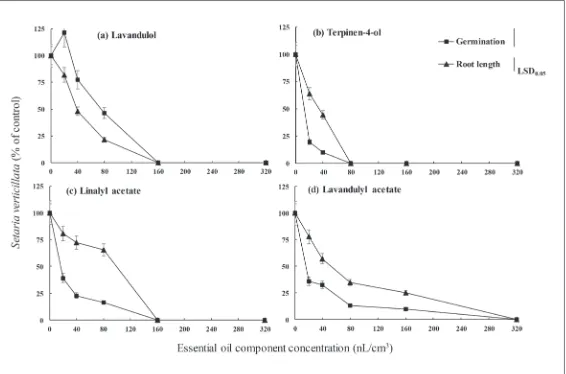
reduction of bristly foxtail germination and root length. Regarding the components of the lavender essential oil, lavandulol, terpinen-4-ol, linalyl acetate and lavan-dulyl acetate were the most phytotoxic to bristly foxtail
Fig. 1. Inhibitory effects of increasing concentrations of carvacrol, carvone, thymol and eugenol on bristly foxtail germination and root length. Percentage inhibition was expressed relative to the control. Vertical lines indicate standard deviation bars based on 3 replicates.
(Fig. 2a-d). In particular, terpinen-4-ol at 80 nL/cm3 completely inhibited
germina-tion and root length of bristly foxtail (Fig. 2b), causing phytotoxicity similar to that of carvone and thymol (Fig. 1b and c). Com-parable to carvacrol (Fig. 1a), lavandulol and linalyl acetate (Fig. 2a and c) caused 100% germination and root length reduc-tion of bristly foxtail at 160 nL/cm3, while
the same effect was provided by lavandulyl acetate at 320 nL/cm3 (Fig. 2d).
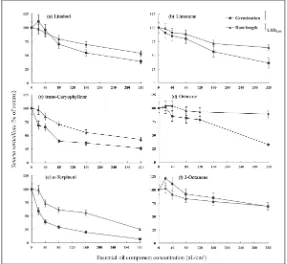
Of the other six components of laven-der essential oil, α-terpineol was the most phytotoxic to bristly foxtail (Fig. 3e) exhib-iting similar phytotoxicity as eugenol (Fig. 1d). In contrast, bristly foxtail germination and root length were slightly affected by the essential oil components limonene, ocimene and 3-octanone (Fig. 3b, d and f), which had the lowest phytotoxic effect.
With regard to the inhibition indices (I), terpinen-4-ol, linalyl acetate and la-vandulyl acetate, as well as carvone and thymol, displayed the highest inhibition potential (I>80%) on bristly foxtail germination (Table 1). Terpinen-4-ol and lavandulol caused the high-est reduction (I>80%) in bristly foxtail root length, similar to carvone, carvacrol and thymol (Table 1). Increased inhibition (I>70%) of seed germination was also induced by α-terpineol, lavandulol and carvacrol, as well as root length reduction by linalyl acetate and lavandulyl acetate (Table 1). The inhibition potential caused by the other essential oil components ranged from low (6.23%) to moderate (58.60%) (Table 1).
Investigation for possible synergy or antagonism
Bristly foxtail germination and root length were signifi-cantly affected by carvacrol and eugenol (p<0.001), as well as by combinations of essential oils components (p<0.001) and their interaction (p<0.001), as revealed by ANOVA.
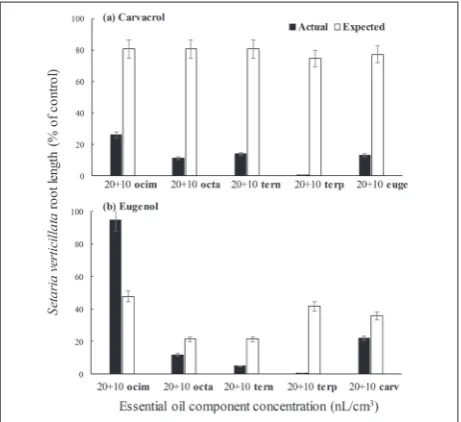
Most of the combinations used indicated signifi-cant synergy (statistically signifisignifi-cant synergy based on χ2 analysis). The α-terpineol was the component
that contributed most to the greatest synergetic effect.
Fig. 3. Inhibitory effects of increasing concentrations of linalool, limonene, trans-caryophyllene, ocimene, α-terpineol and 3-octanone on bristly foxtail germination and root length. Percentage inhibition was expressed relative to the control. Vertical lines indicate standard deviation bars based on 3 replicates.
Table 1. Herbicidal effects of essential oil components on bristly foxtail germination and root length assessed by the inhibition index (I)a.
Essential oil Bristly foxtail
components Germination Root length
Inhibition index
Carvacrol 76.69 b b 85.87 a
(+)-Carvone 86.46 a 86.10 a
Thymol 89.34 a 84.20 a
Eugenol 43.05 de 58.60 cd
Lavandulol 72.05 b 80.00 ab
Terpinen-4-ol 89.39 a 84.80 a
Linalyl acetate 84.54 ab 74.01 b
Lavandulyl acetate 81.91 ab 70.26 b
Linalool 38.29 e 28.11 fg
(+/-)-Limonene 38.29 e 23.23 g
(-)-trans-Caryophyllene 57.31 c 37.71 e
Ocimene 30.02 e 6.23 h
α-Terpineol 72.83 b 46.68 d
3-Octanone 15.44 f 20.16 g
CV (%) 8.8 7.6
ainhibition index (I) calculation is described in the Materials and
Methods.
bMeans within each column followed by the same letter are not
In particular, α-terpineol in combination with either carvacrol or eugenol caused 99% greater reduction of bristly foxtail germination than expected (Fig. 4a and b). Similarly, α-terpineol combined with either carvacrol or eugenol caused 99% greater reduction in bristly foxtail root length than expected (Fig. 5a and b). Eugenol or 3-octanone combined with carvacrol caused 88% greater reduction of bristly foxtail germination than expected (Fig. 4a), while carvacrol in combina-tion with eugenol caused 87% greater reduccombina-tion of bristly foxtail germination than expected (Fig. 4b). Additionally, 3-octanone, terpinen-4-ol or eugenol in combination with carvacrol caused higher (>80%) reduction in bristly foxtail root length than expected (Fig. 5a). However, the eugenol/ocimene combination did not provide a clear synergistic effect.
DISCUSSION
The essential oil components carvone, thymol, car-vacrol and eugenol caused significant reduction in germination and root length of bristly foxtail, while carvone and thymol were more phytotoxic to bristly foxtail than either carvacrol or eugenol. Carvone, thymol and carvacrol have been reported to be more phytotoxic to rigid ryegrass than eugenol [24].
As regards to the components of English laven-der essential oil, lavandulol, terpinen-4-ol, linalyl acetate and lavandulyl acetate were the most phyto-toxic to bristly foxtail. Of the other six components of English lavender essential oil, α-terpineol was the most phytotoxic to bristly foxtail, displaying similar phytotoxicity as eugenol, while limonene was among the least phytotoxic components. The essential oil of English lavender at 1 μl/mL reduced the germination of the weeds annual ryegrass and barnyardgrass, by 63.1% and 18.3%, respectively [6]. In this essential oil, linalool (38.7%), 1,8-cineole (26.5%) and camphor (14.2%) were the main components. Coumarin and 7-methoxycoumarin were the most phytotoxic com-ponents in Lavandula x intermedia extracts to rigid ryegrass [7]. The concentration of 25 ppm completely inhibited rigid ryegrass root length. Linalool was the main component of English lavender essential oil, and the concentration of 32 μL/petri completely inhibited the germination of weed species, sterile wild oat (Avena sterilis L.) and short-spiked canarygrass (Phalaris brachystachys L.) [27].
Germination and root length of bristly foxtail were in most cases reduced with increasing concentrations of essential oil components, but not proportionally. Similar results have been reported in [24] where the
Fig. 4. Actual and expected inhibitory effects on bristly foxtail germination of carvacrol and eugenol combined with four lavender essential oils components. Vertical lines indicate standard deviation bars based on 3 replicates. carv, carvacrol; euge, eugenol; ocim, ocimene; octa, 3-octanone; tern, α-terpineol; terp, terpinen-4-ol.
phytotoxicity of nineteen essential oil components was studied. Also, barnyardgrass, common lambsquarters, sterile wild oat, short-spiked canarygrass and ragweed parthenium (Parthenium hysterophorus L.) germina-tion and growth were further reduced with increasing essential oil concentration [4,27,28].
With respect to the inhibition indices (I), car-vacrol, carvone and thymol were among the seven essential oil components that possessed the greatest phytotoxicity to bristly foxtail. Similarly, lavandulol, terpinen-4-ol, linalyl acetate and lavandulyl acetate caused a high reduction in bristly foxtail germina-tion and root length, while eugenol and α-terpineol exhibited intermediate inhibition. Linalool, limonene,
trans-caryophyllene, ocimene and 3-octanone displayed the lowest inhibition indices. Similarly, in a study of the phytotoxicity of essential oil components on the germination and root length of rigid ryegrass [24], it was found that the inhibition indices of limonene (7.9% and 13.5%, respectively) and of ocimene (10.4% and 28.1%, respectively), were lower than those of carvacrol, thymol or carvone. However, the I values of linalool on rigid ryegrass germination and root length (84.9% and 89.8%, respectively) were greater than those for bristly foxtail.
The three components, carvacrol, carvone and thymol, in the oregano essential oil were among the most phytotoxic components. The high phytotox-icity of oregano and summer savory essential oils reported previously [4,11] could be attributed to the large amounts of these components in their essential oils. Additionally, four of the major components of the lavender essential oil (lavandulol, terpinen-4-oil, linalyl acetate and lavandulyl acetate) provided similar phytotoxicity to bristly foxtail as oregano essential oil components, indicating that the former might exhibit similar oregano essential oil phytotoxic properties. However, more experiments are required to investigate if oregano or lavender essential oils could be used as active ingredients of herbicides, since certain essential oils could similarly act the same way as some chemical herbicides, causing cell membrane damage in sensitive plant species [12,15].
Most of the used combinations of the essential oil components pointed to a significant synergistic effect. Studies related to possible synergistic or antagonistic
activities of essential oil components on important weeds are limited. When carvacrol was combined with eugenol, eucalyptol, estragole or fenchone, a synergistic effect was evident on rigid ryegrass germination and root length [24]. In addition, synergism was observed when thymol was combined with carvone, thujone, estragole or fenchone. Moreover, similar results were detected when linalool was combined with carvone, thujone, estragole, fenchone, trans-2-decanal, limo-nene, eugenol or eucalyptol. However, when thymol was combined with trans-2-decenal, limonene or eugenol, an antagonistic effect was evident as regards rigid ryegrass root length.
Regarding the effects of combinations of essential oil components on microorganism or insects, the com-binations of carvacrol with thymol, cinnamaldehyde with eugenol, trans-anethole with thymol or citronellal with α-terpineol produced synergistic effects [29-31]. The synergistic action achieved by the combination of essential oil components could be attributed either to increased transport in cells [32] or to the presence of different modes of action of essential oil components that cause higher phytotoxicity [33].
CONCLUSIONS
Five of the components of lavender essential oil (la-vandulol, terpinen-4-ol, linalyl acetate, lavandulyl acetate and α-terpineol) exhibited high phytotoxicity against bristly foxtail. Their phytotoxicity was similar to that provided by certain essential oil components such as carvacrol, thymol, carvone and eugenol with phytotoxic properties. Furthermore, the addition of the lavender essential oil components with carvacrol or eugenol, produced a synergistic phytotoxic effect. These results suggest that the natural essential oil of lavender with a high concentration in lavandulol, terpinen-4-ol, linalyl acetate, lavandulyl acetate and
Acknowledgments: The authors thank Dr. De Li Liu, E. H. from the Graham Centre for Agricultural Innovation, Charles Sturt University, Wagga Wagga, NSW 2650, Australia, for providing the WESIA software.
Funding: This research did not receive any specific grant from funding agencies in the public, commercial, or not-for-profit sectors. Author contributions: IV and KD drafted the manuscript; KK and IV conducted the bioassays; IV performed the statistical analyses. All authors read and approved the final manuscript.
Conflict of interest disclosure: The authors declare no conflict of interest.
REFERENCES
1. Isman BM. Plant essential oils for pest and disease manage-ment. Crop Prot. 2000;19:603-8.
2. Jaramillo-Colorado BE, Pino-Benitez N, González-Coloma A. Volatile composition and biocidal (antifeedant and phyto-toxic) activity of the essential oils of four Piperaceae species from Choco-Colombia. Ind Crop Prod. 2019;138:111463. 3. Elakovich SD. Terpenoids as models for new agrochemicals.
In: Biologically active natural products - Potential use in agriculture. In: Cutler HG, editor. Washington, DC: Ameri-can Chemical Society; 1988. p. 250-61.
4. Vasilakoglou I, Dhima K, Wogiatzi E, Eleftherohorinos I, Lithourgidis A. Herbicidal potential of essential oils of oregano or marjoram (Origanum spp.) and basil (Ocimum basilicum) on Echinochloa crus-galli (L.) P. Beauv. and Che-nopodium album L. weeds. Allelopathy J. 2007;20:297-306. 5. Graña E, Sotelo T, Díaz-Tielas C, Reigosa MJ,
Sánchez-Moreiras AM. The phytotoxic potential of the terpenoid cit-ral on seedlings and adult plants. Weed Sci. 2013;61:469-81. 6. Ibáñez MD, Blázquez MA. Phytotoxic effects of commercial Eucalyptus citriodora, Lavandula angustifolia, and Pinus syl-vestris essential oils on weeds, crops, and invasive species. Molecules 2019;24:2847.
7. Haig TJ, Haig TJ, Seal AN, Pratley JE, An M, Wu H. Laven-der as a source of novel plant compounds for the develop-ment of a nature herbicide. J Chem Ecol. 2009;35:1129-36. 8. Qasem JR. Allelopathic effects of selected medicinal plants
on Amaranthus retroflexus and Chenopodium murale. Alle-lopathy J. 2002;10:105-22.
9. Argyropoulos E, Eleftherohorinos IG, Vokou D. In vitro evaluation of essential oils from Mediterranean aromatic plants of the Lamiaceae for weed control in tomato and cot-ton crops. Allelopathy J. 2008;22:69-78.
10. Ibáñez MD, Blázquez MA. Herbicidal value of essential oils from oregano-like flavour species. Food Agric Immunol. 2017;28:1168-80.
11. Dudai N, Poljakoff-Mayber A, Mayer AM, Putievsky E, Lerner HR. Essential oils as allelochemicals and their poten-tial use as bioherbicides. J Chem Ecol. 1999;25:1079-89. 12. Bainard LD, Isman MB, Upadhyaya MK. Phytotoxicity of
clove oil and its primary constituent eugenol and the role of
leaf epicuticular wax in the susceptibility to these essential oils. Weed Sci. 2006;54:833-7.
13. Almarie AA, Mamat AS, Wahab Z, Rukunudin IH. Chemical composition and phytotoxicity of essential oils isolated from Malaysian plants. Allelopathy J. 2016;37:55-70.
14. Silva ER, Lazarotto DC, Schwambach J, Overbeck GE, Soares GLG. Phytotoxic effects of extract and essential oil of Euca-lyptus saligna (Myrtaceae) leaf litter on grassland species. Aust J Bot. 2017;65:172-82.
15. Tworkoski T. Herbicide effects of essential oils. Weed Sci. 2002;50:425-31.
16. Baum SF, Karanastasis L, Rost TL. Morphogenetic effects of the herbicide Cinch on Arabidopsis thaliana root develop-ment. J Plant Growth Regul. 1998;17:107-14.
17. Romagni JG, Allen SN, Dayan FE. Allelopathic effects of volatile cineoles on two plant species. J Chem Ecol. 2000;26:303-13.
18. Fagodia SK, Singh HP, Batisha DR, Kohli RK. Phytotoxic-ity and cytotoxicPhytotoxic-ity of Citrus aurantiifolia essential oil and its major constituents: Limonene and citral. Ind Crop Prod. 2017;108:708-15.
19. Chambdon C, Poupet A, Beck D, Bettachini B, Touche J. In vitro morphogenetic potential of various lavandin and lavender clones: Preliminary observations on the agronomic value of the vitroplants. Agronomie (Paris) 1992;12:173-81. 20. Vouzounis NA, Dararas VE, Georghiou G. Chemical con-trol of weeds in the aromatic crops lavender, oregano and sage. Nicosia, Cyprus; Agricultural Research Institute; 2003. (Agricultural Research Institute, Ministry of Agriculture, Natural Resources and the Environment; Technical bulletin 218).
21. Holm LG, Pancho JV, Herberger JP, Plucknett DL. A geo-graphical atlas of world weeds. New York, USA: John Wiley and Sons; 1979.
22. Dekker J. The foxtail (Setaria) species-group. Weed Sci. 2003;51:641-56.
23. Dayan FE, Owen DK, Duke SO. Rationale for a natural products approach to herbicide discovery. Pest Manag Sci. 2012;68:519-28.
24. Vasilakoglou I, Dhima K, Paschalidis K, Ritzoulis Ch. Herbicidal potential on Lolium rigidum of nineteen major essential oil components and their synergy. J Essent Oil Res. 2013;25:1-10.
25. An M, Pratley JE, Haig T, Liu DL. Whole-range assessment: a simple method for analysing allelopathic dose-response data. Nonlinearity Biol Toxicol Med. 2005;3:245-60. 26. Liu DL, An M, Wu H. Implementation of WESIA:
Whole-range evaluation of the strength of inhibition in allelopathic-bioassay. Allelopathy J. 2007;19:203-14.
27. Uremis I, Arslan M, Sangun MK. Herbicidal activity of essential oils on the germination of some problem weeds. Asian J Chem. 21;2009:3199-210.
28. Singh HP, Batish DR, Setia N, Kohli RK. Herbicidal activity of volatile oils from Eucalyptus citriodora against Parthenium hysterophorus. Ann Appl Biol. 2005;146:89-94.
29. Moleyar V, Narasimham P. Antibacterial activity of essential oil components. Int J Food Microbiol. 1992;16:337-42. 30. Hummelbrunner LA, Isman MB. Acute, sublethal,
oil compounds on the tobacco cutworm, Spodoptera litura (Lep., Noctuidae). J Agric Food Chem. 2001;49:715-20. 31. Lambert RJW, Skandamis PN, Coote P, Nychas G-JE. A
study of the minimum inhibitory concentration and mode of action of oregano essential oil, thymol and carvacrol. J Appl Microbiol. 2001;91:453-62.
32. Ultee A, Kets EPW, Alberda M, Hoekstra FA, Smid EJ. Adap-tation of the food-borne pathogen Bacillus cereus to carva-crol. Arch Microbiol. 2000;174:233-8.
33. Jiang Z, Akhtar Y, Bradbury R, Zhang X, Isman MB. Com-parative toxicity of essential oils of Litsea pungens and
Lit-sea cubeba and blends of their major constituents against the cabbage looper, Trichoplusia ni. J Agric Food Chem. 2009;57:4833-37.
Supplementary Material