Interlingual Interfaces in Chinese Language
Learning and Its Use: Exploring Language
Transfer Errors in Chinese Writing
Yuting Lan
University of Wisconsin Madison, WI, USA
Abstract—Adopting Dulay, Burt and Krashen (1982), James (1998) and Zheng and Park (2013) 's system of error classification, this study investigates L1 transfer errors from English to Chinese based on Chinese translation texts written by intermediate-level American university students. These errors were identified and co-coded using the NVivo qualitative text analysis software program. For example, 在白天做健康的东西[事情] (do healthy things in the day.). It is coded under the subcategories of noun and misformation. Using obtained data, the NVivo program presents the frequency of error types and their attributes. The findings contribute to both theoretical and pedagogical issues by focusing on error types common to Chinese L2 learners and typically manifested in Chinese written production due to influences from English. Finally, this study sheds light on implications for instruction on different types of errors in classroom and on intercultural ambiguity.
Index Terms—error analysis, error type, first language transfer, Chinese
I. INTRODUCTION
First language transfer viewed as a cross-linguistic process has been proven to play an essential role in the development of learners’ interlanguage proficiency and cross-cultural proficiency (Selinker, 1992). In the domain of L1 transfer errors in second language (L2) , many studies have revealed that rules, patterns and habits from L1 interfere with L2 learning and may result in negative effects (Mahmoud, 2000; Wang, W., & Wen, 2002). Therefore, study on L1 transfer error in second languages is of upmost interest or upmost importance. Error Analysis (EA), primarily used as a useful and practical method of investigating ESL/EFL (English as Second / Foreign Language) linguistic errors, can also be considered as a tool for solving theoretical and pedagogical problems of acquisition of other languages (Corder, 1981; Odlin, 1989). Adopting Dulay, Burt and Krashen (1982), James (1998) and Zheng and Park (2013) 's system of error classification, this study investigates L1 transfer errors from English to Chinese based on Chinese translation texts written by intermediate-level American university students. These errors were identified and co-coded using the NVivo qualitative text analysis software program. For example, 在白天做健康的东西[事情] (do healthy things in the day.). It is coded under the subcategories of noun and misformation. Using obtained data, the NVivo program presents the frequency of error types and their attributes. The findings contribute to both theoretical and pedagogical issues by focusing on error types common to Chinese L2 learners and typically manifested in Chinese written production due to influences from English. Finally, this study sheds light on implications for instruction on different types of errors in classroom and on intercultural ambiguity.
II. LITERATURE REVIEW
A. Error Analysis
Error analysis is a type of approach to analyze a second/foreign language learner’s language performance. It plays an essential role in identifying typical language errors, describing those errors, classifying them according to their nature and attributes, and evaluating their seriousness (Corder, 1967). Corder (1967) also pointed out that students’ errors should not be ignored because these errors are developing features for language learners. Therefore, error analysis has the effect of guiding teachers to adopt appropriate teaching strategies to help students to learn better. Error analysis as a fundamental tool in language teaching in order to reorganize a teacher's point of view and readdress his/her methodology for fixing and fulfilling the students' gaps was soon introduced into many domains of second language acquisition (Londono Vasquez, 2007).
B. Interlanguage/ Interlingual Interfaces
“We are hope”, “it is occurs” (Richards, 1974). Selinkker even referred to the negative interference from the learner’s first language habits (Selinker, 1972). Along these hypotheses that more research has been conducted into the hypothesis that L1 interference is a major problem for those that are learning a second language., much research has been conducted in the area of interlingual/ interlanguage interfaces (Sorace and Filiaci 2006, Sorace and Serratrice 2009, Tsimpli and Sorace 2006, and White 2009).
C. Types of First Language Transfer Errors
Interlingual errors, interference error, language transfer error, and cross-linguistic interference error are also known as first language transfer errors. This study adopts Al-Khresheh (2016)’s definition of first language transfer error to identify L1 transfer errors in sample data. He defines that transfer error is error caused by interference from a mother tongue. A student who does not know the rules of a target language will use the same rules as he obtained in his native language. Al-Khresheh also suggested that interlingual errors are committed by literal translation. Therefore, this study aimed at identifying L1 errors triggered by literal translation and classified them according to systems of typical types of interlingual errors.
For error types on L1 transfer error, there are various error types that have been constructed over the years, classified from different perspectives. Dulay, Burt and Krashen (1982) summarized error types using four different taxonomies: error types based on linguistic category (morphology and syntax), surface strategy taxonomy (the skeleton of English clauses, the auxiliary system, passive sentences, temporal conjunctions, sentential complements and psychological predicates), comparative taxonomy (developmental errors and interlingual errors) and communicative effect taxonomy (global errors, local errors and psychological predicates). Built on Dulay and Burt and Krashen's structure on error type, Kim (1988, cited in Lee, 2001) listed four types of errors: misformation, omission, addition, and other. She conducted error analysis with two-hundred 10th grade Korean EFL learners using their English translations of Korean sentences. Kim identified 1122 errors in which transfer errors resulting from L1 structure were higher (24%) than overgeneralization errors (23%). Furthermore, she identified the 1122 detected errors in terms of six domains and subdivided them into 22 linguistic categories. Her findings revealed that errors in articles were most common (354) and that there were only 8 errors in word order and 2 in voice. This study primarily adopted Kim’s classification of error types, which combined her grammatical error categories and four types of error forms (misformation, omission, addition, and other) as subcategories under each grammatical error node.
D. The Present Study
Using error analysis is a useful approach; some scholars have applied it in the English as a second or foreign language context. The scholars’ findings are rich and extensive; for example, Chen (2004) studied 710 Hong Kong Chinese ESL students and found that there are 5 types of error in terms of interlingual transfer. Specifically, students used the syntactic transfer from Chinese to English, which resulted in run-on sentences and incomplete ideas. Chelli (2013) found that the students’ errors in the using ‘of’ preposition and article can be identified into interlingual and intralingual errors. The results showed that 79.15% of the errors made in preposition and 72.85% of the errors made in articles are caused by negative transfer of the Arabic language. Additionally, 20.85% of errors were made in the use of prepositions and 27.15% in the use of articles due to overgeneralization and false concepts; Chelli hypothesized that the errors were mainly due to lack of practice. A study conducted by Cabrera Solano (2014) found that the most common Spanish interference errors were misuse of verbs, omission of personal and object pronouns, misuse of prepositions, overuse of articles and inappropriate/unnatural word order. The aforementioned studies show that L1 caused interference in EFL learners when writing in English, which is often due to a linguistic transference from the native language to the target language.
Most of these studies revolve around error types happening in the EFL/ESL context; however, few current studies address error types in Chinese learning. For example, Mochizuki, K., Sano, H., Shen, Y. M., & Wu, C. H. (2015) studied native English speakers’ and native Japanese speakers’ misuse of Chinese as second language. They only present findings on “一+classifier” structure and leave out differences on the “other” category tag. Additionally, the study fails to thoroughly and completely illustrate native English speakers’ typical errors in terms of interlingual transfer. To revise this, this study exclusively aimed at identifying the types of errors American intermediate-level Chinese as foreign language learners made as a result of interlingual interfaces.
E. Other Recommendations
Use either SI (MKS) or CGS as primary units. (SI units are encouraged.) If your native language is not English, try to get a native English-speaking colleague to proofread your paper. Do not add page numbers.
III. METHOD
A. Participants
produce data for analysis.
B. Data Collection
A total of 60 passages that involved essay writing and translation homework were collected over one academic semester. The action of administrating assignments was conducted as syllabus plans. Researcher had natural access to data without intervening regular schedule of instruction. The data of assignments is the consequence of students’ natural action of writing instead of purposely drafting and modifying. This improves the internal validity of data and functions for the effectiveness of the following data analysis.
C. Method
Errors resulting from first language transfer are coded in their respective nodes. Primary categories of nodes are based on grammatical category, including lexical errors, syntax errors, semantic errors and mechanical errors. Under the categories of lexical error and mechanical error, error nodes comprise of the following four sub-categories:
misformation, omission, addition, and move. The “misformation” node indicates an error resulting from false use, which could be replaced with another word to reach a correct expression. The “omission” code indicates an error resulting from leaving out certain expressions and inserting a new expression will lead to a correct expression. The “addition” code indicates an error resulting from having extra words and deleting the extra word or words will lead to a correct expression. The “move” tag indicates an error due to disordered word order. Data is coded as multiple nodes
(co-occurring nodes) if necessary. For example, 你得重视锻炼,饭食,和习惯,要是你要身体非常好 (You should
pay attention to workout, diet and habit, if you want your body to be well. ) is coded under the type of mechanical error (commas-addition) and complex sentence at the same time.
IV. RESULTS AND DISCUSSION
A total of 358 first language transfer errors were identified and coded under primary nodes. Among them, there are 168 lexical errors, 114 syntax errors, 86 semantic errors and 18 mechanical errors. Table I below provides a comparative analysis of the primary errors (lexical error, syntax error, semantic error and mechanical error). It can be seen that lexical errors were the most common first language transfer errors. Syntax and semantic errors came second, and mechanical errors came last.
TABLE I.
OVERVIEW OF FIRST LANGUAGE TRANSFER ERRORS
PrimaryL1 Error Types
Secondary L1 Error Types
Number of Coding Reference
Number of Items Coded
Percentage of Coding Reference
Example
Lexical Total 168 55 100% 她每天问我跟肥肥跑步。
Adjective 15 10 9% 时间和金钱的压力是非常不健康的,可见
做饭很聪明。
Adj-Addition 0 0
Adj-Misformation 15 10 时间和金钱的压力是非常不健康的,可见
做饭很聪明。
Adj-Move 0 0
Adj-Omission 0 0
Adverb 23 15 14% 可是我的姐姐说我要注意,否则我会多像
肥肥。
Adv-Addition 0 0
Adv-Misformation 13 10 他想买一套三房一厅两卫的房子,只有房
子在城外,而且上班不方便。
Adv-Move 8 6 说在中国学生做太极拳每早晨
Adv-Omission 4 2 我不喝酒,吸烟。
Auxiliary 5 4 3% 毕业以后我的身体可以有很多的问题。
Aux-Addition 1 1 他们可以看的出來我变胖了
Aux-Misformation 3 2 畢業以後我的身體可以有很多的問題。
Aux-Move 0 0
Aux-Omission 1 1 你会能不但减肥,而且更改你的生活方
式。
Classifier 6 5 4% 舅舅告诉柯林她十个年在打太极拳。
Cl-Addition 4 3 我三个年前以来,没吃肉。
Cl-Misforamtion 0 0
CI-Move 0 0
Cl-Omission 2 2 之前,这两习惯我都有。
Conjunction 38 24 23% 虽然她的存款非常少,她经常炒股票。
Conj-Addition 26 20 我的舅舅当大学教授和舅妈当律师。
Conj-Misformation 27 22 这样我们不必报名旅馆,还是买门票。
Conj-Move 14 12 大学生还不必担心发胖如果他们要注意饮
Conj-Omission 37 24 虽然他们差不多五十岁,他们的身材很 好,
Determiner 0 0 0%
Noun 26 15 15% 所以他想买家。
Noun-Addition 0 0
Noun-Misformation 23 15 你可以做很多种锻炼。
Noun-Move 1 1 所以我看到了很多改变我的身体。
Noun-Omission 2 2 我们爱绿,不爱白
Numeral 3 3 2% 人应该试一试天天锻炼伴到一个小时。
Num-Addition 0 0
Num-Misformation 3 3 人应该试一试天天锻炼伴到一个小时。
Num-Move 0 0
Num-Omission 0 0
Particle 23 17 14% 她说因为他买车,天亮很少锻炼,变胖。
Particle-Addition 1 1 我天天分別去了健身房锻炼身体和篮球场
打篮球。
Particle-misformation 2 1 父母看起來他有时会賺钱和赔钱. 很担心.
Particle-Move 0 0
Particle-Omission 20 16 高中我的老师教我们一点儿太极拳
Preposition 5 5 3% 可以进步的方面,好像少点吃快餐,和早
点睡,多喝水等等
Prep-Addition 0 0
Prep-Misformation 3 3 可以进步的方面,好像少点吃快餐,和早
点睡,多喝水等等
Prep-Move 2 2 星期一到星期五我们可以一起住和我的父
母还是你的。
Prep-Omission 1 1 高中我的老师教我们一点儿太极拳
Pronoun 3 3 2% 人应该注意喝吃什么
Pron-Addition 1 1 在生活中,发生不良事情时会有很多次。
Pron-Misformation 0 0
Pron-Move 1 1 你注意多少你吃。
Pron-Omission 1 1 人应该注意喝吃什么
Verb 57 31 34% 我在网上检查。
Verb-Addition 9 8 他们的味道是很好。
Verb-Misformation 44 26 她问了我每天带着我的狗跟着我跑。
Verb-Move 0 0
Verb-Omission 8 6 他的哥哥其实一个模范丈夫。
Syntax Total 114 40 100% 他也赚一些钱炒股票
Adverbial 19 13 17% 所以我们没有年夜饭在他们的家。
Attributive 20 17 18% 房子在城市里太贵了。
Causative Construction
7 5 6% 她问了我每天带着我的狗跟着我跑。
Cleft Construction 1 1 0% 我在网上看过文章说每天睡七八个小时的
觉是最健康。 Comparative
Construction
5 5 4% 一般說來,女人的薪水比男人的薪水那麼
低。
Complement 5 5 4% 不但在舅舅的家里吃很好
Complex Sentence 15 11 13% 你得重视锻炼,饭食,和习惯要是你要身
体非常好。
Object 4 4 4% 年夜饭的时候我不知道什么菜中国人吃。
Relative Clause 1 1 0% 可是我的方法使我的身体健康是锻炼身
体,注意饮食,和睡够觉。 Serial-Verb
Construction
9 8 8% 他也赚一些钱炒股票
Subject 3 1 3% 不但锻炼带健康得而且锻炼减肥。
WH-Question 5 4 4% 我們因该等待在哪儿?
Semantic 86 39 100% 我的中文同班請我去她的家吃年夜飯。
Mechanical Total 18 9 100% 除了春节以外,还有元宵节,端午节,中
秋节,和清明节。
Commas 17 9 95% 可是我最重视锻炼,注意饮食,和睡够
觉。
Commas-Addition 10 8 除了春节以外,还有元宵节,端午节,中
秋节,和清明节。
Commas-Misformation
6 3 我一个星期就在哪儿跑三,四次步
Commas-Move 1 1 你不可以吃太多的饭否则,不能减肥。
Commas-Omission 3 1 我最喜欢早晨的时候锻炼因为以后我有很
Dash 1 1 5% 别熬夜还是别吸烟--对身体不好。
Dash-Addition 0 0
Dash-Misformation 1 1 别熬夜还是别吸烟--对身体不好。
Dash-Move 0 0
Dash-Omission 0 0
Chinese back-sloping comma
0 0
Period 0 0 0%
The analysis below presents a comprehensive analysis of lexical errors and mechanical errors categorized respectively in terms of misformation, omission, addition, and move, semantic errors, and syntax errors.
A. Lexical Errors
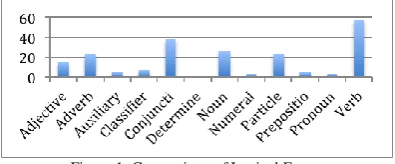
Figure I reveals lexical errors detected in data of L1 transfer errors. Of the 12 categories of lexical errors identified, this study found that students had the greatest problem in verbs. Conjunction errors, noun errors, adverb errors, and particle errors, were also frequent errors found in the data. In contrast, auxiliary errors, classifier errors, numeral errors, preposition errors and pronoun errors were less found, and determiner errors were not detected.
Figure 1. Comparison of Lexical Errors
1. Verb Error
In the analysis (see Table I) of lexical errors, most errors were found from the verb error categories and most verb errors were made in the form of misformation. Specifically, a total of 44 entries were identified as incorrect because of inappropriate verb use, which can be corrected for by substituting the appropriate verb. Meanwhile, 9 references were discovered relating to verb error because of adding certain verbs, and 8 references were listed because of leaving out a verb. Since verb errors in the form of misformation account for the majority of verb errors, it provides clues to understanding constraints in L2 learning.
(1) 每个早晨,柯林看到林雪梅的舅舅去小区的公园打太极拳,问[让]舅舅叫他。
Every morning, Kelin saw Lin Xumei’s uncle practicing taichi in the park of the residential community, so he asked his uncle to teach him.
(2) 请保存[节约]纸张,不要使用一次性筷子。
Please conserve paper. Don’t use one-time use chopsticks.
The two examples illustrate one constraint on lexical development in L2. Both the verb in Sentence (1) and Sentence (2) have two semantic meanings in English: “ask” is associated with “raise” to form phrases like “ask a question” or is synonymous with “have” or “make” to mark a causative structure, like “ask my son to repair it”; “conserve” introduces objects like resources, or objects like energy or strength. These differences are embodied in its equivalents into Chinese. The “ask” in “ask a question” is translated into 问 while the “ask” in “ask my son to repair it” is translated into 让. The “conserve” taking objects of source is translated into 节约,while the “conserve” taking objects of energy is translated into “保存”. As such, the errors made in Sentence (1) and (2) are produced because the lexical system in L1 does not completely match the L2 system and students are not aware of these differences, especially slight differences used in different contexts. It is suggested that it is a challenge for L2 learners to extract and create semantic specifications about a word and integrate such information into the lexical entry of the word.
2. Conjunction error
Conjunction error was the second most frequent error in terms of lexical error, and was detected in all of four forms. Among them, errors due to omission of conjunctions amounted to 37 and were the most found, while conjunction errors because of misformation, addition, and move were counted at 27, 26 and 14, respectively. An alternative way to look at the frequent conjunction errors in the form of omission at this stage is to suggest that information in L1 lemmas may be directly copied or attached to L2 lexical forms to form lexical entries that have L2 lexical forms, but not syntactic information of their L1 translation equivalents. This made errors resulting from omitting certain parts of conjunction in Chinese possible. For example,
(3) 除了多锻炼以外,人[还]应该注意喝吃什么。
Besides more workouts, people [also/still] should pay attention to what to drink and eat.
(4) 虽然她的存款非常少,[但是]她经常炒股票。
In Chinese, the conjunction words 虽然 (although/though) and 除了(besides)do not function as conjunctions independently as in English, where the common structure is “Although + clause, sentence” and “Besides+ Noun Phrase, sentence”. In contrast, 虽然 and 除了 work with another word to comprise conjunction in Chinese and the structure is usually “虽然+clause, 但是(But)+clause” and “除了+clause,还(also/still)+clause”. Here, the omission of the conjunction in Chinese is because the lexical form in L2 has been activated and L1 lexical information was in use. In other words, consciousness of L1 and L2 difference was not built up. It is the same with errors such as 因为我很重视 我的身体,[所以]我每天运动 ( Because I really care for my body, [so] I workout every day. ) and 虽然他们差不多 五十岁,[但是]他们有非常好的身材((Although they are almost 50, [but]they have very good figure).
3. Noun error
Noun errors, identified as the third most frequent error, were found to be mostly made due to misformation, while noun errors in other forms were much less found. The significant difference of noun errors made because of misformation suggests that students at this stage still use directly through L1 lemmas as the default route. Lexical representation is the weak connection between L2 lexical items and conceptual representations. For example,
(5) 我在夜晚上睡觉,在白天做健康的东西[事情]。
I sleep at night, and do healthy things in the day.
(6) 你可以做很多种锻炼[运动]。
You can do many kinds of sports.
Students intended to use 东西in Sentence (3) express things. However, “things” in the sense of semantics is different in Chinese. In Chinese, both事情and 东西 have meaning the of things. 事情is more like a matter or affair, while 东西 is more like a physical thing or object. In Sentence (4), 锻炼 is usually used as verb while 运动 is more used as noun. The common expression connected with the verb 做 is 运动 instead of 锻炼. The two errors illustrate the point that semantic and syntax information which is not shared by students’ L1 language is more likely to be lost in processing an L2 word. An explanation is that words in L2 are only considered to be attached to certain L1 lexical equivalents, and it resulted in L2-specific features being ignored at this stage.
4. Adverb error
Adverb errors and particle errors are the less frequent errors detected in data set compared to verb error, conjunction error and noun. Most of the adverb errors were made in the form of misformation. For example,
(7). 可是我的姐姐说我要注意,否则我会更多[更]像肥肥。
But my sister says I have to pay attention, otherwise I’ll resemble Feifei more.
(8) 他想买一套三房一厅两卫的房子,只有[只是]房子在城外,而且上班不方便。
He’d like to buy a house. He has his eye on a three-bedroom, one living-room, and two-bathroom house, except it’s outside the city and rather inconvenient to get to work.
Here, misformation errors are made when the L1 word is attached to more than one representation under various semantic or syntax conditions. Therefore, wrong L2 words were activated as L1 translation equivalents. “More” in English can serve as an adjective or adverb. When it modifies a noun as an adjective, it is usually translated into 更多 in Chinese, like “I want more food(我想要更多食物). ”, while it is often translated into 更 in Chinese when it is used as an adverb to modify a verb, like “The building looks more like a museum”(这栋楼更像博物馆). Because “more” in Sentence (7) is used to modify the verb “resemble”, it should be translated into 更 but not 更多. “Only” could be used as an adverb, as an adjective (always before a noun), or as a conjunction. In Sentence (6), “only” can be replaced with “but” as a conjunction to indicate contrast. There are many instances where “only” and “but” could be used interchangeably in English. For instance, “You can come; only make sure you’re on time” and “You can come; but make sure you’re on time”. As an adverb, it is translated into “只有” usually. For example, 我只有一个苹果 (I only have one apple). In Sentence (8), “only” functions as conjunction to make contrast. Therefore, its lexical equivalent is supposed to be 只是 in Chinese.
5. Particle error
Particle errors in the form of omission are much more than the number of particle errors in other forms. A total of 20 references were identified as particle errors made because of omitting certain morphemes, while only one entry was found in particle error made due to addition and misformation. Specifically, 19 out of 20 errors in form of omission are made because of leaving out the particle了, and only one error was made because of omitting the particle 上. Their difference in number determines that it is significant to analyze how the errors omitting 了 were possible.
perfective aspect particle to mark the completion of an action. Therefore, L2 learners are likely to drop the particle 了 in Chinese writing under the influence of past tense marker (-ed) in English. For example,
(9) 我的表哥卖[了]他的车。 My cousin sold his car.
(10) 高中我的老师教[了]我们一点儿太极拳
In high school my teacher taught us a bit of taichi.
It can be seen that the above-mentioned examples do not possess any visible perfective aspect markers, like 已经 (already) and 完 (finish). This provides conditions for L2 learners to associate these sentences to past tense instead of perfective aspect. Affected by the suffix (-ed) past tense marker in English, students ignored the marker for completed action 了 in the process of translation.
B. Syntax Errors
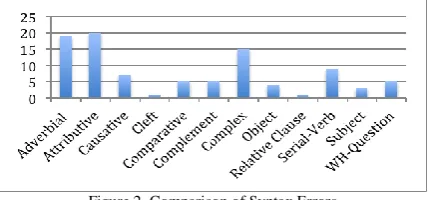
In terms of syntax, identified errors are concerned with many sentence elements and types of sentence structure. Based on the collected data, the participants had the greatest difficulty in using attributives as a sentence element. Adverbial errors are also significant, as Figure 2 demonstrates. Among errors of sentence structure type, complex sentences are the biggest challenge for students. Serial-Verb construction comes in second as another major error of sentence structure.
Figure 2. Comparison of Syntax Errors
1. Attributive error
A total of 20 Attributive errors were found in data. Among them, errors caused by word order accounted for the majority. For example,
(11) 比如,在农村,女孩子的机会学习[学习机会]比男孩子的更少。
For example, in the countryside, the opportunity to study is less for girls than for boys.
(12) 我的方法使我的身体健康[使我的身体健康的方法]是锻炼身体,注意饮食,和睡够觉。
My way of making my body healthy is to exercise, pay attention to diet, and getting enough sleep.
These two examples illustrate how established syntax systems in L1 discourage acquisition sentence structure in L2 when their difference is visible in word order. In English, using a noun as a pre-modifier of a noun is done by using the modifying noun as an attributive noun or noun adjunct is common, whereas another common construction simply uses a prepositional phrase as a postnominal modifier. Its construction is usually “noun(head)+of+noun (postnominal modifier)”, like “the list of documents”. In contrast, attributives usually proceed heads in Chinese with the structure “noun (prenominal modifier)+的+noun(head)”, like “档案(documents)的条目(list)” . Reversing modifiers and heads resulted in the errors in sentences (11) and (12).
2. Adverbial error
A total of 19 adverbial errors were detected and all of them were made because of wrongly placed word order. For example,
(13) 所以我们没有吃年夜饭在他们的家[在他们的家吃年夜饭]。
So we didn't have Chinese New Year’s Eve dinner at their home.
(14) 在中国学生做[打]太极拳每[天]早晨[每天早上打太极拳]。
In China students practice taichi every morning.
In English, adverbs of place and time usually come at the end position of a sentence or clause. In Chinese, place phrases and time phrases are commonly placed before predicates in Chinese when they function as an adverbial to modify an action. Therefore, the adverbial “at their home” (在他们的家)in Sentence (13) should be arranged before verb phrase吃年夜饭 in Chinese translation and form在他们的家吃年夜饭. It is the same in Sentence (14), where “practice taichi” should come after the adverbial of time “每天早上” (every morning).
3. Complex Sentence
dependent clause (when I grow up) usually proceeds the independent clause (I want to be a teacher). Sentences (15) and (16) provide examples of errors attributable to clause order in Chinese:
(15) 大学生还不必担心发胖如果他们注意饮食。[如果大学生注意饮食, 他们还不必担心发胖]。
College students don’t need to worry about becoming fat if they pay attention to their diet.
(16) 偶尔他们吵架因为李文炒股票。[偶尔他们因为李文炒股票吵架]
Sometimes they quarrel because Li Wen speculates on stocks.
In terms of leaving out conjunction words, correlated errors are introduced in conjunction errors. Examples can be found in sentences (3) and (4).
C. Semantic Errors
Semantic errors found in data are mostly resulted from overgeneralization of polysemy in L1. It covers instances where the learner produces a deviant semantic meaning in Chinese on the basis of his/her experience caused by multiple semantic meanings in L1. For example,
(17) 我也要变化[改变]我的生活。
I will change my life too.
(18) 每天健身我会住[活]很久。
I can live longer if I work out every day.
Sentences (17) and (18) provide examples of polysemy of a word in the target language. In English, “change ” can function as a verb or noun. Specifically, it works either as transitive verb or intransitive verb. The transitive “change” takes an object and should be translated into “改变”, such as in Sentence (17) . However, participants translated it into “变化”, which is usually the equivalent of “change” as a noun. Compared to the different parts of speech of “change”, difference of the semantic meaning of “live” in Sentence (18) is less noticeable. The “live” in Sentence (18) is associated with the semantics of longevity, while the more firmly established semantics of “live” is on residence and dwelling, like “I live in Chicago”. In Chinese, the corresponding word for “live” in “I live in Chicago ” is “住”, while equivalence to “live” in sense of longevity is “活”.
D. Mechanical Errors
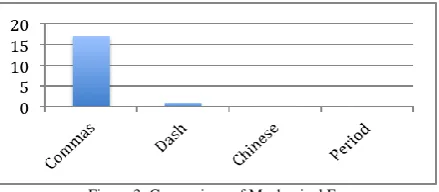
Mechanical errors are those of orthography (spelling and capitalization) and punctuation. In this study, only punctuation errors are included in that category since there is no capitalization issue in Chinese. It is seen in Table III that mistakes made in the aspect of commas accounted for the majority of punctuation errors. Meanwhile, very few dash errors were detected. In the collected data set, no uses of Chinese back dash were found and no period errors were identified.
Figure 3. Comparison of Mechanical Errors
Comma addition is the main form of error under the category of comma errors. In English, a serial comma or series comma (also called an Oxford comma or a Harvard comma)is a comma placed immediately before the coordinating conjunction (usually and or or) in a series of three or more terms. For example, a list of three items might be punctuated either as “A, B, and C” (with the serial comma), or as “A, B and C” (without the serial comma). While in Chinese, only the latter form, namely “A, B 和(and)C” is formally applied. This interlingual difference generated an error in punctuating Sentence (19):
(19) 除了春节以外,还有元宵节,端午节,中秋节,和清明节。
Besides Spring Festival, there are Lantern Festival, Dragon Boat Festival, Mid-Autumn Festival and Tomb-Sweeping Day.
In addition to comma errors made because of adding commas, inappropriate application of commas in sentences is also common. Instead, Chinese back- sloping commas (also named Enumeration comma or Chinese serial comma) should replace commas in sentences. For instance,
(20) 春天,[、]夏天的时候, When it is spring and summer,
(21) 我一个星期就在哪[那]儿跑三,[、]四次步。
I run three or four times a week there.
that the English custom of a serial comma had a negative influence in applying Chinese back- sloping commas, especially when Chinese as Foreign Language students’ consciousness of punctuation use in Chinese has not been engendered.
In all, a large number of errors made by these learners in lexical, syntactic, semantic and mechanical aspects can be explained due to interference from the L1. Many errors are closely related to overgeneralization of application of rules in L1 to contexts where they do not apply. Meanwhile, many mistakes resulted from failure to observe the restrictions of the existing contexts and structures in L2. In addition, L1 transfer errors were identified in various forms: addition, omission, move and misformation. Consequently, it was shown that interference from the mother tongue is a significant source of errors that intermediate-level Chinese as Foreign Language learners make.
REFERENCES
[1] Al-Khresheh, M. H. (2016). A review study of error analysis theory. International Journal of Humanities and Social Science Research, 2, 49-59.
[2] Beare, S. (2000). Differences in content generating and planning processes of adult L1 and L2 proficient writers. Doctoral dissertation, University of Ottawa, Canada.
[3] Cabrera Solano, P. A., Gonzalez Torres, P. F., Ochoa Cueva, C. A., Quinonez Beltran, A. L., Castillo Cuesta, L. M., Solano Jaramillo, L. M., & Arias Cordova, M. O. (2014). Spanish in EFL Writing Skills: A Case of Ecuadorian Senior High Schools.
English Language Teaching, 7(7), 40-48.
[4] Chelli, S. (2013). Interlingual and Intralingual Errors in the Use of Preposition and Articles. As retrieved from
http://dspace.univ-biskra.dz:8080/jspui/bitstream/123456789/3571/1/Interlingual%20or%20Intralingal%20Errors%20in%20the%20Use%20of%2 0Preposition.pdf. (accessed 05/02/2018).
[5] Chen, H. C. (2004). Asymmetrical performances of English null subjects and null objects for Chinese college students. Paper presented at the Thirteenth International Symposium on English Teaching, Taipei.
[6] Corder, S. P. (1967). The significance of learner's errors. International Review of Applied Linguistics, 5 (4), 161-170. [7] Corder, S. P. (1981). Error analysis and interlanguage. Oxford: Oxford University Press.
[8] Dulay, H., Burt, M., & Krashen, S. (1982). Language two. Oxford: Oxford University Press. [9] James, C. (1998). Errors in language learning and use: Exploring Error Analysis. London: Longman.
[10] JoyeceMahmoud, A. ed. (2000). Modern standard Arabic vs. non-standard Arabic: Where do Arab students transfer from? Language, Culture and Curriculum, 13, 126-136.
[11] Kim, I. (1988). A study of the errors in the use of the English verbs with special reference to tense, mood, and voice. Unpublished master's thesis. BusanNational University, Busan, Korea.
[12] Lee, E. P. (2001). Error Analysis on medical students' writing. Retrieved October 21, 2008,from http://www.stc.arts.chula.ac.th/ITUA/Papers_for_ITUA_Proceedings/Eunpyo-new.pdf.
[13] Londono Vasquez, D. A. (2007). Error Analysis. Retrieved October 21, 2008, from http://davidlondono.blogspot.com/search?updated-min=2007-01-01T00%3A00%3A00-08%3A00&updated-max=2008-01-01T00%3A00%3A00-08%3A00&max-results=4.
[14] Lord, G. (2008). Second language acquisition and first language phonological modification. Proceedings of the 10th Hispanic linguistics symposium.
[15] Magnitskaia & C. Zaller (Eds.), Proceedings of the 30th Boston University Conference on Language Development (pp. 653-664). Somerville, MA: Cascadilla Press.
[16] Mochizuki, K., Sano, H., Shen, Y. M., & Wu, C. H. (2015). Cross-Linguistic Error Types of Misused Chinese Based on Learners’ Corpora. International Journal of Computational Linguistics & Chinese Language Processing, Volume 20, Number 1, June 2015-Special Issue on Chinese as a Foreign Language, 20(1), 97-114.
[17] Odline,T.(1989). Language transfer: Cross-linguistic influence in language learning. Cambridge: Cambridge University Press. [18] Selinker, L. (1972). Interlanguage. IRAL, 3, 201-31.
[19] Selinker, L. (1992). Rediscovering interlanguage. London and New York: Longman.
[20] Sorace, A., & Filiaci, F. (2006). Anaphora resolution in near-native speakers of Italian. Second Language Research, 22(3), 339-368.
[21] Sorace, Antonella. & Serratrice, Ludovica. (2009). Internal and external interfaces in bilingual language development: Beyond structural overlap. International Journal of Bilingualism 13, 195-210.
[22] Tsimpli, I., & Sorace, A. (2006). Differentiating interfaces: L2 performance in syntaxsemantics and syntax-discourse phenomena. In BUCLD Proceedings 30.
[23] Wang, W., & Wen, Q. (2002). L1 use in the L2 composing process: An exploratory study of 16 Chinese EFL writers. Journal of Second Language Writing, 11, 225- 246.
[24] Zheng, C., & Park, T. J. (2013). An analysis of errors in English writing made by Chinese and Korean university students.
Theory and Practice in Language Studies, 3(8), 1342-1351.