The Advanced Progressive Technique for Multihop
Wireless sensor Networks
1
B.Venkataramana,
2Kesavarao Seerapu
1,2Dept. of CSE, Avanthi Institute of Engineering & Technology, Visakhapatnam, India
Abstract
In multihop wireless networks, once a mobile node needs to communicate with a destination, it relies upon alternate nodes to propel the packets. This multihop packet transmission will broaden the network scope space exploitation confined power and enhance space separate strength. Inside the arranged multihop wireless network ESTAR coordinates the installment and expectation framework with the directing methodology with the reason for elaborate course dependableness and steadiness. The installment framework portray to claim the nodes that send packets and reward those forward packets. The trust framework is essential to gauge the nodes’ dependability and dependableness in sending packets regarding multi-dimensional trust esteems and in this manner the trust esteems square measure ascertained for every node and created 2 steering protocol is utilized to send the packets through to a great degree trusty nodes having enough vitality to limit the probability of breaking the course. To reinforce the confide in examination, proposal from each node is encased in put stock in computation by TP (Trusted Party). This protocol is created over the Manet network and imitated persecution NS2. Execution assessed from the parameters like packet delivery greatness connection, choice acknowledgment size connection and course period.
Keywords
Multi-hop Wireless Network, Trust Based Method, Securing Heterogeneous Multihop Wireless Networks, Packet Dropping.
I. Introduction
In networks, when a mobile node needs to communicate with a remote destination, it depends on alternate nodes to hand-off the packets with the assistance of multihop wireless networks [1]. coverage region utilizing restricted power and enhance territory phantom effectiveness network are utilized for the transmission of multihop packet. In creating and provincial territories, the network can be conveyed all the more promptly and with ease. HMWNs can actualize numerous valuable applications, for example, information sharing and media information transmission [2]. Cases that are pertinent are, clients in a single territory (private region, Academy grounds, and so forth) having diverse wireless-empowered gadgets (Personal computerized colleagues and different wireless gadgets) can build up a correspondence network. The multihop wireless network can be executed in numerous helpful applications, for example, information sharing and media information transmission. It can build up a network node to impart, disseminate documents, and offer data. The fundamental presumption is restricted assets, for example, battery vitality and accessible network transmission capacity are willing for the nodes. However the disadvantages in the current directing protocol, for example, Dynamic Source Routing (DSR) [6] is accepted that the network nodes are prepared to transfer other nodes’ packets. However this presumption is sensible in a fiasco recuperation in light of the fact that the nodes seek after a shared objective and have a place with one summon, yet it may not bolster for regular citizen applications where the nodes intend to augment their advantages, since their coordination
devours their important assets, for example, transmission capacity, vivacity, and processing power with no advantages. In multihop wireless networks, the huge test is ideal steering. Nature of Service (QoS) prerequisites ought to fulfill a course to guarantee that every session is given by steering protocol (e.g.,ratio band, retard and fatigue). Moreover, the directing protocol ought to maintain a strategic distance from network blockage by adjusting the heaps ideally between courses to use the assets in precise [4]. The gadgets that are taking part in MANET are likely little gadgets, with restricted handling force, maintenance and store limit. The transfer speed is partitioned by all gadgets in the encompassing territory in wireless correspondence. In addition, an expansion in network activity puts additional heap on the nodes in the network, which thus expands vitality usage [5]. Therefore, it is hard to outline a procedure that uses the vitality insignificantly and consistently.
II. Related Work
protocol in [9] can be utilized with E-STAR, here analyst utilizes a basic protocol because of space constraint. In [10], installment is utilized for ruin the reasonable packet-dropping assaults, where the assailants erase packets since they don’t profit by transferring packets. A notoriety framework is utilized to distinguish the silly packet-dropping aggressors once their packet-dropping rates surpass a limit. The odorakopoulos and Baras [1] break down the issue of assessing the trust level as a speculation of the most limited way issue in an arranged chart, in which the edges relate to the conclusion that a node has about other node. The principle objective is empower the nodes to in a roundabout way assemble trust connections utilizing solely observed data. In [2] Velloso et al. Proposed a human-based model which fabricates a trust connection between nodes in the adhoc network. Without utilizing the worldwide put stock in information, they have displayed a protocol that scales productively for networks which is extensive in estimate. In [3], Lindsay et al. outlined a data theoretic system to quantitatively gauge trust esteem and model trust proliferation saw in neighborhood or other little networks. Trust is helpful for measure of Uncertainty and its esteem spoke to by entropy. The verification gathered for noxious and benignant practices are probabilistically mapped by following a changed Bayesian approach strategy. The probabilistic gauge of Bayesian approach is then mapped with entropy. In [4], scientist built up a safe steering protocol with nature of administration bolster has been proposed. The directing measurements are made by blending the necessities on the put stock in estimation of the nodes and the nature of administration of the connections along a course. [6] the specialist have discovered the trust estimation of the node in view of put stock in computation without the false allegation .this figuring of trust is finished with the assistance of ESTAR based framework which thinks about the parameter of number of packets , percent of sessions and the nodes capacity to keep a course associated. This parameter is considered in the paper are taken as hard choice esteem which is extremely hypothetical case yet in down to earth wireless network this parameter don’t have just a single esteem yet an arrangement of qualities from which a choice needs to occur. e.g. number of packets send by a node can be low, medium or high where each of this range will have a progression of qualities i.e. low can be 1 to 100 packet. Medium can be 100 to 10000 packets .High can be 1 lakh to 10 lakh packet But this paper consider just a basic arrangement of significant worth for each of the parameter. The fundamental disadvantage of these methodologies is that the trust esteem will be Calculated in an incorrect way there the general security of the by sending information between nodes which won’t not be reliable and decreasing framework.
III. Methodology
A. Network Architecture
The heterogeneous Multihop Wireless Networks has mobile nodes and offline sure Party (TP) whose public key is well-known to any or all the nodes. The mobile nodes have different hardware and energy capabilities. The network is used for civilian applications, its life is long, and the nodes have long relation with the network. Thus, with every interaction, there’s invariably an expectation of future reaction. every node incorporates a distinctive identity and public/private key try with a limited-time certificate issued by TP. while not a sound certificate, the node cannot communicate nor act as an intermediate node. TP maintains the nodes’ credit accounts and trust values. Each node contacts TP to submit the payment reports and TP updates the concerned nodes’ payment accounts
and trust values. The adversaries have full management on their nodes. they will amendment the nodes’ traditional operation and obtain the scientific discipline identification. they will try to attack the payment system to steal credits, pay less, or communicate at no cost.
B. Attack Scenario
Some adversaries might report incorrect energy capability to extend their likelihood to be elite by the routing protocol, e.g., to earn a lot of credits. The adversaries can also conceive to attack the trust system to falsely augment their trust values to extend their likelihood to participate in routes. they will try and insult different nodes’ trust values. Attackers might launch denial-ofservice attacks by breaking the communication routes intentionally. once a node B receives packets from node A to forward to ensuing node within the route, node B drops the packets and keeps silent to let node A believe that node B is out of transmission vary and also the link between them is broken. These attacks is also launched by compromised, malfunctioned, or low-resource nodes.
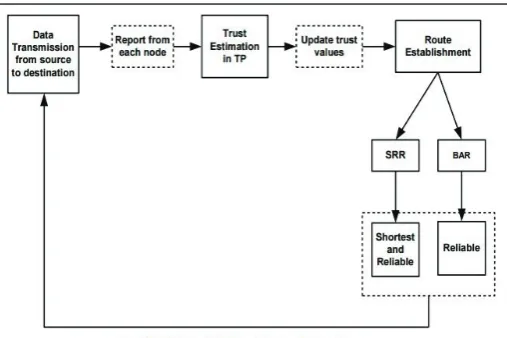
Fig. 1: E-STAR in Multihop Wireless Network
E-STAR in multihop wireless network. In wireless network knowledge transmission from supply to destination and each node can have a singular identity and report back to the trusted party. The trusty party can assess a trust price for each node with their nodes’ past behaviour. After updating the trust values the routing institution process square measure done through by SRR and BAR. Whereas SRR can realize a shortest and reliable path and it avoids the low trusty nodes. BAR can realize the foremost reliable one.
C. Data Transmission Phase
hash messages for composing the report. every node within the route composes a report and submits it once it’s a affiliation to TP to claim the payment and update its trust values.
D. Trust Estimation Phase
Trust Party receives a report, it initial checks if the report has been processed before mistreatment its distinctive symbol. Then, it verifies the authority of the report by computing the node signatures with hash message. If the report is valid, trust party verifies the destination node’s hash message. TP clears the report by rewardable the intermediate nodes and debiting the supply and destination nodes. the amount of sent message is signed by the supply node and therefore the range of delivered messages can be computed from the amount of hashing operations done. The trust values ar calculated from every node based mostly on nodes’ trait and responsibility in relaying packets. it’s honest to extend the trust values of the nodes that aren’t in broken links, as a result of they relayed packets truthfully. On the opposite hand, the trust system decreases the trust values of the 2 nodes in an exceedingly broken link. Trust is also dynamic or time-sensitive. thus trust party must periodically valuate the nodes’ trait, i.e., a trust worth at time t could also be completely different from its worth at another time. that the planned system depends on the multidimensional trust worths rather than single trust value to precisely predict the nodes’ future behavior. Trust values are wont to decide that nodes to pick out or avoid in routing. Since a trust price depicts the chance that the node conducts AN action, route responsibleness are often computed victimization its nodes’ trust values to relinquish probabilistic info concerning the route stability and lifetime. The trust values ar calculated from the subsequent Formula:
T (1) = (No of packets that are forwarded in last t sessions) / (Total no of incoming packets in last t sessions)
T (2) =1-((No of sessions broken by node in the last t sessions)/t))
T (3) = No of session that node at least f packets/t T (4) = No of session node participated in the period t/m
T xyz(i) = Tx(i) x Ty(i) x Tz(i)
Txyz(i) = Trust value denotes the Route reliability x, y, z = Intermediate node i = 1,2,3,4(dimensions)
IV. Dynamic Source Routing Protocol
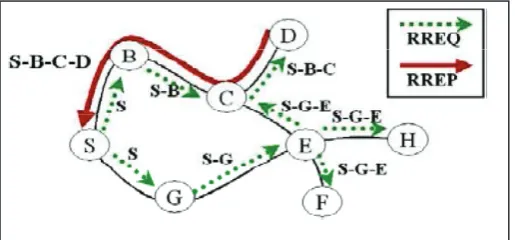
The Dynamic Source Routing protocol (DSR) [4][9] is based on source routing, which means that the originator of each packet determines an ordered list of nodes through which the packet must pass while travelling to the destination. The key advantage of a source routing design is that intermediate nodes do not need to maintain up-to-date routing information in order to route the packets that they forward, since the packet’s source has already made all of the routing decisions. This fact, coupled with the entirely on-demand nature of the protocol, eliminates the need for any type of periodic route advertisement or neighbour detection packets. A. DSR Overview As our work is explicit to DSR, this section provides a brief recapitulate the DSR route discovery process. Dynamic Source Routing (DSR) [5-7] is a beacon-less protocol. During route construction phase, RREQ is flooded in network. The destination nodes respond by RREP, which carries
the route traversed by the RREQ packet. Each RREQ carries a sequence number generated by source which is used to prevent loop formation and to avoid multiple transmission of the same RREQ by intermediate node that receives it through multiple paths. DSR is a purely on-demand ad hoc network routing protocol. This means that a route is discovered only when it is needed and no pre-distribution of connectivity is performed. Since route discovery is done via flooding, nodes do not accumulate network topology information except for cached routes. DSR includes two main mechanisms: route discovery and route maintenance. Route discovery is used to discover a route from a given source to a given destination, while route maintenance is used to manage (cache, expire, switch among) previously discovered routes. Since our focus is on route discovery, we do not further discuss route maintenance [1][3]. Route discovery is composed of two stages: RREQ (RREQ) and RREP (RREP). Whenever a source needs to communicate to a destination and does not have a route in its route cache, it broadcasts a RREQ message to find a route. Each neighbour receives the RREQ and (if it has not already processed the same request earlier) appends its own address to the address list in the RREQ and re-broadcasts the packet.
Fig. 2: RREQ and RREP Mechanism
This process continues until either the maximum hop counter is exceeded (or RREQ is discarded) or the destination is reached. In the latter case, the destination receives the RREQ, appends its address and generates a RREP packet (RREP) back towards the source using the reverse of the accumulated route. Unlike RREQ, RREP percolates towards the source via unicast. When the source finally receives RREP, it stores the Route Discovery of RREQ and RREP packets. DSR route discovery also includes some optimization measures: when processing a RREQ, an intermediate node can be authorized to issue a complete RREP if it already has a valid route to the destination in its route cache. An intermediate node can also switch its network interface into promiscuous mode, in order to harvest routes from passing route replies [7]. These optimizations can be secure in our signature-based schemes. In the first optimization, the route issued by an intermediate node will be authenticated if the node also sends authentication tag(s). For example, the node can store all signatures after a route is verified. In the second optimization, the acquired routes are verifiable from the signatures. However, in this paper, we secure only a basic version of route discovery and the use of these optimizations is beyond the scope of this paper.
V. Proposed Method
and public/private key pair with a limited-time certificate issued by the trusted party. Without any valid certificate, the node cannot communicate nor act as an intermediate node. The trusted party maintains the credit accounts and trust values of the nodes. Each node contacts TP to submit the payment receipts and then TP updates the involved nodes’ payment accounts and trust values. This contact can occur via cellular networks or Internet. Alert-Anonymous Location Based Efficient Routing Protocol ALERT can be used in different network models with node movement patterns. Such as random way point model and group mobility model. Using network model information attacker may find out location of nodes. So anonymity may get threaten. Therefore, an anonymous communication protocol is needed which can provide untraceability to strictly ensure the anonymity of sender. As well as attacker try to block the data packets by injecting packets on a routing path. Therefore, route should also be undetectable. And with help of intersection attack on traffic destination node can be detected, so destination node also needs the protection anonymity. Pseudonym and Location of Node defines dynamic pseudonym is another name or identity given to node. In ALERT pseudonym used as node identifier with replacement of its real MAC address. Nodes MAC addresses can be used to trace nodes existence in the network. Therefore replacing MAC address with pseudonym is the main advantage of ALERT protocol. This pseudonym is the combination of MAC address and Current time stamp. But if this information is known by attacker then it is easily find out the node. Therefore, to prevent this time stamp can be randomly selected. This pseudonym is not permanent; it expires after a specific time period so that attacker cannot associate the pseudonym with nodes. With this pseudonym there is one problem is changing pseudonym frequently create routing uneasy. Therefore these pseudonym changes frequently should be appropriately determined.
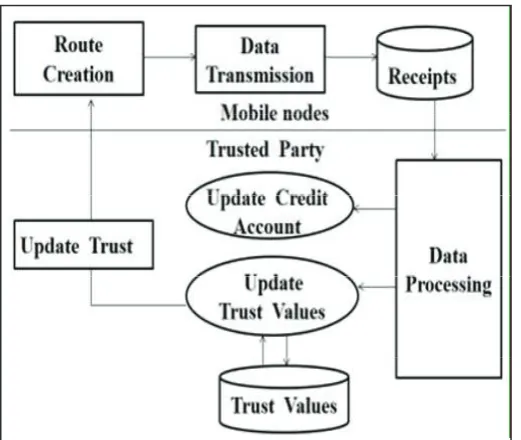
Fig. 3: Proposed System Architecture
The figure shows the E-STAR architecture and it has three main phases. In wireless network data transmission is from source to destination and each node has a unique identity and report to the trusted party. The trusted party will evaluate a trust value for each node based on their nodes past behavior. After updating the trust values the routing establishment process are done by SRR and BAR. Whereas SRR will find one shortest and reliable path and it avoids the low trusted nodes. BAR will find out and select the most reliable one.
VI. Conclusion
The proposed E-STAR uses payment and trust systems with trust-based and energy-aware routing protocol to establish stable and reliable routes in wireless networks. E-STAR stimulates the nodes not only to relay others’ packets but also to maintain the route stability. It also punishes the nodes that report incorrect energy capability by decreasing their chance to be selected by the routing protocol. The proposed SRR and BAR routing protocols is evaluated them in terms of overhead and route stability. These protocols can make informed routing decisions by considering multiple factors, including the route length, the route reliability based on the node’s past behavior, and the route lifetime based on the node’s energy capability. From the results it is proved that the route reliability and packet delivery ratio has been improved using this protocol. The security of packet is decreased with untrusted nodes. In future work provide security for each packet, so that the intruders can’t able to get or damage the packets.
References
[1] Lee K.H, Han K Y, Song Y J,"Capacity Enhancement of Uplink Channel Through spatial reuse in multihop cellular networks", 1997.
[2] Carbone, B., 2006,"Routing Protocols for Interconnecting Cellular and Ad Hoc Networks", UniversiteLibre De Bruxeles , Faculte des Sciences, Department ‗d Informatique,2006‖ Tavel, P. 2007 Modeling and Simulation Design. AK Peters Ltd.
[3] Perkins E C., BhagwatP, "DSDV Routing over a Multihop Wireless Network of Mobile Computers", In Ad hoc Networking Addison Wesley Chapter 3, pp. 53-74, 2001. [4] Clausen T., Jacquet P,"Optimized link state routing protocol
(OLSR)", In RFC3626, 2003.
[5] Johnson B D., Maltz A D., Hu C Y,"The Dynamic Source Routing Protocol for Mobile Ad HocNetworks (DSR)", In Tomasz imielinski and Hank Korth, Mobile Computing, Vol. 353, pp. 153-181. Kluwer Academic Publishers, Chapter 5, 1996.
[6] Park D V., Corson S M,"A Highly Adaptive Distributed Routing Algorithm for Mobile Wireless Networks", At IEEE Conference on Computer Communications, INFOCOM 97, Kobe Japan, 1997.
[7] Perkins E C., Royer Belding M E., Das S.,"On Demand Distance Vector Routing Protocol", In draft – ietfmanet-aodv-13, 2003.
[8] Cavalcanti D, Agarwal D,"Issues in Integrating Cellular Networks WLAN‘s & MANET‘s", IEEE Wireless communications, 2005.
[9] H. Wu, C. Qiao, S. De, O. Tonguz,. 2001,"Integrated cellular and ad hoc relaying systems: iCAR, IEEE Journal on Selected Areas in Communications 19 (10) (2001) 2105–2115. IJCA Special Issue on “Mobile Ad-hoc Networks” MANETs, 2010.
Mr. B.Venkataramana, Pursuing M.Tech (CSE) from Avanthi Institute of Engineering and Technology, Vizianagaram, A.P. Received his B.Tech from RK college of engineering, Vijayawada. He actively participated in various workshops, and seminars and presented papers related to information technology. His area of interests are cloud computing Networking and Network security.