7
THE INCIDENCE OF POTATO VIRUS Y (NECROTIC STRAINS) IN SEED
POTATO GROWN IN SEVERAL ROMANIAN COUNTIES
(PRELIMINARY STUDIES)
Bădărău C.L.1,2)
, Rakosy-Tican E. 3), Aurori A. 3), Chiru S.C. 1), Olteanu Gh. 1), Stefan M. 1), Ghinea A. 1)
1) National Institute of Research and Development for Potato and Sugar Beet, Brasov 2) Faculty of Food and Tourism, Transilvania University, Brașov, Romania
3) Faculty of Biology, Babeș-Bolyai University, Cluj-Napoca, Romania
Keywords: potato virus Y, necrotic strains, potato seed
ABSTRACT
Protective measures of culture against Potato Virus Y necrotic strains (PVYN) infections,
diagnosis and control of this pathogen play an important role in potato seed production
technology and multiplication. Also, the choice of resistant varieties to the PVYN infection
could be one of the measures recommended for farmers and producers. Surveys during 2 years (2014, 2015), in five main seed potato growing areas of Romania (Braşov, Covasna, Harghita, Cluj, Suceava), for 10 varieties (Christian, Roclas., Riviera, Carrera, Bellarosa, Jelly, Desiree, Red Fantasy, Hermes and Red Lady), revelead significant differences in
PVYN incidence.The tests confirmed the PVYN presence in all the regions, with high
prevalence of this virus especially for the cultivars Hermes and Carrera and very low spread for the cultivars Riviera and Christian.
INTRODUCTION
The present paper provides an updated information on incidence of PVY in certified seed potatoes (several cultivars) produced in Romania, in five main regions where aphid infestations in potato were previously studied [unpublished data].
Potato virus Y (PVY, potyvirus genus, family Potyviridae) is one of the most
important economically virus of Solanum tuberosum L. plants, because his frequency and damaging potential. The virus Y occurs worldwide and the plant production with secondary infection can be diminuated with 33-90%, depending on the variety and the virus strains [2]. DeBokx ans Huttinga (1981) state that the PVY infections can reduce yields 10-80% [4]. Rykbost et al. (1999) [12] reported reduction in yield of number 1 tubers of Russet Norkotah by 12-40%. Similary, a reduction in marketable yield of 65% in Russet Norkotah was reported by Hane and Hamm (1999) [7]. Nolte et al. (2004) studyied the effect of tuber borne PVY infection on Russet Bubank, Russet Norkotah and Shepody and reported a yield loss of 0.18 tones/ha for each 1% increase in PVY infection [10].
8
Potato virus Y (PVY) was described for the first time by Smith in 1931 (UK) and for a long time, PVY isolates were classified according to foliar systemic and local symptoms in three main groups PVYO, PVYN, PVYC, depending on the symptoms induced
in Nicotiana tabacum and Solanum tuberosum varieties [13]. In recent years, PVY isolates
were found intermediate between PVYO and PVYN groups, because they share symptoms, serological and genomic properties with the two groups [5,9,14]. Thus, new PVY strains have emerged, some of them (e.g. PVY (N) W) induce barely visible symptoms during the growing season (often being unnoticed during visual inspection) and others (e.g. PVY (N) NTN) produce symptoms on tubers, causing the so-called the necrotic ring staining of tubers (PNRTD). The damage caused by this pathogen agent is both quantitative (significant reduction of production) and qualitative (commercial depreciation of tubers). In case of cultivation of sensitive varieties under favorable conditions, financial losses can be important both for potato consumption (it can become unmarketable) as for seed potatoes (it will be downgraded or rejected from certification). Being very aggressive, these strains can overcome existing resistance to infection with other strains of potato virus Y (PVYo and PVYc) [1]. Due to the fact that this patogen affect the resistance of some potato varieties maybe, there are varieties considered resistant unitll now and could passe into the category of sensitive ones, affecting also the production of the potato in our country.
The study aimed to provide an updated information on incidence of PVY in certified seed potatoes (several cultivars) produced in Romania, in five geographical regions (where aphid infestations in potato were previously studied), in 2014 and 2015.
MATERIAL AND METHOD
Biological material The potato samples were taked from different potato seed
producers and farmers, from the following geographical regions of our country: Braşov, Covasna, Harghita, Cluj and Suceava (table 1).
The varieties tested in this research work were:
- Christian, Roclas (Romanian varieties)
- Bellarosa, Jelly, Red Fantasy, Red Lady, Carrera, Riviera, Hermes, Desiree (foreign varieties)
Before planting and after emergence, the biological material was PVY virus free.
Detection of PVY infections
9
Table 1
Number of PVY and PVYN infected samples
(material collected in 2014 and 2015)
Region
Number samples PVY
infected
Number samples PVYN infected
Number total samples tested
Year 2014
Brasov 138 86 600
Covasna 260 119 1150
Harghita 212 69 478
Cluj 145 93 320
Suceava 128 44 200
TOTAL 883 411 2748
Year 2015
Brasov 338 159 920
Covasna 225 154 500
Harghita 178 70 1080
Cluj 207 97 650
Suceava 149 60 250
TOTAL 1097 540 3400
Biotyping and serotyping. Infection was confirmed by mechanical inoculation of
the positive samples in Nicotiana tabacum (cv. Samsun) under insect proof greenhouse post inoculation. Symptoms on tobacco plantlets were observed daily and recorded at 20-22 days post inoculum. Tobacco samples were ELISA tested to indentify PVYN using an anti-PVY serum (Bioreba, Switzerland), and anti-PVY(N) specific monoclonal antibodies (Bioreba, Switzerland). The methodology used for preliminary typing the PVY isolates is presented in table 2.
Table 2 Differentiation methodology for typing PVY isolates
Symptoms
Nicotiana tabacum
(cv.Samsun)
Patotip Serotip
Group of strains/ Subgroup Products PCR [1]* PINTC tubers* Mosaic
(M) O
N specific -
O - - O/C specific + - - Leaf necroses
(N) N
N specific + N/N
No -
N/NTN No -
O/C specific +
N/W Yes Yes
N/W No No
*data not shownin this study
Statistical interpretation
10
RESULTS AND DISCUSSIONS
For this study, 3,400 potato samples were tested in 2014 and respectively 2,748 samples in 2015 (table 1). The samples were collected from differents sites of 5 Romanian counties (9 producers from Brasov, 11 farmers from Covasna, 5 from Harghita, 6 from Cluj and 5 from Suceava).
Concerning the % PVY infection of the material tested, the lowest value was obtained in Harghita in 2014 (16.5%) and the highest in 2015 in Suceava (64.0%) (figure 2A). On the other hand, percent of infection rates in Harghita in 2015 was 2.6 times higher than in 2014. PVY Infection percentage was higher in Cluj and Suceava in 2015 (figure 2A). On the whole, in both years, there were significant differences depending on the site and area of sampling (figure 1).
There were interesting the closed values obtained for total % PVY infection of the biological material collected in 2014 (32.3%) and 2015 (32.1%) (figure 2A). Very closed values were obtained too, for the total % PVYN infection calculated from total samples PVY infected and from total samples tested in 2014 (49.2%, 15.9%) and 2015 (46.4%, 15.0%) (figure 2B&C).
Figure 1. Incidence of PVYN (preliminary results). Data represent mean values of the % PVYN infection in all the sites surveyed (material collected in 2014 and 2015). Values not followed by the same letter
are significantly different (P=0.05) according to Duncan’s test.
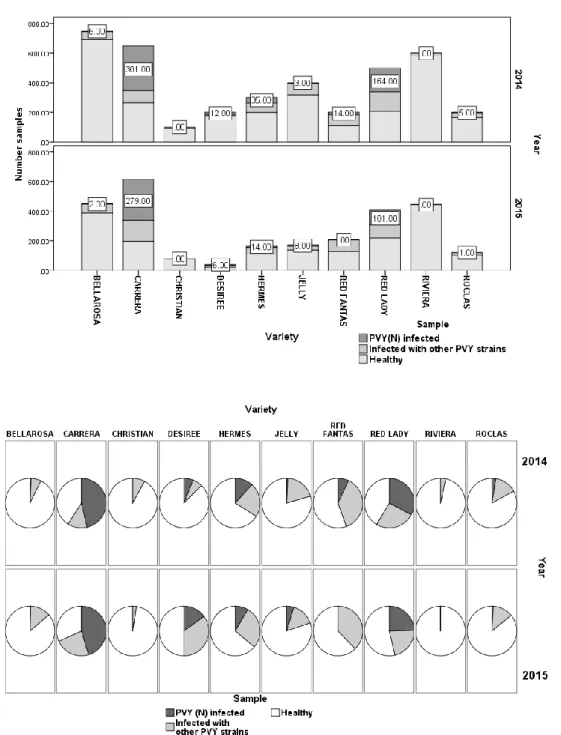
Regarding the PVYN infection level of the material tested in both years, the highest infection level with necrotic strains of PVY was noticed in case of cultivars Carrera, Hermes and Red Lady (figure 3).
The data presented synthetic in figure 2 and 3 will be used in the future for identify favorable and risk areas and improving potato microzoning (based on spatial and temporary assessment of potato virus Y necrotic strains spectrum, the degree of infection with PVY necrotic strains correlated with climate change in Romania).
11
Figure 2. Percentage of PVY and PVYN infection in samples collected in 2014 and 2015, in five seed potato growing areas in Romania A. % PVY infection; B. % PVYN infection (samples PVY necrotic infected reported to total material tested); C. % PVYN infection calculated from PVY infected material
12
Figure 3. Distribution of healthy, PVY and PVYN infected samples, for the cultivars tested - material collected in 2014 and 2015.
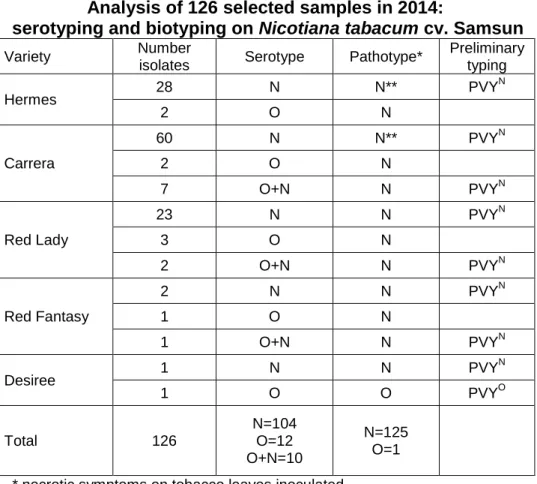
Preliminary typing from a first set of samples collected in 2014
13
Table 3
Analysis of 126 selected samples in 2014:
serotyping and biotyping on Nicotiana tabacum cv. Samsun
Variety Number
isolates Serotype Pathotype*
Preliminary typing
Hermes 28 N N** PVY
N
2 O N
Carrera
60 N N** PVYN
2 O N
7 O+N N PVYN
Red Lady
23 N N PVYN
3 O N
2 O+N N PVYN
Red Fantasy
2 N N PVYN
1 O N
1 O+N N PVYN
Desiree 1 N N PVY
N
1 O O PVYO
Total 126
N=104 O=12 O+N=10
N=125 O=1
* necrotic symptoms on tobacco leaves inoculated
**Symptoms of the pathology caused usually by PVY mosaic, crinkling, necrotic leaves patterns, stunting were forms with increased virulence.
Figure 4. Preliminary results – incidence of PVYN
for the varieties with the lowest and highest level of infection in the studied counties in 2014 and 2015.
14
associated with bending of some leaves, significant size reduction of most leaves and stunting of the whole plant. Despite the PVYN like symptoms induced in all the plants, only for several of them there were recorded positive serological PVYN reactions (table 3). Regarding the most favorable regions for seed potato producing (in case of varieties tested in this study) we cannot give more results until this moment because it is necessary to repeat the experiments in the future. However, preliminary data regarding the cultivars with the lowest and higher PVYN infection level (potato seed grown in different sites from 5 Romanian couties) are presented in figure 4.
In the context of intensify the measures to prevent and control the potato virus Y, the contribution of this paper to the current state of research will result in estimation of PVY spectrum strains spread to some genotypes grown in our country in order to assess the degree of infection with necrotic strains of PVY to several national and foreign varieties more cultivated in different geographical areas of the country and to identify some potato varieties with high resistance or tolerance to infection with viruses PVY (necrotic strains).
Acknowledgements This work was supported by a grant of the Romanian National Authority for Scientific Research, CNDI-UEFISCDI, PN-II-PT-PCCA-2013-4-0452, project number 178/2014 and partially funded by the Romanian grant – MoniCult, project PN-II-PT-PCCA-2013-4-1629.
CONCLUSIONS
In our country, although it is known that financial damage brought by necrotic strains of PVY are major in case of growing susceptible varieties under favorable conditions both for consumption potatoes (it can become unmarketable) and for seed potato (it will be downgraded or rejected from certification), to date there has not been conducted a comprehensive study on a spatial expansion of the spectrum of these viral strains, study that will contribute to the development of the control of emerging necrotic strains of potato virus Y.
In this preliminary study, between the varieties tested in 2014 and 2015 (samples taken from the following counties: Cluj, Suceava, Brasov, Harghita and Covasna) the lowest level of infection with necrotic strains PVY had the following genotypes: Riviera, Bellarosa, Jelly, Christian and Roclas.
BIBLIOGRAPHY
1. Boonham, N., Walsh, K., Hims, M., Preston,, S., North, J., Barker, I., 2002-
Biological and sequence comparisons of Potato virus Y isolates associated with
potato tuber necrotic ringspot disease. Plant Pathology 51: 117-126.
2. Cojocaru, N., 1987- Mozaicul Y (Virusul Y al cartofului – Potato virus Y). In: Protecţia
cartofului: boli, dăunători, buruieni, Editura Ceres Bucureşti, p.63 – 67.
3. Clark, M.F. and Adams, A.N. , 1997- Characterization of the microplate method of the
enzyme-linked immunosorbent assay for the detection of plant virus. Journal of General
Virology 34: 475-483
4. De Bokx, J.A. and Huttinga, H., 1981- Potato virus Y. Descriptions of Plant Viruses
No.242. Commonwealth Mycological Institute/ Association of Applied Biologists, Kew, England.
5. Galvino-Costa, S.B.F., Figueira, A., Camargos, V.V., Geraldino, P.W., Hu, X.,
Nikolaeva, O.V., Kerlan, C., Karasev, A., 2012- A novel type of Potato virus Y
recombinant genome, determined for the genetic strain PVYE. In: Plant Pathology (2012),
15
6. Gray, S., De Boer, S., Lorenzen, J., Karasev, A., Whitworth, J., Nolte, P., Singh,
R., Boucher, A., Xu., H. 2010- Potato virus Y. An evolving concern for potato
crops in the United States and Canada. Plant Disease 94 :1384-1397
7. Hane, D.C., and Hamm, P.B., 1999 - Effects of seed borne potato virus Y inection in
two potato cultivars expressing mild disease symptoms. Plant Diseases 83: 43-45.
8. Lacomme C., Kim Davie, Ross Holmes, Jon Pickup, 2014 - PVYN Prevalence in
Potato Crops: Impact of Strain Competition and Ability to Overcome Plant Resistance
Mechanisms. SASA Edinburgh, UK. The 19 Triennial EAPR Conference, 6-12.07.2014,
Brussels, Belgia
9. McDonald, J.G., and Singh R.P., 1996 - Host range, symptomology and serology of
isolates of potato virus Y (PVY) that shared properties with both the PVYN and PVY°
strain groups. American Potato Journal 73: 309-315
10. Nolte P., Whitwoeth, J.L., Thornton, M.K, McIntosh., C.S., 2004 - Efects of sed
borne Potato virus Y on performance of Russet Burbank, Russet Norkotah and Shepody
potato. Plant Diseases 88: 248-252.
11. Rigotti, S., Gugerli, P., 2007 - Rapid identification of potato virus Y strains by one-step triplex RT-PCR. Journal of Virological Methods, 140: 90–94
12. Rykbost, K. A., Hane, D.C., Hamm, P.B., Voss, R., Kirby ,D.,1999 - Effects of seed –
borne potato virus Y on Russet Norkotah performance. American Journal of Potato
Research 76: 91-96.
13. Singh, R.P., Valkonen, J.P., Gray, S.M., Boonharn, N., Jones, R.A., Kerlan, C. ,
Schubert, J.. 2008 - Discussion paper: The naming of Potato virusY strains infecting
potato. In: Archives of Virology 153: 1-13
14. Valkonen, J.P., 2011 - Family Potyviridae. In: Virus taxonomy. Ninth Report of the
International Committee on Taxonomy of Viruses, A. King, M. Adams, E. Carstens, and E.