Music in the Foreign Language Classroom: How
and Why?
Pauline Degrave UCLouvain, Belgium
Abstract—Despite a positive attitude towards the use of music in the foreign language classroom, teachers rarely integrate music into their lessons. Studies suggest two main explanations for this discrepancy: a limited knowledge of adapted material and a lack of theoretical grounding to support the use of music in the foreign language classroom. This article aims at examining how and why music can be used in the foreign language classroom. The first section describes some musical methodologies frequently used for language acquisition over time and provides references to resources containing music-based exercises for foreign language learning. The second part reviews research studies about the potential benefits of music-related methodologies for language acquisition and for specific linguistic skills.
Index Terms—music, songs, foreign language teaching, methodology
I. INTRODUCTION: TEACHERS’ ATTITUDE AND PRACTICE
Teachers are mostly positive about the incorporation of music in foreign language (FL) classes. In different surveys (Engh, 2013a; Jamoulle, 2017; Tse, 2015), teachers mentioned that they believe music can be beneficial for foreign language acquisition, for language skills as for motivational or cultural aspects. They also indicate that it creates a good, enjoyable, relaxing atmosphere and that it lowers stress levels or affective filters. Despite this positive attitude, the use of music in the language-learning classroom appears to be rather occasional. Through an online questionnaire about the practices of foreign language teachers in 2005-2006 compared to 2013-2014, Ludke & Morgan (forthcoming) examined if the increased scientific interest in research about music and FL learning has been reflected in the extent and the ways teachers from different countries use music in the classroom. They reported that the actual use of music has not notably changed between the two periods and that songs were mainly used with young beginners. This was also stated by Jamoulle (2017) who examined the incorporation of music in English classrooms in Brussels Secondary French-speaking schools. From a sample of 54 teachers, she found that music was not often incorporated in the English classroom and that, if it was, music was mostly used as a fun activity.
Two main reasons could explain ‘the lack of crossover between stated teacher attitudes and stated teacher present classroom practice’ (Engh, 2013a). First, adequate material is not always easy to find. In his paper, Tse (2015, p. 88) mentions that more than 60% of the surveyed teachers (N=60) claim that they ‘do not have enough resources’, that ‘there are inadequate song materials’, and that they ‘find it arduous to find suitable songs for classroom use’ (Tse, 2015, p.88). Creating new musical material can however be very challenging for teachers (Engh, 2013): lyrics of existing songs are not always appropriate, developing materials requires additional preparation time and leading singing, creating music or encouraging students to sing are for some teachers not so comfortable. Secondly, teachers sometimes lack theoretical grounding that could help guide the decision to use music in the classroom. In this regard, Engh (2013b) states that:
[…] while many teachers intuitively felt music was beneficial in teaching English language, there was also the perception that there was a lack of understanding of the theoretical underpinnings that supported such a choice. Therefore, some educators felt unable to defend the decision to champion use of music in the classroom to administrators, business English students or those in a predominantly exam focused environment (p.113).
All in all, teachers seem to be positive about the use of music in the FL classroom, but the incorporation appears rather occasional. A lack of resources and a lack of theoretical grounding could explain this discrepancy. In order to remedy this scarcity of information, this paper aims to state how music can be used in the FL classroom by describing some methods and by giving some resources, and why music can benefit foreign language learning by reviewing research about the impact of music-related methods on FL acquisition
II. HOW CAN MUSIC BE USED IN THE FL CLASSROOM? SOME METHODS AND RESOURCES
A. Sounds and Background Music
Different linguists and researchers have advocated that listening to non-linguistic sounds or having background music during a task could enhance performance, among others at the linguistic level.
In Tomatis’ methods, active listening to sounds is supposed to train the ear to perceive specific frequencies. Alfred Tomatis, an otolaryngologist, stated that ‘the voice only contains what the ear hears’ (Tomatis, 1991, p. 210), which implies that one can only vocally reproduce what one can hear. For Tomatis, this is also relevant for the perception of foreign languages: he claims that languages have different frequency ranges, which makes the perception and production of a language with a large frequency range impossible for a native speaker of a language with a short frequency range (Tomatis, 1991, p. 129-137). In order to establish or re-establish the full potential of the human ear, he developed the ‘Electronic Ear’. With this ear, participants can hear music (often Mozart) or speech, whose sound has been modified to train the ear to correctly hear sound, in particular high-frequency sounds. Thanks to the listening to modified sounds and classical music, ‘the adult learner recovers the ear s/he possessed in childhood and is able to hear correctly the appropriate foreign-language sounds’ (Brancroft, 1999, p. 212). This methodology has also been used in other fields than foreign language acquisition (e.g. to treat dyslexia, autism, motor or attention disorders), has often been criticized, and has been subjected to many meta-analyses (Corbett, Shickman, & Ferrer, 2008; Gilmor, 1999).
Besides this active listening to specific sounds, non-lyrical music has been played in the background to improve language skills. In the late 1960s, Lozanov (1978) developed the Suggestopedia methodology which made use of classical music in order to relax the student’s state of mind and make the brain more receptive to learning: while the teacher reads, music – often baroque – was played in the background (Brancroft, 1999; Lozanov, 1978). In the 1990s, the popular media widely spread the ‘Mozart Effect’: listening to Mozart would make you smarter.This popular belief derives mainly from a scientific study which tested the effect of listening to music on IQ spatial reasoning tasks (Rauscher, Shaw, & Ky, 1993). Participants were given three sets of IQ spatial reasoning tasks, each preceded by either listening to Mozart, or to a relaxation tape or to silence. Results showed that participants ‘performed better on the abstract/spatial reasoning tests after listening to Mozart than after listening to either the relaxation tape or to nothing’ (Rauscher et al., 1993, p. 611). Journalists reported these results stating that ‘listening to Mozart actually makes you smarter’ (Ross, 1994). This popular misinterpretation led to many new studies on the impact of Mozart or other instrumental music on cognitive tasks. Even if there is little evidence left for a specific performance-enhancing Mozart effect (Pietschnig, Voracek, & Formann (2010), Steele, Bass, & Crook (1999), Thompson, Schellenberg, & Husain (2001)), background instrumental music, in general, seems to affect learning (e.g. foreign language vocabulary (de Groot, 2006)). Today, thanks to the new imaging technology, researchers can anatomically analyze whether background music can improve abilities and which specific process is affected and how. With this objective in mind, Ferreri, Aucouturier, Muthalib, Bigand, & Bugaiska (2013) examined the neurological process when background music is played during the encoding of a verbal memory task. Music facilitated the retrieval of the encoded material and results suggest that the dorsolateral prefrontal cortex (DLPFC), a region known to be usually crucial during memory encoding processes, was deactivated during word encoding in the musical context, and that music helps verbal encoding by facilitating associative and organizational processes.
B. Songs
Another and more frequent way of integrating music into the foreign language classroom is the use of songs. This utilization has evolved over time to become a multi-level and multi-skills methodology. From the 1950s through the 1970s, songs were sometimes used with the Audiolingual Method, which is an ‘approach in the teaching of foreign languages based on a system of drills in which the student repeats or adapts model sentences delivered orally or played aloud by the teacher’ (Oxford English Dictionary). In this approach, singing songs made the repetitive drills possible, since songs contain redundancy, and at the same time reduced the boredom of this drill method (Kanel, 2000). When some language teaching approaches became more pervasive, such as the communicative language teaching and the task-based language teaching, ‘there was a sudden demand for pedagogical material for the use of songs in the language-learning classroom’ (Engh, 2013b, p. 113). Different teachers developed their own FL teaching approaches including songs, such as the Contemporary Music Approach of Anton (1990), which uses songs to train grammar skills or the Melodic Approach of Mora (2000), which uses songs and melodic emphasis on language. Except for these specific methodologies, songs can be used in many different ways in the FL classroom, whether using the song as such, the context, the singer, etc.
C. Rhythmical Activities
2016), short rap-songs with useful everyday language. In French, Llorca (2008) developed a similar method in her Ritmimot, which emphasizes French rhythm and prosody.
D. Useful References with Music-based Exercises for FL Classes
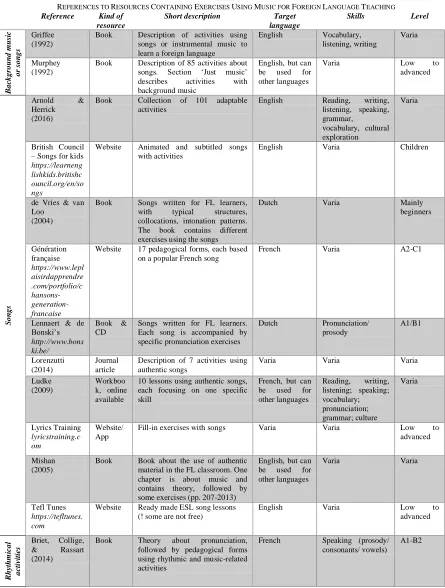
Table 1 lists references to different resources that contain exercises using music or rhythm for foreign language teaching. The table mentions the kind of resources (e.g. book, article, website…), gives a short description of the resource, and details the target language, the skills and the level of the resource.
TABLE I
REFERENCES TO RESOURCES CONTAINING EXERCISES USING MUSIC FOR FOREIGN LANGUAGE TEACHING Reference Kind of
resource
Short description Target language
Skills Level
Ba c k g ro u n d m u si c o r so n g s Griffee (1992)
Book Description of activities using songs or instrumental music to learn a foreign language
English Vocabulary, listening, writing
Varia
Murphey (1992)
Book Description of 85 activities about songs. Section ‘Just music’ describes activities with background music
English, but can be used for other languages
Varia Low to
advanced S o n g s
Arnold & Herrick (2016)
Book Collection of 101 adaptable activities
English Reading, writing, listening, speaking, grammar,
vocabulary, cultural exploration
Varia
British Council – Songs for kids
https://learneng lishkids.britishc ouncil.org/en/so ngs
Website Animated and subtitled songs with activities
English Varia Children
de Vries & van Loo
(2004)
Book Songs written for FL learners, with typical structures, collocations, intonation patterns. The book contains different exercises using the songs
Dutch Varia Mainly
beginners Génération française https://www.lepl aisirdapprendre .com/portfolio/c hansons- generation-francaise
Website 17 pedagogical forms, each based on a popular French song
French Varia A2-C1
Lennaert & de Bonski’s
http://www.bons ki.be/
Book & CD
Songs written for FL learners. Each song is accompanied by specific pronunciation exercises
Dutch Pronunciation/
prosody A1/B1 Lorenzutti (2014) Journal article
Description of 7 activities using authentic songs
Varia Varia Varia
Ludke (2009)
Workboo k, online available
10 lessons using authentic songs, each focusing on one specific skill
French, but can be used for other languages
Reading, writing, listening; speaking; vocabulary; pronunciation; grammar; culture Varia Lyrics Training lyricstraining.c om Website/ App
Fill-in exercises with songs Varia Varia Low to
advanced
Mishan (2005)
Book Book about the use of authentic material in the FL classroom. One chapter is about music and contains theory, followed by some exercises (pp. 207-2013)
English, but can be used for other languages
Varia Varia
Tefl Tunes
https://tefltunes. com
Website Ready made ESL song lessons (! some are not free)
English Varia Low to
advanced Rh y th m ic a l a c ti v it ie
s Briet, & Collige, Rassart
(2014)
Book Theory about pronunciation, followed by pedagogical forms using rhythmic and music-related activities
French Speaking (prosody/ consonants/ vowels)
Deen, Van Veen, & Schutte (2014)
Book & CD
Rap songs with typical sentences about many topics
Dutch Pronunciation & vocabulary (phrases)
Low to advanced
Graham (1993)
Book Rhythmic presentation of American English
English Pronunciation Varia
Lorca, R.
https://www.you tube.com/user/rl lorca100
Online video’s with games
Video’s explaining short games using gestures and voice about the rhythm of French
French Pronunciation, intonation
Beginners
Verboog & Ader
(2016)
Book & CD
60 rap songs about specific topics Each song is accompanied by an activity (speaking, writing, grammar…)
Dutch Mainly
pronunciation (phonemes/intonatio n), but also grammar
Low to advanced
III. WHY SHOULD MUSIC BE USED IN THE FL CLASSROOM? BENEFITS OF MUSIC USE ON FOREIGN LANGUAGE ACQUISITION
Besides a lack of resources, teachers seem also to need some theoretical grounding about the effect of musical methodology on FL acquisition. Research reveals that music can be beneficial for foreign language acquisition, both for specific linguistic skills (e.g. vocabulary, listening skills or pronunciation) as for more general aspects, such as motivation or attention.
A. Non-linguistic Aspects
Several factors have been stated to influence (language) learning, such as motivation (R. C. Gardner & Lambert, 1972), anxiety (Horwitz, Horwitz, and Cope, 1986), personality (Gardner, 1983), etc. The use of music can have an impact on many of these factors, which will in turn affect foreign language acquisition.
According to Mora (2000), one non-linguistic benefit of using music in the classroom concerns the learning styles. As Gardner (1983) pointed out, there exist multiple intelligences: people have different types of intelligences and learn in different ways. In this context, the teacher should vary activities to develop the different intelligences. Using songs makes it possible to address the musical intelligence. Second, using music can reduce foreign language anxiety. It is a proven fact that a feeling of nervousness or apprehension in learning a foreign language is linked with poor foreign language performance (MacIntyre & Gardner, 1991). Dolean & Dolean (2014) and Dolean (2016) analyzed the impact of using songs on foreign language anxiety. They concluded that teaching with songs decreased foreign language anxiety, especially for students with rather high anxiety. As Engh (2013) mentions, ‘music lowers affective barriers and assists in making students more relaxed, thereby more receptive to language learning’ (p. 117). Third, music in the classroom can increase motivation. Since ‘authentic materials are a motivating force for learners’ (Gilmore, 2007), music, which is an authentic activity, and songs, which use authentic texts and language of native speakers, can support the motivating factor (Mishan, 2005). Fourth, the use of music can sustain attention: Wolfe & Noguchi (2009) observed that the participants in their study were more attentive, focused and engaged when listening to a musical story compared to a spoken story. Finally, the use of music and songs in the FL teaching methods provides cultural knowledge of the target language: the context, the singer, the musical style, etc. are culturally rich resources for language lessons. B. Linguistic Aspects
Many studies examined the potential benefit of music-based FL materials on different language skills, such as vocabulary acquisition, listening comprehension, writing skills or phonetic acquisition. The following section reviews the main results.
1. Vocabulary
The potential effect of musical FL teaching methodology on vocabulary recall has been analyzed in several studies. Results are given for the three main approaches, namely music in the background, songs and rhythmical activities.
De Groot (2006) analyzed the effect of background music on vocabulary recall. 36 university students were presented several times L1 – FL pairs of words, followed by different vocabulary recall tests. Half of the students learned the pairs in silence and the other half learned while a Bach’s concerto played in the background. Recall scores were higher for the musical condition compared to the silent condition.
students heard a recorded spoken version of the song. Legg (2009) tested the impact of the song on text recall through an active production of the students: participants had either to rehearse and perform a musical version of a poem or either to answer questions and play memory games. Results show that the students in the musical condition obtain higher results on a translation task than the students in the non-musical situation. However, contradictory evidence was found in other studies. In order to examine word recall in the mother tongue, Racette & Peretz (2007) tested university students in three conditions: either they heard the song and they repeated singing, either they heard the song and they repeated speaking, either they heard the spoken lyrics and they repeated speaking. Unexpectedly, participants recalled fewer words when singing than when speaking, whereas the presentation mode (song or spoken lyrics) had no influence on lyric recall. The authors concluded that ‘the best strategy for learning song lyrics is to ignore the melody. The melody seems to interfere rather than facilitate word recall in songs […]’(Racette & Peretz, 2007, p. 250). As Ludke, Ferreira, & Overy (2014) write ‘one possible explanation for this unexpected result is that the folk songs used by Racette and Peretz had complex, nonrepetitive melodic lines’ (p.43). Furthermore, a non-beneficial effect of songs was also found by Kilgour et al. (2000). They tested lyrics recall with sung lyrics and spoken lyrics. They first observed better recall with the sung than with the spoken version. In a second experiment, they manipulated the presentation rate, so that the duration of the sung and the spoken versions were identical. They found that with an equal presentation rate, there was no advantage for sung over spoken lyrics and suggested that ‘[P]previous findings of melody's aiding text recall may be attributed to presentation rate’ (Kilgour et al., 2000, p. 700).
Regarding the impact of rhythmic activities, the experimental study of Ludke, Ferreira, & Overy (2014) gives interesting results. They analyzed vocabulary learning in three listen-and-repeat conditions: participants heard either sung phrases, rhythmic spoken phrases or spoken phrases. A significant difference between the sung/rhythmical and spoken conditions was found for the tests in which the participants had to speak in the foreign language (Hungarian), although performance was highest in the sung condition for all tests.
2. Writing fluency
Alisaari & Heikkola (2016) analyzed whether writing fluency, viz. the number of words produced in a written text, can be influenced by musical pedagogical methods. In this classroom intervention study, students heard different sung or spoken versions of songs seven times during 15 minutes. The first group just listened to the sung songs, the second listened and sung the song and the third listened to a spoken version of the songs and recited them. At the end of these seven sessions, as in the pretest, students wrote two stories, based on comic strips. The authors observed that the number of words produced increased more in the singing group than in the reciting or listening group, but the differences were not significant.
3. Listening abilities
Kanel (1997) examined whether song based tasks would be as effective at improving listening comprehension in a standard listening test as conventional listening tasks. During this classroom intervention, one group of 10 classes heard regularly songs and made gap-fill quizzes while the other group of 10 other classes was taught listening with nonmusical materials, such as textbooks. The results indicate significant improvement for both groups, but neither treatment was more effective than the other. Furthermore, the participants answered a follow-up questionnaire about the learning methods. Even if there was little variation between both groups about the educational benefits of the respective listening training, it seems that the regular practice, the value in time spent on the quizzes and the interest in English were higher in the song group.
Another important listening skill in foreign language acquisition is the ability to segment speech into words. Schön et al. (2008) performed an experiment to determine whether songs can help learners segment foreign language speech. One group heard a continuous spoken stream of syllables, a second group heard a continuous sung stream of syllables with an association syllable/pitch (e.g. syllable gi = C), a third group also heard a continuous sung stream of syllables but without association syllable/pitch. After this training phase, they heard words and had to mention whether these were present in the stream that they have heard. The percentage correct responses was the highest for the group who heard the sung stream with an association syllable/pitch and the lowest for the group who heard the spoken stream.
4. Phonetic skills
Different studies examined the impact of musical FL methodologies on phonetic skills, both at the segmental and suprasegmental level.
At the segmental level, Lakshminarayanan & Tallal (2007) analyzed whether phoneme discrimination can be trained by listening to stimuli which are non-linguistic but which imitate the acoustic characteristics of linguistic stimuli. Therefore, they tested 19 students divided in a training and a control group. The pre- and posttests were same/different tasks for pairs of stimuli (e.g. ba/da). During the training period (30min per day during five days), the training group heard pairs of frequency modulated sweeps rising or falling in pitch. The participants had to mention the order of the falling and rising sweeps. Observing a significant improvement in ba/da discrimination for the training group, Lakshminarayanan & Tallal (2007, p. 270) concluded that ‘non-linguistic acoustic perceptual training can impact syllable discrimination’.
pre- and posttest – in which participants read aloud words and sentences of the songs in a new context – indicate that the pronunciation of phonemes, the intonation, and the stress patterns were better for the musical group than for the control group.
Different researchers tested the efficacy of music use on FL suprasegmental abilities. Degrave (submitted) examined whether melodies or rhythm can help French-speaking university students to perceive lexical stress in Dutch. 46 French speakers (25 non-musicians and 21 musicians) performed a discrimination task in which stimuli were either naturally spoken, either spoken with a beat on the stress, either sung. Scores were higher for the sung stimuli and for the spoken stimuli with a beat, compared to the spoken stimuli. Heidari-Shahreza & Moinzadeh (2012) focused on the impact of listening to melodies on stress perception. Participants were divided into two groups and were taught four stress patterns of two- and three-syllable English words1 . The experimental group heard first musical stimuli that are acoustically similar to word stress patterns (see Figure 1 for an example).
Figure 1 Musical stimulus acoustically similar to a two-syllable word with the stress on the 2nd syllable
After having heard the musical stimuli, the related target words (e.g. Japan, hotel) were introduced and practiced2. This procedure was repeated for the four stress patterns. The control group listened first to each group of target words, then the placement of the primary stress was indicated and finally, the participants repeated the target words. After a short diversion activity, participants heard sets of four words and mentioned which has a different stress pattern. The experimental group obtained significantly higher results than the control group. A more detailed description of the methodology used would be needed to correctly evaluate the findings reported in this paper.
Finally, Fomina (2000) examined how the quality of the songs can impact the acquisition of FL intonation. In her study, participants heard songs that had either concurrent or non-concurrent melody with natural speech intonation. For example, in the song ‘Tom’s diner’, some melodic lines have a falling intonation, whereas the spontaneous speech intonation should rise (e.g. before a subordinate clause). Participants, who had to reproduce lyrics from the songs in another context, reproduced the phrases with the intonation of the song, even if it was wrong. Fomina (2000) concluded that ‘there exists a certain influence of song melody on speech intonation memorization’ and that ‘song material for teaching and developing different language skills should be carefully selected’.
5. Various skills (vocabulary, grammar, pronunciation, listening comprehension)
Some researchers measured the impact of their musical classroom interventions on different FL skills.
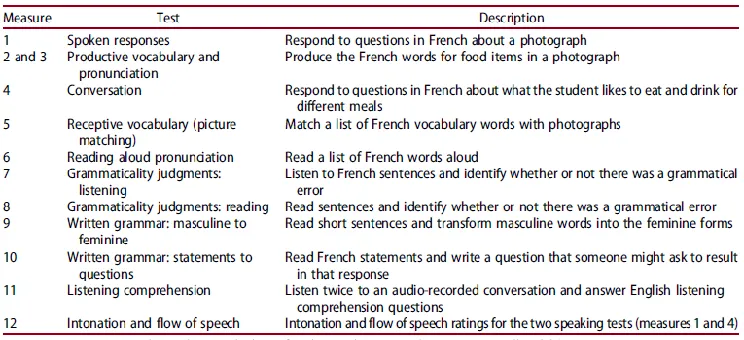
Ludke (2016) conducted a study in two classrooms of English speakers learning French. One group had French lessons that integrated different musical activities, such as creating (rap) songs, singing, listening to music, creating and performing a musical theatre piece. The other group received French lessons that were supplemented with visual art and drama activities, e.g. exercises with pictures, drawing, reading cartoons, write and record a script for a dramatic play. The pre- and posttests measured 12 language skills, as described in Figure 2.
Figure 2 Description of tasks on the pre-and posttests (Ludke, 2016, p.7)
Similar results between the two groups were found for productive vocabulary (task 2), receptive vocabulary with a picture-matching task (task 5) and grammaticality judgments when reading (task 8). The music group obtained lower scores than the visual art group for their pronunciation when reading aloud a list of words (task 6), a slightly higher
1
The four patterns are: 1. two-syllable words, stress on the 1st ; 2. two-syllable words, stress on the 2nd; 3. three-syllable words, stress on the 1st ; 4. three-syllable words, stress on the 2nd.
score for the pronunciation of individual words from photographs (difference of 1.3% - task 3), but got higher scores than the visual art group for the seven other tasks.
Good, Russo, & Sullivan (2015) investigated the effect of a classroom intervention on the pronunciation of phonemes and vocabulary recall. Two groups were trained during four sessions of 20 minutes. The singing group heard a song, repeated the song singing and translated words; the spoken group heard a text, repeated the text and translated words. After the training sessions, the participants took part in four tests: 1. a pronunciation test in which they reproduced the lyrics (singing or speaking), 2. a vocabulary recall test in which they mentioned as many words as they could, 3. a vocabulary translation test which consisted in the translation of given words and 4. a test 6 months after the training in which students had to recall the lyrics and translate words. Results showed that the singing and spoken group equally performed for the pronunciation of consonants and for the translation of words after 6 months. The singing group outperformed the spoken group for the other tasks (pronunciation of vowels, recall, and translation on short term).
IV. DISCUSSION
The present article aimed to provide information about how and why music can be used in the FL classroom, since studies revealed that the discrepancy between the teachers’ positive attitude toward music use in the FL classroom and its limited actual use could be explained by a lack of resources and a lack of theoretical grounding.
The first section provided a short review of music-related methods used in the FL classroom over time. Three main approaches have been described, namely listening to non-linguistic sounds or background music, practicing lyrical songs and using rhythmical activities. Moreover, some references to resources were gathered in order to provide teachers with adapted material to use music in their FL classes.
The second section examined why music can be beneficial for foreign language acquisition. Studies reveal a positive effect on general learning aspects, such as increased motivation and attention, reduced anxiety and cultural enrichment as well as on different linguistic skills. In terms of linguistic improvement, some results state that foreign language performance was higher when methodologies incorporated music, either in the background, through songs or in musical and rhythmical activities, than when no music or other artistic intervention was used. These findings are promising for both teachers and learners: using music for foreign language acquisition would have numerous learning and linguistic benefits and has not to be simply reduced to a ‘fun activity’.
Despite these positive results, it seems that empirical research about the relation between music-related methodologies and FL acquisition is still in its recent years. Hence, there is little published data for some skills or there is contradictory evidence between studies. For example, concerning vocabulary acquisition, Legg (2009), Medina (1990) and Salcedo (2010) reported higher vocabulary scores in the musical groups compared to the control groups, whereas Kilgour et al. (2000) and Racette & Peretz (2007) did not observe any advantage in the musical condition or stated a musical benefit explained by the presentation rate. More research would be needed to enlighten these findings and to fulfill results about other skills, such as listening comprehension, phonetic proficiency or writing skills. In this respect, Ludke (2016) points out: ‘To date, relatively few published, empirical studies have investigated the effects of FL learning through singing and song activities in the classroom, particularly for grammar or pronunciation skills’ (p. 2).
In addition to the need for further research, the present findings must be interpreted with caution. Most studies reviewed here were comparisons or correlational studies. Inferring causation would thereby be unfounded. Such as described in the article, many external factors could explain the improvement of foreign language abilities with musical intervention, e.g. reduced anxiety or the increase of motivation and attention.
Finally, the question arises whether musical methodologies are adapted for every language learner. Personality, hobbies, and interests can positively or negatively interfere with the use of music for foreign language acquisition. For example, De Groot, (2006) reports findings of Furnham & Allass (1999) that stated that introvert persons performed better in observation or recall tasks in silence condition, whereas extraverts ‘generally performed better in the music condition’ (de Groot, 2006, p. 496). Musical training or aptitude could also be an influential factor. Many studies revealed a better performance of musicians compared to non-musicians in language tasks (for a review see Chobert & Besson (2013) and Magne, Schön, & Besson (2003)). In Degrave (submitted), results show that musicians benefit more from the use of melodies or rhythm for word stress detection, compared to non-musicians.
In summary, even if research about the use of music in the foreign language classroom is still in its recent years, this paper contributes to our understanding of FL methodology, giving different ways and resources to use music in the classroom and showing that music can benefit some foreign language skills. Teachers have now to carefully choose, structure and sequence their musical material and methodology in order to fully take benefit from the music-based lessons.
ACKNOWLEDGMENTS
REFERENCES
[1] Alisaari, J., & Heikkola, L. M. (2016). Increasing fluency in L2 writing with singing. Studies in Second Language Learning and Teaching 6.2, 271-292.
[2] Anton, R. J. (1990). Combining Singing and Psychology. Hispania 73.4, 1166-1170. https://doi.org/10.2307/344326. [3] Arnold, J. L., & Herrick, E. (2017). New Ways in Teaching with Music, Alexandria, VA: TESOL Press.
[4] Brancroft. (1999). Suggestopedia and language acquisition. Variations on a theme. Amsterdam: Gordon & Breach Publishers. [5] Briet, G., Collige, V., & Rassart, E. (2014). La prononciation en classe de langue. Grenoble: Presses Universitaires de Grenoble. [6] British Council. Songs for kids. https://learnenglishkids.britishcouncil.org/en/songs. (accessed 04/02/2019).
[7] Chobert, J., & Besson, M. (2013). Musical Expertise and Second Language Learning. Brain Sciences 3.2, 923-940. https://doi.org/10.3390/brainsci3020923.
[8] Corbett, B. A., Shickman, K., & Ferrer, E. (2008). Brief Report: The Effects of Tomatis Sound Therapy on Language in Children with Autism. Journal of Autism and Developmental Disorders 38.3, 562-566. https://doi.org/10.1007/s10803-007-0413-1.
[9] de Groot, A. M. B. (2006). Effects of Stimulus Characteristics and Background Music on Foreign Language Vocabulary Learning and Forgetting. Language Learning 56.3, 463-506. https://doi.org/10.1111/j.1467-9922.2006.00374.x.
[10] de Vries, J., & van Loo, H. (2004). Anders nog iets? Liedjes voor wie Nederlands leert. Amsterdam: Uitgeverij Boom. [11] Deen, J., Van Veen, C., & Schutte, L. (2014). Taalriedels. Amsterdam: Boom.
[12] Degrave, P. (submitted for publication). Music training and the use of songs or rhythm: do they help for lexical stress perception?
[13] Dolean, D. D. (2016). The effects of teaching songs during foreign language classes on students’ foreign language anxiety. Language Teaching Research 20.5, 638-653. https://doi.org/10.1177/1362168815606151.
[14] Dolean, D. D., & Dolean, I. (2014). The Impact of Teaching Songs on Foreign Language Classroom Anxiety. Philologica Jassyensia 10, 513-518.
[15] Engh, D. (2013a). Effective use of music in language-learning: A needs analysis. Humanising Language Teaching, 15.5. [16] Engh, D. (2013b). Why Use Music in English Language Learning? A Survey of the Literature. English Language Teaching 6.2,
113-127. https://doi.org/10.5539/elt.v6n2p113.
[17] Ferreri, L., Aucouturier, J.-J., Muthalib, M., Bigand, E., & Bugaiska, A. (2013). Music improves verbal memory encoding while decreasing prefrontal cortex activity: an fNIRS study. Frontiers in Human Neuroscience 7, 779. https://doi.org/10.3389/fnhum.2013.00779.
[18] Fomina, A. (2000). Song melody influence on speech intonation memorization. In Proceedings of the Sixth International Conference on Music Perception and Cognition. Woods, C., Luck, G.B., Brochard, R. O’Neill, S.A., Sloboda, J.A.
[19] Furnham, A., & Allass, K. (1999). The influence of musical distraction of varying complexity on the cognitive performance of extroverts and introverts. European Journal of Personality 13.1, 27-38. https://doi.org/10.1002/(SICI)1099-0984(199901/02)13:1<27::AID-PER318>3.0.CO;2-R.
[20] Gardner, H. (1983). Frames of Mind. New York: Basic Books.
[21] Gardner, R. C., & Lambert, W. E. (1972). Attitudes and Motivation in Second-Language Learning. Rowley, MA: Newbury House Publishers.
[22] Génération française. 17 fiches pédagogiques pour faire entrer la chanson et la musique contemporaines dans la classe. https://www.leplaisirdapprendre.com/portfolio/chansons-generation-francaise (accessed 04/02/2019).
[23] Gilmor, T. (1999). The Efficacy of the Tomatis Method for Children with Learning and Communication Disorders: A Meta-Analysis. International Journal of Listening 13.1, 12-23. https://doi.org/10.1080/10904018.1999.10499024.
[24] Gilmore, A. (2007). Authentic materials and authenticity in foreign language learning. Language Teaching 40.2, 97-118. https://doi.org/10.1017/S0261444807004144.
[25] Good, A. J., Russo, F. A., & Sullivan, J. (2015). The efficacy of singing in foreign-language learning. Psychology of Music 43.5, 627-640. https://doi.org/10.1177/0305735614528833
[26] Graham, C. (1993). Grammarchants: Student Book. New York, NY, USA: Oxford University Press. [27] Griffee, D. T. (1992). Songs in Action. Hertfordshire, UK: Prentice Hall.
[28] Heidari-Shahreza, M. A., & Moinzadeh, A. (2012). Teaching word stress patterns of English using a musically-simulated technique. Gema Online Journal of Language Studies 12.2, 521-537.
[29] Horwitz, E. K., Horwitz, M. B., & Cope, J. (1986). Foreign Language Classroom Anxiety. The Modern Language Journal 70.2, 125-132. https://doi.org/10.1111/j.1540-4781.1986.tb05256.x.
[30] Jamoulle, N. (2017). Music incorporation in ESL Classrooms and Teachers’ attitude toward music’s use in the language classroom - an examination of French-Speaking secondary Schools in Brussels (Unpublished MA dissertation). Vrije Universiteit Brussel, Brussels.
[31] Kanel, K. (1997). Teaching with Music: A Comparison of Conventional Listening Exercises with Pop Song Gap-fill Exercises. JALT Journal, 19.2, 217-234.
[32] Kanel, K. (2000). Songs in language teaching: Theory and practice. In D. Books, J. Robbins, & R. Long (Eds.), Teacher belief, teacher action: Connecting research and the classroom: Proceedings of the JALT (Japan Association for Language Teaching) 25th Annual International Conference on Language Teaching & Learning and Educational Materials Expo, Tokyo, Japan: JALT, 69–75.
[33] Kilgour, A. R., Jakobson, L. S., & Cuddy, L. L. (2000). Music training and rate of presentation as mediators of text and song recall. Memory & Cognition 28.5, 700–710. https://doi.org/10.3758/BF03198404.
[34] Lakshminarayanan, K., & Tallal, P. (2007). Generalization of non-linguistic auditory perceptual training to syllable discrimination. Restorative Neurology and Neuroscience 25.3-4, 263-272.
[37] Llorca, R. (2008). Parole, rythme et mouvement. Le français dans le monde 359, 29. [38] Lorca, R. https://www.youtube.com/user/rllorca100. (accessed 04/02/2019).
[39] Lorenzutti, N. (2014). Beyond the Gap Fill: Dynamic Activities for Song in the EFL Classroom. English Teaching Forum 1, 14-21.
[40] Lozanov, G. (1978). Suggestology and outlines of Suggestopedy. London: Gordon and Breach. [41] Ludke, K. M. (2009). Teaching foreign language through songs. Edinburgh: University of Edinburgh.
[42] Ludke, K. M. & Morgan K. (forthcoming). Music in the foreign language classroom: A survey of teachers’ opinions and practice. In Tegge F. & Werner V. (eds), Popular Culture in Foreign Language Education. Abingdon, Oxon; New York, NY : Routledge.
[43] Ludke, K. M. (2016). Singing and arts activities in support of foreign language learning: an exploratory study. Innovation in Language Learning and Teaching, 1-16. https://doi.org/10.1080/17501229.2016.1253700.
[44] Ludke, K. M., Ferreira, F., & Overy, K. (2014). Singing can facilitate foreign language learning. Memory & Cognition 42.1, 41-52. https://doi.org/10.3758/s13421-013-0342-5.
[45] Lyrics Training. lyricstraining.com. (accessed 04/02/2019).
[46] MacIntyre, P. D., & Gardner, R. C. (1991). Methods and Results in the Study of Anxiety and Language Learning: A Review of the Literature. Language Learning 41.1, 85-117. https://doi.org/10.1111/j.1467-1770.1991.tb00677.x.
[47] Magne, C., Schön, D., & Besson, M. (2003). Prosodic and melodic processing in adults and children. Behavioral and electrophysiologic approaches. Annals of the New York Academy of Sciences 999, 461-476.
[48] Medina, S. L. (1990). The Effects of Music upon Second Language Vocabulary Acquisition. Paper presented at the Annual Meeting of the Teachers of English to Speakers of Other Languages conference, US: San Francisco. https://eric.ed.gov/?id=ED352834 (accessed 04/02/2019).
[49] Mishan, F. (2005). Designing authenticity into language learning materials. Bristol, UK: Intellect.
[50] Mora, C. F. (2000). Foreign language acquisition and melody singing. ELT Journal 54.2, 146-152. https://doi.org/10.1093/elt/54.2.146.
[51] Moradi, F., & Shahrokhi, M. (2014). The Effect of Listening to Music on Iranian Children’s Segmental and Suprasegmental Pronunciation. English Language Teaching 7.6, 128-142. https://doi.org/10.5539/elt.v7n6p128.
[52] Murphey, T. (1990). The song stuck in my head phenomenon: A melodic din in the lad? System 18.1, 53-64. https://doi.org/10.1016/0346-251X(90)90028-4.
[53] Murphey, T. (1992). Music & Song. Oxford: Oxford Univeristy Press.
[54] Pietschnig, J., Voracek, M., & Formann, A. K. (2010). Mozart effect–Shmozart effect: A meta-analysis. Intelligence 38.3, 314-323. https://doi.org/10.1016/j.intell.2010.03.001.
[55] Racette, A., & Peretz, I. (2007). Learning lyrics: to sing or not to sing? Memory & Cognition 35.2, 242-253.
[56] Rauscher, F. H., Shaw, G. L., & Ky, K. N. (1993). Music and spatial task performance. Nature 365.6447, 611. https://doi.org/10.1038/365611a0.
[57] Ross, A. (1994/08/28). CLASSICAL VIEW; Listening To Prozac. Er, Mozart. New York Times.
[58] Salcedo, C. S. (2010). The Effects of Songs in the Foreign Language Classroom on Text Recall, Delayed Text Recall and Involuntary Mental Rehearsal. Journal of College Teaching and Learning 7.6, 19-30.
[59] Schön, D., Boyer, M., Moreno, S., Besson, M., Peretz, I., & Kolinsky, R. (2008). Songs as an aid for language acquisition. Cognition 106.2, 975-983. https://doi.org/10.1016/j.cognition.2007.03.005.
[60] Steele, K. M., Bass, K. E., & Crook, M. D. (1999). The Mystery of the Mozart Effect: Failure to Replicate. Psychological Science 10.4, 366-369. https://doi.org/10.1111/1467-9280.00169.
[61] TEFL Tunes. Ready made ESL song lessons. https://tefltunes.com/. (accessed 04/02/2019).
[62] Thompson, W. F., Schellenberg, E. G., & Husain, G. (2001). Arousal, Mood, and The Mozart Effect. Psychological Science 12.3, 248-251. https://doi.org/10.1111/1467-9280.00345.
[63] Tomatis, A. (1991). Nous sommes tous nés polyglottes. Paris: Fixot.
[64] Tse, A. Y. (2015). Malaysian teachers’ perspectives on using songs in English language teaching. International Journal of Social Science and Humanity 5.1, 87-89.
[65] Verboog, M., & Ader, L. (2016). Taalraps, een aanstekelijke manier om spreektaal te oefenen. Amsterdam: Uitgeverij Boom. [66] Wolfe, D. E., & Noguchi, L. K. (2009). The use of music with young children to improve sustained attention during a vigilance
task in the presence of auditory distractions. Journal of Music Therapy 46.1, 69-82.
Pauline Degrave graduated in Modern Languages and Letters at UCLouvain (Belgium) in 2009 and specialized in university and higher education pedagogy in 2013 and in secondary school pedagogy in 2017.
She is currently completing her Ph.D. at UCLouvain in Dutch language and linguistics. Her main interests include foreign language acquisition (especially Dutch) and the relationship between music and language. More particularly, she conducts research about the influence of musical practice or ability on the acquisition of foreign language prosody and on the use of music in the foreign language classroom. Next to her research activities, she taught Dutch as a foreign language at Université Saint -Louis and at UCLouvain (2010-2019). She published several research papers and Dutch handbooks. She is currently also working as project manager at UCLouvain for a project around language learning.