ARTIGO ORIGINAL
Mumps Outbreak among Highly Vaccinated
Teenagers and Children in the Central Region
of Portugal, 2012-2013
Surto de Parotidite em Crianças e Adolescentes com Elevada Taxa de
Vacinação na Região Centro de Portugal, 2012-2013
1. Departamento de Saúde Pública. Administração Regional de Saúde do Centro. Coimbra. Portugal.
2. Unidade de Infeciologia. Serviço de Urgência. Hospital Pediátrico. Centro Hospitalar e Universitário de Coimbra. Coimbra. Portugal. 3. Departamento de Saúde Pública. Instituto Nacional de Saúde Dr. Ricardo Jorge. Lisboa. Portugal.
Autor correspondente: Eugénio Cordeiro. [email protected]
Recebido: 22 de Agosto de 2014 - Aceite: 27 de Abril de 2015 | Copyright © Ordem dos Médicos 2015
Eugénio CORDEIRO1, Muriel FERREIRA2, Fernanda RODRIGUES2, Paula PALMINHA3, Elsa VINAGRE3, João Pedro PIMENTEL1
Acta Med Port 2015 Jul-Aug;28(4):435-441
RESUMO
Introdução: A vacina contra o sarampo, parotidite epidémica e rubéola foi introduzida no Programa Nacional de Vacinação em 1987, atingindo rapidamente uma cobertura vacinal > 92% para duas doses, com redução importante da incidência anual da doença. Re-portamos um surto de parotidite na Região Centro de Portugal ocorrido entre outubro de 2012 e março de 2013.
Material e Métodos: Foram investigados os casos de tumefação de glândulas salivares e sintomas compatíveis com parotidite. Para cada caso foram analisados dados demográficos, clínicos, laboratoriais e vacinais.
Resultados: Ao longo de seis meses foram notificados 148 casos: 87,8% ocorreram em três dos 16 concelhos afetados e 78,4% tinham uma relação epidemiológica conhecida. A idade mediana foi de 14,5 anos (2-62) e 70,3% tinham entre 11 e 20 anos; 61,5% eram do sexo masculino. Na maioria dos casos a doença foi ligeira, com uma duração média de sete dias (2-20). A febre ocorreu em 80,4% e a glândula parótida apresentou envolvimento unilateral em 55,4%; sete casos tiveram orquite, um ooforite e uma nefrite. Dois doentes foram internados. A transmissão da doença ocorreu predominantemente em ambiente escolar, com taxas de ataque < 30%. A maioria dos casos ocorreu em indivíduos vacinados (92%), dos quais 86,8% com duas doses. Em 17,7% foi identificada uma dose de vacina contendo a estirpe Rubini. Foi identificado o genótipo G do vírus da parotidite em quatro casos.
Discussão: Este surto de parotidite numa população com coberturas vacinais elevadas, atingindo principalmente adolescentes em meio escolar, poderá dever-se à efetividade parcial da vacina contra a doença (especialmente no grupo vacinado com a estirpe Ru-bini), à perda de imunidade ao longo do tempo ou ainda à discordância entre os genótipos vacinal e circulante causador de doença.
Conclusões: O relato deste surto releva a importância da discussão sobre a necessidade de mais doses de reforço da vacina atual ou de uma nova vacina incluindo mais genótipos para melhorar a imunogenicidade.
Palavras-chave: Adolescente; Criança; Parotidite; Portugal; Surto de Doenças; Vacina Contra Sarampo-Parotidite-Rubéola.
ABSTRACT
Introduction: Mumps vaccine was introduced in the National Immunization Program in Portugal in 1987, rapidly reaching a national coverage > 92%, with important reduction in the annual incidence of the disease. We report a mumps outbreak in the Central Region of Portugal, occurred in the winter 2012-13.
Material and Methods: Cases of salivary-gland swelling and other symptoms compatible with mumps were investigated. Geodemo-graphics, clinical, laboratory and vaccination data were analyzed.
Results: Over six months, 148 outbreak-related cases were reported: 87.8% occurred in three of the 16 affected counties and 78.4% had a known epidemiological link. Median age was 14.5 years (2-62) and 70.3% were 11-20 years old; 61.5% were male. The mean duration of disease was seven days (2-20). The disease was generally mild; 80.4% had fever and in 55.4% there was unilateral involvement of the parotid gland. Seven cases had orchitis, one oophoritis and one had nephritis. Two cases were hospitalized. School transmission predominated and class attack rates were < 30%. Most of the cases occurred in vaccinated individuals (92%) of whom 86.8% had received 2 doses; 17.7% had received one dose of the vaccine containing the Rubini strain. Mumps virus genotype G was identified in 4 cases.
Discussion: This mumps outbreak among a highly vaccinated population, occurring mostly in teenagers at school, could be due to the partial effectiveness of the vaccine against the disease (particularly in the group vaccinated with Rubini strain), waning immunity overtime and genotype mismatch.
Conclusions: This outbreak report shows the importance of discussion about the need of more booster dose of the actual vaccine or new vaccine including more genotypes to improve immunogenicity.
Keywords: Adolescent; Child; Disease Outbreaks; Measles-Mumps-Rubella Vaccine; Mumps; Portugal.
INTRODUCTION
Mumps is a self-limited and transmissible acute viral dis-ease, characterized by fever and non-suppurative swelling of the salivary glands, usually the parotid glands. Approxi-mately one third of infections do not cause clinically appar-ent salivary gland swelling and may even be asymptomatic or subclinical.1 The most serious and frequent
complica-tions of this disease include meningoencephalitis, deafness and orchitis.2
Mumps virus belongs to the Paramyxoviridae family. Twelve different circulating genotypes (A to L) are currently recognized.1
ARTIGO ORIGINAL and rubella (MMR) was introduced in the National Immunization Program (NIP) in 1987 and the disease became notifiable in the same year.3 Over time, the recommended vaccination schedule had underwent several changes: in 1987, the vaccine was introduced with one dose at 15 months; in 1990, a second dose was added at 11-13 years, which has been anticipated to 5-6 years in 2000. In 2012, the first dose was anticipated to 12 months of age. In 1987 the vaccines available in Portugal included Urabe Am9, Rubini and Jeryl-Lynn, and were indistinguishably used in the NIP. In October 1992, the strain Urabe Am9, was suspected to cause post-vaccinal meningitis and therefore suspended.4 Since then, both Rubini and Jeryl-Lynn strains were used and a national coverage > 92% was quickly achieved.5 The number of notifications decreased from a maximum of 19 415 cases in 1997 to a minimum of 140 in 2008.3 The high number of cases notified in 1997 resulted from an outbreak that affected mainly children that had been vaccinated with the Rubini strain.4,6 This outbreak
led to modifications in the vaccine used, with the Rubini strain being replaced by Jeryl-Lynn. However children that have received a first dose of the Rubini strain received only one dose of the Jeryl-Lynn strain.
After the introduction of two doses of Jeryl-Lynn strain vaccine in the NIP in 1998, the annual incidence of mumps rapidly fell steadily. In 2010 and 2011 only 28 sporadic cases were notified to the Central Regional Health Administration (unpublished data).
The genetic distance between genotype A strain of this vaccine and non-A wild strains has been proposed to be a determinant factor in vaccine failure.7 The Jeryl-Lynn
vaccine strain is currently used in most countries in the world and is associated with greater efficacy and safety.7,8
However, in recent years, several outbreaks of mumps have been described around the world affecting mainly teenagers and young adults in populations with high vaccination rates.8
The mismatch between vaccine and circulating strains and likely vanishing immunity over time, open the discussion about vaccine efficacy and the need for additional boosters. Thus, outbreak investigation including virus genotyping is an important tool to trace the patterns of viral circulation. We report an outbreak of mumps in the central region of Portugal that occurred between October 2012 and March 2013.
MATERIAL AND METHODS
Case definition: In this outbreak, a case definition adapted from the European Community Case Definitions for Communicable Diseases9 was used:
Possible: Any person with sudden onset of tender swelling of the parotid or other salivary glands, with or without fever (the disease may present without fever), with or without orchitis or oophoritis;
Probable:Any person meeting the definition of possible case and with an epidemiological link;
Confirmed: Any person meeting the definition of possible case and meeting the laboratory criteria: isolation of mumps
virus from a clinical specimen, detection of mumps virus nucleic acid or mumps virus specific antibody response characteristic of acute infection in serum or saliva.
Epidemiological investigation
An observational descriptive study was performed by a team composed by nurses, public health doctors, pediatricians and virologists. We use a standardized questionnaire in order to assess geodemographic and vaccination status, onset of symptoms, clinical manifestations, duration and complications of the disease. In most cases it was necessary to complement the information using telephone or face-to-face interviews.
The study population included all cases of disease reported by clinicians through the national reporting system of reportable diseases, enhanced by the intervention of the epidemiological investigation team and local health authorities, with active case finding.
Samples were collected from the initial cases and from more severe cases.
Because the outbreak investigation urgency, we were unable to submit an application for approval by the Ethics Committee; however the investigation was done with the support of the Portuguese Directorate-General of Health (DGS). It was invoked a public health interest for gathering and analyzing data related to this outbreak. The confidentiality of the patients was always maintained.
Laboratory testing
Laboratory diagnosis was performed by detection of specific mumps antibodies (IgG and IgM) in serum and/ or detection of viral RNA by nested RT-PCR in oral fluids, using a methodology published elsewhere.10,11 Detection of
viral RNA from oral fluids samples by RT-PCR was carried out at National Institute of Health (INSA) in Lisbon and Health Protection Agency (HPA) in London, UK.
Fourteen cases were confirmed in the laboratory: from these, 9 cases were confirmed by specific antibody response (IgG and IgM) and also by PCR in 2 patients; the other 5 were confirmed by PCR only.
Statistical analysis
Data were analyzed using EpiInfo®software program.
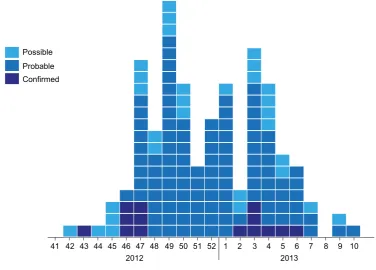
RESULTS Epidemic curve
ARTIGO ORIGINAL
Geographical distribution
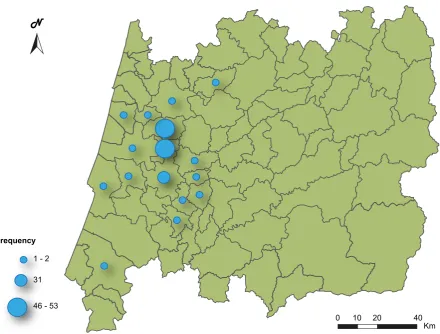
Sixteen counties were affected, with three contributing to 87.8% (130) of the cases (Fig. 2).
Epidemiological links were found in 116 cases (78.4%), 104 of which were classified as probable and 12 as confirmed. Three schools located in the most affected counties represented 80% (100) of these links.
Patients
Demographic characteristics: Patients had a median age of 14.5 years, ranging from 2 to 62 years; 70.3% (104) were between 11 and 20 years old. The percentage of male patients was 61.5% (91).
Clinical manifestations: All patients had signs of inflammation of the parotid or other salivary glands; it was unilateral in 56.1% (83) and bilateral in 43.9% (65). Fever was absent in 19.6% (29) of the patients. The average duration of illness was seven days (2-20 days).
In most cases, the disease was self-limited and did not have complications, with the exception of 7 (7.7%) male patients who developed orchitis and two female patients who developed oophoritis and nephritis (one each). Patients with orchitis were aged 12 - 52 years.
Two cases required hospitalization: a 20 year-old student, with exuberant swelling of the parotid gland and a 17 year-old teenager with testicular torsion related with orchiepididymitis who needed surgery.
Attack rates
Attack rates were calculated for schools and classrooms
in the three schools that had more cases (Table 1). Sick professionals (teachers and cleaning assistants) were not included because the number of cases among them was very low, with negligible expression in rates.
Laboratory testing
Nine cases were confirmed by specific antibody response (IgG and IgM) and simultaneously by PCR in two of them; the other five were confirmed by PCR only. From these cases, four were genotyped, with identification of genotype G in all.
Vaccination data
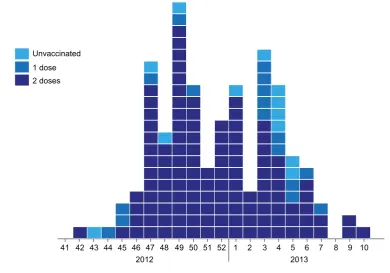
MMR doses: 92% (136/148) of the patients had recei-ved MMR vaccine: 79.7% were inoculated with two doses and 12.2% with one (Fig. 3). Of the 18 patients with a single dose of vaccine, 10 (aged 2 to 6 years old) were vaccinated according to the NIP. Two patients (aged 18 to 20 years old) missed the second inoculation and six (aged 30 to 36 years old), because of their age, only had the opportunity to Figure 1 – Epidemic curve
Week
Possible Probable Confirmed
41 42 43 44 46 47
2012 2013
48 49 50 51 52 1 2 3 4 5 6 7 8 9 10
45
Table 1 - Attack rates by classroom
School Minimum - Maximum values (%)
A 3.7 - 27.8%
B 3.8 - 15.8%
ARTIGO ORIGINAL
receive one dose. The 12 non-vaccinated patients included a 5 year-old girl, a 20 year-old foreign student occasionally resident in Portugal and a 29 year-old male. Nine cases were not vaccinated due to their older age. The average time elapsed between the onset of symptoms and the last inoculation in the two dose vaccinated patients was 9 years (5 months - 15 years). In 63 of the patients, the elapsed time was less than 9 years (53 received last inoculation between 5 - 9 years; 7 between 1 - 5 years; and 3 received last inoculation less than 1 year).
Vaccine strain: The majority of vaccinated patients had a 2-dose vaccine schedule, 71.3% (97/136) received two inoculations of the Jeryl-Lynn vaccine strain and 15.5% (21) one dose of the Rubini strain and another of Jeryl-Lynn. A minority 13.2% (18) had only one inoculation with Jeryl-Lynn.
Vaccine batch and brand: The different batches were analyzed to understand if there was an association with specific batches and higher incidence of disease. The high variability found did not allow the formulation of explanatory hypotheses. Regarding the vaccine brand, all belonged to the same laboratory with the exception of 21 cases vaccinated with the Rubini strain.
DISCUSSION
In recent years, mumps has become a challenging disease for public health professionals, with outbreaks being documented among highly vaccinated populations.12-16
Between October 2012 and March 2013, 148 cases of mumps were notified in the Central Region of Portugal to the Regional Health Administration. In contrast, there was no evidence of outbreaks elsewhere in the country between 2009 and 2012.17 From 2012 no official data was published.
As done by others,12-16 we used a case definition
adapted from the European Community Case Definitions for Communicable Diseases,9 contemplating the existence
of possible cases of mumps without fever. The disease may present without fever or asymptomatic, especially in patients with some degree of immunity.2,3,12,13 In this series, 20% of the cases did not have fever.
The clinical manifestations were as classically described, and complications occurred in 8%, also consistent with other studies.12,13,19-23
The index case and the second one had links to the Netherlands but no link between them neither contact with people from that country for the index case, during the month before the onset of symptoms. Data from the second case was obtained retrospectively from the mumps Figure 2 – Geographical distribution
Frequency
1 - 2
N
31
46 - 53
ARTIGO ORIGINAL hospitalization episode; however, it was impossible to reach
the patient for more accurate information.
Schools functioned as epicenters for spread of disease. Similar studies also reported that mumps outbreaks among highly vaccinated populations tended to occur in high-density settings such as universities and schools, with teenagers as the most vulnerable group.8,10,14-16,18,19 These
findings indicate that among highly vaccinated populations, despite herd immunity, intense exposures to one or more mumps cases may increase the risk of transmission, even in the most recently vaccinated children. It is possible that such risk factors may overcome vaccine-induced immunity resulting in persistence of transmission of the disease.15 Attack rates were comparable to the lowest observed in other outbreaks;13,14,18 rates of 51.3% of students affected
per class have been reported, however vaccination coverage rates were lower in these studies.16
The vaccine coverage in our population was very high, with 92% of the patients having a complete vaccine scheme, with one or two doses of MMR vaccine, according to the age. Similar coverage rates are observed at regional and national level, with an estimated coverage of 98% in 2013.5,24
The vaccine containing the Rubini strain was used in the first dose of 21 patients that were vaccinated with a second dose containing the Jeryl-Lynn strain. Five of the first six cases that were laboratory investigated had been vaccinated with a first dose of vaccine containing the Rubini strain. These 21 patients, vaccinated with a less effective vaccine may have been less protected and could have functioned as the epicenter for the spread of the disease.
Trials with the Jeryl-Lynn vaccine strain demonstrated an efficacy of ~95%, but in epidemic conditions, the effectiveness has been as low as 62%; this is still considerably better than the effectiveness of Rubini (which has an effectiveness of close to 0% in epidemic conditions).25 Indeed, a statistically significant difference has not always been demonstrated, but receiving two doses of vaccine may confer up to five times the protection of a single dose.25 Genotype G was identified in four cases tested in this outbreak. This genotype has been isolated in several outbreaks in the western hemisphere with similar characteristics.7,8,26,28 Nowadays all MMR vaccines contain
genotype A. We are therefore faced with a mismatch between the genome of the strain isolated in the outbreak and the genome of the strain contained in the vaccine. It is described that mismatches might result in incomplete antigenic neutralization that is most evident between genotype A and genotypes B-D and G-I, which is directly related to greater phylogenetic distance.7 However, several
studies support that the vaccine containing the genotype A Jeryl-Lynn strain induces antibodies that effectively neutralize genotype G viruses, which would be explained by the existence of common proteins, target of neutralizing antibodies induced by the vaccine.7,8,12,26-28
Outbreaks suggest that antibodies might decline over time and protection may wane. In our study, the average time between onset of symptoms and the last inoculation of patients with 2 doses was 9 years. According to some published data, the effectiveness of 1 dose of vaccine decreases from 96% to 66% in 11 to 12 year-olds after vaccination; and the effectiveness of 2 doses declines
Figure 3 – Vaccination data: MMR doses Week
Unvaccinated 1 dose 2 doses
41 42 43 44 46 47
2012 2013
48 49 50 51 52 1 2 3 4 5 6 7 8 9 10
ARTIGO ORIGINAL from 99% to 86% (p < 0.001 for 1 or 2 doses).
29 These
data support our results with the highest number of cases in adolescents and adults. However, the older recipients of vaccine in our study were surprisingly less affected by the disease, which might be explained by the closest contact among the teenager group. As presented here and by others,12,14,15 mumps affects mainly teenagers and young adults in situations of spatial confinement, such as schools and barracks, suggesting that intense exposure in certain situations of closer contact, facilitates the transmission and exceeds the protection induced by the vaccine. However, high rates of coverage with two doses might reduce the severity of disease and transmission from person to person in situations with less intense exposure, even in collective establishments.12,30
Some authors have proposed the administration of a third dose of vaccine to compensate the decreased immunity over time that makes more susceptible to disease teenagers and young adults, groups in which complications are more frequent in particular orchitis.16,30,31 Recruits
vaccinated without record of previous vaccinations, escaped outbreaks in the United States in 2006.12,16,31 Moreover,
those inoculated with doses of vaccine containing the Rubini strain are less protected, forming a susceptible group which could promote virus circulation and thus outbreaks and would be prime candidates for a booster dose.5
The combined impact of mismatch between strains of the circulating virus and the vaccine, also the decrease of immunity over time suggests the need for new vaccine strategies, such as additional doses of the current vaccine, more immunogenic vaccines, or both.
The major limitation of our study was the low number of cases analyzed in laboratory. Despite the investigation team efforts, it was not possible to confirm the disease in all cases. Those that were analyzed in the laboratory had fever and an exuberant clinic. Thus, most cases were classified only based on clinical and epidemiological links.
We analyzed only the cases reported to the Regional Health Administration, however, we think that the effort of the multidisciplinary team through additional research cases in hospital information systems and awareness of medical staff in all health centers, might have reduced the risk of unreported cases.
The high variability found in the vaccine batches and the almost absence of variability of producer laboratory
made the inferential analysis impossible, for this variables of interest. Thus we were limited to a descriptive analysis.
CONCLUSION
This outbreak among a highly vaccinated population occurring mostly in teenagers at schools with multiple, prolonged and intense exposure, could be due to partial effectiveness of MMR vaccine against mumps particularly in the group vaccinated with Rubini strain, waning immunity overtime and genotype mismatch.
The need of more booster doses of the actual vaccine or new vaccines including more genotypes to improve immunogenicity should be discussed.
INFORMATIONS
Previously delivered as a poster at the 31st Annual Meeting of the European Society for Paediatric Infectious Diseases - Milan, Italy, May 28 to June 1, 2013 and as oral communication at the Congresso Nacional de Pediatria, Porto, on October 04, 2013.
ACKNOWLEDGEMENTS
We would like to thank Kevin Brown from Immunization and Diagnosis Virus Reference Department, HPA Microbiology Services, Health Protection Agency, London, UK.
PROTECTION OF HUMANS AND ANIMALS
Because the outbreak investigation urgency, we were unable to submit an application for approval by the Ethics Committee; however the investigation was done with the support of the Portuguese Directorate-General of Health (DGS). It was invoked a public health interest for gathering and analyzing data related to this outbreak.
DATA CONFIDENTIALITY
The authors declare that the confidentiality of the patients was always maintained.
CONFLICTS OF INTEREST
The authors declare that there are no conflicts of interest.
FUNDING SOURCES
No subsidies or grants contributed to this work.
REFERENCES
1. American Academy of Pediatrics. Mumps. In: Pickering LK, Baker CJ, Kimberlin DW, Long SS, editors. Red Book: 2012 Report of the Committee on Infectious Diseases. Am Acad Pediatr. 2012:514-8. 2. Chin J editor. Control of Communicable Disease Manual. Am Public
Health Assoc. 2000:353-5.
3. Ministério da Saúde - Direcção Geral da Saúde. Avaliação do programa nacional de vacinação – 2º inquérito serológico nacional. Portugal Continental 2001-2002. Lisboa: DGS; 2004.
4. Gonçalves G, De Araújo A, Monteiro Cardoso ML. Surto de parotidite associado a uma fraca eficácia da vacinação - Porto, Portugal, 1996. Euro Surveill. 1998;3:119-21.
5. World Health Organization. Immunization: Measles (MCV) by country. [consultado 2013 Mar 15]; Disponível em: http://apps.who.int/gho/data/ node.main.A826.
6. Rebelo-de-Andrade H; Giria M. Vírus da Parotidite Epidémica. In Direcção Geral da Saúde. Avaliação do programa nacional de vacinação e melhoria do seu custo-efectividade: 2º Inquérito Serológico Nacional Portugal Continental 2001-2002. Lisboa: DGS; 2004:147-58.
7. Kaaijk P, Van der Zeijst B, Boog M, Hoitink C. Increased mumps incidence in the Netherlands: review on the possible role of vaccine strain and genotype. Euro Surveill.2008;13:18914.
ARTIGO ORIGINAL Pediatr Infect Dis J. 2013;32:381-2.
9. Decisão da Comissão das Comunidades Europeias de 28 de Abril de 2008. Lei 1559/46 de 18.6.2008. J Oficial União Europeia. 2008;159:46- 90.
10. Jin L, Beard S, Brown DW. Genetic heterogeneity of mumps virus in the United Kingdom: identification of two new genotypes. Pediatr Infect Dis J. 1999;180:829-33.
11. Jin L, Brown DW, Litton PA, White JM. Genetic diversity of mumps virus in oral fluid specimens: application to mumps epidemiological study. Pediatr Infect Dis J. 2004;189:1001-8.
12. Barskey AE, Schulte C, Rosen JB, Handschur EF, Rausch-Phung E, Doll MK, et al. Mumps outbreak in Orthodox Jewish communities in the United States. N Engl J Med. 2012;367:1704-13.
13. Nelson GE, Aguon A, Valencia E, Oliva R, Guerrero ML, Reyes R, et al. Epidemiology of a mumps outbreak in a highly vaccinated island population and use of a third dose of Measles – Mumps – Rubella Vaccine for outbreak control — Guam 2009 to 2010. Pediatr Infect Dis J. 2013;32:374-80.
14. Greenland K, Whelan J, Fanoy E, Borgert M, Hulshof K, Yap KB, et al. Mumps outbreak among vaccinated university students associated with a large party, the Netherlands, 2010. Vaccine. 2012;30:4676-80. 15. Kutty PK, McLean HQ, Lawler J, Schulte C, Hudson JM, Blog D, et al.
Risk factors for transmission of mumps in a highly vaccinated population in Orange County, NY, 2009-2010. Pediatr Infect Dis J. 2014;33:121-5. 16. Snijders BE, Van Lier A, Van de Kassteele J, Fanoy EB, Ruijs WL,
Hulshof F, et al. Mumps vaccine effectiveness in primary schools and households, the Netherlands, 2008. Vaccine. 2012;30:2999-3002. 17. Ministério da Saúde - Direcção Geral da Saúde. Doenças de Declaração
Obrigatória 2009-2012, Volumes I e II. Lisboa. DGS; 2014.
18. Deeks SL, Lim GH, Simpson MA, Gagné L, Gubbay J, Kristjanson E, et al. An assessment of mumps vaccine effectiveness by dose during an outbreak in Canada. CMAJ. 2011;183:1014-20.
19. Pérez-Vilar S, Gutiérrez-Gimeno MV, Rodríguez-Galán MA, Díez-Domingo J, Puig-Barberà J, Gomar-Fayos J, et al. Sospecha de reacciones adversas a la vacuna triple vírica notificadas al centro de farmacovigilancia de la comunidad valenciana. An Pediatr. 2013;78:297-302.
20. Smith SD, Gemmill I. Mumps: resurgence of vanquished virus - case report. Can Fam Physician. 2011;57:786-90.
21. Coffinières E, Turbelin C, Riblier D, Aouba A, Levy-Bruhl D, Arena C et al. Mumps: burden of disease in France. Vaccine. 2012;30:7013-8. 22. Tae BS, Ham BK, Kim JH, Park JY, Bae JH. Clinical features of mumps
orchitis in vaccinated postpubertal males: a single-center series of 62 patients. Korean J Urol. 2012;53:865-9.
23. Hahné S, Whelan J, Binnendijk RV, Swaan C, Fanoy E, Boot H, et al. Mumps vaccine effectiveness against orchitis. Emerg Infect Dis. 2012;18:191-3.
24. Administração Regional de Saúde do Centro. Programa Nacional de Vacinação. Avaliação 2013. [consultado 2013 Mar 15] Disponível em: http://www.arscentro.min-saude.pt/SaudePublica/Material/Documents/ Relat%C3%B3rio%20Avalia%C3%A7%C3%A3o%20PNV%20 2013%20-%20ARSC,IP.pdf.
25. Peltola H, Kulkarni PS, Kapre SV, Paunio M, Jadhav SS, Dhere RM. Mumps outbreaks in Canada and the United States: time for new thinking on mumps vaccines. Clin Infect Dis. 2007;45:459-66. 26. Rubin SA, Link MA, Sauder CJ, Zhang C, Ngo L, Rima BK, et al. Recent
mumps outbreaks in vaccinated populations: no evidence of immune escape. J Virology. 2012;86:615-20.
27. Jin L, Rima B, Brown D, Orvell C, Tecle T, Afzal M, et al. Proposal for genetic characterisation of wild-type mumps strains: preliminary standardisation of the nomenclature. Arch Virol. 2005;150:1903–9. 28. Cortese MM, Barskey AE, Tegtmeier GE, Zhang C, Ngo L, Kyaw MH, et
al. Mumps antibody levels among students before a mumps outbreak: in search of correlate of immunity. J Infect Dis. 2011;204:1413-22. 29. Cohen C, White JM, Savage EJ, Glynn JR, Choi Y, Andrews N, et al.
Vaccine effectiveness estimates, 2004-2005 mumps outbreak, England. Emerg Infect Dis. 2007;13:12-7.
30. Levine H, Rishpon S, Huerta-Hartal M, Davidovitch N. Preventing mumps outbreaks in confined settings - comprehensive ring vaccination as a containment strategy. Hum Vaccin. 2011;7:1389-93.
Eugénio CORDEIRO, Muriel FERREIRA, Fernanda RODRIGUES, Paula PALMINHA, Elsa VINAGRE, João Pedro PIMENTEL