RESEARCH
A mixed-methods evaluation
of a community physical activity program
for breast cancer survivors
Catherine M. Sabiston
1*, Angela J. Fong
2, Erin K. O’Loughlin
3and Sarkis Meterissian
4Abstract
Background: Given the benefits of physical activity for health and survival, clinicians are seeking opportunities for cancer patients to become more active independent of rehabilitation programs that are small, time-limited, and location specific. This proof-of-concept study evaluated a community-based physical activity program (Curves™) for increasing physical activity among women diagnosed and treated for breast cancer.
Methods: Women were recruited from a breast cancer clinic through physician chart review. In study 1, women (n = 14) received the community physical activity memberships (Curves™), guidelines, and a pedometer. This group was compared to women (n = 16) who received physical activity guidelines and a pedometer on changes in physi-cal activity. In study 2, women (n = 66) completed self-report questionnaires after Curves™ memberships expired to evaluate the program. Study 3 was a qualitative study exploring the benefits and barriers of the physical activity program among women (n = 6) who attended Curves™ regularly.
Results: Provision of memberships to a community-based physical activity program did not improve physical activity levels beyond educational and information resources. However, there are a number of advantages to community-based physical activity programs, and the women offer a number of suggestions for improvements for community physical activity opportunities aimed at breast cancer survivors.
Conclusions: Women-only community-based physical activity programs may be a viable option to help introduce women to get active after treatment.
Trial registration ISRCTN, ISRCTN14747810. Registered on 18 October 2017—Retrospectively registered, https ://doi. org/10.1186/ISRCT N1474 7810
Keywords: Exercise, Barriers, Facilitators, Oncology, Survivorship
© The Author(s) 2019. This article is distributed under the terms of the Creative Commons Attribution 4.0 International License (http://creat iveco mmons .org/licen ses/by/4.0/), which permits unrestricted use, distribution, and reproduction in any medium, provided you give appropriate credit to the original author(s) and the source, provide a link to the Creative Commons license, and indicate if changes were made. The Creative Commons Public Domain Dedication waiver (http://creat iveco mmons .org/ publi cdoma in/zero/1.0/) applies to the data made available in this article, unless otherwise stated.
Background
Breast cancer is the most common cancer diagnosis among Canadian women [1]. With 5-year survival rates approaching 90%, there are many women who are liv-ing with the long-term effects of breast cancer diagnosis and treatment [2]. Identifying modifiable and practical ways of reducing the acute and longer-term health bur-den of breast cancer is a public health priority. Increasing
physical activity may be a cost-effective, feasible, safe, and effective way of helping women to manage the aftermath of breast cancer.
The benefits of physical activity (PA) for breast cancer survivors (BCS) are well-documented [3, 4]. Evidence from longitudinal research demonstrates a link between PA and reductions in risk for secondary cancers, recurrences, and cancer and all-cause mortality [5–7]. The evidence from randomized controlled trials suggests that PA improves physical, mental, and social health and well-being factors including cardiovascular fitness, physical function and weight management, reductions in depression and anxiety, and improvements in quality of life [3, 8]. Yet 50% to 90%
Open Access
*Correspondence: [email protected]
1 Faculty of Kinesiology and Physical Education, University of Toronto, 55
Harbord Street, Toronto, ON M5S 2W6, Canada
of BCS are not meeting the recommended PA guidelines of 150 min per week of moderate to vigorous PA [9–11]. The low number of BCS engaging in health-enhancing PA, in spite of the well-documented benefits, is concern-ing and efforts are needed to increase opportunities for PA among BCS. In fact, the medical community is seeking PA opportunities for BCS patients independent of rehabilita-tion programs that are small, time-limited, and locarehabilita-tion specific [12, 13].
Community-based PA opportunities may be ideal for BCS [14, 15]. Community-based programs can include cancer-specific PA programs provided within local spe-cialized centers and hospitals [15] or activity programs such as horseback riding [16], triathlon training [17], mountain climbing [18], and dragon boating [19]. These cancer-specific programs have shown improvements in cardiovascular fitness, strength, fatigue, psychosocial wellbeing, and posttraumatic growth among BCS [16– 19]. While these PA programs specifically targeting BCS are deemed enjoyable and effective for many women, other cancer survivors report wanting to be physically active among women who have not been diagnosed with breast cancer. As such, these BCS may avoid targeted
cancer PA programs and there is a need to identify and evaluate women-specific PA opportunities offered in the community.
Curves™ is a women-only circuit training facility with numerous locations across North America. This program may be particularly attractive to BCS as it is women-only and offers PA coaching support that is not in the context of cancer care [20]. This PA program has been shown to raise metabolic rates and to increase PA in overweight and sedentary women and, due to its popularity and the fact that it is community-based, this circuit-training PA program may lead to sustainable lifestyle changes in BCS [21, 22]. In fact, the American College of Sports Medi-cine roundtable on exercise guidelines for cancer survi-vors specifically identified the need to evaluate Curves™ as a PA program for cancer survivors [9].
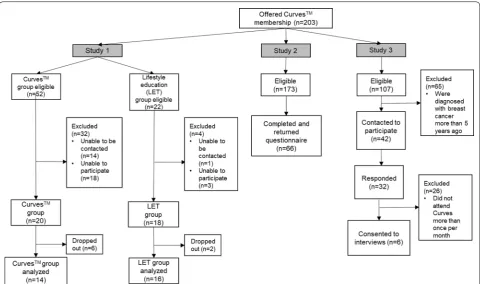
The purpose of this current proof-of-concept research was to evaluate Curves™ as a PA program for BCS. This purpose is addressed with three interrelated stud-ies focused on a sample of BCS who were eligible for Curves™ memberships from a local breast cancer clinic in a large urban city in Canada. Specifically, 203 women accepted complimentary memberships to the PA pro-gram over a 1-year period and served as the sampling frame for the three studies in the current program of research. All participants across the three studies were mutually exclusive (i.e., only participated in one of the studies). Generally, participants were eligible for the studies if they (a) had been diagnosed with breast can-cer; (b) were ≥ 18 years of age; and (c) could read and
understand English or French. The flow of participants among all three studies is depicted in Fig. 1.
Study 1
Using a proof-of-concept paradigm [23], the purpose of study 1 was to compare Curves™ and a lifestyle PA intervention on improving PA levels among BCS over 12-weeks. The lifestyle PA strategy was evidence-based [24, 25] using simple strategies such as providing PA information, guidelines and a pedometer for increasing PA behavior. Compared to structured exercise programs, lifestyle interventions have led to similar fitness gains and adherence [24, 25] and have previously demonstrated positive health benefits among BCS [26–32]. This evi-dence suggests that it may be feasible and efficient to tar-get lifestyle strategies among BCS [24, 33, 34].
Methods
Participants and procedures
All participants were screened by the head surgical oncologist using chart review and informed of the study in person at a regularly scheduled medical appointment. Participants were randomly assigned to the community PA program (Curves™) or a lifestyle PA program. Par-ticipation in the Curves™ group involved accepting a complimentary membership in addition to general PA Guidelines [35], a cancer specific report on PA guidelines [9], and a pedometer. At the time of the study, Exercise Guidelines for People with Cancer were not yet published [36]. Women were asked to attend the Curves™ pro-gram as much as the PA guidelines recommend (e.g., 3 to 5 days per week) to ensure ecological validity. As an indi-cator of cost effectiveness, memberships were estimated at a cost of $420 per year, per person. Guidelines and materials were free, and pedometers cost the research team $12 per person.
Participants in the lifestyle PA group were given all lifestyle intervention materials without a complimentary membership. These women were asked to follow the rec-ommendations outlined in the educational and guideline materials, which included striving towards 150 min of moderate-to-vigorous PA per week [9]. All participants completed self-report measures at baseline, were given study materials, and then completed measures 12-weeks post-baseline. Participants in the lifestyle group were offered a Curves™ membership after the 12-week inter-vention period.
analysis of variance F-test family with alpha = 0.05 and power of 0.08, 2 groups with 2 assessments, and a corre-lation among repeated measures estimated at 0.5, a total of N= 58 BCS were required for recruitment.
Measures
Socio‑demographics and cancer history
Socio-demographic variables included age; ethnicity; highest education achieved, and marital status. Cancer-related variables included stage of cancer diagnosis, time since diagnosis and treatment, and types of cancer treat-ment received (e.g., lymph node dissection, lumpectomy, mastectomy/double mastectomy, chemotherapy, radio-therapy, hormone therapy). Finally, body mass index (BMI) was calculated from self-reported weight and height.
Physical activity
Women self-reported PA using Short Questionnaire to Assess Health-Enhancing PA (SQUASH) [37] which is designed to assess daily PA during leisure time, work, school, daily transportation or other daily activities. The SQUASH has been validated against accelerom-eter data, which resulted in spearman correlation for
overall reproducibility being 0.58 (95%-CI 0.36–0.74; [37]). Participants were asked to report daily activities by indicating the frequency, duration, and intensity of each bout. PA scores were calculated by multiply-ing the number of bouts per week by the number of minutes per bout, and multiplying that score by the intensity score, for each of the specific activities [36]. For the purpose of this study, only PA that could be modified (leisure, sport, and household) was totalled as the primary endpoint and is presented in Metabolic Equivalent (MET) units of energy costs [37]. To provide context, one MET is equivalent to sitting at rest, light intensity activities are ascribed a MET value around 3, moderate intensity activities are based on a MET value of around 5, and vigorous/strenuous activity is ascribed a MET value approximating 9 [37].
Women were also given a pedometer (StepsCount, Ontario, Canada) to wear each day from time awaken-ing until bedtime except for durawaken-ing water activities and showering/bathing. A logbook was also provided to keep track of daily steps. Average number of steps per week was computed. For pedometer assessment to align with main analyses, average steps for week 1 (baseline) and week 12 were used in analyses.
[image:3.595.58.539.87.371.2]Data analysis
Descriptive statistics (means and standard deviations or frequencies) were calculated. To address the main pur-pose, a repeated measures univariate analysis of variance (RM ANOVA) model was estimated to assess differences in the PA program and lifestyle groups on PA over time. Where appropriate, Cohen’s d effect sizes were also cal-culated and reported.
Results
A total of 38 BCS were recruited and consented to the study, although 8 women dropped out of the study before baseline assessment. A summary of
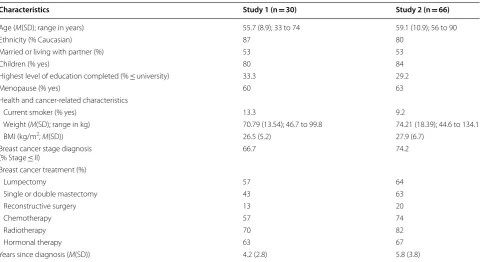
demographic characteristics of the analytical sample of participants (N = 30; n = 14 Curves™ and n = 16 life-style PA) can be found in Table 1. Of note, the women in the groups were not significantly (p < 0.05) differ-ent on any measured descriptive variable. Means and standard deviations for PA levels by groups over the 12 weeks are presented in Table 2. Effect sizes are also reported. There were no significant differences in self-reported baseline PA across the groups. In the RM ANOVA, there were no significant main effects, Time
F(1,28) = 0.80, p = 0.38; Group F(1,28) = 0.91, p = 0.35, or interaction, F(2,56) = 0.10, p = 0.92.
Table 1 Participant demographic characteristics for study 1 and study 2
All study samples were independent and no one participant was involved in more than one study. Participant demographic characteristics for study 3 are reported in the associated results section
Characteristics Study 1 (n = 30) Study 2 (n = 66)
Age (M(SD); range in years) 55.7 (8.9); 33 to 74 59.1 (10.9); 56 to 90
Ethnicity (% Caucasian) 87 80
Married or living with partner (%) 53 53
Children (% yes) 80 84
Highest level of education completed (% ≤ university) 33.3 29.2
Menopause (% yes) 60 63
Health and cancer-related characteristics
Current smoker (% yes) 13.3 9.2
Weight (M(SD); range in kg) 70.79 (13.54); 46.7 to 99.8 74.21 (18.39); 44.6 to 134.1
BMI (kg/m2; M(SD)) 26.5 (5.2) 27.9 (6.7)
Breast cancer stage diagnosis
(% Stage ≤ II) 66.7 74.2
Breast cancer treatment (%)
Lumpectomy 57 64
Single or double mastectomy 43 63
Reconstructive surgery 13 20
Chemotherapy 57 74
Radiotherapy 70 82
Hormonal therapy 63 67
Years since diagnosis (M(SD)) 4.2 (2.8) 5.8 (3.8)
Table 2 Means and standard deviations for PA levels measured by self-report (METS) and pedometer (Steps) for the PA program and lifestyle groups in study 1
a METS = metabolic equivalents for physical activity
b Steps are per day on average over the week, rounded to closest step. For step counts, there were 8 women in the PA program group and 11 women in the lifestyle
group who complied with wearing the pedometer and who are included in the analysis
Group METSa
mean (SD) Effect size (d) Steps
b
mean (SD) Effect size (d)
Baseline PA program 3663 (3064) 0.14 7326 (2343) 0.71
Lifestyle 3026 (2182) 5375 (3133)
12-weeks PA program 3306 (2160) 0.23 6335 (1370) 0.28
[image:4.595.58.539.282.544.2] [image:4.595.58.540.615.696.2]For pedometer data, seven women from the Curves™ group and 12 women from lifestyle group complied with wearing the pedometer (50% and 75% compliance rates, respectively). These 19 women provided 1593 days of pedometer data and median days worn per week was seven. Means and standard deviations for the average step count over the week of assessment for the pedom-eter data for those who wore the device are reported in Table 2. There was no time effect, F(1,18) = 0.67, p = 0.24, group effect, F(1, 18) = 0.31, p = 0.59, or time × group interaction, F(2,34) = 0.93, p = 0.35.
Brief summary
Overall, there were no differences in the groups based on PA participation. In this proof-of-concept study, the lack of differences may be attributed to a small sample size, additional sociocultural factors that were not meas-ured in this study that may have influenced the groups unequally, or ineffective memberships to Curves. Under-standing participation trends and experiences in the community-based program is important to better explain these findings.
Study 2
Given the findings of the first study, the purpose of study 2 was to explore attendance at the Curves™ PA program,
identify potential personal and cancer-specific factors associated with attendance, and describe the barriers and facilitators to participating in the program.
Methods
Participants and procedure
One year following the provision of complimentary pro-gram memberships, 173 BCS who were not involved in study 1 were invited to participate in study 2. Sixty-six BCS (response rate of 38.2%) provided informed consent and completed a mailed questionnaire 1 year following the provision of their Curves™ membership. Question-naires were completed and returned by mail.
Measures
Sociodemographic and cancer history variables were assessed as described in study one.
Attendance
Frequency of program attendance was assessed to exam-ine use of memberships (i.e., 1 = once; 2 = less than once a month; 3 = once per month; 4 = two to three times per month; 5 = once per week; 6 = two to three times per week; and 7 = four or more times per week). Additionally, participants were asked to describe their program partic-ipation at (i.e., 1 = I didn’t attend Curves™; 2 = I dropped out of Curves™ after trying it; 3 = I sporadically attended
Curves™; and 4 = I attended Curves™ as much as I could). Curves™ PA engagement was dichotomized as either no or little participation (= 0) compared to regular partici-pation (= 1) to further explore predictors of behavior.
Evaluation of the PA program
A questionnaire was developed to evaluate partici-pants’ experiences at the Curves™ program.
Ques-tions were modeled from common theories of behavior change including Theory of Planned Behavior [38] and Expectancy-Value Model [39, 40]. Questions exam-ined: extent of met needs (e.g., “To what extent did the Curves™ program meet your needs?”) rated as 1 = met
none of my needs to 4 = met all of my needs, satisfac-tion with Curves™ service (e.g., Overall, how satisfied
were you with the service you received at Curves™?) with
responses of 1 = very dissatisfied to 4 = very satisfied, and likelihood of choosing Curves™ in the future (e.g., If you
were to continue to exercise at a fitness facility, would you use Curves™ again?) rated as 1 = definitely not to
4 = definitely yes. Specifics of Curves™ location (distance
from home, attendance patterns) were also examined.
Facilitators and barriers of the PA program
Women were asked to list three things they liked about the program and three things they disliked about the PA program in an open-ended question which were then coded based on common barriers for PA [41, 42] including: time, lack of social influences, energy (includ-ing fatigue), lack of motivation, injury/pain, competence and ability, and tangible factors and infrastructure. PA facilitators were coded based on common factors associ-ated with enjoyment and PA participation [41] included: positive social influences (staff, members), variety and flexibility of opportunities, PA program specifics (e.g., duration, intensity), proximity/location, and physical and mental health outcomes.
Data analysis
Results
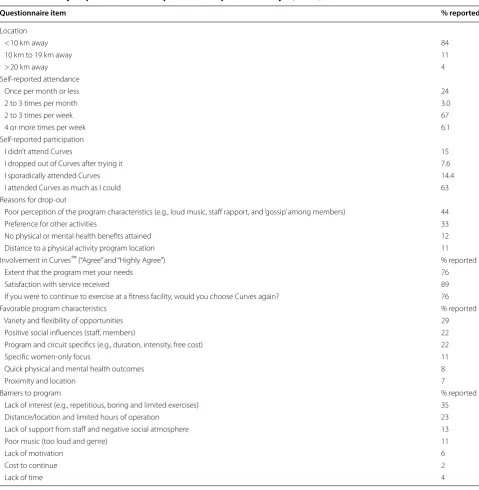
Participant characteristics are summarized in Table 1. The findings from study 2 are presented in Table 3. In summary, participants lived relatively close to a Curves™ location with 84% living less than 10 km away.
Women attended the program 2 to 3 times per week (67%), and reported that they attended the program as much as they could (63%). However, 15% did not attend Curves™ at all and 8% dropped out after trying it once.
Reasons for not attending the program were: advanced disease and on-going treatments (n = 5), injury preclud-ing exercise (n = 1), and moved or the Curves™ gym in neighbourhood closed (n = 4). Reasons for drop-out, in which women could report as many as they wanted, included: poor perception of the program characteris-tics including loud music, preference for other activi-ties, no health benefits attained, and distance to a PA program location.
Table 3 Summary of questionnaire and open-ended responses in study 2 (n = 66)
Questionnaire item % reported
Location
< 10 km away 84
10 km to 19 km away 11
> 20 km away 4
Self-reported attendance
Once per month or less 24
2 to 3 times per month 3.0
2 to 3 times per week 67
4 or more times per week 6.1
Self-reported participation
I didn’t attend Curves 15
I dropped out of Curves after trying it 7.6
I sporadically attended Curves 14.4
I attended Curves as much as I could 63
Reasons for drop-out
Poor perception of the program characteristics (e.g., loud music, staff rapport, and ‘gossip’ among members) 44
Preference for other activities 33
No physical or mental health benefits attained 12
Distance to a physical activity program location 11
Involvement in Curves™ (“Agree” and “Highly Agree”) % reported
Extent that the program met your needs 76
Satisfaction with service received 89
If you were to continue to exercise at a fitness facility, would you choose Curves again? 76
Favorable program characteristics % reported
Variety and flexibility of opportunities 29
Positive social influences (staff, members) 22
Program and circuit specifics (e.g., duration, intensity, free cost) 22
Specific women-only focus 11
Quick physical and mental health outcomes 8
Proximity and location 7
Barriers to program % reported
Lack of interest (e.g., repetitious, boring and limited exercises) 35
Distance/location and limited hours of operation 23
Lack of support from staff and negative social atmosphere 13
Poor music (too loud and genre) 11
Lack of motivation 6
Cost to continue 2
[image:6.595.57.537.237.728.2]Women who attended the program were generally sat-isfied with their experience, reported that the program met their needs, and reported that they would choose Curves™ again if they were going to exercise at a fitness facility. However, none of the women had purchased a Curves™ membership at the time of completing the ques-tionnaire. There were no differences between groups of women who attended Curves™ compared to those who did not on any personal or cancer-related factors.
Based on a qualitative assessment of open-ended responses to the list of facilitators and barriers pertain-ing to the program, there were 110 reported favourable characteristics (coded as variety and flexibility of oppor-tunities, social influences, program/circuit specifics, women-only focus, physical and mental health outcomes, and proximity/location) and 83 barriers (lack of interest, distance/location and limited hours of operation, lack of support and negative social atmosphere, poor music, lack of motivation, cost to continue, and lack of time) of the program. See Table 3 for questionnaire and open-ended responses.
Brief summary
There were a number of barriers and facilitators to pro-gram participation that may be used to inform future program development for community PA opportuni-ties among women with breast cancer. Offering variety in programs and flexibility in participation, such as the “drop in” and short circuit nature of the program, appear to be critical to favourable perceptions. This finding is in line with recent empirical evidence on the importance of perceptions of variety in PA [43, 44]. The women-only focus was a valuable feature, yet the BCS reported some lack of support for fitness that may have hindered their attendance. Given that these findings were drawn from an open-ended survey, it is important to further understand the factors that are appreciated based on the Curves™ program.
Study 3
Study 3 was a qualitative study among a unique sample of women who attended Curves™ and who were
pur-posefully selected to participate in individual interviews aimed at understanding the experience of participating in the Curves™ PA program.
Methods
Participants and procedures
Women were purposefully sampled if they had attended Curves™ at least once a month for the duration of the
membership and that they had been diagnosed with breast cancer within 5 years prior to study (Fig. 1). Women who participated in studies one and two were
not sampled. The women identified a time and loca-tion for individual semi-structured interviews exploring their experiences of the program. Interviews lasted 45 to 60 min in length, were audio-recorded and transcribed verbatim.
Data analysis
Audio files were transcribed verbatim and transcripts were analyzed using inductive thematic analysis [45]. Transcripts (raw data) were read multiple times by the second author and memoing was conducted to make note of developing concepts. Follow-up reading of each transcript by the second author was used to catego-rize similar codes into subthemes, and subthemes were organized into themes. An impartial research assistant reviewed themes for internal homogeneity to ensure fit within themes and external heterogeneity to ensure clear distinction between themes. When the author and research assistant did not agree, discussion occurred until consensus was reached. Descriptions of themes were developed, representative quotes were chosen, and all authors reviewed the themes and quotes.
Results
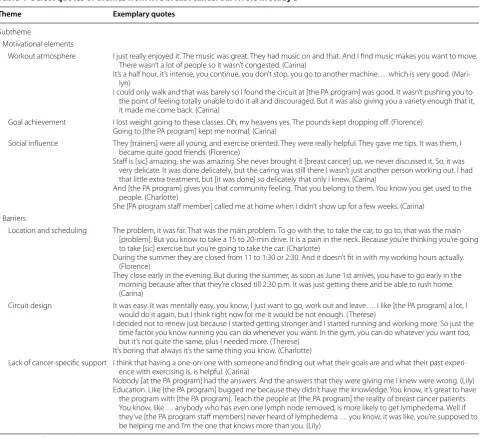
Women (N = 6) were an average of 55 years old, iden-tified as Caucasian (100%), mostly (67%) university educated and married (50%). They were all breast can-cer survivors (100%) who had completed treatment an average of 3.7 (SD = 1.1) prior to the study commenc-ing. Treatment included lumpectomy (67%), single or double mastectomy (33%), reconstructive surgery (33%), chemotherapy (50%), radiotherapy (83%) and hormonal therapy (67%). Participants reported that they attended Curves™ on a regular basis ranging from once per week to multiple times per week. Most of the women (n = 5) attended the PA program for almost a full year; however, none renewed their program mem-bership. Two main themes and six sub-themes were identified generally around the motivation and barriers of the PA program (see Table 4 for quotes; pseudonyms are used for anonymity).
Motivational elements: “Going to Curves™ kept me normal” Positive enablers for PA associated with Curves™ were
coded as motivational elements. There were three sub-themes that developed from the data: (i) workout atmos-phere, (ii) goal achievement, and (iii) social influences.
Workout atmosphere
program duration, intensity being personal and challeng-ing yet manageable, ease of gettchalleng-ing on machines, variety of machines, and music.
Goal achievement
Women mentioned weight management as a program benefit. Most (83%) also discussed the program helped them meet goals related to feeling better, finding an enjoyable activity and helped them re-gain a sense of normality.
Social influence
A majority (67%) of women expressed social outcomes related to attending the program. Women attending the program felt that the staff, few other BCS, and other women attending the program were supportive. Spe-cifically, BCS felt that trainers hired at the location she attended were helpful and inspirational. They appreciated that the staff focused on them as women and not as BCS.
Barriers: “…Plus, I needed more”
The negative or challenges to PA that were experienced or perceived at Curves™ were coded into the main theme
Table 4 Select quotes of themes from five breast cancer survivors in study 3
Names reported are pseudonyms
Theme Exemplary quotes
Subtheme
Motivational elements
Workout atmosphere I just really enjoyed it. The music was great. They had music on and that. And I find music makes you want to move. There wasn’t a lot of people so it wasn’t congested. (Carina)
It’s a half hour, it’s intense, you continue, you don’t stop, you go to another machine…. which is very good. (Mari-lyn)
I could only walk and that was barely so I found the circuit at [the PA program] was good. It wasn’t pushing you to the point of feeling totally unable to do it all and discouraged. But it was also giving you a variety enough that it, it made me come back. (Carina)
Goal achievement I lost weight going to these classes. Oh, my heavens yes. The pounds kept dropping off. (Florence) Going to [the PA program] kept me normal. (Carina)
Social influence They [trainers] were all young, and exercise oriented. They were really helpful. They gave me tips. It was them, I became quite good friends. (Florence)
Staff is [sic] amazing, she was amazing. She never brought it [breast cancer] up, we never discussed it. So, it was very delicate. It was done delicately, but the caring was still there I wasn’t just another person working out. I had that little extra treatment, but [it was done] so delicately that only I knew. (Carina)
And [the PA program] gives you that community feeling. That you belong to them. You know you get used to the people. (Charlotte)
She [PA program staff member] called me at home when I didn’t show up for a few weeks. (Carina) Barriers
Location and scheduling The problem, it was far. That was the main problem. To go with the, to take the car, to go to, that was the main [problem]. But you know to take a 15 to 20-min drive. It is a pain in the neck. Because you’re thinking you’re going to take [sic] exercise but you’re going to take the car. (Charlotte)
During the summer they are closed from 11 to 1:30 or 2:30. And it doesn’t fit in with my working hours actually. (Florence)
They close early in the evening. But during the summer, as soon as June 1st arrives, you have to go early in the morning because after that they’re closed till 2:30 p.m. It was just getting there and be able to rush home. (Carina)
Circuit design It was easy. It was mentally easy, you know, I just want to go, work out and leave…. I like [the PA program] a lot, I would do it again, but I think right now for me it would be not enough. (Therese)
I decided not to renew just because I started getting stronger and I started running and working more. So just the time factor you know running you can do whenever you want. In the gym, you can do whatever you want too, but it’s not quite the same, plus I needed more. (Therese)
It’s boring that always it’s the same thing you know. (Charlotte)
Lack of cancer-specific support I think that having a one-on-one with someone and finding out what their goals are and what their past experi-ence with exercising is, is helpful. (Carina)
Nobody [at the PA program] had the answers. And the answers that they were giving me I knew were wrong. (Lily) Education. Like [the PA program] bugged me because they didn’t have the knowledge. You know, it’s great to have
[image:8.595.59.540.95.533.2]of barriers, and there were three sub-themes: (i) location and scheduling; (ii) circuit design, and (iii) lack of cancer-specific support.
Location and scheduling
Lack of locations near participants’ homes was an issue. Similarly, circuit schedules and seasonal schedules were perceived as inconvenient by participants.
Circuit design
Two women mentioned the circuit itself did not meet their exercise intensity needs. This may have been a reason for why some women did not renew their mem-berships. Furthermore, half of the women mentioned a lack of program variety. While these were program chal-lenges, it was also apparent that the program was a plat-form that led to other PA opportunities.
Lack of cancer‑specific support
Improvements centred around specific types of social support. For instance, having specific, one-on-one sup-port from staff members would be helpful for fostering attendance. Similarly, one participant felt that she lacked informational support from the program. Based on BCS’ perceptions and experiences, it was clear that further tai-lored social support was valuable for their interest and enjoyment.
Brief summary
BCS who attended Curves™ experienced a number of benefits and reported a number of factors that influenced their decision to discontinue. These factors were cen-tered on specific program logistics that could be alcen-tered for improved sustainability. Specifically, community PA programs should be accessible and flexible in hours of operation, should hire knowledgeable staff specific to breast cancer (or oncology more generally) and PA, and should offer a variety of PA plans in both number of exer-cises as well as intensity. Based on the strengths of the program, the duration of the activity was highly valued (e.g., 30 min). The women-only focus and motivated staff were also important. These factors overall are not sur-prising given the plethora of research identifying lack of perceived social support, lack of facilities or facilities that are close by and lack of motivation as barriers to engag-ing in PA for both BCS and other cancer survivors [14, 41, 46]. Furthermore, participants valued that staff knew they had cancer, and that there was no emphasis or focus on cancer; however, they also desired cancer and exer-cise-specific information.
Discussion
The overall purpose of this research was to evaluate Curves™ as a community-based PA program for BCS.
This was accomplished through three studies with inde-pendent samples, which indeinde-pendently aimed to (a) com-pare two ecologically valid programs for changes in PA levels in BCS (study 1); (b) evaluate attendance, attitudes and beliefs about characteristics of the Curves™
pro-gram (study 2); and (c) explore experiences of BCS who attended Curves™ through interviews (study 3). Based on
results of study 1, Curves™ did not significantly increase
PA levels in BCS who received free, 1-year memberships. Findings from studies two and three suggest that BCS who attended the program were not interested in the program for long. While a few women discussed ease of the program, there was no adaptation over time that lim-ited interest once women improved. Nonetheless, it may be that similar community-based PA programs may be a promising opportunity for initiating PA among BCS who can then gain confidence and skill to advance to other physical activities. The women-only focus, time commit-ment of 30 min, simple circuit, and encouraging envi-ronment are all positive features that could be adopted in survivorship PA programs that may also be transition opportunities for BCS to gain competence, social sup-port, and a sense of personal agency and control. In this way, sustainability of the PA program may not be a pri-mary goal—the program can be effective at fostering a sense of normalcy among BCS and building a foundation for PA in a community setting outside of survivorship programming.
While current findings confirm there are many barriers to PA which developed from the Curves™ environment,
these barriers are consistent with situational contexts of community programs more generally, including dis-tance to closest location, hours of operation and staff [14]. Furthermore, cost of on-going memberships may have been a limitation to continued participation. Over-all, providing yearly memberships to over 200 women cost an estimated $85,000. Given that Curves™ had
memberships because their medical team provided them with the opportunity may be a reflection of external and introjected motivation regulations that are also not likely to lead to sustainable PA [49]. As such, further consid-eration is needed for the appropriate model of providing community-based PA opportunities to BCS.
In contrast to previous findings, women did not dis-cuss other common environmental or situational barriers such as lack of time, inclement weather and absence of equipment [41] or disease-related barriers such as feel-ing sick, fatigue and safety concerns about exercise [14, 50]. It may be that women felt supported for PA by their medical team in the act of being offered a membership and hence felt it was safe. Medical team, and primarily physician support, is a key factor in increasing PA atti-tudes and behaviors [51, 52]. Time and financial barriers were not likely discussed given the short circuit training model at the PA program and provision of free member-ships. Furthermore, women did not discuss body image challenges that are common challenges to PA among BCS [41, 53, 54]. It may be that the women-only focus at the PA program offered a comfortable environment for PA. Given these findings, the PA program may be perceived to be a welcoming and safe environment for PA and these features are likely to enhance perceptions of compe-tence and social support that are linked to long-term PA participation.
This work is not without its limitations. Specifically, the sample may not have been representative of BCS from this large urban centre in that they were predomi-nately Caucasian, affluent and well-educated. The sam-ple size for study 1 was small, and many of the women had already received memberships thus precluding ran-dom assignment to intervention groups. There are also a number of additional sociocultural factors and condi-tions reflecting interseccondi-tions of race, identity, value sys-tems, health perceptions, and socioeconomic position that were not assessed in study 1 that may have pre-cluded finding differences in the intervention groups. The response rate for study 2 was low, although consist-ent with self-report survey research [55]. Additionally, the PA program staff or organizational leaders were not involved in the research. Future work is needed on better understanding the integration of BCS into a PA program from the program provider perspectives. In spite of these limitations, the results offer an evaluation of an under-studied yet highly available PA opportunity for women.
Conclusions
Based on strengths and weaknesses of the PA program circuit, survivorship programs can benefit from integrat-ing women-only, supportive, small class size, short time commitment, self-paced circuit training PA features
while also highlighting trained staff in oncology and fit-ness, adding variety and challenge, and regular adap-tations based on training gains. Future interventions targeting BCS should account for these features. It is important to note that the PA program and other similar community-based programs may be a gateway opportu-nity to help women initiate PA in a safe and comfortable environment. Understanding the importance of commu-nity PA programs is essential for translating research into practice [56] and helping more women to increase their PA.
Acknowledgements
Not applicable.
Authors’ contributions
CS and SM conceptualized studies. CS, AF, EO collected, analyzed and inter-preted data. CS and AF drafted the first version of the manuscript. All authors contributed to all subsequent versions of the manuscript. All authors read and approved the final manuscript.
Funding
This study was funded by the Canadian Breast Cancer Foundation (#499062) and Cedar’s Breast Center Fundraising initiative (#20257).
Availability of data and materials
All data generated or analyzed during this study are included in this published article. The data generated and analyzed in the current study are available from the corresponding author upon reasonable request.
Ethics approval and consent to participate
All studies were approved by the host university (REB #29262) and hospital research ethics review boards (REB #GEN-10-022).
Consent for publication
Not applicable.
Competing interests
The authors declare that they have no competing interests.
Author details
1 Faculty of Kinesiology and Physical Education, University of Toronto, 55
Harbord Street, Toronto, ON M5S 2W6, Canada. 2 School of Kinesiology
and Health Studies, Queen’s University, Kingston, Canada. 3 Centre Hospitalier
de L’université de Montréal & Individualized Program Department, Concordia University Montreal, Montreal, Canada. 4 Department of Surgery and
Oncol-ogy, McGill University, Montreal, Canada.
Received: 12 February 2019 Accepted: 14 June 2019
References
1. Canadian Cancer Society. Canadian Cancer Society’s Advisory Committee on Cancer Statistics. Vol. 2016, Canadian Cancer Statistics 2017. Toronto; 2017. cancer.ca/Canadian-CancerStatistics-2017-EN.pdf%0A.
2. Feuerstein M, Ganz PA. Health services for cancer survivors. New York: Springer; 2011.
3. Battaglini CL, Mills RC, Phillips BL, Lee JT, Story CE, Nascimento MG, et al. Twenty-five years of research on the effects of exercise training in breast cancer survivors: a systematic review of the literature. World J Clin Oncol. 2014;5(2):177–90. http://www.pubme dcent ral.nih.gov/artic leren der. fcgi?artid =40147 91&tool=pmcen trez&rende rtype =abstr act. 4. Sabiston CM, Brunet J. Reviewing the benefits of physical activity during
5. Holmes MD, Chen WY, Feskanich D, Kroenke CH, Colditz G. After breast cancer diagnosis. J Am Med Assoc. 2014;293(20):2479–86.
6. Urbscheit N, Brown K. The association between physical activity and breast cancer recurrence and survival. Curr Nutr Rep. 2014;3:16–21. 7. Nelson SH, Marinac CR, Patterson RE, Nechuta SJ, Flatt SW, Caan BJ, et al. Impact of very low physical activity, BMI, and comorbidities on mortality among breast cancer survivors. Breast Cancer Res Treat. 2016;155(3):551–7.
8. Speck RM, Courneya KS, Mâsse LC, Duval S, Schmitz KH. An update of controlled physical activity trials in cancer survivors: a systematic review and meta-analysis. J Cancer Surviv. 2010;4(2):87–100.
9. Schmitz KH, Courneya KS, Matthews C, Demark-Wahnefried W, Galvão D, Pinto BM, et al. American College of Sports Medicine roundtable on exercise guidelines for cancer survivors. Med Sci Sports Exerc. 2010;42(7):1409–26.
10. Lynch BM, Dunstan DW, Healy GN, Winkler E, Eakin E, Owen N. Objectively measured physical activity and sedentary time of breast cancer survivors, and associations with adiposity: findings from NHANES (2003–2006). Cancer Causes Control. 2010;21(2):283–8.
11. Sabiston CM, Brunet J, Vallance JK, Meterissian S. Prospective examination of objectively assessed physical activity and sedentary time after breast cancer treatment: sitting on the crest of the teachable moment. Cancer Epidemiol Biomarkers Prev. 2014;23(7):1324–30. http://cebp.aacrj ourna ls.org/conte nt/23/7/1324.full.
12. Fong AJ, Faulkner G, Jones JM, Sabiston CM. A qualitative analysis of oncology clinicians’ perceptions and barriers for physical activity counsel-ling in breast cancer survivors. Support Care Cancer. 2018;26(9):3117–26. 13. Santa Mina D, Sabiston CM, Au D, Fong AJ, Copozzi LC, Langelier D, et al.
Connecting people with cancer to physical activity and exercise pro-grams: a pathways to create accessibility and engagement. Curr Oncol. 2018;25(2):149–62.
14. Wurz A, St-Aubin A, Brunet J. Breast cancer survivors’ barriers and motives for participating in a group-based physical activity program offered in the community. Support Care Cancer. 2015;23(8):2407–16. https ://doi. org/10.1007/s0052 0-014-2596-2.
15. Santa Mina D, Au D, Brunet J, Jones J, Tomlinson G, Taback N, et al. The effects of the community-based, Wellspring Cancer-Exercise Program on functional and psychosocial outcomes in cancer survivors. Curr Oncol. 2017;24(5):284–94.
16. Cerulli C, Minganti C, De Santis C, Tranchita E, Quaranta F, Parisi A. Thera-peutic horseback riding in breast cancer survivors: a pilot study. J Altern Complement Med. 2014;20(8):623–9.
17. Ng AV, Cybulski AN, Engel AA, Papanek PE, Sheffer MA, Waltke LJ, et al. Triathlon training for women breast cancer survivors: feasibility and initial efficacy. Support Care Cancer. 2016. https ://doi.org/10.1007/s0052 0-016-3531-5.
18. Burke SSM, Sabiston CMC. Fostering growth in the survivorship experi-ence : investigating breast cancer survivors’ lived experiexperi-ences scaling Mt. Kilimanjaro from a posttraumatic growth perspective. Qual Rep. 2012;17:32–7. http://eric.ed.gov/?id=EJ978 731.
19. McDonough MH, Sabiston CM, Ullrich-French S. The development of social relationships, social support, and posttraumatic growth in a dragon boating team for breast cancer survivors. J Sport Exerc Psychol. 2011;33(5):627–48.
20. Mutrie N, Campbell A, Barry S, Hefferon K, Mconnachie A, Ritchie D, et al. Five-year follow-up of participants in a randomised controlled trial show-ing benefits from exercise for breast cancer survivors durshow-ing adjuvant treatment. Are there lasting effects? J Cancer Surviv. 2012;6(4):420–30. 21. Kreider RB, Serra M, Beavers KM, Moreillon J, Kresta JY, Byrd M, et al. A
structured diet and exercise program promotes favorable changes in weight loss, body composition, and weight maintenance. J Am Diet Assoc. 2011;111(6):828–43.
22. Kerksick C, Thomas A, Campbell B, Taylor L, Wilborn C, Marcello B, et al. Effects of a popular exercise and weight loss program on weight loss, body composition, energy expenditure and health in obese women. Nutr Metab (Lond). 2009;6(1):23.
23. Czajkowski SM, Heart N, Powell LH, Adler N, Francisco S, Naar-king S, et al. From ideas to efficacy: the ORBIT model for developing behavioral treat-ments for chronic diseases. Health Psychol. 2016;34(10):971–82. 24. Dunn AL, Andersen RE, Jakicic JM. Lifestyle physical activity interventions.
Am J Prev Med. 1998;15(4):398–412.
25. Vallance JKH, Courneya KS, Plotnikoff RC, Yasui Y, Mackey JR. Randomized controlled trial of the effects of print materials and step pedometers on physical activity and quality of life in breast cancer survivors. J Clin Oncol. 2007;25(17):2352–9. http://jco.ascop ubs.org.myacc ess.libra ry.utoro nto.ca/ conte nt/25/17/2352.full.
26. Demark-Wahnefried W, Kenyon AJ, Eberle P, Skye A, Kraus WE. Prevent-ing sarcopenic obesity among breast cancer patients who receive adjuvant chemotherapy: results of a feasibility study. Clin Exerc Physiol. 2002;4(1):44–9.
27. Eyigor S, Karapolat H, Yesil H, Uslu R, Durmaz B. Effects of pilates exercises on functional capacity, flexibility, fatigue, depression and quality of life in female breast cancer patients: a randomized controlled study. Eur J Phys Rehabil Med. 2010;46(4):481–7.
28. Morey MC, Snyder DC, Sloane R, Cohen HJ, Peterson B, Hartman TJ, et al. Effects of home-based diet and exercise on functional outcomes among older, overweight long-term cancer survivors. JAMA. 2009;301(18):1883. 29. Mustian KM, Katula JA, Zhao H. A pilot study to assess the influence of tai
chi chuan on functional capacity among breast cancer survivors. J Sup-port Oncol. 2006;4(3):139–45.
30. Snyder D, Morey MC, Sloane R, Stull V, Cohen HJ, Peterson B, et al. Reach out to ENhancE Wellness in Older Cancer Survivors (RENEW): design, methods and recruitment challenges of a home-based exercise and diet intervention to improve physical function among long- term survivors of breast, prostate, and colorectal cancer. Psycho-Oncology. 2009;439:429–39.
31. Demark-Wahnefried W, Clipp EC, Morey MC, Pieper CF, Sloane R, Snyder DC, et al. Lifestyle intervention development study to improve physical function in older adults with cancer: outcomes from Project LEAD. J Clin Oncol. 2006;24(21):3465–73.
32. Vallance JKH, Plotnikoff RC, Karvinen KH, Mackey JR, Courneya KS. Mainte-nance in breast cancer survivors. Am J Health Behav. 2010;34(2):225–37. 33. Andersen RE, Wadden T, Bartlett SJ, Zemel B, Verde TJ, Franckowiak SC.
Effects of lifestyle activity vs structured aerobic exercise in obese women: a randomized trial. JAMA. 1999;281(4):335–40.
34. Simkin-Silverman LR, Wing RR, Boraz MA, Kuller LH. Lifestyle interven-tion can prevent weight gain during menopause: results from a 5-year randomized clinical trial. Ann Behav Med. 2003;26(3):212–20. 35. Canadian Society of Exercise Physiology. Canadian physical activity and
sedentary behaviour guidelines. 2012.p. 1–32. https ://www.csep.ca/guide lines .
36. Segal R, Zwaal C, Green E, Tomasone J, Loblaw A, Petrella T. Exer-cise for people with cancer: a systematic review. Curr Oncol. 2017;24(4):e290–315.
37. Wendel-Vos GCW, Schuit AJ, Saris WHM, Kromhout D. Reproducibility and relative validity of the short questionnaire to assess health-enhancing physical activity. J Clin Epidemiol. 2003;56(12):1163–9.
38. Ajzen I. From intentions to actions: a theory of planned behavior. Action control. Heidelberg: Springer; 1985. p. 11–39. https ://doi. org/10.1007/978-3-642-69746 -3_2.
39. Wigfield A, Eccles JS. Expectancy–value theory of achievement motiva-tion. Contemp Educ Psychol. 2000;25(1):68–81.
40. Eccles JS, Wigfield A. Motivational beliefs, values, and goals. Annu Rev Psychol. 2002;53:109–32.
41. Brunet J, Taran S, Burke S, Sabiston CM. A qualitative exploration of barri-ers and motivators to physical activity participation in women treated for breast cancer. Disabil Rehabil. 2013;35(24):2038–45.
42. Ottenbacher A, Day R, Taylor W, Sharma S, Sloane R, Snyder D, et al. Exercise among breast and prostate cancer survivors—what are their bar-riers? J Cancer Surv . 2011;5(4):413–9. http://resol ver.schol arspo rtal.info/ resol ve/19322 259/v05i0 004/413_eabap csatb .
43. Sylvester BD, Standage M, McEwan D, Wolf SA, Lubans DR, Eather N, et al. Variety support and exercise adherence behavior: experimental and mediating effects. J Behav Med. 2016;39(2):214–24.
44. Sylvester BD, Lubans DR, Eather N, Standage M, Wolf SA, McEwan D, et al. Effects of variety support on exercise-related well-being. Appl Psychol Health Well-Being. 2016;8(2):213–31.
45. Braun V, Clarke V. Using thematic analysis in psychology. Qual Res Psychol. 2006. https ://doi.org/10.1191/14780 88706 qp063 oa%23.VaWGh xNVik o. 46. Blaney J, Lowe-Strong A, Gracey J, Rankin-Watt J, Campbell A.
•fast, convenient online submission
•
thorough peer review by experienced researchers in your field
• rapid publication on acceptance
• support for research data, including large and complex data types
•
gold Open Access which fosters wider collaboration and increased citations maximum visibility for your research: over 100M website views per year
•
At BMC, research is always in progress.
Learn more biomedcentral.com/submissions
Ready to submit your research? Choose BMC and benefit from:
questionnaire-survey. Psychooncology . 2011;194:186–94. http://eprin ts.ulste r.ac.uk/11010 /1/Janin e_surve y_paper .pdf.
47. Vigna S, Malmendier U. Paying not to go to the gym. Am Econ Rev. 2006;96:694–719. https ://doi.org/10.1257/aer.96.3.694.
48. Strohacker K, Galarraga O, Williams DM. The impact of incentives on exer-cise behavior: a systematic review of randomized controlled trials . Vol. 48, Annals of behavioral medicine : a publication of the Society of Behavioral Medicine. 2014. p. 92–9. https ://journ als-schol arspo rtal-info.myacc ess. libra ry.utoro nto.ca/pdf/08836 612/v48i0 001/92_tioio esror ct.xml. 49. Wilson PM, Blanchard CM, Nehl E, Baker F. Predicting physical activity
and outcome expectations in cancer survivors: an application of self-determination theory. Psychooncology . 2006;15(7):567–78. https ://journ als-schol arspo rtal-info.myacc ess.libra ry.utoro nto.ca/pdf/10579 249/v15i0 007/567_ppaao esaao st.xml.
50. Courneya KS, McKenzie DC, Reid RD, Mackey JR, Gelmon K, Friedenreich CM, et al. Barriers to supervised exercise training in a randomized con-trolled trial of breast cancer patients receiving chemotherapy. Ann Behav Med. 2008;35(1):116–22.
51. Thornton JS, Frémont P, Khan K, Poirier P, Fowles J, Wells GD, et al. Physical activity prescription : a critical opportunity to address a modi fi able risk factor for the prevention and management of chronic disease : a position statement by the Canadian Academy of Sport and Exercise Medicine. Br J Sports Med. 2016;50:1–6.
52. Nadler M, Bainbridge D, Tomasone J, Cheifetz O, Juergens RA, Suss-man J. Oncology care provider perspectives on exercise promotion in
people with cancer: an examination of knowledge, practices, barriers, and facilitators. Support Care Cancer. 2017;25(7):2297–304. https ://doi. org/10.1007/s0052 0-017-3640-9.
53. Sabiston CM, McDonough MH, Crocker PRE. Psychosocial experi-ences of breast cancer survivors involved in a dragon boat program: exploring links to positive psychological growth. J Sport Exerc Psychol. 2007;29(4):419–38.
54. McDonough MH, Sabiston CM, Crocker PRE. An interpretative phenom-enological examination of psychosocial changes among breast cancer survivors in their first season of dragon boating. J Appl Sport Psychol. 2008;20:425–40. https ://doi.org/10.1080/10413 20080 22418 57. 55. Vallance JKH, Lavallee C, Culos-Reed N, Trudeau M. Rural and small town
breast cancer survivors’ preferences for physical activity. Int J Behav Med. 2013;20(4):522–8. https ://doi.org/10.1007/s1252 9-012-9264-z.
56. Phillips SM, Alfano CM, Perna FM, Glasgow RE. Accelerating translation of physical activity and cancer survivorship research into practice: recom-mendations for a more integrated and collaborative approach. Cancer Epidemiol Biomarkers Prev. 2014;23(5):687–99.
Publisher’s Note