Available online throug
ISSN 2229 – 5046
EFFECTS OF THERMAL RADIATION AND HALL EFFECTS ON MHD FREE CONVECTION
FLOW OF VISCO-ELASTIC FLUID THROUGH POROUS MEDIUM PAST
AN INFINITE VERTICAL POROUS PLATE
G. KATHYAYANI
1*, D. M. PRAVEEN BABU*
21
Assistant Professor, Department of Applied Mathematics,
Yogi Vemana University, Kadapa, (A.P.), India.
2
Ph. D Scholar, Department of Applied Mathematics,
Yogi Vemana University, Kadapa, (A.P.), India.
(Received On: 03-05-16; Revised & Accepted On: 18-05-16)
ABSTRACT
This study investigates on unsteady MHD free convection flow of a viscous, incompressible and electrically
conducting visco-elastic fluid through a porous medium with simultaneous heat and mass transfer near an infinite vertical porous plate under the influence of uniform transverse magnetic field and taking hall current into account. To check the accuracy of the numerical solutions for energy, state and momentum equations are obtained by using the perturbation method for small elastic parameter. The expressions for the velocity, temperature and concentration have been derived analytically and also its behaviour is computationally discussed. The effect of various governing parameters controlling the physical situation is discussed with the aid of line graphs. Significant results from this study are obtained for that velocity, temperature and concentration. The skin friction on the boundary, the heat flux in terms of the Nusselt number, and the rate of mass transfer in terms of the Sherwood number are also obtained and their behaviour computationally discussed. During the course of numerical computation, an excellent agreement was found between the profiles with z and time series profiles.Keywords: Hall effects, Heat and mass transfer, MHD flows, porous medium, unsteady flows and visco-elastic fluids.
INTRODUCTION
The study of hydro magnetic free convection flow finds applications in science and engineering, in areas such as geophysical exploration, solar physics, and astrophysical studies. The convection problem in a porous medium has important applications in geothermal reservoirs and geothermal extractions. The process of heat and mass transfer is encountered in aeronautics, fluid fuel nuclear reactor, chemical process industries and many engineering applications in which the fluid is the working medium. When the strength of the magnetic field is strong, one cannot neglect the effect of Hall current. It is of considerable importance and interest to study how the results of the hydro dynamical problems get modified by the effect of Hall currents. Hall currents give rise to a cross flow making the flow three dimensional.
on unsteady MHD Couette flow of a Bingham fluid through a Porous medium in a parallel plate channel with uniform suction and injection under the effect of inclined magnetic field and taking Hall currents. Veera Krishna.M and Devika Rani [16] investigated unsteady MHD mixed convection oscillatory flow of viscous incompressible fluid in a rotating vertical channel with radiation effects. Radiative heat transfer on unsteady MHD oscillatory visco-elastic flow through porous medium in a parallel plate channel was studied by Veera Krishna et al., [17].
The present work is motivated to study the heat and mass transfer unsteady MHD free convection flow of a viscous, incompressible and electrically conducting visco-elastic fluid through a porous medium near an infinite vertical porous plate under the influence of uniform transverse magnetic field and taking hall current into account.
FORMULATION AND SOLUTION OF THE PROBLEM
We consider the unsteady flow of an incompressible MHD free convection flow of Visco-elastic fluid through a porous medium with simultaneous heat and mass transfer near infinite vertical oscillating porous plate under the influence of uniform transverse magnetic field and taking hall current into account. The plate temperature is constant to be maintained. The Visco-elastic and Darcy’s resistance terms are taken into account with constant permeability of the porous medium. The physical configuration of the problem is shown in Figure 1.
We consider the Cartesian co-ordinate system such that
0
z
=
on the plate. The suction velocity normal to the plate is a constant and may be written as,w = -W0. All the fluid properties considered constant except that the influence of the density variation with temperature. The influence of the density variation in other terms of the momentum and the energy equation and the variation of the expansion coefficient with temperature is negligible. This is the well-known Boussinesq approximation. Under these conditions, the unsteady hydromagnetic flow through porous medium under the influence of uniform transverse magnetic field is governed by the following system of EquationsFigure-1: Physical configuration of the Problem
Equation of continuity:
0
w
=
z
∂
∂
(2.1)Equation of Momentum:
2
0 2
1
u
+ w
u
=
u
1
B J
yu
g
(
T
T
) +
g * C
(
C
)
t
t
z
z
t
k
ν
λ
∂ ∂
∂
ν
∂
λ
∂
β
∞β
∞
+
+ +
−
+
−
−
∂ ∂
∂
∂
∂
(2.2)2
0 2
1
v
+ w
v
=
v
1
B J
xv
t
t
z
z
t
k
ν
λ
∂ ∂
∂
ν
∂
λ
∂
+
− +
+
∂ ∂
∂
∂
∂
(2.3)Equation of Energy:
2
2
r
q
T
T
T
+ w
=
t
z
α
z
z
∂
∂
∂
∂
−
∂
∂
∂
∂
(2.4)Equation of Concentration:
2
2
C
C
C
+ w
= D
t
z
z
∂
∂
∂
∂
∂
∂
(2.5)Using Rosseland approximation for radiation,
2
4
(
)
r
q
T
T
z
α
∞∂
=
−
The corresponding boundary conditions are
0
w wu
= =
v
,T
=
T ,C
=
C
at
z
=
0
(2.7)0
u
= =
v
,T
=
T ,C
∞=
C
∞at
z
→ ∞
(2.8)When the strength of the magnetic field is very large, the generalized ohm’s law is modified to include the hall current so that
(
)
1
e e
e
O e
J
J
B
E V
B
P
B
e
ω τ
σ
η
+
×
=
+ × +
∇
(2.9)We also assume that the electric field E=0 under assumptions reduces to
x y
J
+
m J
=
σB v
0 (2.10)y x
J
−
m J
= −
σB u
0 (2.11)where
m
=
τ ω
e e is the hall parameter.On solving equations (2.10) and (2.11) we obtain
(
)
0
x 2
σ
B
J
v
mu
1 m
=
+
+
(2.12)(
)
0
y 2
σB
J
mv u
1 m
=
−
+
(2.13)Substituting the equations (2.12) and (2.13) in (2.3) and (2.2) respectively, we obtain
2 2
0
2 2
1
u
+ w
u
=
u
1
σB
(
mv u
)
u
t
t
z
z
t
1 m
k
ν
λ
∂ ∂
∂
ν
∂
λ
∂
+
+ +
− −
∂ ∂
∂
∂
∂
+
(
) +
(
)
g
β
T
T
∞g * C
β
C
∞+
−
−
(2.14)2 2
0 2
2
(
)
1
v
+ w
v
=
v
1
σ
B
v
mu
v
1 m
t
t
z
z
t
k
ν
λ
∂ ∂
∂
ν
∂
λ
∂
+
− +
+
+
∂ ∂
∂
∂
∂
+
(2.15)We choose,
q
=
u
+
iv
and taking into consideration, the momentum equation (2.14) and (2.15) can be written as, we obtain2 2
0
2 2
1
1
(
) +
(
)
(1
)
B
q
q
q
+ w
=
q
g
T
T
g * C
C
t
t
z
z
t
m
k
σ
ν
λ
ν
λ
β
β
ρ
∞ ∞
∂ ∂
∂
∂
∂
+
− +
+
+
−
−
∂ ∂
∂
∂
∂
+
(2.16)We introduce the non-dimensional variables,
2
0 0
0 0 w w
tW
zW
T
T
C
C
u
v
u*
,v*
,t*
, z*
,
, C*
W
W
ν
ν
θ
T
T
C
C
∞ ∞
∞ ∞
−
−
=
=
=
=
=
=
−
−
Making use of non-dimensional variables, the governing equations reduces to (Dropping asterisks)
2 2
2 2
1
1
1
(
)
1
q
q
q
M
=
q Gr
C
t
t
z
z
t
m
K
λ
∂ ∂
∂
∂
λ
∂
θ φ
+
−
− +
+
+
+
∂ ∂
∂
∂
∂
+
(2.17)2
2
1
Pr
=
R
t
z
z
θ
θ
θ
θ
∂
−
∂
∂
−
∂
∂
∂
(2.18)2
2
1
C
C
C
=
t
z
Sc
z
∂
−
∂
∂
∂
∂
∂
(2.19)The corresponding non-dimensional boundary conditions are
0
1
1
We assume the solutions of the equations (2.17) to (2.19) as,
0
(
)
( )
i tq z,t
=
q t e
ω ,θ
(
z,t
)
=
θ
0( )
t e
i tω ,C z,t
(
)
=
C t e
0( )
i tω (2.22)Using the equations (2.22), the equations (2.10) to (2.12) reduces and Solving making use of the boundary conditions, ,we obtained the velocity, temperature and concentration distributions.
𝑞𝑞= ((𝑎𝑎1+𝑎𝑎2)𝑒𝑒−𝑚𝑚1𝑧𝑧− 𝑎𝑎1𝑒𝑒−𝑚𝑚2𝑧𝑧− 𝑎𝑎2𝑒𝑒−𝑚𝑚3𝑧𝑧 )𝑒𝑒𝑖𝑖𝑖𝑖𝑖𝑖 (2.23)
𝜃𝜃=𝑒𝑒−𝑚𝑚2𝑧𝑧𝑒𝑒𝑖𝑖𝑖𝑖𝑖𝑖 (2.24) 𝑐𝑐=𝑒𝑒𝑖𝑖𝑖𝑖𝑖𝑖 (2.25)
SKIN FRICTION
The skin friction at the plate is given by
(
1 1 2 1 2 2 3)
0
(
)
i tz
q
m a
a
a m
a m
e
z
ωτ
=∂
=
= −
+
+
+
∂
(2.26)NUSSELT NUMBER
The rate of heat transfer, that is, the heat flux at the plate Z=0 in terms of the Nusselt number, is given by
2 0
i t
z
Nu
m e
z
ωθ
=∂
= −
=
∂
(2.27)SHERWOOD NUMBER
The rate of mass transfer at the plate Z=0 in terms of the Sherwood number is given by
3 0
i t
z
C
Sh
m e
z
ω =∂
= −
=
∂
(2.28)RESULTS AND DISCUSSION
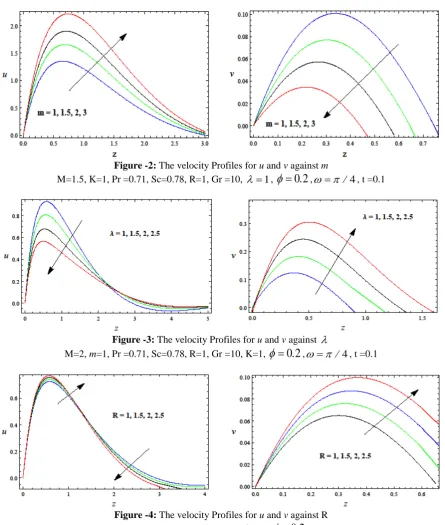
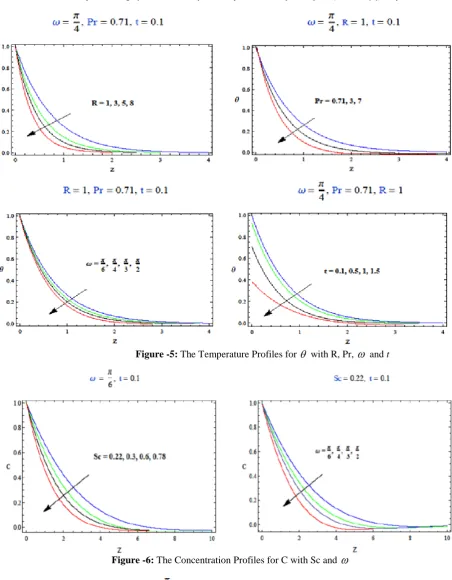
We have considered the unsteady MHD free convection flow of a viscous, incompressible and electrically conducting visco-elastic fluid through a porous medium with simultaneous heat and mass transfer near an infinite vertical porous plate under the influence of uniform transverse magnetic field and taking hall current into account. The plate temperature is constant to be maintained. The visco-elastic and Darcy’s resistance terms are taken into account with constant permeability of the porous medium. The governing equations of the flow field are solved by a regular perturbation method for small elastic parameter. The expressions for the velocity, temperature, concentration have been derived analytically and also its behaviour is computationally discussed with reference to different m, M, K,
λ
, Gr, Sc, R,ω
,φ
, parameters as shown in the line graphs using Mathematica.We noticed that, the magnitude of the velocity components u increases and v reduces with increasing hall parameter m
From the time series profiles7, 8, 9 the behaviour of the results for the velocity are found in good agreement between the profiles with z and time series profiles with magnetic field parameter M. Similarly, we obtained time series profiles for temperature with radiation parameter R and for Concentration with frequency of oscillation
ω
.The skin friction is significant phenomenon which characterizes the frictional drag force at the solid surface. From Table 1, it is observed that the skin friction increases with the increase in hall parameter m, permeability parameter K, Radiation parameter R and Buoyancy ratio
φ
, but it is interesting to note that the skin friction decreases with theincrease in Hartmann number M, visco-elastic parameter
λ
, the frequency of oscillationω
, Prandtl number Pr, thermal Grashof number Gr, Schimdt number Sc and time t. From Table -2, it is to note that all the entries are positive. It is seen that Radiation parameter R, the Prandtl number Pr and the frequency of oscillationsω
increase the rate of heat transfer (Nusselt number Nu) at the surface of the plate, the Nusselt number Nu reduces with increasing time t.From Table- 3 it is to note that all the entries are positive. It is observed that Schmidt number Sc, the frequency of oscillations
ω
and time t increase the rate of mass transfer at the surface of the plate.Figure -2: The velocity Profiles for u and v against m
M=1.5, K=1, Pr =0.71, Sc=0.78, R=1, Gr =10,
λ
=
1
,φ
=
0 2
.
,ω π
=
/
4
, t =0.1Figure -3: The velocity Profiles for u and v against
λ
M=2, m=1, Pr =0.71, Sc=0.78, R=1, Gr =10, K=1,
φ
=
0 2
.
,ω π
=
/
4
, t =0.1Figure -4: The velocity Profiles for u and v against R
Figure -5: The Temperature Profiles for
θ
with R, Pr,ω
and tFigure -6: The Concentration Profiles for C with Sc and
ω
Figure - 8: Time series profile for
θ
with Radiation parameter RFigure - 9: Time series profile for concentration C with
ω
Table-1: Skin Friction
M K λ R Pr Gr φ Sc ω t m τ
2 1 1 1 0.71 10 0.2 0.22 π/4 0.1 1 5.923870 2.5 1 1 1 0.71 10 0.2 0.22 π/4 0.1 1 5.090920
3 1 1 1 0.71 10 0.2 0.22 π/4 0.1 1 4.423994 2 2 1 1 0.71 10 0.2 0.22 π/4 0.1 1 6.445740 2 3 1 1 0.71 10 0.2 0.22 π/4 0.1 1 6.651547 2 1 1.5 1 0.71 10 0.2 0.22 π/4 0.1 1 5.484708 2 1 2 1 0.71 10 0.2 0.22 π/4 0.1 1 4.973461 2 1 1 2 0.71 10 0.2 0.22 π/4 0.1 1 6.105673 2 1 1 3 0.71 10 0.2 0.22 π/4 0.1 1 6.960908 2 1 1 1 3 10 0.2 0.22 π/4 0.1 1 3.643617 2 1 1 1 7 10 0.2 0.22 π/4 0.1 1 2.357887 2 1 1 1 0.71 15 0.2 0.22 π/4 0.1 1 3.536831 2 1 1 1 0.71 20 0.2 0.22 π/4 0.1 1 2.715774 2 1 1 1 0.71 10 0.5 0.22 π/4 0.1 1 7.428604 2 1 1 1 0.71 10 0.7 0.22 π/4 0.1 1 8.431760 2 1 1 1 0.71 10 0.2 0.6 π/4 0.1 1 5.794396 2 1 1 1 0.71 10 0.2 0.78 π/4 0.1 1 5.738639 2 1 1 1 0.71 10 0.2 0.22 π/3 0.1 1 5.415466 2 1 1 1 0.71 10 0.2 0.22 π/2 0.1 1 4.351939 2 1 1 1 0.71 10 0.2 0.22 π/4 0.5 1 5.368414 2 1 1 1 0.71 10 0.2 0.22 π/4 0.8 1 4.601975 2 1 1 1 0.71 10 0.2 0.22 π/4 0.1 2 7.464147
Table-2: Nusselt number Table-3: Sherwood number
CONCLUSIONS
The unsteady flow of an incompressible MHD free convection flow of Visco-elastic Kuvshinshiki fluid through a porous medium with simultaneous heat and mass transfer near an infinite vertical oscillating porous plate under the influence of uniform transverse magnetic field has been discussed. The influence of the dimensionless parameters on velocity temperature, Concentration, skin friction, Nusselt number and Sherwood number is demonstrated on figures and discussed. From the results obtained, the findings are:
1. The magnitude of the resultant velocity reduces with increasing the intensity of the magnetic field or Prandtl number Pr or Schimdt number Sc.
2. The resultant velocity enhance with increasing Hall parameter m or Grashof number Gr or Buoyancy ratio
φ
. 3. The resultant velocity enhances with increasing the permeability parameter K throughout the fluid region.Lower the permeability of the porous medium lesser the fluid speed in the entire region.
4. The reversal behaviour is observed with increasing visco-elastic parameter
λ
or the frequency of oscillationω
.5. The magnitude of the resultant velocity enhances and the experiences retardation in the flow field with increasing radiation parameter R and reverse trend is observed with increasing time, whereas velocity component v increases with increasing R and t.
6. The magnitude of the temperature of the flow field diminishes as the Prandtl number or time or the frequency of oscillation.
7. The concentration reduces at all points of the flow field with the increase in the Schmidt number Sc, and presence of the frequency of oscillation
ω
reduces the concentration distribution.8. Also, the skin friction increases with the increase in m, K, R and
φ
, reduces with the increase in M,λ
,ω
, Pr, Gr, Sc and t.9. The rate of heat transfer (Nusselt number Nu) at the surface of the plate increase R, Pr or
ω
, and reduces with increasing time t.10. The Schmidt number Sc,
ω
and time t increase the rate of mass transfer (Sh) at the surface of the plate. 11. Moreover, the time required for the velocity and temperature fields, skin-friction, Nusselt number and massGrashof number to attain maximum rests on the dimensionless parameters.
12. The results for the velocity are found in good agreement between the profiles with z and time series profiles with magnetic field parameter. Similarly, we obtained temperature with R and Concentration with frequency of oscillation.
REFERENCES
1. Azzam, G. E. A. (2002). Radiation effects on the MHD-mixed free-forced convective flow past a semi-infinite moving vertical plate for high temperature differences. Phys. Scr., 66, pp. 71–76.
2. Baoku, I.G., Israel-Cookey, C., Olajuwon, B.I., (2012). Magnetic field and thermal radiation effects on steady Hydromagnetic Couette flow through a porous channel. Surv. Math. Appl. 5, 215–228.
3. Chamkha, A. J. (2004). Unsteady MHD convective heat and mass transfer past a semi-infinite vertical permeable moving plate with heat absorption. Int. J. Eng. Sci., 42, 217–230.
4. Chaughan, D., Rastogi, P., (2012). Heat transfer effects on a rotating MHD Couette flow in a channel partially by a porous medium with hall current. J. Appl. Sci. Eng. 15 (3), 281–290
5. Cheng. P and Lau K H (1977). In Proc., 2nd Nation’s Symposium Development, Geothermal Resources, pp. 1591-1598.
R Pr
ω
t Nu1 0.71
π
/
4
0.1 1.333165 2 0.71π
/
4
0.1 1.6301773 0.71
π
/
4
0.1 1.876962 1 3π
/
4
0.1 3.873236 1 7π
/
4
0.1 7.955346 1 0.71π
/
3
0.1 1.375590 1 0.71π
/
2
0.1 1.476144 1 0.71π
/
4
0.8 1.2342011 0.71
π
/
4
1.2 1.007703Sc
ω
t Sh0.22
π
/
4
0.1 0.435384 0.3π
/
4
0.1 0.5340970.6
π
/
4
0.1 0.8658050.78
π
/
4
0.1 1.051093 0.22π
/
3
0.1 0.490472 0.22π
/
2
0.1 0.590352 0.22π
/
4
0.5 0.4914630.22
π
/
4
0.8 0.5020786. Cheng. P and Teckchandani L (1977). Numerical Solutions for Transient Heating and Fluid withdrawal in a Liquid- Dominated Geothermal Reservoir, in The Earth’s Crust: Its Nature and Physical Properties, Vol. 20, pp. 705-721.
7. Farhad, A., Norzieha, M., Sharidan, S., Khan, I., Samiulhaq, (2012). Hydromagnetic rotating flow in a porous medium with slip condition and Hall current. Int. J. Phys. Sci. 7 (10), 1540–1548.
8. Hazem, A.A., (2010a). Unsteady MHD Couette flow of a viscoelastic fluid with heat transfer. Kragujevac J. Sci. 32, 5–15.
9. Hazem, A.A., (2010b). The effect of suction and injection on unsteady Couette flow with variable properties. Kragujevac J. Sci. 32, 17–24.
10. Kim, Y. J. (2000). Unsteady MHD convective heat transfer past a semi-infinite vertical porous moving plate with variable suction. Int. J. Eng. Sci., 38, 833–845.
11. Makinde, O. D. (2005). Free convection flow with thermal radiation and mass transfer past a moving vertical porous plate. Int. Commun. Heat Mass Transfer, 32, 1411–1419.
12. Ogulu, A. and Prakash, J. (2006). Heat transfer to unsteady magneto-hydrodynamic flow past an infinite moving vertical plate with variable suction. Phys. Scr., 74, 232–239.
13. K. Rakesh, C. Khem (2011), Effect of slip conditions and Hall current on unsteady MHD flow of a viscoelastic fluid past an infinite vertical porous plate through porous medium, Int. J. Eng. Sci. Technol. 3 (4). 14. Salama. F.A., (2011). Convective heat and mass transfer in a non-newtonian flow formation in a Couette
motion in magnetohydrodynamics with time- varying suction. Therm. Sci. 15 (3), 749–758.
15. Veera Krishna.M and G.Dharmaiah (2013), Heat Transfer on unsteady MHD Couette flow of a Bingham fluid through a Porous medium in a parallel plate channel with uniform suction and injection under the effect of inclined magnetic field and taking Hall currents, Int. J. App. Math. Appl., 5(2), 147-163.
16. Veera Krishna.M, B.Devika Rani (2014), Unsteady MHD mixed convection oscillatory flow of viscous incompressible fluid in a rotating vertical channel with radiation effects, Mathematical Sci. Int. Res. J. 3(2), 718-726.
17. Veera Krishna.M, L.Hari Krishna and S.V.Suneetha, Radiative heat transfer on unsteady MHD oscillatory visco-elastic flow through porous medium in a parallel plate channel, Mathematical Sci. Int. Res. J. 3(2), 803-810.
Source of support: Nil, Conflict of interest: None Declared
[Copy right © 2016. This is an Open Access article distributed under the terms of the International Journal of Mathematical Archive (IJMA), which permits unrestricted use, distribution, and reproduction in any medium, provided the original work is properly cited.]