Losing Forward: An Ethnographic Study of the LGBT Movement in North Carolina
Laura Meadows
A dissertation submitted to the faculty of the University of North Carolina at Chapel Hill in partial fulfillment of the requirements for the degree of Doctor of Philosophy in the School of
Journalism and Mass Communication.
Chapel Hill 2015
© 2015
ABSTRACT
Laura Meadows: Losing Forward: An Ethnographic Study of the LGBT Movement in North Carolina
(Under the direction of Daniel Kreiss)
On May 8, 2012, North Carolina voters approved a constitutional amendment banning marriage equality in the state. On October 10, 2014, a federal judge ruled the amendment unconstitutional. This ethnographic study of the state’s LGBT movement during this timeframe explores both the campaign that led to the marriage ban and its aftermath through participant observation, in-depth interviews, and qualitative analysis of legacy and social media archives, revealing a state-level movement that was transformed through its engagement in the electoral field.
Specifically, this study transports Chadwick’s (2013) analytical approach of the hybrid media system into the study of social movements, viewing the movement activities of North Carolina’s LGBT activists through the lens of a system “built upon interactions among older and newer media logics” in order to reveal the complexity of contemporary media strategies
distinct perspective through which to examine the trajectory of a social movement and the experiences, interactions, and events that alter its course.
PREFACE
TABLE OF CONTENTS
LIST OF FIGURES………..viii
LIST OF TABLES……….……….ix
CHAPTER 1: INTRODUCTION..………..1
Introduction………..1
(A brief) History of the North Carolina LGBT Movement….………...………...11
Methods………….……….21
CHAPTER 2: THE HYBRID MEDIA SYSTEM AT THE HYPER-LOCAL LEVEL…...…….31
Introduction………31
Literature Review……….………..34
Professional Media and Movements…...……..………..34
Social Media and Movements………37
The Hybrid Media System……….40
Findings……….42
Entering the Hybrid Media System………42
Leveraging Myriad Media……….47
Strategically Exploiting the Hyper-local………...53
Discussion………..56
CHAPTER 3: MOVEMENT PUBLICS..………..60
Introduction………60
Publics and Social Movements………..65
Discursive Strategies………..69
Role of Social Media……….72
Findings……….74
Movement Publics as Discursive Groupings....……….74
Movement Publics as Sanctuaries...……….78
Movement Publics as Access Points………..83
Resonance Through Identity Deployment……….88
Engaging Latent Movement Publics………..92
Discussion………..94
CHAPTER 4: CATALYZING EVENTS...………...97
Introduction………97
Literature Review……….103
The LGBT Movement at the Ballot Box……….103
Leveraging Election Cycles…….………105
Movements in the Electoral Field………106
Findings………...109
Organizational Growth……….109
Heightened Media Visibility………115
Coalition Growth……….119
Discussion………122
CHAPTER 5: LOSING FORWARD..………124
LIST OF FIGURES
Figure 1.1 Organizational chart of the Protect All NC Families campaign………...17
Figure 1.2 Protect All NC Families one-sheet………...18
Figure 2.1 Mitchell County GSA’s poster…...………..………....46
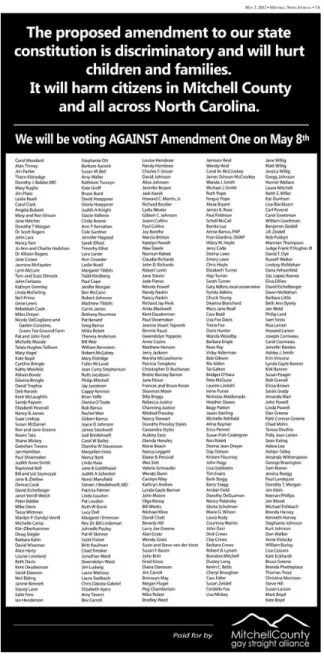
Figure 2.2 Mitchell County GSA’s Amendment One Advertisement………...55
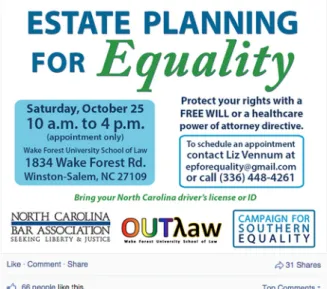
Figure 3.1 Campaign for Southern Equality Facebook post...………...80
Figure 3.2 The Freedom Center for Social Justice Facebook post…….………...81
Figure 3.3 Campaign for Southern Equality Facebook post…...………...81
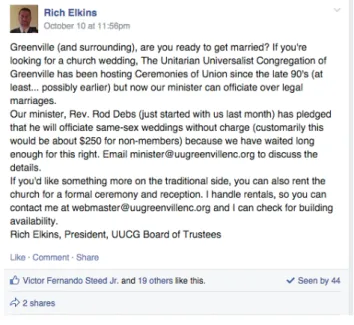
Figure 3.4 Facebook post on Eastern Carolina Equality’s page.………...82
Figure 3.5 Campaign for Southern Equality Facebook post..………….………...83
Figure 3.6 Neighbors for Equality Facebook post.………….………...83
Figure 3.7 Neighbors for Equality Facebook post………...84
Figure 3.8 Campaign for Southern Equality Facebook post….……….85
Figure 3.9 Facebook post on C.A.F.E.’s page..………...85
Figure 3.10 Neighbors for Equality Facebook post..……….86
Figure 3.11 Campaign for Southern Equality Facebook post…...………...87
Figure 3.12 Campaign for Southern Equality Facebook post...……….87
Figure 4.1 Mitchell County GSA’s Decision Day event article….……….113
Figure 4.2 Neighbors for Equality Facebook post…..……….119
Figure 4.3 Moral March 2014 meme…..……….121
Figure 4.4 Moral March 2014 meme…..……….122
LIST OF TABLES
Table 1.1 List of North Carolina newspapers qualitatively analyzed………....29
CHAPTER 1: INTRODUCTION Introduction
On May 8, 2012, North Carolina voters went to the polls and voted to amend their state constitution to define marriage exclusively as between one man and one woman. Despite a multi-million dollar, months-long campaign, the effort to defeat Amendment One failed, and North Carolina became the 31st state to constitutionally ban same-sex marriage. In a year of
unprecedented progress for the LGBT movement nationally – Minnesota’s citizens voted against a similar constitutional ban, the U.S. military’s “Don’t Ask, Don’t Tell” policy barring openly gay, lesbian, or bisexual persons from serving was repealed, and the citizens of Washington, Maryland, and Maine voted to legalize same-sex marriage – North Carolina’s vote marked the state in the eyes of many as a regressive community, a vacuum of LGBT progress. As a
prominent New York Times columnist explained of Amendment One’s passage, “But that was the South” (Bruni, 2012).
Nearly two and a half years later, on October 10, 2012, Judge Max O. Cogburn, Jr., a federal judge in North Carolina’s Western District, struck down Amendment One as
of court victories and brought marriage equality to an array of states from Idaho to Indiana to West Virginia. In the state of North Carolina, between the waging of the Amendment One campaign and Judge Cogburn’s ruling, dozens of LGBT groups formed, hundreds of LGBT-focused articles, op-eds, and letters to the editor were published in the states’ newspapers, and thousands of individuals joined LGBT organizations as members, supporters, followers, or Facebook friends. Despite this progress, however, the narrative often hues to a familiar script: “But my read is that it takes a certain kind of very brave gay person to live in the South and bear the nasty parts” (Lowder & Stern, 2014).
These judgments ignore the textured reality of the South generally, and North Carolina specifically. Despite such stereotypical assumptions about the South, a vibrant, though specific, LGBT movement has developed below the Mason-Dixon line. Illustrative of the Southern LGBT movement is the Mitchell County Gay Straight Alliance (Mitchell County GSA). Organized by two local residents of Bakersville, NC, population 459, the group’s initial meeting was attended by dozens of protesters holding signs exhorting “Christian” values and giving voice to fears that the group would work to “force their lifestyle” upon the town. Less than two years later, in 2012, the Mitchell County GSA organized a reading of “8,” portraying the closing arguments of the trial that overturned Proposition 8, a California ballot proposition and state constitutional
amendment that banned same-sex marriage. They held the event in the Mitchell County Historic Courthouse, and more than 100 people attended. There were no protests. Even more, less than two years after that, in 2014, the co-founders of the Mitchell County GSA established the
As demonstrated in part by the Mitchell County GSA, the Southern LGBT movement reflects the region’s rural areas, religiosity, and racial composition. The Coalition to Protect All NC Families, the campaign to defeat North Carolina’s Amendment One, was led by more established organizations like the American Civil Liberties Union of North Carolina (ACLU-NC), Equality NC, and the Human Rights Campaign (HRC), but represented a diverse group of national, regional, and local organizations such as the Mitchell County GSA and the National Association for the Advancement of Colored People (NAACP). In a concerted effort to achieve a shared electoral goal, and based on a messaging strategy developed by the campaign’s steering committee in conjunction with a prominent national pollster, these groups communicated (and, at times, reshaped) campaign messages that focused on children who might lose their healthcare, women who might lose their domestic violence protections, and families that might be harmed by the negative political consequences of the proposed “marriage amendment.”
This messaging is surprising because towns like Bakersville and messages about harms to children are not often, if ever, equated with LGBT activity. Rather, the movement has typically been associated in both the activist and academic mind with urban environments. In D’Emilio’s (1998) seminal history of the origins of the LGBT movement and the development of its
collective identity, he situates the movement’s beginning around the Second World War when large gay and lesbian communities formed in urban areas such as New York City and San
Francisco. Relatedly, other scholars have noted the development of gay and lesbian communities in New York (Chauncey, 1995), Chicago (Faderman, 1991), San Francisco (Gallo, 2006), and Washington, D.C. (Johnson, 2004). As Gray (2009) notes, “This particular history of gay and lesbian visibility positions the city’s capacities to make space for queer difference and
In addition to an urban bias with regard to conceptions of LGBT collective identity, the continued oppositional interactions between the LGBT movement and the Christian right
(Fetner, 2008) are illustrative of the fact that a secularist worldview has also become an expected feature of the movement (Wilcox, 2003). In short, the recognizable LGBT community is urban and secular. Whether owing or contributing to this conception, few studies in any discipline have examined the movement in rural or Southern contexts (for exceptions, see Gray, 2009; Stein, 2001; Fellows, 1998; Howard, 1999), and few scholars have specifically examined the
intersection of the contemporary LGBT movement and electoral campaigns (for an exception, see Stone, 2012) and modern day organizational and communicative efforts of LGBT activists in these contexts.
Recognizing that a specific LGBT movement operates in the more religious and rural South, this dissertation examines the Amendment One campaign and its aftermath to allow for the exploration of a series of understudied questions in the context of the LGBT movement in the South, but with implications far beyond it for movements more generally: What communicative, organizational, and mobilizing strategies do social movement organizations utilize to build diverse bases of support in politically-antagonistic settings? How do organizational actors tailor their messaging and organizational strategies to appeal to specific audiences in varied political, social, and cultural contexts? How do activists groups leverage electoral politics to increase their communicative reach in their local communities? How do activists on the hyper-local, local, and state levels navigate multiple media platforms within our contemporary, and increasingly
To answer these questions, this dissertation explores the communicative and organizing efforts of the many organizational actors comprising North Carolina’s LGBT movement through ethnographic research conducted over a nearly 18-month span from September 2011 to January 2013. In addition to field observations of the political, social, and cultural work of these actors operating across the state, I conducted open-ended interviews with key movement actors and collected and analyzed Internet archives, public records, and legacy media archives. I chose this time period because it spanned the state’s most high profile, resource-intensive, LGBT-focused political engagement. Additionally, it allows for analysis of the development and deployment of the campaign coalition to contest Amendment One, as well as an examination of the effects of the campaign on subsequent movement work.
In order to situate the efforts of North Carolina’s LGBT movement actors within the context of the larger movement, I draw on an influential strand of framing and social movement theory which posits that a key aspect of social movements is “meaning work.” As Benford and Snow (2000) note:
From this perspective, social movements are not viewed merely as carriers of extant ideas and meanings that grow automatically out of structural arrangements, unanticipated events, or existing ideologies. Rather, movement actors are viewed as signifying agents actively engaged in the production and maintenance of meaning for constituents, antagonists, and bystanders or observers (Snow & Benford, 1988). They are deeply embroiled, along with media, local governments, and the state in what has been referred to as ‘the politics of signification’ (Hall, 1982) (p. 613).
As one author has noted, “The South has been – and is – the country’s most diverse region; our colorful characters come wrapped in all kinds of packages” (Burns, 2012). As a region, the South is more rural, more racially dichotomous, more religious, and more politically conservative than the rest of the United States. Whereas 80% of Americans nationwide live in urban areas, just 66% of North Carolinians do so. While African Americans comprise 12% of the population nationally, 22% of North Carolinians are black and this number continues to grow (U.S. Census Bureau, 2010). Though the country as a whole is on the verge of becoming a minority Protestant country, evangelical, Mainline Protestant, and historically black churches thrive below the Mason-Dixon line (Pew Forum on Religion & Public Life, 2008). Finally, more than 40% of North Carolinians identity themselves as conservatives, while just 20% label
themselves liberals (Saad, 2012). Despite these characteristics of Southern peculiarities, the size of North Carolina’s LGBT population is remarkably similar to that of the rest of the country. While the proportion of citizens that identify as lesbian, gay, bisexual, or transgender nationally is 3.5%, the state’s proportion is 3.3% (Gates & Newport, 2013).
In an effort to broaden their base of support, movement actors working in the state
targeted their messages, and the messengers that delivered them, to a host of disparate audiences. In short, they spoke to people where they were. Consequently, these actors facilitated the
supporters, North Carolina’s movement actors engaged in the instrumental practice of convening movement publics through strategic dialogue. Recognizing that a singular, monolithic message such as “equality” would be ineffective amongst the culturally diverse groups within the state, LGBT movement actors used strategically targeted communicative and organizational tactics to build a diverse coalition of supporters.
In doing so, activists convened historically underrepresented publics with only tenuous connections to the movement, most notably in rural and faith communities, to fight against Amendment One and remain active and visible within the LGBT movement after Election Day. In arguing that North Carolina’s LGBT movement is constituted by diverse publics, this
dissertation draws on Fraser’s (1992) conceptualization of “subaltern counterpublics,” as well as Warner’s (2002) contention that “publics exist only by virtue of their imagining” (p. 8), in order to complicate our understandings of the diversity within a single movement. To date, social movements literature has not recognized such diversity within movements. Even more, this dissertation contributes to an emergent body of literature at the intersection of new media technologies and social movements by illustrating the role of media in convening movement publics.
Further, this dissertation will contribute to literatures that look at the intersections of institutional and non-institutional politics by conceptualizing the Amendment One campaign as a catalyzing event that convened and mobilized new organizational, material, and cultural
resources for activists, energized the work of existing movement actors, and changed the
campaign’s efforts into long-term organizing and heightened visibility. For instance, Equality NC grew its membership from 25,000 people to more than 125,000. Since the campaign ended, the organization has utilized these contacts to rally support for a host of LGBT and progressive issues. Seeking to capitalize on the heightened attention to LGBT issues within the state, the leaders of the Campaign for Southern Equality (CSE) launched a series of “We Do” direct actions on May 9, visiting a county courthouse to request and be denied a marriage license, which continued throughout the summer and fall, garnering national attention in publications such as the New York Times and USA Today. Originally organized to fight against Amendment One, the Mitchell County GSA remained visible in Bakersville and surrounding communities after the vote, hosting events such as “8” and teaming up with Equality NC to convene a town hall meeting to discuss next steps for their movement work. These organizations typify work being done across the state and, though varied in their objectives and tactics, all have worked to remain visible within their communities.
movement influence over elections and the political influence gained through such electoral support” (p. 297). The catalyzing events concept offers a framework through which to evaluate the effects of social movements on electoral campaigns, and vice versa.
As scholars have long known, media coverage is a vital resource for social movements seeking broader audiences (Rohlinger, 2002). To date, however, the vast majority of literature on media and movements focuses on a single medium rather than the interactions between multiple media platforms, movement actors, and audiences. Recognizing that North Carolina’s LGBT activists strategically navigated a complex and interconnected media environment, not only at the state level but also at the local and hyper-local ones, to increase their communicative reach, this dissertation focuses on that complexity through the analytical framework of Chadwick’s (2013) hybrid media system. Defined as a system “built upon interactions among older and newer media logics – where logics are defined as technologies, genres, norms, behaviors, and organizational forms – in the reflexively connected fields of media and politics” (2013, p. 4), Chadwick’s conceptualization provides a new framework through which to illustrate the contemporary media strategies of movement actors. In doing so, this dissertation advances literature that has tended to focus on either the role of legacy mass media (Gamson, 1998) or digital media (Stein, 2009) within movement organizing. Further, this study explicates the understudied role of social media in state and hyper-level electoral and movement work.
citizens can be legally fired for their sexual orientation in 29 states. Same-sex couples are discriminated against (most often, legally) when looking for housing at a much higher rate than heterosexual couples. Even more, opposition to LGBT equality generally is significantly higher among religious individuals and communities – an issue of vital importance to Southern LGBT organizations. As one author notes, “Even as we celebrate victories like this month’s Supreme Court order on same-sex marriage, the real front in the battle for equality remains the small towns that dot America’s landscape” (House, 2014). In short, the LGBT movement will continue to fight for full legal and cultural equality for the foreseeable future and will need to develop messaging strategies to build supportive and persuade antagonistic publics. North Carolina provides an exemplary case to explore this next phase of the LGBT movement.
The remainder of this dissertation proceeds as follows. I provide a “state of the
(A brief) HISTORY OF THE NORTH CAROLINA LGBT MOVEMENT
In September 2011, North Carolina remained the only Southern state without a
constitutional amendment banning same-sex marriage. However, the General Assembly that was sworn in for the 2011-2012 session was the state’s first legislature since 1870 with a Republican majority in both the Senate and the House of Representatives and supporters of “traditional” marriage soon seized their opportunity to advocate for one. Beginning in May 2011, both supporters and opponents of the proposed constitutional amendment began rallying their followers, creating advertisements, holding press conferences, and lobbying their state representatives. Both sides rallied thousands of followers during the five-month run-up to the September legislative vote. As will be discussed in more detail below, though the proposed ballot initiative failed to qualify for the ballot during the regular 2011 legislative session, it passed both chambers during the Fall 2011 special session after being voted out of committee by a single vote, setting up an eight-month electoral campaign that became known as Amendment One. As this section will show, the actions of the state’s G.O.P. legislators galvanized a long-establishing network of organizations, many of whom had been active in the state for decades.
Importantly, North Carolina’s movement actors worked within a specific sociopolitical context in which rural, faith, and communities of color were central to any and all organizational activities. And, though people in the South express greater opposition to LGBT issues generally than does the country at large, there has been increasing support for same-sex marriage,
ethos of an “imagined, affable familiarity” with friends and strangers alike, which creates what Gray, referencing cultural theorist Raymond Williams, has labeled a “structure of feeling” (2009, p. 5). These dynamics fostered a movement focused not only on LGBT equality, but also on faith, rural communities, and the importance of protecting families and children.
Before the 1990s, gay bars served as the meeting and organizing places for North Carolina’s LGBT communities. As one activist told me, “Bars were our early LGBT centers, especially in rural areas” (Personal recording, October 26, 2012). Echoing Epstein’s (1996) narrative surrounding the explosion in LGBT activism after the start of the AIDS epidemic, many of the state’s early LGBT organizations formed in direct response to the rise of the disease, though very few of them are still in existence today. For instance, in 1994, Marty Daughtry, aided by Mandy Carty, established Down East Pride, a nonprofit focused on organizing
Greenville’s LGBT community and raising awareness of the region’s AIDS epidemic. While the group disbanded within a few years, Daughtry described it as a “metamorphosis” for the LGBT community, as an evolution beyond the bar scene that had dominated the community.
Though most early organizational efforts were short-lived, Southerners on New Ground, established in 1993, bucked this trend and is still in existence today. Co-founded by Mandy Carter, a San Francisco expat who relocated to North Carolina in 1982, S.O.N.G. works
multi-issue activism and raising awareness of the intersections between these at times divided movements. While S.O.N.G. has participated in more explicitly political battles, such as the Amendment One campaign, the majority of their work has focused on training organizational actors and facilitating discussions between organizations, most often in rural and small
communities, regarding the importance of both intersectional work and incorporating LGBTQ issues into broader justice movements.
Equality NC, on the other hand, was established in 1979 as a political action committee to support pro-equality candidates and to explicitly lobby the state’s General Assembly for rights and protections. To this day, it is the only LGBT organization in the state dedicated to
advocating for rights and justice within North Carolina’s legislatures. Before the Amendment One campaign, the organization focused most of its organizing efforts in areas surrounding Raleigh, NC, eschewing work in rural areas of the state, in order to focus on raising money and building support among elite business and political actors which organizational actors could later leverage for political gain. To that end, Equality NC assisted law makers in the passage of the state’s Inclusive School Violence Protect Act and the Healthy Youth Act, as well as the maintenance of the North Carolina’s HIV/AIDS Prevention & Care Funding program.
In addition to S.O.N.G. and Equality NC, the state’s PFLAG groups, formerly known as Parents and Families of Lesbians and Gays, constitute the longest-standing LGBT-focused organizations in North Carolina. Beginning in the early 1990s, PFLAG groups formed in
remained active ever since, holding monthly meetings and working on issue education and advocacy efforts within their local community. In many rural areas throughout the state, local PFLAG groups constitute one of the few LGBT-focused resources in their communities, making them a haven for LGBT individuals as well as their friends and families.
While Campaign for Southern Equality (CSE) has been in existence for only a few years, the Asheville-based and regionally-focused organization has played a key role in bringing national visibility to North Carolina’s LGBT movement. Led by Reverend Jasmine-Beach
Ferrara, CSE advocates for full federal equality for Southern LGBT citizens through direct action protests. Through the organization’s We Do campaigns, CSE mobilizes couples to visit their local Registers of Deeds to request marriage licenses in order to draw attention to the unequal status of LGBT couples in states where same-sex marriage is illegal, unconstitutional, or both. While advocating for federal equality through protests in state Registers of Deeds office might seem oxymoronic, their efforts have garnered significant national media attention and drawn attention to LGBT movement work in the South.
Clinton Tabernacle African Methodist Episcopal Zion Church, Reverend Reggie Longcrier of Exodus Missionary Outreach Church, and Reverend William Barber of the NAACP of North Carolina and Greenleaf Christian Church.
As mentioned above, in 2011 North Carolina remained the only Southern state without a constitutional amendment banning marriage equality. Beginning in May 2011, during the General Assembly’s regular session, the battle to keep Amendment One off of the May 2012 primary ballot began in earnest. Equality NC’s lobbyist, Alex Miller, worked within the
The orchestrators of the legislative battle became the orchestrators of the amendment campaign. In October 2011, on behalf of the amendment’s opponents, Miller, Equality NC’s lobbyist and interim executive director, and Sean Kosofosky, executive director of Blueprint NC, a coalition of progressive public policy, advocacy, and grassroots organizing nonprofits,
assembled a steering committee to create and oversee the campaign against Amendment One, which became known as the Protect All NC Families campaign. Both Miller and Kosofsky participated in the legislative fight to keep the amendment off the state’s ballot and so were keenly aware of the diverse communities that could be mobilized against the amendment. Further, both knew that the campaign must reach as many disparate communities and gather as many resources as possible. To that end, Miller and Kosofosky gathered a diverse group of representatives from national, regional, and local organizations and groups, including the
American Civil Liberties Union (ACLU), the Human Rights Campaign (HRC), Faith in America (FIA), S.O.N.G., Self-Help, Equality NC, and Replacements, Ltd.
ACLU “loaned” Colin Stephans to serve as MacNeil’s deputy. Finally, the consultancy firm New Kind was retained to develop and execute the campaign’s social media strategy.
This decision to adopt a messaging strategy focused on the proposed amendment’s potential harms to families, women, and children created a dualistic environment in which campaign staffers and LGBT activists maneuvered between a protected invisibility and a symbolic annihilation. However, choosing to focus on these particular harms also produced a political milieu in which LGBT activists could potentially ask for the support of all North Carolinians regardless of their feelings on marriage equality, providing necessary cover to a campaign that needed to convince hundreds of thousands of opponents of same-sex marriage to vote against an amendment that banned it. As the following chapters will argue, the Amendment One campaign allowed a broad and diverse coalition of progressive, civil rights, faith, and rural publics to coalesce, to evolve on issues affecting the LGBT community, and to develop a broad base of supporters new to activist politics.
The first deployment of this messaging strategy came during the campaign’s 5-week Race to the Ballot micro-campaign, which produced the majority of Protect All NC Families’ legacy and social media coverage during the early part of the Amendment One fight. Led by Equality NC’s Jones and Speer, a small group of campaign staffers and documentarians organized a series of daily events from January 27 to March 2, 2012, in urban and rural cities from Asheville to Wilmington. In all this group traveled more than 2,500 miles across the state, visited 28 counties, and organized over 75 events which were attended by nearly 10,000 people, and raised more than $100,000 for the campaign. More importantly, as will be shown in later chapters, these events helped to establish ties between movement organizations in areas all across the state.
amendment and to mobilize supporters against it. Jones organized a series of Speaker’s Bureau trainings in some of the same areas she visited during Race to the Ballot and taught supporters how to talk to their friends, neighbors, and families, many of whom did not support LGBT equality. Speer targeted campus groups, helping them to organize voter registration drivers and mobilize students to vote. Kennedy attended a series of fundraisers with high-dollar donors, fielded near constant calls from press across the state, organized a series of weekly meetings with national consultants and political bloggers, and orchestrated several press conferences to
introduce campaign messages. And, importantly for the long-term trajectory of the state’s LGBT movement, the NAACP’s Reverend Barber, through a series of rallies and press conferences, emerged as a vital coalition partner and spokesperson for the concerns of LGBT communities specifically and progressive politics generally.
In the process of detailing how the Amendment One campaign came together, I argue that we should conceptualize these organizational efforts in terms of convening and fostering multiple and diverse movement publics. All told, the campaign raised more than two million dollars, aired dozens of television and radio ads across the state, and mobilized more than 800,000 people to vote against the amendment. Nonetheless, North Carolina’s constitution was amended by 61% of voters to expressly ban marriage equality. However, as the following chapters will show, while the Protect All NC Families campaign lost, it acted as a catalyzing event, allowing the state’s LGBT movement to lose forward.
In the process of documenting the movement in North Carolina, this dissertation seeks to bring together and make contributions to a number of different literatures on the LGBT
through a more nuanced, less urban-centric (Hirshman, 2012) and less religiously antagonistic (Fetner, 2008; Barton, 2012) lens to show that the movement’s publics sit in church pews and live in rural spaces (Wilcox, 2003). Second, though political communication scholars have begun to examine the relationship between networked media, electoral campaigning, and social
movements (Chadwick, 2007; Karpf, 2012; Kreiss, 2012), the role of networked media has been understudied with respect to state level electoral campaigning. And, while Earl and Kimport’s (2011) important work on web activism and its effect on collective mobilization has shown that the Internet allows activists to create, organize, and participate in collective action at
significantly reduced costs, as well as to act cooperatively despite a lack of physical proximity, we currently lack research regarding the applicability and effects of these communicative technologies on more narrowly defined geographic and cultural communities. Finally, by charting the development and strategic deployment of frames targeted to convene specific movement publics, this dissertation adds to understandings of social movements’ “identity deployment” (Bernstein, 1997; Ferree, 2003) efforts by showing how multiple identities and frames can be deployed within a single campaign or movement organization to reach a range of audiences with varied social and cultural backgrounds.
Methods
This dissertation grew from a more delimited project: an ethnographic study of the Protect All NC Families campaign. In the course of my fieldwork, I found a host of interesting and contradictory dynamics at play within the LGBT movement in North Carolina. The state’s politics have been described as “neither red nor blue, but a shade of deep Dixie purple” (Fausset, 2014):
Durham, Merge Records, an independent music label, nurtures a stable of vanguard rock ’n’ roll bands that help define the evolving aesthetic of global hipsterdom. It is a state that could elect a smooth-talking populist Democrat like John Edwards to the Senate, and also an ultraconservative Republican like Senator Jesse Helms, who died in 2008 (Fausset, 2014).
While I expected to see movement organizing and mobilization in the Durhams of North Carolina during the campaign, I was surprised by the movement work being done amongst the Helms voters during and after the campaign. I grew interested in the question of what effects the Amendment One campaign had on movement activity, organizing, and visibility in communities across the state, and specifically in rural and faith communities, before, during, and after the vote?
Focusing on the communicative and organizational efforts of key state and regional movement actors and organizations, this dissertation builds upon a diverse body of work that looks across discrete election cycles and social movement campaigns to analyze the work of networks of influential movement actors. For example, Kreiss (2012) argues that the Democratic Party’s successful adoption of new media tools during President Obama’s presidential campaign was the result of organizational and technical innovations that emerged during Howard Dean’s failed 2004 primary campaign and which were subsequently disseminated across Democratic politics via a group of key Internet staffers. As Kreiss (2012) notes, this analytical and
This dissertation focuses on the Amendment One campaign to guide the identification and analysis of the work of a group of influential movement actors working within North Carolina, the majority of whom were a part of the Protect All NC Families’ campaign staff or coalition (an important exception is CSE whose board voted not to join). These actors held differing commitments and loyalties both to the campaign and to their own social movement work, and they aptly illustrate the temporary and shifting nature of the alliances that form during campaigns but that are transformed after election day. Though most work surrounding the intersection of social movements and electoral politics focuses on particular campaigns or social movement work, this dissertation follows movement actors as they came together and moved through both the Protect All NC Families campaign and its aftermath in an effort to explore the power of a catalyzing event to transform the subsequent work of a social movement.
The socio-historical environment of North Carolina will be of particular interest to this study. While Southerners tend to be more rural, more religious, more racially diverse, and more politically conservative than the rest of the country, the size of North Carolina’s LGBT
population is on par with other regions. However, to date, historical studies of the LGBT movement and its collective identity focus on urban areas to the virtual exclusion of rural communities. For instance, D’Emilio (1998) argues that the anonymity of urban centers was a prerequisite for the development of LGBT collective identity from World War II to the
Stonewall Riots. Bérubé (1990) similarly notes that the migration of individuals from rural areas to urban centers during the Second World War allowed for the formation of LGBT collective identity, while Fejes (2008) focuses on early ballot initiative battles to secure equal legal
While scholars tend to ignore LGBT movement work in non-urban areas, several studies focused on rural areas inform this work. Most importantly, Gray’s (2009) ethnography of queer rural Appalachian youth as they construct their LGBT identities along the boundaries of public spaces and through the affordances of the Internet provides a solid foundation upon which to examine the rural queer experience. As Gray (2009) argues, “rural youth negotiate queer desires and embodiments under different logistical realities” (p. 5). While this dissertation does not focus exclusively on identity construction, it shares Gray’s perspective that there is no singular gay culture, that the spaces in which LGBT movement work occurs shapes the type of work that is possible and effectual.
To explore these dynamics, I present evidence largely drawn from extensive ethnographic fieldwork. According to Schatz (2009), there are two core principles of ethnography: participant observation and an ethnographic sensibility. The former requires the immersion of the research within a community, and the latter focuses the researcher’s gaze on people’s own meanings of their actions and environments. Collectively, these principles imbue ethnography with its power to generate the type of data researchers can use to question generalities and produce innovative epistemological perspectives and frameworks. For example, Ashforth’s (2005) Witchcraft, Violence, and Democracy in South Africa begins with the assumption that witchcraft is real, allowing the author to pose the question, “Why has the government not taken steps to protect innocent people in South Africa from witches?” This question, posed from the vantage point of members of the community, provides an analytically distinct perspective from which to
management of witches as a religious issue to an issue of public safety. This shift privileges his subjects’ perspectives and allows him to question accepted understandings of the issue.
Several traditions within the social sciences have utilized ethnographic methodologies to study contentious politics, journalism, and political communication. While generally agreeing that participant observation and an ethnographic sensibility are uniform features of ethnography, differences emerge as to the degree to which scholars should be enmeshed in their field site. For example, after spending 12 months living in Fargo, ND, Ginbsburg (1998) sought to understand the modern day abortion debate through immersion in a single town as movement actors
navigated and contested the opening of an abortion clinic. To contextualize the activities of the people, activists, and organizations she observed, Ginsburg (1998) provided historical material that situated their actions within the broader, national abortion debate.
While Ginsburg utilized historical materials to create a distance between herself and the contemporary social debates she was observing, other scholars recognize their status as insiders in the communities or movements under investigation, but view this positionality as a positive. For instance, Gitlin (1980) leverages his insider knowledge of and experience with the Students for a Democratic Society (SDS) and the anti-war movement of the 1960s to explore the
Other scholars of contentious politics and social movements have taken a broader perspective in conceptualizing their field sites. Sobieraj (2011) sought to understand “media-centered activism” through an examination of dozens of social movement organizations and interest groups during key moments of political opening. By ethnographically observing these groups at the 2000 ad 2004 Republican and Democratic National Conventions, as well as the 2000 presidential debates, Sobieraj (2011) found that these groups structured their activities during such events to garner media attention (which they rarely got) at the expense of building relationships with new and current supporters (who they ignored). While she acknowledges the peculiar and fractured perspective that this conceptualization of her field site produced,
Soberiaj’s method highlights the analytic power of using a broad perspective to understand the ways in which social movement and interest groups operate within the political field.
Fewer schlars, however, have utilized ethnographic methods to investigate aspects of political communication. The field’s flagship journal, Political Communication, rarely publishes qualitative work, and the field of political science has generally relied on quantitative methods, such as experimental design, surveys, regression models, and game theory (Karpf, Kreiss, & Nielsen, 2013). As the aforementioned work shows and this dissertation argues, political
ethnography can highlight the lack of conformity within political and social movement organizations, illustrating the reality that contention exists both within and between parties, organizations, and movements.
Drawing on the work of these scholars, this dissertation utilizes ethnography to follow the work of a key set of LGBT movement and organizational actors through a ballot initiative
campaign and in the months following the vote in order to trace their organizational,
mobilization, and communicative efforts both during and after the Amendment One campaign. Specifically, through campaign manager Jeremy Kennedy, I gained access to the entire campaign coalition and was invited to attend weekly campaign staff and national consultant meetings throughout March and April of 2012, as well as weekly calls with national political bloggers. Through observations of these meetings and phone calls and informal interviews with campaign staffers, movement organizational actors, and movement supporters, I inductively broadened my work to include additional field sites and a diverse group of organizations. These physical sites of field observation included the campaign’s headquarters, the offices of New Kind, a Raleigh, NC-based consultancy providing services to the campaign, and steering committee members such as Equality NC, allied civil society organizations and churches, and field offices across the state. I also observed the various events these groups hosted across the state to reach legacy and social media producers, faith, rural, college, and LGBT communities, and general public
Equality NC, CSE, Neighbors for Equality, Mitchell County GSA, and Eastern Carolina
Equality, attending town hall-style meetings, direct actions in county Register of Deeds offices, Pride events, conferences, and fundraising galas across the state. (For a complete list of field work sites, see Appendix A).
I supplement these data sources with in-depth interviews with local, state, regional, and nationally-based movement actors (for a complete list of interviews, see Appendix B).
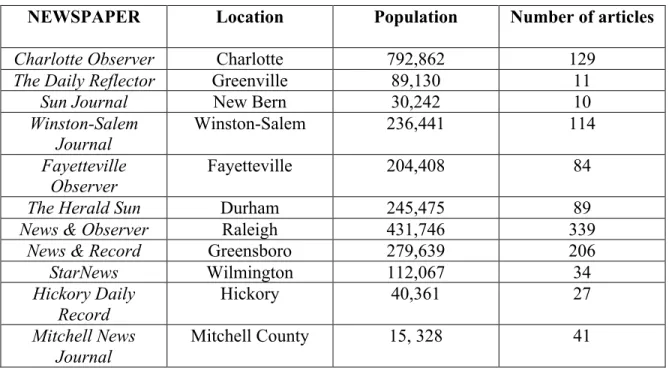
NEWSPAPER Location Population Number of articles
Charlotte Observer Charlotte 792,862 129
The Daily Reflector Greenville 89,130 11
Sun Journal New Bern 30,242 10
Winston-Salem
Journal Winston-Salem 236,441 114
Fayetteville
Observer Fayetteville 204,408 84
The Herald Sun Durham 245,475 89
News & Observer Raleigh 431,746 339
News & Record Greensboro 279,639 206
StarNews Wilmington 112,067 34
Hickory Daily Record
Hickory 40,361 27
Mitchell News
Journal Mitchell County 15, 328 41
Table 1.1: List of North Carolina newspapers qualitatively analyzed
As the fieldwork for this project progressed, I quickly realized that I was part of the dynamics of the LGBT movement in the South. I was born and raised in Huntington, WV, population 49,138; I grew up in a Southern Baptist church in which homosexuality was categorically condemnable; I am the lone progressive in a close-knit and supportive family of political conservatives; and, I am an out and vocal lesbian. As with many Southern LGBT people, I am most at home in small towns, amongst people who live by an ethos of familiarity and affability toward friends and strangers alike. And, as with many Southern LGBT people, I have engaged both supportive and antagonistic family, friends, and peers in seemingly
innumerable conversations regarding my own sexuality as well as the concerns of the broader LGBT movement. Although I did not realize it at the time, I have been speaking to people where they are for years.
the insights of my personal background. As a social scientist, my aim has been to produce a well-grounded piece of scholarship that will speak to a range of literatures in mass communication, social movement studies, political science, and new media studies. And, as a queer Appalachian, I hope to use this platform to challenge existing understandings of the LGBT movement as exclusively urban and secular, highlight oft-ignored movement actors and dynamics, and offer insight for the movement going forward.
Aside from my identity as an LGBT person in the South, while in the field I developed a relationship with Jen Jones, Director of Communications for both the Protect All NC Families campaign and Equality NC. After meeting during the campaign and beginning a relationship several months later, we married in Washington, D.C., this past August. As numerous scholars have noted, engaging in intimate relationships with informants in the field provides both
advantages and restrictions with regard to what the researcher sees and the conclusions she draws (For example, see Dubisch, 1995; Goode, 1999; Irwin, 2006). In an effort to limit my own
CHAPTER 2: THE HYBRID MEDIA SYSTEM AT THE HYPER-LOCAL LEVEL Introduction
Episode 2.1
Mitchell News-Journal, Bakersville, NC, February 1, 2012
“The Mitchell County Gay Straight Alliance’s return to Bakersville on Monday for a moderated town hall meeting at the Historic Courthouse could have hardly been more different than their initial gathering in November at the library across the street.
Last time, supporters of the upcoming ballot referendum, which if passed would amend the North Carolina constitution to define heterosexual marriage as the only domestic legal union recognized by the state, protested across the street in front of the courthouse with prayers, songs and picket signs.
This time there was peace at least, if not necessarily love and understanding as well. Those in favor and those against the amendment met together in the same room for an open discussion of how the vote on May 8 could affect unmarried couples across the state, gay and straight alike.
Audience members in support of the amendment were less confrontational than before in expressing their Biblical, scriptural objections to homosexuality.
‘I believe our nation was founded on God, and that’s what I live by,” Rev. Cass Buchanan of Freedom Baptist said. ‘You can doctor it up how you want, but we have a word that tells us how to live. Homosexuality is a sin. God loves everybody. We’re here to tell you that God loves you, and can change you if you’ll let Him. Sin is sin, and wrong in God’s eyes.’
The six-member panel opposed to the amendment listened and said they respected the differing opinions put forward.
‘I respect your beliefs. God does love all of us, and the Constitution is supposed to protect all of us,’ Equality N.C. attorney Jen Jones said. ‘We don’t have to agree. I think it’s so powerful to be in the same room talking about this.’
about the amendment. For an hour and a half, more than 100 supporters and opponents of Amendment One engaged in a dialogue about the amendment, about the LGBT movement, and about sin and salvation. The event was covered on the front page of the county’s weekly
newspaper. The organizers quickly produced a 20-minute video featuring highlights of the discussion and posted it to YouTube. Participants tweeted and posted comments to Facebook, many of which were shared by dozens and sometimes hundreds of followers. While the conversation may or may not have changed the views of many in the audience, it made the LGBT community more visible and asserted its presence both in the town, as well as within a broader social media network of LGBT publics.
This episode encapsulates the complex and interconnected media environment LGBT activists in North Carolina leveraged to speak to the social, political, and cultural realities of myriad Southern and national audiences. Attuned to the various publics within the state and aware of the media outlets that reached them, activists strategically employed various media platforms to assert their visibility within their communities, connect with supporters, and network with allied individuals and organizations. The conceptualization of the hybrid media system, defined as a system “built upon interactions among older and newer media logics – where logics are defined as technologies, genres, norms, behaviors, and organizational forms – in the reflexively connected fields of media and politics” (Chadwick, 2013, p. 4), affords an
analytical lens through which to reflect on the complexity of contemporary media strategies deployed by movement actors at the state, local, and hyper-local levels.
hybrid media system to the study of movements’ media communications and providing a more empirically rich description of contemporary media strategies. In doing so, it advances beyond most social movement scholarship that recognizes either the continued importance of
professional media (Gamson, 1998) or the ascendance of digital media within movement
organizing (Stein, 2009), but that fails to integrate these complementary realities. For instance, in studying the means through which activists from ideologically diverse organizations sought to gain the attention of the wider public during presidential elections, Sobieraj (2011) focused entirely on their efforts to court professional media attention. Conversely, Earl and Kimport’s (2011) work centers on activists’ utilization of Internet-enabled tools only, with no consideration of their interaction with other media. In this chapter, however, I argue that broadening the scope of inquiry to include various media draws attention to such overly simplistic and ultimately false divisions between media and actors and moves us toward a richer understanding of the ways movements interact with media.
activists and organizations utilize digital media (Stein, 2009), as well as the ways these same actors appropriate digital media for offline organizing (Kang, 2012).
This chapter proceeds in three parts. I first discuss the literature surrounding professional media and social movements, the role of digital media in social movement organizing, and hybrid media systems in order to situate the actions of actors working at the hyper-local level to create and leverage a complex media system in order to make their community visible to
multiple publics. I then provide three empirical sections that chronologically detail the execution of a group’s media strategies from the perspective of the activists themselves operating on the ground in a small North Carolina town and trace the development of their interconnections with professional media actors, social media audiences, and state-level movement actors through a case study of the Mitchell County GSA. I conclude with a discussion of how analyzing this case through the lens of a hybrid media system complicates our understanding of the contemporary “movement-media dance” (Gitlin, 2003, p.17) and the methodological means through which we can understand it.
Literature Review
Professional Media and Movements
The majority of mass communication scholarship on social movements focuses explicitly on content in professional media outlets or movement publications. While movement scholars in fields such as sociology and political science tend to leave the actual content unexamined while asserting the relevance of it for the development and maintenance of collective identity, perhaps the most compelling area of study in the mass communication literature focuses on the content of media generated by social movements. For instance, Streitmatter’s (1995) study of One,
provided a voice to hidden and mostly isolated individuals and helped to nationalize a movement that had historically been centered in large urban areas such as New York and San Francisco.
Other literature in this tradition focuses on analysis of coverage of social problems or protests generally and speaks to the overarching ways that the professional media cover social movement actors. Kensicki (2004) examined the framing of diverse social problems, including coverage of pollution, poverty, and incarceration, to show that professional media outlets rarely reported on the specific causes or responsible agents. Similarly, Thrall (2006) content analyzed professional media coverage of more than 200 interest groups and correlated the amount and type of coverage these groups received with their resource levels, finding that resource-poor groups receive infrequent and more negative coverage than resource-rich groups. Finally, Boyle, McLeod, and Armstrong’s (2012) content analysis of professional media coverage of 40 years of protest group activity revealed that groups employing protest tactics that more directly challenge the status quo receive more critical coverage.
strategies, tactics, and collective identity to a broader audience. Similarly, Andrews and Biggs (2006) argue that the news media were crucial for spreading information about the 1960s sit-ins that moved through the American South. And, in their study of the German Radical Right, Koopman and Olzak (2004) argue that these right-wing groups utilize violent tactics to the degree that they gain public visibility and resonance. In short, these scholars argue that interactions between social movements and political or corporate authorities is mediated.
Other scholars have noted a relationship between movement actors’ understanding of media processes and the strategic development and delivery of movement messages. For
example, within literature on the LGBT movement, Bernstein (1997) illustrates the balancing act social movement actors and organizations must engage in when they find themselves engaged in electoral battles. Through an examination of several LGBT rights campaigns, Bernstein
demonstrated the ways in which movement actors utilize various identities in movement
communications in order to mobilize supporters, convert political opponents, and garner positive media attention for their cause. Stone (2012) provides a broader analysis of these dynamics in an examination of more than 100 anti-LGBT ballot initiatives, arguing that some constituencies within the movement (ex. transgender people, communities of color) are symbolically
Not only can a movement’s relationship with professional media affect its messaging, but at times it can alter the entire trajectory of the movement. Gitlin’s The Whole World is Watching stands as the seminal work examining the connection between media and movements. Focused on the New Left during the 1960s, Gitlin’s book argues that the movement’s interactions with the mainstream mass media shaped its collective identity, created factions within its organizations, and transformed its strategic goals. According to Gitlin, the movement’s goals centered on gaining the media spotlight, forcing the actors involved to contort the movement’s messaging and tactics to fit the frames already present in the media. Sobieraj (2011) illustrates a similar phenomenon, but does so through an examination of dozens of interest groups and social
movement organizations that convened around the 2000 and/or 2004 Republican and Democratic national conventions. Explaining that these organizations were focused almost entirely on
leveraging the political openings provided by the conventions into media coverage of their causes, Sobieraj argues that this media-centrism adversely affected the ability of organizations to form alliances with other like-minded groups and to meaningfully interact with potential
supporters present at the convention. Social Media and Movements
more pertinent for social movements than when considering the ways social media has (or has not) provided a forum for non-elites to command attention within the broader public sphere.
Access to social media tools offers social movement actors pathways to increase their visibility and voice, freed in part from professional media gatekeepers. As Thompson (2005) writes:
In this new world of mediated visibility, the making visible of actions and events is not just the outcome of leakage in systems of communication and information flow that are increasingly difficult to control: it is also an explicit strategy of individuals who know very well that mediated visibility can be a weapon in the struggles they wage in their day-to-day lives (p. 31).
Further, new media technologies have freed visibility from historical, spatial, and temporal limitations, creating a “more intensive, more extensive and less controllable”
information environment (Thompson, 2005, p. 48). Consequently, individuals connected via the Internet have been empowered to assert their voices within the broader public sphere (Tierney, 2013). Freelon and Karpf (2014) provide empirical support for this notion, at least within the Twittersphere, showing that non-political elites and non-elites were impactful network hubs for political conversation during the 2012 U.S. Presidential debates.
Additionally, scholars have argued that the Internet provides activists with new means to reach supporters and share information at little to no cost (Earl & Kimport, 2011). While
did not affect the organizations’ decision-making processes (Mercea, 2013; Micó & Casero-Ripollés, 2014).
Other scholars have theorized that social media are deeply entangled in the physical world of social interaction (Kang, 2012). Penney and Dadas (2014) analyzed Twitter use during offline protests, focusing on the ways activists utilized the service’s tweeting and retweeting functions. Harlowe’s (2011) study of the 2009 Guatemalan justice movement showed that not only did movement actors leverage Facebook to spread information without concern for time and geography, but users were able to leverage the social medium to mobilize offline movement activities, including protests. Conversely, however, Harlow and Guo (2014) found that, in organizing immigrant activists, social media worked most effectively to raise awareness of an issue but were less successful in motivating people to participate in offline events and protests.
Despite these impressive and interdisciplinary literatures on the interactions between both professional and social media and social movements, scholars have rarely examined both
professional and social media platforms within the same movement, protest, or campaign. As Mattoni and Treré (2014) observe, “As far as the mainstream media literature is concerned, scholars have addressed the radio (Roscigno & Danaher, 2004), the television (McLeod & Detenber, 1999) or the press (Gamson & Wolfsfeld, 1993; Kielbowicz & Scherer, 1986) but seldom the interaction between movements and several forms of media” (p. 254). Additionally, these scholars note a tendency among scholars to focus on “the latest technological platform as a fetish” when studying social movements (p. 255). Collectively, these biases within the literature on media and social movements decontextualize the interconnections between media,
The Hybrid Media System
Whether working at the transnational or the hyper-local level, movement actors utilize an array of communicative tools, including face-to-face encounters, personal networks, placards, yard signs, newspapers, radio, television, email, Facebook, Twitter, Instagram, and more, to speak to supporters, opponents, politicians, media, and publics of varied political, social, and cultural leanings. And, in our social media age, all of these constituencies can speak back. Recognizing this reality, and in an effort to preserve this complexity, this chapter adopts Chadwick’s (2013) analytical approach, viewing the movement activities of North Carolina LGBT activists through the lens of the hybrid media system concept. As Chadwick (2013) argues,
Hybridity offers a powerful mode of thinking about media and politics because it
foregrounds complexity, interdependence, and transition. Hybrid thinking rejects simple dichotomies, nudging us away from “either/or” patterns of thought and toward “not only, but also” patterns of thought. It draws attention to flux, inbetweenness, the interstitial, and the liminal. It reveals how older and newer media logics in the fields of media and politics blend, overlap, intermesh, and coeveolve. Hybrid thinking thus provides a useful disposition for studying how political actors, publics, and media of all kinds interact (p. 4).
Chadwick (2013) argues that contemporary power in political communication is exercised by those actors able to produce, disseminate, and leverage information to their own ends across myriad platforms. Further, since these actors operate in a dynamic, contingent
environment, scholars must proceed prudently when attempting to predict the behaviors of actors based on past goals and previously used messaging strategies. Though Chadwick (2013) is focused on political communication at the national level, his approach will benefit analyses in “any context in which it is important to try to make sense of political communication by exploring the interactions between older and newer media logics” (p. 22), where logics are defined as “technologies, genres, norms, behaviors, and organizational forms” (p. 4).
Findings
Entering the Hybrid Media System
In the western part of the state, between the liberal strongholds of Asheville and Boone, NC, surrounded by the Blue Ridge Mountains, is Mitchell County, population 15,579. The county is served its mass media news by the Mitchell News-Journal, a weekly newspaper, and a single AM station, reflecting the unique, delimited media environment local activists negotiated to further their goals. Bakersville is the county seat and one of ten townships in the county. Though an hour’s drive along a short series of county roads connects the three cities, Mitchell County’s conservatism seemingly negates their proximity, creating wide – and for most
residents, welcome - gulfs between the towns’ citizens. While Asheville is home to more than 20 breweries, Mitchell County was dry until 2009. Though Boone’s 17,774 residents rival the population of Mitchell County, its churches do not. Boone has less than 20; Mitchell County has more than 60. A quick reading of the paper’s letters to the editor gives an idea of the social leanings of the town. Search for homosexual, gay, or LGBT on the paper’s website and you will see headlines for letters to the editor, such as “New Testament is against homosexuality, also” (Turner, H., 2012, May 9), “As Christians we do not think about what God ordains, we know” (Basini, S. F., 2013, July 31), and “Democrats are fulfilling promises for homosexuals and abortionists” (Reilly, B., 2009, February 4). Read through them and you will find passages, such as:
Amid this environment, two local residents decided to organize an LGBT equality group. Amy Waller owns a pottery studio in downtown Bakersville and is a member of the small but vibrant arts community that has developed in the area. Allison Bovée moved to Bakersville in 2000 with her partner Mary Vogel, after having lived in Atlanta for decades. The two
developed a friendship soon after Bovée moved to town, sharing an interest in the arts, as well as politics. Though both Waller and Bovée had previously participated in various protests and activist groups, the Mitchell County GSA was their first foray into LGBT organizing. Bovée describes being prompted to do something out of frustration with the letters to the editor, but mostly by the looming Amendment One campaign:
At some point in 2011, there were all these letters that were going back and forth in the local paper. I can’t remember what came first, but some guy wrote a letter saying he had seen two women kiss each other and it made him puke. Ha! I think Mary wrote a letter back to him and some other people wrote some letters to him...I read a lot. I keep up with current events, so I knew that by this time, they put Amendment One on the ballot in 2011 for 2012. But in the spring of 2011, before they had actually drawn it up, I knew it was coming down the pike because I’d been reading all about it, so I contacted my state senator, Ralph Hise, and asked if he would meet with me. Amy and I had lunch with him at that little coffee shop downtown and we talked to him about Amendment One, about the coming Amendment One. He was very cordial, very nice, but it was like talking to a brick wall. ‘I understand but my religion teaches me that marriage is between a man and a woman,’ he said. And I said, ‘But we don’t live in a theocracy.’ But he never really, he just didn’t get it (Personal comments, June 21, 2013).
So, exasperated with the dialogue surrounding LGBT issues in the local paper, angry about the impending Amendment One campaign, and disappointed with their political leadership, Waller and Bovée decided to get involved. As Bovée tells it, “Amy said that we need to do something, so I said, let’s do it. So we decided to start a group” (Personal comments, June 21, 2013).
repositories of expertise and as advisors for fledgling grassroots groups. Even before getting together for their initial planning meeting in October of 2011, Waller and Bovée reached out to Equality NC for guidance. On phone calls and over email, the two Bakersville residents worked with former Director of Organizing Sam Parker and Communications Director Jen Jones to get ideas regarding the benefits and drawbacks of 501(c)(3) versus 501(c)(4) statuses, social media strategies, and suggestions for events to mobilize their community. Based on this advice from Equality NC, as well as their own experience with activism, Waller and Bovée created the Mitchell County Gay Straight Alliance.
From its inception, the two grassroots activists wanted their group to act as a vehicle to make the LGBT community more visible within Mitchell County and they utilized media platforms that could help them accomplish this. To that end, Waller and Bovée utilized media tools they deemed to be most prominent to local Mitchell County audiences who mostly lacked an understanding of LGBT issues but who largely convened around their local papers. Their first order of business was a name for the group. According to Bovée, “We thought about calling it Equality Something or something or something before we finally decided that we’d all it a Gay Straight Alliance. Although that name is normally reserved for groups at school, we wanted people to understand what it was. So that’s what we did. To make it real clear” (Personal comments, June 21, 2013). All three women recognized that straight allies would be central to their work both for reasons of inclusivity but also for sheer practicality. As the women explained to me, there simply would not be a critical mass of open LGBT folks in a place the size of Mitchell County.
considered for their role as community informers when they are considered at all (Reader, 2012), in this case they also serve as blank slates upon which readers spoke directly to other readers. Bovée and Waller, recognizing this reality and seeking to assert themselves into the heart of their local community’s dialogue, penned a letter to the editor during this initial meeting, which they later placed in both the Mitchell News-Journal and Asheville’s Mountain Express. In it the two articulated their goals for the group: “We hope that by being more visible in our community, we may make Mitchell County more welcoming to gay people and their friends and family members who care for them” (Mountain Express, 2011, December 6). Additionally, they began taking advantage of the Mitchell News-Journal’s “Activities” section, where local residents can post information regarding their events free of charge, posting weekly about their group and its events. For instance, a typical post from the group read, “Mitchell County Gay Straight Alliance NOW FORMING. Our goal is to work toward ensuring equal rights and justice for lesbian, gay, bisexual, and transgender (LGBT) people in Mitchell County and to educate ourselves about the proposed marriage amendment to the N.C. Constitution. For more information, email
[email protected]” (Mitchell News-Journal, 2012, January 11), and ran beside announcements for the Disabled American Veterans Chapter 58, Carolina Style Chorus, Cribbage Club, Blue Ridge Bridge Club, Calvary Baptist Church, Mitchell-Yancey Tea Party Meeting, and the Appalachian Republican Women.