COMPARATIVE EFFECTIVENESS OF SURVEILLANCE AND CURRENT TREATMENT APPROACHES FOR THE DETECTION AND MANAGEMENT OF HEPATOCELLULAR CARCINOMA IN EAST ASIA
Diana R. Chirovsky
A dissertation submitted to the faculty of the University of North Carolina at Chapel Hill in partial fulfillment of the requirements for the degree of Doctor of Philosophy in the Department of Health
Policy and Management in the Gillings School of Global Public Health.
Chapel Hill 2014
Approved by:
ABSTRACT
Diana R. Chirovsky: COMPARATIVE EFFECTIVENESS OF SURVEILLANCE AND CURRENT
TREATMENT APPROACHES FOR THE DETECTION AND MANAGEMENT OF HEPATOCELLULAR CARCINOMA IN EAST ASIA
(Under the direction of Kristen Hassmiller Lich)
Treatment approaches for hepatocellular carcinoma (HCC) in China are distinct in the use of resection with more advanced HCC, and continued research is needed to re-evaluate the
appropriateness of guideline recommendations. Surveillance is recommended among individuals with chronic hepatitis B virus (HBV) infection in East Asia to improve early disease detection; however, only limited evidence exists to quantify its survival impact, and the ideal screening interval is not known. The overall objectives of this dissertation were to (1)compare the effectiveness of HCC treatment
approaches in China, (2) evaluate the impact of 6-month and 12-month screening intervals compared with no surveillance among individuals with chronic HBV in China, and (3) examine the survival Impact of surveillance among HCC patients in Taiwan.
ACKNOWLEDGEMENTS
I am incredibly grateful to my many mentors, colleagues, and family members, who have provided their guidance and support to successfully complete this work. First and foremost, I would like to thank Kristen Hassmiller Lich, my advisor and dissertation chair. Kristen has been a solid guiding force in developing the skills and, perhaps more importantly, the confidence to push myself harder. She was the first to introduce me to advanced methods in simulation modeling, which are highly intellectually stimulating, but quite intimidating at first glance. To meet this challenge, she encouraged me to pursue coursework outside of our department and connected me with researchers in the field. The knowledge and expertise I have gained from working with Kristen have not only shaped my dissertation research, but have also fostered a profound commitment to producing highly innovative and policy relevant research.
Beyond serving as a critical member of my dissertation committee, I would like to thank Andrea Biddle for establishing the pre-doctoral fellowship program between our department and Bristol-Myers Squibb and for awarding me the honor to serve as the first fellow. The fellowship has been a truly amazing experience in more ways than one. The program exposed me to new disease areas in oncology and provided incredibly rich data to conduct my dissertation analyses. In addition, I would have never completed my research without the generous funds to purchase software and technical support, attend training courses, and travel to China to meet with clinical investigators. Andrea served as my greatest advocate to ensure that all of these resources were available to me.
methodologically sound. Sid generously provided his clinical insights to strengthen the accuracy of my analyses. Lucinda was instrumental in providing detailed information surrounding the data used in my analyses and connecting me with clinical investigators in East Asia. Stephanie helped interpret the results of my analyses to better relay the importance of my work.
In addition to the aforementioned dissertation committee members, I would like to
acknowledge the many colleagues who were involved with my research. I would like to extend my greatest appreciation to all of the members of Global Health Economic and Outcomes Research team at Bristol-Myers Squibb. In particular, I thank John O’Donell, Gil L’Italien and Sam Wagner for welcoming me as their first fellow and for going above and beyond my expectations in providing resources and contacts to complete my research. I also thank Ying Zhang for assisting with data cleaning and providing overall SAS support, as well as Yanjun Zhang and Hong Li for coordinating my trip to China. In addition, I would like to acknowledge Nathaniel Osgood from the University of Saskatoon and the AnyLogic team for their continued programming support, as well as Minshan Chen and BoKang Cui for allowing me to visit their hospital to gain further insights into the management of hepatocellular carcinoma in China.
TABLE OF CONTENTS
LIST OF TABLES ... x
LIST OF FIGURES ... xii
LIST OF ABBREVIATIONS ... xiv
CHAPTER 1: INTRODUCTION ...1
CHAPTER 2: LITERATURE REVIEW ...7
Overview ...7
Burden of Hepatocellular Carcinoma in East Asia ...8
Disease Staging for Hepatocellular Carcinoma ...9
Guideline Recommended Treatment Approaches for Hepatocellular Carcinoma ... 11
Comparative Effectiveness of Treatments for Hepatocellular Carcinoma ... 12
Surveillance to Detect Hepatocellular Carcinoma ... 14
Impact of Hepatocellular Carcinoma Surveillance on Survival Outcomes... 14
Controversies Surrounding Hepatocellular Carcinoma Surveillance ... 15
Prior Decision Models of Hepatocellular Carcinoma Surveillance ... 16
Advantages of an Individual-Based Model for Hepatocellular Carcinoma Surveillance ... 20
Significance and Contribution ... 21
CHAPTER 3: COMPARATIVE EFFECTIVENESS OF CURRENT TREATMENT APPROACHES FOR HEPATOCELLULAR CARCINOMA: RESULTS FROM A LONGITUDINAL OBSERVATIONAL STUDY IN CHINA ... 26
Introduction ... 26
Results ... 33
Discussion ... 36
CHAPTER 4: INDIVIDUAL-BASED MODEL OF SURVEILLANCE TO DETECT HEPATOCELLULAR CARCINOMA AMONG INDIVIDUALS WITH CHRONIC HEPATITIS B VIRUS INFECTION IN CHINA ... 56
Introduction ... 56
Methods ... 58
Results ... 71
Discussion ... 73
CHAPTER 5: IMPACT OF SURVEILLANCE ON THE SURVIVAL OF PATIENTS WITH HEPATOCELLULAR CARCINOMA: RESULTS FROM A LONGITUDINAL STUDY IN TAIWAN ... 95
Introduction ... 95
Methods ... 96
Results ... 102
Discussion ... 105
CHAPTER 6: POLICY IMPLICATIONS, LIMITATIONS, AND CONCLUSIONS ... 117
Summary of Findings, Policy Implications and Limitations ... 117
Future Research Agenda ... 124
Conclusions ... 126
APPENDIX A: TREATMENT APPROACHES CAPTURED IN THE HCC BRIDGE STUDY DATABASE. ... 127
APPENDIX B: SUMMARY OF RESULTS FOR THE LITERATURE SEARCH ON PUBLISHED ARTICLES THAT ASSESSED THE NATURAL HISTORY OF HEPATOCELLULAR CARCINOMA AMONG INDIVIDUALS WITH CHRONIC HEPATITIS B VIRUS INFECTION. ... 128
APPENDIX D: SUMMARY OF PUBLISHED STUDIES THAT ASSESSED TUMOR GROWTH IN HEPATOCELLULAR CARCINOMA AND REPORTED ESTIMATES FOR TUMOR VOLUME DOUBLING TIME (N=19), GROUPED ACCORDING TO
INCLUSION STATUS IN THE POOLED META-ANALYSIS. ... 131 APPENDIX E: SUMMARY OF RESULTS FOR THE LITERATURE SEARCH ON
PUBLISHED ARTICLES THAT ASSESSED THE ACCURACY OF DIAGNOSTIC
IMAGING MODALITIES FOR THE DETECTION OF HEPATOCELLULAR CARCINOMA. ... 134 APPENDIX F: HCC BRIDGE STUDY SAMPLE SELECTION FOR MODEL PARAMETERS
INCORPORATED IN THE SIMULATION MODEL. ... 137 APPENDIX G: DEMOGRAPHICS AND CLINICAL CHARACTERISTICS FOR PATIENTS
DIAGNOSED WITH HCC IN TAIWAN, ACCORDING TO SURVEILLANCE STATUS,
LIST OF TABLES
TABLE 2.1: SUMMARY OF OVERALL STRUCTURE AND KEY MODEL INPUTS
FROM PRIOR DECISION MODELS OF HCC SURVEILLANCE. ... 23 TABLE 3.1: DEMOGRAPHICS AND CLINICAL CHARACTERISTICS FOR PATIENTS
DIAGNOSED WITH HCC, ACROSS DIFFERENT CITIES IN CHINA. ... 42 TABLE 3.2: DISEASE CHARACTERISTICS FOR PATIENTS DIAGNOSED WITH HCC,
ACROSS DIFFERENT CITIES IN CHINA. ... 43 TABLE 3.3: PRIMARY TREATMENT APPROACHES FOR PATIENTS DIAGNOSED
WITH HCC ACROSS DIFFERENT REGIONS IN CHINA. ... 44 TABLE 3.4: PRIMARY TREATMENT APPROACHES, ACCORDING TO DISEASE STAGE,
FOR PATIENTS DIAGNOSED WITH HCC IN CHINA. ... 45 TABLE 3.5: ADDITIONAL TREATMENT APPROACHES FOLLOWING PRIMARY
TREATMENT FOR PATIENTS DIAGNOSED WITH HCC IN CHINA. ... 47 TABLE 3.6: COX PROPORTIONAL HAZARD MODELS OF THE ASSOCIATION BETWEEN
PRIMARY TREATMENT AND OVERALL SURVIVAL, ACCORDING TO DISEASE STAGE,
AMONG PATIENTS DIAGNOSED WITH HCC IN CHINA. ... 48 TABLE 4.1: MODEL PARAMETERS INCORPORATED IN THE SIMULATION MODEL
TO PROJECT THE NATURAL HISTORY OF CHRONIC HBV DISEASE AND SENSITIVITY
OF DIAGNOSTIC IMAGING FOR SURVEILLANCE. ... 77 TABLE 4.2: FREQUENCY OF PRIMARY TREATMENT APPROACHES FOR PATIENTS
DIAGNOSED WITH HCC, ACCORDING TO TUMOR CHARACTERISTICS AND LIVER FUNCTION, INCORPORATED IN THE SIMULATION MODEL: RESULTS FROM THE
HCC BRIDGE STUDY IN CHINA, (N=4,797). ... 79 TABLE 4.3: DISTRIBUTION OF TUMOR CHARACTERISTICS AMONG HCC PATIENTS
WHO DID NOT UNDERGO SURVEILLANCE INCORPORATED IN THE MODEL
CALIBRATION: RESULTS FROM THE HCC BRIDGE STUDY IN CHINA (N=3,288). ... 80 TABLE 4.4: DISTRIBUTION OF TUMOR CHARACTERISTICS AMONG HCC PATIENTS
WHO DID NOT UNDERGO SURVEILLANCE: RESULTS FROM THE HCC BRIDGE
STUDY IN CHINA COMPARED WITH MODEL OUTPUT AFTER CALIBRATION. ... 81 TABLE 4.5: MODEL ESTIMATED RATES OF HCC DISEASE PROGRESSION AND
INCIDENTAL/SYMPTOMATIC DIAGNNOSIS: RESULTS OF MODEL CALIBRATION. ... 82 TABLE 4.6: COMPARISON OF MODEL OUTCOMES ACROSS SURVEILLANCE
STRATEGIES FOR THE DETECTION OF HEPATOCELLULAR CARCINOMA AMONG
INDIVIDUALS WITH CHRONIC HBV INFECTION. ... 83 TABLE 5.1: DEMOGRAPHICS AND CLINICAL CHARACTERISTICS FOR PATIENTS
TABLE 5.2: TUMOR CHARACTERISTICS AND PRIMARY TREATMENT APPROACHES FOR PATIENTS DIAGNOSED WITH HCC IN TAIWAN, ACCORDING TO
SURVEILLANCE STATUS. ... 110 TABLE 5.3: COX PROPORTIONAL HAZARDS MODEL OF THE ASSOCIATION BETWEEN
SURVEILLANCE STATUS AND OVERALL SURVIVAL FOR PATIENTS DIAGNOSED WITH
LIST OF FIGURES
FIGURE 2.1: SUMMARY OF TREATMENT RECOMMENDATIONS FOR PATIENTS DIAGNOSED WITH HCC BASED ON THE CHINA MINISTRY OF HEALTH (CMH) COMPARED WITH THE AMERICAN ASSOCIATION FOR THE STUDY OF LIVER
DISEASE (AASLD) GUIDELINES. ... 25 FIGURE 3.1: SUMMARY OF TREATMENT RECOMMENDATIONS FOR PATIENTS
DIAGNOSED WITH HCC BASED ON THE CHINA MINISTRY OF HEALTH (CMH) COMPARED WITH THE AMERICAN ASSOCIATION FOR THE STUDY OF LIVER
DISEASE (AASLD) GUIDELINES. ... 49 FIGURE 3.2: SAMPLE SELECTION FROM THE HCC BRIDGE STUDY IN CHINA. ... 50 FIGURE 3.3: UNADJUSTED KAPLAN-MEIER SURVIVAL CURVES FOR PATIENTS
DIAGNOSED WITH HCC IN CHINA, ACCORDING TO DISEASE STAGE. ... 51 FIGURE 3.4: PROPENSITY SCORE ADJUSTED† KAPLAN-MEIER SURVIVAL CURVES
FOR PATIENTS DIAGNOSED WITH HCC, ACCORDING TO DISEASE STAGE AND PRIMARY TREATMENT: A) VERY EARLY/EARLY STAGE, B) INTERMEDIATE STAGE - SOLITARY TUMOR > 5CM, C) INTERMEDIATE STAGE – MULTINODULAR TUMORS,
D) ADVANCED STAGE. ... 52 FIGURE 4.1: MODEL HEALTH STATES FOR THE CHRONIC HBV AND HCC DISEASE
PROGRESSION COMPONENTS OF THE SIMULATION MODEL. ... 84 FIGURE 4.2: MODEL HEALTH STATES AND TRANSITION LOGIC FOR THE HCC
TREATMENT COMPONENT OF THE SIMULATION MODEL. ... 85 FIGURE 4.3: RESULTS OF THE POOLED RANDOM EFFECTS META-ANALYSIS FOR
TUMOR VOLUME DOUBLING TIME (DT) CONDUCTED AMONG STUDIES THAT
ASSESSED TUMOR GROWTH IN HCC. ... 86 FIGURE 4.4: GRAPHICAL ASSESSMENT OF MODEL FIT FOR THE UNADJUSTED
PARAMETRIC SURVIVAL CURVES† IN COMPARISON WITH THE LIFE-TABLE SURVIVAL CURVE ESTIMATES FOR EACH PRIMARY HCC TREATMENT AND DISEASE STAGE: RESULTS FROM THE HCC BRIDGE STUDY IN CHINA (N=4,797). A) RESECTION, B) ABLATION, C) TRANS-ARTERIAL THERAPY, D) SUPPORTIVE
CARE AND TERMINAL DISEASE STAGE. ... 87 FIGURE 4.5: COMPARISON OF MODEL-PROJECTED OVERALL SURVIVAL
ACROSS SURVEILLANCE STRATEGIES AMONG INDIVIDUALS WHO DEVELOPED HCC, ANALYZED USING THE LIFE-TABLE METHOD. A) BASE CASE ANALYSES, AND PROBABILISTIC SENSITIVITY ANALYSES: B) NO SURVEILLANCE VS. 6-MONTH US + AFP, C) NO SURVEILLANCE VS. 12-MONTH US + AFP,
FIGURE 5.2: KAPLAN-MEIER SURVIVAL CURVES FOR PATIENTS DIAGNOSED WITH HCC, ACCORDING TO SURVEILLANCE STATUS: A) UNADJUSTED FOR LEAD TIME BIAS AND SELECTION BIAS, B) LEAD TIME BIAS ADJUSTMENT, USING DT = 60-200 DAYS, C) PROPENSITY-BASED WEIGHTING AND LEAD TIME BIAS ADJUSTMENT, USING DT = 60-200 DAYS, D) PROPENSITY-BASED
LIST OF ABBREVIATIONS
AASLD Association for the Study of Liver Disease
AFP alpha-fetoprotein
AIC akaike information criterion
ALD alcoholic liver disease
ANOVA analysis of variance
CI confidence interval
CMH China Ministry of Health
CP Child-Pugh
CT computed tomography
CVD cardiovascular disease
DT tumor volume doubling time
ECOG Eastern Cooperative Oncology Group
HBV hepatitis B virus
HCC Hepatocellular carcinoma
HCC BRIDGE BRIDGE to Better Outcomes in Hepatocellular Carcinoma Study
HCV hepatitis C virus
HR hazard ratio
MRI magnetic resonance imaging
NAFLD nonalcoholic fatty liver disease
PS propensity score
REVEAL-HBV Risk Evaluation of Viral Load Elevation and Associated Liver Disease/ Cancer-Hepatitis B Virus
RR risk ratio
TM tumor metastases
SE standard error
US ultrasound
CHAPTER 1: INTRODUCTION
Hepatocellular carcinoma (HCC) is highly prevalent and is the second leading cause of cancer-related death in East Asia, where hepatitis B virus (HBV) infection is endemic and is the primary etiological risk-factor for HCC. 1 Current approaches for improving survival with HCC are primarily focused on the early detection and treatment of HCC. 2,3 Recommended treatment approaches for HCC in China are largely distinct from those in other settings, particularly in the use of surgical resection among more advanced stage patients. 3-5 With recent advancements in resection and localized therapies for HCC, continued research is needed to re-evaluate the appropriateness of current guideline
recommendations. 3
Resection and tumor ablation are the main curative treatment options for HCC, but eligibility to receive curative therapy diminishes with more advanced disease. 2,3 Both the CMH and Taiwanese Department of Health have strived to improve the early detection of HCC by providing government-funded HCC surveillance in high-risk areas. 3,6,7 In both China and Taiwan, recommended screening tests include abdominal ultrasound (US) and measurement of serum alpha-fetoprotein (AFP), with a cut-point of ≥ 200 ng/mL. 2,3
for tumor growth. 10-13 The results of these studies suggested that surveillance significantly improves survival, even after lead time adjustment. 10-13 However, such methods were based solely on current knowledge surrounding HCC tumor growth, and did not comprehensively incorporate the full range in DT seen across prior tumor growth studies in HCC. 14-27
In addition, the ideal screening interval for HCC surveillance is not known. 2,4,8,28 Consensus guidelines suggest an interval of 6-12 months, based on average DT, 2,4,8 although there are no randomized studies that have determined the optimal interval. Guidelines acknowledge that the optimal interval for HCC surveillance should be assessed from the view of both resource use and survival outcomes, as it is clear that more frequent tests can detect HCC nodules of smaller size. 2,3 Thus,
determining the optimal approach for HCC surveillance requires both an understanding of tumor development and progression over time, and an accurate assessment of treatment patterns and associated survival in clinical practice.
Thus, there are several gaps in the literature surrounding the appropriate treatment of patients diagnosed at various stages of disease, particularly for patients with intermediate to advanced HCC. 2-5 Surveillance among individuals at high-risk for HCC is recommended in East Asia, but further research is needed to understand its current impact on survival with HCC, and determine the optimal approach in light of the need to conserve resources. 2-4,8 Accordingly, this dissertation examined the comparative effectiveness of surveillance and current treatment approaches for the detection and management of HCC in East Asia. Specific aims included:
1. Compare the effectiveness of current treatment approaches for patients diagnosed with HCC in China
a. Assess overall survival with primary treatment for patients diagnosed at various stages of HCC disease, controlling for selection bias
according to disease stage at diagnosis
c. Explore disease characteristics and current treatment approaches for HCC across different regions in China
2. Develop an Individual-based model to simulate a randomized trial of HCC surveillance among individuals with chronic HBV infection in China
a. Provide a transparent overview of the model structure and input parameters b. Calibrate unknown parameters of HCC disease progression and incidental diagnosis c. Evaluate the impact of different screening intervals (i.e., 6 month vs. 12-month) for
HCC surveillance based on current recommendations in China
3. Examine the current Impact of surveillance on the survival of patients diagnosed with HCC in Taiwan
a. Estimate the survival benefit of surveillance, adjusting for lead time and selection bias
b. Compare tumor characteristics and primary treatment approaches, by surveillance status
Clinical information for patients diagnosed with HCC were obtained from the global Bridge to Better Outcomes in HCC (HCC BRIDGE) study, a retrospective observational study of patients newly diagnosed with HCC from January 1, 2005 through June 30, 2011 across 14 countries in East Asia, Europe, and North America. 29,30 Data to assess Aims 1 and 2 were obtained from the HCC BRIDGE study in China, conducted across 10 tertiary hospital centers from 7 geographically diverse cities in mainland China. For the simulation model in Aim 2, comprehensive literature reviews were additionally
parameters synthesized in Aim 2.
With advancements in the management of HCC in China, continued research is needed to assess current treatment patterns and re-evaluate the appropriateness of current guideline recommendations. To assess current treatment approaches (Aim 1), patients with HCC included in the HCC BRIDGE study were first stratified according to disease stage at diagnosis, based on categories defined in the China Ministry of Health (CMH) guidelines. 3 For each disease stage, trends in the frequency of primary treatments were compared with current guideline recommendations (Aim 1b). To compare survival with primary treatment, Kaplan-Meier curves were constructed for each disease stage; survival differences were assessed using the log-rank test (Aim 1a). 31 Multivariate Cox proportional hazard models further assessed the association between primary treatment and the hazard of death (aim 1a), controlling for underlying differences in patient characteristics across treatment groups. 31 Propensity score (PS) analysis, using the methods of propensity-based weighting and regression-based adjustment, were conducted to address residual selection bias. 32,33 PS for each treatment were estimated using multinomial logistic models. 32 Models for each disease stage controlled for patient demographics, co-morbidities, etiology, liver function, disease characteristics, and hospital site where treatment was received. Additional analyses explored disease stage at diagnosis and primary treatment across different regions in China; differences were assessed using the Chi2 test (Aim 1c). 34
parameters of HCC disease progression and incidental diagnosis, based on the distribution of tumor characteristics seen among HCC patients who did not receive surveillance from the HCC BRIDGE study in China (Aim 2b). The HCC BRIDGE study data was further used to assign HCC treatment probabilities and project survival with treatment using a series of parametric survival curves (2a). 31
Based on the accuracy of diagnostic tests for HCC, the simulation model assessed three different strategies for HCC surveillance (Aim 2c): 1) no surveillance (for comparison), 2) 6-month US and AFP (with cutpoint ≥ 200 ng/mL), and 3) 12-month US and AFP. As the primary outcome, overall survival following HCC development was compared across surveillance strategies using the Kaplan-Meier method; survival differences were assessed using the log-rank test . 31 Additional analyses compared disease stage and primary treatment at diagnosis, with statistical differences evaluated using the Chi2 test. 34 Probabilistic sensitivity analyses were conducted to provide estimates of uncertainly in the model-projected outcomes. 40
A major limitation of prior studies assessing the survival impact of HCC surveillance is the potential for lead time bias related to the earlier diagnosis of HCC. 9 Using data from the HCC BRIDGE study in Taiwan, analyses assessed the impact of surveillance on survival, controlling for lead time bias (Aim 3a). Surveillance was defined as a binary variable, which indicated whether a patient received regular diagnostic imaging, with or without AFP, every 6-12 months. Lead time was approximated using the well-established formula for tumor growth and subtracted from the survival of patients in the surveillance group. 10,11,13 Analyses explored different assumptions surrounding the estimated lead time, using a range in median DT estimated across prior tumor growth studies (synthesized in Aim 2). 14-27
assessed survival according to surveillance status, controlling for both lead time and selection bias; survival differences were assessed using the log-rank test. 31 As secondary outcomes, the study also compared tumor characteristics and primary treatment approaches according to surveillance status; statistical differences were evaluated using the Chi2 test (Aim 3b). 34
Together, these studies can help improve the detection and management of HCC in East Asia, where HCC is one of the leading causes of cancer-related mortality. 43,44 Continued research is needed to re-evaluate the appropriateness of current guideline recommendations in China, particularly with limited evidence on the comparative effectiveness of therapies for intermediate to advanced disease. 3 Both China and Taiwan have implemented community-based surveillance to improve the early detection of HCC, but additional research is needed to examine the impact of HCC surveillance on survival
outcomes. 3,6,7 Given the substantial clinical and economic burden of HCC in East Asia, this dissertation can help inform efforts to ensure that individuals at high-risk for developing HCC are properly monitored given limited resources, and patients with HCC receive appropriate treatment to improve survival.
Sections of the dissertation are organized as follows: Chapter 2 details the current literature on the burden of HCC in East Asia, consensus guidelines for HCC management, comparative effectiveness of current treatment approaches, survival impact of HCC surveillance, and decision models of HCC
CHAPTER 2: LITERATURE REVIEW
Overview
HCC is highly prevalent in East Asia, with more than one-half of all global cases occurring in China alone. 45 Recognizing the clinical and economic burden of HCC, the CMH has declared HCC as one of 5 tumors of high national importance and has published its newest Diagnosis and Treatment
Guidelines for Primary Liver Cancers (2011 edition). 3 The guidelines are largely distinct from those in other settings, mainly in their recommendations for patients diagnosed with intermediate and advanced HCC. 3-5,8 With recent advancements in the treatment of HCC, continued research is needed to re-evaluate the appropriateness of current guideline recommendations. To this end, this study explored current treatment approaches and compared the effectiveness of primary treatment on overall survival for patients diagnosed at various stages of disease in China.
explored, using a range in median DT estimated across prior tumor growth studies. 14-27
Using an
individual-based model to simulate a randomized trial of surveillance, the study further examined the impact of different screening intervals among individuals with chronic HBV infection, based on current recommendations in China.
This dissertation collectively contributes to the existing literature in HCC by providing a more comprehensive outlook on the comparative effectiveness of current treatment approaches and surveillance for HCC, while addressing the limitations of prior studies. In terms of policy relevance, the results can be used to (1) inform clinicians about the appropriate used of current treatments options for HCC in comparison with guideline recommendations in China, (2) provide additional evidence on the current impact of HCC surveillance in clinical practice to inform ongoing policy efforts to improve the early detection of HCC, and (3) determine the optimal screening interval for surveillance to improve survival with HCC in the setting of limited resources.
Burden of Hepatocellular Carcinoma in East Asia
HCC is the third leading cause of cancer-related death worldwide. 47,48 HCC is highly prevalent in East Asia, with more than one-half of all global cases occurring in China alone. 45 HCC is the third most frequent cancer and the second leading cause of cancer-related death in China; an estimated 402,000 new cases were diagnosed and 372,000 HCC-related deaths occurred in 2008. 47 In Taiwan, HCC is the leading cause of cancer-related death among males and the second among females, with age-adjusted mortality rates of 40.8 and 14.1 per 100,000 persons, respectively. 49
common factors contributing to HCC in North America and Europe, HCC in East Asia is primarily linked to a high prevalence of HBV infection (9.75%) and to a lesser extent HCV infection (prevalence: 3.2%). 45,50 Both chronic HBV or HCV infection can progress to liver cirrhosis, characterized by permanent scarring or fibrosis of liver tissue, which in turn can lead to the development of HCC. In 2006, more than 80% of HCC cases in China were related to HBV infection, whereas 17% were related to HCV infection. 45
Although both HBV and HCV infection are direct risk factors for HCC, the mechanisms through which infection is contracted can lead to a different disease course. In East Asia, HBV is generally contracted through vertical transmission from mother to child, whereas HCV is generally contracted through needle contamination or injection drug use. 51,52 As a result, individuals with chronic HBV may develop HCC in late adulthood (≥40 years), whereas development of HCC in HCV generally occurs at a later age (mean age >60 years). 52 In addition, whereas HCC related to HCV almost always occurs with cirrhosis, HCC among individuals with chronic HBV can develop without the presence of underlying cirrhosis in approximately 10-20% of cases. 52
During the past 3 decades, national campaigns to vaccinate infants in East Asia against HBV have diminished the incidence of new infection; however, effects on HCC incidence will not be seen until 20-30 years from now when these individuals reach late adulthood. 45,53 In addition, antiviral therapies to slow the progression of chronic HBV to the development of cirrhosis and HCC have demonstrated only a modest impact. 54 Therefore, current approaches to HCC management are primarily focused on the early detection and treatment of HCC.
Disease Staging for Hepatocellular Carcinoma
number of tumor nodules, and tumor spread, defined by the presence of vascular invasion (i.e., macrovascular invasion or invasion of the main branch of the hepatic vein, any portal vein, or any vascular or bile duct) and tumor metastases (i.e., hepatic lymph node, extrahepatic or any
regional/distant metastases). An important consideration when evaluating therapeutic options for HCC is liver function. 2 A small percentage of patients (~10-20%) with chronic HBV may be diagnosed with HCC in the absence of cirrhosis. 52 The remaining patients are further staged based on degree of cirrhosis measured by the Child-Pugh (CP) scoring system, derived using laboratory values (i.e., international normalized ratio, bilirubin, albumin and prothrombin) and liver characteristics (i.e., presence of ascites and encephalopathy) at diagnosis. 3,55 Individuals with compensated cirrhosis with no or mild symptoms generally score in the range of CP A-B, whereas individuals with clinically significant decompensated cirrhosis generally score as CP C. Performance status is commonly measured using the Eastern
Cooperative Oncology Group (ECOG) scoring criteria, with scores ranging from 0-2 = fully active/partially disabled to 3-4 = substantially/completely disabled, and 5 = dead. 3,56
Early: 2-3 tumors, with largest diameter ≤3 cm, and Intermediate: 2-3 tumors, with largest diameter >3 cm, or ≥4 tumors (of any size).
Guideline Recommended Treatment Approaches for Hepatocellular Carcinoma
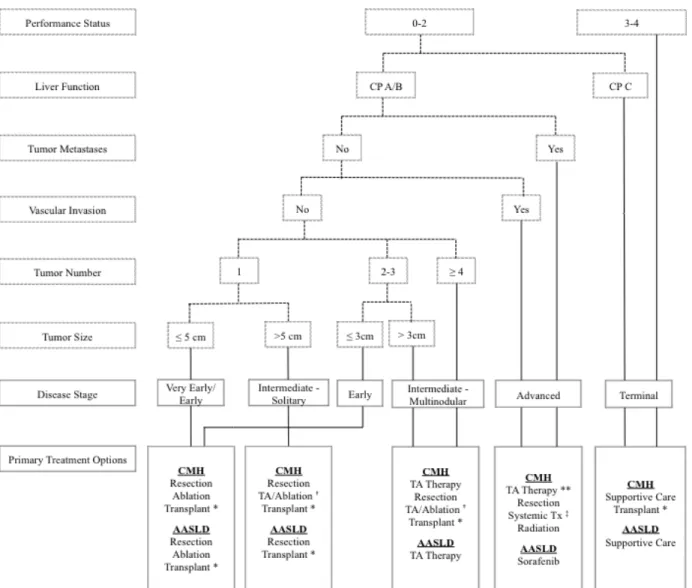
Recommended treatment approaches for HCC in China are largely distinct from those in the United States and Europe (Figure 2.1). 3-5 Worldwide consensus guidelines consistently recommend resection as the primary treatment for patients with early HCC and well-preserved liver function, and acknowledge that ablation may be used as a less invasive alternative. 2-5 Liver transplant is also commonly recommended for early HCC, as it can both remove the cancerous tumor and cure the underlying liver disease; however, a shortage of suitable donors has limited its availability in China. 3
The majority of patients worldwide are diagnosed with intermediate to advanced HCC, for which the most appropriate treatments remain controversial. 2-5 According to guidelines published in the United States and Europe, the primary treatment option for intermediate HCC, characterized by multinodular tumors (i.e., 2-3 tumors, with largest ≥3 cm or ≥4 tumors), is trans-arterial (TA) therapy, and the only recommended therapeutic option for advanced HCC is sorafenib. 4,5,8 In contrast, the CMH guidelines have adopted a more aggressive approach. Whereas the CMH guidelines agree that surgical resection may be recommended for large solitary HCC (i.e., > 5 cm), the guidelines further recommend resection for multinodular HCC, provided the tumors are in a suitable location and the patient has well-preserved liver function. 3 Furthermore, patients with advanced disease may receive resection, provided the same conditions apply, although treatment is mainly for palliative intent. TA therapy and systemic therapy are recommended for intermediate and advanced stage patients, respectively, who are not optimal surgical candidates or who elect to forgo surgical treatment.
Europe, where HCC is primarily linked to chronic HCV infection and ALD, nearly all patients present with cirrhosis. 57 In contrast, in China and other parts of East Asia, more than 80% of cases are related to chronic HBV infection; in this setting, HCC patients generally have well-preserved liver function, and approximately 10-20% of patients do not have evidence of cirrhosis. 52 Consensus guidelines agree that patients with significant liver function impairment, particularly portal hypertension, are poor candidates for surgical resection due to an increased risk of liver failure post resection. 4-7 Thus, in western settings, resection is often not recommended based on underlying liver impairment alone and/or portal
hypertension, regardless of tumor characteristics.
Comparative Effectiveness of Treatments for Hepatocellular Carcinoma
Studies conducted in East Asia have assessed the effectiveness of surgical resection for patients with intermediate and advanced disease, with varying results. Prior research suggests that resection may be safely performed among patients with large solitary tumors with no evidence of vascular invasion, as the risk of recurrence is not significantly increased as compared to smaller tumors. 58,59 In contrast, earlier observational studies found that patients with multinodular HCC are poor candidates for resection, due to an increased risk of tumor recurrence. 58,60 With recent advancements in surgical techniques, however, a larger number of multinodular tumors are now considered resectable, with 3-year survival reaching as high as 35-56%. 61-63 Nevertheless, direct comparisons of survival with TA therapy have been limited. A recent prospective study conducted by Luo et al. (2011) in China
compared survival with resection (n=85) and TA therapy (n=83) among patients with large (≥5 cm) and multiple (≥2) tumors that were deemed resectable based on extensive clinical discussion. 63 Overall 3- and 5-year survival for patients who received resection (35% and 24%, respectively) were higher than those for patients initially allocated to TA therapy (26% and 19%, respectively), although survival
therapy group subsequently received resection during follow-up. Although further evidence is needed, the authors suggested that TA therapy may be a better initial treatment for intermediate stage HCC, and resection should be recommended among patients who respond well to TA therapy.
Studies conducted among advanced stage patients with portal vein tumor thrombosis have reported modest survival benefits associated with resection; however, post-operative recurrence and post-surgical complications are common. 64,65 Thus, the role of resection remains controversial, particularly in the absence of head-to-head clinical trials comparing survival with that of sorafenib. A clinical trial of sorafenib conducted in East Asia demonstrated improved survival over placebo (p=0.014), with a reported median survival of 6.5 (5.6-7.6) months. 66 Other systemic treatments for HCC have been proven ineffective. 67,68
Prior studies comparing long-term survival between resection and tumor ablation for early stage disease have largely reported conflicting results. 69-71 Clinical trials conducted in China noted higher survival rates with resection, but did not find a statistically significant difference in survival between the two groups. 72,73 In contrast, another trial found a substantial survival advantage with resection among early stage patients; 3-year survival rates for radiofrequency ablation versus resection were 69.6% and 92.2%, respectively (p=0.001). 74 It should be noted, however, that the trials enrolled different
Surveillance to Detect Hepatocellular Carcinoma
Resection and tumor ablation are the main curative treatment options for HCC, but eligibility to receive curative therapy diminishes with more advanced disease. 2,3 Whereas survival with HCC is generally poor (5-year survival 16.2%), 5-year survival for patients diagnosed at an earlier stage who receive curative therapy can exceed 50%. 43,44 Both the CMH and Taiwanese Department of Health have strived to improve the early detection of HCC by providing government-funded HCC surveillance in high-risk areas. 3,6,7 In China, HCC surveillance is recommended every 6 months among men aged ≥40 years and women aged ≥50 years who are at high risk for HCC, including individuals with a history of chronic HBV or HCV infection, alcoholism and/or diabetes, or family history of HCC. 3 In Taiwan, HCC
surveillance is also recommended every 6 months, but is primarily indicated among individuals with cirrhosis related to chronic HBV or HCV infection. 2
In both China and Taiwan, recommended screening tests include abdominal US and
measurement of serum AFP, with a cut-point of ≥200 ng/mL. 2,3 Additional screening modalities include computed tomography (CT) and magnetic resonance imaging (MRI) scan. However, these tests are generally not recommended as primary screening tests given their high cost, and are mainly used to confirm diagnosis. Guidelines acknowledge the use of additional biomarkers, such as
des-c-carboxyprothrombin and lens culinaris agglutinin-reactive fraction of AFP as potential screening tools; however, they do not provide any specific recommendations surrounding these tests. 2
Impact of Hepatocellular Carcinoma Surveillance on Survival Outcomes
specificity of the test. 75 Since the 1980s, the primary strategy for HCC surveillance evolved to the use of AFP in combination with US among individuals at high-risk for HCC. 76
A randomized control trial among 18,816 participants with chronic HBV infection in China found that surveillance every 6 months with US and AFP was associated with a significant 37%-reduction in 5-year mortality. 9 Despite demonstrating survival benefit, the trial had several limitations, including potential lead time bias related to the earlier diagnosis of HCC, a relatively low number of HCC cases (n=153) collected over a short follow-up (5 years), and suboptimal adherence to the surveillance protocol (less than 60%). Nevertheless, the trial provides the best evidence of a survival benefit
associated with surveillance in HCC. An earlier trial also conducted in China failed to show benefit with surveillance, largely because HCC patients did not undergo appropriate treatment. 46
Controversies Surrounding Hepatocellular Carcinoma Surveillance
An important limitation to the seminal trial of surveillance in China, as well as other studies assessing the impact of surveillance, is the potential for lead time bias. 9 This bias may occur if
surveillance merely detects the tumor at an earlier stage without affecting the course of disease, leading in an overestimation of survival gains with surveillance. 2 To address this limitation, observational studies have approximately adjusted for lead time by applying different assumptions surrounding
estimated DT to the well established formula for tumor growth, first proposed by Schwartz (1961). 10-13
t =
where: t = time interval between measurements (days) DT = tumor volume doubling time (days)
Using this formula, lead time represents the time interval (t, in days) for the primary tumor to grow from the median diameter among patients in the surveillance group (D0) to the median diameter among patients in the no surveillance group (D1). The estimated lead times are then subtracted from the survival of patients in the surveillance group. The results of observational studies suggest that surveillance significantly improves survival, even after lead time adjustment using a range in DT from 60 to 120 days. 10-13 However, such methods are based solely on current knowledge surrounding HCC tumor growth. Tumor growth in HCC is highly heterogeneous across individuals, and other aspects of HCC progression, including the development of multinodular HCC, vascular invasion and tumor metastases, are not fully understood. 14-27
Although HCC surveillance is recommended, the ideal screening interval for surveillance is not known. Consensus guidelines suggest an interval of 6-12 months, based on average DT. 2,4,8 Prior clinical studies have adopted an interval of 6 months between periodic diagnostic tests, 9-11,28,30,77 although there are no randomized studies that have determined the optimal interval. Evidence from a small retrospective study in Italy suggests that survival is similar among HCC patients who receive surveillance at a 6-month interval, as compared with a 12-month interval. 28 However, clinical guidelines have been hesitant to make definite recommendations using the results of this study alone. 5 Guidelines acknowledge that the optimal interval for HCC surveillance should be assessed from the view of both resource use and survival outcomes, as it is clear that more frequent tests can detect HCC nodules of smaller size. 2,3
Prior Decision Models of Hepatocellular Carcinoma Surveillance
involve the systematic comparison of the costs and outcomes of two or more interventions, generally using decision modeling techniques. 40 In this case, each surveillance strategy is compared with the option of not providing surveillance.
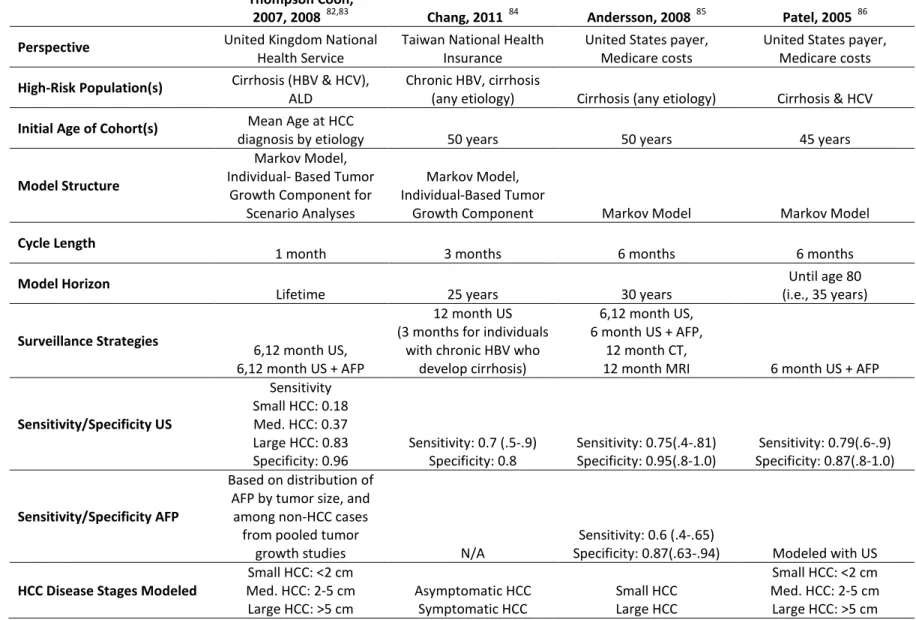
In general, prior decision models of surveillance were developed using an aggregate state-transition (Markov) model, simulating the impact of alternative intervention scenarios on outcomes among specific patient cohorts (Table 2.1). 78-86 In all cases, individuals were initially assumed to have no HCC disease at the start of simulation. In turn, the progression of chronic liver disease was modeled, incorporating the risk of worsened liver function, HCC development and death. Specific high-risk populations incorporated in the models included individuals with cirrhosis, whereas one study additionally modeled individuals with chronic HBV without cirrhosis.84
Among the alternative surveillance strategies modeled, all models incorporated screening with US ± AFP in 6- or 12-month intervals; 78-86 additional strategies included the use of CT, MRI, and contrast enhanced US. 79-81,85 In evaluating the cost-effectiveness of these strategies, 5 studies assumed the perspective of the United States payer, 80,81,85-87 2 studies modeled the perspective of the National Health Service in the United Kingdom, 82,83 2 studies assumed the perspective of the national health insurance system in Japan, 78,79 and one study modeled the perspective of the National Health Insurance program in Taiwan. 84
In modeling tumor progression, the majority of models incorporated evidence from prior tumor growth studies; however, the methods for incorporating this information varied considerably. Most authors manually calibrated the transition probabilities from small to large HCC tumors to reflect the expected tumor size over time. 81,85-87 Unfortunately, the details of these methods were largely unclear. In contrast, Thompson Coon et al. and Chang et al. developed a more sophisticated approach using individual-based sampling methods. 82-84 This method involved a two-dimensional representation of tumor growth: The authors assumed a relationship between tumor growth and time (e.g., exponential growth) and provided a scale parameter (i.e., DT) to adjust the rate of tumor growth. Although the methods employed by Chang et al. and Thompson Coon et al. were similar, the assumptions surrounding tumor growth and distribution of tumor doubling time were different (Table 2.1). 82-84 Using the tumor growth equation and a specified distribution of DT, the model would project tumor size for individuals with HCC. The results for different values of DT then were pooled across a series of simulations to estimate ranges in the costs and outcomes associated with surveillance versus no surveillance.
Whereas numerous studies have measured tumor growth in HCC, clinical data do not provide the necessary information to fully characterize the development of satellite tumors and tumor spread over time. The estimation of these parameters would require information regarding when each individual developed an HCC tumor and when further complications occurred. Such information is largely unavailable in clinical databases since most early stage patients are treated; even if patients elect to forgo treatment, large sample sizes would be needed to establish statistical power. As a result, prior decision models made simplified assumptions surrounding tumor progression in HCC. 81,85-87 For instance, both Chang et al. and Thompson Coon et al. observed that multinodular tumors and tumor metastases tended to occur with larger tumors. 70-72 Based on these relationships, the authors assumed that a large primary tumor > 5 cm could serve as a surrogate for more advanced HCC. 82-84 These
between tumor size and the presence of tumor-related complications in HCC, it is not uncommon for patients to present with multiple small tumors, with primary tumor size < 5 cm. 11,12,28 Secondly, treatment approaches and survival outcomes for patients with intermediate solitary HCC (> 5 cm) are vastly different than for individuals with other disease-related complications in addition to a large primary tumor. 2,3
In addition, the rate at which HCC is detected outside of a surveillance program, either incidentally or based on clinical symptoms, cannot be directly measured. Doing so would require knowing the proportion of all HCC cases (undiagnosed and diagnosed) that are detected in regular clinical practice. A number of models excluded this parameter and assumed that all HCC patients in the no surveillance group were diagnosed with large HCC based on clinical symptoms. 85,86 In doing so, however, these models likely overestimated the impact of surveillance. To approximate this parameter, Thompson Coon et al. manually calibrated the probability of incidental diagnosis, by tumor size, to reflect the overall distribution of tumor size from a study of patients diagnosed incidentally in clinical practice. 82,83 However, the details surrounding the calibration procedures were not fully documented.
Advantages of an Individual-Based Model for Hepatocellular Carcinoma Surveillance
A major limitation of prior cohort-based models of HCC surveillance, which use Markov chains to model transitions through different health states, is that they cannot flexibly incorporate the impact of accumulating medical history in determining model transitions, and survival outcomes. 40 In HCC, treatment options and survival outcomes are highly dependent on tumor stage at diagnosis, liver function, gender, and age. 2 Prior Markov models have partially accounted for these interactions by stratifying HCC disease states according to degree of underlying cirrhosis when allocating treatment. 81,84,85
On the other hand, in the absence of detailed data in regular clinical practice, these studies have not accounted for differences in treatment outcomes related to patient age, gender, and degree of cirrhosis.
In addition, prior decision models have made simplifying assumptions about the rate of tumor growth in HCC, 85,86 when, in reality, rates of tumor progression are highly heterogeneous across individuals. 15,18,26 Indeed, in a scenario analysis performed by Thompson Coon et al., 83 in which tumor growth rates were varied across ten simulated cohorts, the optimal intervals for HCC surveillance varied substantially when it was assumed that the majority of individuals had very slow growing versus fast growing tumors. Therefore, providing an accurate representation of tumor growth in HCC, as well as other aspects of tumor progression, is essential for understanding the optimal screening interval for HCC surveillance and the potential impact of non-compliance with surveillance protocols.
component and an intervention component. 92,93 The natural history model is developed first in the absence of an intervention. The intervention is then incorporated into the natural history model to alter the course of disease. Individual-based models are often complex, and the amount of complexity is largely governed by the disease process, specific questions to be addressed, and data available to inform model parameters. 40,91,93 As such, individual-based models are often used when large detailed datasets are available, as they can better incorporate the richness of the data to address a range of decision problems in the disease area as they emerge.
Significance and Contribution
With recent advancements in the treatment of HCC, continued research is needed to re-evaluate the appropriateness of current guideline recommendations. Studies conducted in East Asia have assessed the effectiveness of surgical resection for patients with intermediate and advanced disease, with varying results, and few studies have conducted direct survival comparisons with TA and sorafenib therapy. 58,60-65 Prior literature comparing long-term survival between resection and tumor ablation for early stage disease have also reported conflicting results. 69-71 The current study provides detailed comparative analyses of survival with HCC treatment for patients diagnosed at various stages of disease to clarify best treatment practices. The results of this study can provide valuable insights into the impact of disease characteristics and current treatment approaches on the prognosis of HCC in China, to help prioritize areas for improvement.
HCC. The current study uses a large dataset of patients diagnosed with HCC in Taiwan to examine the survival impact of surveillance. The analyses leverage previously established methods for lead time bias adjustment using the well-established formula for tumor growth in HCC, 10-13 and further extend this work by incorporating the full range in median DT estimated across prior tumor growth studies. 14-27
Although HCC surveillance is recommended, the ideal screening interval for surveillance is not known. 2,4,8 Determining the optimal approach for HCC surveillance requires both an understanding of tumor progression over time, and an accurate assessment of treatment patterns and associated survival in clinical practice. In the absence of more detailed data, prior Markov models of HCC surveillance have made simplifying assumptions surrounding tumor progression and the impact of patient characteristics in determining HCC treatment and survival outcomes. 83-86 The individual-based model of HCC
2
3
Table 2.1: Summary of overall structure and key model inputs from prior decision models of HCC surveillance. †
Thompson Coon,
2007, 2008 82,83 Chang, 2011 84 Andersson, 2008 85 Patel, 2005 86
Perspective United Kingdom National
Health Service
Taiwan National Health Insurance
United States payer, Medicare costs
United States payer, Medicare costs
High-Risk Population(s) Cirrhosis (HBV & HCV), ALD
Chronic HBV, cirrhosis
(any etiology) Cirrhosis (any etiology) Cirrhosis & HCV
Initial Age of Cohort(s) Mean Age at HCC
diagnosis by etiology 50 years 50 years 45 years
Model Structure
Markov Model, Individual- Based Tumor
Growth Component for Scenario Analyses
Markov Model, Individual-Based Tumor
Growth Component Markov Model Markov Model
Cycle Length
1 month 3 months 6 months 6 months
Model Horizon
Lifetime 25 years 30 years
Until age 80 (i.e., 35 years)
Surveillance Strategies
6,12 month US, 6,12 month US + AFP
12 month US (3 months for individuals
with chronic HBV who develop cirrhosis)
6,12 month US, 6 month US + AFP,
12 month CT,
12 month MRI 6 month US + AFP
Sensitivity/Specificity US
Sensitivity Small HCC: 0.18 Med. HCC: 0.37 Large HCC: 0.83 Specificity: 0.96
Sensitivity: 0.7 (.5-.9) Specificity: 0.8 Sensitivity: 0.75(.4-.81) Specificity: 0.95(.8-1.0) Sensitivity: 0.79(.6-.9) Specificity: 0.87(.8-1.0) Sensitivity/Specificity AFP
Based on distribution of AFP by tumor size, and
among non-HCC cases from pooled tumor
growth studies N/A
Sensitivity: 0.6 (.4-.65)
Specificity: 0.87(.63-.94) Modeled with US
HCC Disease Stages Modeled
Small HCC: <2 cm Med. HCC: 2-5 cm Large HCC: >5 cm
Asymptomatic HCC Symptomatic HCC
Small HCC Large HCC
2
4
Thompson Coon,
2007, 2008 82,83 Chang, 2011 84 Andersson, 2008 85 Patel, 2005 86
Modeling Tumor Size
Probability HCC growth manually calibrated to tumor growth studies
Scenario Analyses: Exponential tumor growth rate, normal & 2
beta distributions (fast, slow) of tumor doubling
time *
Tumor growth rate piecewise linear & uniform distribution of tumor doubling time *
Probability HCC growth manually calibrated to
tumor growth studies (details unclear)
Probability HCC growth manually calibrated to tumor growth studies
(details unclear)
Inc./Symp. Diagnoses
Calibrated (manually) to reflect distribution of tumor size at diagnosis
Inc./symp. diagnoses incorporated (details unclear)
Symptomatic presentation only of large HCC tumors
(details unclear)
Symptomatic presentation only of large
HCC tumors
HCC Treatments
Resection, ablation TA therapy, supportive
care
Resection, ablation, liver transplant, no treatment
Resection, ablation, liver transplant, supportive
care
Resection, liver transplant, supportive
care
Excess Mortality **
Decompensated cirrhosis, large HCC, HCC treatment
Compensated cirrhosis, decompensated cirrhosis, large HCC, HCC
treatment
Decompensated cirrhosis, large HCC, HCC treatment
Decompensated cirrhosis, large HCC, HCC treatment
ALD = alcoholic liver disease, AFP = alpha-fetoprotein, CT = computed tomography scan, HBV = hepatitis B virus, HCC = hepatocellular carcinoma, HCV = hepatitis C virus, Med. = medium, Inc. = incidental, MRI = magnetic resonance imaging, Symp. = symptomatic, TA = trans-arterial, US = ultrasound
† A total of 10 decision models of HCC surveillance were identified; detailed comparisons were performed for the studies that provided the most appropriate model structure and transparent overview of the model methodology. 82-86
* Tumor growth was varied at the individual level.
Figure 2.1: Summary of treatment recommendations for patients diagnosed with
China Ministry of Health (CMH) 3 compared with the American Association for the Study of Liver Disease (AASLD) guidelines. 5,8
AASLD = American Association for the Study of Liver Disease, CMH = China Ministry of Health, CP = Child score, HCC = hepatocellular carcinoma, TA = trans
* According to the AASLD guidelines, liver transplant is recomm
criteria. 5,94 The CMH guidelines primarily recommend liver transplant for patients with unresectable HCC or for
those who cannot tolerate ablation or T
†
Combination therapy with trans-arterial therapy followed by ablation among patients who respond to treatment.
** TA therapy is recommended for patients without evidence of tumor metastases.
‡
Recommended systemic treatments include sorafenib, other molecular targeted therapies, chemotherapy and Traditional Chinese medicine. 3
Figure 2.1: Summary of treatment recommendations for patients diagnosed with HCC based on the compared with the American Association for the Study of Liver
AASLD = American Association for the Study of Liver Disease, CMH = China Ministry of Health, CP = Child score, HCC = hepatocellular carcinoma, TA = trans-arterial therapy, Tx = treatment
* According to the AASLD guidelines, liver transplant is recommended for patients who fall within the Milan The CMH guidelines primarily recommend liver transplant for patients with unresectable HCC or for those who cannot tolerate ablation or TA therapy due to poor liver function. 3
arterial therapy followed by ablation among patients who respond to treatment.
** TA therapy is recommended for patients without evidence of tumor metastases. 3
Recommended systemic treatments include sorafenib, other molecular targeted therapies, chemotherapy and HCC based on the compared with the American Association for the Study of Liver
AASLD = American Association for the Study of Liver Disease, CMH = China Ministry of Health, CP = Child-Pugh
ended for patients who fall within the Milan The CMH guidelines primarily recommend liver transplant for patients with unresectable HCC or for
arterial therapy followed by ablation among patients who respond to treatment.
CHAPTER 3: COMPARATIVE EFFECTIVENESS OF CURRENT TREATMENT APPROACHES FOR HEPATOCELLULAR CARCINOMA: RESULTS FROM A LONGITUDINAL OBSERVATIONAL STUDY IN CHINA
Introduction
Hepatocellular carcinoma (HCC) is one of the most prevalent and deadly cancers worldwide. 47,48 HCC is particularly common in Asian-Pacific countries, with more than one-half of all global cases
occurring in China alone. 45 In China, HCC is the third most frequent cancer and the second leading cause of cancer-related death; an estimated 402,000 new cases were diagnosed and 372,000 HCC-related deaths occurred in 2008. 47
In recent years, the China Ministry of Health (CMH) has declared HCC as one of 5 tumors of high national importance and has published its newest Diagnosis and Treatment Guidelines for Primary Liver Cancers (2011 edition). 3 Consistent with consensus guidelines published by other developed nations, 2,4,5
recommended therapeutic options for HCC are administered based on tumor stage, liver function and performance status (Figure 3.1). 3 Worldwide, clinical guidelines consistently recommend resection as the primary treatment for patients with early HCC and well-preserved liver function, and
acknowledge that ablation may be used as a less invasive alternative. 4-7
resection for multinodular HCC, provided the tumors are in a suitable location and the patient has well-preserved liver function. 3 Furthermore, patients with advanced disease may receive resection, provided the same conditions apply, although treatment is mainly for palliative intent. TA therapy and systemic therapy are recommended for intermediate and advanced stage patients, respectively, who are not optimal surgical candidates or who elect to forgo surgical treatment.
In part, the apparent disagreement in treatment recommendations can be explained by distinctions in the clinical context surrounding HCC across different regions. In the United States and Europe, where HCC is primarily linked to chronic hepatitis C virus (HCV) infection and alcohol-related liver disease (ALD), nearly all patients present with cirrhosis. 57 In contrast, in China and other parts of East Asia, more than 80% of cases are related to chronic hepatitis B virus (HBV) infection; in this setting, HCC patients generally have well-preserved liver function, and approximately 10-20% of patients do not have evidence of cirrhosis. 52 Consensus guidelines agree that patients with significant liver function impairment, particularly portal hypertension, are poor candidates for surgical resection due to an increased risk of liver failure post resection. 4-7 Thus, in western settings, resection is often not recommended based on underlying liver impairment alone and/or portal hypertension, regardless of tumor characteristics.
Studies conducted in East Asia have assessed the effectiveness of surgical resection for patients with intermediate and advanced disease, with varying results. Earlier observational studies found that patients with multinodular HCC are poor candidates for resection, due to an increased risk of tumor recurrence. 58,60 With recent advancements in surgical techniques, however, a larger number of
multinodular tumors are now considered resectable, with 3-year survival reaching as high as 35-56%. 61-63
benefits associated with resection; however, post-operative recurrence and post-surgical complications are common. 64,65 Thus, the role of resection for advanced HCC remains controversial.
With recent advancements in the treatment of HCC, continuing research is needed to re-evaluate the appropriateness of current guideline recommendations. Therefore, the objective of this study was to explore current treatment approaches and to compare the effectiveness of primary treatment on overall survival for patients diagnosed at various stages of disease in China.
Methods
Study Sample
The study sample included data from the Bridge to Better Outcomes in Hepatocellular Carcinoma (HCC BRIDGE) study in China, a longitudinal cohort study of patients diagnosed with HCC across 12 tertiary hospital centers from 9 geographically diverse cities in mainland China. Details of the study design and complete inclusion criteria for the HCC BRIDGE study have been previously described.
29 Briefly, patients age ≥ 18 years who were newly diagnosed with HCC from January 1, 2005 through June 30, 2011 and received active treatment for HCC at one of the participating hospital sites were retrospectively enrolled in the study. Patients with unknown date of HCC diagnosis and/or date of first visit to the participating site or whose first HCC treatment was received via participation in a randomized clinical trial were excluded. All patients were followed until September 30, 2012 or date of death.
For the present study, additional inclusion criteria included complete clinical tumor
Data Collection
Data for the HCC BRIDGE study were systematically collected for all enrolled patients through a retrospective review of patient medical records. 29 Study data were entered into an electronic data capture system developed by Outcome Sciences, Inc. (Cambridge, MA, USA) and were subject to rigorous monthly data monitoring and cleaning. The institutional review boards from each participating hospital site approved the data collection for the HCC BRIDGE study. Data analyses for the present study were approved by The University of North Carolina Office of Human Research Ethics.
Available treatment approaches for HCC included: 1) surgical resection, 2) liver transplant, 3) ablation, 4) TA therapy, 5) systemic therapy, 6) supportive care, and 7) radiation/other locoregional therapy. The full list of therapies for each treatment approach are listed in Appendix A. The dates of all recorded treatments were compared to identify the primary and subsequent treatment approaches,. The primary treatment approach was generally defined as the first recorded treatment, with certain exceptions. Supportive care is often administered to reduce symptoms prior to or during primary therapy. 3 If patients received another therapy within one month (30 days) after supportive care, the other therapy was considered to be the primary treatment. In practice, TA therapy can be used to shrink the tumor(s) in preparation for surgical treatment. 3 For such cases, the primary treatment approach was considered to be surgical treatment, rather than TA therapy. Separate categories were created for patients who first received TA therapy then underwent resection, liver transplant or tumor ablation within 6 months (182 days) after the first administration of TA therapy. After this period, any additional treatment following TA therapy was considered to be a second-line approach either to treat the primary or de novo HCC lesions.
invasion and/or tumor metastases. To measure liver function among individuals with cirrhosis, Child-Pugh (CP) scores were calculated, and presence of portal hypertension was documented at diagnosis. 3,55 Performance status was measured using the Eastern Cooperative Oncology Group (ECOG) scoring criteria. 3,56 Patients with incomplete data were excluded from the analyses. In cases where patients had multiple clinical assessments over time, only assessments obtained within 6 months (182 days) before and after date of diagnosis were considered, and the closest date to diagnosis was used. Laboratory values were taken within 1 month (30 days) before to 6 months (182 days) after date of diagnosis, and the earliest available laboratory values were selected. To maintain clinical validity,
analyses and interpretation of clinical information at diagnosis were based on extensive discussions with an expert panel of gastroenterologists/hepatologists from China as well as other countries participating in the HCC BRIDGE study.
Additional patient demographic and clinical characteristics were collected at time of diagnosis or first visit to the hospital site, including patient age, gender, etiology, co-morbidities, and insurance status. Etiology of HCC included chronic HBV infection, chronic HCV infection, ALD, non-alcoholic fatty liver disease (NAFLD), primary biliary cirrhosis, hemochromatosis, inherited metabolic disorder or idiopathic disease, based on documented evidence in the patient medical record. Relevant
co-morbidities included diagnosed diabetes mellitus, cardiovascular disease (CVD) and hypertension. 95,96 Patients who paid out of pocket for their treatment were considered uninsured.
Data Analyses
Descriptive analyses compared patient demographics, clinical characteristics, disease stage and primary treatment approaches across different cities in China. Statistical differences were assessed using analysis of variance (ANOVA) tests for continuous variables, and the χ2 or Fisher exact tests for categorical variables. 34 To assess compliance with the CMH guidelines for HCC treatment, additional analyses explored primary treatment approaches, according to disease stage, as well as additional treatment approaches following primary treatment.
Survival analyses were conducted to assess differences in survival, according to disease stage and primary treatment. Survival was estimated from the date of first treatment until death or censoring. Patients who did not die during follow-up were considered censored at the last known follow-up or study end (September 30, 2012). For each disease stage, unadjusted survival probabilities were estimated using the Kaplan-Meier method and compared by the log-rank test. 31 The life-table method was used to calculate yearly probabilities of survival; 95% confidence intervals (CI) were computed using the log-log transformation of the survivor function. 31
power, only analyses for treatments with an a priori minimum of n=50 patients were conducted; patients receiving other treatments were excluded. Models for all disease stages controlled for the following patient demographics and clinical characteristics: age, gender, co-morbidities, etiology, liver function (i.e., CP status and portal hypertension), and hospital site where treatment was received. Additional covariates for advanced stage disease included indicators for type of vascular invasion and/or tumor metastases. For all other disease stages, models controlled for tumor size and number of tumor nodules, based on the aforementioned categories outlined in the CMH guidelines. 3 Model fit for different specifications was assessed using the Akaike information criterion (AIC). 31 Model-estimated standard errors were adjusted using robust sandwich standard errors to account for patient clustering by hospital sites. 97 Log cumulative hazard plots stratified by treatment were estimated to test the proportional hazard assumption. 31
The model-estimated PS then were incorporated into the Cox proportional hazard models for each disease stage, in place of the model covariates specified above, to compare the hazard of death with treatment. Using regression-based adjustment, the estimated PS were directly included in the regression as a linear model covariate. 32 For the method of propensity-based weighting, patients were weighted using stabilized inverse probability weights, defined as the ratio of the marginal predicted probability of treatment (m) divided by the PS (i.e., m/PS). 33 Stabilized weights were chosen over standard inverse probability of treatment weights (i.e., 1/PS) to provide better estimates of the variance in treatment effect. To further remove selection bias from survival comparisons across treatments, patients were weighted by the stabilized inverse probability weights to form adjusted survival probabilities using the Kaplan Meier and life-table methods. 99
All analyses were conducted using SAS version 9.2 (Cary, North Carolina, United States). An a priori 5% significance level was used for all statistical tests, as well as tests for model specification.
Results
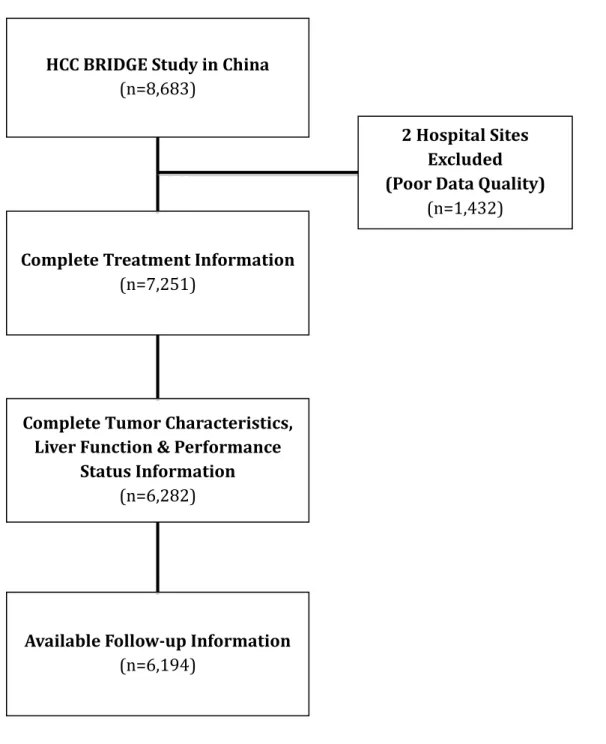
A total of 6,194 patients from 10 hospital sites across 7 cities in China were included in the study (Figure 3.2). Primary treatment approaches for the full HCC BRIDGE study (n=7,251) compared with the final sample (n=6,194, 85.4%) were similar (p=0.09), suggesting that unavailable disease characteristics and follow-up dates were primarily missing at random (data not shown).
(71.1%), only 22.2% of patients treated in Beijing were uninsured. Additional differences included higher percentages of patients with underlying etiology related to chronic HCV infection in Harbin (11.9%), and moderate to severe liver impairment (i.e., CP B-C) in Xi’an (22.1%) and Nanning (24.6%).
Disease Characteristics
Nearly 40% of patients were diagnosed in the intermediate stages, and more than one- third of patients (34.5%) were diagnosed with advanced stage HCC characterized by vascular invasion (16.7%) and tumor metastases (17.8%) (Table 3.2). In contrast, less than one-quarter of patients (24.2%) were diagnosed in the early stages, when patients are prime candidates for curative surgical treatment. Disease stage at diagnosis varied significantly across the sampled cities (p<0.0001). In Beijing, a larger percentage of patients were diagnosed in the early disease stages (38.5%), and only 12.3% were diagnosed with advanced HCC. In Xi’an and Shanghai, on the other hand, nearly one-half of all patients were diagnosed with advanced HCC (Xi’an: 51.7%, Shanghai: 44.9%).
Current Treatment Approaches
TA therapy was the most common primary treatment approach, administered to approximately one-half (50.6%) of all patients, followed by surgical resection, performed among nearly one- third (32.8%) of all HCC patients (Table 3.3). Additional primary treatment approaches included tumor ablation (8.1%) and supportive care (4.7%); other primary treatments, including liver transplant (0.7%), systemic therapy (1.4%), and radiation/other (1.7%), were seldom used. Administration of TA therapy within 6 months prior to tumor ablation (39.8%) and liver transplant (32.6%) was common, but less common for resection (5.1%). Primary treatment approaches significantly differed across cities (p<0.0001).