Understanding Self-Interest: A Concept Bridging the Gap between Psychology and Politics
Jennifer Kirstin Benz
A dissertation submitted to the faculty of the University of North Carolina at Chapel Hill in partial fulfillment of the requirements for the degree of Doctor of Philosophy in the Department of Political
Science.
Chapel Hill 2011
Approved by:
Thomas M Carsey
Melanie Green
Jim Stimson
Michael MacKuen
ii
iii
ABSTRACT
Jennifer Kirstin Benz: Understanding Self-Interest: A Concept Bridging the Gap between Psychology and Politics
(Under the direction of Thomas M Carsey)
iv
ACKNOWLEDGMENTS
This dissertation could not have been written without the support and encouragement of so many friends, family, and mentors. While proud to have completed my Ph.D., I am mostly humbled by the incredibly smart and caring people who helped through this long journey. First and foremost, of course, is my dissertation advisor, Dr. Tom Carsey. I feel very fortunate that Tom and I arrived at Carolina back in 2006. His reputation for outstanding mentorship and scholarship preceded him and I am grateful that we connected early in my graduate career. Every piece of feedback he provided helped me grow as a researcher and every interaction taught me how to be a good colleague. Additionally, my graduate experience was immensely enhanced by working with Dr. Virginia Gray. I am proud to have her as a mentor, co-author, and friend. The members of my dissertation
committee, Drs. George Rabinowitz, Melanie Green, Jim Stimson, and Mike MacKuen were exceptionally generous with both their time and ideas. Finally, a special dedication to George
Rabinowitz: George’s rare combination of an exceptionally keen mind and genuine heart brought out the very best in all his students. He left this world far too soon, but the impacts he made as a scholar and educator will continue for generations. I will strive to meet his high standards in everything I do.
I am extremely privileged to call NORC at the University of Chicago my home as a
v
My incredible friends and family provided the bedrock for me to start building my career. Since high school, Betsy Holbrook, Vik Keenan, Becca and Dan Huben, Mike Torello, Kathy Wright, and, Kate and John Holthausen were sources of unwavering love even through the many missteps I took before finding my path. When I moved to DC, fate, under the guise of a paperwork error, brought me to an apartment next door to Karen and Dan Hertel. They, along with Dusty Lockhart, welcomed me into their family and have been incredible friends ever since. Justin Brown has meant more to me and contributed more to my life and career than he will ever know, and certainly more than he will ever acknowledge. He has an amazing ability to keep me grounded and remind me of the big picture. Whenever I need a little courage, I think of all he does.
vi
TABLE OF CONTENTS
LIST OF TABLES………vii
LIST OF FIGURES……….…………viii
Paper 1: An Integrated Model of Self-Interest in Policy Attitude
Formation……….……….……….1
Paper 2: When Self-interest and Self-identification
Conflict……….…………23
Paper 3: Sending Signals: How Self-interested Individuals Help
Policymakers……….………..47
APPENDICES……….………73
BIBLIOGRAPHY……….………86
vii
LIST OF TABLES
1.1: Traditional Model Comparing Self-Interest, Symbolic Politics,
and Sociotropic Perceptions……….12 1.2: Preferences for Expanded Coverage Policies (1993-2008)
Given Insurance Status and Symbolic Beliefs………...15 1.3: Preferences for Expanded Coverage Policies (2009-2010) Given
Insurance Status and Symbolic Beliefs………..16 1.4: Preferences for Expanded Coverage Policies (2009-2010)
Given Insurance Status and Sociotropic Perceptions………..19 2.1: Percent in Favor of Tax Stimulus by ELM Condition………...38 2.2: Effect of Self-Interest on Attitude Strength and Behavior
Intentions……….40 2.3: Effect of the Self-Interest – Party Interaction on Attitude
Strength and Behavior Intentions……….41 3.1: Attitude Constraint by Perceived Self-Interest in 2009………57 3.2: Attitude Constraint by Perceived Self-Interest in 2010………61 3.3: Average, Minimum, and Maximum Inter-attitude Associations
viii
LIST OF FIGURES
1.1: Expected Interaction of Self-Interest and Symbolic Beliefs
under the Integrated Model of Self-Interest………8 1.2: Predicted Probability of Support for Universal Coverage
Given Insurance Status……….13 1.3: Predicted Probability of Support for Universal Coverage
Given Insurance Status & Party Affiliation………..17 1.4: Predicted Probability of Support for Universal Coverage Given
Insurance Status & Sociotropic Perceptions………..20 2.1: Hypothesized Effect of Self-Interest on Attitude by Party Endorsement
and Argument Strength……….35 2.2: Hypothesized Effect of Self-Interest on Attitude Strength and
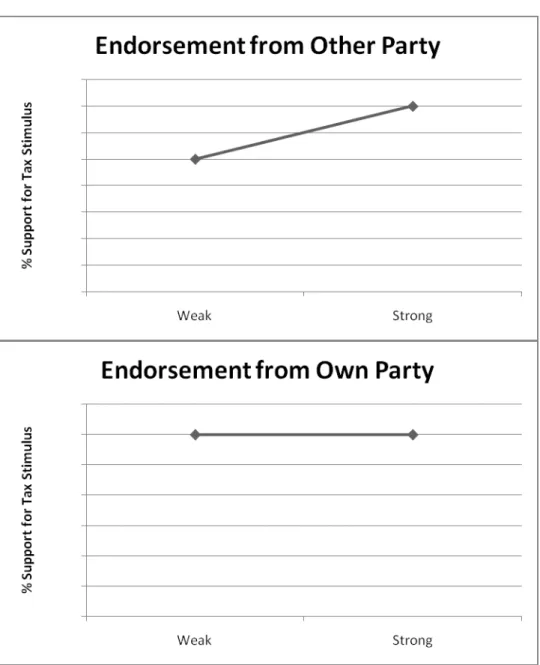
Behavior by Party Endorsement………..37 2.3: The Effect of Self-Interest, Partisan Cues, and Argument
Quality on Attitudes………39 2.4: Hypothesized Effect of Self-Interest and Partisan Identification on
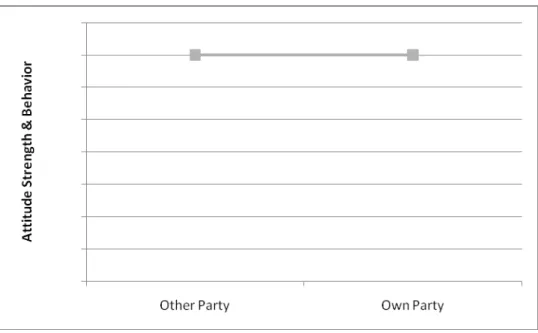
Attitude Change by Party Endorsement……….43 2.5: Effect of Self-Interest and Partisan Identification on Attitude
Paper 1: An Integrated Model of Self-Interest in Policy Attitude Formation
The function of self-interest in political behavior is regularly debated in both the normative and empirical literatures. One important puzzle is the discrepancy between the significant role of self-interest in the economic, public policy and normative political literatures and its insubstantial role in the political public opinion literature. The public opinion literature has generated two widely cited theories in which an individual’s symbolic beliefs and perceptions of the larger national situation are more predictive than self-interest for determining policy and electoral preferences. Empirical tests generate support for both of these theories, but the accumulated body of evidence demonstrates that the theories are conditional upon individual and contextual factors. The result is an unclear
understanding of the basic structure of public policy attitudes. In this paper, I develop the Integrated Model of Self-Interest to explain the determinants of public policy attitudes. Rather than viewing self-interest, symbolic beliefs, and perceptions of the national situation as competing determinants of public policy attitudes, I present a model that integrates these factors and predicts how they interact in the political context during the process of attitude formation. Tests of the model show the direct and indirect effects of self-interest to be a significant determinant of policy attitudes when the policy outcomes and consequences are clear.
Despite the theoretical disagreement about the determinants of public policy preferences, aggregate public opinion is a proven influence on the policy process in the United States. A
2
observe that individual self-interest has a large effect on the public’s preferences for large-scale change (Oberlander 2003; Blendon 2006). Oberlander writes, “The insured are generally satisfied with their own medical care, even if they think poorly of the system as a whole. Consequently, the well-insured are not a reliable constituency for change. Indeed, any reform that threatens to alter their medical care arrangements is likely to provoke public opposition” (2003).
Observations like this challenge conventional thinking in political science about the
determinants of policy attitudes, and most especially, the role of self-interest. The Integrated Model of Self-Interest I develop in this paper provides a way to reconcile the discrepancy between the observed effects of interest in the policy environment and the inability to find an effect of self-interest in the political science literature. I begin with a brief review of the literatures on symbolic beliefs and voting based on perceptions of the national economic situation, highlighting the role that self-interest plays in those theories. I then present the Integrated Model of Self-Interest and discuss the expectations of the model for understanding attitudes toward public policy issues. In the next section, I utilize individual level opinion data on preferences for policies expanding health care coverage from 1993 - 2010 to test aspects of the theory. I conclude with a discussion of the results and their implications for the role of self-interest in politics.
Sociotropic Perceptions
Early theories of public opinion emphasized the role of self-interest as a major determinant of individual preferences. Campbell et al. (1960) articulate a notion of public policy preferences as mere expressions of “primitive self-interest” (Campbell et al 1960). Popkin et al. (1976) assert that the influence of economic conditions on electoral outcomes results from individuals basing their electoral decisions upon the tangible economic situations they face in their daily lives. The self-interested motivations of these “pocketbook voters” served as a central theme in the work on the political economy of individuals for several years.
Kinder and Kiewiet conducted the first critical investigation of the pocketbook voter
3
condition and place credit or blame on the incumbent government accordingly. Furthermore, they showed that sociotropic perceptions are not simply expressions of ideological or partisan loyalties. They and others showed that sociotropic perceptions are more predictive of vote choice than
pocketbook considerations (Fiorina 1981; Kinder and Kiewiet 1981; Kinder 1981; Lewis-Beck 1988). Kinder and Kiewiet (1981) expressed an agnostic belief about the motivation driving
sociotropic effects. They were clear that sociotropic politics did not necessarily imply a politics of altruism. Sociotropic politics, they believed, could very well be a politics of indirect self-interest, but they were unable to adequately test for this possibility. Several scholars have since taken up this issue and the evidence that has accumulated suggests that sociotropic politics are not indirect expressions of self-interest. Evaluations of group fairness, social value commitments, and beliefs in economic individualism seem to moderate the role of self-interest and bolster the effect of sociotropic perceptions (Mutz and Mondak 1997; Funk 2000; Funk and Garcia-Monet 1997; Feldman 1982).
Symbolic Politics
At about the same time that the sociotropic politics literature began questioning the role of self-interest, work by Sears and his colleagues explored the relative contribution of self-interested motivations compared to symbolic beliefs about race1, political parties, and ideology in predicting policy preferences and political behaviors (Kinder and Sears 1981; Lau et al. 1978; Sears et al. 1980). Their studies found little or no effect of self-interest on policy preferences across a number of domains. Even when self-interest effects were present, their explanatory power compared to symbolic beliefs was quite small. A recent replication and update of the original work confirms the dominant role of symbolic beliefs (Lau and Heldman 2009).
Overall then, the bulk of the evidence from the sociotropic perceptions and symbolic beliefs literatures reduces self-interest to a negligible determinant of policy preferences. However, several studies do find a role for self-interest when examining preferences for policies that offer clear benefits or costs (Sears and Citrin 1985; Dixon et al. 1991; Wolpert and Gimpel 1998; Bergen 2009).
4
Furthermore, survey and laboratory based experiments demonstrate that priming self-interest can induce significant self-interest effects in policy preferences (Sears and Lau 1983; Chong et al. 2001). Taken together, these results suggest that theories of political attitude determinants should not be so quick to dismiss the role of self-interest. The empirical data imply that the role of self-interest is conditional and the evidence to date implies that self-interest is most likely to have an impact on attitudes when an individual is aware of his or her self-interest and when the implications of the policy options for the individual are clear. However the literature does not clearly articulate the mechanisms that underlie the conditional nature of self-interest.
The Elaboration Likelihood Model
The conditional nature of self-interest can potentially be explained using models of attitude formation available in the social psychology literature. Dual process theories of attitude formation provide an account of how attitudes can form under different processes, including those requiring more cognitive effort than the others. Some of the more common models in the literature are the Motivation and Opportunity as Determinants (MODE) model, the Heuristic-Systematic Model (HSM), and the Elaboration Likelihood Model (ELM) (Fazio 1990; Eagly and Chaiken 1993; Petty and Cacioppo 1986). Of these models, which offer distinct but related accounts of attitude formation and the consequences of attitudes, the ELM provides the clearest way to think about self-interest in regard to attitude formation in the political and policy context. The Elaboration Likelihood Model (ELM) of persuasion is of particular relevance to understanding the roles of self-interest, sociotropic perceptions, and symbolic beliefs. The Elaboration Likelihood Model puts forth two routes that individuals might take when forming an attitude (Petty and Cacioppo 1981). Individuals who are both motivated and able to cognitively process information relevant to the attitude are likely to take the central route to forming attitudes, which involves more cognitive processing and leads to relatively accessible and stable attitudes (Petty et al. 1995). These individuals are said to have high
5
consequences for the individual, motivates individuals to engage in central route processing (Petty and Cacioppo 1979). Individuals lacking the motivation or ability to process information are likely to take the peripheral route to forming an attitude, such that they rely on simple cues and heuristics rather than cognitive processing. These individuals are said to have low elaboration likelihood as they do not attend carefully to the message or undergo a process of accessing relevant information from memory.
There are several features of the Elaboration Likelihood Model that can lend insight into the conditional nature of self-interest observed in the political and policy context. First, individuals who rely exclusively on cues or who engage fully in cognitive processing occupy the endpoints of the elaboration likelihood continuum. Most individuals fall somewhere along the continuum such that they rely on both cognitive processing and cues to form their opinions (Petty and Cacioppo 1986).
Second, pieces of information and cues can serve multiple roles for individuals2. A common example used in the literature is an ad that shows a picturesque view of a sandy beach. In an advertisement for a hotel in Hawaii, this picture serves as relevant information for cognitive
processing in the central route because it supplies information on the benefits of the hotel. The same scene appearing in an advertisement for a car serves only as a peripheral cue because it does not provide any relevant information about the qualities of the car (Staats and Staats 1957). In other words, a piece of information can serve as a cognitive argument or as a peripheral cue depending on the context.
An Integrated Model of Self-Interest
My objective is to apply these concepts from ELM to provide a theoretical understanding of the conditional nature of self-interest effects in politics. The Integrated Model of Self-Interest begins with the premise that the political environment provides individuals with a large amount of information they can use to form policy preferences. Individuals can use each piece of information as either an informational argument or a peripheral cue (i.e. heuristic) depending on the degree to which an
6
individual is relying on cognitive processing to form their preferences. Included among the different types of information available are:
Arguments about the merits and consequences of policy options for different types of individuals. These arguments connect policies with individual self-interest3.
Arguments about the merits and consequences of policy options for different groups. These arguments connect policies with an individual’s social identifications4.
Endorsements of policy options by politicians and political parties. These endorsements serve to connect the policy options to political affiliations, like parties.
Policy frames that connect the policy to broader ideological values, such as conservatism or equality5.
Recall from the discussion of the Elaboration Likelihood Model (ELM) that individuals are likely to engage in cognitively oriented information processing, called central route processing, when they are able and motivated to think about the issue (Petty and Cacioppo 1986). In the realm of political decision-making, I propose that self-interest serves as a source of motivation that has consequences for information processing, attitudes, and behavior that are distinct from social
identifications like party affiliation or values like ideology6. Self-interest suggests that the policy issue carries significant consequences for the individual. As self-interest increases, people will become more motivated to engage in the political environment.
3 Self-interest is defined as an individual’s material interests. These material interests are not limited to monetary resources like tax refunds, but can also include resources like health insurance or local infrastructure improvements.
4 Social identifications are defined as groups to which individuals consider themselves members or affiliates. These identifications include objective memberships like race and gender, as well as subjective memberships like political parties.
5 Values are defined as abstract beliefs about how a person should behave and the ideal outcomes he or she should achieve. Some examples of values in the political realm include ideology and equality.
7
The Integrated Model of Self-Interest generates two hypotheses about the conditional nature of self-interest in the political context. First, the effects of self-interest are expected to be significant whenever the policy outcomes and consequences are clear. When a policy articulates clear benefits and costs, self-interested individuals will be motivated to hold attitudes aligned with their self-interest. Furthermore, the significant effect of self-interest should remain even when controlling for symbolic beliefs and sociotropic perceptions. There are two features of the political context that are likely to dampen the observed effects of self-interest in the political context. First, policies are presented to individuals in a political environment that often obfuscates policy details including messages about how a policy will affect different segments of the population. The second feature is methodological. Public opinion surveys often use questions that measure self-interest in narrow terms, while
measuring policy preferences broadly. For example, many surveys measure personal health insurance status at a particular point in time and measure preferences for more or less government spending on health in the future. The effect of broad government spending in a policy domain for an individual is unclear. As such, self-interest effects are unlikely to be observed when indicators are measured at different levels of specificity7.
Second, self-interest should moderate the effects of sociotropic perceptions and symbolic beliefs. Individuals with a self-interest in a policy will be more likely to cognitively engage in an issue and less likely to rely on cues in the political environment. Under this model the influence of self-interest and sociotropic perceptions and symbolic beliefs to determine policy preferences will differ depending on the relevance of the policy issue for the individual. Individuals without a tangible interest in a policy will not be motivated to elaborate on the information available in the political environment and will therefore rely on symbolic beliefs and sociotropic perceptions as cues to form their attitudes. As a result, the Integrated Model of Self-Interest expects significant differences based upon symbolic beliefs and sociotropic perceptions to exist among individuals without a tangible interest in the policy. However, when an individual has a tangible stake in a policy, the model expects self-interest to moderate the influence of symbolic and sociotropic cues.
8
Figure 1.1 depicts the relationship between self-interest and a symbolic belief, party identification, for a hypothetical policy8. The first hypothesis of the Integrated Model of Self-Interest predicts that, overall, self-interested individuals will support the policy more than individuals without an interest. Furthermore, the situation pictured is one in which self-interested individuals and
Democrats tend to support the policy. In this situation, the second hypothesis of the Integrated Model of Self-Interest predicts little or no significant difference among self-interested Democrats and
Republicans and a significant difference between Democrats and Republicans without a self-interest in the policy. Additionally, the nearly flat slope of the Democrats’ line predicted by the second hypothesis of the theory means that very little difference exists among Democrats regardless of self-interest, but self-interested Republicans should differ from Republicans without an interest in the policy.
Figure 1.1: Expected Interaction of Self-Interest and Symbolic Beliefs under the Integrated Model of Self-Interest
For a policy in which self-interested individuals and Democrats are in support.
9
Data and MethodsIn this paper, I test the expectations that self-interest will have an effect for policies with tangible individual outcomes, and, that self-interest will moderate the effects of sociotropic
perceptions and symbolic beliefs using multivariate regression techniques with national survey data. I use the health care reform case as an example of a policy with tangible policy consequences.
The use of survey data requires the researcher to make a decision about the self-interest of an individual respondent or category of people. My selection of health care reform, particularly policies aimed at expanding health care coverage and improving access, is intended to minimize the error associated with that judgment. Being uninsured or underinsured in this country creates a number of tangible effects including fragmented health care, delayed treatments, failed detection of preventable diseases, and increased financial instability9. Policies that guarantee health care coverage provide tangible benefits for the medically uninsured.
At the same time, the provision of universal health care coverage invokes sociotropic and symbolic considerations as well. Frequently the debate over reform includes sociotropic messages about the chance that the reform could lessen the overall effectiveness and efficiency of the system for the country. Symbolic beliefs about reforms, especially those regarding universal coverage, are embodied in the rhetoric of big government that is consistently present in the elite debate over the policy. Because health reform policies offer tangible benefits to the medically uninsured and under-insured while simultaneously engaging political symbols and sociotropic perceptions, the policy provides a reasonable test of the Integrated Model of Self-Interest.
To operationalize these concepts for testing the model, I utilize data from a variety of national surveys of adults about health care issues archived at the Roper Center10. The surveys were fielded in 1993, 2004, 2006, 2008, 2009, and 2010. The time period of the surveys covers years when health reform was both at the top of the agenda (1993, 2009-2010) and when the policy was low on the
9 Reports from the Institute of Medicine develop and discuss these implications more fully. Institute of Medicine (IOM). 2003. A Shared Destiny: Community Effects of Uninsurance. Washington, DC: National Academy Press See also, The Kaiser Commission on Medicaid and the Uninsured. 2009. Five Facts about the Uninsured. Available at: http://www.kff.org/uninsured/7806.cfm, accessed June 2010.
10
agenda (2004, 2006, and 2008). The dependent variables in the analyses include several questions about support for various policies that expand coverage or access to health insurance for the
uninsured and underinsured. The surveys were selected because the questions ask for respondents’ attitudes on specific policies with clear implications for the uninsured and underinsured.
Furthermore, because of the various time periods, the policy questions cover a variety of policies and popular phrases and terminologies (e.g., “government plan,” “mandate,” “universal coverage”). Self-interest, the key independent variable, is operationalized as having some form of health insurance or health care coverage. Symbolic beliefs include self-identification as a Democrat or Republican. Sociotropic perceptions are operationalized as a question that asks respondents the degree to which they believe health reform will benefit the country as a whole. To reduce the risk of omitted variable bias, I include controls for education, gender, race, and income.
To test the Integrated Model of Self-Interest’s second hypothesis that self-interest moderates symbolic beliefs and sociotropic perceptions, I form a series of interaction terms. The first set is an interaction between health insurance status and the pair of party affiliation variables representing Democrats and Republicans. The omitted baseline category is for non-partisans. Party identification is selected as the symbolic belief because the parties have well known public stances on health care coverage reforms. For example, Republicans most often view public insurance options as inefficient and prefer to find market based solutions that give individuals the tools needed to manage their own access and care such as tax incentives, while Democrats are more often associated with preferences for government interventions to extend coverage and improve access. The second interaction term is between insurance status and the belief that health reform will benefit the country as a whole.
Findings
11
coverage reforms. In accordance with the Integrated Model of Self-Interest’s expectation that self-interest is likely to affect attitudes when policies have tangible consequences for individuals, these particular survey questions provide a clear choice for uninsured individuals between a system that intends to cover all individuals through some policy mechanism and the current system in which they do not have coverage.
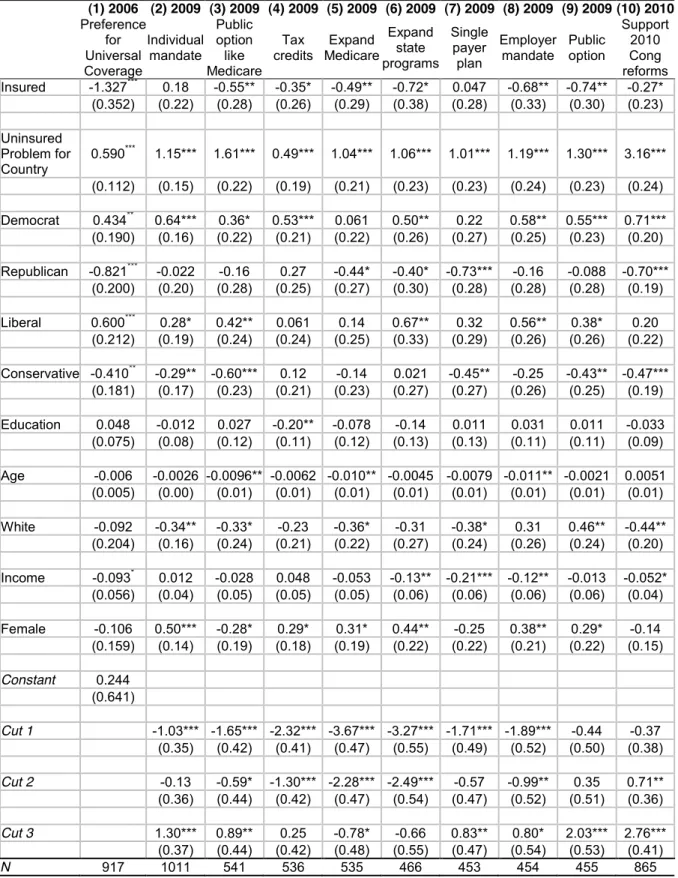
As shown in Table 1.1, the traditional model used in the symbolic politics and sociotropic perceptions literatures behaves as expected, overall, for the ten models estimated in the table. Looking at Model 1 from a 2006 survey as an example, the coefficients on the Democrat and liberal terms are significant and positive and the coefficients on the Republican and conservative terms are negative and significant coefficients as expected. Joint Wald hypothesis tests confirm that Democrats and Republicans are significantly different from one another, as are liberals and conservatives11. The significant and positive coefficient on the sociotropic perceptions term indicates that those individuals who consider the uninsured problem to be critical for the country as a whole are more likely to support universal coverage than those who do not think it is a critical problem. Of note is the significant and negative sign on the insured term meaning that insured individuals are significantly less likely to prefer a system of universal health insurance even after controlling for symbolic beliefs and
sociotropic perceptions. Most models in the symbolic politics literature find that self-interest variables contribute very little compared to models including only symbolic belief variables (Lau and Heldman 2009).
12
Table 1.1: Traditional Model Comparing Self-Interest, Symbolic Politics, and Sociotropic Perceptions
(1) 2006 (2) 2009 (3) 2009 (4) 2009 (5) 2009 (6) 2009 (7) 2009 (8) 2009 (9) 2009 (10) 2010 Preference for Universal Coverage Individual mandate Public option like Medicare Tax
credits Medicare Expand
Expand state programs Single payer plan Employer mandate Public option
Support 2010 Cong reforms Insured -1.327*** 0.18 -0.55** -0.35* -0.49** -0.72* 0.047 -0.68** -0.74** -0.27*
(0.352) (0.22) (0.28) (0.26) (0.29) (0.38) (0.28) (0.33) (0.30) (0.23)
Uninsured Problem for Country 0.590
*** 1.15*** 1.61*** 0.49*** 1.04*** 1.06*** 1.01*** 1.19*** 1.30*** 3.16***
(0.112) (0.15) (0.22) (0.19) (0.21) (0.23) (0.23) (0.24) (0.23) (0.24)
Democrat 0.434** 0.64*** 0.36* 0.53*** 0.061 0.50** 0.22 0.58** 0.55*** 0.71*** (0.190) (0.16) (0.22) (0.21) (0.22) (0.26) (0.27) (0.25) (0.23) (0.20)
Republican -0.821*** -0.022 -0.16 0.27 -0.44* -0.40* -0.73*** -0.16 -0.088 -0.70*** (0.200) (0.20) (0.28) (0.25) (0.27) (0.30) (0.28) (0.28) (0.28) (0.19)
Liberal 0.600*** 0.28* 0.42** 0.061 0.14 0.67** 0.32 0.56** 0.38* 0.20 (0.212) (0.19) (0.24) (0.24) (0.25) (0.33) (0.29) (0.26) (0.26) (0.22)
Conservative -0.410** -0.29** -0.60*** 0.12 -0.14 0.021 -0.45** -0.25 -0.43** -0.47*** (0.181) (0.17) (0.23) (0.21) (0.23) (0.27) (0.27) (0.26) (0.25) (0.19)
Education 0.048 -0.012 0.027 -0.20** -0.078 -0.14 0.011 0.031 0.011 -0.033 (0.075) (0.08) (0.12) (0.11) (0.12) (0.13) (0.13) (0.11) (0.11) (0.09)
Age -0.006 -0.0026 -0.0096** -0.0062 -0.010** -0.0045 -0.0079 -0.011** -0.0021 0.0051 (0.005) (0.00) (0.01) (0.01) (0.01) (0.01) (0.01) (0.01) (0.01) (0.01)
White -0.092 -0.34** -0.33* -0.23 -0.36* -0.31 -0.38* 0.31 0.46** -0.44** (0.204) (0.16) (0.24) (0.21) (0.22) (0.27) (0.24) (0.26) (0.24) (0.20)
Income -0.093* 0.012 -0.028 0.048 -0.053 -0.13** -0.21*** -0.12** -0.013 -0.052* (0.056) (0.04) (0.05) (0.05) (0.05) (0.06) (0.06) (0.06) (0.06) (0.04)
Female -0.106 0.50*** -0.28* 0.29* 0.31* 0.44** -0.25 0.38** 0.29* -0.14 (0.159) (0.14) (0.19) (0.18) (0.19) (0.22) (0.22) (0.21) (0.22) (0.15)
Constant 0.244 (0.641)
Cut 1 -1.03*** -1.65*** -2.32*** -3.67*** -3.27*** -1.71*** -1.89*** -0.44 -0.37 (0.35) (0.42) (0.41) (0.47) (0.55) (0.49) (0.52) (0.50) (0.38)
Cut 2 -0.13 -0.59* -1.30*** -2.28*** -2.49*** -0.57 -0.99** 0.35 0.71** (0.36) (0.44) (0.42) (0.47) (0.54) (0.47) (0.52) (0.51) (0.36)
Cut 3 1.30*** 0.89** 0.25 -0.78* -0.66 0.83** 0.80* 2.03*** 2.76*** (0.37) (0.44) (0.42) (0.48) (0.55) (0.47) (0.54) (0.53) (0.41)
N 917 1011 541 536 535 466 453 454 455 865
13
The coefficient on the insurance status term shows a significant, negative relationship of
being insured to preferring a system of universal health insurance over the current system. This is
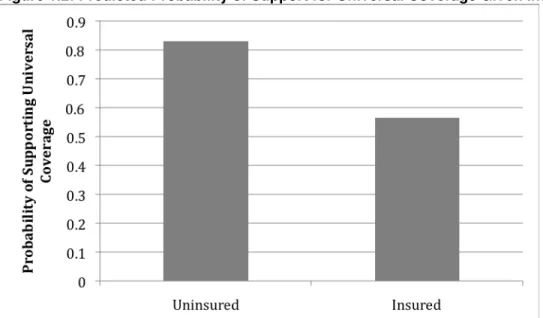
true for eight of the ten models. Figure 1.2 demonstrates the effect of insurance status on
preferences for universal coverage in the traditional model of symbolic politics or sociotropic
perceptions shown in Table 1.1. The predicted probability of supporting universal coverage for
insured individuals is .56 (95% CI: 0.53, 0.60) and .83 (95% CI: 0.74, 0.92) for uninsured
individuals12. This represents a nearly 30 percentage point increase in support as individuals move
from being insured to being uninsured. These results provide support for the Integrated Model of
Self-Interest’s expectation that self-interest will have an effect on policy attitudes when the policy has
tangible consequences.
Figure 1.2: Predicted Probability of Support for Universal Coverage Given Insurance Status
Note: Predicted probabilities generated using Model 1 from Table 1.1. All other variables are held at their mean or modal value.
The significant effect of self-interest in the traditional symbolic politics and sociotropic
perceptions model is due to the characteristics of the policy option being considered. First, the policy
provides a tangible policy outcome for the uninsured. Second, it provides a clear contrast to the
current system which is not meeting the needs of the uninsured and is therefore likely to activate
self-interest. The Integrated Model of Self-Interest specifies that these types of characteristics, which
14
exemplify the idea of tangible policy consequences, are necessary to activate self-interest. These
features are often lacking in the policy options used in traditional models of symbolic politics and
sociotropic perceptions.
Of central interest in evaluating the Integrated Model of Self-Interest is whether or not the
effects of symbolic beliefs and sociotropic perceptions are moderated by self-interest. A moderated
effect will provide evidence for the model’s hypothesis that self-interest has the effect of lessening
individuals’ reliance on peripheral cues like party identification. For the case of expanding health care
coverage, the expectation of the Integrated Model of Self-Interest, as depicted in Figure 1.1, is that
Democrats will have similar preferences for universal coverage regardless of insurance status, while
insured Republicans should express less support for universal coverage compared to uninsured
Republicans and all Democrats.
The data to evaluate these hypotheses are presented in Tables 1.2 and 1.3. These tables
use the Integrated Model of Self-Interest to predict support for several different types of health care
coverage policies between 1993 and 2010. The expected negative and significant coefficient on the
insurance status and Republican term is significant in nine of the thirteen models. Also as expected,
the coefficient on the insurance status and Democrat interaction terms are not distinguishable from
zero in all but one case. Furthermore, the negative coefficient on the insurance status term, which is
significant in six of the models, indicates that insured non-partisans are less likely to support policies
15
Table 1.2: Preferences for Expanded Coverage Policies (1993-2008) Given Insurance Status and Symbolic Beliefs
(1) 1993 (2) 2004 (3) 2006 (4) 2008
Preference for expanded coverage over cost
control policy
Repeal tax cuts to expand
coverage
Preference for universal coverage over current
system
Preference for universal coverage over current
system
Insured -0.70** -0.080 -.996** -0.564*
(0.32) (0.32) (0.523) (0.304)
Democrat 0.64 0.98** 0.370 -0.300
(0.50) (0.47) (0.694) (0.544)
Republican 0.42 -0.064 0.226 -0.604
(0.47) (0.47) (0.821) (0.633)
Insured*Democrat -0.35 -0.51 0.131 0.992
(0.54) (0.51) (0.718) (0.751)
Insured*Republican -0.68* -0.82* -1.266** -0.712*
(0.51) (0.52) (0.739) (0.401)
Liberal 0.16 0.607*** 0.644***
(0.22) (0.208) (0.222)
Conservative -0.66*** -0.546*** -0.851***
(0.19) (0.175) (0.196)
Education 0.025 0.037 0.035 0.052
(0.06) (0.09) (0.073) (0.061)
Age -0.0080** 0.17** -0.006 -0.001
(0.00) (0.08) (0.005) (0.005)
Income -0.17*** -0.086 -0.091** -0.176***
(0.05) (0.09) (0.549) (0.061)
White -1.00*** -0.36* -0.121 -0.263
(0.26) (0.22) (0.201) (0.241)
Female -0.072 0.42*** .062 -0.153
(0.16) (0.17) (0.153) (0.165)
Constant 2.07*** 1.971*** 1.594***
(0.51) (0.614) (0.562)
Cut 1 -0.65*
(0.45)
Cut 2 0.98**
(0.45)
N 818 571 917 842
16
Table 1.3: Preferences for Expanded Coverage Policies (2009-2010) Given Insurance Status and Symbolic Beliefs
(1) 2009 (2) 2009 (3) 2009 (4) 2009 (5) 2009 (6) 2009 (7) 2009 (8) 2009 (9) 2010
Individual mandate
Public option like
Medicare
Tax credits Medicare Expand Expand state programs
Single
payer plan Employer mandate Public option
Support 2010 Cong
reforms
Insured 0.079 -0.64* 0.18 -0.32 -0.64 -0.81** -0.33 -0.69** -0.071
(0.27) (0.40) (0.33) (0.36) (0.56) (0.43) (0.44) (0.41) (0.28)
Democrat 0.65** -0.022 1.35*** 0.35 0.64 -0.41 0.65 0.11 1.12***
(0.34) (0.43) (0.45) (0.51) (0.72) (0.50) (0.55) (0.46) (0.18)
Republican 0.79 -0.30 1.33** 0.39 -1.47* -2.08** 1.95** 0.074 -1.11***
(0.67) (0.85) (0.66) (0.74) (0.98) (0.92) (0.92) (0.49) (0.20)
Insured* 0.24 0.79 -0.90** -0.12 0.043 1.01 0.14 0.77 0.25
Democrat (0.38) (0.49) (0.51) (0.55) (0.76) (0.56) (0.60) (0.52) (0.54)
Insured* -1.11* -0.19 -1.38** -1.18* 1.05 1.40 -2.42*** -0.36 -0.61*
Republican (0.70) (0.91) (0.69) (0.80) (1.03) (0.97) (0.99) (0.57) (0.45)
Liberal 0.41** 0.62*** 0.078 0.23 0.85*** 0.44* 0.73*** 0.68*** 0.33
(0.19) (0.24) (0.24) (0.24) (0.32) (0.28) (0.26) (0.26) (0.50)
Conserv- -0.43*** -0.78*** 0.0064 -0.30* -0.16 -0.58** -0.43* -0.61*** -0.30
ative (0.17) (0.23) (0.21) (0.23) (0.26) (0.27) (0.26) (0.24) (0.41)
Education 0.014 0.11 -0.17* -0.032 -0.10 0.051 0.027 0.049 -0.033
(0.08) (0.12) (0.11) (0.11) (0.12) (0.12) (0.11) (0.11) (0.09)
Age -0.0029 -0.0092* -0.0055 -0.0091* -0.0032 -0.0084 -0.0076 -0.0023 -0.0017
(0.00) (0.01) (0.01) (0.01) (0.01) (0.01) (0.01) (0.01) (0.00)
Income 0.018 -0.021 0.055 -0.045 -0.13** -0.19*** -0.11** -0.036 -0.025
(0.04) (0.05) (0.05) (0.05) (0.06) (0.07) (0.06) (0.06) (0.04)
White -0.36** -0.33* -0.26 -0.37** -0.42* -0.42** 0.11 0.31* -0.63***
(0.16) (0.22) (0.22) (0.22) (0.27) (0.25) (0.25) (0.24) (0.19)
Female 0.51*** -0.28* 0.30** 0.32** 0.43** -0.20 0.41** 0.29* -0.29**
(0.14) (0.18) (0.18) (0.19) (0.22) (0.21) (0.21) (0.22) (0.15)
Cut 1 -1.54*** -2.40*** -2.04*** -3.78*** -3.87*** -2.76*** -2.33*** -1.41*** -1.84***
(0.35) (0.50) (0.44) (0.51) (0.67) (0.59) (0.57) (0.55) (0.39)
Cut 2 -0.69** -1.44*** -1.02** -2.42*** -3.12*** -1.66*** -1.47*** -0.68 -1.11***
(0.36) (0.50) (0.45) (0.50) (0.64) (0.57) (0.57) (0.55) (0.38)
Cut 3 0.68** -0.12 0.52 -0.98** -1.36** -0.30 0.23 0.88* 0.24
(0.37) (0.50) (0.46) (0.50) (0.65) (0.56) (0.57) (0.56) (0.38)
N 1011 541 536 535 466 453 454 455 865
17
To help with interpretation, predicted probabilities for the interaction effect are presented in
Figure 1.3. Again, as in Table 1.1 and Figure 1.1, the 2006 survey that asks respondents to choose
between the current system and a system of universal insurance is used to illustrate the effect. The
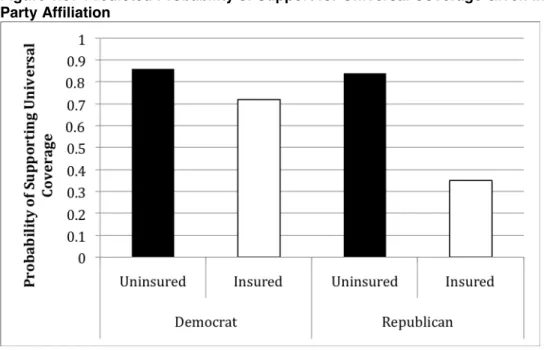
data are included in Table 1.2 as Model 3. Looking at Figure 1.3, there are two important features to
notice. First, there are no significant differences in preferences by party for self-interested individuals
with a tangible stake in the policy outcome. The probability of preferring universal coverage to the
current system is statistically the same for uninsured Democrats is (.86, 95% CI: .74, .98) and
uninsured Republicans (.84, 95% CI: .67, .99) 13. Second, insured Republicans, whose probability of supporting universal coverage is .35 (95% CI: .27, .44), are significantly different from uninsured
Republicans and all Democrats. The probability of preferring universal coverage to the current system
is .72 (95% CI: .65, .78) for insured Democrats, which is significantly lower than uninsured
Democrats. These results provide support for the idea that self-interest lessens individuals’ reliance
on symbolic cues in the political environment.
Figure 1.3: Predicted Probability of Support for Universal Coverage Given Insurance Status & Party Affiliation
Note: Predicted probabilities generated using the Integrated Model of Self-Interest from Table 1.2, Model 3. All other variables are held at their mean or modal value.
18
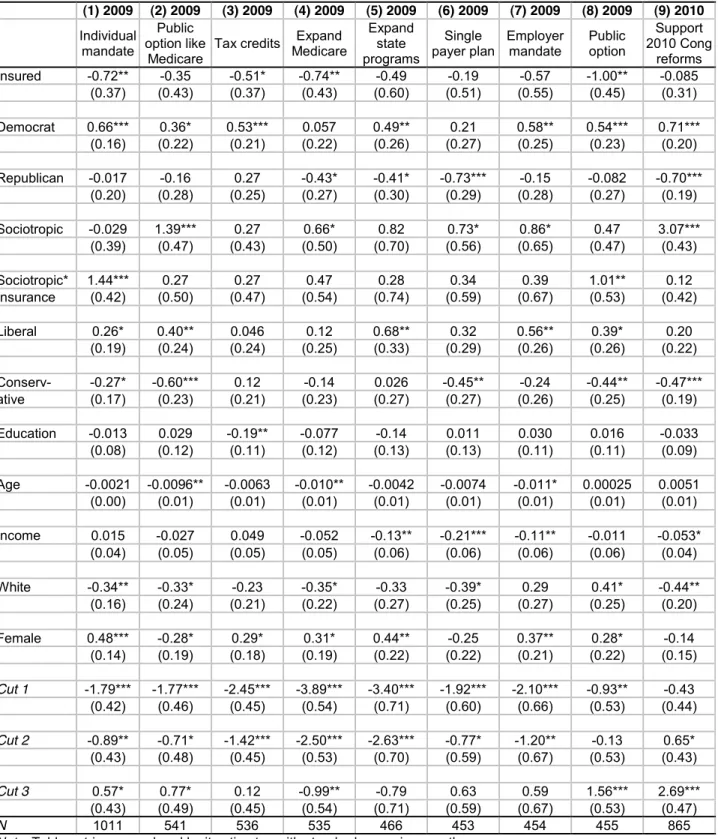
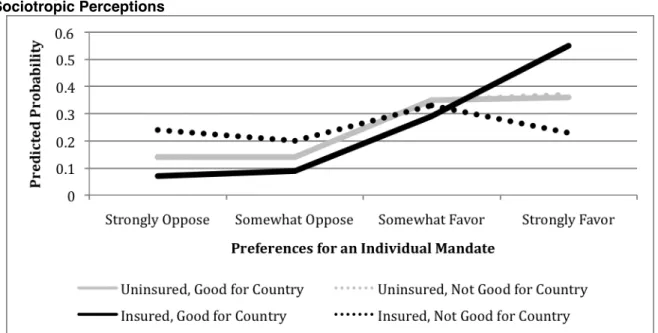
The Integrated Model of Self-Interest also predicts that self-interest should moderate the effects of sociotropic perceptions. The data for this expectation are presented in Table 1.4 and provide mixed evidence14. The interaction term between insurance status and perceptions that health reform will benefit the country as a whole is only significant in two of the nine models. Figure 1.4 depicts the predicted probabilities for Model 1. The dependent variable in this model is support for a mandate that all Americans have health insurance with financial assistance for those who cannot afford it. As seen in Figure 4, the influence of sociotropic perceptions is lessened for uninsured individuals. The proportion of uninsured respondents who oppose and support the individual
mandate is the same regardless of perceptions of how the policy will benefit the country as a whole. Among the insured, respondents who believe the individual mandate will benefit the country as a whole are more likely to support the policy compared to those respondents who believe the policy will not benefit the country. Although the finding of self-interest lessening the influence of sociotropic perceptions is as expected under the Integrated Model of Self-Interest in this case, the effect is not consistently significant.
19
Table 1.4: Preferences for Expanded Coverage Policies (2009-2010) Given Insurance Status and Sociotropic Perceptions
(1) 2009 (2) 2009 (3) 2009 (4) 2009 (5) 2009 (6) 2009 (7) 2009 (8) 2009 (9) 2010 Individual
mandate
Public option like
Medicare
Tax credits Medicare Expand Expand state programs
Single
payer plan Employer mandate Public option
Support 2010 Cong
reforms
Insured -0.72** -0.35 -0.51* -0.74** -0.49 -0.19 -0.57 -1.00** -0.085
(0.37) (0.43) (0.37) (0.43) (0.60) (0.51) (0.55) (0.45) (0.31)
Democrat 0.66*** 0.36* 0.53*** 0.057 0.49** 0.21 0.58** 0.54*** 0.71***
(0.16) (0.22) (0.21) (0.22) (0.26) (0.27) (0.25) (0.23) (0.20)
Republican -0.017 -0.16 0.27 -0.43* -0.41* -0.73*** -0.15 -0.082 -0.70***
(0.20) (0.28) (0.25) (0.27) (0.30) (0.29) (0.28) (0.27) (0.19)
Sociotropic -0.029 1.39*** 0.27 0.66* 0.82 0.73* 0.86* 0.47 3.07***
(0.39) (0.47) (0.43) (0.50) (0.70) (0.56) (0.65) (0.47) (0.43)
Sociotropic* 1.44*** 0.27 0.27 0.47 0.28 0.34 0.39 1.01** 0.12
Insurance (0.42) (0.50) (0.47) (0.54) (0.74) (0.59) (0.67) (0.53) (0.42)
Liberal 0.26* 0.40** 0.046 0.12 0.68** 0.32 0.56** 0.39* 0.20
(0.19) (0.24) (0.24) (0.25) (0.33) (0.29) (0.26) (0.26) (0.22)
Conserv- -0.27* -0.60*** 0.12 -0.14 0.026 -0.45** -0.24 -0.44** -0.47***
ative (0.17) (0.23) (0.21) (0.23) (0.27) (0.27) (0.26) (0.25) (0.19)
Education -0.013 0.029 -0.19** -0.077 -0.14 0.011 0.030 0.016 -0.033
(0.08) (0.12) (0.11) (0.12) (0.13) (0.13) (0.11) (0.11) (0.09)
Age -0.0021 -0.0096** -0.0063 -0.010** -0.0042 -0.0074 -0.011* 0.00025 0.0051
(0.00) (0.01) (0.01) (0.01) (0.01) (0.01) (0.01) (0.01) (0.01)
Income 0.015 -0.027 0.049 -0.052 -0.13** -0.21*** -0.11** -0.011 -0.053*
(0.04) (0.05) (0.05) (0.05) (0.06) (0.06) (0.06) (0.06) (0.04)
White -0.34** -0.33* -0.23 -0.35* -0.33 -0.39* 0.29 0.41* -0.44**
(0.16) (0.24) (0.21) (0.22) (0.27) (0.25) (0.27) (0.25) (0.20)
Female 0.48*** -0.28* 0.29* 0.31* 0.44** -0.25 0.37** 0.28* -0.14
(0.14) (0.19) (0.18) (0.19) (0.22) (0.22) (0.21) (0.22) (0.15)
Cut 1 -1.79*** -1.77*** -2.45*** -3.89*** -3.40*** -1.92*** -2.10*** -0.93** -0.43
(0.42) (0.46) (0.45) (0.54) (0.71) (0.60) (0.66) (0.53) (0.44)
Cut 2 -0.89** -0.71* -1.42*** -2.50*** -2.63*** -0.77* -1.20** -0.13 0.65*
(0.43) (0.48) (0.45) (0.53) (0.70) (0.59) (0.67) (0.53) (0.43)
Cut 3 0.57* 0.77* 0.12 -0.99** -0.79 0.63 0.59 1.56*** 2.69***
(0.43) (0.49) (0.45) (0.54) (0.71) (0.59) (0.67) (0.53) (0.47)
N 1011 541 536 535 466 453 454 455 865
20
Figure 1.4: Predicted Probability of Support for Universal Coverage Given Insurance Status & Sociotropic Perceptions
Note: Predicted probabilities generated using the Integrated Model of Self-Interest from Table 1.4, Model 1. All other variables are held at their mean or modal value.
Discussion
The results presented in the case of universal health insurance provide support for the
Integrated Model of Self-Interest. The theory generates three predictions. First, the effects of self-interest on policy attitudes will be significant when the consequences and benefits of the policy are
clear. The results support the hypothesis. The provision of expanded health care coverage and improved access provides a tangible benefit to those individuals without health insurance. Individuals
currently lacking health insurance, those with a tangible interest in the policy, were significantly more likely to support the policy. This effect persisted even when symbolic beliefs, such as party affiliation
and ideology, and sociotropic perceptions of the uninsured problem were controlled for in the model. The significant effect of self-interest found in this analysis differs from the results found in much of the
symbolic politics literature. According to the Integrated Model of Self-Interest, this discrepancy is explained by differences in the policy options under consideration. In the present study, the
dependent variables provide a policy option that clearly describes a new system of health care in which all individuals have some form of health insurance. This policy option poses tangible benefits
21
literature lacks these same characteristics. Under those conditions, when tangible policy effects are
not clear to respondents, the Integrated Model of Self-Interest would not predict significant effects for
self-interest.
Second, the Integrated Model of Self-Interest predicts that self-interest will moderate the
effects of symbolic beliefs and sociotropic perceptions. The results presented here for the case of
health care coverage and access preferences demonstrate significant differences between individuals
without an interest in the policy based on party affiliation, and no such differences between those
individuals with an interest in the policy. As expected, the uninsured were equally as likely to support
health coverage policies regardless of party affiliation. The Integrated Model of Self-Interest posits
that the uninsured are motivated to centrally process information in the political environment. The
data presented above provide evidence for the idea that Republicans without insurance relied less on
party message cues and formed attitudes in support of expanded health care coverage.
Furthermore, the insured, those without a tangible interest in the policy, showed significant
differences in support for universal coverage by party affiliation. This suggests that party messages
were processed peripherally as cues rather than elaborated upon centrally as arguments. Although
correlational in nature, these results provide support for the Integrated Model of Self-Interest’s
prediction that self-interest motivates individuals to centrally process political information, while those
without an interest are likely to accept the symbolic political information as a peripheral cue.
Similarly, the Integrated Model of Self-Interest also predicts that self-interest will moderate
the influence of sociotropic perceptions on policy attitudes. The evidence of this effect of self-interest
was weaker in the case of expanded health coverage policies. Insurance status significantly
moderated the influence of respondents’ perceptions that health reform would be good for the country
in a minority of the models presented. In the few cases where the effect was significant, the results
demonstrated the expected relationship. Uninsured individuals’ support for expanded health
coverage policies were equal regardless of their views about the effect of reform for the country as a
whole. Insured individuals’ support for the policies differed significantly according to their perceptions
22
ConclusionsThe Integrated Model of Self-Interest provides a new way of conceiving the role of
self-interest in politics. Self-self-interest serves to motivate individuals to carefully process the information
they receive from the political environment to form policy attitudes rather than simply relying on
symbolic cues or perceptions of the national situation. The Integrated Model of Self-Interest provides
insights into understanding the determinants of public policy attitudes. In the aggregate, these
attitudes function as inputs in the public policy process and serve as predictors of policy outcomes
(Erikson et al. 2002).
Additionally, the Integrated Model of Self-Interest may have implications for political behavior.
The attitudes formed by self-interested individuals are predicted to be strong and therefore more
predictive of behavior. Scholars have begun to explore the idea that self-interest may have more of a
political impact in terms of behavior than attitudes (William and Ratner 1998; Green and Cowden
1992). The Integrated Model of Self-Interest would provide a theoretical rationale for these
predictions. The model would predict that policy attitudes formed by self-interested individuals
demonstrate the attributes of all attitudes formed using central route processing such as persistence,
certainty, and improved likelihood to predict behavior. The data utilized for testing the hypotheses in
this study are not capable of evaluating this expectation of the theory. Future experimental work will
be needed to compare the characteristics of attitudes resulting from individuals lacking self-interest
and those with self-interest in a public policy. Testing the behavioral impact of the theory would
provide an even greater understanding of the subtle, but significant, role that self-interest plays in
Paper 2: When Self-interest and Self-identification Conflict
Self-interest is a concept germane to many theories in economics, political science, and
psychology. Although somewhat obscured by different terminology, such as vested interest or
personal relevance, the function of self-interest as a motivating force for individuals is prominent in
some of the most widely discussed and contested social science theories of this generation. While
many of these theories (e.g. dual process theories of attitude formation) assume self-interest as a
prime motivator of individual thought and behavior, other theories (e.g. symbolic politics) challenge
that notion directly. Furthermore, empirical evidence can be readily cited to support both positions.
Even the most cursory review of the literature surrounding self-interest will reveal an
important puzzle. A cumulative body of empirical evidence in social psychology research supports
the notion of self-interest as an important and relatively consistent force in the formation, structure,
and expression of attitudes. However, a more disjointed body of empirical evidence in the political
science literature finds self-interest to be an inconsistent and relatively weak predictor of political and
policy attitudes and behavior. Identifying a cohesive approach to studying the operation of
self-interest in the political context will have implications for several important political processes such as
the representation of interests, the translation of public opinion into public policy, and political
participation.
In this paper, I argue that the self-interest puzzle exists because political scientists have done
a poor job of incorporating the psychology of self-interest into their theories while social psychologists
have failed to incorporate the complexities of social contexts, like politics, into their theories. My goal
in this project is to overcome the theoretical and methodological differences between the two
disciplines in order to uncover an integrated understanding of self-interest. To do this, I develop the
24
conditional effects of self-interest within the dynamic political context. My general expectation is that
the realities of the political context condition the effects of self-interest seen in the psychological
literature. As a result, direct effects of self-interest are rare in politics, but important indirect effects
should be realized at the individual and aggregate levels.
I begin with a discussion of the arguments and theories surrounding self-interest in both
political science and social psychology. I then present the Integrated Model of Self-Interest and use
the theory to generate hypotheses about the role of self-interest in policy attitudes and behavior. I
present data from two survey-based experiments to evaluate the hypotheses. The results provide
evidence that self-interest moderates the effects of partisanship and that it has additional influence
beyond political attitudes including attitude strength and behavioral intentions.
The Role of Self-Interest in Politics
Political Preferences. Early theories of public opinion emphasized the role of self-interest
as a major determinant of individual preferences. Campbell et al. (1960) articulate a notion of public
policy preferences as mere expressions of primitive self-interest (Campbell et al 1960). Popkin et al.
(1976) assert that the influence of economic conditions on electoral outcomes results from individuals
basing their electoral decisions upon the tangible economic situations they face in their daily lives.
The self-interested motivations of these pocketbook voters served as a central theme in the work on
the political economy of individuals for several years.
Kinder and Kiewiet conducted the first critical investigation of the pocketbook voter
assumption (1981). In doing so, they defined the sociotropic voter as an individual influenced most of
all by the nation’s economic condition and not the condition of their own pocketbook (Kinder and
Kiewiet 1981). They argued that individuals develop rough evaluations of the nation’s economic
condition and place credit or blame on the incumbent government accordingly. Furthermore, they
showed that sociotropic perceptions are not simply expressions of ideological or partisan loyalties.
They and others showed that sociotropic perceptions are more predictive of vote choice than
pocketbook considerations (Fiorina 1981; Kinder and Kiewiet 1981; Kinder 1981; Lewis-Beck 1988).
Kinder and Kiewiet (1981) expressed an agnostic belief about the motivation driving
25
altruism. Sociotropic politics, they believed, could very well be a politics of indirect self-interest, but
they were unable to adequately test for this possibility. Several scholars have since taken up this
issue and the evidence that has accumulated suggests that sociotropic politics are not indirect
expressions of self-interest. Evaluations of group fairness, social value commitments, and beliefs in
economic individualism seem to moderate the role of self-interest and bolster the effect of sociotropic
perceptions (Mutz and Mondak 1997; Funk 2000; Funk and Garcia-Monet 1997; Feldman 1982).
At about the same time that the sociotropic politics literature began questioning the role of
self-interest, work by Sears and his colleagues explored the relative contribution of self-interested
motivations compared to symbolic beliefs about race1, political parties, and ideology in predicting
policy preferences and political behaviors (Kinder and Sears 1981; Lau et al. 1978; Sears et al.
1980). Their studies found little or no effect of self-interest on policy preferences across a number of
domains. Even when self-interest effects were present, their explanatory power compared to
symbolic beliefs was quite small. A recent replication and update of the original work confirms the
dominant role of symbolic beliefs (Lau 2007).
Overall then, the bulk of the evidence from the sociotropic perceptions and symbolic beliefs
literatures reduces self-interest to a negligible determinant of policy preferences. However, several
studies do find a role for self-interest when examining preferences for policies that offer clear benefits
or costs (Sears and Citrin 1985; Dixon et al. 1991; Wolpert and Gimpel 1998). Furthermore, survey
and laboratory based experiments demonstrate that priming interest can induce significant
self-interest effects in policy preferences (Sears and Lau 1983; Chong et al. 2001). Taken together, these
results suggest that theories of political attitude determinants should not be so quick to dismiss the
role of self-interest. The empirical data imply that the role of self-interest is conditional and the
evidence to date implies that self-interest is most likely to have an impact on attitudes when an
individual is aware of his or her self-interest and when the implications of the policy options for the
individual are clear. The Integrated Model of Self-Interest that I develop provides a theoretical
framework for understanding these mixed findings.
1 Early work by Sears and colleagues on symbolic racism has been criticized for methodological
26
Political Behavior. Although the evidence for a connection between self-interest and
political preferences is, at best, irregular, more consistency can be found in the connection between self-interest and political behavior. Several studies utilizing local political events at the level of the university (Regan and Fazio 1977), the metropolitan area (Green and Cowden 1992), the state (Sivacek and Crano 1982), or national policy (Ratner and Miller 2001) confirm a weak or non-existent connection between self-interest and attitudes, but a strong connection between self-interest and political behaviors such as petition signing, contacting representatives, and participation in relevant interest organizations. For example, Green and Cowden (1992) look for the effect of self-interest in a policy area where the effects of symbolic politics are often cited as more powerful than self-interest. They examine busing proposals to integrate schools and find that attitudes in opposition to the policy were equal among affected and unaffected whites. However, affected whites were significantly more likely to participate in anti-busing organizations than unaffected whites. The researchers of the aforementioned studies differ in their specific explanations of the causal mechanisms driving the self-interest and behavior connection, a point I elaborate upon more fully in a later section. The basic sentiment in this body of research is that self-interest may not have any influence on the low-cost act of expressing an attitude, but it can influence the decision to engage in more costly behaviors.
Beyond the explicit investigation of self-interest’s influence on political behaviors, a role for self-interest is apparent in other models of behavior. For example, rational choice models applied to voting, for example, attempt to explain how individuals act given their preferences (Downs 1957; Aldrich 1993). Self-interest, in addition to other values (Mansbridge 1995), is often the assumed antecedent to the exogenously fixed preferences of individuals in these models. While rational choice models take preferences and their antecedents as givens, the Integrated Model of Self-Interest explains the mechanisms and consequences of how these preferences are formed.
The Role of Self-Interest in Social Psychology
Attitude Formation. Dual process theories of attitude formation provide an account of how
27
two models, which offer distinct but related accounts of attitude formation, the ELM provides the
clearest way to think about self-interest in regard to attitude formation.
The ELM puts forth two routes that individuals might take when forming an attitude (Petty and
Cacioppo 1981). Individuals who are both motivated and able to cognitively process information
relevant to the attitude are likely to take the central route to forming attitudes, which involves more
cognitive processing and leads to relatively strong attitudes (Petty et al. 1995). These individuals are
said to have high elaboration likelihood. High elaboration indicates a process in which individuals
carefully attend to issue messages, access relevant information from memory, elaborate upon the
message using the information from memory, and form an attitude based on this analysis (Petty and
Cacioppo 1986). Research on the ELM finds that personal relevance (i.e. self-interest), which occurs
when an issue has significant consequences for the individual, motivates individuals to engage in
central route processing (Petty and Cacioppo 1979) 2. Individuals lacking the motivation or ability to
process information are likely to take the peripheral route to forming an attitude, such that they rely on
simple cues and heuristics rather than cognitive processing. These individuals are said to have low
elaboration likelihood as they do not attend carefully to the message or undergo a process of
accessing relevant information from memory3.
Attitude Strength. As implied by the dual process models, not all attitudes are equal. Some attitudes are considered stronger than others according to the degree to which an attitude is
persistent, resistant to change, affects information processes, and is predictive of behavior (Krosnick
and Petty 1995). The empirical evidence is accumulating in favor of the view that attitude strength is
not a single construct, but rather several theoretically and methodologically distinct concepts including
2 Individuals can be motivated to use central route processing for several reasons. In addition to the
motivation of self-interest (i.e. personal relevance) discussed in this project, another well researched motivation is an individual’s need for cognition. Individuals high in need for cognition (NFC) enjoy engaging in effortful and analytic thinking (Cacioppo and Petty 1982).
3 It should be noted that individuals who rely exclusively on cues or who engage fully in cognitive
processing occupy the endpoints of the elaboration likelihood continuum. Most individuals fall somewhere along the continuum such that they utilize both arguments and cues to form their
28
attitude importance, accessibility, certainty, ambivalence, and extremity (Miller and Peterson 2004;
Boninger et al. 1995; Visser et al. 2003).
Attitude importance is frequently linked to self-interest in the literature. Attitude importance is
defined as an “individual’s subjective sense of the concern, caring, and significance he or she
attaches to an attitude” (Boninger et al. 1995, p.62). Attitude importance is a subjective judgment an
individual makes about his or her own attitude. Because individuals are generally aware of what
issues they feel passionately about, the concept of attitude importance is commonly operationalized
using a straightforward question(s) about the degree to which the respondent is concerned and cares
about the issue. Important attitudes have several consequences relevant to understanding political
public opinion. For example, important attitudes are associated with information storage and retrieval
processes that improve levels of knowledge accumulation and accurate recall (Krosnick 1990,
Holbrook et al. 2005).
The research to date identifies three significant causes of attitude importance: material
self-interest, personal values, and social identifications. Both survey and experimental data suggest that
each antecedent has an independent and significant effect on attitude importance (Boninger et al.
1995). First, when a person’s attitude becomes instrumental to personal outcomes, like tangible
rights, privileges, or lifestyle, material self-interest can lead to attitude importance (Johnson and Eagly
1989, Boninger et al. 1995). In the political realm, policies for which people perceive a direct stake in
their outcome are likely to activate self-interest (Pompkin et al. 1976). Second, when an individual
relates the attitude object to his or her personal values, the attitude is likely to be personally important
(Boninger et al. 1995). Values guide individuals to determine what attitudes and beliefs are worth
caring about (Rokeach 1968). To the extent that an issue and a value are linked, an individual will
consider the attitude to be important (Boninger et al. 1995). Third, when a social group that a person
identifies with becomes linked to an attitude, the individual may consider the attitude to be personally
important. There are two possible mechanisms for this link. First, an attitude may become important
if the rights of an individual’s group are challenged, even if the individual is not personally affected
(Modigliani and Gamson 1979). For example, a retired woman may consider her attitudes on an
29
materially impacted by the policy. Second, an attitude may become important for an individual
because the group considers the issue important (Sherif and Hovland 1961). Per the previous
example, if the National Organization for Woman declares the equal pay policy a top priority, the
retired woman who identifies with the group may reflect that priority in her personal attitudes.
The implication of this research for politics is that individuals with a self-interest in an issue
are likely to form strong attitudes about the issue, and in particular, consider those attitudes to be
personally important. But, this implication fails to consider the complexities of the political context. If
self-interest, social identifications, and values all have independent effects on attitude importance, we
need to consider the common political situation in which an individual’s self-interest does not comport
with his or her social identifications or values on a particular issue. This complexity is exactly what
the Integrated Model of Self-Interest is able to address.
The Attitude-Behavior Connection. The initial explosion of social psychological research
related to attitudes was based, in large part, on the assumption that attitudes guide behavior. This
assumption was challenged directly in the late sixties when evidence against attitude-behavior
consistency was produced in study after study (Wicker 1969, Abelson 1972, Rokeach 1968). The
field then shifted direction and began a line of research on the moderators of the attitude-behavior
connection (Ajzen and Fishbein 1977, Fazio and Zanna 1981). Moderators of the attitude-behavior
connection range from methodological issues such as ensuring comparable specificity of attitude and
behavior measurement (Ajzen and Fazio 1977), qualities of individuals such as self-monitoring
(Snyder 1987), qualities of the context such as social norms (Ajzen and Fishbein 1980), and qualities
of attitude strength such as importance or accessibility (Krosnick and Petty 1995, Fazio 2000).
There are three moderators of the attitude-behavior connection that explicitly or implicitly
involve self-interest. The first moderator is direct behavioral experience. In one study involving an
undergraduate housing shortage, researchers found higher levels of attitude-behavior consistency
among students with direct, personal experience with the shortage than students with only second
hand knowledge of the shortage (Regan and Fazio 1977). Additional laboratory experiments find
support for the idea that individuals who form their attitudes based on personal involvement with the