ESTIMATION AND TESTING OF PARAMETERS UNDER
CONSTRAINTS FOR CORRELATED DATA
Laura Farnan
A dissertation submitted to the faculty of the University of North Carolina at Chapel Hill in partial fulfillment of the requirements for the degree of Doctor of Philosophy in the Department of Biostatistics, Gillings School of Global Public Health.
Chapel Hill 2011
Approved by:
Shyamal D. Peddada, PhD Anastasia Ivanova, PhD Pranab K. Sen, PhD Bahjat F. Qaqish, PhD
© 2011 Laura Farnan
ABSTRACT
LAURA FARNAN: Estimation and Testing of Parameters under Constraints for Correlated Data
(Under direction of Dr. Shyamal D. Peddada and Dr. Anastasia Ivanova)
This dissertation work is motivated by problems encountered in the analysis of
some toxicological and clinical trials data, where repeated measurements are made on
each subject, and the investigator expects trends in mean response among dose groups
and/or time points. There are two components to this research. The first component
focuses on estimation of parameters subject to inequality constraints when the covariance
matrix of the unrestricted estimator is non-diagonal. In particular, statistical properties of
several available constrained estimators are investigated theoretically and via simulations
under different covariance structures. The second component is developing a simple, yet
statistically appropriate methodology for testing hypotheses in a linear mixed effects
model with an inequality constraint in the alternative. Since in many applications one
cannot be certain about the normality of the data, a bootstrap based methodology using
MINQUE-Williams’ type test is implemented for testing the above hypotheses. The
resulting methodology is illustrated by re-analyzing the blood mercury level data
ACKNOWLEDGEMENTS
Now, that my dissertation is drawing to a close, I would like to acknowledge all
those people who have made it such a success. Firstly, I would like to thank my advisors
Dr. Shyamal D. Peddada and Dr. Anastasia Ivanova. Not only did they provide guidance
in research, but they also offered a lot of emotional support and encouragement along the
way.
I would also like to sincerely thank Dr. Pranab K. Sen, Dr. Bahjat F. Qaqish, and
Dr. Amanda H. Corbett for being on my advisory committee and for providing insightful
comments that have definitely made my dissertation better. I certainly appreciate NIEHS
researcher Dr. Walter Rogan for providing the data for the analysis.
I am extremely thankful to Dr. Marijus Radavičius, a professor at Vilnius
University. He encouraged me to start research in a field that I was truly passionate
about (applications of statistics in medicine) and to pursue my doctoral studies abroad.
I would also like to thank Dr. Jeannette Bensen, a Co-Director of the North
Carolina-Louisiana Prostate Cancer Study (PCaP), for being such an awesome employer.
Beyond the mere financial support her employment provided, I truly appreciate her
understanding, patience and support at times when I needed it the most.
Finally, I would like to thank my husband and daughter, as I certainly would not
have been able to complete this journey without them - my husband Kirby for all his
encouragement and support during the difficult times, and my daughter Katie for her
TABLE OF CONTENTS
LIST OF TABLES ... ix
LIST OF FIGURES ... xi
I. INTRODUCTION – LITERATURE REVIEW ...1
1.1. Motivation ... 1
1.2. Methods of estimation ... 4
1.2.1. Some special covariance structures... 11
1.3. Testing of hypotheses... 14
II. CONSTRAINED ESTIMATION AND THE PERFORMANCE OF PAVA...20
2.1. Performance of PAVA in the case of p = 2... 22
2.2. Performance of PAVA for p > 2 under various covariance structures... 23
2.2.1. SBD covariance structure... 23
2.2.2. Covariance matrices where 1 is an eigenvector ... 28
2.2.3. Star-shaped order covariance structure ... 28
2.3. Conclusions and recommendations ... 29
III. CONSTRAINED TESTING IN A LINEAR MIXED EFFECTS MODEL...33
3.1. The model and notations ... 34
3.2. The likelihood ratio test under homoscedastic errors... 36
3.4.1. Homoscedastic errors ... 42
3.4.2. Heteroscedastic errors ... 43
3.5. MINQUE-Williams based methodology... 43
3.5.1. Homoscedastic errors ... 47
3.5.2. Heteroscedastic errors ... 49
3.6. Some concluding remarks ... 50
IV. SIMULATION STUDIES FOR CONSTRAINED TESTING IN LINEAR MIXED EFFECTS MODELS ...56
4.1. Normally distributed data... 56
4.1.1. Study design ... 56
4.1.2. Results for homoscedastic case ... 58
4.1.3. Results for heteroscedastic case ... 60
4.1.4. Robustness under the misspecified covariance structure ... 63
4.2. Non-normally distributed data ... 65
4.2.1. Log-normally distributed data... 66
4.2.2. A mixture of two normally distributed random variables... 71
4.2.3. Gamma-distributed random errors ... 72
4.3. Concluding remarks and recommendations ... 73
V. ILLUSTRATION ...75
VI. SUMMARY AND CONCLUDING REMARKS ...81
APPENDICES ...85
A Proofs and additional lemmas of Chapter 2... 85
B Proofs of Chapter 3 ... 99
LIST OF TABLES
Table
5.1. Mean blood concentration of organic mercury in children given placebo ... 78
5.2. Mean blood concentration of organic mercury in children given succimer ... 79
7.1. Abbreviations for tests... 107
7.2. Type I errors for homoscedastic normally distributed data ... 107
7.3. Power for homoscedastic normally distributed data... 108
7.4. Type I errors for heteroscedastic normally distributed data ... 108
7.5. Power for heteroscedastic normally distributed data... 108
7.6. Type I errors for normally distributed data with an unspecified covariance matrix... 109
7.7. Power for normally distributed data with an unspecified covariance matrix ... 109
7.8. Type I errors for normally distributed data with the auto-correlation covariance matrix ... 110
7.9. Power for normally distributed data with the auto-correlation covariance matrix ... 110
7.10. Type I errors for homoscedastic log-normally distributed data... 111
7.11. Power for homoscedastic log-normally distributed data ... 111
7.12. Type I errors for heteroscedastic log-normally distributed data... 111
7.13. Power for heteroscedastic log-normally distributed data ... 112
7.14. Type I errors for the mixture of two normally distributed random variables ... 112
7.15. Power for the mixture of two normally distributed random variables... 113
7.16. Type I errors when random errors follow gamma distribution... 113
7.17. Power when random errors follow gamma distribution ... 113
7.18. Type I errors for homoscedastic normally distributed data ... 114
LIST OF FIGURES
Figure
1. Examples of some order restrictions. ... 5
2. Star-shaped ordering... 8
3. MSE and Coverage Probability of
θ
1 ... 214. MSE of
θ
2 as a function ofσ
2... 235. Total MSE as a function of
σ
2 ... 256. MSE and Coverage Probability of
θ
1 and θp as a function of σ2 ... 267. MSE and Coverage Probability of θ1 as a function of σ2 ... 27
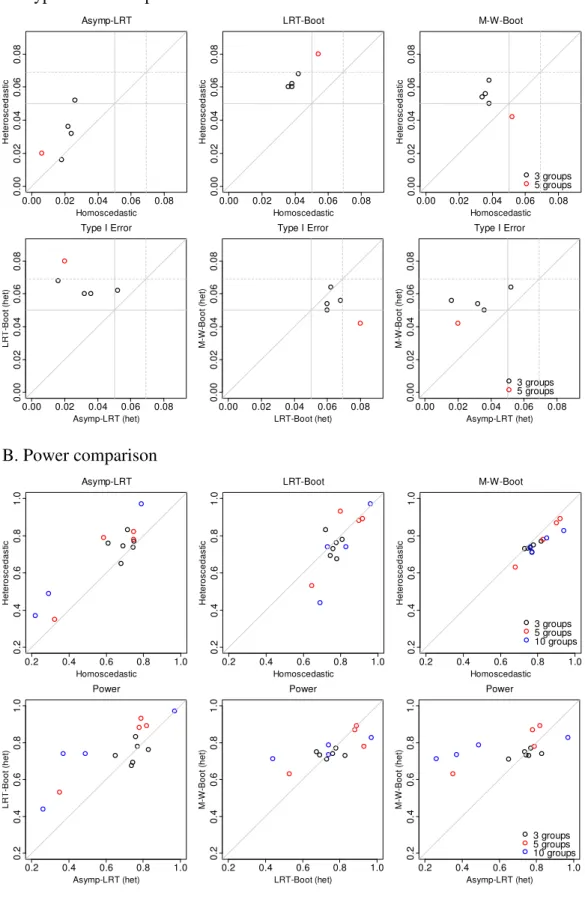
8. Type I Error and Power of homoscedastic tests on the normally distributed homoscedastic data... 58
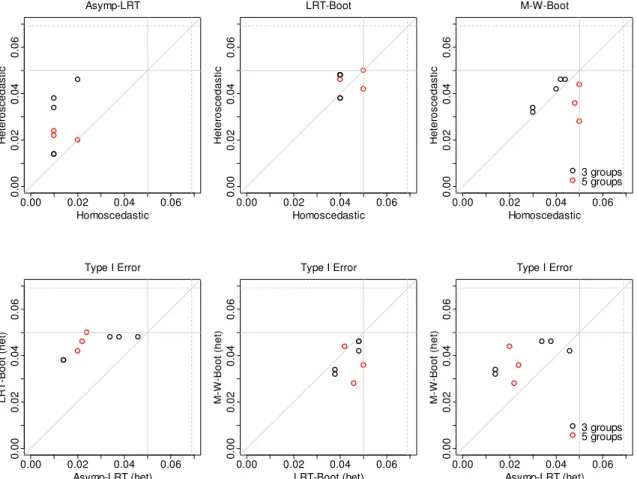
9. Comparison of Type I Error and power of heteroscedastic tests on the normally distributed homoscedastic data... 59
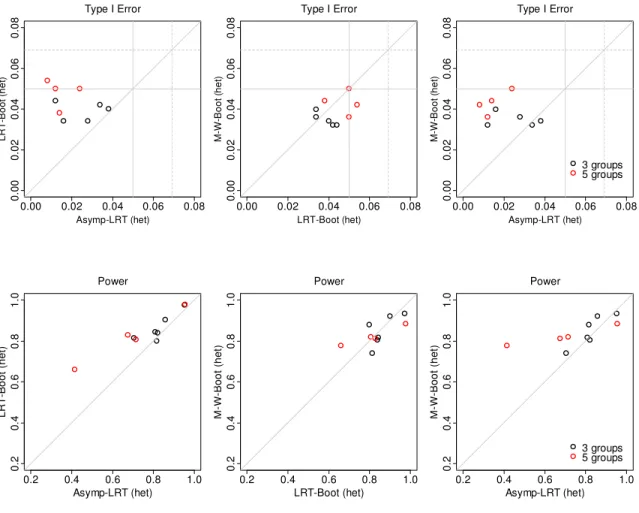
10. Type I Error and Power of heteroscedastic tests on the normally distributed heteroscedastic data ... 61
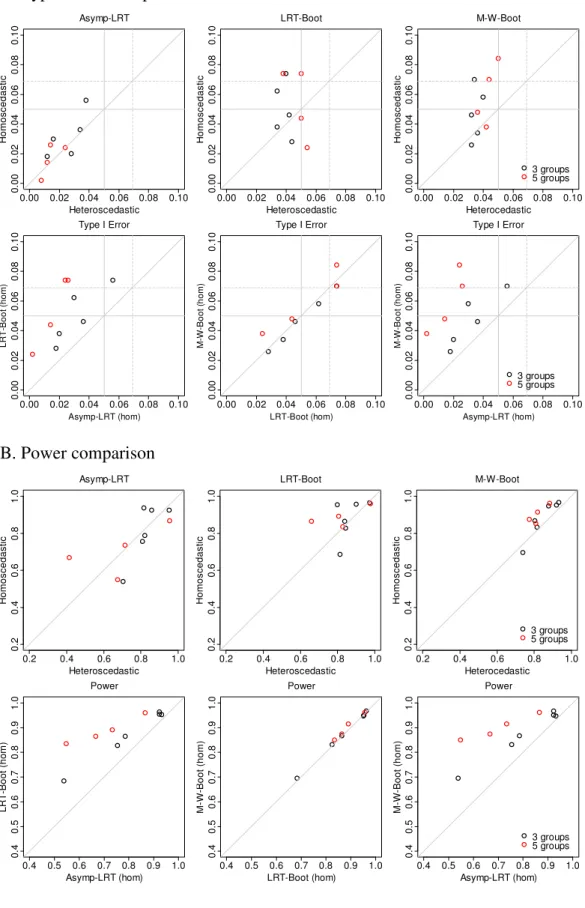
11. Comparison of Type I Error and Power of homoscedastic tests on the normally distributed heteroscedastic data... 62
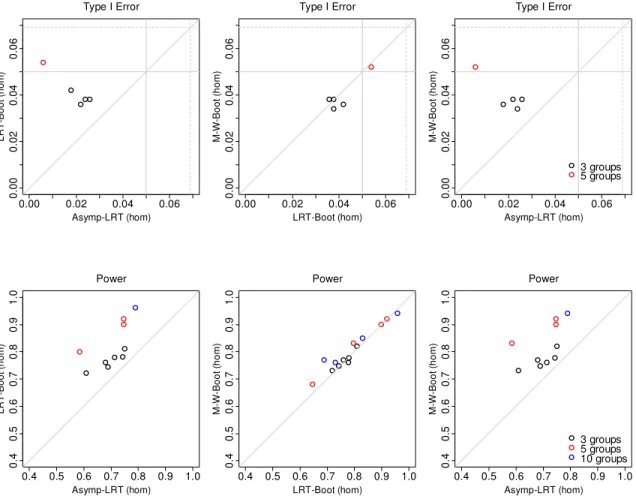
12. Type I errors under the misspecified covariance matrix. ... 65
13. Type I Error and Power of homoscedastic tests on the log-normally distributed homoscedastic data... 67
14. Comparison of Type I Error and power of heteroscedastic tests on the log-normally distributed homoscedastic data ... 68
15. Type I Error and Power of heteroscedastic tests on the log-normally distributed heteroscedastic data ... 69
16. Comparison of Type I Error and Power of homoscedastic tests on the log-normally distributed heteroscedastic data ... 70
18. Type I errors of a proposed test for a mixture of two normally
distributed random variables ... 72 19. Type I errors of a proposed test when random errors follow the gamma distribution ... 73 20. Normal probability plots of organic mercury level in log-scale
for placebo and succimer groups. ... 77 21. Histograms of organic mercury level in log-scale for placebo and succimer groups... 77 22. Studentized residuals by time point... 78 23. Estimated mean blood log concentration of organic mercury in
CHAPTER 1
INTRODUCTION – LITERATURE REVIEW
1.1.Motivation
This dissertation work is motivated by problems encountered in the analysis of
some toxicological data and clinical trials data, where repeated measurements are made
on each subject, and the investigator expects trends in mean response among dose groups
and/or time points. For example, Cao et al., 2011 were interested whether succimer, a
mercaptan compound known to reduce blood lead concentration in children, also reduces
blood mercury concentration. They used samples from a randomized placebo-controlled,
double-blind trial clinical trial of succimer for lead poisoning in 780 children aged 12-33
months, called the Treatment of Lead-exposed Children trial, or TLC (Rogan, 1998). In
TLC, 384 children were assigned to the placebo group and 396 to the succimer group.
Up to three 26-day courses of succimer or placebo therapy were administered, depending
on response to treatment in those, who were given succimer. For children in each group,
blood lead concentrations were obtained twice before randomization and then on days 7,
28, and 42 after the beginning of each course of treatment. After treatment was stopped,
blood lead levels were measured every three to four months until 36 months after the
initiation of treatment. Cao et al. (2011) measured mercury in pre-treatment samples
in 1-week post-treatment blood samples (N = 768) and in a 20% random sample of the
338 children who received the maximum 3 courses of treatment.
In addition to the presence of variance components, the data can be potentially
heteroscedastic since the variability across time may not necessarily be constant. Very
little literature exists on constrained inference in linear mixed models even under
homoscedasticity, let alone under heteroscedasticity. Silvapulle (1997) proposed a
methodology for testing linear constraints regarding fixed effects parameters under some
conditions on the design matrices. The resulting test procedure does not depend upon the
unknown variance components, thus ignores correlations within the subject over time.
Thus the methodology developed in Silvapulle (1997) is restrictive and is not applicable
to the present context. As observed in Hoferkamp and Peddada (2002), the biggest
challenge in linear mixed models with or without heteroscedasticity is the derivation of
restricted maximum likelihood estimators (RMLE) for various parameters of the model.
Consequently, the derivation of the likelihood ratio test is non-trivial and has not been
derived in the literature so far.
Examples such as the above one are rather common in applications, and often
researchers tend to use the classical mixed effects analysis of variance followed by
“post-hoc” analyses to make pair-wise comparisons rather than testing for the desired order
restriction. There is clearly a demand for well developed theory and methodology for
such problems.
Another example that motivated this research is a recently published
dose of an investigational drug. The objectives of this trial were estimation of the mean
response (measured in minutes) under the assumption that mean responses are
constrained by an umbrella order and comparing the best dose with placebo and control.
Since each subject received two different doses (one of which was dose 0 mg, placebo),
unrestricted estimates of mean response were correlated. Instead of maximizing the
likelihood under restrictions while taking into account correlation structure, the
investigators obtained unrestricted estimates first, while taking into account correlation
structure and then obtained parameter estimates using a simpler method that is based on a
well known pool adjacent violators algorithm (PAVA) (Silvapulle and Sen, 2005). The
PAVA is used when non-decreasing order is assumed and proceeds as follows. If a pair
of adjacent unrestricted estimates violates the hypothesized order, then, according to the
algorithm, each such pair of estimates is replaced by their average. The process is
repeated until all estimates satisfy the hypothesized order. Although PAVA is a very
convenient methodology to implement, as described in the following sections, very little
is known about theoretical properties of PAVA.
Motivated by the above applications, in this dissertation research we will focus on
two aspects of constrained inference; (a) estimation of parameters for correlated data
subject to inequality constraints, and (b) testing hypothesis for correlated data under
inequality constraints. In section 1.2, we will review the literature on the estimation of
parameters under constraints, when the underlying data are correlated, and in section 1.3
1.2.Methods of estimation
Let
(
θ θ1, 2,..,θp)
′ =
θ θθ
θ denote an unknown parameter vector whose components
satisfy inequality constraints. Problem of estimating parameters under constraints arises
for a variety of reasons. In some applications, such as in dose-finding clinical trials,
constrained estimation plays an important role for determining dose at which the next
patient needs to be treated (Stylianou and Flournoy, 2002; Ivanova et al., 2009; Conaway,
Dunbar and Peddada, 2004). In other situations, such as in toxicology, researchers are
often interested in testing for patterns of response. Again, in all such situations one needs
to perform constrained testing of parameters. For example, toxicologists are usually
interested in testing the hypothesis that the tumor incidence rate increases with the dose
of a toxin, i.e. testing H0:θ1=θ2 =…=θp against
1 2
:
A p
H θ ≤θ ≤…≤θ , known as
simple order restriction (Peddada, Dinse and Kissling, 2007). Similarly, when
comparing multiple toxins with the control, toxicologists often test the hypothesis that the
tumor incidence due to a toxin is larger than the tumor incidence due to control, i.e., test
0: 1 2 p
H θ =θ =…=θ against 1
:
A i
H θ ≤θ , i≥2, known as simple tree order. In all such situations, the test statistic requires the estimation of parameters under the inequalities
specified by the alternative hypothesis.
A variety of inequality constraints have been discussed in the literature, such as
the simple order θ1≤θ2 ≤…≤θp, the umbrella order
1 2 i i 1 p
θ ≤θ ≤…≤θ ≥θ+ ≥…≥θ , the
single loop order, etc. (Stylianou and Flournoy, 2002; Ivanova et al., 2009; Conaway et
Often order restrictions can be expressed using graphs as shown in Figure 1. In
Chapter 3 we will focus on simple order restriction (a).
Figure 1. Examples of some order restrictions.
There exists over 50 years of literature on the estimation and testing of hypothesis
under inequality constraints on the parameters θ θ1, 2,..,θp in a variety of settings. For a
comprehensive review on estimation and testing of parameters under constraints, one
may refer to Silvapulle and Sen (2005) and van Eeden (2006). Much of the literature is
based on the likelihood principle. However, as reviewed in van Eeden (2006) and
Silvapulle and Sen (2005), several alternative estimation and testing procedures have
been proposed in the literature. They are often computationally simpler to implement and
are designed for the specific parametric model and specific order restrictions. Among
these methods, PAVA is one of the most popular methods for estimating parameters
under simple order restriction.
Suppose ˆUMLE
(
θˆ1UMLE,θˆ2UMLE,..,θˆUMLEp)
′ =
θ θθ
θ is an unrestricted estimator of θθθθ , where
the components of ˆUMLE
(
ˆ1UMLE, ˆ2UMLE,.., ˆUMLE)
pθ θ θ ′
= θ θθ
θ are independently distributed, then
(
)
2 1ˆ
min ,
p
UMLE
i i i
C i
w
θ
θ
∈ =
−
∑
θ θθ
θ (1)
where C is the set of known inequalities satisfied by the components of θθθθ, and wi is
some known weight, usually taken to be the reciprocal of the variance of
θ
ˆiUMLE.If C is a subset of the parameter space satisfying simple order constraints, then the above minimization problem (1) is often solved by using the well-known pool
adjacent violator algorithm (PAVA) (cf. Silvapulle and Sen, 2005). Analytically, the
PAVA estimator for θi,i=1,2,...,p under θ1≤θ2 ≤...≤θp is given by the following equivalent formulae (cf van Eeden, 2006):
( )
1
ˆ
ˆ min max
t
UMLE j j j s PAVA p
i i t p s i t j j s w
w
θ
θ
=≤ ≤ ≤ ≤
= =
∑
∑
(2)1
ˆ max min
t
UMLE j j j s
t i t p s i
j j s w
w
θ
=
≤ ≤ ≤ ≤
= =
∑
∑
,where
(
)
1 . ˆ
j UMLE
j w
Var
θ
= The superscript (p) in ˆPAVA p( )
i
θ denotes the PAVA estimate of
i
θ
based on p groups.If the components of
θ
θθ
θ
ˆ
UMLE are independently and normally distributed with known variances, then PAVA results in the restricted maximum likelihood estimatoris derived by solving the following constrained minimization problem, where Σ is the (known) covariance matrix of
θ
θθ
θ
ˆ
UMLE:(
)
1(
)
C
ˆ ˆ
min UMLE − UMLE .
∈
′
− Σ −
θ θθ
θ
θ
θ
θ
θ
θ
θ
θ
θ
θ
θ
θ
θ
θ
θ
θ
θ
(3)Diaz and González (1988) identified some sufficient conditions on Σ for which PAVA and RMLE are the same. For example, the sufficient conditions are satisfied
when Σ is an intra-class correlation matrix. In general, however, they are not the same. If the unconstrained estimator is multivariate normally distributed, then the above
minimization problem results in RMLE. Again, we emphasize on the fact that PAVA, as
well as the solution to (3), provides robust estimators to θθθθ by not relying on the
knowledge of the underlying likelihood function which may not always be known.
Furthermore, the computation of the RMLE may not always be straightforward,
especially when Σ is unknown (Shi, Zheng and Guo, 2005; Hoferkamp and Peddada, 2002). Also, as observed by several authors (cf. Lee, 1988; Fernandez, Rueda and
Salvador, 1999), the RMLE may not always perform well in terms of the mean squared
error even when Σ is known. Hwang and Peddada (1994) argued that the RMLE is not only universally dominated by the UMLE under certain conditions, but any fixed width
confidence interval centered at the RMLE may actually have a zero coverage probability
as p increases. They surprisingly note that the RMLE may fail even in the case of simple order when the underlying covariance matrix is non-diagonal.
As an example of the RMLE failing in the case of some specific covariance
matrix, let us discuss an example of star-shaped ordering presented by Shaked (1979).
Consider a species consisting of k individuals each of which has a quantitative
generation by
µ
i+1≥0. The expected value of X of the population in generation i is denoted byθ
i. Assume that k new individuals are produced in each generation, are added to the population, and thatµ
i+1≥θ
i (i.e. X is improving on the average). Theexpected value of X in generation i is
(
1 2 ...)
i i i
θ
=µ
+µ
+ +µ
andθ
i+1≥θ
i for all i=1,…,p−1. (4)Figure 2. Star-shaped ordering
In this example µµµµ=
(
µ µ1, 2,…,µp)
satisfies star-shaped order restriction(
)
(
)
1 1 2 2 ... 1 2 ... p p
µ
≤µ
+µ
≤ ≤µ
+µ
+ +µ
and θθθθ =(
θ θ1, 2,…,θp)
satisfies thesimple order restriction
θ
1 ≤θ
2 ≤...≤θ
p. Thus, if X~ N( , )µµµµ I and(
1)
ˆ ... ,
i X Xi i
non-results indicate that RMLE is dominated by PAVA and, as the dimension p increases, it is also dominated by UMLE. These results are consistent with findings of Hwang and
Peddada (1994). This example is revisited on page 13.
PAVA is widely used even in situations where the unrestricted estimators are not
independently distributed, due to its computational simplicity. For instance, in clinical
trials involving repeated measurements on the same subject, Ivanova et al. (2009)
describe a proof-of-concept trial with crossover allocation, where PAVA was used to
estimate the target dose at the end of the trial. Other examples where PAVA was used for
correlated data include multidimensional scaling (Robertson, Wright and Dykstra, 1988),
non-parametric semi-variogram estimation (Kim and Boos, 2004), linear models with
covariates (Bretz, 2006), general constrained smoothing (Mammen, Marron, Turlach and
Wand, 2001), estimation of the baseline survivor function in a proportional hazard model
(Young, Jewell and Samuels, 2008; Li and Tseng, 2008), analysis of functional magnetic
resonance imaging (FMRI) data (Woolrich, Ripley, Brady and Smith, 2001), and ranking
and selection (Huang, 1984).
Shin et al. (1996) demonstrated that the solution to (3) is asymptotically equal to
the solution of
(
) (
1)
C
ˆ ˆ
min UMLE UMLE
∈
′
− Ω −
θ θθ
θ θθθθ θθθθ θθθθ θθθθ , where
Ω
1 is a suitable diagonal matrix.Thus by choosing suitable weights, one may solve the simpler isotonic regression
problem (1) using standard PAVA, which only requires a simple hand held calculator
rather than solving the optimization problem (3).
Although PAVA is widely used even when the components of
θ
θθ
θ
ˆ
UMLE are not independent, there do not seem to exist any results in the literature on the performance ofPAVA and solution to (3), with the exception of Diaz and González (1988) who identify
sufficient conditions under which PAVA provides the solution to (3).
In Chapter 2, PAVA will be evaluated in terms of mean squared error and
universal domination criterion (Hwang, 1985) under the assumption, that the unrestricted
estimator is multivariate normally distributed. For a pair of univariate estimators ηˆ1 and
2
ˆ
η of a parameter
η
, ηˆ1 is said to universally dominate (also known as stochasticallydominate) ηˆ2 if for all η and all c>0, P
(
|ηˆ1−η|<c)
≥P(
|ηˆ2 −η|<c)
with a strict inequality for someη
. Equivalently, ηˆ1 is said to universally dominate ηˆ2 if(
| ˆ1 |)
(
| ˆ2 |)
Eφ η −η ≤Eφ η −η for all non-decreasing functions
φ
with a strict inequality for someη
. We demonstrate, that under certain conditions the RMLEdominates the PAVA estimator in terms of the mean squared error when p=2, and that under certain conditions the PAVA estimator dominates the UMLE. In the case of p>2 we will consider a variety of covariance structures, that are commonly encountered in the
theory of experimental designs, clinical trials, econometrics, etc. Under certain
conditions on the elements of the covariance matrix we demonstrate that the PAVA
estimator universally dominates the UMLE. Since for certain patterns of covariance
matrices, the PAVA estimator and the RMLE are the same (Diaz and González, 1988),
thus, in such situations we actually derive universal domination results for the RMLE.
1.2.1. Some special covariance structures
Since it may not be possible to investigate the properties of the PAVA estimator
for arbitrary covariance matrices, in this dissertation the universal domination of the
PAVA estimator over the UMLE will be explored under some special covariance
structures. The covariance structures considered in this dissertation are described below.
1.2.1.1.Supplemented balance designs (SBD)
There exists an exhaustive amount of literature on experimental designs for
comparing treatment groups against a control group. For an efficient design it is well
known that the number of replicates for the control group should be larger than the total
number of treatment groups (Pearce, 1960). The basic idea of SBD is to “supplement”
(also referred to as “augment” or “reinforce”) a block design consisting of p−1 treatment groups by m replicates of the control group in each block. Typically these designs are such, that every pair of treatments occurs with equal frequency in all blocks,
and the frequency of co-occurrence of a treatment and the control is constant in all
blocks. Pearce (1960) termed these designs Supplemented Balance Designs (SBD). Properties of such designs have been well studied in the literature (Stufken, 1987;
Hedayat, Jacroux and Majumdar, 1988; Gupta, 1989). Consider a SBD where
observations are taken in blocks of size m+
(
p−1)
n, with m observations in a block taken on the control treatment, i=1, and n observations taken on each of the treatments2, ,
i= … p. Observations are normally distributed with variance σ2
. While
each block are assumed to be correlated with a correlation coefficient ρɶ. Denote
[
]
2 2
1 1 (m 1) m
σ
=σ
+ −ρ
ɶ , 2 2[
]
2 1 (n 1) n
σ
=σ
+ −ρ
ɶ and[
1 (m 1)]
m[
1 (n 1)]
nρ
ρ
ρ
ρ
=
+ − + −
ɶ
ɶ ɶ .
Let ˆθθθθUMLE denote the UMLE of θθθθ . The first component of θθθθ is the mean of the control group, and the remaining p−1 components are the means of the treatment groups. Then the variance-covariance matrix of the vector ˆθUMLE
θθ
θ is
2
1 1 2
2
1 2 2
σ
ρσ σ
ρσ σ
σ
′
=
Σ
K
1
1 , (5)
where 1 is a vector of 1s, ρ ≥ −1 (p−2) and K=(1−ρ)I+ρJ. As usual, I denotes the
(
p−1) (
× p−1)
identity matrix, and J is a(
p−1) (
× p−1)
matrix of 1s (see Nigam et al., 1988, for more details).Note that the above covariance structure also arises naturally in other contexts as
well, such as graphical models (Whittaker, 1990; Lauritzen, 1996), and lattice model
(Andersson and Perlman, 1993; Dempster, 1972). For a review on Σ one may refer to Sun and Sun (2005), where the authors consider a more general form of this matrix.
In this dissertation we focus on estimation of the control mean θ1, the largest
mean θp and elementary contrasts of treatment means with the control mean θi−θ1,
2, 3, ,
i= … p under the constraint that
1 2 ... p
θ ≤θ ≤ ≤θ . In section 2.2 (page 23) we
present Theorem 2.2 demonstrating that in case of SBD covariance structure (5) and
the control and the highest dose groups. Supporting simulation results are presented in
Figure 5 and Figure 6.
We also argue that, since Theorem 2.2 also holds in the case of simple tree order
restriction as well, PAVA may perform better than UMLE for the control group in this
case. Results of supporting simulation studies are presented in Figure 7.
1.2.1.2.Designs where 1 is an eigenvector of the covariance matrix
There are many designs used in clinical trials and in other applications where
every principal sub-matrix of Σ has 1=(1,1,...,1) ' as an eigenvector. Some common examples include: (a) the intra-class covariance matrix of the form Σ=αI+βJ, where
J is a matrix of 1’s, (b) cross-over designs where patients in Group A receive treatments
1, 3, 5, etc, patients in Group B receive treatments 2, 4, 6, etc; all observations have the
same variance, and the correlation coefficient within subject is same in both groups, and
(c) covariance matrix of elementary contrasts
(
2 1 3 1 1)
ˆ ˆUMLE ˆUMLE, ˆUMLE ˆUMLE,..., ˆUMLE ˆUMLE p
θ θ θ θ θ θ ′
= − − −
δδδδ in a SBD.
1.2.1.3.Covariance matrix in a star-shaped ordering
Suppose X ~ N( , )
µ
µ
µ
µ
I , then the components ofµ
µ
µ
µ
are said to satisfy a star-shaped order if µ1≤(
µ1+µ2)
2≤...≤(
µ1+µ2 +...+µp)
p. As discussed in Shaked (1979) and Dykstra and Robertson (1982), star-shaped order restriction arises naturally in manyapplications. Performing a liner transformation θˆi =
(
X1+...+ Xi)
i, we have ˆ ~ ( , )N Σθ θ
θ θ
θ θ
θ θ with
θ
i =(
µ
1+...+µ
i)
i satisfying the simple order restriction pθ
θ
1 1 2 1 3 1
1 2 1 2 1 3 1
1 3 1 3 1 3 1
1 1 1 1
p p p
p p p p
=
Σ
… … …
⋮ ⋮ ⋮ ⋱ ⋮
…
. (6)
In section 2.2 (page 29), we present Theorem 2.3 demonstrating that in case of
star-shaped order restriction on the mean components, PAVA may perform better than
UMLE for the control group. Supporting simulation results are presented in Figure 3.
1.3.Testing of hypotheses
Testing hypotheses under inequality constraints is a well researched area. For a
comprehensive account, one may refer to the recent book by Silvapulle and Sen (2005).
In addition to the standard likelihood ratio test, a variety of alternative tests are available
for comparing means of two or more independent normal populations when no covariates
are present. Suppose θθθθˆUMLE ~N( ,θθθθ σ2I) and suppose one is interested in testing the following hypotheses regarding the components of θθθθ , where the alternative hypothesis is
the simple tree order
0: 1 2 p versus A: 1 i, 2
H θ =θ =…=θ H θ ≤θ ≤ ≤i p
(with at least one strict inequality). In addition to the classical likelihood ratio test, a
popular alternative test for testing the above hypotheses is the Dunnett’s test (Dunnett,
1955), which is defined as follows. For an elementary contrast θi −θ1, the UMLE is
1
ˆUMLE ˆUMLE i
θ
−θ
, i≥2. An estimator of the variance of this estimator is given by(
ˆ ˆ)
2ˆ UMLE UMLE 2ˆ
linear model. The Dunnett’s test statistic is given by max ˆiUMLE ˆ1UMLE ˆ 2 .
i θ −θ σ As
noted by Marcus and Talpaz (1992), a potential weakness of this statistic is that its
numerator does not use the inequality constraint specified by the alternative hypothesis.
Accordingly, they modified the numerator of the statistic by replacing the UMLE by the
RMLE of θθθθ under the simple tree order constraint. Although the resulting test improves
the power of Dunnett’s test for certain choices of θθθθ , it is surprising that it does not
improve the power uniformly for all θθθθ . More recently Tang and Lin (1997) introduced
an Approximate Likelihood Ratio (ALR) test that can be used for testing the above
hypothesis. A distinct advantage of ALR is that it is computationally simple to
implement for any p and it performs very well in terms of power in comparison to both the classical likelihood ratio test as well as Dunnett’s test for certain choices of θθθθ . The
procedure of Marcus and Talpaz (1992) was inspired by the earlier papers of Williams
(1971, 1972, 1977). In his 1971 and 1972 papers, Williams discussed the problem of
comparing means of the treatment groups with the control group in a dose response study
where the population means are assumed to be non-decreasing with dose (i.e.
1 2 ... p
θ ≤θ ≤ ≤θ ). In Williams (1971) the test statistic was
(
1)
ˆ ˆ
ˆ 2
RMLE UMLE p
θ
θ
σ
−
, where as in
Williams (1972) he used
(
1)
ˆ ˆ
ˆ 2
RMLE RMLE p
θ
θ
σ
−
, where
θ
ˆRMLE is the RMLE under the simpleorder constraint. In his 1977 paper, Williams considered the problem of testing
0: 1 2 ... p
H
θ
=θ
= =θ
versus Ha:θ
1≤θ
2 ≤...≤θ
p (with at least one strict inequality)using the statistic
(
1)
ˆ ˆ
ˆ 2
RMLE RMLE p
θ
θ
σ
−
Nonparametric versions of Dunnett's test and Williams’ test were also developed
in the literature using rank based methods by Dunn (1964) and Shirley (1977),
respectively. These methods are widely used in practice for their practical simplicity, and
simulation studies reported in the literature suggest, that these methods compete very
well against the likelihood ratio tests.
It is reasonable to anticipate or assume a monotonic mean response in dose
response studies conducted by toxicologists. In such situations, the Williams’ test (1972,
1977) tends to have a higher power than the Dunnett’s test when comparing the mean
response at the highest dose with that of the control group. However, there are instances
where, perhaps due to toxicity at high doses, the mean response at the higher doses may
change direction resulting in a down-turn (or up-turn) in the mean response. In such
situations, the Williams’ test (1972, 1977) loses power in comparison to the Dunnett’s
test when comparing the mean of the highest dose with the control. Typically, in the
analysis of their 90 day pre-chronic rodent cancer studies, the National Toxicology
Program (NTP) uses either Dunnett’s test or Williams’ test depending upon the data –
which is unsatisfactory. Since in practice it is not feasible to determine a priori whether
the departure from monotonic response will take place or not, it is important to develop a
method that would be robust to both possibilities. In Peddada et al. (2006) such a robust
procedure was developed using the point estimators developed in Hwang and Peddada
(1994). The resulting methodology seems to perform as well as the Williams’ test when
the mean responses are monotonic in dose and performs as well as Dunnett’s test when
In many applications such as in epidemiology, researchers are often interested in
testing for the equality of mean responses of various groups against the alternative
hypothesis that the means are constrained by some inequality constraints, after adjusting
for various covariates. Often such problems can be formulated using fixed effects linear
models and applying the likelihood ratio methodology as detailed in Silvapulle and Sen
(2005). Several variations to the likelihood ratio principle have been proposed in the
literature. As previously stated, the likelihood ratio principle provides a rich framework
to conduct the analyses of such data. In the presence of covariates (whether continuous
or categorical), the unrestricted estimators of treatment means are not necessarily
independently distributed. In such a case, as noted in the previous sections and in Hwang
and Peddada (1994) and others, the RMLE may not perform well as an estimator of the
mean vector. Consequently, one cannot assume that the likelihood ratio based methods
would perform well in terms of power since they use RMLE. For this reason, Betcher
and Peddada (2009) developed a Dunnett-type test statistic that uses a modified RMLE as
the point estimator of the mean vector. Based on the simulation studies reported in
Betcher and Peddada (2009), in the case of simple order, their new method provides
better confidence intervals than those based on RMLE.
Constrained inference in linear mixed effects models arises naturally in many
applications, such as the ones described in this Chapter1. Specifically, they arise
naturally in the context of repeated measurement designs. Silvapulle (1997) proposed a
simple methodology for testing linear constraints regarding fixed effects parameters
under some conditions on the design matrices. The resulting test procedure does not
In the case of general mixed effects models, a natural strategy for testing for
inequalities among treatment effects after adjusting for covariates would be to develop a
likelihood ratio test. Such a strategy necessarily requires the derivation of RMLE under
inequality constraints. As noted in the literature, this is a very challenging problem.
Hoferkamp and Peddada (2002) proposed an EM based algorithm for estimating
regression parameters under constraints, when the error variances are heteroscedastic and
potentially subject to inequality constraints. Under some conditions on design matrices,
they discussed the convergence of their algorithm. Recently, Shi et al. (2005) addressed
the problem in a slightly different context. They considered the usual fixed effects model
but allowed the error variance to be multivariate normally distributed with an unknown
non-diagonal covariance matrix Σ. Thus, unlike the linear mixed effects model where
Σ has a special structure, in Shi et al. (2005) it was not constrained by a particular structure.
They developed EM algorithm to estimate regression parameters subject to
inequality constraints in such a linear model and identified conditions under which the
EM algorithm converges. None of these papers discusses the problem of testing
regression parameters under constraints in a linear mixed effects model. They are all
limited to the constrained estimation problem and none of these papers address the testing
problem.
Apart from the earlier attempts in some special cases, tests for linear mixed
models under inequality constraints on the fixed effects parameters has not been well
case when normal populations are correlated as in a repeated measurements design. In
this paper, the author does not include any covariates. Silvapulle (1997) generalized
Mukerjee (1988) to some unbalanced designs with incomplete data. He noted that
within-subject correlations make it difficult to generalize some tests into repeated models.
Earlier, Singh and Wright (1990) considered order restricted inference on fixed effects in
a two-factor mixed model. They presented an analogue to the usual F-test for homogeneity and obtained several closed-form results.
There did not exist a systematic general methodology for the analysis of linear
mixed effects models, when the regression parameters are subject to inequality
constraints, until Davidov and Rosen (2011), who derived the likelihood ratio test for
testing the hypotheses of the type H0:
η
η
η
η
=0 vs HA:η
η
η
η
≥0 when 2N
σ =
Σ I . In Section 3.2, the likelihood ratio test of Davidov and Rosen (2011) is reviewed, and in Section 3.3,
the likelihood ratio test under heteroscedastic error structure
1 2
2 2 2
1 n : 2 n : : k nk
diag
σ
σ
σ
=
Σ I I … I is derived. Motivated by various limitations of these
likelihood ratio tests, in Section 3.4 an EBLUP bootstrap methodology is described under
homoscedastic as well as heteroscedastic error structures. An alternative method
analogous to Williams (1971) and based on Rao’s MINQUE theory (1970, 1971, 1972) is
explored in Section 3.5. In Chapter 4, extensive simulation studies are performed to
evaluate the performance of various tests in terms of the Type I error and power. Since
very limited literature is available for this very important practical problem, this
dissertation work extends the existing knowledge in this field substantially. The
proposed methodologies are illustrated in Chapter 5 using the recently published
CHAPTER 2
CONSTRAINED ESTIMATION AND THE PERFORMANCE
OF PAVA
In this section, we will describe some of the theoretical and simulation results
obtained so far in this dissertation with regards to the constrained estimation problem.
Proofs of theorems are presented in Appendix A.
We assume that UMLE of θθθθ ,
θ
θθ
θ
ˆUMLE, is distributed according to a multivariate normal distribution with mean θθθθ and covariance matrix Σ. As often done, without loss of generality, unless stated otherwise, we assume the sample size of 1, because it can beabsorbed in Σ. In general, the order restricted estimators (whether RMLE or other constrained estimators) do not always perform well in all settings. Their performance
depends upon the type of inequality constraints as well as the covariance structure and the
dimension p (cf. Lee, 1988; Hwang and Peddada, 1994; Fernandez et al., 1999).
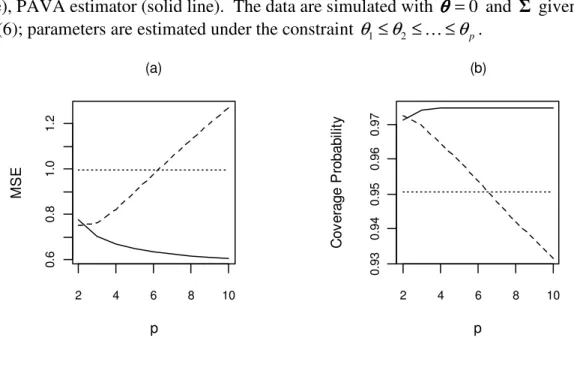
To illustrate this point, we provide results of a small simulation study in Figure 3.
In this study, we simulated data from a -variatep normal distribution with mean vector 0
= θ θθ
θ and covariance matrix Σ given by (6).
Under the constraint
θ
1 ≤θ
2 ≤…≤θ
p, we estimated the MSE of the UMLE,PAVA estimator, i.e. P
(
θ
ˆ1UMLE−θ
1 <1.96)
, P(
θ
ˆ1RMLE −θ
1 <1.96)
and(
ˆ1 1 1.96)
PAVA
P
θ
−θ
< (Figure 3 (b)). We chose the value of 1.96, because for this valueof the critical constant, the confidence interval centered at UMLE has a coverage
probability of 0.95. All results are based on 100,000 simulation runs.
Figure 3. MSE and Coverage Probability of
θ
1: UMLE (dotted line), RMLE (dashed line), PAVA estimator (solid line). The data are simulated with θθθθ =0 and Σ given by (6); parameters are estimated under the constraintθ
1≤θ
2 ≤…≤θ
p.From the Figure 3, it is clear that for the covariance matrix considered in this
example, the RMLE performs poorly both in terms of MSE as well as the coverage
probability, as p increases, while the PAVA estimator performs the best. In view of the above illustration and the fact that PAVA is widely used in practice even for correlated
data, we investigate its performance relative to UMLE in terms of universal domination
criterion.
2 4 6 8 10
0
.6
0
.8
1
.0
1
.2
(a)
p
M
S
E
2 4 6 8 10
0
.9
3
0
.9
4
0
.9
5
0
.9
6
0
.9
7
(b)
p
C
o
v
e
ra
g
e
P
ro
b
a
b
ili
2.1.Performance of PAVA in the case of p = 2
We begin by comparing the MSE of the UMLE, RMLE and PAVA estimator for
2
p= to demonstrate that, even in this simple setting, the performance of PAVA can depend upon the underlying correlation structure. We assume that ˆUMLE
(
,)
N Σ
∼
θ θ
θθ θθ
θ θ ,
1 2
θ
≤θ
and the elements of Σ have no special structure with Var(
θ
ˆ1UMLE)
=σ
12,(
)
22 2
ˆUMLE
Var
θ
=σ
, and Cov(
θ
ˆ1UMLE,θ
ˆ2UMLE)
=ρσ σ
1 2.Theorem 2.1:
(a) If
ρ
≤0 and eitherθ
2 ≥θ
1≥0 or 0≥θ
2 ≥θ
1, thenE(
θ
ˆ2PAVA −θ
2)2 ≤E(θ
ˆ2 −θ
2)2;(b) if
θ
1≤θ
2 andρ σ
( 2 −σ
1)(ρσ
2 −σ
1)≥0, thenE(
θ
ˆ2RMLE −θ
2)2≤E(θ
ˆ2PAVA−θ
2)2.To understand the performance of PAVA in the case, when the sufficient
conditions of Theorem 2.1 are not true, we simulated the data from bivariate normal
distributions with mean vector
(
0, 0)
′,σ
1 =1,ρ
=0.9 andσ
2 ranging from 0.1 to 1.4.Under the constraint θ1≤θ2, the estimated MSE of UMLE, RMLE and PAVA estimator
Figure4. MSE of
θ
2 as a function ofσ
2: UMLE (dotted line), RMLE (dashed line), PAVA estimator (solid line). The data are simulated withθ
1 =θ
2 =0,ρ
=0.9,σ
1=1; parameters are estimated under the constraintθ
1≤θ
2. Shaded area shows the values of2
σ
, where the conditions of Theorem 2.1 are satisfied, i.e.,σ
2 ≥σ ρ
1 .0.2 0.6 1.0 1.4
0
.0
0
.5
1
.0
1
.5
2
.0
σ2
M
S
E
Theorem 2.1, together with Figure4, suggests that the performance of PAVA
depends upon the underlying correlation structure even in the case of p=2. We note from Figure4, that RMLE performs better than PAVA for the choice of parameters
considered in this simulation study. In view of the above findings, we deduce that
domination results may not exist for arbitrary covariance structures when p>2. Therefore in section 2.2 we consider some covariance structures that arise naturally in
many applications and investigate the performance of PAVA relative to UMLE for those
structures.
2.2.Performance of PAVA for p > 2 under various covariance structures
2.2.1. SBD covariance structure
It is well-known that in many situations the total MSE of the RMLE is smaller
than that of the UMLE (cf. Fernandez et al., 1999). Surprisingly, based on a small
estimator is not only smaller than the total MSE of the UMLE but it is almost as small as
the total MSE of the RMLE, if not smaller. We find this to be an interesting and a
surprising result. In this simulation experiment,
θ
θθ
θ
ˆUMLE, the UMLE ofθθ
θ
θ
, was generated according to a multivariate normal distribution with meanθθ
θ
θ
and the covariance matrix given by (5), p=10,σ
1=1 andρ
=0.4. However, since it is well-known thatreduction in the total MSE does not necessarily imply a reduction in the MSE of
individual coordinates (Lee, 1988; Fernandez et al., 1999), in Figure 6 we investigated
the performance of the PAVA estimator of the control mean
θ
1 and the largest meanθ
pin terms of universal domination criterion. We identify sufficient conditions, under which
PAVA performs better than UMLE. Recall from Hwang (1985) that universal
domination is equivalent to domination in terms of all monotonic functions of quadratic
loss and hence implies domination in terms of MSE. Analytical comparisons between
PAVA and RMLE appear to be intractable and hence are not discussed here.
Theorem 2.2: Suppose θθθθˆUMLE ∼N
(
θθθθ,Σ)
, where Σ is of the form (5) and suppose1 2 ... p
θ ≤θ ≤ ≤θ .
(a) If either
2 2
1 2
1 2
( 1 / )
0,
( 1)( 2 2 / )
p
p p
σ
σ
ρ
σ
σ
− +
− < <
− − +
σ
1 <σ
2 orρ
>0,σ
1 >σ
2, then forall c>0, P
(
θ
ˆ1PAVA p( ) −θ
1 <c) (
≥Pθ
ˆ1UMLE−θ
1 <c)
.(b) If either
2 2
1 2
1 2
1 2
( 1 / )
0,
( 1)( 2 2 / )
p
p p
σ
σ
ρ
σ
σ
σ
σ
− +
− < < >
− − + or
1 2
0
ρ
σ
1σ
< < < , then for all
c>0,
(
ˆPAVA p( )) (
ˆUMLE)
p p p p
Figure 5. Total MSE as a function of
σ
2: UMLE (dotted line), RMLE (dashed line), PAVA estimator (solid line). The data are simulated with p=10,θ
i =0, i=1,…, ,p Σgiven by (5),
ρ
=0.4,σ
1=1; parameters are estimated under the constraint1 2 p
θ
≤θ
≤…≤θ
.0 2 4 6 8 10
0
2
0
0
6
0
0
σ2
T
o
ta
l
M
S
E
We performed extensive simulation studies to compare UMLE, RMLE and
PAVA including the situations where the sufficient conditions of the above theorem are
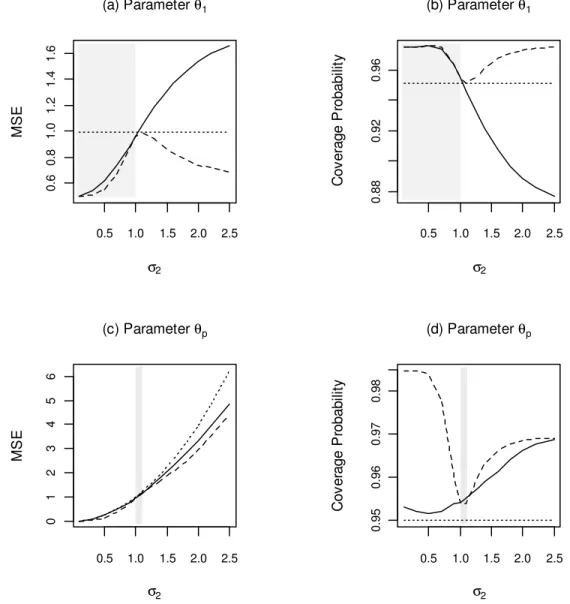
not satisfied. A small sample of the results is provided in Figure 6. As expected, PAVA
performs well in terms of MSE as well as the coverage probability, when the sufficient
conditions of Theorem 2.2 are satisfied. However, its performance can be rather poor
when the sufficient conditions are not satisfied. It is important to recognize that the
sufficient conditions provided in parts (a) and (b) of Theorem 2.2 are disjoint. Together
with the fact that simulation results suggest these conditions may even be necessary, we
Figure 6. MSE and Coverage Probability of
θ
1 andθ
p as a function ofσ
2: UMLE(dotted line), RMLE (dashed line), PAVA estimator (solid line). The data are simulated with p=5,
θ
i =0, i=1,…,p, Σ given by (5),ρ
=0.9,1 1
σ
= ; parameters are estimated under the constraintθ
1≤θ
2 ≤…≤θ
p. Shaded area shows the values of2
σ
, where the conditions of Theorem 2.2 are satisfied, i.e.σ
2 <σ
1 for (a), (b) and1 2 1
σ
<σ
<σ ρ
for (c), (d).0.5 1.0 1.5 2.0 2.5
0
.6
0
.8
1
.0
1
.2
1
.4
1
.6
(a) Parameter θ1
σ2
M
S
E
0.5 1.0 1.5 2.0 2.5
0
.8
8
0
.9
2
0
.9
6
(b) Parameter θ1
σ2
C
o
v
e
ra
g
e
P
ro
b
a
b
ili
ty
0.5 1.0 1.5 2.0 2.5
0
1
2
3
4
5
6
(c) Parameter θp
σ2
M
S
E
0.5 1.0 1.5 2.0 2.5
(d) Parameter θp
σ2
C
o
v
e
ra
g
e
P
ro
b
a
b
ili
ty
0
.9
5
0
.9
6
0
.9
7
0
.9
8
Note that the proof of Theorem 2.2 does not use any information regarding the
1 ( ) 1 1 1 ˆ
ˆ min .
t UMLE j j j PAVA p t t p j j w w θ θ = ≤ ≤ = =
∑
∑
Corollary 1: Suppose θθθθˆUMLE ∼ N
(
θθθθ,Σ)
, where Σ is of the form (5) and suppose1 i
θ ≤θ ,
2
i ≥ . If either
2 2
1 2
1 2
( 1 / )
0,
( 1)( 2 2 / )
p p p σ σ ρ σ σ − +
− < <
− − + σ1 <σ2 or ρ >0, σ1 >σ2, then
for all c>0, P
(
θ
ˆ1PAVA p( ) −θ
1 <c) (
≥Pθ
ˆ1UMLE −θ
1 <c)
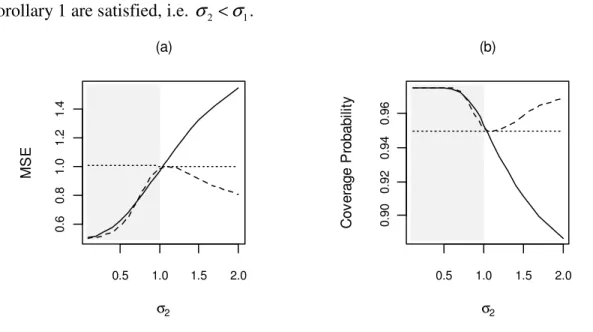
.Again, as above, the simulation results provided in Figure 7 suggest that PAVA
performs very well relative to both UMLE and RMLE when the sufficient conditions of
Corollary 1 are satisfied (shaded area). Otherwise, its performance can be very poor
(unshaded area).
Figure 7. MSE and Coverage Probability of θ1 as a function of σ2: UMLE (dotted line), RMLE (dashed line), PAVA estimator (solid line). The data are simulated with p=5,
0
i
θ
= , i=1,…,p, Σ given by (5),ρ
=0.9,1 1
σ
= ; parameters are estimated under the constraint θ1 ≤θi, i ≥2. Shaded area shows the values of σ2 where the conditions of Corollary 1 are satisfied, i.e. σ2 <σ1.0.5 1.0 1.5 2.0
0 .6 0 .8 1 .0 1 .2 1 .4 (a) σ2 M S E
0.5 1.0 1.5 2.0
2.2.2. Covariance matrices where 1 is an eigenvector
Recall the design described in section 1.2 on page 13, where every principal
sub-matrix of Σ has 1=(1,1,...,1) ' as an eigenvector. Following arguments similar to those
in the proof of Theorem 2.2 or by appealing to Hwang and Peddada (1994), we deduce
the following important corollary. Note that, different from Theorem 2.2, the following
result applies to all coordinates of the mean vector .θθθθ
Corollary 2: Suppose θθθθˆUMLE ∼N
(
θθθθ,Σ)
. If every principal sub-matrix of Σ has(1,1,...,1) '
1= as an eigenvector, and suppose that
θ
1 ≤θ
2 ≤...≤θ
p, then for all 1, 2,...,i= p and c>0, P
(
θ
ˆiPAVA p( )−θ
i <c) (
≥Pθ
ˆiUMLE −θ
i <c)
.In the case of intra-class covariance structure, from Theorem 2.2 of Diaz and
González (1988), we deduce that RMLE and PAVA are identical. Hence in that case the
above corollary applies to RMLE as well.
2.2.3. Star-shaped order covariance structure
Recall the star-shaped order restriction (defined in section 1.2.1 on page 13) with
covariance matrix Σ given by (6). Appealing to Theorem 2.2 in Diaz and González (1988) we note that PAVA and RMLE of µ are the same, but PAVA and RMLE of θ
are not the same. As observed in the simulation study reported in Figure 3, RMLE of θ1
Theorem 2.3: Suppose θθθθˆUMLE ∼ N
(
θθθθ,Σ)
, where(
)
1, 2,..., p
θ θ
θ
=
θ
θθ
θ
,θ
1≤θ
2 ≤...≤θ
p, and Σ is given by (6). For all c>0, P(
θ
ˆ1PAVA p( ) −θ
1 <c) (
≥Pθ
ˆ1UMLE −θ
1 <c)
.2.3.Conclusions and recommendations
Often in clinical trials repeated measurements are made on each subject, the
investigator expects trends in the mean response among dose groups and/or time points,
and the problem of interest is to estimate and test parameters under such constraints on
the mean responses. For example, Ivanova et al. (2009) describe such a Phase II trial,
where each patient received control and two doses of the drug. The Pool Adjacent
Violators Algorithm (PAVA) was designed for estimating parameters under the simple
order restriction (i.e. increasing or decreasing order among the mean responses), when
unrestricted estimators of parameters are independent. However, PAVA is also often
used even when unrestricted estimators are correlated. Based on the results obtained in
this research, it appears that simple PAVA based algorithms may be reasonable even if
the unrestricted estimators are correlated.
For example, in a Supplemented Balance Design (SBD), where a researcher is
interested in estimating elementary contrasts of each dose group with the control group
(under the constraint that the mean responses are monotonic in dose), we found that the
confidence interval centered at PAVA estimate of an elementary contrast between the
dose group and the control group will have larger coverage probability than the
confidence interval centered at the UMLE of the contrast. Thus, PAVA is recommended
over UMLE for estimating all elementary contrasts of dose groups with the control group.
covariance matrix of the sample mean vector has an intra-class covariance structure and
satisfies the conditions of Corollary 2; thus, PAVA is recommended over UMLE for
estimating all treatment means under the simple order constraint, and also, all elementary
contrasts when they are subject to the simple order constraint. We also note that for
estimating the control group mean (under either simple order or simple tree order
restriction on treatment means), the PAVA performs better than the UMLE if: 1) the
variance in the control group is smaller than the variance in the treatment group and the
correlation between groups is negative or 2) the variance in the control group is larger
than the variance in the treatment group, and the correlation between groups is positive.
There are situations in clinical trials, when a large number of treatments need to
be compared, and not all treatments can be present in each block. In such case, a
balanced incomplete block design (BIBD) may be considered. For illustration, consider a
dose-response study consisting of control, low-dose and high-dose groups of a drug, and
litters of mice are taken to be blocks. A BIBD can be constructed as follows. Suppose
each block (litter) consists of two pups. The pups in the first block are randomly
assigned to either control or low-dose group; pups in the second block are randomly
assigned to either control or high-dose group; and the pups in the third block are
randomly assigned to the low or high-dose group. The resulting design is a BIBD.
A feature of a BIBD is that all blocks have the same number of treatments, and all
treatments, as well as all pairs of treatments, are observed the same number of times in
the experiment. Furthermore, the correlation coefficient between sample means is
BIBD has an intra-class covariance structure. Thus, the covariance matrix satisfies the
conditions of Corollary 2. Note that the randomized complete block design (RCBD) can
be thought as a special case of BIBD. Thus, Corollary 2 also applies to an RCBD. Thus,
in these cases PAVA is recommended over UMLE for estimating all treatment means
under the simple order constraint, and more importantly, all elementary contrasts when
they are subject to simple order constraint. Again, a confidence interval centered at
PAVA of any such contrast will have larger coverage probability than the confidence
interval centered at the UMLE of the contrast.
Analytical comparisons between PAVA and RMLE appeared to be intractable and
hence were not discussed in Chapter 2. However, performed simulations indicate that the
RMLE might perform better or worse than PAVA, depending on the covariance matrix of
the UMLE. It is known that in many situations the total mean squared error (MSE) of the
RMLE is smaller than that of the UMLE. Surprisingly, based on a small simulation study
under SBD, when the variance in the control group is smaller than the variance in the
treatment group, and the correlation between groups is positive, we discover that the total
MSE of the PAVA estimator is not only smaller than the total MSE of the UMLE, but it
is also smaller than the total MSE of the RMLE. Note, that if variances of the control
group and treatment group under a SBD are equal, RMLE and PAVA estimates of
treatment means under the simple order constraint are the same. Star-shaped order is a
known example where the RMLE does not perform well. We have shown that PAVA is
superior to UMLE as well as RMLE for estimating the control mean in the case, where
In general, it may not be possible to recommend an estimation procedure for an
CHAPTER 3
CONSTRAINED TESTING IN A LINEAR MIXED EFFECTS
MODEL
Motivated by the data of Cao et al. (2011) discussed in Chapter 1, the focus of this
chapter is to develop statistical methodology for performing constrained inference on the
location parameters of a linear mixed effects model, where covariance structure is of the
form Cov( )Y =UTU′+Σ, where T and Σ are diagonal matrices. Although such a structure is reasonable in the motivating example and is often used when analyzing
repeated measures data (cf. Khattree and Naik, 1999), in general, however, depending
upon the application, the covariance structures may be more complicated or unspecified.
For example, in a random slopes model for repeated measurement designs, it is common
to have the structure of T to be of the form T= ⊗I Ω, where Ω is a non-diagonal matrix. A common choice for Ω is the auto-correlation structure. There are also
instances where the structure of the covariance matrix Cov( )Y may not be pre-specified. In Sections 3.2 and 3.3 we describe the likelihood ratio tests (LRT), developed in
Davidov and Rosen (2011) for constrained inference in linear models with covariance