CRITICAL PEDAGOGY IN U.S. HISTORY CLASSROOMS: CONSCIENTIZATION AND CONTRADICTORY CONSCIOUSNESS
Hillary Parkhouse
A dissertation submitted to the faculty at the University of North Carolina at Chapel Hill in partial fulfillment of the requirements for the degree of Doctor of Philosophy in the School of
Education (Culture, Curriculum and Change).
Chapel Hill 2016
ABSTRACT
Hillary Parkhouse: Critical Pedagogy in U.S. History Classrooms: Conscientization and Contradictory Consciousness
(Under the direction of Xue Lan Rong)
Critical pedagogy has been a significant interest area for education researchers and
practitioners over the past fifty years because of the promise it offers not only for more equitable, democratic, and student-centered education, but also for a more just world. Although there have been major theoretical contributions to the field of critical pedagogy, relatively little empirical research has been conducted on its use in K-12 classrooms. Furthermore, the research has tended to focus more on teachers’ dispositions and approaches than it has on students’ responses to critical pedagogy. This postcritical ethnography responds to these gaps in two ways: first, by exploring specific approaches to critical pedagogy in two 11th grade, urban U.S. History
classrooms; and second, by integrating observational data with teacher and student interviews to illuminate how the teachers and students together resist traditional forms of schooling in the US.
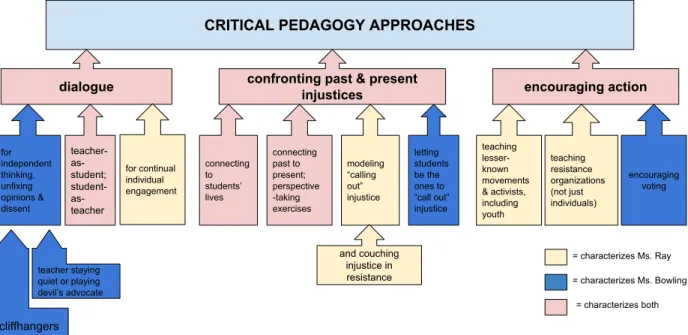
The findings suggest that the approaches used by teachers with a critical orientation included dialogue for dissent and for unfixing opinions, teaching oppression but pairing it with examples of resistance, and encouraging students to take action to address contemporary
injustices. Students in these classrooms demonstrated critical consciousness related to racism and their definitions of citizenship. However, dominant ideologies such as meritocracy,
This work is dedicated to the two teachers and fifty-three students who allowed me into their classrooms and generously shared their thoughts, concerns, and hopes with me. I learned as much from these two teachers as their students did—about reading the world, about effecting
ACKNOWLEDGEMENTS
This dissertation would not have been possible without the support and guidance of my committee. George Noblit, the lessons I have learned from you are immeasurable—through theory group, through your individual support whenever I need it, and through many
conversations over pad thai and shrimp-flavored chips. Cheryl Bolick, thank you for introducing me to the social studies research world and all of your great colleagues within it. Suzanne Gulledge, I am grateful for your constant encouragement and reassuring positivity. Jeremy Hilburn, you taught me everything I know. And you modeled (and still model) for me what an ideal mentor is—in giving your time, your thoughtful feedback, your reassurance, and your endearingly self-deprecating humor. Ashley, you defined true friendship and self-sacrifice in offering to be a reader when I know you had zero extra time. You are my personal and professional role model. And to Xue Lan Rong, my advisor, you have taught me how to be a scholar and have done everything in your power to ensure my success. I am grateful for your time, your honest guidance, and your genuine concern not just for my professional future, but also for my overall health and happiness. I will pay your generosity forward.
Fede, Matt, Melissa, Mariah, Betsy, Esme, Katy, and Sharon, thank you for your constant
support and for accepting me in all my nerdiness. To my New York teacher friends, Kelly, Sarah, Nicole, Chad, and Elle, thank you for the much-needed support in those early years of teaching.
To my family. Mom, you are the reason I am passionate about social justice, eager to learn as much as possible, and wary of wordy sentences. Thank you for the endless emotional and editorial support you have provided over the last five years (and all the years before that). Dad, thank you for reminding me how proud you are and for all the relaxing visits and
nourishing dinners to sustain me through my doctoral work. Lo, you know there is no way to put into words how much I love you. I wouldn't be me without you. Whether you’re in Alaska, Nepal, or South America, I never feel far from you. Thank you for fulfilling my dream to have you as a roommate, for giving me confidence in everything I do, and for valuing my attempts to give you big sister advice even though I am usually the one receiving it from you.
I am also grateful to my almost-family members: Susan and Alyssa. Susan, I became a different person through our four years as roommates and twelve more as best friends. You helped me become more self-assured, outgoing, and less of a worrywart. Thank you for finding my ideal place to live and being a big reason my life is so good. My Lyssa, you are like a sister to me, only with a more similar brain and personality to my own. I am thankful for the love I can still feel from you even when you are gone for months in Jordan, Liberia, or Pohnpei.
And to Thomas. Our friends may tease us for sharing a dropbox folder of critical theory readings, but I just feel lucky to have someone I can share all parts of my life with. You inspire me with the passion, precision, and focus you put into your own research on the uneven
TABLE OF CONTENTS
LIST OF TABLES ... xiii
LIST OF FIGURES ... xiv
LIST OF ILLUSTRATIONS ... .xv
CHAPTER 1: INTRODUCTION AND OVERVIEW OF STUDY ... 1
Introduction ... 1
Research Questions ... 3
Outline of the Dissertation ... 3
CHAPTER 2: LITERATURE REVIEW AND THEORETICAL FRAMEWORK ... 5
Introduction ... 5
Origins of Critical Theory: Marx and His Followers ... 6
Culture and Consciousness: The Frankfurt School and Gramsci ... 10
Hegemony ... 12
Progressive and regressive hegemony ... 13
Hegemony and Resistance in Schools ... 14
Intellectual Movements with Influences on and from Critical Theory ... 16
Critical Race Theory ... 16
Critical feminisms ... 17
Postcolonial theory ... 18
Critical Pedagogy: The Theory ... 19
Critical pedagogy and hegemony ... 22
Critical pedagogy in multicultural social studies classrooms ... 23
Critical Pedagogy: Critiques and Possibilities ... 28
Critical Pedagogy in Classrooms: A Review of the Limited Extant Literature ... 30
CHAPTER 3: RESEARCH METHODS ... 35
Postcritical Ethnography ... 35
Researcher positionality and self-reflexivity ... 37
Research Sites ... 39
Schools ... 40
Participants ... 41
Selection and recruitment ... 41
Ms. Bowling ... 42
Ms. Ray ... 43
The students ... 45
Data Collection ... 46
Classroom observations ... 46
Teacher interviews ... 48
Student interviews ... 49
Data Analysis ... 49
Co-investigation ... 50
Coding and story-constructing ... 52
Limitations ... 55
Introduction ... 58
Multi-Voice Classrooms ... 60
Dialogue for Dissent, Unfixing Opinions, and to Dissolve the “Homogenous Glob” ... 62
Teaching for dissent and deviating from the status quo ... 62
Unfixing opinions ... 67
Heterogeneity as an Impetus for Dialogic Pedagogy ... 72
Anti-Critical Voices ... 73
A Less Dissentful Purpose for Dialogue ... 76
Summary ... 80
CHAPTER 5: “THAT ACTUALLY IS MESSED UP”: CRITIQUES OF OPPRESSIVE SOCIAL STRUCTURES AT VARYING DEPTHS ... 83
Introduction ... 83
Teacher Goals: Honesty without Cynicism ... 85
Prior Learning: Lies Previous Teachers Told (or Did Not Tell) Them ... 86
Critiquing Past Injustices ... 90
Conscientization of Present Injustices ... 92
Overarching Belief That Society is Relatively Better Now ... 93
Racism as the Contemporary Injustice ... 94
Police brutality ... 95
Racist nativism ... 105
Racial conscientization: Summary ... 110
Structures Not Yet Critiqued: Sexism, Neocolonialism, and Capitalism ... 113
Neocolonialism ... 117
Capitalism ... 120
Acknowledgment of wealth inequality ... 121
The myth of social mobility and intersections with racism and nativism ... 123
No alternatives to market capitalism ... 126
American Exceptionalism and the Effects of Conscientization on Patriotism ... 129
Summary ... 133
CHAPTER 6: THRESHOLDS OF CONSCIENTIZATION ACROSS AREAS ... 135
Introduction ... 135
Perspective-Taking, Complexity, and Empathy ... 138
Teacher goals ... 138
Approaches used by teachers and thresholds crossed by students ... 140
Bottlenecks ... 145
Teachers’ analysis of the balance between teaching values and teaching critique ... 147
Confronting Contemporary Injustices ... 149
Teacher goals and concerns ... 149
Thresholds crossed ... 153
Bottlenecks ... 156
Political Action ... 162
Teaching philosophies regarding political action ... 163
Thresholds crossed ... 166
Co-analysis of the disinterest in participation ... 171
Thresholds and Bottlenecks Summary ... 172
CHAPTER 7: SYNTHESIS AND IMPLICATIONS ... 174
Introduction ... 174
Synthesis of Responses to Critical Pedagogy: Conscientization Bounded by Cultural Hegemony ... 176
Evidence of conscientization ... 176
Regressive hegemonic boundaries: Patriotism, individualism, and meritocracy ... 179
Dominant ideologies eclipse identity-based differences ... 181
Implications for Critical Pedagogy Practice ... 183
Two sets of approaches to critical pedagogy ... 185
Bottlenecks and suggestions for addressing them ... 188
Summary: What should critical pedagogy in history class look like? ... 197
Implications for Future Research ... 199
Conclusion ... 201
APPENDIX A: KEY CONCEPTS DEFINED ... 203
APPENDIX B: INTERVIEW PROTOCOLS ... 205
APPENDIX C: COMPLETE CODEBOOK ... 208
APPENDIX D: “THE GOOD WIFE’S GUIDE” ... 215
LIST OF TABLES
Table 1. Teacher Participants ... 44
Table 2. Students Interviewed ... 45
Table 3. Students Quoted in Class Observations, but Not Interviewed ... 47
LIST OF FIGURES
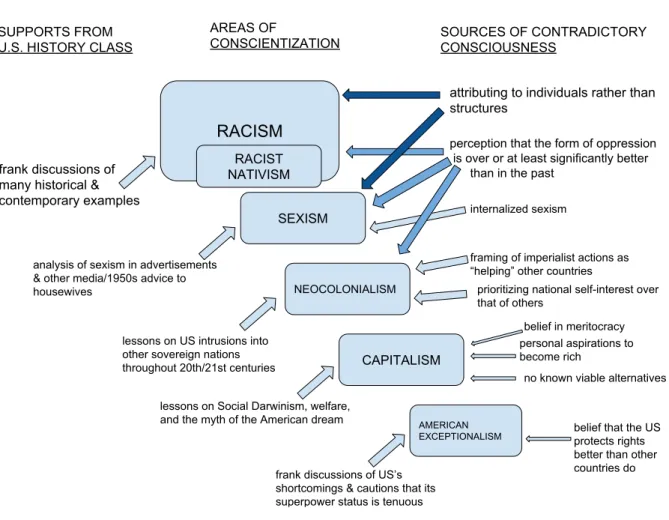
Figure 1. Critical Pedagogy Methods Used by Ms. Ray and Ms. Bowling ... 60 Figure 2. Areas of Conscientization, Supports, and Sources of
LIST OF ILLUSTRATIONS
CHAPTER 1: INTRODUCTION AND OVERVIEW OF STUDY Introduction
Since the start of public schooling in the US, the question of how education can serve to create a more equitable society has inspired the work of countless educators and scholars (Darder, 2012). However, in 2016, education still fails to afford everyone an equal chance at economic stability and self-actualization. Class- and race-based disparities in school quality for American children actually limit—rather than promote—many children’s chances of upward social mobility. Despite two decades of education reform intended to close the so-called “achievement gap” between low-income students and their more affluent peers, little has improved (Malott & Porfilio, 2011). Furthermore, the wealth gap between upper-income individuals and the rest of America continues to widen (DeSilver, 2013), raising the question of how well education is serving its intended purpose as the great equalizer.
Educators around the country are preparing the next generation to address these issues, however, and these efforts can serve as beacons of hope when the neoliberal tide shows no signs of ebbing (Malott & Porfilio, 2011). One source of their inspiration is the critical pedagogy1
theorized by Paolo Freire, Henry Giroux, Peter McLaren, bell hooks, and many others. Critical pedagogy, a central focus of this study, is defined here as education that aims for emancipation of historically oppressed populations, recognizes students as producers of knowledge, and bases educational methods on students’ everyday realities (Darder, Baltodano, & Torres, 2009). In doing so, it offers students greater opportunities to name injustice and question the status quo
than is offered through traditional pedagogical methods that treat students as empty banks into which information is deposited (Freire, 1970).
Although critical pedagogy has been widely theorized in education literature, there are relatively few empirical studies on its usage in K-12 classrooms (Duncan-Andrade & Morrell, 2008). There are examples of more specific approaches inspired by critical pedagogy, such as hip-hop pedagogy (Stovall, 2006) and critical media literacy (Leard & Lashua, 2006), but few if any studies examine critical pedagogy more broadly. Perhaps researchers hesitate to prescribe a particular form critical pedagogy should take, given that its form should be greatly dependent upon contextual factors such as student background and experiences (Darder, Baltodano, & Torres, 2009). However without many models of what critical pedagogy may look like in classrooms, teachers have no support in making sense of the sometimes dense theoretical language used by critical pedagogues (Hytten & Bettez, 2011) or in applying its tenets to their own contexts.
foundations of current conditions as well as how activists in the past have struggled for progressive change.
Research Questions
In this study, I attempt to address these gaps in the research by examining possibilities for critical pedagogy in U.S. History classrooms with an emphasis on its impacts on students. My research questions are:
1. How do critical U.S. History teachers attempt to facilitate student conscientization (critical consciousness)?
2. In what ways and to what extent do students develop critical consciousness, if at all? Whereas prior studies have focused exclusively on teachers’ engagement with critical pedagogy (García-González, 2000; Katz, 2014) or student resistance (Ginwright & Cammarota, 2007; Giroux, 1983; Scott, 1990; Willis, 1977), I analyze both simultaneously in order to illuminate the interplay between pedagogy and conscientization. For this reason, the research questions will not be addressed one-by-one but rather they iteratively inform each other throughout the paper.
Outline of the Dissertation
The next chapter of the dissertation will review the origins of critical pedagogy, from its roots in critical theory. I will describe how Gramsci and others furthered the field of critical theory by exploring the role of culture and hegemony in shaping the common sense of the masses. The chapter will also review literature on critical pedagogy in theory, in practice, and in social studies specifically, as well as the critiques of critical pedagogy.
Chapter Three will describe the research methods of this study, which are rooted in
uses of dialogue in each and how these aligned with critical pedagogy. Chapter Five will explore students’ conscientization as it related to various social structures including racism, sexism,
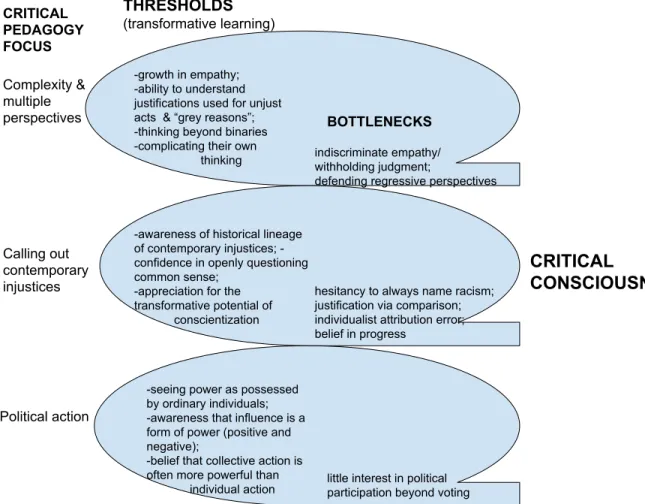
neocolonialism, and capitalism. Interwoven are more depictions of the teachers’ approaches, in order to illuminate how these potentially contributed to varying levels of conscientization. Chapter Six examines themes across areas of conscientization in terms of the thresholds students crossed and the bottlenecks they encountered as residual ideologies sustained some levels of contradictory consciousness. Finally, Chapter Seven synthesizes these analyses and suggests implications for teaching practice and for future research. Appendix A is a list of the key
CHAPTER 2: LITERATURE REVIEW AND THEORETICAL FRAMEWORK Introduction
I initially started this project with an expectation that my analysis would be shaped by Freirean critical pedagogy and postcolonial theory2. Over the course of the project, however, I realized that making sense of my observations required additional theoretical approaches. Although postcolonial theory could help illuminate the ways in which students’ identities— particularly immigrant students subject to neocolonialism and Latin@ and Black students subject to internal colonialism (Maseman, 2013)—are constructed and deconstructed by discourses (Smith & Riley, 2009), it was the class’s commonly held perceptions of social issues such as race and gender, rather than constructions of individual identities, that more compellingly answered the question of how students developed critical consciousness. Secondly, although critical pedagogy remained a central lens for my interpretations, these commonly held perceptions required some additional theoretical constructs for analysis. Such constructs included false consciousness, contradictory consciousness, and mystification3, among others, which led me to revise my theoretical framework to expand upon Post-Marxist critical theory, which is a school of thought from which critical pedagogy emerged.
As postcritical ethnography is an overarching frame (both theoretical and
methodological) for this study, I ought also to communicate to readers that Post-Marxist critical theory is not the only or necessarily the best lens through which to understand the data. That I found myself guided by it does not mean other observers would do the same, nor that my
participants would agree, were they to study these philosophies and then read transcripts from the study. But all research involves subjective choices and interpretations on the part of the researcher (Denzin & Lincoln, 2000), so this dissertation is not unique in this manner; rather my study is uniquely postcritical in that I make efforts to turn the critique back on myself as the researcher as I consider the ethical and political implications of the knowledge claims made. As Anders (2012) explained, postcritical ethnographers should repeatedly ask themselves, “What role do I play in the telling of it and what responsibility do I have in the production of it?” as well as “How might I interpret this differently?” (p. 104). In other words, what other
representations are possible? This offers one means of turning the critique back on itself, by asking how the researcher’s positioning, actions, and analysis might be critiqued. I continually posed these questions to myself throughout all stages of the research and will address them at various points in this dissertation.
Origins of Critical Theory: Marx and His Followers
For the purposes of this dissertation, I will here briefly describe a few of the elements of the theories of Karl Marx and his followers that are of particular relevance to this study. Some of the key concepts from these theories that shaped my interpretations of the data are dominant ideology, false consciousness, mystification, and reification. Before delving into these, I will provide some elaboration on the ways Marx permanently altered the way we understand
values. Therefore, I will briefly distinguish between Marxism and communism (in fact, Marx was not the first to propose communism) and highlight the major contributions that we owe to the 19th century German economist and philosopher (Levinson, 2011).
Today it may seem self-evident that social activities are profoundly shaped by people’s access to economic security, and that the question of material production was handled differently in various eras, producing various types of societies (e.g. feudal, capitalist). However it was Marx who popularized this way of thinking and who thus allowed, for the first time, analysis of social injustices as rooted in economic systems but also as produced through human activity rather than naturally predetermined (Layder, 1994). Thus much contemporary analysis into the systemic roots of social inequities owes some debt of gratitude to Marx. For instance, the growing body of work in the political economy of education similarly focuses on the impacts of economic conditions on the political and institutional structures of a society (Weingast & Wittman, 2008).
Living during the industrial revolution in Europe and surrounded by liberal political philosophers who focused on the individual, Marx stood apart in arguing that capitalism
subsumed the individual in its class-based system (Levinson, 2011). These classes were created as the owners of the means of production (capitalists) limited the wages of laborers to ensure surplus value of labor, in other words profit (Marx, 1894/1950). This departed from previous economic systems in which laborers could see a direct relationship between the amount of labor they provided and the amount of return on their labor (Layder, 1994). Influenced by Hegel’s belief that history unfolded in a dialectical process, Marx predicted that laborers would
That we have not seen the end of capitalism leads some to dismiss Marx. The term
Marxism evokes negative reactions from many people in the West who confuse his theories with the actions and doctrines of the Soviet Union, and to a lesser extent China, North Korea, Cuba and Southeast Asia; however, many of the defining features of these regimes—particularly those most condemned, such as the lack of democracy—are unrelated to Marx’s theories. Much of what is commonly attributed to Marx is actually a product of Vladimir Lenin’s political doctrine, a doctrine that greatly diverged from Marx’s vision (Hobsbawm, 1994). In fact, Marx’s
predictions of the failure of capitalism to support individual economic security and liberty are finding support in the empirical work of contemporary economists. In his book Capital in the 21st Century, Thomas Picketty (2014) used an enormous database of historical wealth in various countries to show that over the history of capitalism, the rate of return on capital has exceeded the economic growth rate, leading to a rise in wealth inequality that will persist unless
interventions are made.
Others have criticized Marxism for being overly structural and deterministic, for treating power as one-dimensional rather than fragmented, and for neglecting the complexity of social life in its concern only with labor and the relationship of individuals to their labor (Layder, 1994). Another area of critique has been its focus on class at the exclusion of oppression based on other social constructions such as race, ability, gender, and sexual orientation.
many others who are oppressed, these four concepts can also be useful in understanding how their oppression is sustained. It is for these reasons, in part, that Marxism gained popularity with education theorists in the 1970s and greatly influenced the development of theories of critical pedagogy (Giroux, 1983).
Marx argued that culture promotes dominant ideologies in that “it makes that which is conventional and socially constructed seem natural and inevitable” (Smith & Riley, 2009, p. 7). As critical pedagogy scholar McLaren (2009) explained, “We have been ‘fed’ dominant
ideologies for decades through the mass media, schools, and family socialization” (p. 70). This creates false consciousness, a term used by Engels and Lukács to describe the condition in which people are content despite material or other disadvantages (Levinson, 2011)4. One example would be poor Americans favoring market capitalism because they erroneously believe both that it is inevitable and natural, and that it allows them a way to scale the socioeconomic ladder. This is a form of mystification, a process that is supported by reification. Mystification prevents recognition of the oppressive realities of capitalism. Reification is the means by which social constructions, such as race and class for example, become perceived as objective and permanent realities unrelated to the social forces that produced them (Smith & Riley, 2009).Mystification prevents the working class from realizing that they have become objects rather than subjects capable of creative production. As a result, the workers, believing themselves to be free actors in the market system, consent to capitalism despite its stratifying outcomes.
Many followers of Marx took up this study of how ideology produces this consent through examining the “everyday cultural practices that ‘produce consent’ to the commodity
logic” (Foley, p. 191). According to French social theorist Louis Althusser (1969), “men ‘live’ their ideologies” as ideologies are a “profoundly unconscious . . . system of representations . . . that act on one in a process that escapes them” (p. 233). This shift to the study of culture, and its relations to material production and labor, characterized much of the critical theory developed by twentieth century followers of Marx. In the next section, I summarize the key concepts within critical theory that shaped my analysis of the classrooms studied for this dissertation.
Culture and Consciousness: The Frankfurt School and Gramsci
Although the group of German-speaking intellectuals referred to as “the Frankfurt school” were diverse in both thought and, ultimately, geographic location, they share this identifier due to origins with the Institute for Social Research in Frankfurt, founded in the early 1920s (Smith & Riley, 2009). Two key assertions emerging from the Frankfurt School that frame this study are (a) study of culture is needed to understand the ways dominant structures are reinforced (Smith & Riley, 2009) and (b) transformation of society will first involve changes in individual consciousness (Levinson, 2011). The Frankfurt School made a shift in focus from prior Marxist thought, from seeing the economy as the primary determiner of the superstructure to looking at how culture and intermediate social structures produce mystification. One Frankfurt School figure, Theodor Adorno, for example, posited the notion of the culture industry as the force by which the logic of capitalist institutions is rationalized and standardized (Darder, 2012). Elements of culture such as religion and, in contemporary contexts, popular media, serve to pacify the masses and prevent resistance (Levinson, 2011).
read political and cultural theorists of the 20th century, having been taken up by every field in the social sciences and humanities (Ives, 2004). Gramsci argued that the state and ruling elite
maintain power not only through physical force (e.g., enforcement of laws), but through control of ideas and regulation of beliefs. This is achieved through hegemony, a Gramscian idea that is especially helpful in understanding the formation of beliefs and ideas within schools, as well as those formed outside of schools thus impeding alternative worldviews from forming within them. Whereas the Marxist notion of false consciousness explains why individuals may be mystified into holding views inconsistent with their own experiences, Gramsci’s notion of hegemony helps explain why even large groups do so and often with some awareness of the inconsistency (Ives, 2004).
By contrast, good sense, is the practical and empirical knowledge that may offer an alternative understanding of the world. Since good sense stems from lived experiences and therefore “has an affective or emotional aspect which is absent from abstract theorizing,” (Jones, 2006, p. 55), it was important for Gramsci to merge this worldly good sense with philosophic understandings. Thus education should reveal to people the ways that their worldly experiences are connected to social structures and theories. Gramci’s notion of contradictory consciousness thus differed from Engels’s and Lukác’s definitions of false consciousness in that Gramsci believed the oppressed have some level of awareness of their own domination (Levinson, 2011). It is important to note that he also asserted that contradictory consciousness affects us all, as we are all “of some conformism or other, always man-in-the-mass or collective man” (Gramsci, 1971, p. 324). Freire (1970) too recognized “the duality of the oppressed: they are contradictory, divided beings, shaped by and existing in a concrete situation of oppression and violence” (p. 55).
Hegemony. Prior to Gramsci, the term hegemony was used to refer to the dominance or authority of one nation-state over others. Gramsci was also familiar with the use of the term by linguists as a synonym for the prestige that results in one social group adopting the linguistic forms of another group. Gramsci redefined hegemony to mean “the formation and organization of consent” (Ives, 2004, p. 2), although his theorization of the concept is more complicated. He was interested in understanding why entire groups would accept and sometimes even actively support institutions that undermine their interests, in his case Italian fascism rather than
of color consent to racist policies. For these reasons, the concept of hegemony continues to have wide-reaching appeal to scholars in a variety of disciplines.
Usage of the term by readers of Gramsci, however, has not been consistent. In fact, Gramsci’s writings in general have been subject to multiple interpretations, in part due to his preference for avoiding creating new terms in favor of re-using old terms in new ways. This decision was in line with his political opposition to the imposition of a new language on groups, particularly on the rural peasants of southern Italy (Ives, 2004). Today the most common
definition of hegemony, and the one used by many critical education scholars, is the “ability of the state and the ruling class to regulate beliefs within civil society” (Smith & Riley, 2009, p. 36), which is accomplished through consent of the dominated and then coercion if necessary. Critical pedagogy scholar Henry Giroux (1981) defined hegemony as:
a form of ideological control in which dominant beliefs, values, and social practices are produced and distributed throughout a whole range of institutions such as schools, the family, mass media, and trade unions. (p. 94)
An important characteristic of this understanding of hegemony is that subordinate social groups, through mystification and false consciousness perpetuated by ideology, fail to see that the beliefs they ascribe to are keeping them subordinate. Shared opposition to these subordinating beliefs has been referred to as counterhegemony. However, Gramsci never used this term (Ives, 2004). The reason Gramsci did not use counterhegemony is that, for him, hegemony is not always in the service of the dominant group. Subordinate groups can also use hegemony to win consent as they attempt to gain power.
power through organized consent. It could also be used negatively, or regressively, as a means by which dominant groups control the masses through coercion and passive or even active consent. Although most critical education scholars have conceived of hegemony as the latter, at least one education scholar, Jim Trier (personal communication) has wondered if the progressive form of hegemony might serve well as an analytical tool for understanding the ways in which education can organize consent in order to transform society. Marginalized groups would attain power as a “result of organic intellectuals working from within ‘common sense’ to create culture, a world-view and institutions that integrate and organize diverse ways of understanding the world” (Ives, 2004, p. 100). Support for such an idea can be found in the theoretical and empirical work on resistance in schools.
Hegemony and Resistance in Schools
view, schools are somewhat independent of the capitalist market economy and can actually be a source of contradiction and opposition against dominant interests.
Thus resistance theories facilitated a whole new line of questions about the ways in which students and teachers can actually critique and oppose the reproductive nature of schools and society. Solórzano and Delgado Bernal (2001) created a typology of four types of student
resistance/reactionary behavior, using a Latino Critical Race (LatCrit) framework and analysis of two Chicana/o student resistance movements to inform their theory. These four types are: (a) reactionary behavior, (b) self-defeating resistance, (c) conformist resistance, and (d)
transformational resistance (p. 316). Reactionary behavior, which may take the form of skipping school or challenging the teacher solely for entertainment purposes, does not qualify as
resistance because it lacks a critique of social oppression. Self-defeating resistance characterizes Willis’s (1977) lads in that they have some critique of social conditions but are not motivated by social justice and wind up re-creating the conditions of oppression. Conformist resistance occurs when students are motivated by social justice but do not challenge existing social systems. They may have a more liberal view that it is the individual’s fault if he or she does not succeed and thus address social problems like high drop-out rates with individualistic solutions such as tutoring or counseling. Finally, transformative resistance pairs critiques of oppression with a desire for social justice, resulting in the greatest potential to effect social change (Solórzano & Delgado Bernal, 2001). This final type of resistance is the aim of critical pedagogy and therefore something I hoped to see in my observations of the two classrooms studied here. Before
critical teachers in diverse classrooms may address issues of racism, sexism, xenophobia, nativism, and American exceptionalism.
Intellectual Movements with Influences on and from Critical Theory
Critical Race Theory. Critical Race Theory (CRT) emerged in part to respond to the insufficiency of Marxist, neo-Marxist, and other social theories to adequately explain the persistence and ubiquitousness of racism as an oppressive force that cannot be explained by, much less reduced to, class oppression (Ladson-Billings & Tate, 2006). CRT has origins in history, law, critical social theory, and pragmatism, among others, and can be “seen as both a historical movement and a philosophical orientation that recognizes the centrality and
permanence of racism in the United States” (Levinson, 2011, p. 201). Postmodern perspectives have called into question the usefulness of race as a category, arguing that its socially
constructed nature results in epistemological limitations (Ladson-Billings & Tate, 2006). However the reification of race produces material consequences for people of color and thus cannot be dismissed purely based on the fact that there is no biological or natural basis for racial categorizations.
a camouflage for the self-interest, power, and privilege of dominant groups in U.S. society” (Solórzano & Yosso, 2001, pp. 472-473). CRT is also committed to social justice and the naming of one’s own reality through methods such as storytelling, counternarratives, testimonios, family histories, revisionist histories, poetry, and others (Cervantes-Soon, 2012; Ladson-Billings & Tate, 2006; Solórzano & Yosso, 2001). In these ways, CRT has provided valuable tools for teachers wishing to help students understand and challenge racism.
Critical feminisms. Feminist theories have a long and complex history, so in the
interests of space, I will here briefly identify a few of the overlapping elements of critical theory and feminist theories that are specifically relevant to this dissertation. At the most basic level, an interest in student critical consciousness entails consciousness of all of the oppressive structures in society, including racism, sexism, classism, and so forth, as well as their intersections.
Feminist scholars have highlighted the ways in which sexism continues to operate, even while women in the US make gains in areas such as access to wider career options, higher salaries, and greater autonomy. Their work has highlighted how sexism serves as a prime example of the ways in which culture and ideology can obscure oppressive forces in order to secure consent from the oppressed. Sensoy and DiAngelo (2012) explained this well:
In order to understand how the pervasiveness of violence against women, and violence against women of Color, poor women, and women with disabilities in particular, becomes so normalized as to be virtually invisible, one must practice seeing the interconnections between socialization, institutions, and culture. (p. 82)
In addition, just as the institutional nature of racism is denied through individualistic rationalizations such as pointing to examples of successful people of color as evidence that racism no longer exists, the structural constraints of sexism get denied through pointing to women’s suffrage or the protections against violence that American women have when
prevents many people from recognizing and opposing how women continue to be reduced to their appearance (Langton, 2009), among other problematic effects of sexism. For instance, the idea that a woman’s value is directly related to her attractiveness to men continues to be
normalized in American society through mainstream media such as music videos, movies, and advertising (Sensoy & DiAngelo, 2012). Again the dominant ideology of liberal individualism explains away this objectification through arguments that women have a choice whether or not to participate in the production or consumption of these media. Gramsci’s notions of contradictory consciousness and hegemony through consent, however, help explain why women would participate in their own objectification even while they also may wish for an end to patriarchy. This is just one example of the many manifestations of sexism in the contemporary US and one way in which a critical theory analysis of culture can help explain its durability and invisibility.
Postcolonial theory. A final field related to critical theory and relevant to critical pedagogy, particularly within social studies, is postcolonial theory. It too encompasses a complex body of work from a variety of fields, so for the purposes of this dissertation I will focus on how it has been used by anti-colonial educators in alignment with the aims of critical consciousness raising. Kincheloe, a social studies educator and critical pedagogy scholar, argued,
critical teachers need to view their work in the context of living and working in a nation state with the most powerful military industrial complex in history. It is a complex that has shamefully used the monist agenda fueled by corporate accumulation by means of force. Indeed, the war on terror is a cloaking divide to hide broader, imperialistic political and economic goals. (Kincheloe, 2008, p. 40)
Thus a postcolonial analysis of the current global social order supports consciousness raising in that the “ethnocentric global hegemony of Western/Enlightenment humanism is key to an understanding of the unequal distribution, value, wealth, and labor among different social
colonizing and colonized countries, but also social groups within the same nation state through
internal colonialism. Among populations residing within the same borders, particularly in the US, “there continues to be a structured relationship of cultural, political, and economic domination and subordination between European whites on the one hand, and indigenous and non-white peoples on the other” (Tejeda, Espinoza, & Gutiérrez, 2003, p. 11). Thus the concept of internal colonialism is also helpful in raising consciousness regarding how racism and nativism are reproduced in our postcolonial context, also through dominant ideologies and hegemony.
These are just a few of the many theoretical traditions related to critical theory. Other discourses that share a similar interest in power, positionality, and language include
postmodernism, poststructuralism, cultural studies, and queer theory, among others (Segall, 2013). Beginning with Marx’s interest in the origins of social inequities and particularly his notion of reification to explain how certain social constructions, such as class, come to be seen as natural and neutral, these discourses have analyzed other ways in which “knowing, subjectivity, identity, and voice are constructed” (Segall, 2013, p. 478). I have highlighted the three examples of CRT, critical feminism, and postcolonial theory, as these particularly relate to the critical pedagogies of these two history teachers as well as my own analysis of the classrooms observed. In future work, I hope to explore how other traditions may further enhance critical pedagogy and student consciousness-raising, as well as additional ways in which these three can be
illuminating in these regards.
Critical Pedagogy: The Theory
Freire transformed the field of education and influenced countless teachers, researchers, and scholars in other fields such as philosophy, political science, theology, and literary theory (Kincheloe, 2008). His concepts of the banking model of education, and its counterparts,
dialogics and problem-posing methodology resonated with educators striving for social justice and resisting domination. This section will briefly describe these and other origins of critical pedagogy, while the next section argues for the need for critical pedagogy in history classrooms.
Origins and aims of critical pedagogy. Freire’s seminal Pedagogy of the Oppressed
(1970) analyzed liberation and proposed how it might be achieved. He argued that it can only be achieved by the oppressed because “the oppressor, who is himself dehumanized because he dehumanizes others, is unable to lead this struggle” (p. 47); however the oppressor can work in solidarity with the oppressed. Liberation can only be achieved, Freire argued, through “a
humanizing pedagogy in which the revolutionary leadership establishes a permanent relationship of dialogue with the oppressed” (p. 68). Freire went on to outline the characteristics of this humanizing, revolutionary pedagogy.
First, it cannot be the common banking form in which “the teacher issues communiqués and makes deposits which the students patiently receive, memorize, and repeat” (p. 72) because students will then passively accept the world, rather than transform it. Rather, students’
conscientization (or critical consciousness) must be raised through dialogical relations with the teacher. This allows the teacher’s authority to be dialectical with the students’ authority:
as teachers relinquish the authority of truth providers, they assume the mature authority of facilitators of student inquiry and problem posing. In relation to such teacher authority, students gain their freedom—they gain the ability to become self-directed human beings capable of producing their own knowledge. (Kincheloe, 2008, p. 17)
social realities which shape their lives and discover their own capacities to recreate them” (Darder, Baltodano & Torres, 2009, p. 14). Some of these realities include social
practices--“what people say and do,” social forms—“the principles that provide and give legitimacy to specific social practices,” and social structures—“constraints that limit individual life and appear to be beyond the individual’s control, having their sources in the power relations that govern society” (McLaren, 2009, p. 67). In other words, conscientization facilitates students’ growing awareness of the often hidden ways in which power shapes everything from schooling to culture to what counts as knowledge in our society.
Second, Freire specified that dialogue to transform the world must be entered with love, humility, faith, trust, hope, and critical thinking. This inclusion of love, faith, and hope is particularly important for addressing the fear that critical pedagogy gives students a negative impression of society or a sense of helplessness to change it. Freire instead championed a hopeful perspective that society was constructed by humans and therefore can be reconstructed by humans (Kincheloe, 2008). Finally, Freire argued that both teachers and students must pair their actions with reflection. Freire termed this praxis. Through praxis and dialogue, Freire believed that students would learn to read the world and thereby learn to transform it.
social order and reproducing the same stratifications that exist in wider society. Critical pedagogy attempts to disrupt this reproductive function of schooling.
Critical pedagogy and hegemony. For students to acquire conscientization of the social forces that maintain and reproduce inequities, they need an understanding of hegemony
(McLaren, 2009). As mentioned previously, hegemony can be progressive or regressive. Referring to regressive hegemony, Darder, Baltodano and Torres (2009) argued
“understanding how hegemony functions in society provides critical educators with the basis for understanding not only how the seeds of domination are produced, but also how they can be challenged and overcome through resistance, critique, and social action.” (p. 12)
While some scholars such as Giroux and McLaren (1987) have thus advocated
counterhegemonic teaching, given that Gramsci’s theory included a progressive hegemony for dismantling oppression, it seems this may offer the alternative education scholars are seeking. Gramsci saw progressive hegemony, or “moral and intellectual leadership” (Jones, 2006, p. 61) as the means by which the transformation of society could occur:
The working class, he writes, can only ‘become the leading and the dominant [i.e. hegemonic] class to the extent that it succeeds in creating a system of class alliances which allows it to mobilize the majority of the working population against capitalism and the bourgeois State’ (Gramsci 1994: 320). (as cited in Jones, 2006, p. 58)
Based on this usage of hegemony, the term counterhegemony would suggest something against forming class alliances through consent. Instead, it may be more helpful to consider how education might contribute to a progressive hegemony in which subordinate groups mobilize against oppressive structures5
.
Critical pedagogy in multicultural social studies classrooms. Social studies classes such as U.S. History are well suited for critical pedagogy. Because a crucial element of critical pedagogy is the historicity of knowledge, Darder (2012) argued, “the study of history, which has deteriorated at all levels of schooling, must be elevated to a position of critical influence” (p. 84). Giroux (1983) argued that in the absence of an understanding of the historical antecedents to the current social order, the social order is perceived to be inevitable or invariable. This represents one problem with a common approach to social studies—as citizenship transmission (Barth & Shermis, 1970). Teaching for citizenship transmission involves persuading students that the nation’s current systems of democracy and capitalism are the best, which means that any unfortunate historical episodes such as slavery or displacement of Native Americans must have been an inevitable “price to pay for ‘progress’” (Barth & Shermis, 1970, p. 745). While such an approach to social studies may (or may not, in the case of critically conscious students)
successfully indoctrinate students to be loyal and obedient members of the state, Darder (2012) argued,
instead of orienting the curriculum to a patriotic purpose that stresses the role of great men in shaping our contemporary world, or featuring events whose meaning is usually lost to students, teachers should assist students in understanding history as a social process—a process that incorporates both the participation of social movements and the state, as well as the economic and cultural forces acting as significant determinants in society. Further, since historical events often conceal more than they reveal, a critical historical understanding is also closely predicated on deconstructing events, texts, and images of the past. (p. 84)
In this way critical pedagogy can help students see that current inequalities are not inevitable and understand the social forces that have shaped these current conditions.
outlined a theory of critical bicultural pedagogy to meet the needs of working-class racialized students. This pedagogy must:
1. be built on a theory of cultural democracy;
2. support a dialectical, contextual view of the world; 3. recognize forms of cultural invasion;
4. use dialogue to allow for students of color to find their voice and to critique and transform the world;
5. address the political nature of schooling, as well as power in society; 6. be dedicated to the empowerment of all people and beings. (p. 102)
The emphasis on democracy, dialogue, power, and a dialectical view of the world are derived from Freirean critical pedagogy. Darder’s framework is helpful for imagining a critical pedagogy that can be used in multicultural classrooms because it is additive (Valenzuela, 1999), culturally relevant (Ladson-Billings, 1995) and culturally sustaining (Paris, 2012) in the sense that
nondominant heritage cultures are not only maintained, but also treated as valid and valuable sources of knowledge. For example, within social studies classrooms, teachers can enact additive pedagogy by having transnational students undertake a comparative study between the
governments of their heritage countries and the U.S. government (Hilburn, 2015).
Overall however, social studies education, and history instruction in particular, have been largely unaffected by the insights of critical theories (Segall, 1999). They are still taught
primarily from the perennialist and essentialist perspectives that there is a certain body of knowledge students must acquire to be loyal, obedient citizens and/or to be economically
allegiance over truth (Fischer, 2005; Paul, 2014). These protests suggest that students are not only longing for a more critical social studies education; they are also suspicious of attempts to deny them this. Critical pedagogy is particularly crucial in history education if students are to confront the social problems they face now and will face later, through understanding the ways knowledge and the social world are constructed through dominant discourses. The study of history thus “requires contestation, deconstruction, and action, not passivity, blind acceptance, and retention” (Segall, 1999, p. 371).
As suggested by Segall (1999), critical pedagogy requires more than deconstruction and understanding, however; action is also needed. Students must begin to imagine and enact possibilities for changing society. Peter McLaren, in his book Capitalists and Conquerors: A Critical Pedagogy against Empire (2005), argued:
any institution worthy of the appellation ‘school’ must educate students to become active agents for social transformation and critical citizenship. . . This is an urgent task because the important challenge ahead is to educate a citizenry capable of overcoming the
systemic exploitation of so many of the world’s populations. (p. 105)
Citizenship education in particular, then, is a key component of critical pedagogy and a task that is often perceived as the responsibility of social studies educators (Hickey, 2002). But citizenship education, like the other elements of socials studies education, typically takes the form of “the same patriotic, Eurocentric narrative that has been taught since the nation’s founding” despite the fact that this narrative “does not speak for a large percentage of those currently living in the United States, nor does it adequately prepare students to live in a society characterized by increased diversity, immigration, and pluralism” (Journell, 2011, p. 11).
majority of students “are educated for check-out lines and voting booths, while only a few are educated for board rooms and legislatures” (Parker, 1996, p. 107). There is also an insinuation that to be “American” is to adopt White identities (Pérez Huber, Lopez, Malagon, Velez & Solórzano, 2008; Urrieta, 2004). It should not be surprising, then, that many youth perceive such curricula as at odds with their own experiences (Rubin, 2007), and do not see how they can participate in this non-inclusive political process (Niemi & Niemi, 2007) or how their participation would matter (Levinson, 2012).
Moreover, interest in political issues and voting among American young people is declining (CIRCLE, 2003). There is also a large disparity in political efficacy and engagement, or a “civic empowerment gap” (Levinson, 2012, p. 31), between middle/upper-class White students and poor students and Students of Color. This gap persists into adulthood, where people earning $75,000 or more are six times more likely to be politically involved than those earning under $15,000 (p. 34). This gap is much greater than it was in the late nineteenth and early twentieth centuries, and it is about three times higher than it is in European, Asian, and North and South American countries (Levinson, 2012). Such a gap undermines democracy because “the legitimacy, stability, and quality of democratic regimes are all directly dependent on the robust participation of a representative and large cross-section of citizens” (p. 48).
and unifying. As a result, citizenship education needs to be “problematized and reconstructed” (Giroux, 2005, p. 6) for our current and future generations of culturally diverse and transnational students.
identifying political and social changes needed and developing a sense of efficacy that they can contribute to these changes.
Critical Pedagogy: Critiques and Possibilities
Critical pedagogy has been criticized for its overly theoretical nature and the specialized, abstract language used by its proponents (Hytten & Bettez, 2011). Hytten and Bettez contended that this may explain why it is not more explicitly utilized in the broader field of social justice in education. Indeed a search of literature on “social justice” and education yields far more results (1,150,000 in Google Scholar) than a search of literature on “critical pedagogy” and education (55,200 in Google Scholar). A search through the ERIC database similarly yields fewer research articles on critical pedagogy than on social justice.
Another line of critique of critical pedagogy is that it treats race as an epiphenomenon of class (see Jennings & Lynn, 2005 for one example). Freire responded to these critiques by saying that, although he was preoccupied with class in Pedagogy of the Oppressed, he never intended to ignore race and has always worked against all forms of oppression, including racial (Au, 2011). In keeping with this view and aim, I take the position in this study that oppression in the US cannot be explained by one power structure, not even class. I also concur with Solórzano and Yosso’s (2005) assertion that race, class, and gender intersect with one another in ways that make it impossible to analyze any of these in isolation from the others.
In a widely-cited article in Harvard Educational Review, feminist scholarElizabeth Ellsworth (1989) critiqued critical theory for its rationalist assumptions and the fact that
specifically to refer to all of them at once. In the literature Ellsworth reviewed, she also found that discussions of classroom practices were stripped of “historical contexts and political
position” (p. 300). My intention is to preserve these contexts and positionings in my discussions of the classrooms analyzed here.
Despite the criticisms, I believe that teaching practices can greatly benefit from the extensive theoretical work done in critical pedagogy over the last 45 years. This body of
knowledge does offer guidance embedded within its abstract depictions of oppression and power, although the authors are typically careful not to be prescriptive given that contexts should always be taken into account. Furthermore, critical pedagogy is not a pie in the sky that can only be practiced by academics with the ability to decode its theoretical language. My view of critical pedagogy aligns with that of Fischman and Haas (2009) who acknowledged that it is less of an ideal endpoint than it is an orientation, a commitment to a path along which there will inevitably be stumbling blocks and detours:
The committed intellectual is more of an orientation or a process than a final state of being, and perhaps more importantly, commitment likely precedes or at least develops with conscientization (Fischman & McLaren, 2005). Thus, the teaching of critical pedagogy should begin here as well . . . an educator who is a committed intellectual is sometimes critically self-conscious and actively engaged in social networks, but at other times is confused, or even unaware of his or her limitations or capacities to be an active proponent of social change. They will continue to be both oppressed and oppressor, even as they struggle to become less of both. (p. 571)
both propose possibilities for practice as well as considerations for further theorization of critical pedagogy.
Critical Pedagogy in Classrooms: A Review of the Limited Extant Literature
The majority of the literature on critical pedagogy is conceptual (e.g. Breunig, 2005; Freire, 1970, 1998; Giroux, 1983, 2011; Kincheloe, 2008; McLaren, 2015; McLaren &
Kincheloe, 2007; McInerney, Smyth, & Down, 2011). The problem with this is that “the ways in which critical practice is produced in real schools are much more complex than the ways that critical theories of schooling are elaborated in the academy” (Niesz, 2006, p. 343). Of the relatively small amount of empirical literature on implementation of critical pedagogy, most has focused on its use within teacher education (Harman & McClure, 2011; Helmer, 2014; Huerta-Charles, 2007) or adult education more broadly (Bartlett, 2005; Kaufmann, 2010), or its use in spaces outside of the classroom such as in Gay-Straight Alliances (Mayo, 2013), or local communities resisting global capitalism (Téllez, 2006).
Due to “Freire’s emphasis on local contextualization as a vital element for his methods, which contrasts with the need to emancipate huge numbers of people from oppression,” there has been a “predominance within critical pedagogy of either small local projects, or
much has used interviews to gain knowledge of pre-service and practicing teachers’ ideas about critical pedagogy (e.g., Katz, 2014) rather than observational data in classrooms or interviews with students. García-González (2000) did actually conduct observations along with teacher interviews, but her research question focused solely on teachers’ beliefs and practices, not on how students responded. As Katz (2014) argued in reference to her own research, “learning more about students’ experiences with critical pedagogy would be a worthwhile next step in this research” (p. 2).
Other scholars have paired data on teacher approaches with data on student responses. Gilbert (2011), for example, did so in his comparative study of two science educators assigned to teach “lower-track” science courses. One used traditional, lecture-based approaches, while the other used critical science education, which is grounded in critical theories, multicultural education, and feminist thought. Gilbert (2011) found that students in the first class viewed the pedagogy as “watered-down” (p. 414) and alienating, while students in the second class reported they came to better understand the content and found the classroom context “respectful and intellectually challenging” (p. 414). The data analysis primarily centered on how students interpreted their teachers’ pedagogy, rather than how they developed critical consciousness.
Liou and Antrop-González (2011) conducted a self-study of their use of critical race pedagogy in an urban classroom comprised predominantly of Students of Color. They taught students the concept of critical race theory, guided the students to apply it to their own
pedagogy: critical race pedagogy; however, the breadth and depth of their discussions on teaching approaches and student responses were limited.
The most extensive publication on critical pedagogy based on empirical research is Jeff Duncan-Andrade and Ernesto Morrell’s (2008) book, The Art of Critical Pedagogy: Possibilities for Moving from Theory to Practice in Urban Schools. In it, the authors describe the various
ways they have implemented the principles of critical pedagogy over twelve years while teaching at urban high schools in the Bay Area of California. Their stated goal was to develop a grounded theory of practice, in other words, “a theory that begins with the core principles of critical pedagogy but uses empirical data from theoretically informed practice to develop a more nuance and particular theory of critical pedagogy as it applies to urban education in new-century schools” (p. 49). To inform this theory, they used multi-year projects they conducted as English teachers, as basketball coaches, in a college access program for Students of Color, and in a summer
seminar for youth participatory action research. From these projects, they proposed the following core principles of critical pedagogy:
1. Educators should explicitly tell students the form their critical pedagogy is taking (e.g., critical media literacy, youth participatory action research, etc.) and how it is culturally, personally, and intellectually relevant to students. It should also build on student
knowledge and provide access to the discourses of dominant institutions.
2. Educators should create a “critical counterculture” by challenging local contexts of exploitation, connecting these to larger national and global struggles, and replacing them with “a culture of excellence and justice” (p. 172).
4. Finally, educators should help students reflect on what they learn and generate ideas for advancing their work, such as through building smaller projects into larger ones so that students are motivated to continue their work toward social justice.
This extensively researched grounded theory of practice offers more specific guidance than much of the theoretical literature on critical pedagogy. At the same time however, it seems most
relevant to teachers who are able to engage students in in-depth projects on relevant local issues that will require much time and autonomy from the usual curriculum. Teachers of elective or arts classes and leaders of extra-curricular programs may have the easiest time implementing these principles, but teachers of science, math, and social studies may struggle to adapt them to classes with more prescriptive content standards. Thus more research is needed that studies how teachers within these disciplines are able to reflect the principles of critical pedagogy.
In terms of social studies education or history classes specifically, there is little empirical research in classrooms on the use of critical pedagogy to develop students’ critical consciousness. The only one I was able to find was David Stovall’s (2006) study of self-led critical hip hop pedagogy workshops in a Chicago high school. The workshops took place in a class called Society and Social Inequalities and used hip hop lyrics to address historical and social contexts of issues related to the students’ lives outside of school. His article focused primarily on how he selected and presented the chosen songs to students, the comments they made in class
discussions and connections they made to literature read in class, and finally their overall
opinions of the workshops. There is little information on the students’ conscientization during or after the projects.
classrooms to analyze the ways in which the subjectivities of educators shaped their
interpretations of critical theories. She found that, although their methods aligned with critical pedagogy in some ways, the teachers did not reflect the social critique that accompanies critical education theories.
This study seeks to expand the body of literature on critical pedagogy in three ways. First, it responds to the critics of critical pedagogy who fear it is too abstract, too theoretical, and too disconnected from the everyday happenings of classrooms to feasibly guide teachers’ practices. By presenting data from classrooms within two public schools in which elements of critical pedagogy, in some form, are visible, I hope to contribute to the conversation on what critical pedagogies might look like in actual public classroom settings. Second, very little research has illuminated students’ responses to critical pedagogy. This study includes daily classroom
CHAPTER 3: RESEARCH METHODS
This dissertation is a postcritical ethnography (Noblit, Flores, & Murillo, 2004)
conducted in two urban U.S. history classrooms in the southeastern region of the United States. This chapter will first elaborate on how postcritical ethnography, which blurs the line between theory and method (Noblit, Flores, & Murillo, 2004, p. 3), shaped the particular research methods selected for this study. Consistent with this theoretical orientation, I will provide a reflexive description of my role, motivations, and limitations as the researcher. Next I will
describe the context of the study and my rationales for the selection of site and participants. I will then outline the data collection and analysis procedures and return to postcritical ethnography to consider the ways in which these procedures facilitated nonexploitation and co-investigation. Finally I conclude with the limitations of the study.
Postcritical Ethnography
criticized for its “silencing of polyphony, male domination, theoretical oversimplification of power relations, and Eurocentric notions of emancipation” (Noblit, 1999, p. 4). From the perspective of critical pedagogy, thematic investigation and education (which Freire viewed as “simply different moments of the same process” [1970, p. 109]) should be dialogic, reflexive, and done with others, rather than to or for them. This aligns well with the suggestions of postcritical ethnographers that our research ought to be tempered through self-reflexivity and nonexploitation (Gunzenhauser, 2004). Thus postcritical ethnography complements both critical theory and critical pedagogy in that it acknowledges participants as co-constructers of knowledge and commits to a critique of “self, interpretation, and representation” (Anders, 2012, p. 100). In this way, it reminds me to critique the ways that, despite my intentions, the study reflects Eurocentric ways of knowing and may contribute to the colonial project (Denzin & Lincoln, 2000).
Self-reflexivity requires turning the critique back on the analysis, the theory, and the researcher herself. This is necessary since “all research is interpretive; it is guided by the researcher's set of beliefs and feelings about the world and how it should be understood and studied” (Denzin & Lincoln, 2000, p. 22). Self-reflexivity requires the researcher to consider the ethical and political implications of the knowledge claims made. Self-reflexivity in postcritical ethnography reminds me to unpack the implications of the fact that “the researcher is the main research instrument” (Grammes, 2010, p. 8). As Anders (2012) stressed, postcritical
means of turning the critique back on itself, by asking how the researcher’s positioning, actions, and analysis might be critiqued.
Researcher positionality and self-reflexivity. Throughout the data collection, analysis, and representation process, I attempted interrogate my own positioning, actions, and
interpretations. I will present my background, subjectivities, and interests here to assist the reader’s interpretation of the study and to disclose my motivations and goals in undertaking this project.
While growing up, I spent perhaps more time than most people reflecting on my many privileges. My mother would tell me, “You know, we didn’t do anything to deserve being born into a middle-class American family.” Although colorblindness (Ladson-Billings & Tate, 2006) characterized family discourse, I nevertheless had a sense that the playing field is not even, and that it was only by chance that I happened to be at the easier end of it. I went into teaching, and later research, in the idealistic hopes of evening the field, in some small way.
seventeen, he was able to see the cultural imperialism of the U.S. for what it was, an ability that I, his teacher and senior by five years (but also beneficiary of this imperialism), lacked.
And yet, sadly, I cannot say that I did a great job of teaching from a critical or anti-colonial perspective during the following five years I taught U.S. history at a public high school in New York City with a predominantly Dominican population. Yes, I was critical of early twentieth century U.S. interventions in Central America and the Caribbean, in part to honor my students’ indignation at the violation of their countries’ sovereignty. And like them, I was critical of the U.S. immigration policies at the time, in part because so many of my students rarely saw their mothers or fathers as a result of it. In other words, if I was operating under any sort of critical pedagogical framework, it stopped wherever my students’ personal experiences ended. I wanted them to understand the historical origins of the social inequities they faced, such as the economic disparities between the U.S. and Dominican Republic, but I was not aware of critical pedagogy or how it could be used to facilitate this understanding. Since then I have wondered, if I had been more knowledgeable of neocolonialism, power, oppression, and the relations between these and culture and identity, would my students have achieved greater critical consciousness as a result? This study will not answer that question, but I hope it will begin to explore some
possibilities.
I share these stories for several reasons. One is to admit that I am no expert on critical pedagogy in U.S. history classrooms; thus the study requires a methodology that acknowledges participants’ role in knowledge construction. This is one reason postcritical ethnography appealed to me. Secondly, I share with my participants the struggles that accompany public school teaching in the U.S. in our era of accountability, privatization of schools, and