Mention the term “geothermal energy” to most people and they will probably picture something similar to the illustration in figure 1. This kind of geothermal energy, i.e. the kind that produces geysers like Old Faithful and other hydrothermal phenomena (hot springs, mudpots, fumaroles and so on) is associated with volcanism. Heat from magma (molten rock below the earth’s surface) is transferred to the surrounding country rock and groundwater and in some parts of the world such as Iceland, New Zealand, and parts of the Pacific Northwest (specifically northern California and central Oregon) this heat is harnessed to produce geothermal energy.
But effective use of the earth’s natural heat does not always require high temperatures. Consider this: a few feet below the earth’s surface the temperature remains essentially constant - typically somewhere in the range of 45°-75° F, year-round. Even in North Dakota, with its scorchingly hot summers and frigid winters, the ground temperature not far below the frost line never varies from a fairly temperate 45°-55° F. This low temperature geothermal resource is available on every continent and, properly exploited, provides a remarkably efficient way of heating and cooling buildings of just about any size.
Geothermal systems of this kind are sometimes referred to as geoexchange systems because not only is heat withdrawn from the ground, it is also transferred to it. The direction of heat flow depends on whether the system is operating in heating or cooling mode, as we shall see.
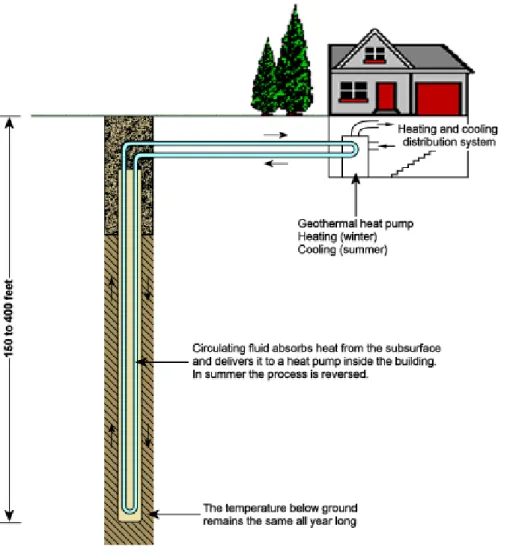
All geothermal (geoexchange) systems have three main components: (i) a means of transferring heat to and from the subsurface, (ii) a heating and cooling device (heat pump), and (iii) a heating and cooling distribution system. Figure 3 shows a typical configuration for what is known as a “closed loop” geothermal system.
Heat is extracted from, or transferred to, the subsurface via a series of high density polyethylene (HDPE) loops through which a fluid is circulated. This fluid may be water or an aqueous solution of a pre-approved heat transfer material such as propylene glycol or denatured ethanol. Loop systems are classified as either open or closed, and those loops can be configured in one of three ways: vertically, horizontally, or in a pond/lake. The type chosen depends on the available land area, and the soil and rock type at the installation site. These factors will help determine the most economical choice for installation of the ground loop.
In an open loop geothermal system, water is pumped directly from an aquifer via one or more wells into the building where it passes through a heat pump before being returned to the aquifer by a separate (discharge ) well or released into a nearby lake or stream. However, despite their relative simplicity, open-loop geothermal systems are not as popular as the closed-loop variety. This is largely due to the fact that
GEOTHERMAL ENERGY: ANOTHER ALTERNATIVE
By Lorraine A. Manz
Figure 1. Old Faithful is one of more than 300 geysers in Yellowstone National Park that are the product of geothermal energy. (Photo by George Marler)
Figure 2. The Geysers Geothermal Field near Santa Rosa, CA obtains its heat (at about 330° F) from a large magma chamber about 4.5 miles below the earth’s surface. It is the largest producing geothermal field in the world, producing enough electricity to meet the demands of a city the size of San Francisco. (Photo courtesy of Pacific Gas & Electric and DOE/NREL). As we all know, North Dakota has no volcanoes, and as
far as geologists are able to tell this region of North America never has. Here, unlike Yellowstone for example, molten rock lies far below the solid continental crust so temperatures in the shallow subsurface are relatively cool. In North Dakota, we are never likely to see power plants quite like the ones in northern California’s Geysers Geothermal Field (fig. 2).
they require an abundant, clean groundwater supply and in some states, including North Dakota, may be subject to additional regulatory control.
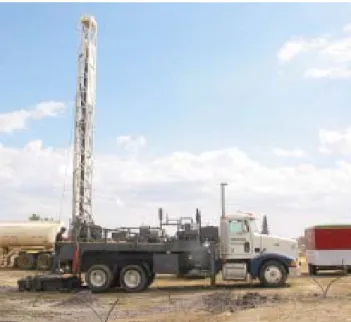
In closed-loop systems like the one shown in figure 3 the heat transfer fluid flows through a continuous, closed circuit of loops, which are installed in the ground in either a vertical or horizontal configuration or under water in a lake or pond. Most geothermal systems in North Dakota are vertical closed-loop systems. The construction of a vertical closed-closed-loop geothermal system requires the drilling of a series of holes, about four inches in diameter, spaced 15 to 20 feet apart, and ranging in number from as few as four to several hundred, depending on the size of the building, and between 100 and 400 feet deep (typically 150-200 feet in North Dakota) (fig. 4). Two 1¼-inch HDPE pipes, connected by a u-tube, are inserted into each well and cemented in place with a thermally conductive grout. The loops are connected in a series by a horizontal manifold (fig. 5), which carries the heat transfer fluid to and from the heat pump.
Once the loops are connected, the ground surface is leveled and smoothed. Very often it is grassed over or paved, leaving no visible evidence of the well field beneath.
Figure 3. The basic components of a closed-loop geothermal system (vertical configuration).
Horizontal closed loop systems are constructed in a similar way to vertical systems except that the loops are laid horizontally, or coiled into a “slinky” shape if space is limited, in trenches about six feet deep. The “slinky” is also the loop design of choice for pond/lake systems where the loop field is installed under water instead of in the ground. A minimum annual water depth of six feet is required for these systems to function efficiently and needless to say, they are not common in North Dakota.
The heart of any geoexchange system is the geothermal heat pump. Also known as ground source heat pumps these highly efficient devices may be viewed very simply as a sort of two-way air conditioner. Their principles of operation are the same as is their objective – to move heat from one place to another. In summer, heat is withdrawn from the building and discharged into the ground via the circulating heat transfer fluid. In winter, the process is reversed and heat is extracted from the ground. However, unlike a conventional furnace, which heats air drawn from outside (and we all know how cold that can be on a January night in North Dakota), a geothermal heat pump extracts heat from a fluid that is already relatively warm – a far more cost-effective method of keeping Old Man Winter at bay.
can be transferred to something else such as another liquid or a gas. It’s an odd, counterintuitive concept, but wonderfully elegant nonetheless and it is the fundamental principle upon which all heat pumps work.
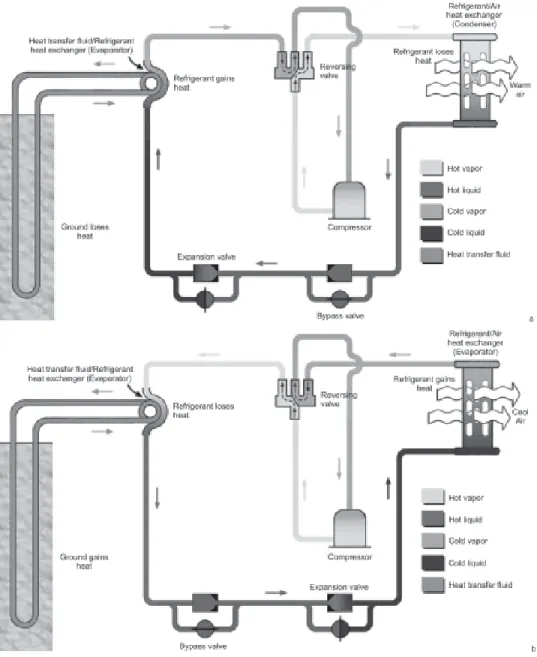
Figure 6 shows the basic components of a geothermal heat pump. Besides a power source, all heat pumps consist of a compressor, an expansion valve, a condenser, and an evaporator, which are connected together via a system of pipes and coils filled with a refrigerant. Geothermal heat pumps have an additional component a reversing valve -which allows the refrigerant to flow through the system in both directions (heating vs. cooling mode).
Heat flows naturally from warm areas to cold ones. When the pump is in heating mode (fig. 6a) heat transfer fluid is pumped from the wells to an evaporator (fluid/refrigerant heat exchanger). Cold, liquid refrigerant enters the evaporator and absorbs heat from the fluid causing it (the refrigerant) to vaporize into a gas. (Liquids used as refrigerants have extremely low boiling points and require very little heat input to do this.) Cooled heat transfer fluid leaves the evaporator and is returned to the ground. At the same time, the gaseous refrigerant is pumped to the compressor where it is pressurized and its temperature is thereby increased. From the compressor, the hot gas enters the condenser (refrigerant/ air heat exchanger). Here, the heat from the gas is transferred to return air from the building, which is then delivered back into the building via a suitable distribution system. The gas, as it cools, condenses back to a liquid and returns to the evaporator to begin the cycle again.
In summer a reversing valve enables the cycle to work the other way (fig. 6b). In this mode the refrigerant is vaporized by heat from warm air in the building and the hot, pressurized gas condensed back into a liquid as it gives up its heat to the circulating fluid in the loops of the geothermal well field. Heat is thus transferred into the ground and the building is provided with cool air. Some geothermal heat pumps contain an additional heat exchanger, which is connected to a water heater. In summer, the “excess heat” from the building is absorbed by the water, thereby reducing significantly the additional energy required to maintain a constant temperature.
So how do geoexchange systems compare with more conventional heating and cooling (HVAC) systems? The bad news is they are not cheap to install. The owner of a well-insulated house with 3,000 square feet of floor space for example, could expect to spend around $10,000 for a vertical closed-loop heating and cooling system, whereas a more conventional system (a high-efficiency natural gas furnace using 80 dekatherms per year with standard electric central air conditioning) would only cost about $4,000. But, and this is a very big but, as the figures in Table 1 show, the higher investment wins out over the long-term.
Figure 4. A truck-mounted drill rig is used for the construction of the wells in a vertical geothermal loop field. The V-shapes in the foreground are tops of the pairs of HDPE piping (the loops) protruding from finished wells. (Photo by Tom Torstenson)
Figure 5. After the wells are completed, a trench is dug to a depth below the frost line and the well heads are connected to a horizontal “header“ pipe that carries the heat transfer fluid to and from the heat pump. Depending on the number of wells, more than one circulatory zone may be constructed, enabling operation only of as much of the well field as is required to maintain the building’s temperature at the desired level. (Photo by Tom Torstenson)
So how exactly does a heat pump move heat? One thing to keep in mind is that heat is a form of energy and all but the very coldest materials contain some amount of heat. Make sense? Probably not, but try to think of heat in this context not so much as synonymous with what we consider warmth but rather as a relative term. Water at 45° F, for example, is hotter (contains more heat energy) than water at 35° F, but by no stretch of the imagination would we consider either to be warm. When water at 45° F is cooled to 35° F that extra little bit of heat energy is extracted and under the right conditions
Figure 6. Schematic of a geothermal heat pump operating in (a) heating mode (b) cooling mode. (Modified from graphics at www.geo4va.vt.edu. Used with permission.)
Table 1. A general comparison of geothermal vs. conventional heating costs for a 3,000-square-foot residence in North Dakota. Cooling (air conditioning) costs are not included because in North Dakota they are relatively insignificant, although the geothermal system in cooling mode would be more efficient than a conventional air conditioner. (Source: ND Department of Commerce).
Geothermal Conventional
Initial investment $10,000 $4,000
Annual heating cost $260 (@ 3.5¢ per kWh)a $640 (@ $8 per dktb)
$960 (@ $12 per dktc)
Annual savings $380 (@ $8 per dktb)
$700 (@ $12 per dktc)
Payback 15.8 years (@ $8 per dktb)
8.6 years (@ $12 per dktc)
aAssuming a coefficient of performance (COP) of 3 for the heat pump and an efficiency rating of 94% for the furnace bCurrent (October 2006) cost of natural gas
Where do these savings come from? Without going into too much detail, the effectiveness of a heat pump is defined in terms of a coefficient of performance (COP). This is a measure of the amount of heat energy delivered per unit of electrical power consumed. Most geothermal heat pumps have a COP of between 3 and 4, which means that for every watt of electrical power used they deliver the equivalent of 3 to 4 watts of heat energy. In other words, they deliver 3 to 4 times as much energy as they consume. The very best natural gas furnaces, on the other hand, only have COP equivalents of about 0.9 to 0.97. This, and the relatively low cost of electricity, compared to natural gas, are two reasons why geothermal systems are so much cheaper to run than conventional gas furnaces. A third reason, which has to do with heating cold air versus extracting heat from a relatively warm fluid, has already been discussed.
The annual cost savings are significant and our homeowner will have fully recovered his or her investment within about 15 years if current natural gas prices remain the same, less if they rise, which they probably will. Of course a payback time on the order of years means that installing a geothermal heating and cooling system in your home is not going to be worth your while unless you are planning to stay put for the duration.
Not surprisingly, larger geothermal systems have shorter payback periods. The Century Center in Bismarck (fig. 7) was built in 2003 and has a gross floor area of 112,617 square feet, which is heated and cooled by more than 200 individual heat pumps connected to a geothermal well field consisting of 286 wells divided into 22 zones. (The well field at the new Bank of North Dakota building will be about half this size.) An auxiliary system keeps the sidewalk on the north side of the building dry and free of ice in the winter.
The decision to install a geothermal system instead of a more conventional means of climate control added an extra $100,000 to the final construction bill. Yet this extra cost took only 2½ years to recover and the energy savings continue to grow as facility management fine-tunes the system.
In general geoexchange systems use 25% to 50% less electricity than conventional HVAC systems and the EPA estimates that geoexchange systems can reduce energy consumption by as much as 72%, with a corresponding reduction in emissions of up to 44%1. But it is not just their incomparable efficiency that makes geoexchange systems such an appealing alternative energy resource. The well field at the Century Center occupies an area of about 2 acres on the north side of the building but it is completely hidden and is, in fact, covered by a parking lot (fig. 8). This unobtrusiveness is characteristic. Once completed, a geothermal well field, regardless of its size and configuration, presents an essentially featureless surface, which may be paved or grassed over. Many are disguised as parking lots, play areas or lawns.
Figure 7. The Century Center in Bismarck is the largest state building in North Dakota to have a geothermal heating and cooling system.
Figure 8. The well field at the Century Center lies beneath the parking lot on the north side of the building. (White rectangle in this aerial photograph.)
Inside the building the geothermal heat pump quietly goes about its business. Because they have few moving parts and do not have external condensing units like air conditioners, geothermal heat pumps are durable, very reliable, and produce little noise. Typically they can be expected to last at least 20 years. And finally, there is the energy source itself – the earth – a heat sink in summer and a provider of warmth in winter; a simple cycle of energy transfer: clean, unlimited and completely renewable.
1 U.S. Department of Energy – Energy Efficiency and
Renewable Energy. A Consumer’s Guide to Energy efficiency and Renewable Energy – Benefits of Geothermal Heat Pump Systems. September 12, 2005. November 1, 2006. http://www.eere.energy.gov/consumer/your_home/ space_heating_cooling/index.cfm/mytopic=12660
The actual number of geoexchange systems in North Dakota is not known because the state did not introduce a geothermal regulatory program until 1984. Records exist for at least 100 mostly open-loop systems installed between 1979 and 1985, but many more remain undocumented. Since 1984 more than 250 commercial and residential geoexchange systems have been installed in North Dakota (fig. 9). Approximately 30% of these systems are residential and all but a handful are vertical closed loop. And while 250 or so installations statewide may not seem like very many, it is worth considering that these systems required the drilling of more than 11,000 wells with a combined depth of 1.9 million feet, or 360 miles – just a little over the full distance along I94 from Fargo to Beach on the North Dakota-Montana border.
Each dot on the map in figure 9 represents a single geothermal installation. In cities such as Bismarck and Fargo, where there are several (indicated by a correspondingly larger dot), the actual number is shown in parentheses. These installations may be found in churches such as the Basilica of St. James in Jamestown, many schools and colleges (the largest
facility in the state is the 688-well system at Fargo Middle School), museums and historic sites (e.g., the Cowboy Hall of Fame in Medora and Fort Buford State Historical Site), public buildings including the Bismarck and Dickinson municipal airports, the Bank of North Dakota building currently under construction in Bismarck, health and fitness centers, retirement homes, hotels, community centers, manufacturing and retail outlets and so on and so on. Anything is possible.
Since 1984 geothermal heating and cooling systems have been regulated by the North Dakota Geological Survey under Chapters 38-19 and 43-02-07 of the North Dakota Century and Administrative Codes respectively. The regulatory program was introduced to ensure that geothermal systems are designed and constructed according to certain standards and do not pose any kind of environmental hazard such as surface or groundwater contamination. Copies of these regulations are available on request and may also be downloaded from the NDGS web site at http:// www.state.nd.us/ndgs/geothermal/geothermalh.htm. Figure 9. Distribution of post-1984 geothermal installations (commercial and residential) in North Dakota. Except where indicated each dot represents a single installation.
“Rocks are records of events that took place at the time they formed. They are books. They have a different vocabulary, a different alphabet, but you learn how to read them”