Arabic WordNet: Semi-automatic Extensions using Bayesian Inference
Horacio Rodríguez
1, David Farwell
1, Javi Farreres
1, Manuel Bertran
1, Musa Alkhalifa
2, M.
Antonia Martí
21 Universitat Politècnica de Catalunya Jordi Girona, 1-3; 08034 Barcelona; Spain E-mail: horacio, farwell, farreres, [email protected]
2 Universitat de Barcelona Gran Via 585; 08007 Barcelona; Spain E-mail: [email protected], [email protected]
Abstract
This presentation focuses on the semi-automatic extension of Arabic WordNet (AWN) using lexical and morphological rules and applying Bayesian inference. We briefly report on the current status of AWN and propose a way of extending its coverage by taking advantage of a limited set of highly productive Arabic morphological rules for deriving a range of semantically related word forms from verb entries. The application of this set of rules, combined with the use of bilingual Arabic-English resources and Princeton's WordNet, allows the generation of a graph representing the semantic neighbourhood of the original word. In previous work, a set of associations between the hypothesized Arabic words and English synsets was proposed on the basis of this graph. Here, a novel approach to extending AWN is presented whereby a Bayesian Network is automatically built from the graph and then the net is used as an inferencing mechanism for scoring the set of candidate associations. Both on its own and in combination with the previous technique, this new approach has led to improved results.
1.
Introduction
An Arabic WordNet (AWN – Black, et al., 2006; Elkateb, et al., 2006; Rodríguez et al., 2008) has been built along the last two years following the EuroWordNet methodology of manually encoding a set of base concepts while maximizing compatibility across wordnets (Arabic and English in this case). As a result, there is a straightforward mapping from Arabic WordNet onto Princeton WordNet 2.0 (PWN – Fellbaum, 1998). In addition, the AWN project aimed to provide a formal specification of the senses of its synsets using the Suggested Upper Merged Ontology (SUMO – Niles & Pease, 2001). This representation serves as an interlingua among all wordnets (Pease, 2003; Vossen, 2004) and will underlie the development of semantics-based computational tools for multilingual NLP.
Accordingly with the objectives of the project, Arabic WordNet currently consists of 11,270 synsets (7,961 nominal, 2,538 verbal, 661 adjectival, and 110 adverbial), containing 23,496 Arabic expressions. This number includes 1,142 synsets that correspond to named entities which have been extracted automatically and are being checked by the lexicographers. For the most up-to-date statistics see:
http://www.lsi.upc.edu/~mbertran/arabic/awn/query/sug_ statistics.php
2.
Prior Work on the Semi-automatic
Extension of AWN
Although AWN has been constructed manually, efforts are underway to partially automate the process using
bilingual lexical resources and applying morphological rules. Here we are especially interested in reducing the development effort by reducing the number of decisions made in regard to accepting or rejecting a proposed extension. Using lexical resources for extending wordnets for languages other than English is not new. In some cases a substantial part of the work has been performed automatically, using PWN as source ontology in combination with bilingual and monolingual resources for proposing correlates (e.g., Benítez, et al., 1998; Agirre, et al., 2002; Chen, et al., 2002; Miháltz & Prószéky, 2003; Barbu & Barbu-Mititelu, 2005; and Farreres, 2005).
We have investigated two general approaches which take advantage of an important characteristic of Arabic (and other Semitic languages), the fact that words sharing a common root (i.e. sequence of almost always three consonants) usually have related meanings and can be derived from a common base verbal form by means of a reduced set of lexical rules.
For instance, the verbal basic form َسَرَد (DaRaSa, to study/to learn) has a a root reduced to سرد (DRS), from this root, lexical rules can produce derived verbal forms as َسRرَد (DaRRaSa, to teach), among others. From any verbal form (whether basic or derived), both nominal and adjectival forms can also be generated in a highly systematic way: the nominal verb (masdar) as well as masculine and feminine active and passive participles. Examples include the masdar ٌسْرَد (DaRSun, lesson, study), ٌسUرَVُX (MuDaRRiSun, male teacher) or YَZUرَVُX (MuDaRRiSatun, female teacher).
Selection Threshold candidates accept reject precision recall F1
HEU all heuristics 272 135 137 0.50 0.61 0.55
HEU heuristics 1,2 61 40 21 0.65 0.18 0.28
BN 0 554 223 331 0.40 1 0.57
BN 0.01 243 125 118 0.51 0.56 0.53
BN 0.02 214 116 98 0.54 0.52 0.53
BN 0.07 112 65 47 0.58 0.29 0.39
BN 0.1 100 60 40 0.60 0.27 0.37
BN + HEU 0 272 154 118 0.56 0.69 0.62
BN + HEU 0.01 212 121 91 0.57 0.54 0.55
BN + HEU 0.02 201 115 86 0.57 0.41 0.48
BN + HEU 0.07 92 65 27 0.71 0.38 0.5
BN + HEU 0.1 83 59 24 0.71 0.12 0,21
Table 2: Results
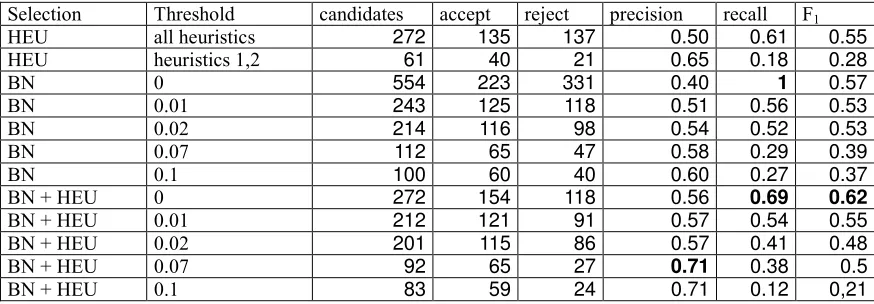
Results are presented in Table 2. Figures are included on the number of candidates proposed by each method, the number of accepted and rejected ones by human validation and the usual precision, recall and F1 measures. As can be seen, the BN approach doubles the number of candidates of the previous HEU approach (554 vs. 272). The number of accepted candidates for the first case (223) is used as upper bound for recall calculation. We have used a balanced F1 although we are more interested on a getting a higher recall. Rows 1 and 2 show the results of our previous heuristics-based approach. The next 5 rows present the BN approach using different thresholds. Finally we present the results of intersecting both methods. The highest precision is obtained using the intersection method and restrictive threshold. Although recall is low, the number of candidates for AWN is high (92 words from the original 11 base forms). An analysis of the errors shows a substantial number were due to the lack of the shadda diacritic or the feminine form. Fixing these would increase the accepted forms to 81 from 60 for a threshold of 0.1 and the precision to 0.67 from 0.6, a 10% improvement.
5.
Conclusion
A novel approach for semi-automatically extending AWN’s coverage using Bayesian Networks has been presented. The approach takes profit of some characteristics of Arabic language that allow an easy development of a limited set of highly productive lexical rules for deriving from a verbal entry a set of semantically related word forms and extends a previous approach based on the performance of a set of heuristics. Initial experiments using both procedures and their combination show promising results.
6.
Acknowledgements
This work was supported by the US Central Intelligence Agency.
7.
References
Agirre, E., Ansa, O., Arregi, X., Arriola, J., Diáz de Ilarraza, A., Pociello, E., Uria, L., (2002). Methodological issues in the building of the Basque
WordNet: Quantitative and qualitative analysis. In
Proceedings of the First International WordNet Conference, 21-25 January 2002. Mysore, India.
Barbu, E., and Barbu-Mititelu, V., (2005). A case study in automatic building of wordnets. In Proceedings of OntoLex 2005 - Ontologies and Lexical Resources.
Benítez, L., Cervell, S., Escudero, G., López, M., Rigau, G., Taulé, M., (1998). Methods and tools for building the Catalan WordNet. In Proceedings of LREC Workshop on Language Resources for European Minority Languages.
Black, W., Elkateb, S., Rodriguez, H, Alkhalifa, M., Vossen, P., Pease, A., and Fellbaum, C., (2006). Introducing the Arabic WordNet Project. In
Proceedings of the Third International WordNet Conference, Fellbaum and Vossen (eds).
Chen, H., Lin, C., and Lin, W., (2002). Building a Chinese-English WordNet for translingual applications.
ACM Transactions on Asian Language Information Processing 1 (2), 103–122.
Elkateb, S., Black, W., Rodriguez, H., Alkhalifa, M., Vossen, P., Pease, A., and Fellbaum, C., (2006). Building a WordNet for Arabic. In Proceedings of the Fifth International Conference on Language Resources and Evaluation, Genoa, Italy.
Fellbaum, C. (ed.) (1998) WordNet: An Electronic Lexical Database. Cambridge, MA: MIT Press.
Farreres, J. (2005) Creation of wide-coverage domain-independent ontologies. PhD Thesis,
Departament de Llenguatges i Sistemes Informàtics, Univertitat Politècnica de Catalunya, Barcelona, Spain. Miháltz, M., and Prószéky, G., (2003). Results and evaluation of Hungarian nominal WordNet. In
Proceedings of the Second International WordNet Conference. Masaryk University, Brno, pp. 175–180. Niles, I., and Pease, A., (2001) Towards a Standard Upper
Ontology. In Proceedings of FOIS 2001, Ogunquit, Maine, pp. 2-9.
Pease, A. (2003) The Sigma Ontology Development Environment. In Working Notes of the IJCAI-2003 Workshop on Ontology and Distributed Systems, Vol. 71 of the CEUR Workshop Proceeding series.
Rodríguez, R., Farwell, D., Farreres, J., Bertran, M., Alkhalifa, M., Martí, M.A., Black, W., Elkateb, S., Kirk,
J., Pease, A., Vossen, P., and Fellbaum, C., (2008). Arabic WordNet: Current State and Future Extensions. Proceedings of The Fourth Global WordNet Conference, Szeged, Hungary. January 22-25, 2008. Vossen P. (2004) EuroWordNet: a multilingual database
of autonomous and language specific wordnets connected via an Inter-Lingual-Index. International Journal of Lexicography, Vol.17 No. 2, OUP, 161-173. Witten, I.H. and Frank, E. (2005) Data mining: Practical machine learning tools and techniques (second edition). San Francisco, CA: Morgan Kaufmann.